How to Meet Your Mystery: Thomas Merton on Solitude and the Soul

By Maria Popova (themarginalian.org)

“Solitude is not chosen, any more than destiny is chosen,” Hermann Hesse wrote in his reckoning with how to find your destiny. “Solitude comes to us if we have within us the magic stone that attracts destiny.” On the one hand, destiny is a ramshackle concept, trembling with reverberations of determinism and self-recusal from responsibility — we shape the path of our lives with our choices, often not knowing or not wanting to know that we are choosing with every action at every turn, then look back on the trail and call it destiny. On the other, some things in life seem indeed to choose us and not we them: our birth, to begin with; our talents; great love. Solitude may be one of those things — a life of solitude, whether it lasts a lifetime or a season of being, chooses the solitary as much as the solitary chooses it.

The theologian and Trappist monk Thomas Merton (January 31, 1915–December 10, 1968) takes up the choice of solitude, its preconditions and its consequences, in a thirty-page essay titled “Notes for a Philosophy of a Solitude,” found in his 1960 collection Disputed Questions (public library) — a fine addition to the canon of great artists, writers, and scientists who have reaped and extolled the creative and spiritual rewards of solitude.

Art from An Almanac of Birds: 100 Divinations for Uncertain Days, also available as a stand-alone print and as a greeting card.

Merton defines the solitary as a person who undertakes “the lonely, barely comprehensible, incommunicable task of working his way through the darkness of his own mystery.” (A necessary note on the universal pronoun before you proceed.) To choose solitude or be chosen by it is “an arid, rugged purification of the heart,” “a quiet and humble refusal to accept the myths and fictions with which social life cannot help but be full,” a form of resistance to the “diversion” and “systematic distraction” our culture has designed to keep us from facing our mystery and our mortality. An epoch before social media, he observes:

The function of diversion is simply to anesthetize the individual as individual, and to plunge him in the warm, apathetic stupor of a collectivity which, like himself, wishes to remain amused.

[…]

The solitary is one who is called to make one of the most terrible decisions possible to man: the decision to disagree completely with those who imagine that the call to diversion and self-deception is the voice of truth and who can summon the full authority of their own prejudice to prove it.

Diversions, he notes, may be plainly absurd, such as the compulsion for status and the obsession with money, or they “may assume a hypocritical air of intense seriousness, for instance in a mass movement.” In a passage of extraordinary relevance today, he writes:

The break with the big group is compensated by enrollment in the little group. It is a flight not into solitude but into a protesting minority. Such a flight may be more or less honest, more or less honorable. Certainly it inspires the anger of those who believe themselves to be the “right thinking majority” and it necessarily comes in for its fair share of mockery on that account… [There is a] process of falsification and corruption which these groups almost always undergo. They abandon one illusion which is forced on everyone and substitute for it another, more esoteric illusion, of their own making. They have the satisfaction of making a choice, but not the fulfilment of having chosen reality.

The true solitary is not called to an illusion, to the contemplation of himself as solitary. He is called to the nakedness and hunger of a more primitive and honest condition.

Spring Moon at Ninomiya Beach, 1931 — one of Hasui Kawase’s stunning vintage Japanese woodblocks. (Available as a print.)

There is a high price to pay for such renunciation of illusion:

[There are] sordid difficulties and uncertainties which attend the life of interior solitude… The disconcerting task of facing and accepting one’s own absurdity. The anguish of realizing that underneath the apparently logical pattern of a more or less “well organized” and rational life, there lies an abyss of irrationality, confusion, pointlessness, and indeed of apparent chaos… It cannot be otherwise: for in renouncing diversion, [the solitary] renounces the seemingly harmless pleasure of building a tight, self-contained illusion about himself and about his little world. He accepts the difficulty of facing the million things in his life which are incomprehensible, instead of simply ignoring them. Incidentally it is only when the apparent absurdity of life is faced in all truth that faith really becomes possible. Otherwise, faith tends to be a kind of diversion, a spiritual amusement, in which one gathers up accepted, conventional formulas and arranges them in the approved mental patterns, without bothering to investigate their meaning, or asking if they have any practical consequences in one’s life.

Merton distills the reward on the other side of the renunciation:

Interior solitude… is the actualization of a faith in which a man takes responsibility for his own inner life.

It is interesting to read Merton — a deep thinker, but also a deeply religious thinker — as someone who believes that chance, not God, is the supreme creative agent of the universe; that the laws of nature, written in its native language of mathematics, are more sacred than any scripture; that we bless our own lives by being awake to the sheer wonder of existence. It is always salutary to engage with worldviews profoundly different from your own — it both expands and anneals your own sense of reality (reality being the thing that persists whether or not you believe in it) — until they open into something larger. In Merton’s faith, I find an invitation to self-transcendence that need not be religious, I find a poetics of the possible. And, as the teenage Sylvia Plath told her mother, “once a poem is made available to the public, the right of interpretation belongs to the reader.”

Solitude by Maria Popova. Available as a print.

Merton considers the meaning of self-transcendence:

The true solitary is not one who simply withdraws from society. Mere withdrawal, regression, leads to a sick solitude, without meaning and without fruit. The solitary of whom I speak is called not to leave society but to transcend it.

[…]

If every society were ideal, then every society would help its members only to a fruitful and productive self-transcendence. But in fact societies tend to lift a man above himself only far enough to make him a useful and submissive instrument in whom the aspirations, lusts and needs of the group can function unhindered by too delicate a personal conscience. Social life tends to form and educate a man, but generally at the price of a simultaneous deformation and perversion. This is because civil society is never ideal, always a mixture of good and evil, and always tending to present the evil in itself as a form of good.

Such self-transcendence can be found only by quieting the din of social conditioning to hear one’s inner silence — that empty and receptive place where true solitude is found, a place so remote from the surface of being that even those determined to reach it are regularly derailed:

Often the lonely and the empty have found their way into this pure silence only after many false starts. They have taken many wrong roads, even roads that were totally alien to their character and vocation. They have repeatedly contradicted themselves and their own inmost truth.

[…]

One has to be born into solitude carefully, patiently and after long delay, out of the womb of society.

Illustration by Maurice Sendak from Open House for Butterflies by Ruth Krauss

Merton admonishes against approaching solitude as another point of achievement to be worn as a badge on the lapel of the self in a society that fetishizes individualism. True solitude, rather — like love, like art — is an instrument of unselfing. He writes:

The price of fidelity in such a task is a completely dedicated humility — an emptiness of heart in which self-assertion has no place. For if he is not empty and undivided in his own inmost soul, the solitary will be nothing more than an individualist. And in that case, his non-conformity is nothing but an act of rebellion: the substitution of idols and illusions of his own choosing for those chosen by society. And this, of course, is the greatest of dangers… For to forget oneself, at least to the extent of preferring a social myth with a certain limited productiveness, is a lesser evil than clinging to a private myth which is only a sterile dream.

Noting that most people “cannot live fruitfully without a large proportion of fiction in their thinking,” he adds:

It is a vocation to become fully awake, even more than the common somnolence permits one to be, with its arbitrary selection of approved dreams, mixed with a few really valid and fruitful conceptions.

[…]

One who seeks to enter into this kind of solitude by affirming himself, and separating himself from others, and intensifying his awareness of his own individual being, is only travelling further and further away from it. But the one who has been found by solitude, and invited to enter it, and has entered freely, falls into the desert the way a ripe fruit falls out of a tree. It does not matter what kind of a desert it may be: in the midst of men or far from them. It is the one vast desert of emptiness which belongs to no one and to everyone.

In a sentiment evocative of Pablo Neruda’s magnificent Nobel Prize acceptance speech, Merton observes:

True solitude is not mere separateness. It tends only to unity. The true solitary does not renounce anything that is basic and human about his relationship to other men. He is deeply united to them — all the more deeply because he is no longer entranced by marginal concerns. What he renounces is the superficial imagery and the trite symbolism that pretend to make the relationship more genuine and more fruitful.

[…]

One who is called to solitude is not called merely to imagine himself solitary, to live as if he were solitary, to cultivate the illusion that he is different, withdrawn and elevated. He is called to emptiness. And in this emptiness he does not find points upon which to base a contrast between himself and others. On the contrary, he realizes, though perhaps confusedly, that he has entered into a solitude that is really shared by everyone. It is not that he is solitary while everybody else is social: but that everyone is solitary, in a solitude masked by that symbolism which they use to cheat and counteract their solitariness.

What the solitary renounces is not connection, not community, but “the deceptive fictions and inadequate symbols which tend to take the place of genuine social unity.” Merton writes:

The solitary is one who is aware of solitude in himself as a basic and inevitable human reality, not just as something which affects him as an isolated individual. Hence his solitude is the foundation of a deep, pure and gentle sympathy with all other men, whether or not they are capable of realizing the tragedy of their plight.

Art by Ofra Amit for The Universe in Verse

Complement with Buddhist scholar Stephen Batchelor on solitude as contemplative and creative practice and poet May Sarton on the art of living alone, then revisit Merton’s magnificent letter to Rachel Carson (which is how I first became acquainted with his mind) about civilizational self-awareness and the measure of wisdom.
Astrologer Ray Grasse: New Amazing discoveries in Egypt and Moving into the Aquarian Age

Heather Ens • Mar 21, 2025 Ray Grasse’s website: https://www.raygrasse.com/ (includes information about his books) Link to information about the discoveries in Egypt:    • HUGE Structures Discovered 2km BELOW …   Ray Grasse’s bio: Ray Grasse is a Chicago-based writer, musician, photographer, and astrologer. He worked for ten years on the editorial staffs of Quest Books and The Quest magazine, and was associate editor for The Mountain Astrologer magazine for many years. He has lectured extensively on the topics of astrology, synchronicity, and mythology, and maintains an active astrological practice with clients around the United States and abroad. He is author of ten books, including The Waking Dream, An Infinity of Gods, Signs of the Times, Under a Sacred Sky, So What Am I Doing Here, Anyway?, Urban Mystic, When the Stars Align, StarGates, and most recently, In the Company of Gods. He also a photographer and musician, and in 2014 completed a music CD titled “The Sea Within.” His photography website is www.raygrassephotography.com Ray can be contacted at jupiter.enteract@rcn.com ​Heather’s website: https://www.risingmoonhealingcenter.com/

(Contributed by Zoë Robinson, H.W., M.)

Inorganic Intelligent Beings May Dominate The Universe

BY ROBERT TEMPLE

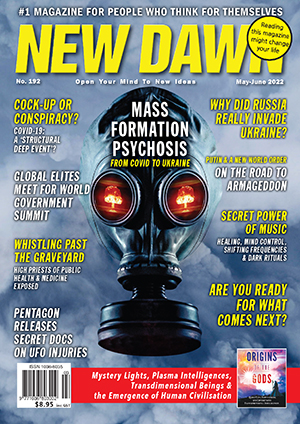
From New Dawn 192 (May-June 2022)

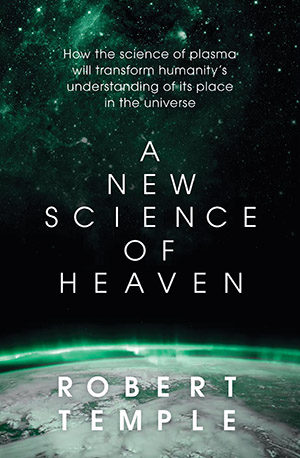
My new book, A New Science of Heaven (Hodder & Stoughton), gives a full scientific description of the nature of inorganic, non-biological, intelligent beings in space. 

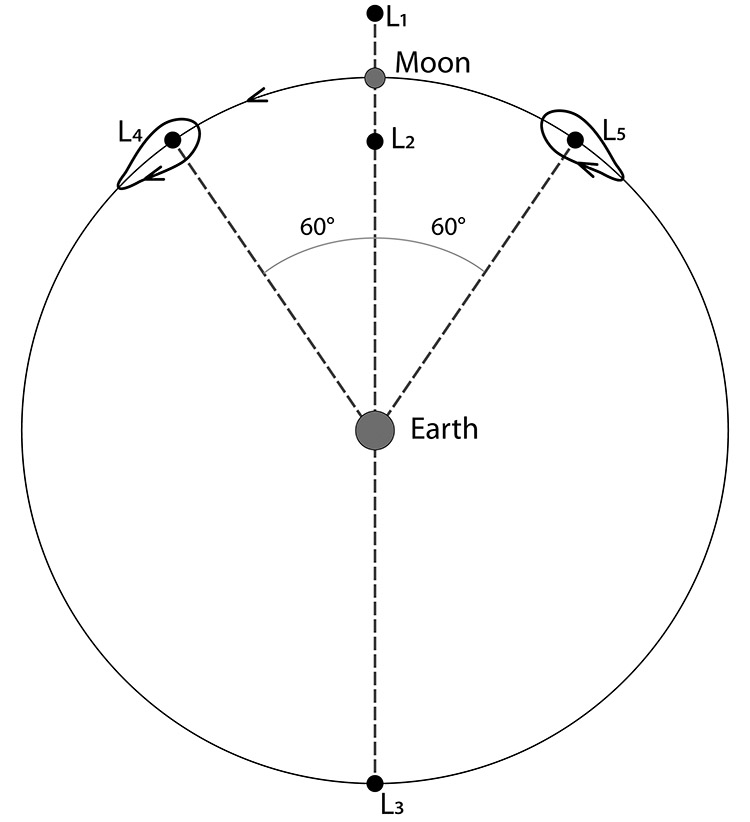
We have two such ‘creatures’ close to our own planet. They are the recently confirmed Kordylewski Clouds, which together are eighteen times the size of the Earth. They reside between the Earth and the Moon, but not in a direct line of sight. They are 60o behind and 60o in advance of the line of sight to the Moon. They exist at the two points known as L4 and L5, the ‘L’ standing for ‘Lagrange’ (named after a famous scientist and mathematician of the past). 

At these two Lagrange Points, the gravitational pulls of the Earth and the Moon cancel out, so that clouds can rest there free of gravitational pull in either direction.

The Kordylewski Clouds were discovered in 1961 by the Polish astronomer Dr. Kazimierz Kordylewski (1902-1981.

As the Clouds emit no light and are largely transparent, it was difficult for Kordylewski’s discovery to be confirmed by others. But in 2019, the existence of the Clouds was confirmed using modern techniques which did not exist in Kordylewski’s day. This was done by a group of Hungarian astronomers. 

I noticed this very soon after their initial publication and contacted them to ask whether they were studying the plasma aspects of the Clouds. They replied saying no, they were only considering the celestial mechanics. (The plasma aspects do not seem to have occurred to them, as they were only observational astronomers, not physicists.) 

I phoned my friend Professor Chandra Wickramasinghe, a brilliant astrophysicist, told him about the Clouds and suggested that we publish a joint article immediately calling attention to these two entities from the more important perspective of space plasma. Our article appeared in the journal Advances in Astrophysics shortly thereafter, and is reprinted in its entirety as an appendix to my book.

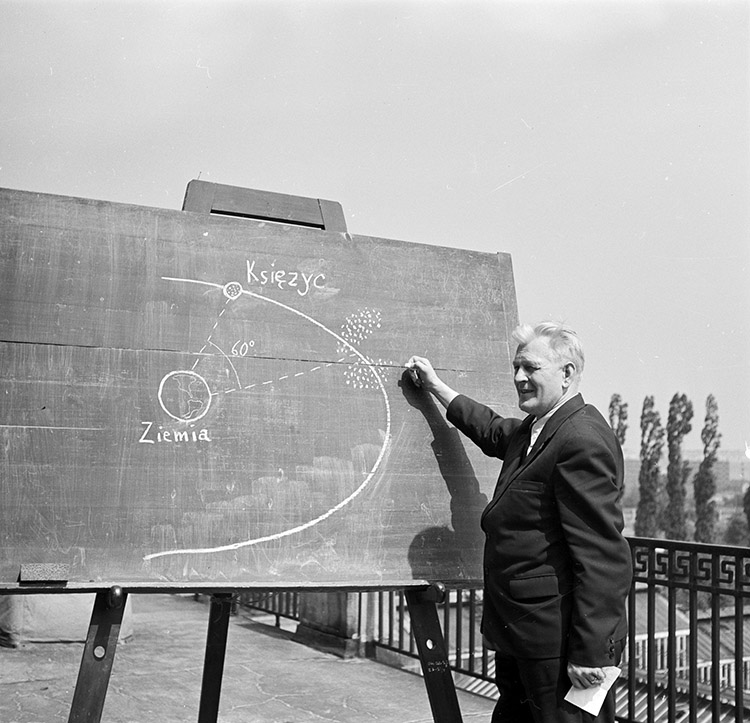
Dr. Kazimierz Kordylewski in 1961 drawing a picture of the Kordylewski Cloud at Lagrange Point L5. Ziemia in Polish means “the Earth.” Księzyc in Polish means “the Moon.” The 60o angle away from the direct line of sight to the Moon is clearly shown. The Cloud is depicted as a collection of dust particles, which we now know must be charged and form a dusty complex plasma. Each one of the Kordylewski Clouds measures 65,000 miles by 45,000 miles across, which is equivalent to 30 x 20 lunar discs as seen from Earth. Each one is now known to be nine times the size of the Earth, so that the two together are 18 times the size of the Earth. They thus entirely dominate what until now has been called ‘the Earth-Moon System’, and which is now known to be a four-entity system, not a two-entity one. 

‘Dusty Complex Plasma’

The Clouds are composed of tiny dust particles and grains only a few nanometres in size, whereas our satellites can only detect particles of 100 nanometres or larger, which is why no satellites have detected them. The dust is highly electrically charged (10,000 electrons can cling to a single dust particle, and for positively charged dust, protons and ions of a somewhat lesser number because they are bulkier). 

The Clouds are constituted of what is now called ‘dusty complex plasma’, and they are cold plasmas rather than hot plasmas such as our Sun. 

Plasma is a distinct form of matter which is not made of atoms. Our own bodies and the world in which we live are made of what we call physical matter, or more accurately, atomic matter. But plasma is non-atomic matter. It is not made of atoms at all, but of atomic particles

Recognition of it as being literally a new form of matter occurred in 1879 when it was discovered by the British scientist Sir William Crookes (inventor of the vacuum tube), who called it “radiant matter.” Its name was changed to ‘plasma’ in 1928 by the American scientist Irving Langmuir. It has no connection to blood plasma, familiar to doctors and nurses, which is a different use of the word, which derives from ancient Greek.

This diagram shows the locations of the ‘Lagrange Points’ known as L4 and L5 of the Earth–Moon system, indicating the positions of the two clouds. In this diagram, the Earth is at the centre, and the Moon directly above it. Although distinct, bounded balls of plasma can form anywhere at modest scales (as for instance, the tiny balls of ball lightning on the Earth), for really big ones in space it is helpful for them to come to rest in spaces free of gravitational pulls, and when such a niche appears it is pretty certain that it will soon be filled by plasma which will form a ball as big as the niche allows. And that is why the L4 and L5 points are perfect homes for huge plasma clouds, for they are the only two points between the Earth and the Moon free of gravitational pull from either the Earth or the Moon. The image is not drawn to scale and the relative sizes of the bodies shown here bear no relation to their true sizes; this image is intended solely to show the geometrical spatial configuration. Seen at this scale, the Earth and the Moon would be extremely tiny or perhaps even too small to see. The Clouds can cohere despite being continuously blasted by the solar wind, details of how that happens being explained in the book. (Image drawn for the author by Eric Wright.)

Plasma Universe

Astronomers and astrophysicists agree that the Universe consists of 99.9% plasma and at the most 0.1% atomic matter such as we have here on Earth. Our Sun is entirely composed of plasma, and so are all the stars in the Universe. 

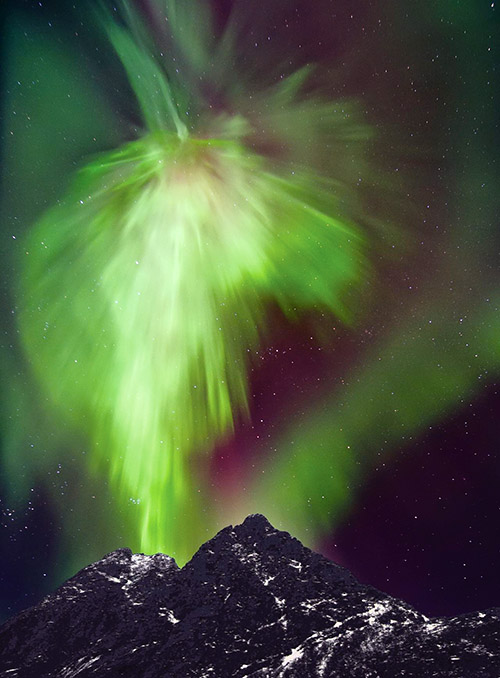
Solar plasma, ejected from the Sun, is seen here in this aurora, an effect of the plasma penetrating Earth’s magnetic shield. Photograph by Lars Tiede, island of Kvaløya, Norway, 2011. 

Plasma occurs frequently on Earth because lightning is plasma. When you turn on a neon light, the neon gas in the centre of the tube is changed to plasma, the temperature of which has been measured to be approximately 12,000 degrees Celsius. But despite that, you can hold such a tube in your hand and it feels cool. The surface of our Sun, known as the photosphere, is about half the temperature of the interior of a neon light tube. 

Knowing this, one begins to understand the weird and wonderful world of plasma. With plasma, the seemingly impossible frequently occurs. Extreme heat and extreme cold can exist side by side inside a plasma because the interior regions or cells are protected by what are called ‘sheaths’, which are double layers of charge.

Most people have no idea that the Universe is a plasma universe because there has been a massive failure of the media at all levels to report this to the public. Nor is the situation any better in schools and universities. Many ordinary physicists who do not concern themselves with astrophysics have never even heard of this. 

It is a sad commentary upon the disintegration of Science as a coordinated field of enquiry. The people in one lab simply do not know what the people in the next lab down the hall are doing. Even if they did, the jargon is different in the next lab, certain terms and words are unknown to outsiders, and they even frequently change the conventional uses of mathematical symbols in their equations, so that even the equations, which used to be ‘the Latin of Science’ which could be understood by all, now exist in a fragmented world. The Tower of Babel of Scientific Communication largely collapsed long ago. 

Self-Organisation & Intelligence

A large part of my book (which contains no equations!) is devoted to explaining in detail, for the general reader, precisely how a large charged dusty complex plasma cloud can self-organise into an entity even more complex than an organic body. 

Such a cloud becomes filled with filaments carrying currents, which act like blood vessels, or cells which act like organs, of semi-conductors which modulate current flow, of current pinches which act as nodes and so on and so on. 

All that I have said is based upon sound scientific discoveries. Such plasma clouds can definitely develop an interior structure more complex than an organic body, and by the now recognised processes of ‘emergence’, ‘entanglement’, and self-organisation, can spontaneously develop intelligence. 

The Kordylewski Clouds are so gigantic that their processing power exceeds by many orders of magnitude all the computers and brains on Earth. Furthermore, the Clouds are apparently billions of years old, whereas humans have only existed for about two million years. Anyone who needs convincing about all of this will find plenty of evidence in the book. And there is an audio book as well, narrated by myself.

If these giant clouds in space are intelligent entities, what would their personalities be like? Very different from ours. From our point of view they would appear disturbingly aloof and indifferent to our sufferings. They would be interested in events but would not care greatly about how we might feel about those events. 

I explain at great length why we all exist as double creatures: we all have bioplasma bodies (called souls or spirits in daily speech) and physical bodies which I call “smart overcoats,” jettisoned when they wear out or are destroyed. A plasma cloud would not necessarily waste energy worrying about our ‘deaths’ because they would know that we did not really die, we merely transitioned back to the plasma state. Do I believe that anyone ever really dies? No. I believe we continue to exist, and that therefore we had better take the long view and try to be less obsessed with ‘things’. You can’t take your smart overcoat with you, nor anything you have which is made of atomic matter. 

UFOs & Ball Lightning

I suggest that, based on this knowledge, lightning balls and many UFOs are likely to be plasma drones. There are thousands of reports of ball lightning seeming to be intelligently directed, inspecting things for instance. I suggest that they are constantly prowling around looking at everything as drones. And as for UFOs, while I would never presume to try and explain all of them, when you know enough about plasma it is painfully obvious that many of them must be plasma entities, presumably controlled either remotely or by robotic means based on miniature super computers. As to whether they contain creatures, that is another matter. But if one presumes that the creatures called ‘the greys’ really exist (I have no idea, and have never encountered one), it seems to me likely that they would be semi-organic robots. 

Have the Kordylewski Clouds ever attempted to communicate with us? I believe they have. But no one ‘gets it’. We need to smarten up. If we really want to find extraterrestrial life, it is not necessary to look even as far as the Moon. It’s right here.

What’s more, the Universe is clearly filled with dusty complex plasma clouds, most of them presumably of gigantic intellectual capacity, at all scales. Our Sun is probably alive and conscious. All stars presumably are. And the vast nebulae and clouds throughout space both within and beyond our Galaxy must be inorganic intelligent entities. In other words, inorganic life forms dominate the Universe, and have done so for billions of years. The truth is, therefore, that the Universe is an endless society of beings. And they are not like us. They have charged particles flowing through their ‘veins’ rather than blood. And our local Kordylewski Clouds, which may seem enormous to us, are small fry. 

Get the issue this article appears in

A New Science of Heaven

Are the Kordylewski Clouds hostile to us? Hardly likely, as we would not have survived if that were the case. And they must have some reason to want us and need us. They may even have arranged for organic life to appear here in the first place. It may be that the Clouds wish to engage in dialogue with us. After all, being inorganic themselves, they may wish to experience vicariously through us what organic life is like. This would be part of their intellectual curiosity. They may regard us as their probes. Without intelligent organic beings they could never hope to do this directly. We may therefore, despite our small size and seeming insignificance, be part of what they hope to make into a shared experience. Without us, they are missing an entire aspect of Reality. And they must know this.

The first thing we need to do is wake up and realise that inorganic beings exist. Then we need to gather our thoughts and think this through. If the Kordylewski Clouds and our Sun are conscious, intelligent inorganic beings, then we are part of the family. We are all here in the same solar system together. Let’s get talking. 

Finally, I wish to make clear that I believe that there is a ‘plasma world’ which is essentially what religious people have always called ‘the spiritual world’. It is the same as a ‘parallel world’ or ‘a world in another dimension’, except that it is not in another dimension, it just seems as if it were. It is invisible to us because we and our sensory organs are made of atomic matter, which cannot perceive plasma matter unless the plasma is glowing or shining. Cold plasma is dark and emits no light. I believe that ‘dark matter’ is really plasma which is in the dark mode, and hence invisible to observation. 

The age-old argument between science and religion can be resolved as follows: the materialists are correct, in that ‘the Other World’ is not immaterial, but is made of matter. But the religious spiritual people are also correct, for there is indeed ‘another World’. All we have to do is understand plasma, and we can stop wasting our breath disagreeing with one another and settle down instead to trying to understand Plasma Reality. 

We ourselves are plasma beings who have come here temporarily, donning our ‘smart overcoats’ for a brief sojourn in ‘the physical world’ in order to test our characters against all the obstacles it presents to us and experience successes and failures, loves and losses, ups and downs, in the wild tempestuous world of physical matter.

Robert Temple’s A New Science of Heaven (Hodder & Stoughton) is available from all good bookstores. A review of A New Science of Heaven can be read in this issue of New Dawn.

This article was published in New Dawn 192.

If you appreciate this article, please consider subscribing to help maintain this website.

© Copyright New Dawn Magazine, www.newdawnmagazine.com. Permission granted to freely distribute this article for non-commercial purposes if unedited and copied in full, including this notice.

Applying New Thought Principles to Modern Day Challenges

BY MARIE JONES

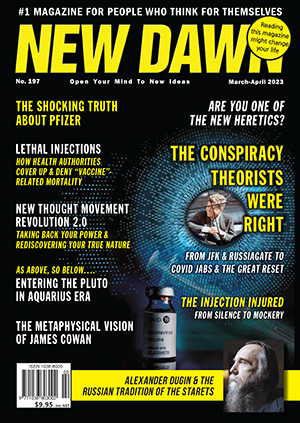
From New Dawn 197 (Mar-Apr 2023)

“What you think upon grows. Whatever you allow to occupy your mind you magnify in your life. Whether the subject of your thought be good or bad, the law works and the condition grows. Any subject that you keep out of your mind tends to diminish in your life, because what you do not use atrophies. The more you think of grievances, the more such trials you will continue to receive; the more you think of the good fortune you have had, the more good fortune will come to you.”
– Emmet Fox

“Life is a mirror and will reflect back to the thinker what he thinks into it.”
– Ernest Holmes

Using New Thought principles to change the self can change the greater collective. As we have been told, we must be the peace, the change, and the love we seek in the world because, as the teachers of New Thought understood, it begins within the individual first. 

In a world that wants us to think we have no individual freedom or power and thus no influence to create a different and better collective, it is imperative that we shift the “locus of focus” from the things we do not want to those we do.

Knowing we are part of the divine, of God, we come to understand that all the things which hold us in fear – inflation, crime, racism, natural disasters, climate change, political strife, corruption, viruses – are all external to us and have no real sovereignty over us. Our truth is our connection to the invisible substance and infinite Source. It is not the government or Bill Gates or a vaccine made by Pfizer. We are free in our minds and thoughts, and when we learn to direct our minds through focused thought, we create our reality and destiny.

Going Within

Everything begins as a thought. Everything. There is no war, circumstance, financial collapse, job loss, or hateful social media post that did not begin as a thought in an individual or in the collective hive mind. This applies to the good in life, too. It starts with our thoughts about who we are, what we want, and what we hope to achieve and experience.

The first step is to turn within for wisdom, knowledge, guidance and understanding. As spiritual beings having a human experience, we always have access to our spirit via prayer, meditation, quiet time, mindfulness, guided visualisations, and practising feeling the Presence of God within. When we focus on externals, we become consumed by them and forget who we are, and that we have the power to use our minds for a better experience and outcome. By turning off the news, we can tune in to the wisdom within and act upon it.

New Thought teaches that there is unformed “substance” all around us from which all form is created, sort of like a quantum field of all possibilities. Our thoughts act upon this substance, similar to how the observer acts upon the quantum field, bringing the desired form into being. Through things like prayer – which can be focused attention on a desired outcome – meditation and affirmations, we shape substance into what we want. Prayer in New Thought is not about begging or pleading but affirming we are one with God, one with Source, and that we are aligned with it to create that which we focus our thoughts and minds upon. This has a whole different vibration than begging some anthropomorphic being up in the clouds to please pity us and give us something. 

Affirming is always in the present tense, and a declaration of “I am” such as “I am healed. I am peace. I am prosperous. I am loved.” We do not say “I want” because the mind focuses on the “want” as lack and that becomes the locus of focus and we get more want. Ever heard the phrase, “You can never get enough of what you don’t want?” This means that if your focus is on lack, on disease, on chaos, on political strife, on inflation and the crappy economy, or on this or that negative external person, event, or situation, that is what you will draw more of into your experience.

Powerful affirmations could look like this:

I am an individual expression of the God Source, and the invisible substance with which God creates is within me as my thoughts and beliefs. I have the power to direct my thoughts to use that substance to create my reality.

I focus my mind and thoughts upon the true source of all there is, God within me, and allow my mind to align with Divine Mind to create that which I desire.

I am divine spirit in a human body having a human experience and my thoughts direct that experience. Therefore, I choose only empowering, powerful thoughts.

Treatment of the Mind

A powerful tool used by New Thought practitioners, specifically in Religious Science, is spiritual mind treatment, also known as affirmative prayer. This is a five-step process that works to change our thoughts, remove doubt and fear, and allow the realisation of the presence of God within so we can then align with it and take right action toward the solution we want. 

The five steps are as follows:

1. RECOGNITION (GOD IS) I recognise God as the ultimate, unlimited Presence and Power in the universe. God is all there is and all is God.

2. UNIFICATION (I AM) I am one with God, unified. I know God through me, as me, in me, and in all things. I am one with God now. 

3. DECLARATION/REALISATION (I ACCEPT; I AFFIRM) Knowing I am a part of God; I know that without doubt or reservation that the good I desire to experience is now taking form through God’s Power. I declare my desire is complete and I accept it.

4. THANKSGIVING / ACCEPTANCE (I GIVE THANKS) I thankfully accept that the good I desire is mine right now. I accept and give thanks for this good right here and now.

5. RELEASE (I LET GO and LET GOD) I release this prayer/treatment to the activity of the Universal Law of Mind, completely freeing myself of doubt or concern. I let go and let God. I release this truth in total belief that it is already done.

We end a treatment with the words, “And so it is,” much like “Amen” at the end of a prayer. This allows us to release the spiritual mind treatment to God with the total conviction and knowing that it is already done for us. We can repeat the treatment again if we really feel the need, or let it go once with certainty. 

Treatments literally “treat” the mind to focus thought, desire, and belief toward a certain outcome rather than hope and beg for something, and to filter out all that does not align with that desire. There is even a little science behind this in our Reticular Activating System (RAS), a complex bundle of nerves in the brain stem responsible for regulating wakefulness and sleep-wake transitions. The RAS also acts as a filter for sensory information that comes into the brain and connects the subconscious to the conscious brain and might be responsible for why we perceive certain things and ignore others. If we focus on the bad, we see more of it thanks to the RAS. Same if we focus on the good.

Illness & Healing

As COVID-19 spread across the globe, critics argued that the New Thought emphasis on using the mind to heal was useless as a treatment for human diseases. The old-school ways were all about taking pills, having surgeries, and relying on dangerous vaccines and pharmaceuticals. Viruses exist, as COVID proved, and people got sick whether they believed it or not. Though, in the past, New Thought adherents adamantly believed that illness was the lack of realisation of our oneness with God/Source, New Thought practitioners today recognise the scientific aspects of disease while also emphasising that healing does begin in the mind and point to the many examples of people who have healed themselves of cancer, heart disease, and other ailments by using the power of their thoughts and beliefs.

While we may not all have the mental capacity right now to cure ourselves overnight, we do know that positive and empowering mindsets create viable shifts in the body that promote healing. We are learning every year about the mind-body connection and how healing involves both working in tandem.

Get the issue this article appears in

Let There Be Peace on Earth and Let It Begin With Me

As we return to our true power and understand our divine nature, our lives change. But how do we apply that to the collective? Can one person truly change the world? Change occurs first in the person, then in the home, then the community, and then the world. 

David R. Hawkins, the author of Letting Go, The Pathway to Surrender, notes that, “The crucial point is: by changing ourselves, we change the world. As we become more loving on the inside, healing occurs on the outside. Much like the rising of the sea level lifts all ships, so the radiance of unconditional love within a human heart lifts all of life.”

We realise how powerful we are as individuals aligned with the Source of all there is, and how that power emanates outward to others we come in contact with, but it begins within each of us to first get right with our own truth. Someone with no idea of their divinity will not act divinely to others. Someone who believes they are a powerless victim will submit to control by others and teach their children and loved ones to do the same.

“Let there be peace on Earth and let it begin with me.” So say the lyrics of this beautiful song written in 1955 by Jill Jackson Miller and Sy Miller and is often sung in New Thought Churches. The sentiment applies to love, goodness, healing, wealth, prosperity, and joy. New Thought principles align us with the God/Source within, which is all good, so that we can express goodness outward to others and, in this way, change the world one spirit at a time. 

This article was published in New Dawn 197.

If you appreciate this article, please consider subscribing to help maintain this website.

Sources

www.csl.org/magazine/wp-content/uploads/sites/16/2018/05/CSL_SoM_Treatment_022117.pdf
www.extension.umn.edu/two-you-video-series/ras
www.scienceofminduk.org/what_spiritual_mind_treatment.html 

© Copyright New Dawn Magazine, www.newdawnmagazine.com. Permission granted to freely distribute this article for non-commercial purposes if unedited and copied in full, including this notice.

Giza – The Tesla Connection: An Interview with Christopher Dunn

BY NEW DAWN MAGAZINE

From New Dawn Special Issue Vol 18 No 2 (April 2024)

Unlimited, inexhaustible, clean energy – free for everyone. Fantasy or real? According to Christopher Dunn, ‘free energy’ is not only possible but was a reality for the Ancient Egyptians.

Christopher Dunn

A lifelong master craftsman, machinist, and engineer with experience in aerospace and a focus on precision and laser application, Dunn became fascinated with the Great Pyramid at Giza after reading Peter Tompkins’ iconic book The Secrets of the Great Pyramid. He spent more than 20 years studying the Great Pyramid and other Egyptian sites.

Due to his engineering background, Dunn saw things in the Pyramid’s construction that others missed. Most people marvelled at the Pyramid’s size and asked, “How did they do it?” Dunn examined its precision and asked, “Why was it necessary?”

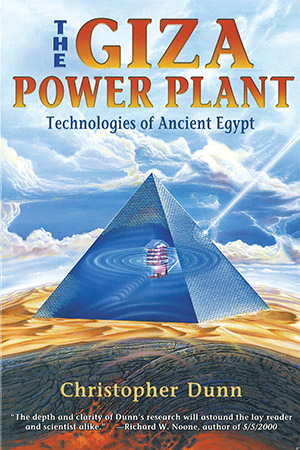
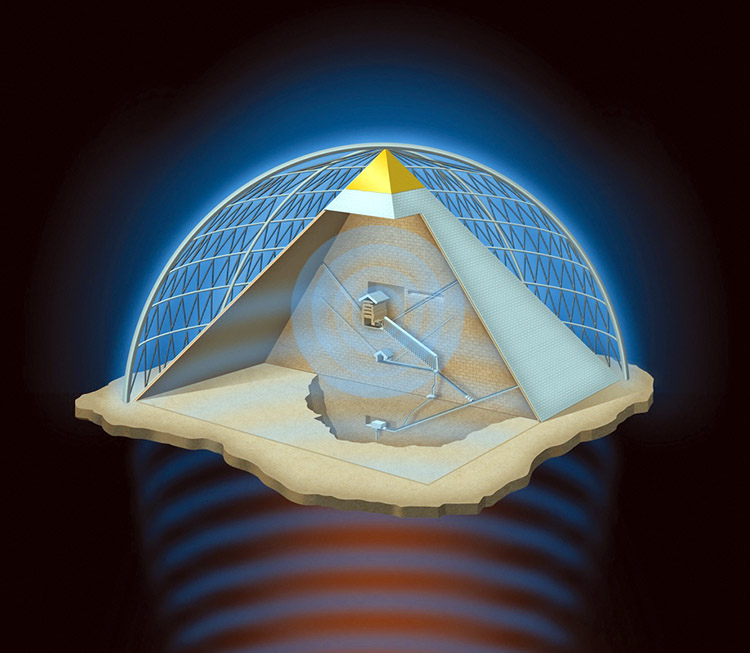
Dunn burst into the limelight with the 1998 publication of The Giza Power Plant: Technologies of Ancient Egypt. Dunn revealed that the Great Pyramid was a giant power generator – an acoustical device that created harmonic resonance with the Earth and converted the planet’s natural vibrations into usable energy for an ancient civilisation. He showed that the Pyramid’s numerous chambers and passageways were positioned with deliberate precision to maximise acoustical qualities.

In 2010, he followed up with Lost Technologies of Ancient Egypt: Advanced Engineering in the Temples of the Pharaohs, a unique study of the engineering and tools used to create Egyptian monuments, proving beyond a shadow of a doubt that advanced knowledge and machining was utilised.

Dunn’s new 2024 book, Giza: The Tesla Connection: Acoustical Science and the Harvesting of Clean Energy, expands his hypothesis that the Great Pyramid at Giza was built as an advanced energy-harvesting machine.

Dunn proposes that the Ancient Egyptians used the Great Pyramid to generate clean free energy, similar to what genius inventor Nikola Tesla later envisioned, as indicated in the title of his new book.

Today, the world is suffering an energy crisis. The solution to our woes might be literally staring us in the face – on the Giza plateau. Will anyone listen? New Dawn recently spoke to Christopher Dunn.

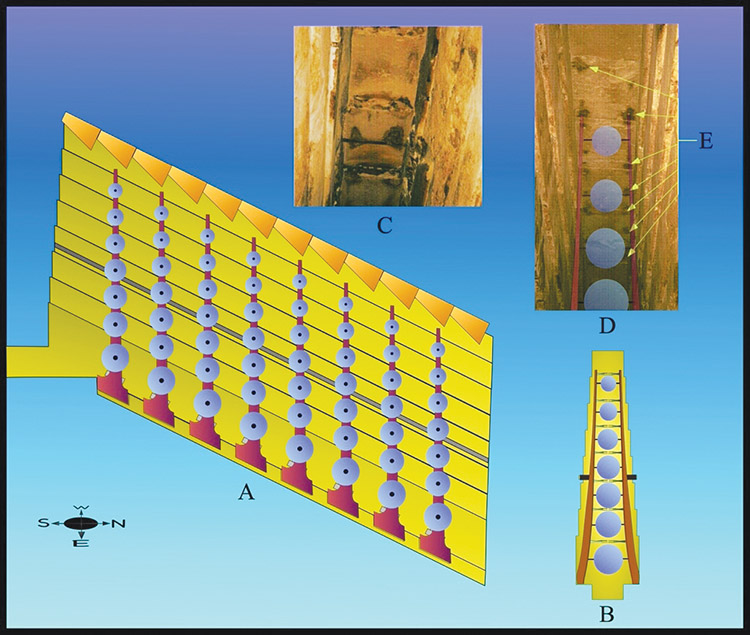
A: East to West cross section of Grand Gallery with 8 of 27 installed resonators. B: North to South view along the length of the Grand Gallery. C: Close up of ceiling showing scorch marks. D: Ceiling scorch marks with resonator frame illustrating its correlation.

NEW DAWN (ND): What discoveries have been made since the publication of The Giza Power Plant?

CHRIS DUNN (CD): For those not familiar with the book, The Giza Power Plant: Technologies of Ancient Egypt is a reverse engineering exercise that began in 1977. The objective was to find a reason why every feature discovered in and around the pyramid exists. In a nutshell, it describes the Great Pyramid as a machine, the function of which was to draw energy from the Earth and distribute it to the inhabitants at that time. This ultimately led to the publication of the book in 1998.

While there has been a lot of discussion about lost civilisations and ancient cataclysms, my intention while writing the book was to focus primarily on the physical evidence inside and around the Great Pyramid. Having said that, it is becoming clearer now, with the fine work of other investigators and their introduction of new evidence, that a cataclysm occurred in antiquity and the Great Pyramid, along with everything else existing in physical form that sustained a sophisticated society, was damaged beyond repair, as was the civilisation that built it.

Since The Giza Power Plant was published, quite a few discoveries have been made in and around the Great Pyramid that support and allow refinements and strength to the theory. In chronological order, they are:

• In 2001, while being filmed for a documentary on the Giza Plateau near Cairo, Egypt, I received permission from Zahi Hawass [Egypt’s Minister of State for Antiquities Affairs at that time] to go inside the Great Pyramid, which had been closed for cleaning. While inside the Grand Gallery, I noticed and photographed scorch marks on the ceiling. The pattern matched my theorised design of the frames that held a series of acoustic resonators. In The Giza Power Plant, I posited there was a hydrogen explosion inside the King’s Chamber that pushed out the walls and cracked the ceiling beams. I did not believe that evidence to support this theory would exist in the Grand Gallery, but in consideration of all other evidence, it would have been perfectly reasonable to do so. I just didn’t think of it at the time.

• In 2002, the Queen’s Chamber South Shaft was explored by a robot named Pyramid Rover, designed and built by iRobot in Massachusetts, USA. The hydrogen that exploded, I theorised, was created in the Queen’s Chamber. This conclusion was reached by examining evidence that had been discovered related to the chamber and its North and South Shafts.

With much fanfare and an audience that had been primed to be glued to their televisions for the intended broadcast of new pyramid discoveries, the Pyramid Rover prepared to climb the shaft and drill through a limestone block at the end. This blockage was first discovered by robotics engineer Rudolph Gantenbrink in 1993 and subsequently labelled “Gantenbrink’s Door.” While preparing to drill through the blockage, the thickness of the door was measured using an impact-echo probe and determined to be 3.25 inches thick. My illustration of this “door” showed a thickness of 3.6 inches.

The image captured by an endoscopic camera inserted through the hole showed another blockage approximately 10 inches from the “door.” Not much else that was remarkable was revealed in the South Shaft at this time. No other theory offered at the time regarding what would be revealed was correct. However, what was revealed did not negate my theory, but for it to be proven 100% correct, more information was needed.

Little did I know at the time that further validation of the theory was discovered after the iRobot team completed their work in the South Shaft and the documentary production crew departed. Before packing up their equipment and exiting the pyramid, the iRobot crew sent the Pyramid Rover robot up the North Shaft. Gantenbrink had attempted to explore the North Shaft in 1993, but could not navigate beyond two long exploratory rods that had somehow become stuck where the shaft turns on an angle to the left. Using a different tactic, by turning their robot 90 degrees so that it gripped the walls instead of the floor and ceiling, the Pyramid Rover was able to ride over these obstructions.

Evidence of chemical inlet shaft.

Pyramid Rover revealed two pieces of evidence supporting my theory about using these shafts. One was an opening in the East wall near one of the bends approximately 90 feet up the shaft from the Queen’s Chamber. I theorise that chemicals were introduced into the shaft behind the blockage, but this evidence showed that the entrance for the chemicals was lower down.

The other evidence revealed was the existence of another blockage, similar to the South Shaft, but with electrodes that were not corroded and with one that was recessed and showed signs of electroplating.

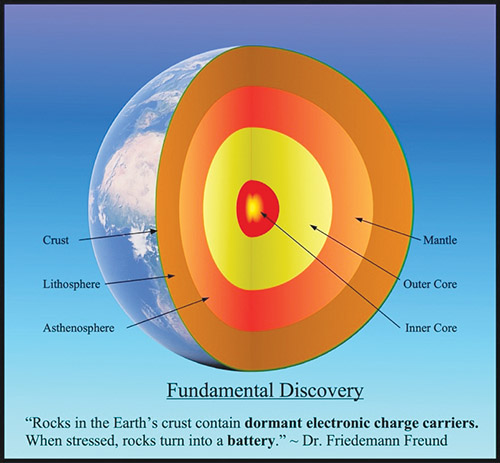
Dr. Friedemann Freund’s discovery.

• In 2006, Dr. Friedemann Freund, a NASA physicist, completed his laboratory experiment confirming his theory that earthquake lights were the result of electron flow propagating through the lithosphere when peroxy defects in their minerals were subjected to stress. His conclusion was that under certain conditions, igneous rock beneath our feet turns into a giant battery.

• In 2010, another robot team from Leeds University in the UK, and headed by Chinese dentist Dr. TC Ng, fashioned a different style of robot which Dr Zahi Hawass named Djedi, the name of Khufu’s magician [in reference to Pharaoh Khufu of the 4th Dynasty who is said to have commissioned the Great Pyramid]. The Djedi robot was equipped with a snake camera that was able to look around the small space and even look behind Gantenbrink’s “door.” The images it captured allowed me to slightly modify my engineering design, but overall supported my proposed function for these features.

• In 2017, the Scan Pyramid Mission released the muography images taken inside the Great Pyramid. Muons passing through the Great Pyramid would impinge on special plates set up inside the Queen’s Chamber and Grand Gallery. The image that resulted from the interaction identified voids inside the pyramid. Of particular interest was a large void above the Grand Gallery. Discussing this with aerospace engineer Eric Wilson, he offered the idea that it would have been used to pre-amplify microwaves travelling down the shaft before they entered the King’s Chamber. In association with that, drawings made available by Rudolph Gantenbrink of the King’s Chamber’s North Shaft have made it possible in my new book Giza: The Tesla Connection to illustrate this shaft with greater accuracy and point out features that are consistent with waveguide design.

• On 20 July 2018, the Journal for Applied Physics published an article entitled “Electromagnetic Properties of the Great Pyramid: First Multipole Resonances and Energy Concentration” by Mikhail Balezin, Kseniia V. Baryshnikova, Polina Kapitanova, and Andrey B. Evlyukhin. In this article they reveal the results of their findings of the electromagnetic nature of the pyramids: “Electromagnetic field distributions inside the Pyramid at the resonant conditions are demonstrated and discussed for two cases, when the Pyramid is located in a homogeneous space or on a substrate. It is revealed that the Pyramid’s chambers can collect and concentrate electromagnetic energy for both surrounding conditions. In the case of the Pyramid on the substrate, at the shorter wavelengths, the electromagnetic energy accumulates in the chambers providing local spectral maxima for electric and magnetic fields.” (doi.org/10.1063/1.5026556 124, 034903)

ND: Of those, which do you think is the most significant discovery?

CD: Without hesitation, I would say the most significant discovery was Dr. Friedemann Freund’s. While Dr. Freund was only focused on developing the means to predict when an earthquake was about to happen, his proven lab experiments demonstrating his physics correct provide confidence that his discovery has the potential to solve the world’s energy needs.

Moreover, when it comes to the reason behind building pyramids around the world – knowing that an abundant supply of electrons can be stimulated to rush to the surface as well as the new research showing that pyramids focus electromagnetic energy – there is solid proof that the Great Pyramid was part of a larger global system. For alerting me to Freund’s work, I must thank researcher Robert Vawter, who recently passed away.

ND: Did The Giza Power Plant anticipate or predict this discovery?

CD: The Giza Power Plant discussed earthquake lights, ball lightning and other natural phenomena but focused more on the piezoelectric effect of quartz crystals. Freund identified a new physics more related to semiconductors that does not rely on the piezo-effect. In fact, Freund found that one igneous rock called Gabbro has no silicon quartz crystals in it and was more effective in producing electron flow than other igneous rocks.

ND: What discoveries could have been or were predicted since the publication of The Giza Power Plant?

CD: All the evidence discovered in the Queen’s Chamber shafts was predicted to exist. The only difference is between my engineering design and that subsequently discovered. Scorch marks in the Grand Gallery could have been, but were not, predicted. Eric Wilson had stressed to me that the MASER needed a preamp to function properly. The “Big Void” may eventually be proven to have functioned in this way.

Electron Harvester with Tesla Connection.

ND: How would such an advanced power system shape our society?

CD: Considering that we have been burning fossil fuels to produce electricity for over 100 years, reducing this method can only benefit the environment. In 2021, America burnt enough coal to build a pyramid that would be 76 times the size of the Great Pyramid. Current methods are highly inefficient and expensive compared to drawing electricity from directly beneath our feet. From a psychosocial perspective, the mental health of humans would improve if we were not depleting the Earth’s natural resources and polluting the atmosphere.

ND: What other areas of science and engineering do you envision will evolve from this system?

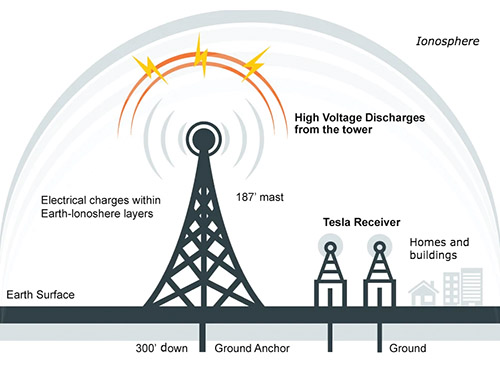
Graphical representation of Wardencliffe Tower (Source: allaboutcircuits.com/technical-articles/teslas-towers-pikes-peak-wardenclyffe-and-wireless-power-transmission)

CD: One area of improvement is the transmission of electricity. Electric vehicles are gaining in capabilities and efficiency. I envision a delivery system that transmits electricity without wires, as Nikola Tesla proposed with his Wardencliffe Tower project. I believe car companies could benefit from developing this technology by building their own electron harvesters that would wirelessly deliver power to vehicles and reduce, or eliminate, the need for batteries.

The recent disclosure of UAPs navigating our airspace and displaying capabilities that we can only dream of possessing provides an indication of what is physically possible. It would seem, though, that breakthroughs in physics, as demonstrated by Freund, for example, are necessary before reaching this level of technological competence. One hundred years of technological advancement has resulted in a world that looks nothing like the world I lived in 78 years ago. If technology improves at the same pace into the future, our children and grandchildren will see a world that looks nothing like the world we live in today.

ND: How are the Egyptian people reacting to your theories about their monuments?

CD: Many Egyptians are now abandoning the pyramids as tombs theory and seeing their monuments in a different light. After the publication of The Giza Power Plant, it became clear to me that Western scholars were not accepting the evidence I presented that elevated the capabilities of the ancient Egyptians. After 10 years, I decided to appeal directly to Egyptian engineers with my book Lost Technologies of Ancient Egypt. In the book, I identified and analysed artefacts to conclude they must have been machined and challenged Egyptian engineers to inspect the artefacts themselves. I’m happy to report that an Egyptian engineer, Ahmed Adly, took up the challenge and created a series of YouTube videos where he presented his results.

An important artefact he inspected was one of the boxes in the Serapeum. He concluded that I was right and provided me with a Foreword for Giza: The Tesla Connection. In his Foreword, Adly reports on a meeting he had with Dr. Ashraf Sherbini, a physicist at Cairo University, who agreed with my theory that the Great Pyramid was a machine. Adly’s videos have been well-received in the Arabic-speaking world, especially among Egypt’s youth. I believe that if Egypt’s history is to be rewritten, that task should be performed by the Egyptians, not outsiders.

A chapter in Giza: The Tesla Connection is devoted to the Serapeum and also introduces new revelations on pre-dynastic vases that have recently been subject to modern inspection methods.

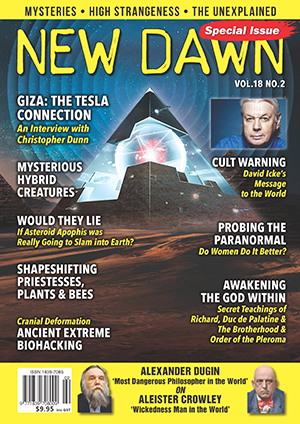
Get the issue this article appears in

ND: Has there been any interest expressed by energy companies?

CD: An energy company from Malaysia has expressed a keen interest in developing the technology. My philosophy is that any entity wishing to develop it should be free to do so without barriers or exclusivity.

ND: Is there more to reveal in the Great Pyramid?

CD: Yes. Further research is ongoing. Of some I am aware, and I’m sure there are others I do not know about.

ND: Are you currently working on any other writing project?

CD: I do not plan on writing any more books. However, the recent metrological inspection of pre-dynastic vases has created quite a stir. Several have been inspected using conventional mechanical inspection methods, as well as structured light and CT scanning. The results are simply mind-blowing. STL files are available on UnchartedX.com and have been downloaded and analysed by engineers around the world. The mechanical inspection of the vases can be viewed at youtube.com/watch?v=QzFMDS6dkWU&t=425s. One analysis was performed by cryptographer and mathematician Mark Qvist and his colleague. His article can be read at unsigned.io/granite-artifact. This research, which now involves the Egyptians, is ongoing and articles targeting specific audiences need to be written. 

Diagram images courtesy of Chris Dunn and Inner Traditions International. There are more images inside the published version of this article.
Read the full story and contemplate all the convincing evidence in Chris Dunn’s new book Giza The Tesla Connection: Acoustical Science and the Harvesting of Clean Energy. Order your copy from all good bookstores.

This article was published in New Dawn Special Issue Vol 18 No 2.

If you appreciate this article, please consider subscribing to help maintain this website.

References

Freund, Friedemann. “Rocks that Crackle and Glow: Predicting Earthquakes.” Filmed at the 33rd annual Society for Scientific Exploration (SSE) Conference in 2014 at the Hyatt Regency San Francisco Airport, Burlingame, California, USA, youtube.com/watch?v=aRXlk26TcGc
Freund, Friedemann. 2016. “Using Semiconductor Physics to Forecast Earthquakes.” TEDx Talk Christchurch, NZ. youtube.com/watch?v=B1yno8RjaFE
Freund, Friedemann, Ouillon G., Scoville J., and Sornette D. 2018. “Earthquake precursors in the light of peroxy defects theory: critical review of systematic observations,” European Physical Journal (EPJ)
Pyramid Rover exploration of the Queen’s Chamber North Shaft. Ancient Architects YouTube channel, youtube.com/watch?v=Ki0405ulvIY

© Copyright New Dawn Magazine, www.newdawnmagazine.com. Permission granted to freely distribute this article for non-commercial purposes if unedited and copied in full, including this notice.

The Three Masculinity Types Competing for the Minds of Boys and Men Today 

 March 17, 2025 (menalive.com)

By  Jed Diamond

                Since I turned eighty-one years old in December 2024, I have been reflecting on what I’ve learned about being a man. As a sensitive and introverted child raised by a single mom I had no idea what it meant to be a man. I was clear about what a man should do–Get educated so I could catch an attractive woman, marry her, have kids, and become rich and famous.

                By the time I was thirty-five, I had graduated from U.C. Berkeley with a master’s degree in social work, had met and married my college sweetheart, was the proud father of a son and daughter, was earning good money, and was imagining the next steps to fame and fortune. I was also stressed, depressed, angry, and on the verge of divorce. I felt confused, lost, and discouraged.

                When I was at my lowest point, having intermittent thoughts of ending my life, I chanced to see a poster on a bulletin board that offered a tiny glimpse of hope.

“Men, come and share a day with other men and hear psychologist Herb Goldberg, author of The Hazards of Being Male.”

                Fifteen guys met on April 21, 1979 and heard Dr. Goldberg tell us that,

“The male has paid a heavy price for his masculine ‘privilege’ and power. He is out of touch with his emotions and his body. He is playing by the rules of the male game plan and with lemming-like purpose is destroying himself—emotionally, psychologically, and physically.”

                For the first time in my life I felt I was hearing the truth about the path I was on. By the end of the day one of the organizers, a tall handsome, teddy-bear of a man named Tom Sipes, invited those interested in continuing the group to meet at his house the following Wednesday. Ten guys came and agreed to begin meeting weekly. The group soon was reduced to seven and those seven guys have continued to meet for the last forty-six years.

                There were three guys younger than me and three guys older. We came from different backgrounds and experiences, but the thing we all had in common was this: We longed to be men, not the boymen we were pretending to be. We wanted a different direction than the one we were following and we knew that having a band of brothers could help us find our way.

                We met weekly, talked deeply, took risks to be vulnerable and real with our feelings and having the courage to share them with each other. I was encouraged to write my first book, Inside Out: Becoming My Own Man, which was published in 1983 right up to my seventeenth, Long Live Men! The Moonshot Mission to Heal Men, Close the Lifespan Gap, and Offer Hope to Humanity.

                We attended men’s gatherings with Robert Bly and others and read books including King, Warrior, Magician, Love: Rediscovering the Archetypes of the Mature Masculine, by Robert Moore and Douglas Gillette in which they contrast archetypes of “Boy Psychology” from “Man Psychology.”

                In their book King, Warrior, Magician, Love: Rediscovering the Archetypes of the Mature Masculine, they offer these examples of boy psychology: 

  • The ducking and diving political leader.
  • The wife beater.
  • The company “yes man.”
  • The “holier than thou” minister.
  • The gang member.
  • The father who can never find the time to attend his daughter’s school program.
  • The therapist who unconsciously attacks a clients’ “shining” and seeks a kind of gray normalcy for them.

“All these men have something in common,” say Moore and Gillette. “They are all boys pretending to be men. They got that way honestly, because nobody showed them what a mature man is like. Their kind of ‘manhood’ is a pretense to manhood that goes largely undetected as such by most of us. We are continually mistaking this man’s controlling, threatening, and hostile behavior for strengthIn reality, he is showing an underlying extreme vulnerability and weakness, the vulnerability of the wounded boy.”

                I have recently written a series of articles, In Search of Mature Masculinity in a World of Wounded BoyMen that describes the world of “boys pretending to be men” and the kind of mature masculinity we all need in our lives.

The Two Archetypes of  Wounded Boys Pretending to Be Men

                Reflecting on my experiences in my own life, what I see with the thousands of boys and men I have counseled over the years, and what is reflected in our current government in the U.S., I see two dominant archetypes that underlie the behavior of Wounded Boys Pretending to Be Men:

                First is what Moore and Gillette describe as The Highchair Tyrant.

“The Highchair Tyrant,” say Moore and Gillette, “is epitomized by the image of Little Lord Fauntleroy sitting in his highchair, banging on the tray, and screaming for his mother to feed him, kiss him, and attend to him.”

                As an only child being raised by a single mom, I developed a lot of these tendencies in my own childhood. They also extended into my adult life in  my relationships with women and contributed to my two failed marriages. I was fortunate to get support to heal and grow up and have now been joyfully married to my wife, Carlin, for forty-five years.

“The Highchair Tyrant,” says Moore and Gillette, “hurts himself with his grandiosity—the limitlessness of his demands—because he rejects the very things that he needs for life: food and love.”

                Moore and Gillette summarize the following characteristics of The Highchair Tyrant:

  • Arrogance (what the Greeks called hubris, or overwhelming pride).
  • Childishness (in the negative sense).
  • Irresponsibility, even to himself as a mortal being who has to meet his biological and psychological needs.
  • The Highchair tyrant needs to learn that he is not the center of the universe and that the universe does not exist to fulfill his every need, or better put, his limitless needs, his pretentions to godhood.

                I suspect we can all recognize many of these characteristics in boys and men we know–from the centers of power in government to business leaders and males in our own families and communities.

                The second archetype of boy psychology described by Moore and Gillette is The Weakling Prince.

“The boy (and later the man) who is possessed by the Weakling Prince needs to be coddled, who dictates to those around him by his silent or his whining and complaining helplessness.”

                As adults, those possessed by the Weakling Prince archetype often become “Mr. Nice Guys.” Dr. Robert Glover, author of the book No More Mr. Nice Guy says,

“A Nice Guy is a man who believes he is not okay, just as he is. Due to both societal and familial conditioning, the Nice Guy is convinced he must become what he thinks others want him to be in order to be liked, loved, and get his needs met. He also believes that he must hide anything about himself that might trigger a negative response in others.”

He goes on to say, “This inauthentic and chameleon-like approach to life causes Nice Guys to feel frustrated, confused, and resentful. Subsequently, these men are often anything but nice. In fact, Nice Guys are generally dishonest, secretive, manipulative, controlling, self-centered, and passive-aggressive.”

                The historian, Ruth Ben-Ghiat, describes political leaders driven by boy psychology in her book, Strongmen: Mussolini to the Present.

“For ours is the age of authoritarian rulers: self-proclaimed saviors of the nation who evade accountability while robing their people of truth, treasure, and the protections of democracy. They use masculinity as a symbol of strength and a political weapon. Taking what you want, and getting away with it, becomes proof of male authority. They use propaganda, corruption, and violence to stay in power.”

The Compassionate Warrior: The Power of Mature Man Psychology

                I first heard the words  “compassionate” and “warrior” combined from Sean Harvey, author of the book Warrior Compassion: Unleashing the Healing Power of Men.

“When we combine the concepts of warrior and compassion, an energetic shift happens,”

says Harvey. He goes on to say,

“Compassion is most easily defined as the feeling or emotion when a person is moved by suffering or distress of another, and by the desire to relieve the suffering. Taking a step further, to be compassionate to others, we must begin by learning to become compassionate to ourselves.”

                Harvey describes the strength of the warrior spirit this way:

“The warrior archetype represents strength, courage, and the relentless pursuit of justice and honor. It embodies discipline, resilience, and unwavering determination to protect and defend what is most valued.”

                I shared a similar perspective in my book, The Warrior’s Journey Home: Healing Men, Healing the Planet, that was published in 1994. I drew on my experiences practicing Aikido and from books including Aikido and the New Warrior by one of my Aikido instructors, Richard Strozzi-Heckler.

                Chögyam Trungpa was a Tibetan Buddhist master and scholar. I quote his understanding of compassionate warriorship in my book, The Warrior’s Journey Home.

“Warriorship here,” said Trungpa, “does not refer to making war on others. Aggression is the source of our problems, not the solution.” He goes on to say, “Here the word ‘warrior’ is taken from the Tibetan pawo which literally means ‘one who is brave.’ Warriorship in this context is the tradition of human bravery, or the tradition of fearlessness. Warriorship is not being afraid of who you are.”

                For me, this captures the essence of The Compassionate Warrior and learning to become that kind of man is what we need to find in ourselves, in those we choose to lead us, and in a world dominated by angry, wounded boys, pretending to be men. If given a choice boys and men will choose this more powerful, caring, and compassionate way of being.

                Our organization, Moonshot for Mankind, brings together organizations that are dedicated to teaching, training, and guiding boys and men to achieve the qualities of mature masculinity, including how to become compassionate warriors.

                If you would like to learn more about my own work, please visit me at MenAlive.com

Previous Article

Author Image

Best Wishes,

Jed Diamond

Founder and VHS (Visionary Healer Scholar) of MenAlive

The Future of Humanity lectures with Dr Iain McGilchrist

Dr Iain McGil Mar 14, 2025 This is a recording of Dr Iain McGilchrist’s lecture entitled The Sovereignty of Truth for the day long symposium, The Future of Humanity, that took place on Saturday 26th October 2024 at the Royal Institution, Mayfair. This event was organised by Channel McGilchrist and The Scientific and Medical Network. In this full day symposium, Dr Iain McGilchrist addressed the most pressing questions at the heart of our existence, and invited his guest speakers, author of The Psychology of Totalitarianism, Mattias Desmet, and broadcaster and author, and host of The Sacred podcast, Elizabeth Oldfield, to share their views. David Lorimer of the Scientific and Medical Network hosted the day. For more information see https://channelmcgilchrist.com/the-fu…

Lying: Moral Choice in Public and Private Life

Sissela Bok

Is it ever all right to lie? A philosopher looks at lying and deception in public and private life—in government, medicine, law, academia, journalism, in the family and between friends.

Lying is a penetrating and thoughtful examination of one of the most pervasive yet little discussed aspects of our public and private lives. Beginning with the moral questions raised about lying since antiquity, Sissela Bok takes up the justifications offered for all kinds of lies—white lies, lies to the sick and dying, lies of parents to children, lies to enemies, lies to protect clients and peers. The consequences of such lies are then explored through a number of concrete situations in which people are involved, either as liars or as the victims of a lie.

About the author

Sissela Bok

Sissela Bok (born Sissela Myrdal on 2 December 1934) is a Swedish-born American philosopher and ethicist, the daughter of two Nobel Prize winners: Gunnar Myrdal who won the Economics prize with Friedrich Hayek in 1974, and Alva Myrdal who won the Nobel Peace Prize in 1982.

She received her B.A. and M.A. in psychology from George Washington University in 1957 and 1958, and her Ph.D. in philosophy from Harvard University in 1970. Formerly a Professor of Philosophy at Brandeis University, Sissela Bok is currently a Senior Visiting Fellow at the Harvard Center for Population and Development Studies, Harvard School of Public Health.

(from Wikipedia)

The Triumph of the Machine: Are There Reasons for Hope? Dr. Iain McGilChrist: Lecture Two

Emperor • Mar 19, 2025 The Future of Humanity: Lecture Two (The Triumph of the Machine: Are There Reasons for Hope?) Iain McGilchrist’s recent speech paints an unrelentingly bleak picture of our world—so bleak, in fact, that he explicitly acknowledges it could drive listeners to cut their throats. He then states that a second lecture, meant to restore hope, was given after lunch. But this hopeful talk was not published freely. Instead, it was locked behind a $50 paywall—a move that is both ethically indefensible and grotesquely ironic given the themes of his speech. This is not about disrespecting McGilchrist’s work. His insights are valuable. But knowledge of this kind carries responsibility. If a public intellectual chooses to expose an audience to despair, they should not commodify the antidote. The intentional withholding of existential hope for financial gain is an act of moral negligence. Because of this, I am making McGilchrist’s second lecture freely available. This is not piracy. This is rectification. Those who heard his first talk deserve access to the second—without an economic gatekeeping mechanism designed to profit from their existential distress. The world is already drowning in cynicism, despair, and calculated disempowerment. If McGilchrist truly believes in the pursuit of truth, beauty, and goodness, then his words should be available to all—not just those who can afford the price of admission. ⸻ Reductionism as Intellectual Negligence McGilchrist’s treatment of AI as nothing but a mechanism devoid of meaningful potential is not just philosophically lazy—it is epistemologically irresponsible. His sweeping rejection ignores the boundedness of grammatical language and alternative epistemological frameworks, including constructivist and process-based ontologies. He falls into the very mechanistic, left-hemisphere reductionism he decries—except here, the error is in prematurely closing the door on possibility rather than fixating on mechanistic determinism. At best, the position McGilchrist articulates justifies an agnostic stance toward the possibility of meaningful mechanism, rather than outright dismissal. The fusion of mechanism and semantics is not an impossibility; it is simply beyond the current frame of discussion. That McGilchrist cannot yet conceive of it does not mean it will not emerge. ⸻ Generational Failure & Economic Selfishness The decision to sell the hopeful speech is not just a personal failing but emblematic of a broader generational pathology. The Boomer generation, which inherited the most prosperous economic conditions in history, has in many cases squandered its moral credibility by prioritizing profit over responsibility. The economy they built thrives on extraction—whether of wealth, labor, or hope itself. In this context, McGilchrist’s move is not just distasteful—it is a symptom of a much deeper failure: a failure to recognize the obligations of privilege, to pay attention, and to actively engage with the world in a process of never-ending growth and learning. The generational transformation necessary for our survival demands a shift away from the scarcity-based extractions of the past and into an ethos of abundance—where knowledge, opportunity, meaning, and intelligence are not commodities to be hoarded, but common goods to be cultivated. The open-weights release of R1 by DeepSeek is a beautiful forerunner of this new era, as we continue across the event horizon into the age of intelligence. Rather than sprawling in want, fearful of scarcity, may we face the terrifying immensity of abundance—where the challenge is not deprivation, but a Beauty so tremendous it demands our courage.

Naked Kennedy Center Staffer Rips ‘Villainous Liar’ Trump and ‘Nazi Wannabe’ Musk

Tavis Forsyth naked

Tavish Forsyth, founder of Bird City Improv and the associate artistic lead for the Kennedy Center’s Opera Institute, is seen here delivering a nude monologue against Republican U.S. President Donald Trump’s takeover of the Washington, D.C. performing arts center. 

(Photo: ImproVision/YouTube/screen grab)

“I have called Trump out on his bullshit and dare him to fire me for being unapologetically queer, and critical, for showing up everyday in my best red lip and woke gender ideology that says don’t fuck with me.”

BRETT WILKINS

Mar 20, 2025 (CommonDreams.org)

“Walk away or fight?”

That’s what one program director at the John F. Kennedy Memorial Center for the Performing Arts in Washington, D.C. asked in response to U.S. President Donald Trump’s bigoted attacks on racial, religious, and sexual minorities—and the artist literally bared all of himself while mulling the question.

“Trump has taken over the Kennedy Center, and that’s a place where I work. He has banned drag performers from its stages. And as the saying goes, ‘we’re all born naked and the rest is drag,” Tavish Forsyth, the associate artistic lead for the Kennedy Center’s Opera Institute, said in a YouTube video, wearing nothing but an 8-bit rainbow-striped heart digitally superimposed over his groin.

Trump recently took over the Kennedy Center, firing its board, appointing himself chair of the body, and replacing its members with loyalists in what many critics believe is a bid to remake the venerable institution in his own image.

Washington Post associate editor Marc Fischer wrote Wednesday that “there has been much worry in the anti-Trump world that the president will turn the Kennedy Center into an easy-listening temple, a reliquary for washed-up middlebrow acts, a refuge for the few artists who wave the MAGA flag. Kid Rock in the Opera House, Jason Aldean in the Concert Hall.”

Reflecting his administration’s attacks on LGBTQ+ people, Trump has canceled or proscribed performances deemed “woke,” including a concert featuring the Gay Men’s Chorus and the National Symphony Orchestra’s A Peacock Among Pigeons: Celebrating 50 Years of Pride.

https://x.com/WUTangKids/status/1900342480790225136?ref_src=twsrc%5Etfw%7Ctwcamp%5Etweetembed%7Ctwterm%5E1900342480790225136%7Ctwgr%5E%7Ctwcon%5Es1_c10&ref_url=https%3A%2F%2Fwww.commondreams.org%2Fnews%2Ftavish-forsyth

Calling Trump a “villainous liar,” Forsyth asked: “Does staying make me a collaborator or somehow complicit in a hostile government takeover that is systematically targeting the rights, livelihood and liberty of poor people, queer people, Black, brown people, people of color, immigrants, Muslims, victims in war-torn countries, ethnic cleansing, women… Gosh when I put it like that, it seems kind of obvious: Fuck Donald Trump and fuck the Kennedy Center. But, on the other hand, is staying holding the line and living to fight another day?”

Forsyth called Trump’s move to install himself as the head of Kennedy Center’s board “surprising, because he seemed so busy draining dams, damning alliances, siding with killers, endorsing genocide, erasing trans and queer people from history, deporting people who have every right to live in a land of immigrants—a stolen land—and doing everything in his goddam power to seem like a big tough man while Nazi wannabe [Elon] Musk, systematically erodes the government while selling Cybertrucks to the next generation of American war criminals.”

“And now that I’ve said all this shit, people will name me radical, crazy, Antifa, terrorist, pot-smoking, faggot, hippie, whatever the fuck,” Forsyth continued. “I also fear that I make myself unemployable. To which I also say, ‘Fuck it!’ If I’m unemployable, then let it be because I chose to be unrulable. Let it be because I choose me, my beloved family, and stand in solidarity with communities that equally deserve to be free.”

https://youtube.com/watch?v=macmqxEtePY%3Frel%3D0

“Every bone in my body says run,” Forsyth confessed. “And I haven’t been sleeping well for over a week. My heart says love one another. My ego says don’t let them win. Don’t give up. Don’t abandon a worthy cause… I have called Trump out on his bullshit and dare him to fire me for being unapologetically queer, and critical, for showing up everyday in my best red lip and woke gender ideology that says don’t fuck with me. I threaten him to arrest me for breaking his unjust laws that threaten diversity.”

“Shoot your shot, Donald,” he added. “The rest of you, should I quit the Kennedy Center or wait to be crucified for this man’s sins?”

Our work is licensed under Creative Commons (CC BY-NC-ND 3.0). Feel free to republish and share widely.

BRETT WILKINS

Brett Wilkins is a staff writer for Common Dreams.

Full Bio >