“I did not know that I could only get the most out of life by giving myself up to it,” the British psychoanalyst Marion Milner wrote under a pseudonym in her superb century-old field guide to the art of knowing what you really want — that most difficult, most rewarding among the arts of living. It is hard to know what we want because, disquieted daily by “this sadness of never understanding ourselves,” it is hard to know who we are. To want anything is to acknowledge a lack, a gap between the real and the ideal, between the life we have and the life we desire, which is fundamentally a gap between who we are and who we wish to be.
In our yearning for an answer, for a bridge between the real self and the ideal self, we have invented religion and psychotherapy, we have turned to shamans and self-help gurus, we have fasted and prayed, filled out personality tests and followed autosuggestion protocols. But while a certain level of restlessness is necessary to our creative vitality — that “divine dissatisfaction” out of which art is born — living with a sense of perpetual deficiency petrifies the possible in us. For, as Kurt Vonnegut knew, there is no greater enemy to happiness than the sense of not enough, the feeling that we need to have more or be more in order to live with a fullness of being and an inner completeness.
British psychoanalyst Adam Phillips offers an antidote to our civilizational cult of self-improvement in his slender, potent book On Getting Better (public library).
We are trapped, he observes, by our frame of reference:
If you have a broken leg, or a fever, you know what is to be aimed for; if you have a broken heart or a sense of shame, it is not quite so clear… Patients come to psychoanalysis with an idea of cure because, historically, they have been to medical doctors, and before that they have been to religious healers. A culture that believes in cure is living in the fallout, in the aftermath, of religious cultures of redemption.
[…]
Self-improvement can be self-sabotage. Too knowing; too knowing of the future. A distraction, a refuge from one’s personal vision.
He considers the paradox at the crux of our zeal for self-improvement:
We can’t imagine our lives without the wish to improve them, without the progress myths that inform so much of what we do, and of what we want (we don’t tend to think of ourselves as wanting to be what we are already). Whether we call it ambition, or aspiration, or just desire, what we want and what we want to be is always our primary preoccupation, but it is always set in the future, as though what could be — our better life, our better selves — lures us on. As though it is the better future that makes our lives worth living; as though it is hope that we most want.
The problem with an idealized future is that every ideal is not only a form of wanting but a form of presumed knowledge — about what is optimal and desirable, about the vector of change — and yet the future is fundamentally unknowable. (This is why the things we most ardently desire are the most transformative, but we suffer a congenital blindness to what lies on the other side of transformation.) Phillips writes:
One cannot know the consequences of one’s wanting, because one can’t know the future except as an assumed replication of the past… It is almost certain that we won’t or can’t get what we want, partly because, from a psychoanalytic point of view, we are largely unconscious, unaware, of what we want.
With an eye to a word so fashionable that we have hollowed it of meaning by overuse and mususe, by making it a catchall for anything that challenges and disquiets us — trauma — he adds:
There is, after all, no life without trauma; indeed, the word misleadingly makes us think of something being interrupted, rather than of something integral, something essential to our lives. So much depends on what we can make of what happens to us, and on what we make of what we do; on our being able to metabolize or digest our experience; on our capacity or willingness to transform our experience rather than be merely victimized by it. When getting better doesn’t only mean getting safer, it means being able to risk feeling more alive, to risk taking risks, to risk learning and not learning from experience.
[…]
Learning from experience means learning what your experience can’t teach you — the nature and quality of future experience.
Those soul-broadening, life-deepening risks, those blessed unknowns of the future fometing the capacity for self-surprise that keeps us from ossifying, are precisely what Mario Benedetti placed at the center of his stunning poem “Do Not Spare Yourself.”
Each day under President Trump feels like a fresh episode of a reality show that none of us signed up for—like if Netflix did a Caribbean-set Napoleon Island starring a hologram of Napoleon himself.
Trump’s decisions—ranging from international diplomacy (or lack thereof) to domestic policies that seem designed to enrage massive rotating chunks of the nation—raise an inevitable question: What is he doing? More specifically, why is he doing what he’s doing?
At this point, anyone who expects predictability or reasoned policy out of Trump is either hopelessly optimistic or watching an entirely different administration than the rest of us. But as wild as his decision-making process appears, I have three theories that attempt to explain the method (or lack thereof) behind the madness. Let’s break these down.
Theory 1: Trump is a Russian Asset
This theory isn’t new, but let’s be real: If someone had laid out Trump’s actions over the past several years and presented them without names attached, the conclusion that he’s working to advance Russian interests wouldn’t sound like a wild conspiracy. It’s often so out there that the aforementioned Netflix would surely pass at this reality series because it’s, well, just too over the top.
From his fawning admiration of Vladimir Putin to his relentless efforts to weaken NATO and insult US allies, Trump has consistently pushed policies and rhetoric that benefit Moscow. And let’s not forget his handling of Ukraine—particularly his suggestion that the US should reconsider its support and his troubling history of withholding aid while pressuring the Ukrainian government for political favors. If you’re Putin, you couldn’t ask for a more effective tool to disrupt Western unity.
Now, does this mean Trump is knowingly working for the Kremlin? Nah—and that’s the disconnect with this theory and why when members of Congress hint at this without explanation, they’re being dangerously reductive.
There’s always the possibility that he’s just being manipulated, that he enjoys the strongman aesthetic Putin embodies, or that he’s simply taking actions that align with his own self-interest (including the ever-elusive and probably totally made-up “p-tape”), regardless of how they impact national security. But regardless of whether he’s a willing agent or an oft-useful idiot, the outcome is the same: Russia benefits, and America looks markedly weaker on the world stage.
Theory 2: Trump is Trying to Foment Global Chaos
For a man who ran a campaign on the promise of putting “America First,” Trump sure seems intent on making the world and America a far more unstable place.
Pulling out of international agreements, stoking trade wars, cozying up to dictators while alienating allies—it’s almost as if he wants the world order to fall apart. And maybe he does. After all, Trump has never been a fan of institutions he doesn’t personally control. If global stability comes from organizations like the UN, NATO, and the European Union, then undermining them plays right into his personal brand of nationalism and his own political survival strategy.
Trump thrives in chaos, as evinced by his seemingly hourly off-on trade wars. He’s at his best (or at least most effective) when he can create a crisis and then position himself as the only one who can fix it. The logic here is simple: If the world is on fire, people are too distracted (or terrified) to focus on his failures, especially if Trump comes in with even a glass of water.
The problem for Trump is that his glass is usually filled with gasoline these days. He’s banking on the reality that strongmen do well in times of uncertainty, and Trump—despite his bluster about democracy—has always had an authoritarian streak.
The problem, of course, is that playing with global stability is a dangerous game. Markets tank, wars break out, and people suffer. But for Trump, that’s just collateral damage in the larger pursuit of power.
Theory 3: He’s Just Worse at Presidenting Than Last Time
As shocking as this might sound, it’s possible that Trump’s presidential skillset second term is shaping up to be even less stellar than his first.
One thing we learned from his initial presidency is that he thrives on spectacle, but governing isn’t really his thing. The first time around, at least he had people—some competent, some not—who managed to keep certain aspects of government running despite the chaos. This time, however, the guardrails seem to be gone. The remaining Trump loyalists appear to be either blindly devoted or too afraid to contradict him, leading to an even greater level of mismanagement and erratic policymaking.
It’s also worth noting that Trump has never been particularly interested in learning as much as he is in asserting that he knows better. He governs by instinct, impulse, and grievance—a dangerous goulash (“ghoulash” would be more appropriate today). If his first term proved anything, it’s that when left to his own devices, Donald J. Trump almost always struggles to execute even basic functions of government. His approach to leadership is essentially a mix of gut feelings, excerpts from conservative news segments, and whatever gets the biggest applause at his rallies. That’s not a strategy—it’s a recipe for disaster.
So, Which Theory is Right?
The frustrating answer is that it’s probably a mix of all and none of the above. Trump’s presidency (both of them) has been a cocktail of incompetence, self-interest, and a complete disregard for long-term consequences. His actions benefit Russia, whether he intends them to or not. He thrives in chaos, whether he’s actively trying to create it or just incapable of preventing it. And he genuinely doesn’t seem to know what he’s doing—at least not in a way that resembles functional governance.
At the end of the day, Trump remains an enigma wrapped in a bad spray tan. But one thing is clear: whatever his motivations, the consequences of his presidency will be felt for years to come. And whether he’s a Russian asset, a chaos agent, or just deeply incompetent, the American people—and the world—are left to deal with the fallout.
Buckle up, because it’s going to be an even bumpier ride.
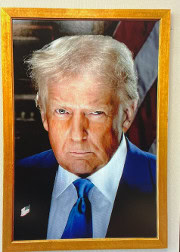
Trump Police Mug Shot which is posted in the entrance to the Oval Office in the White House
Author: Hailey Shafir, LCMHCS, LPCS, LCAS, CCS
Medical Reviewer: Naveed Saleh, MD, MS
Published: January 28, 2025 (choosingtherapy.com)
What Is a Psychopath?
The term psychopath connotes a vivid image of a person who lacks empathy and is likely to engage in aggressive or violent behavior towards others. Psychopathy is not a clinical diagnosis, but does share many traits with antisocial personality disorder (ASPD), a serious and chronic personality disorder. It has been hypothesized that psychopathy is an extreme version of ASPD, but there are key differences in their presentation.4Sociopaths and psychopaths both lack empathy and concern for others, but psychopaths are more likely to engage in violence without thought about its consequences or the harm it brings others. 1,3,5
Psychopaths often engage in criminal, cruel, or socially irresponsible behavior, including lying, stealing, or being violent or abusive toward others. Because psychopaths have no empathy for a person’s needs or rights, they also feel no remorse—even when their actions harm others. These combined traits and deficits mean that psychopaths are likely to engage in crime, violence, abusive behavior, and additional forms of cruel or dangerous behaviors. 1,3,5,7
Would You Like to Try Therapy?
BetterHelp has over 30,000 licensed therapists who provide convenient and affordable online therapy. BetterHelp starts at $65 per week and is FSA/HSA eligible by most providers. Take a free online assessment and get matched with the right therapist for you.Free Assessment
20 Signs of a Psychopath
Many psychopathic people are pathological liars and master manipulators, which can make it much more difficult to spot the signs of a psychopath. Psychopathic traits and characteristics often become more obvious when you have more frequent interactions with a person, at which point the symptoms of psychopathy may become more evident.
Here are 20 signs of a psychopath to look out for:
1. Superficial Charm & Charisma
Psychopaths can be very charming, charismatic, and persuasive people. This can be especially so with female psychopaths, who are more social and emotional than their male counterparts. While they lack true empathy, they are often very skilled at “faking” prosocial behaviors like flattery, kindness, and false sympathy. They may use these skills to get what they want from people, but eventually, they are unable to keep up with the act. Over time, the charm and charisma will probably wear off, unmasking an underlying coldness or cruelty.1,7
2. Unnecessary Cruelty or a Mean Streak
Once the superficial charm and charisma wear off, a psychopath will often demonstrate moments of cruelty or meanness. These may include gossip, biting comments, lashing out aggressively at others, or being entertained when they hurt or embarrass someone. Cruelty and meanness are hallmark signs of a psychopath and typically lead to a pattern of violating the rights of others.1,3,7
3. Lies, Exaggerations, & Dishonesty
Psychopaths are often pathological liars, using deception to manipulate, control, or influence others for their own benefit. They may exaggerate the truth to inflate their ego, distort facts to suit their agenda, or fabricate stories entirely to achieve their goals. Unlike most people, who might feel guilt or fear about being caught in a lie, psychopaths lack a conscience, making dishonesty a guilt-free and frequent behavior. Deception is also a hallmark symptom of antisocial personality disorder (ASPD), often manifesting as ‘faked’ remorse or concern designed to mislead others.2,7,8
4. Lack of Accountability & Playing the Blame Game
Psychopaths commit some of the cruelest, most violent, and most heinous acts in society. However, they rarely take responsibility for their actions. Instead, they are more likely to blame others, make excuses, and try to justify their actions, no matter how bad they are. This sign of a psychopath is indicative of their lack of morals and conscience, meaning they do not have the same sense of ‘right and wrong’ that most people do.7,8
5. Need for Power, Control, & Dominance
Many psychopaths seek out positions of power and authority because they enjoy domination and control of other people. According to research, psychopaths may search for and secure positions of leadership in the corporate world, suggesting there is a grain of truth in the stereotype of the “psychopathic CEO.”9 There is also a known overlap between psychopathy, narcissism, and Machiavellianism (immoral and exploitative tendencies), which can lead to this hunger for control.8,10
6. Sadistic Enjoyment of Pain & Suffering
Sadism is a word that describes a sick sense of pleasure from the pain and suffering of others. For some psychopathic people, the pain of others is sexually arousing. On the other hand, pleasure is non-sexual and has more to do with excitement, power, or the ‘rush’ of the experience.3,7,8 Not all psychopaths are sadistic, but this quality is not an uncommon trait in a psychopath, which may explain why psychopathic traits predict violent and sexually violent crimes with 80% accuracy.1
7. Boredom & Thrill-Seeking Behaviors
Because psychopaths lack some of the normal emotional wirings that most individuals have, it takes a lot more to excite them, make them happy, or thrill them. Psychopaths are overall less impulsive than sociopaths because they aren’t driven by strong emotions, but their dulled emotional response may cause them to seek out thrills. This may be why psychopaths are more likely to engage in crime, violence, sexual promiscuity, and drug or alcohol use. 1,3,7
8. Disregard for Rules, Laws, & Norms
Psychopaths do not follow the same code of ethics as most people in society, which is why they often behave in immoral or illegal ways. These may include minor offenses like inappropriate comments and profanity, or serious offenses such as crime and violence. Not all psychopaths are violent criminals, but a high percentage of those who commit crimes (especially violent crimes) have psychopathic traits.1,6,7
9. Unaffected & Unafraid of Consequences
Many individuals who engage in criminal behaviors live in fear of being caught. However, psychopaths don’t always possess this same worry. This may be partially explained by the fact that psychopaths are believed to have abnormalities in areas of the brain that create normal fear responses and those related to impulse control and good long-term decision-making.3,5
10. Detached, Cold, & Callous Demeanor
Psychopaths often display a cold, callous, and apathetic demeanor.1,7,8 The differences in the structure of their brains are believed to limit their ability to experience a normal range of human emotions, making them less likely to experience strong feelings.3,5 In situations when others are sad, upset, anxious, or excited, a psychopath may seem oddly detached or apathetic.8
Top Rated Online Therapy Services
BetterHelp – Best Overall
“BetterHelp is an online therapy platform that quickly connects you with a licensed counselor or therapist and earned 4 out of 5 stars.”Take a free assessment
Online-Therapy.com – Great Alternative
In addition to therapy, all Online-Therapy.com subscriptions include a self-guided CBT course. Visit Online-Therapy.com
11. A History of Childhood Behavior Problems
Antisocial personality disorder can be diagnosed only after the age of 18, but the signs and symptoms of ASPD usually begin in childhood or early adolescence.2 Most psychopaths show signs of conduct disorder before the age of 15, and the most severe psychopaths may be able to trace their behavioral issues to before the age of 10.6 Some common signs of a psychopath in childhood include frequent fights, lying, stealing, cruelty to animals or other children, and a disregard for rules or authority.2,6
12. A Trail of Short, Broken Relationships
Because of an inability to empathize with other people, it makes sense that psychopaths have trouble forming and maintaining close relationships. While they may be able to use their charm or powers of persuasion to fool somebody into liking them, they usually lack the ability to sustain these relationships over time.8 This is why most psychopaths have very short, shallow relationships, as well as a long trail of individuals who they’ve betrayed, hurt, or turned into enemies.
13. Exploitation of Others for Personal Gain
Psychopaths are master manipulators who readily use, abuse, and exploit others to achieve their goals, whether it’s power, wealth, or recognition. Their lack of empathy and remorse allows them to disregard the harm they cause, leaving a trail of victims in their pursuit of personal gain. Psychopaths are unhesitant to betray or undermine even those who have supported them, seeing people as mere tools to advance their agenda. This calculated and self-serving behavior underscores their dangerous and destructive nature.1,3,7
14. Calculated & Strategic Planning
While sociopaths are driven by emotions, a psychopath is cool-headed and calculated in their decision-making.1,3,7 This can make them more dangerous as it’s not as easy to predict what they will do or when they will make their move. Some psychopaths devise detailed plans on how to con, exploit, or take advantage of people who are naturally generous. While psychopaths are not generally patient individuals, they are typically less impulsive than sociopaths.1,3,6,7,9
15. A Lack of Conscience
Even when they harm another person, a psychopath will not feel genuine remorse for their actions, and may not be phased by the consequences of their actions when they get in trouble. This also makes them especially dangerous because they are less likely to limit their behavior based on fears of getting caught and feeling guilty after. Psychopaths are also less likely to learn from their mistakes.
16. Abnormal Ways of Thinking
Abnormal thoughts are common in psychopaths because their brains are wired differently. This could cause them to make strange, odd, or off-putting comments during normal conversations. A psychopath may occasionally provide a disturbing view into their twisted minds when talking about strange things they like, mean comments about others, or statements that make it clear they don’t care about anyone else.
17. Poor Attention Span & Loss of Interest
A lesser-known sign of psychopathy is a poor attention span, often resembling symptoms of ADHD. Psychopaths are prone to boredom, quickly losing interest in activities, tasks, or relationships that once captured their attention. They constantly seek new thrills or excitement, leaving behind unfinished projects, abandoned goals, and strained relationships. This restless nature often contributes to a pattern of irresponsible decision-making, as they prioritize short-term gratification over long-term commitments or consequences.7,8
18. Violent Tendencies, Abuse, or Aggression
One of the most dangerous signs of a psychopath is a tendency towards violence, aggression, and abuse. Psychopathy is one of the strongest predictors of violent behavior, including crimes and sexual violence. Unfortunately, many violent psychopaths will re-offend, even after receiving treatment, rehabilitation, serving prison time, or having other legal consequences.1,3,5,7
19. Hostile & Oppositional by Nature
Another less commonly known psychopath trait is a hostile and oppositional demeanor. While psychopaths can pretend to be friendly and charming for a short time, their true nature is aggressive. Psychopaths are more likely to hold racist, sexist, or misogynistic views toward others, and treat people in malicious or unkind ways.1,7 They may be more argumentative and combative, seeking out conflict and confrontation (while most people try to avoid it).
20. Masters of Deception
A final warning sign of a psychopath is a person who seems to be especially skilled at the art of deception. Psychopaths are masters of deception and use distortions of truth, gaslighting, and other dishonest tactics to emotionally manipulate others and falsely represent the facts. Unfortunately, psychopaths in treatment may use these deceptive tactics to fool counselors and treatment providers into thinking they have improved. One study found that psychopaths with the highest treatment success scores were most likely to re-offend.9
Find a Therapist Who Specializes in Personality Disorders.
BetterHelp has over 30,000 licensed therapists who provide convenient and affordable online therapy. BetterHelp starts at $65 per week and is FSA/HSA eligible by most providers. Take a free online assessment and get matched with the right therapist for you.Free Assessment
Is There a Psychopath Test?
The most commonly used psychopathy test is the Psychopathy Checklist, or PCL-R, which is a 20-question survey used to identify the traits, characteristics, and signs of a psychopath.7 Technically, psychopathy is not a diagnosable condition listed in the DSM 5 but it includes symptoms of ASPD in addition to the predilection for violence and bringing harm to others.2
Psychopaths display many of the symptoms of ASPD and also a range of other traits, characteristics, and behaviors. While individuals with ASPD may or may not seek treatment, individuals who display psychopathy are likely to engage in behaviors that result in criminal charges and incarceration. In fact, the PCL-R has been validated specifically with incarcerated populations, as these facilities are where psychopathy is most likely to be diagnosed.4
How to Deal With Someone Who Shows Signs of Psychopathy
While individuals with ASPD may be callous and manipulative in how they treat others, psychopathic individuals pose a serious threat to personal safety. Psychopaths have no empathy for others’ suffering and often enjoy the act of causing others to experience pain. If you are in the company of someone who exhibits psychopathic tendencies, prioritizing your personal safety is essential. Trust your instincts and have a plan for escape, if needed.
Some tips for managing interactions with a psychopath include:
Set boundaries: Psychopaths are masters at taking advantage of others, so ensure you enforce limits on the time you spend in their proximity.
Maintain your composure: Psychopathic individuals try to get others off-balance through their words or actions, so be prepared and don’t let them get the best of you.
Control your emotions: Keep cool and don’t rise to their bait. When you are able to stay calm and not react in fear or anger, you avoid giving them any advantage.
Be skeptical of what they say: Don’t let yourself be gaslit; don’t buy into their wild tales or efforts to get you to think that they are victims. They may be seeking sympathy in order to gain your trust to take advantage of you in disturbing ways.
Trust your instincts: When most people are in the company of individuals with personality disorders, they get a feeling that there’s something amiss. If you feel that a person is showing signs of psychopathic thoughts or actions, trust yourself and find a way to exit the situation.
Engage in reality-testing with trusted others: When you feel that someone’s behavior isn’t “normal,” check in with people you trust to confirm your feelings and brainstorm ways to respond.
Avoid face-to-face engagement: If you must communicate with someone with psychopathic tendencies, use email to ensure that there is less chance to be at a disadvantage. Email is less personal and allows for distance that can serve as protection.
Can You Treat Psychopathy?
Antisocial personality disorder is an underlying condition that drives psychopathy and is among the most difficult mental health issues to treat and there is no cure for psychopathy. Research suggests that psychopaths rarely seek treatment on their own and that when they are forced into treatment, it usually does not lead to long-term improvements or changes.6 In fact, some studies comparing treated and untreated psychopaths found that treatment increases the likelihood of crime and violence in those with a history of these behaviors.10
Research suggests that early intervention may help prevent the development of antisocial personality disorder (ASPD) in some cases. Addressing early signs of antisocial behavior in young children, such as aggression or rule-breaking, can reduce the likelihood of these behaviors escalating into ASPD.11 However, for children raised in high-risk environments—characterized by neglect, abuse, or chronic instability—preventing the disorder becomes significantly more challenging. While there is no cure for ASPD, individuals committed to change can work to minimize symptoms through targeted therapies and supportive interventions.
Psychopathy Treatment Options
There is always hope for a person who has a sincere desire to change and improve themselves, no matter what their diagnosis is. Therapies like cognitive behavioral therapy (CBT), may help people with ASPD manage their symptoms and improve their relationships, decision-making, and behavior.6
There are no medications that can treat or cure psychopathy, unfortunately. However, there are often co-occurring disorders that are diagnosed that can be successfully treated with medicine. These include antidepressants for depression, medications to manage anxiety, and medicine like Antabuse for addictions, among others. When symptoms of these disorders are managed through medication, symptoms related to psychopathy may be reduced and overall well-being can be improved.
Find a Therapist Who Specializes in Personality Disorders.
BetterHelp has over 30,000 licensed therapists who provide convenient and affordable online therapy. BetterHelp starts at $65 per week and is FSA/HSA eligible by most providers. Take a free online assessment and get matched with the right therapist for you.Free Assessment
In My Experience
Because of the severity of psychopathy and the poor response to treatment, most people are advised to limit their contact with psychopathic people in order to avoid becoming victims. Knowing the signs and symptoms of a psychopath can help you identify a person with these dangerous traits, and finding the right therapist who has experience and knowledge of ASPD can help you learn ways to cope and heal from these interactions.
It’s said that you are what you eat, but these days perhaps you’re also what you tweet. Or stream. Or binge. Just as you might regret indulging in dubious street food, you may later regret swallowing those half-baked WhatsApp forwards and other the artificially flavored postings whipped up by paid operatives.
Just as a bad diet can lead to health problems, consuming harmful media can pollute our understanding of the world.
As an antidote, we’ll serve up five delectable words with food-related etymology (literally, true story). Enjoy these words from the culinary world that have simmered their way into everyday language. Each one is a tasty metaphor ready for use beyond the kitchen.
farce
PRONUNCIATION:
(fars)
MEANING:
noun:
1. A light play, film, or literary work involving absurd, exaggerated, or improbable situations.
2. Humor of this type.
3. An absurd or ridiculous situation; mockery.
4. A mix of finely chopped ingredients used as stuffing.
verb tr.:
1. To pad a speech or written work with jokes or witty remarks.
2. To stuff or fill with culinary mixture.
ETYMOLOGY:
From Old French farce (stuffing, interlude), from Latin farsa, feminine of Latin farsus, from farcire (to stuff). Earliest documented use: 1390.
The Lord of Success is a delicious card, indicating that we have achieved a natural state of inner balance and harmony which allows us to use our energies without diversion nor interference. More often than not, these energies are directed into practical channels – in the workplace, dealing with things in the home environment.This is because Disks are about the more mundane aspects of everyday life, and about home and family – some people see Disks as purely money-related, but this is a misunderstanding of their deep function. Rather than interpreting Disks purely in a financial context, we are better served by seeing them as relating to the basic nuts and bolts of security. This includes money and finances, of course, but also covers all sorts of other areas too – the basic trust and reliability of our friends and family, the nature of our home, the set of tasks which form our job. However, I digress ;-)On a day ruled by the Six of Disks, we need to be taking stock of our overall position in a practical sense. This is a day to sort out your bank accounts, check your credit card balance, look in your birthday book for upcoming important dates, check what food you have in the freezer, about those people closest to you and consider how they’ve been doing recently.It’s a practical, down-to-earth day where you look around and feel grateful for the things, creatures and people you have in your life. Everybody has something to be grateful for… and most of us have a lot to be grateful for. And on a day ruled by the Lord of Success it’s time to say thankyou!
Affirmation: ” I am blessed with the bounty of life.”
Joseph Campbell Foundation Mar 15, 2025 This video is a special release from the original Thinking Allowed series that ran on public television from 1986 until 2002. It was recorded in February 1987. Here Campbell describes his overall vision of the role of mythology in culture.
The Inner Reaches of Outer Space: Metaphor as Myth and as Religion
Developed from a memorable series of lectures delivered in San Francisco, which included a legendary symposium at the Palace of Fine Arts with astronaut Rusty Schweickart, Joseph Campbell’s last book explores the space age. Campbell posits that the newly discovered laws of outer space are actually at work within human beings as well and that a new mythology is implicit in this realization. He examines the new mythology and other questions in these essays which he described as “a broadly shared spiritual adventure.”
Joseph Campbell was an American author and teacher best known for his work in the field of comparative mythology. He was born in New York City in 1904, and from early childhood he became interested in mythology. He loved to read books about American Indian cultures, and frequently visited the American Museum of Natural History in New York, where he was fascinated by the museum’s collection of totem poles.
Campbell was educated at Columbia University, where he specialized in medieval literature, and continued his studies at universities in Paris and Munich. While abroad he was influenced by the art of Pablo Picasso and Henri Matisse, the novels of James Joyce and Thomas Mann, and the psychological studies of Sigmund Freud and Carl Jung. These encounters led to Campbell’s theory that all myths and epics are linked in the human psyche, and that they are cultural manifestations of the universal need to explain social, cosmological, and spiritual realities.
After a period in California, where he encountered John Steinbeck and the biologist Ed Ricketts, he taught at the Canterbury School, and then, in 1934, joined the literature department at Sarah Lawrence College, a post he retained for many years. During the 40s and ’50s, he helped Swami Nikhilananda to translate the Upanishads and The Gospel of Sri Ramakrishna. He also edited works by the German scholar Heinrich Zimmer on Indian art, myths, and philosophy. In 1944, with Henry Morton Robinson, Campbell published A Skeleton Key to Finnegans Wake. His first original work, The Hero with a Thousand Faces, came out in 1949 and was immediately well received; in time, it became acclaimed as a classic. In this study of the “myth of the hero,” Campbell asserted that there is a single pattern of heroic journey and that all cultures share this essential pattern in their various heroic myths. In his book he also outlined the basic conditions, stages, and results of the archetypal hero’s journey.
Throughout his life, he traveled extensively and wrote prolifically, authoring many books, including the four-volume series The Masks of God, Myths to Live By, The Inner Reaches of Outer Space and The Historical Atlas of World Mythology. Joseph Campbell died in 1987. In 1988, a series of television interviews with Bill Moyers, The Power of Myth, introduced Campbell’s views to millions of people.
Katie Razzall, Culture and media editor•@katierazz
Sarah Bell, BBC News
Sarah Wynn-Williams says she watched Facebook grow from “a front row seat”
Meta has won an emergency ruling in the US to temporarily stop a former director of Facebook from promoting or further distributing copies of her memoir.
The book, Careless People by Sarah Wynn-Williams, who used to be the company’s global public policy director, includes a series of critical claims about what she witnessed during her seven years working at Facebook.
Facebook’s parent company, Meta, says the ruling – which orders her to stop promotions “to the extent within her control” – affirms that “the false and defamatory book should never have been published”.
The UK publisher Macmillan says it is “committed to upholding freedom of speech” and Ms Wynn-Williams’ “right to tell her story”.
It told the BBC that she had been due to do “extensive media” in the UK and internationally and “has been prevented from doing so”.
At a hearing on Wednesday at the American Arbitration Association – a neutral third party which resolves disputes out of court – Ms Wynn-Williams was told she must refrain from engaging in or “amplifying any further disparaging, crucial or otherwise detrimental comments”.
All previous disparaging comments “to the extent within her control” must also be retracted, the ruling also said.
The book is former New Zealand diplomat Ms Wynn-Williams’ account of joining Facebook in 2011 and watching it grow from a “front row seat”.
Meta disputes the allegations contained in the book. Regarding China, it says it is “no secret we were once interested” in operating services there. “We ultimately opted not to go through with the ideas we’d explored.”
Ms Wynn-Williams has also filed a whistleblower complaint with the US markets regulator, the Securities and Exchange Commission (SEC), alleging Meta misled investors – which Meta also denies. The BBC has reviewed the complaint.
Sarah Wynn-Williams pictured with Mark Zuckerberg, centre, and Joel Kaplan, now Meta’s chief global affairs officer
During the emergency hearing the arbitrator, Nicholas Gowen, found Meta had provided enough evidence that Ms Wynn-Williams had potentially violated her severance contract. She did not personally attend Thursday’s hearing.
In his ruling, Mr Gowan said Meta would suffer “immediate and irreparable loss” in the absence of a temporary ruling in the case.
He did not order the book’s publisher, Flatiron Books, or its parent company, Macmillan, to take any action.
The ruling will remain in effect unless it is modified or lifted following a full hearing.
Following the decision, Meta spokesperson Andy Stone said in a post on X: “This ruling affirms that Sarah Wynn-Williams’ false and defamatory book should never have been published.”
Careless People was released in the US, where it is number six on the Amazon chart, on Tuesday. It was published in the UK on Thursday.
In a statement, a spokeswoman for Macmillan said: “As publishers, we are committed to upholding freedom of speech and her right to tell her story. Due to legal process instituted by Meta, the author has been prevented from continuing to participate in the book’s publicity.”
“Nonsense is just information not taken in through the five senses.”
–Jeffrey Mishlove
New Thinking Mar 16, 2025 Lisa Smartt, MA, is a linguist, educator, and poet. She founded The Final Words Project, an ongoing study devoted to collecting and interpreting the mysterious language at the end of lives. She is author of Words at the Threshold: What We Say When We’re Nearing Death. Here she points out that much can be learned about the consciousness of dying individuals by paying attention to their language. One can develop an appreciation for speech that seems nonsensical by understanding that a dying person may be experiencing two different realities simultaneously. Similar patterns can often be found in individuals experiencing other altered states of awareness such as dementia or schizophrenia. Her work is largely predicated on Raymond Moody’s studies of near-death experience and the language of nonsense. New Thinking Allowed host, Jeffrey Mishlove, PhD, is author of The Roots of Consciousness, Psi Development Systems, and The PK Man. Between 1986 and 2002 he hosted and co-produced the original Thinking Allowed public television series. He is the recipient of the only doctoral diploma in “parapsychology” ever awarded by an accredited university (University of California, Berkeley, 1980). He is also the Grand Prize winner of the 2021 Bigelow Institute essay competition regarding the best evidence for survival of human consciousness after permanent bodily death. He is Co-Director of Parapsychology Education at the California Institute for Human Science. (Recorded on January 30, 2019)
It’s March, and the Second presentation of the Salon Calvin Season. This month’s Salon Calvin begins with the first of this year’s presentations of the master storyteller William Shakespeare’s plays.
Storytelling is drawn from a personal odyssey of the author’s own path or the path of the author’s protagonist. It always begs to ask a question or point a finger to an issue or answer that may not be apparent to its audience until it is pointed out. storytelling is one of the most effective ways to connect with people’s hearts and minds.


If you have a broken leg, or a fever, you know what is to be aimed for; if you have a broken heart or a sense of shame, it is not quite so clear… Patients come to psychoanalysis with an idea of cure because, historically, they have been to medical doctors, and before that they have been to religious healers. A culture that believes in cure is living in the fallout, in the aftermath, of religious cultures of redemption.











 Calvin