You’re invited to join us this Friday evening for a special Holiday Edition of our usual Group Dynamics conversation. Put on your straight thinking Santa hat, your prettiest “ugly” Christmas sweater, an elegant yarmulke, or a holly-and-ivy crown, and let’s celebrate! We can reminisce, talk about our plans, share stories, and maybe even project some New Year’s resolutions.
THIS FRIDAY at 5:30 PM Pacific / 6:30 Mountain / 7:30 Central / 8:30 Eastern
Join us in community and spirit for this special open discussion!
To understand why certain Silicon Valley billionaires have aligned with MAGA Republicans in 2024, we must examine their shared worldviews.
Some political observers have drawn a simplistic conclusion about the tech figures backing Trump. They see these billionaires as motivated by a basic desire for lower taxes and fewer regulations. But that’s only part of the story.
While taxes and regulations may be important issues, they do not fully explain the MAGA-tech alliance. In reality, this alliance is about power and about reshaping the world in the 21st century and beyond. A new ideological faction is emerging from Silicon Valley: tech authoritarianism. It overlaps significantly with Trump’s MAGA party and thus has resulted in a (temporary) alliance.
In these rough notes, I’ll examine some of these overlaps.
Strict Father Morality
First, it helps to understand Dr. George Lakoff’s “Strict Father Morality” concept, which provides a framework for understanding the Republican moral belief system. Strict Father Morality is a worldview based on a hierarchical, authoritarian family model where the metaphorical father – the leader – is the ultimate authority.
Strict Father morality results in a so-called “moral hierarchy” that governs how the world should work. Here it is:
God above Man
Man above Nature
Men above Women
Whites above Nonwhites
The Disciplined (Strong) above the Undisciplined (Weak)
The Rich above the Poor
Employers above Employees
Adults above Children
Western culture above Other cultures
U.S. above Other countries
Christians above Non-Christians
Straights above LGBTQ people
In reactionary Republican politics, this hierarchy forms the moral order of society. As we say at FrameLab: If you want to understand the reasons behind extreme Republican policies, consult this list to find the answer. It’s not just one form of bigotry or prejudice – it’s a coherent, intersectional, organized system of supremacies.
This is especially true of the Republican Party in the MAGA era, where these interlinked hierarchies have become more pronounced. This rigid authority and hierarchy are what make MAGA an authoritarian movement.
MAGA + Tech Authoritarians
As the Republican Party has gone full authoritarian, it has attracted strong support from an emergent group of tech billionaires who share its authoritarian politics.
Some of these tech authoritarians have tried to rebrand their politics as “gray” – neither blue (Democratic) nor red (Republican). However, the overlap between the tech authoritarian belief systems and Strict Father Morality reveals the deep reactionary roots of the tech-MAGA alliance.
At the core of both systems is the preservation of hierarchies. Here are the areas where I see shared beliefs between MAGA and the tech authoritarians:
Men above women:
Tech authoritarians are primarily men. They increasingly embrace a toxic brand of male aggression and supremacy.
They promote aggressive “alpha” masculinity and the new “pronatalism” movement, which redefines women’s roles mostly around subservience and childbearing.
Whites above Nonwhites:
Tech authoritarians are primarily white.
They decry diversity, equity, and inclusion initiatives, favoring a system that upholds white supremacy, which they consider the traditional (and logical) moral order.
The Rich Over the Poor:
Tech authoritarians are wealthy. They believe the rich should have more power than everyone else.
They are using their massive wealth to reshape politics and tip the scales toward MAGA.
They seek to solve many problems, but never the vast economic inequality from which they derive their power.
The Disciplined (Strong) above the Undisciplined (Weak):
They often view their success as a product of superior intelligence, discipline, and strength, reinforcing a belief in their inherent “deservedness.”
They fetishize maniacal workaholic lifestyles, insisting that their mega wealth is the result of discipline. But their wealth is largely derived from the labor, property, taxes and talent of others.
Employers above Employees:
Many tech authoritarians are CEOs. They naturally prioritize the power of employers over workers, aligning with corporate supremacy.
Man above Nature:
Despite rhetoric about saving the planet, tech authoritarians favor technological “solutions” over structural changes.
They believe they can defeat aging and even death with technological enhancements.
Figures like Elon Musk think humans must urgently migrate off Earth and become “multi-planetary” (which would put humankind under corporate governance…in space).
Meanwhile, Musk’s Neuralink company is trying to merge technology with the human brain and create an era of “transhumanism.”
They believe they can conquer nature with technology.
Straights Above LGBTQ people:
Tech authoritarians are primarily straight (with notable exceptions). They may not have anti-LGBTQ stances derived from religious morality, but their alliance with the Christian Right makes them open to using the LGBTQ community as a scapegoat.
Since MAGA Republicans also vilify Trans people as part of the culture war, the tech authoritarians are willing to use Trans people as scapegoats. Ironically, these tech authoritarians plan a “transhuman” future in which humankind defies nature by merging with technology, changing the very definition what it means to be a human being in ways far more radical than mere gender transition.
The emphasis on breeding and pronatalism also makes it easier to scapegoat LGBTQ people (even though heterosexuality has nothing to do with having children).
Where Tech Authoritarians Diverge
While Silicon Valley oligarchs align with most aspects of traditional Strict Father Morality, they also introduce some twists:
Tech as God (Above Man): God is above man in the conservative “strict father” hierarchy, and so authority is derived from God. But the tech authoritarians aren’t very religious. Instead, they have replaced God with technology. This means that those who control tech – the tech authoritarians themselves – are the ultimate authority in place of God. While a handful of these tech elites claim to be religious to some degree, it is not their defining characteristic. Instead, they place their faith in technology, their own intelligence, and in the impending arrival of the supposed “superintelligence” (A.I.) that will radically reshape the world in their image.
Tech interests above National interests: Tech authoritarians view loyalty to nations as an old-fashioned superstition. They see nation-states as outdated concepts. With ideas like the Network State, they seek to replace traditional countries with tech-ruled territories. They admire authoritarian countries and openly side with these countries (especially Putin’s Russia) over the United States. They have no loyalty to democracy. They prefer whatever systems best serve their own interests, regardless of what that means for others.
These two key differences are potential points of conflict in the MAGA-Tech Authoritarian alliance.
Summary: An Alliance of Hierarchy
The MAGA-Tech alliance is rooted in a shared hierarchical worldview. This worldview concentrates power in the hands of wealthy and predominantly white men. Their job is to impose a strict social order based on their continuing supremacy.
Trump Republicans and tech authoritarians may frame their beliefs differently, but their actions reveal an alignment: maintaining hierarchy, resisting egalitarianism, and elevating profit, power, and their own desires above all else.
What the tech authoritarians describe as “gray” politics is a 21st century version of Strict Father Morality. It is a moral system that replaces God with technology and money – and with the moral supremacy of those who control both.
This is a work in progress, so I welcome any feedback from FrameLab readers. Let me know what you see, or what I might have missed.
For more information…
For more on Strict Father Morality and Donald Trump, read “Understanding Trump” by Dr. Lakoff, which was written before the 2016 election:
THE HEAVENS—Groaning to Himself as the professionally dressed evangelists rounded the corner, the Lord God Almighty reportedly locked the gates of heaven Tuesday after spotting Mormon missionaries milling around outside. “Maybe if we turn off all the lights and pretend no one’s here we can get rid of them,” said the Creator of the Universe, rapidly motioning to nearby angels to stop playing their harps until the coast was clear. “Ugh, this is the last thing I need right now. I’m just trying to enjoy a quiet afternoon in My kingdom, and now I’m going to have to smile and nod while these weirdos go on and on about The Watchtower. Or wait, is that Jehovah’s Witnesses? Whatever, same thing. But what else am I supposed to do—tell them I think their religion is bullshit and slam the gate in their face? I wish.” At press time, reports confirmed God was cursing Himself after one of the missionaries had spotted Him crouching behind His throne.
Because I read for the same reason I write — to fathom my life and deepen my living — looking back on a year of life has always been looking back on a year of reading. This year was different — a time of such profound pain and profound transformation that it fused reading and writing into a single, surprising act of the unconscious: I began making bird divinations to clarify the confusion of living and refill my reservoir of trust in the cohesion of the world. This daily practice left a great deal less time for other reading, especially anything new: The written word today seems more and more resigned to commodified virtue signaling and hollow self-help, so I found myself returning more and more to trustedtreasures that have stood the test of time and changing moral fashions. Of the few new books I did read, these are the ones I will keep returning to for substance and succor in the years ahead.
MARIE HOWE: NEW AND SELECTED POEMS
Here is my favorite poem from it (which is also one of my favorite poems of all time), and here is another.
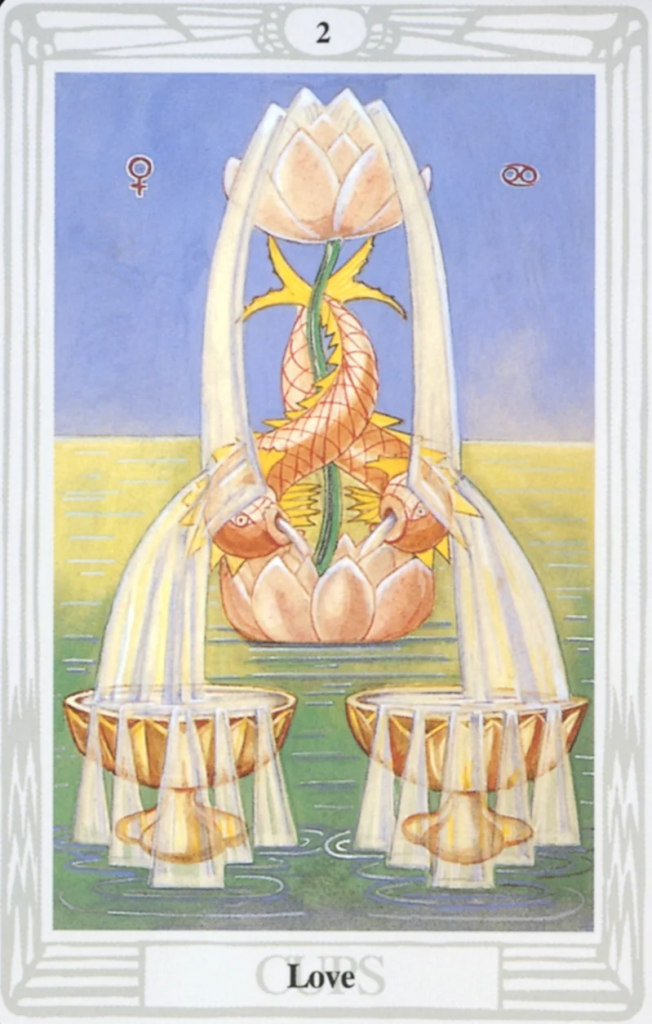
As I said when defining this card, the most important aspect of the Lord of Love is that we learn to develop self-love, self-trust and self- reliance. Hopefully there are many of you who can think, with confidence, I’ve done this.And for those of you who can, a day ruled by the Two of Cups is a day to count those you love, and those who love you. It is a day to be deeply grateful that you have such abundance and bounty in your life. There is no greater wealth we can aspire to than a wealth of love.For those people who have not yet managed to achieve real self-love, this is a day to work on it. Throughout a day ruled by the Lord of Love, try to be conscious of your feelings toward yourself. Look carefully at the ways you choose to describe yourself. Examine how you feel when dealing with other people.Try to see yourself and your actions without standing in judgement on them. Often it is the obsession with judging ourselves (often through our interpretation of how others see us) that stops us from seeing ourselves as loving and loveable. So put a hold on your judgement on this day.Simply observe what you do, what you think, how you feel. If you discover that you are putting yourself down, then decide that, at least for today, you will stop. After all, if you get so much out of doing this, you can always start again tomorrow ;-)Instead, say your affirmation, tell that judgmental little gremlin that it can have the day off, and allow the world to reflect you back to yourself. You might just get a big surprise!
Affirmation: “Love flows into my life in an endless stream.”
New Thinking Allowed with Jeffrey Mishlove Dec 17, 2024 James Cooke PhD trained as a neuroscientist after an awakening as a teenager that showed him the reality of spiritual states of consciousness. He holds three degrees from Oxford University (a PhD and Masters in Neuroscience & a BA in Experimental Psychology). He has conducted scientific research for over a decade at institutions such as Oxford University, University of California, Berkeley, University College London, Trinity College Dublin, and Riken Brain Sciences Institute in Tokyo. James is the author of The Dawn of Mind: How Matter Became Conscious and Alive, which synthesizes science and spiritual insight to offer a radical solution to the Hard Problem of Consciousness. His website is https://www.drjamescooke.com/ Here he describes his position as a philosophical monist who maintains that life requires consciousness and that consciousness requires life. He sees himself as a “naturalist,” but only in the sense of rejecting dualistic interpretations of reality. If supposed supernatural evidence is genuine, he maintains that it will fit into a monistic description of the world. 00:00 Introduction 02:23 James’ spiritual awakening 06:41 Buddhism 15:45 Process philosophy and Alfred North Whitehead 18:29 The “hard problem of consciousness” 23:14 Naturalism and consciousness 34:13 Consciousness and the brain 39:59 Artificial intelligence and consciousness 44:51 Autopoiesis and phenomenology 52:11 Conclusion New Thinking Allowed host, Jeffrey Mishlove, PhD, is author of The Roots of Consciousness, Psi Development Systems, and The PK Man. Between 1986 and 2002 he hosted and co-produced the original Thinking Allowed public television series. He is the recipient of the only doctoral diploma in “parapsychology” ever awarded by an accredited university (University of California, Berkeley, 1980). He is also the Grand Prize winner of the 2021 Bigelow Institute essay competition regarding the best evidence for survival of human consciousness after permanent bodily death. He serves as Co-Director for Parapsychology Education at the California Institute for Human Science. (Recorded on November 30, 2024)
Object permanence is the understanding that whether an object can be sensed has no effect on whether it continues to exist. This is a fundamental concept studied in the field of developmental psychology, the subfield of psychology that addresses the development of young children’s social and mental capacities. There is not yet scientific consensus on when the understanding of object permanence emerges in human development.
Jean Piaget, the Swiss psychologist who first studied object permanence in infants, argued that it is one of an infant’s most important accomplishments, as, without this concept, objects would have no separate, permanent existence. In Piaget’s theory of cognitive development, infants develop this understanding by the end of the “sensorimotor stage“, which lasts from birth to about two years of age.[1] Piaget thought that an infant’s perception and understanding of the world depended on their motor development, which was required for the infant to link visual, tactile and motor representations of objects. According to this view, it is through touching and handling objects that infants develop object permanence.[2]
Early research
Developmental psychologist Jean Piaget conducted experiments that collected behavioral tests on infants. Piaget studied object permanence by observing infants’ reactions when a favorite object or toy was presented and then was covered with a blanket or removed from sight. Object permanence is considered to be one of the earliest methods for evaluating working memory.[3] An infant that has started to develop object permanence might reach for the toy or try to grab the blanket off the toy. Infants that have not yet developed this might appear confused.[4] Piaget interpreted these behavioral signs as evidence of a belief that the object had ceased to exist. Reactions of most infants that had already started developing object permanence were of frustration because they knew it existed, but did not know where it was. However, the reaction of infants that had not yet started developing object permanence was more oblivious. If an infant searched for the object, it was assumed that they believed it continued to exist.[1]
Piaget concluded that some infants are too young to understand object permanence. A lack of object permanence can lead to A-not-B errors, where children reach for a thing at a place where it should not be. Older infants are less likely to make the A-not-B error because they are able to understand the concept of object permanence more than younger infants. However, researchers have found that A-not-B errors do not always show up consistently.[5] They concluded that this type of error might be due to a failure in memory or the fact that infants usually tend to repeat a previous motor behavior.[1]
Stages
Peek-a-boo is a prime example of an object permanence test.[6]
In Piaget’s formulation, there are six stages of object permanence.[7] These are:
0–1 months: Reflex schema stage – Babies learn how the body can move and work. Vision is blurred and attention spans remain short through infancy. They are not particularly aware of objects to know they have disappeared from sight. However, babies as young as seven minutes old prefer to look at faces. The three primary achievements of this stage are sucking, visual tracking, and hand closure.[8]
1–4 months: Primary circular reactions – Babies notice objects and start following their movements. They continue to look where an object was, but for only a few moments. They ‘discover’ their eyes, arms, hands and feet in the course of acting on objects. This stage is marked by responses to familiar images and sounds (including parent’s face) and anticipatory responses to familiar events (such as opening the mouth for a spoon). The infant’s actions become less reflexive and intentionality emerges.[8]
4–8 months: Secondary circular reactions – Babies will reach for an object that is partially hidden, indicating knowledge that the whole object is still there. If an object is completely hidden, however, the baby makes no attempt to retrieve it. The infant learns to coordinate vision and comprehension. Actions are intentional, but the child tends to repeat similar actions on the same object. Novel behaviors are not yet imitated.[8]
8–12 months: Coordination of secondary circular reactions – This is deemed the most important for the cognitive development of the child. At this stage the child understands causality and is goal-directed. The very earliest understanding of object permanence emerges, as the child is now able to retrieve an object when its concealment is observed. This stage is associated with the classic A-not-B error. After successfully retrieving a hidden object at one location (A), the child fails to retrieve it at a second location (B).[8]
12–18 months: Tertiary circular reaction – The child gains means-end knowledge and is able to solve new problems. The child is now able to retrieve an object when it is hidden several times within their view, but cannot locate it when it is outside their perceptual field.[8]
18–24 months: Invention of new means through mental combination – The child fully understands object permanence. They will not fall for A-not-B errors. Also, a baby is able to understand the concept of items that are hidden in containers. If a toy is hidden in a matchbox then the matchbox put under a pillow and then, without the child seeing, the toy is slipped out of the matchbox and the matchbox then given to the child, the child will look under the pillow upon discovery that it is not in the matchbox. The child is able to develop a mental image, hold it in mind, and manipulate it to solve problems, including object permanence problems that are not based solely on perception. The child can now reason about where the object may be when invisible displacement occurs.[8]
Contradicting evidence
In more recent years, the original Piagetian object permanence account has been challenged by a series of infant studies suggesting that much younger infants do have a clear sense that objects exist even when out of sight. Bower showed object permanence in 3-month-olds.[9][10] This goes against Piaget’s coordination of secondary circular reactions stage because infants are not supposed to understand that a completely hidden object still exists until they are eight to twelve months old. The two studies below demonstrate this idea.
The first study showed infants a toy car that moved down an inclined track, disappeared behind a screen, and then reemerged at the other end, still on the track. The researchers created a “possible event” where a toy mouse was placed behind the tracks but was hidden by the screen as the car rolled by. Then, researchers created an “impossible event”. In this situation, the toy mouse was placed on the tracks but was secretly removed after the screen was lowered so that the car seemed to go through the mouse. The infants were surprised by the impossible event, which suggests they remembered not only that the toy mouse still existed (object permanence) but also its location. Also in the 1991 study the researchers used an experiment involving two differently sized carrots (one tall and one short) in order to test the infants’ response when the carrots would be moved behind a short wall.[10] The wall was specifically designed to make the short carrot disappear, as well as tested the infants for habituation patterns on the disappearance of the tall carrot behind the wall (impossible event).[10] Infants as young as 3+1⁄2 months displayed greater stimulation toward the impossible event and much more habituation at the possible event. The same was true of the tall carrot in the second experiment. This research suggests that infants understand more about objects earlier than Piaget proposed.[1]
There are primarily four challenges to Piaget’s framework:
Whether or not infants without disabilities actually demonstrate object permanence earlier than Piaget claimed.[11]
There is disagreement about the relative levels of difficulty posed by the use of various types of covers and by different object positions.[12]
Controversy concerns whether or not perception of object permanence can be achieved or measured without the motor acts that Piaget regarded as essential.[13]
The nature of inferences that can be made from the A-not-B error has been challenged. Studies that have contributed to this discussion have examined the contribution of memory limitations, difficulty with spatial localization, and difficulty in inhibiting the motor act of reaching to location A on the A-not-B error.[10]
One criticism of Piaget’s theory is that culture and education exert stronger influences on a child’s development than Piaget maintained. These factors depend on how much practice their culture provides in developmental processes, such as conversational skills.[1]
The great advantage of theater is that it presses knowledge into our entire being. Unlike academic study, which mostly engages our mental function, enactment must involve our emotional and physical functions as well. It is a powerful tool for understanding, and understanding is our most powerful agent for lasting change.
While planning our first international gathering in Rome in 2017, I realized that exploring the city’s world-famous sites wouldn’t be enough. I wanted to find ways of making what we saw personal and relevant. How could we take in the architecture of the Pantheon, the stories portrayed in Saint Peter’s Basilica, and the Capitoline Museum’s sculptures, and make them personally meaningful? The answer lay in one of humanity’s oldest teaching tools: the theater.
Theater is as old as civilization itself. Archaeological records suggest that the earliest farming communities incorporated dramatic enactments in their rituals and ceremonies. This was not for entertainment; it was a method of engaging the whole community. Dramatic enactments evolved through the centuries to become the theater we know from Ancient Greece, Medieval Europe, and Classical India. Although it took different forms, it always served the same fundamental purpose: to breathe life into abstract principles and make them living realities.
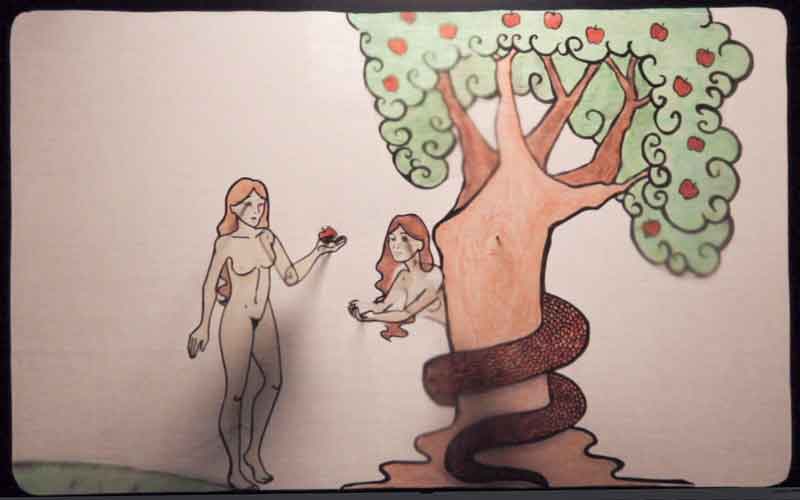
Our first attempt at theater in Rome was modest. We enacted the story of Adam and Eve, a central feature of Christian art. We reverted to the medium of shadow puppets; behind a backlit screen, practitioners brought color-paper figurines to life in a play of light and darkness. This particular medium demands little acting experience and spares participants the challenge of direct exposure on stage. The success of this initial venture was encouraging, and we began experimenting later with on-stage theater as well. At subsequent gatherings, practitioners learned their lines or music, creatively constructed props and costumes from local materials, and rehearsed every day. We enacted plays themed around stories directly related to the historical-cultural sites we visited. For example, The Churning of the Milky Ocean in Angkor Wat; The Hero Twins’ Journey to the Underworld in Palenque; and The Israelites’ Exodus from Egypt in Luxor.
The Temptation of Eve | Shadow Puppet Reenactment
Rodney Collin said that one could only really understand anything if one simultaneously appreciated it with the mind, emotions and physical senses. The great advantage of theater is that it presses knowledge into our entire being. Unlike academic study, which mostly engages our mental function, enactment must involve our emotional and physical functions as well. It is a powerful tool for understanding, and understanding is our most powerful agent for lasting change. If students could deeply understand even one thing from their participation in a gathering, they would be returning home with a lasting profit.
We used theater once more in our recent gathering in India. We performed The Great Departure, the story of Prince Siddhartha’s gradual awakening to the reality of his confinement in a palatial prison. Like the Prince, we do not initially realize we live in sleep, confined to an imaginary picture of ourselves and the reality of the world around us. The play follows Siddhartha’s growing awareness of his condition, his attempts to break free, and his final escape. The image of Siddhartha stepping out of the confinement of his palace made for a powerful finale. There was truth in this spectacle, as well as drama and fun.
The success of The Great Departure highlighted another advantage of theater: its adaptability. It can be performed at the humblest levels as well as on the grandest scale. Our journey with theater reflects this range. We began with shadow puppets in Rome, where practitioners could hide behind a screen while giving voice to the story of Adam and Eve. With each subsequent gathering, our ambitions grew along with our capabilities. By the time we staged The Great Departure, our theatrical endeavors had evolved from an exercise in self-development to a performance capable of touching both participants and audience alike. Although still only dabbling with the humble registers of theatrical experience, our productions have come to achieve an artistic quality that can move others, a bridge between inner meaning and outer expression.
Below are photographs from our performance of The Great Departure in India.
New Thinking • Dec 16, 2024 Gary Lachman is the author of twenty-one books on topics ranging from the evolution of consciousness to literary suicides, popular culture and the history of the occult. He has written a rock and roll memoir of the 1970s, biographies of Aleister Crowley, Rudolf Steiner, C. G. Jung, Helena Petrovna Blavatsky, Emanuel Swedenborg, P. D. Ouspensky, and Colin Wilson, histories of Hermeticism and the Western Inner Tradition, studies in existentialism and the philosophy of consciousness, and about the influence of esotericism on politics and society. In this interview, rebooted from 2018, he shares his passion and personal interest in the life and work of Colin Wilson, who achieved worldwide fame at the age of 24 with the release of his first book, The Outsider. He was regarded as England’s “homegrown existentialist”. Subsequently, Wilson wrote over 100 books. His massive analysis, The Occult, received international acclaim and was followed by many other titles dealing with esoteric topics. This lengthy interview is peppered with descriptions of philosophical, literary, psychological and occult personalities. Lachman also shares several personal stories about his relationship with Colin Wilson. New Thinking Allowed host, Jeffrey Mishlove, PhD, is author of The Roots of Consciousness, Psi Development Systems, and The PK Man. Between 1986 and 2002 he hosted and co-produced the original Thinking Allowed public television series. He is the recipient of the only doctoral diploma in “parapsychology” ever awarded by an accredited university (University of California, Berkeley, 1980). He is also the Grand Prize winner of the 2021 Bigelow Institute essay competition regarding the best evidence for survival of human consciousness after permanent bodily death. He serves as Co-Director for Parapsychology Education at the California Institute for Human Science. (Recorded on December 18, 2018)
Consciousness, spirituality, biography, sexuality, androgyny, futurism, space, the arts, science, astrology, democracy, humor, books, movies and more