2. To dance in an energetic manner, especially to rock music.
noun:
1. A style of blues music played on the piano, characterized by a fast tempo and repetitive bass pattern.
2. A form of lively dance.
ETYMOLOGY:
From boogie-woogie, from African American Vernacular English. Further etymology is uncertain, perhaps of West African origin. Earliest documented use as both noun and verb: 1929.
“Times are difficult globally; awakening is no longer a luxury or an ideal. It’s becoming critical. The earth seems to be beseeching us to connect with joy and discover our innermost essence. This is the best way we can benefit others.”
Pema Chodron (b.1936) American Buddhist Monk
AN OPPORTUNITY FOR DAILY REFLECTION BROUGHT TO YOU BY THE SCHOOL OF PRACTICAL PHILOSOPHY
When we reach deep inside ourselves, with a heart that is unafraid and accepting, we will discover new depths of strength and power. These deep reaches of wisdom, which lay dormant with in the subconscious until we are brave enough to search them out, will bring balance and equilibrium. And from new centredness will arise an unshakeable trust in ourselves that will carry us forward through life.It’s true that when we travel deep inside ourselves, we will also find material that we might prefer to leave unacknowledged – but the Nine of Wands, Lord of Strength, reminds us that in being true to ourselves we release energies that will help us to deal with whatever we find within. And after all, whatever lies inside our own subconscious is, for better or for worse, a part of us.When the Nine of Wands turns up in a reading, we can be re-assured that we have what it takes to get by. Even in times of stress and difficulty, inner strength will rise up to guide us forward toward our goals. And in the process we shall learn more about ourselves and our abilities, gaining a new all-round perspective which brings security and self-confidence.This card tells us to trust ourselves. We have everything we need. There is no necessity to analyse nor question. And absolutely no excuse to give in to doubt!
Translation is a 5-step process of “straight thinking in the abstract” comparing and contrasting what you think is the truth with what you can syllogistically and axiomatically prove is the truth.
The claims in a Translation may seem outrageous, but they are always (or should always be) based on self-evident syllogistic reasoning. Here is one Translation from this week.
1) Truth is that which is so. That which is not truth is not so. Therefore truth is all that is. Truth being all is therefore total, therefore whole, therefore complete, therefore whole, therefore well. Truth being that which is true is therefore that which is real, that which is actual, that which is correct, that which is right, that which is perfect. i think therefore I am. Since I am and since Truth is all that is, therefore I am Truth, I being Truth, must have all the attributes of Truth. Therefore I, being, am total, whole, complete, well, true, real, actual, correct, right, perfect, Since I am Truth and since I am mind/consciousness, therefore Truth is Mind/Consciousness.
2) Flesh is heir to congestive heart failure, diabetes and bed sores.
Word-tracking: flesh (and blood); relatives, real people heir: to inherit from a predecessor predecessor: one who has departed congestive heart failure: not able to flow blood out from the heart, too much in, not enough out heart: compassion, love diabetes: too much urine urine; waste, exhaust bedsores: caused by being confined to bed
3) Truth being true, therefore real, nothing in life can be unreal, therefore we are surrounded by infinite reality. Truth being all, therefore without limit, there is no ending or beginning to Truth. Therefore Truth has no predecessors or inheritors AND there is no departure from Truth. Truth being one, therefore all-inclusive, there is no “in and out” of Truth. Therefore Truth is Self-contained balance, equanimity. Truth being one, love is a given. Truth being complete, therefore full, therefore whole, therefore well, cannot at the same time produce waste. Therefore there is no waste in Truth OR Truth sustains only Itself. Truth being without limits is therefore without confinement. Therefore Truth is always free to go.
4) We are surrounded by infinite reality. Truth has no predecessors or inheritors AND there is no departure from Truth. Truth is Self-contained balance, equanimity. Love is a given. There is no waste in Truth OR Truth sustains only Itself. Truth is always free to go.
5) There is no departure from the loving Self which contains us and surrounds us all.
If humanity cannot live with the dangers and responsibilities inherent in freedom, it will probably turn to authoritarianism. This is the central idea of Escape from Freedom, a landmark work by one of the most distinguished thinkers of our time, and a book that is as timely now as when first published in 1941. Few books have thrown such light upon the forces that shape modern society or penetrated so deeply into the causes of authoritarian systems. If the rise of democracy set some people free, at the same time it gave birth to a society in which the individual feels alienated and dehumanized. Using the insights of psychoanalysis as probing agents, Fromm’s work analyzes the illness of contemporary civilization as witnessed by its willingness to submit to totalitarian rule.
Erich Fromm, Ph.D. (Sociology, University of Heidelberg, 1922) was a German-American social psychologist, psychoanalyst, sociologist, humanistic philosopher, and democratic socialist. He was a German Jew who fled the Nazi regime and settled in the United States. He was one of the founders of The William Alanson White Institute of Psychiatry, Psychoanalysis and Psychology in New York City and was associated with the Frankfurt School of critical theory.
Fromm explored the interaction between psychology and society, and held various professorships in psychology in the U.S. and Mexico in the mid-20th century.
Fromm’s theory is a rather unique blend of Freud and Marx. Freud, of course, emphasized the unconscious, biological drives, repression, and so on. In other words, Freud postulated that our characters were determined by biology. Marx, on the other hand, saw people as determined by their society, and most especially by their economic systems.
In one of the gigglier moments in modern movie history, Dr. Evil, awakening from thirty years of cryogenic sleep, threatens the world with utter destruction unless it pays him…one million dollars. (His criminal accomplices explain inflation to him, and he ups his price to $100 billion; happily, Austin Powers saves the world, and the cash).
Donald Trump has his own number—a clean billion, which is what he told fossil fuel executives they should pay in return for giving them literally anything they want in his next administration. That they would use that power to once-and-for-all overheat the earth is a given; the level of corruption and danger here is so over the top that it almost seems like a movie—but not a comedy, unless you run Exxon.
Please—this free newsletter needs a few valiant souls to pay the modest, voluntary subscription fee to keep it coming free to everyone.Subscribe
That’s not the only valuation we’ve gotten in recent weeks. In a largely overlooked story a few weeks ago, a Reuters team obtained the report that Citibank had prepared for the Federal Reserve, outlining its exposure to climate risk—or, more exactly, the risk of the world actually taking this problem seriously and tackling it head-on. The report said that
The analysis said that if efforts to combat climate change ramped up enough to put the world on a path to bringing greenhouse gas emissions down to zero on a net basis by 2050, the bank would suffer $10.3 billion in loan losses over 10 years, more than the $7.1 billion in losses expected if those efforts did not speed up…
While the estimated hit to Citigroup would be small in relation to the $730 billion wholesale loan book assessed, the analysis provides rare insight into how the transition away from fossil fuels could affect a top Wall Street bank in a key area of its business.
The losses would occur because some of Citigroup’s borrowers in the oil, gas and real estate sectors would take a financial hit if the world was immediately put on track to curb overall greenhouse gas emissions to zero on a net basis by 2050, the document reviewed by Reuters showed.
One way of reading this is to say that Citibank values the earth at something less than the $3.2 billion it would lose if we stopped climate change. We can make this assumption because Citibank—along with its confreres in the big banking world—continue to pour huge amounts of money into the fossil fuel sector, completely ignoring the advice of scientists, and of the International Energy Agency which called for a halt to all new investments in 2021. The latest evidence of their incredible disregard for the future came this week, when Rainforest Action Network and partners issued the 2024 version of the invaluable Banking on Climate Chaos report. The 2024 edition shows that Citi has tossed just shy of $400 billion at the industry since the Paris climate accords were signed, good for second place on the all-time list just behind Chase and just ahead of Bank of America.
This explains why, among other things, there will be a Summer of Heat on Wall Street, starting soon—with civil disobedience centered on Citibank. (There’s even an Elders Week, which Third Act is helping coordinate—if you can remember banking before ATMs, we’ll see you July 8-13)
But there have been other estimates recently, far more realistic.
I wrote a few weeks ago about a new study that found global incomes would fall by a fifth. Now there’s an even newer study that goes that one better. It comes from economists at Harvard and Northwestern, and instead of using the traditional method of examining how much damage climate change will do country by country and then adding it up, they attempt to model the effects of global climate shocks—big disasters. There’s an excellent summary by one of the authors on Twitter, but I will highlight just a couple of points. Assuming the temperature increases 3 degrees Celsius—which is more or less the track we’re on, and I think pretty much guaranteed if Trump and his ilk succeed in slowing the transition to a clean energy economy—then there will be
a 31% welfare loss in permanent consumption equivalent in 2024, that grows to nearly 52% by 2100. Our results also indicate that world GDP per capita would be 37% higher today had no warming occurred between 1960 and 2019 instead of the 0.75°C observed increase in global mean temperature.
Those numbers to those who know how to read them are stark and staggering—the world would be far richer today were it not for global warming, and that number will just keep going up. But here’s the line that sticks in my mind:
“These magnitudes are comparable to the economic damage caused by fighting a war domestically and permanently.”
That is to say, we are buying ourselves, and everyone who comes after us, a life in endless wartime, all because we can’t be bothered to rapidly transform our energy system. And when I say ‘can’t be bothered,’ I mean it. The oil companies are treacherous, but that makes venal sense: they’ve got no other business to fall back on (Well, except for Shell, which is learning to market completely bogus carbon credits). The banks are, in a sense, even more venal: Citi would lose a small fraction of its business if it behaved with any kind of moral clarity, but that is clearly too much to ask.
But others are…just ridiculous. In a remarkable piece of reporting Bloomberg’s Ben Elgin details how the California Restaurant Association put the kibosh on the city of Berkeley’s plan to prevent new restaurants from using gas, and instead getting them to use induction cooktops. Read it and weep:
When Berkeley became the first city in the country to ban the extension of gas pipes into new buildings, it targeted a contentious source of climate pollution. The combustion of gas inside of homes and businesses to power things like furnaces, water heaters and stoves accounts for 9% of California’s emissions, or 33 million metric tons of heat-trapping gases per year, equivalent to the entire climate footprint of Hong Kong.
With the US gas system continuing to expand – the industry connects one new customer to the gas grid each minute – Berkeley was the first to try to stop this climate problem from becoming bigger. Since it enacted its ordinance in 2019, more than 100 cities, counties and states across the country have followed.
Today, these efforts are reeling. The California Restaurant Association took the city to court in November 2019, arguing that its 20,000-plus members preferred cooking with a gas flame and that, even though the rule wouldn’t require changes to existing buildings, such an ordinance would limit their options when opening new locations. Moreover, they argued, federal energy laws preempt these aggressive local ordinances.
After a see-sawing legal battle, the restaurants prevailed. When Berkeley’s last-ditch request for a rehearing was rejected earlier this year, the city in March canceled its ordinance, prompting a jubilant CRA to declare it a “significant triumph for chefs and restaurateurs.”
Now, Bloomberg Green has learned, a coalition of gas companies and their supporters are planning to wield the restaurants’ legal victory to beat back similar rules across the western US. This puts restaurants directly at odds with a hospitableplanet, as there’s no feasible pathway to avert catastrophic warming if places like California don’t sharply reduce gas combustion in buildings, according to climate experts.
I’m the cook in our household, and I’ve used induction cooktops for years—$60 from Amazon. They work better than gas—boil faster, finer temperature control—but even if they worked worse, who cares? We’ve got to actually make some changes or we can’t actually have a working world. Who’s going to go out for dinner on a melting planet. It’s incredible to have perfectly fine substitutes for fossil-powered technology and then refuse to use it: take, for example, the automakers, who a new study this week found to be united in their efforts to sabotage the transition to EVs
“An analysis of climate policy advocacy in seven key regions (Australia, EU, India, Japan, South Korea, UK and the US) finds that auto associations are leading efforts to delay and weaken key climate rules for light-duty vehicles.
“In the US, the Alliance for Automotive Innovation has led opposition to ambitious fuel economy (CAFE) and GHG emissions standards, while in Australia, the Federal Chamber of Automotive Industries (FCAI) led a strategic campaign to weaken fuel efficiency standards.”
“Of the eight automotive industry associations included in this study, every automaker (except Tesla), remains a member of at least two of these groups, with most automakers a member of at least five of these associations globally.”
If all of this seems overwrought to you—how could climate change actually do that much damage to our economy?—then finish off by reading a report by the veteran climate reporter Chris Flavelle in today’s Times. It delineates what global warming is currently doing to the home insurance market in the U.S.—which is to say, threatening to collapse it
The insurance turmoil caused by climate change — which had been concentrated in Florida, California and Louisiana — is fast becoming a contagion, spreading to states like Iowa, Arkansas, Ohio, Utah and Washington. Even in the Northeast, where homeowners insurance was still generally profitable last year, the trends are worsening.
In 2023, insurers lost money on homeowners coverage in 18 states, more than a third of the country, according to a New York Times analysis of newly available financial data. That’s up from 12 states five years ago, and eight states in 2013. The result is that insurance companies are raising premiums by as much as 50 percent or more, cutting back on coverage or leaving entire states altogether. Nationally, over the last decade, insurers paid out more in claims than they received in premiums, according to the ratings firm Moody’s, and those losses are increasing.
The growing tumult is affecting people whose homes have never been damaged and who have dutifully paid their premiums, year after year. Cancellation notices have left them scrambling to find coverage to protect what is often their single biggest investment. As a last resort, many are ending up in high-risk insurance pools created by states that are backed by the public and offer less coverage than standard policies. By and large, state regulators lack strategies to restore stability to the market.
As the former state insurance commissioner of California put it, “I believe we’re marching toward an uninsureable future.”
And since the insurance industry is the part of our capitalist system that we task with understanding risk, that’s saying something.
+Key players in the Big Oil ecosystem have apparently been cooperating with OPEC to raise prices for American consumers. The Federal Trade Commission is not happy—read their complaint here (except for the redacted parts).
For more dirt on this dirtiest of industries, a new book from Justin Nobel, Petroleum 238, chronicles the waste, some of it radioactive, that the hydrocarbon cartel has been piling up. Another good reminder that even if the climate wasn’t being wrecked we should be working hard to get off gas and oil.
And speaking of books worth reading: the veteran environmental journalist Jonanthan Mingle has a vivid new account of the fight against the Atlantic Coast pipeline; it chronicles some of the best activists in the country, and it makes the case that this newsletter keeps hitting on: don’t be fooled into thinking that gas is ‘cleaner.’
+Lots of farmers love solar power: as Peter Sinclair points out in this account, because “clean energy development, solar and wind, represent a financial lifeline to diversify incomes, keep farms in the family and farmers on the land as stewards.” The option is often sprawling suburban development, which “will destroy open land essentially forever.” He’s also run the numbers for one midwestern state on how much land it requires:
An ambitious build out of utility scale solar in Michigan would require about 2.5 percent of our 10 million acres of agricultural land. By comparison, today we devote between 7 and 10 percent of that land to corn ethanol production, which is a much more destructive and less efficient use of that land.
A recent study by Renew Wisconsin showed that, comparing the use of farmland for ethanol or solar, as measured in the potential for EV vs combustion vehicle mileage, showed that “…ethanol used in internal combustion engines requires about 85 times the amount of land to power the same amount of driving as solar-charged electric vehicles.”
+Batteries, batteries, batteries. Here’s more on a subject I’ve been harping on: California now has such a big bank of batteries that when the sun goes down it can become the biggest source of power to the grid. As Julian Spector reports:
Dispatch data from CAISO shows that the evening hours are now a hotbed for battery activity. For instance, on the last day of April, the battery fleet kicked in around 6 p.m. and ran through midnight. The batteries hit a record for most power delivered just before 8 p.m., with 7 gigawatts; that was within spitting distance of the gas fleet’s performance at the time, something unheard of in years past.
For years, evenings in California were fossil gas’s time to shine. Now the evening capacity role is increasingly a toss-up with batteries, at least in the shoulder months. Gas will still play a crucial role in the hotter months as evening demand outstrips the capacity of the shiny new battery fleet. But the trends in April are validating the thesis that storage plus solar can extend the clean energy transition into the nighttime — and California’s clean energy fleet is only getting bigger.
And it’s not just California. Texas is playing big in the battery game too all of a sudden, and in late April they made up for a bunch of off-line gas plants and saved the system from a meltdown.
Enormous, digitally controlled batteries across the Lone Star State rapidly injected 2 gigawatts of power into ERCOT’s wires just before 8 p.m., staving off potential power shortfalls and lowering electricity costs for customers.
Aaron Zubaty, CEO of Eolian Power, was watching these events closely. His company owns and operates some of the biggest batteries in Texas, and he saw April 28 as a test for the ascendant Texas energy storage industry.
“This was the largest instantaneous amount of energy storage deployed to date in the Texas market, but nevertheless is a record that will be substantially exceeded this summer as more energy storage capacity is commissioned in the coming months,” he noted at the time.
It didn’t take long for that prediction to come true. On May 8, evening demand was climbing and conventional power plants totaling nearly 22 gigawatts of capacity were offline. Just before 8 p.m., the batteries surged more than 3 gigawatts onto the wires, beating the April 28 record by 50 percent.
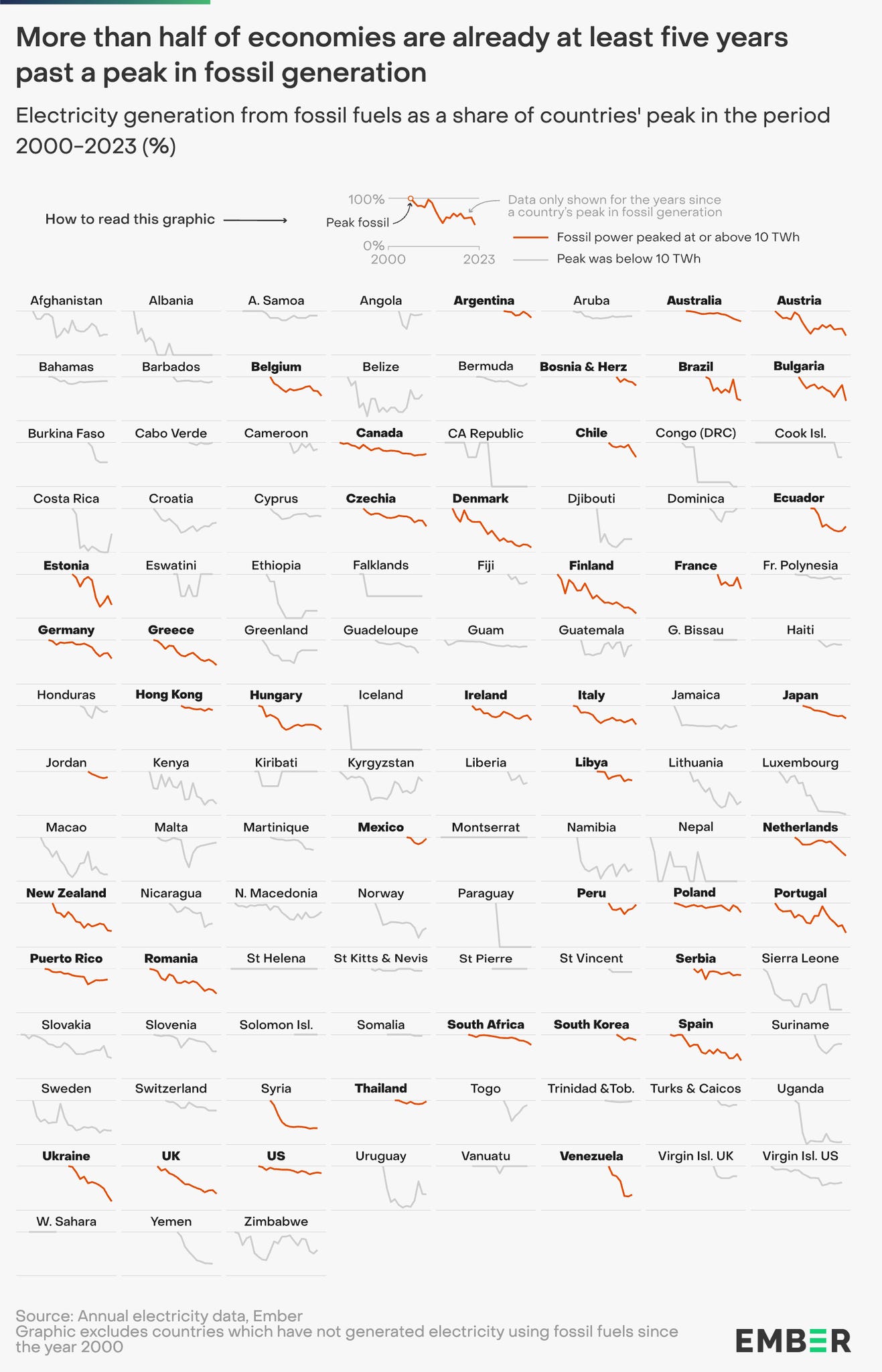
+Fascinating graph, courtesy of the data mavens at Ember, shows that 51 countries have now seen their fossil fuel emissions from power generation drop dramatically. It’s a sign that renewables aren’t just adding to the power sector, but beginning to substitute for fossil fuels
+Down to the wire in New York for a bunch of key climate bills, particularly the Climate Superfund Bill (which passed the Vermont legislature last week!). Rich Schrader of the NRDC details the desperate efforts of the fossil fuel industry to, well, lie about Empire State energy policy
+Important podcasts: one walks people through the ongoing conversion of parts of the Amazon ‘rainforest’ into dry savannah as the temperature warms. Jeremy Campbell:
Where there used to be forest, you’re not going to get any more of that transpiration cycle, and so the drying isn’t limited to the places where deforestation happens. Where things are dry, things get hotter. And then when you add like we had last year with the horrible situation throughout the Amazon of an El Nino-induced heat spike and drought, then you have villages that rely on fish, rely on the rivers to get around because the rivers are the highways of the Amazon, who are literally stranded. So the drying out of the Amazon is a tremendous biodiversity challenge, it’s also a tremendous economic challenge. But it’s also a human tragedy that is taking tremendous costs on the people of the Amazon as well.”
Meanwhile, in the midwest the story is almost the opposite: With more co2 in the atmosphere, trees are outcompeting grasses across the Great Plains, as Science Friday reports. This slowly spreading ‘green glacier’ is bad for biodiversity—but also for the climate because the dark green trees absorb more sunlight than the prairies and grasslands they replace.
+A Sierra Club report details the grim conditions for workers and communities around new LNG export terminals along the Gulf of Mexico
Jeff Kiefer has worked for the last year as a safety manager for a contractor helping to build fossil fuel company Venture Global’s huge LNG (liquefied natural gas) export facility in coastal Louisiana. For up to 60 hours a week, Kiefer supervises his team as they construct steel framing for the $21 billion Plaquemines Parish plant, which, when completed in 2026, will cover some 600 acres and be one of the biggest LNG producers in the country.
Kiefer, a 70-year-old longtime energy sector worker, describes the experience as “hell.”
“It’s terrible conditions,” he told Sierra in a conversation in mid-April. “Today was miserable,” because high winds were kicking up even more dust than usual. Kiefer said he had to shelter in his truck to avoid the dust getting into his eyes and mouth.
+Finally, a truly notable obituary this week, for California Republican Congressman Pete McCloskey. Although the Times concentrates on his opposition to the Vietnam War, I think history will remember him most for being the GOP face of the first Earth Day. I interviewed him once, and remember him telling the story of that mammoth effort; after 20 million Americans took to the streets, he reported getting back to his Capitol Hill office on Monday morning and finding a line of Republican Congressmen out in the hall. “They all said the same thing: ‘tell us about this ecology stuff.’” It’s sobering to remember that once upon a time we had Republican environmental leadership. RIP.
Kintsugi (Japanese: 金継ぎ, romanized: “golden joinery”), also known as kintsukuroi (金繕い, “golden repair”), is the Japanese art of repairing broken pottery by mending the areas of breakage with urushi lacquer dusted or mixed with powdered gold, silver, or platinum.(Wikipedia.org)
On a recent Sunday, the glittering coastline buffeting the Santa Monica Pier teemed with throngs of tourists. Visitors tried their hand at carnival games and rides on the waterfront, stopping to snap photos backdropped by the city’s arching blue-and-white sign. Others took in the sunshine while moseying around shops and dive bars around Ocean Avenue, which overlooks the vast azure expanse of the Pacific.
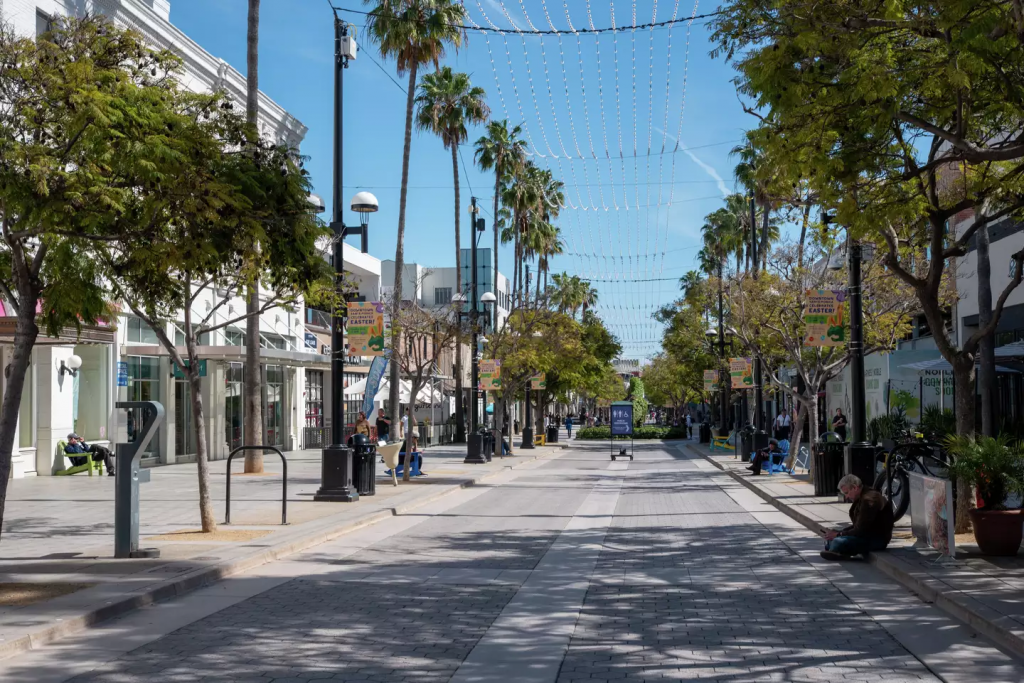
Yet that same liveliness evaporated a mere three blocks over at the city of Santa Monica’s Third Street Promenade. Although the shopping and dining enclave is a car-free, open-air mall not unlike other heavily visited sites including Universal CityWalk and the Grove, only a small handful of people venture over to the outdoor esplanade these days. An estimated 10 million people visit the pier yearly; only a tiny fraction of them appear to be interested in the promenade. The leisurely Adirondack chairs lining the sidewalks sit vacant, the once-plentiful street performers have mostly vanished, and it’s not unusual to spot back-to-back-to-back retail vacancies along each nearly empty block.
It’s all one giant missed opportunity for Santa Monica, the standalone Los Angeles County city with the multimillion-dollar coastline. For decades, the promenade was seen as a masterful reimagining of public space, a rare pedestrian-only area in a region with underperforming public transit and too many cars.
It wasn’t always this bleak. In the mid-2000s, when Sally Koslov first began operating her mobile tarot card and palm reading cart along the promenade, the street was “jumping,” as she describes it. “There were never any places for rent,” she says. “There were so many people, I couldn’t even push this cart to get through the sidewalk.” She’s still here working on the promenade, though sales aren’t nearly as good these days.
Stephanie McCaffrey, the co-founder and co-owner of the indoor pickleball facility Pickle Pop, which opened on the Third Street Promenade in 2023, used to play professional soccer before she became a small business owner. When she and her teammates traveled to Los Angeles, they’d spend a day out shopping and eating along the Third Street Promenade.
“It was absolutely buzzing and super busy,” she says of the area back in the mid- to late 2010s. “So to go back five or six years later and see what happened was really shocking.”
The promenade once helped brand Santa Monica as an internationally known place — and for a while it fulfilled that promise, acting as a critical economic lifeline into the area. As one of the United States’ early outdoor malls, with nods to many famous and historic European esplanades, the Third Street Promenade was designed as a natural landing spot for tourists. In years past, the promenade also featured a bevy of mom-and-pop businesses mixed in with national retailers, bringing in locals who could run errands without a car.
Ultimately, a confluence of factors — some intentional, others unavoidable — led to the recent decline of the Third Street Promenade. In some ways, the downfall isn’t that dissimilar to the decline of other areas like Melrose Avenue in central Los Angeles. The difference is that the promenade is a car-free area in Southern California that’s decently accessible via public transportation. It’s also blessed with incredible access to the nearby ocean. But these days, not even the salty air has been able to stave off stagnation.
What went so wrong?
‘Where traffic is taboo and the stroller is supreme’
In reality, this isn’t the first time the area has struggled. The Third Street Promenade emerged during the unshakeable rise of rampant American consumerism in the late 1950s. Back then, shopping centers were all the rage, which spelled trouble for traditional commercial stretches in city centers across the country, including downtown Santa Monica. To lure people back, the local Chamber of Commerce commissioned architect Victor Gruen to study the area and devise a plan that would cater to consumers’ evolving interests. The scope would be large, but no less robust than similar revitalization efforts of the day in other regions like Redondo Beach and Fresno.
In 1960, Gruen proposed (among other things) that the city remodel aging buildings, expand Palisades Park along Ocean Avenue, and build a pedestrian-only, outdoor shopping mall on Third Street. The area would fit in nicely with the rest of the city’s new look, and would even boast a much-needed department store, according to the Los Angeles Times. Notably, these plans included “the building of a physical connection between the beach and the new mall section,” as the paper reported at the time, the latter of which would flourish with “kiosks, trees, bushes, flowers, music, special lighting, benches, fountains, and ramadas.”
Designed by Charles Luckman and Associates (one of the architecture firms behind the space-age Theme Building at LAX, as well as the Disneyland Hotel and Madison Square Garden), the mall opened in 1965 to fanfare and a celebrity-studded celebration. In one newspaper ad from the time, the promenade — known then as the Santa Monica Mall — promised “fun and fashions” to visitors in a rarefied space “where traffic is taboo and the stroller is supreme.”
Phil Brock, a native of Santa Monica and the city’s current mayor, remembers when Third Street Promenade 1.0 became part of the coastal enclave’s fabric.
“They closed the street, made it into a mall, and for a while it worked,” he says. “It was amazing and different. And then it started to wane.”
In the 1980s, a new era of mallgoing had taken over American cultural life. In an effort to compete for relevance, the city tried to get visitors to the area by, quixotically, building an indoor mall named Santa Monica Place right at the southern end of the Third Street Promenade. Naturally, the buzziness of that new mall further drew people away from the promenade for a number of years, until another nearby West LA cultural mainstay, Westwood Village, started to see a decline in the mid-1980s. Coincidentally, the Third Street Promenade had undergone a new renovation around then, and the revamped outdoor mall “changed and became hot” again, Brock says.
But that success came at the expense of small local businesses, says Andrew Thomas, the CEO of the nonprofit Downtown Santa Monica, which aims to boost the city. “The promenade went through a period where there were many, many mom-and-pop [businesses],” Thomas says. “And then as it grew in popularity and became more and more desirable, the national [chains] came in and pushed out a lot of those mom-and-pops.”
The displacement of small businesses telegraphed a major problem that continues to vex the Third Street Promenade today: staggeringly high rental prices. “In a way, we’re a victim of our own success, because those national retailers were able to pay quite a bit more than the mom-and-pops, which drove up the rents and drove out the mom-and-pops,” Thomas adds, “And [that] left some of our local community feeling that the promenade … just wasn’t for them, because it didn’t have that same sort of local sense.”
Mayor Brock agrees. “In 2018/2019, we discovered that only 12% of Santa Monicans went to the promenade in an average year,” he says. “If you and I opened a restaurant together, we would need locals to come in every day. The tourists, the visitors, would be the gravy. But you can’t keep a restaurant booming if you don’t have the neighbors, and that’s what we lost.”
A new reality
The third (and current) decline of the Third Street Promenade began about a decade ago, coinciding with the retail apocalypse that swallowed up mainstay chain stores starting in the mid-2010s. The sales of stalwart national retailers on the promenade began sagging around 2018, Brock says, with names like Restoration Hardware and more recently REI departing the area in and around the outdoor mall.
Around then, he adds, the lease for the gargantuan Barnes & Noble space came up for renegotiation, and the owners of the building sought to double the rent. “Barnes & Noble was like, ‘We can’t sell that many books, and in that case we’re going to leave,’” Brock says. After the bookstore chain vacated its anchor multi-story space on the promenade, the building’s owners weren’t able to lease it right away. The darkened building felt like a crater on the once bustling block. Eventually, the landlords were able to reach a new lease agreement with WeWork … until the co-working startup imploded and they pulled out too.
Then a series of calamities befell the struggling area: COVID-19 hit, and every nonessential business shuttered out of necessity. During those early pandemic days, businesses saw revenue fall to nearly zero while also battling a rash of break-ins. “A lot of the mom-and-pop stores were broken into,” says tarot reader Koslov of that time. “It really dampened their financials.” Some of those businesses never reopened on the promenade, even after lockdown mandates eased.
The homelessness crisis touching every part of Los Angeles County has also impacted Third Street Promenade, especially in recent years. From 2022 to 2023, the number of people experiencing homelessness in the city of Santa Monica increased 15%.
“This is a root cause issue with Los Angeles as a broader county, with regards to I think homelessness and crime, unfortunately,” says Pickle Pop co-founder McCaffrey. These concerns aren’t localized to Santa Monica, or even LA: San Francisco’s Union Square has been struggling in recent years with similar issues and major retailers leaving the area.
These gnarled problems have been further exacerbated by rising global inflation over the past few years. Even the post-pandemic “revenge travel” trend couldn’t buoy the Third Street Promenade’s woes, though Taylor Swift’s six-night stint at SoFi Stadium last year did bring an uptick in hotel rental rates in Santa Monica, says Downtown Santa Monica CEO Thomas.
Ahead of major cultural events landing in LA County — notably the 2028 Olympics — the city is investing more heavily in hospitality offerings. The nearby Fairmont Miramar Hotel is getting a major revamp, and the city has for years explored more renovation options for the promenade specifically. In many ways, fixing the outdoor mall problem is a core issue for Santa Monica, the proudly independent city that has never, like so many other municipalities, been swallowed up by the much larger city of Los Angeles.
Santa Monica is home to celebrities, the quietly wealthy and many large corporations, such as Hulu, Snap (of Snapchat fame) and video game maker Activision. Its beaches welcome millions of annual tourists, and the city sits as a gateway to areas like Malibu and Venice Beach. It has always been a place apart from the rest of Los Angeles, the city by the sea with its own public transportation and walkable streets. But today, a big, uncomfortable question mark sits at its civic center.
Filling the Third Street Promenade’s empty commercial vacancies remains a work in progress. While some rental rates along the street have fallen slightly since the pandemic, a handful of landlords along the promenade “have refused to accept the new reality and have not lowered their rent enough to attract new tenants,” Brock says. “That impacts not only them, but it impacts the entire promenade.”
According to the most recent data shared by Downtown Santa Monica, 73 of 97 ground-floor commercial spaces on the promenade are currently occupied by longtime leaseholders and pop-up businesses alike, meaning the overall vacancy rate shakes out to about 25%. That emptiness is especially pronounced in the promenade’s 1200 block, where more than 38% of spaces sit vacant.
Part of the struggle is psychological. Businesses want to be around other thriving businesses, not a slew of vacancies, and customers want to be in a place that feels alive and vital, not empty and grim. But the promenade also faces a unique architectural issue that’s made it harder to find tenants, as opposed to other car-free zones like, say, the Grove. The commercial spaces along the Third Street Promenade are, for the most part, massive. While some commercial vacancies on the street currently listed on the retail leasing site LoopNet are in the ballpark of 2,000 square feet, others can balloon into tens of thousands of square feet.
Those limitations impact the types of businesses that can command such a space, and rental prices tend to be exponential when that much square footage is involved — and when it’s that close to prime oceanfront real estate. That significant overhead doesn’t exactly help potential upstarts get in the game, either. So for now, many of the promenade’s largest and most important retail spaces remain stubbornly empty, with devastating downstream consequences.
The future is … ‘eatertainment’?
Even with these less-than-ideal circumstances, some up-and-comers have been able to make the promenade work — and leaders are hoping their success can potentially provide a model for other businesses moving forward. When McCaffrey and Erin Robertson (her partner in business and in life) were looking for a place to open their pickleball pop-up, they found a sweet spot on the promenade that was formerly an Adidas store. The 10,000-square-foot venue could accommodate various pickleball courts, as well as a lounge area where champs and benchwarmers alike could take a break with cocktails and bites to eat.
Pickle Pop opened last year on a pop-up lease at a price far below market value, McCaffrey tells me. Their business has been so successful (mainly stemming from corporate buyouts and parties, though players can rent the courts on an hourly basis, too) that the owners have not only signed a lease to remain there for at least another year, but they’ve also outgrown their space.
“I don’t know how much more revenue we could do out of that size facility,” McCaffrey says, adding that Pickle Pop has exceeded expected revenue several times over. When we touch base over the phone, in fact, McCaffrey is on the road scouting other, bigger locations to hopefully open other Pickle Pop outposts both in and outside California.
When I ask McCaffrey why she thinks Pickle Pop has succeeded where others haven’t, she partially attests it to the popularity of “eatertainment,” or competitive socializing writ large. (Think Topgolf, pingpong and other venues combining restaurant concepts with low-stakes, sporty fun.)
“Just seeing pickleball as a use, it strikes me as probably the future,” says Thomas. He sees businesses like Pickle Pop as vital to the city’s larger plans, particularly the desire to get more people living in the city full-time. Thomas says that at the moment, the city has about 2,300 units of housing that are either under construction, approved or pending approval, with more in the application phase.
“So many more residents are living here downtown, [it’s] such a great captive audience,” he adds. “They’re going to want experiences and they’re going to want places to eat, and they’re not going to want to drive to get there.”
The city of Santa Monica hopes that the promenade’s fortunes will further shift given recent legislation that has loosened zoning laws in the area. By easing up on restrictions that limited the likes of arcade games, amplified music and dancing, as well as alcohol exemption permits, more businesses can open on the promenade. That’s why a tattoo parlor has emerged in recent years on the promenade, and Brock says a cannabis lounge or dispensary will probably open there eventually.
McCaffrey says that the alcohol exemption eligibility meant that even as a pop-up, Pickle Pop nabbed conditional use permitting for a liquor license right away. The lack of red tape proved to be critical in those early days of building their business.
Some of the street’s long-gone linchpins are returning, too. This summer, Barnes & Noble is slated to come back to the promenade, though it’s reopening at another location. Thomas says “there’s probably another half dozen businesses” opening their doors along the Third Street Promenade over the next few months. Former competitor (and current companion in Santa Monica’s economic uncertainty) the Santa Monica Place is hard at work on a new location of mega-popular chain Din Tai Fung, too, which would definitely bring more customers in from Ocean Avenue. Thomas says the city is optimistic that tourist numbers will have “fully recovered” by 2025 to pre-pandemic levels, with that data exceeding expectations the following year.
“I feel like we took a big chance on becoming a pedestrian mall a long time ago, and it’s really been great for us,” Thomas says. “And we’ve been copied many times. I think about the Grove, the Americana … and in those places, I’m not saying they aren’t fun, [but] I wouldn’t call them authentic like we are.
“Downtown Santa Monica, this is an experience when you come here. And it’s real.”
Paula Mejía is a Colombian American writer and editor from Houston, Texas. She is a contributing culture editor at SFGATE, and was formerly the arts editor at the Los Angeles Times and a Senior Editor at Texas Monthly. Her writing has appeared in the New Yorker, the New York Times, GQ, Rolling Stone and more. A co-founding editor of “Turning the Tables,” NPR Music’s Gracie Award–winning series about centering women and nonbinary artists in the musical canon, she is also the author of a 33⅓ series installment on the Jesus and Mary Chain’s 1985 album Psychocandy. She teaches graduate arts writing at USC’s Annenberg School for Communication and Journalism and lives in Los Angeles.
Consciousness, spirituality, biography, sexuality, androgyny, futurism, space, the arts, science, astrology, democracy, humor, books, movies and more