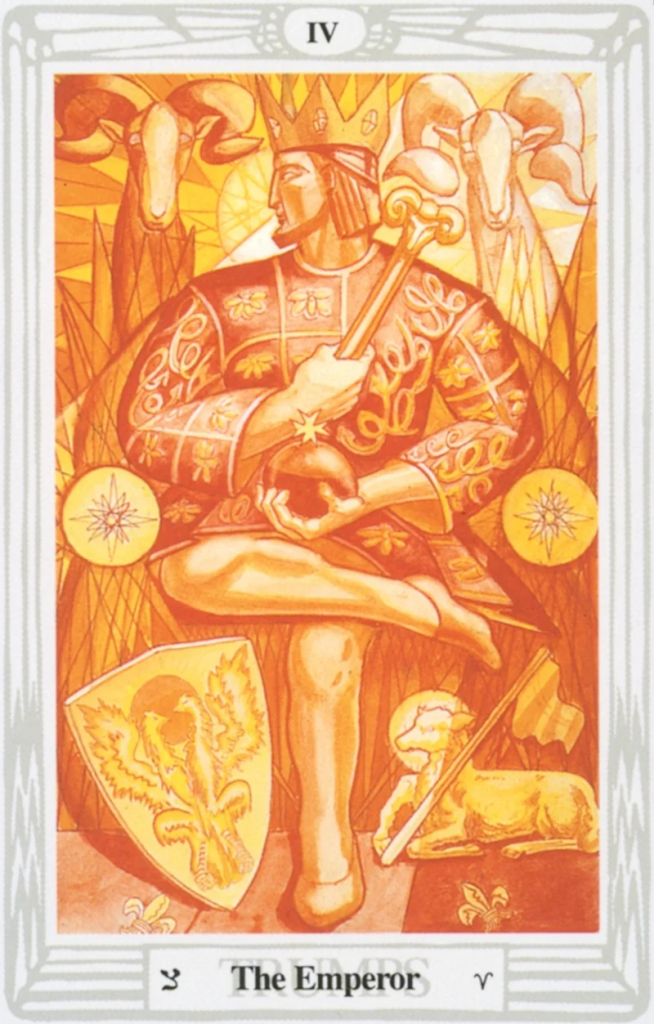
The Emperor is numbered four and is the Empress’s other half. Here is a man in the prime of life – successful, confident, secure and well-established. Where the Empress is allied with the Moon, the Emperor is aligned with the Sun.The Emperor is quick and energetic, exerting dynamic control over his life. He feels born to rule and at his best is a thoughtful and sensitive leader. He listens to others but always the final decision is his own.This is a man who has proved himself worthy. He has won most of his battles and now is the time to rule over a rich and bountiful land. He is the King Arthur type. He also represents fatherhood – fertile man, protector and providor.When we are the Emperor, we are taking hold of our power. We are prepared to protect and defend the vulnerable, as well as to shed the lazy and weak. Finally, we are willing and ready to pass on what we have discovered to others who are ready to learn.
Translation is a 5-step process of “straight thinking in the abstract” comparing and contrasting what you think is the truth with what you can syllogistically and axiomatically prove is the truth.
The claims in a Translation may seem outrageous, but they are always (or should always) be based on self-evident syllogistic reasoning. Here is one Translation from this week.
1) Truth is that which is so. That which is not truth is not so. Therefore Truth is all that is. Truth being all is therefore total, therefore whole, therefore complete, therefore otherless, therefore one, therefore united, therefore harmonious, therefore orderly. Truth being true is therefore right, therefore correct, therefore proper, therefore appropriate, I think therefore I am. Since I am and since Truth is all that is, therefore I, being, am Truth. Since I, being, am Truth, therefore I, being, have all the attributes of Truth. Therefore I, being, am total, whole, complete, otherless, one, united, harmonious, orderly, right, correct, proper, appropriate. Since I, being, am Truth and since I am mind/consciousness, therefore Truth is Mind/Consciousness.
2) Life proceeds from birth to infancy, to adolescence to maturity to senility to death.
Word-tracking: life: live, to exist, to be birth: begininfancy: without speech adolescence: not fully grown mature: ripe, timely appropriate time senility: old, forgetful, confused death: end, termination
3) Truth being all that is is therefore all that lives. Truth being all and there being no limits to all, therefore Truth is birthless and deathless. Truth being Living, therefore Living is birthless and deathless. Truth being all that is, is not something that grows or becomes ’cause that would imply that at one time it wasn’t there or may not be there later, therefore Truth is not an appearance which comes and goes. Truth/Living is the reality which underlies appearance. So Truth does not have a birth, does not have an infancy does not have an adolescence, or a full maturity which leads to senility and death. Therefore the full maturity of Truth is an ever-present Living, ripe to the touch, inexhaustible and real.
4) Truth is all that lives. Truth is birthelss and deathless. Living is birthless and deathless. Truth is not an appearance which comes and goes. Truth/Living is the reality which underlies appearance. The full maturity of Truth is an ever-present Living, ripe to the touch, inexhaustible and real. 5) Truth is ever-present Living, ripe to the touch, inexhaustible, real and eternal.
In 1943, the U.S. government announced that Liberty ships would begin to be named after distinguished journalists who had died in action. The first Liberty ship to be named for a war correspondent was the SS Webb Miller. The ship carried American soldiers onto the beaches at Normandy.[14]
Scholars now consider Miller’s account of Bluebeard’s death a classic of spot journalism. The report is often required reading for aspiring journalists.[15]
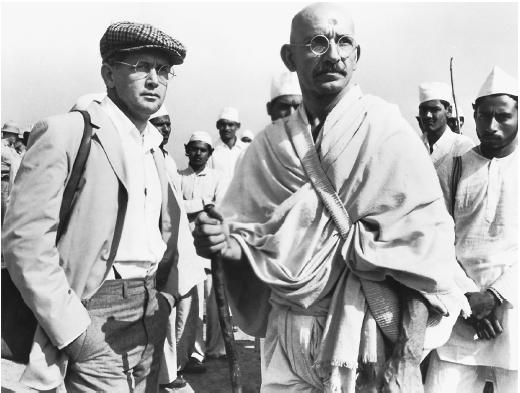
Webb Miller was also the inspiration for the character of Vince Walker in the movie Gandhi, portrayed by Martin Sheen.[1]
“These primates’ fierce battles were instigated by coalitions of adult males, with the sole aim of extending their territory. The areas where the fighting took place corresponded to the land conquered by force.”
Warring chimps (not pictured) were observed by Jane Goodall in Tanzania in 1974. (Image credit: USO via Getty Images)
War and violence can often seem like uniquely human acts that have been present for most of our recent history. But do other animals wage “war”? In this excerpt from “The Beast Within: Human as Animals” (2024, Johns Hopkins University Press), scientific researcher Jessica Serra looks at the dark side of chimpanzees’ (Pan troglodytes) behavior to show that our closest living relatives also have a taste for warfare.
Among nonhuman mammals, hostility between rival groups is quite widespread, but it rarely leads to death. The frequent fighting between males is most often limited to intimidation behavior. While certainly frightful, it is rarely fatal. There is one exception, however: our closest cousins, the chimpanzees! Ethological studies have shown animals to be capable of forming complex political alliances. English primatologist Jane Goodall made a major discovery on this subject when she revealed an unsuspected dark side in chimpanzees.
In 1974, when Goodall was studying the behavior of chimpanzee colonies in Gombe, Tanzania, she observed a social divide between two groups in one of the communities. The first group, called the Kasakela community because they occupied the north part of the park bearing this name, was composed of eight adult males and twelve adult females, as well as their young. The second group, called the Kahama community, consisted of six adult males, an adolescent male and three adult females.
The hostilities began in an extremely violent way when a male from the Kasakela group killed Godi, a male from the Kahama group. The rage of the Kasakelas continued to plague the Kahamas for the next four years, during which time six more males were killed. As for the Kahama females, two disappeared and three were beaten by a gang of violent males.
Chimpanzees show murder and cruelty are not just human traits. (Image credit: Yannick Tylle via Getty Images)
The end of this “four-year war” resulted in the Kasakela community taking over the Kahama’s territory. It was a short-lived victory, however, since another community of chimpanzees living nearby managed to scare the Kasakelas away.
Goodall recounted her poignant memories of this war in her memoir “Through a Window: My Thirty Years with the Chimpanzees of Gombe.” She recalls, “For several years I struggled to come to terms with this new knowledge. Often when I woke in the night, horrific pictures sprang unbidden to my mind — Satan [one of the apes], cupping his hand below Sniff’s chin to drink the blood that welled from a great wound on his face; old Rodolf, usually so benign, standing upright to hurl a four-pound [1.8 kilograms] rock at Godi’s prostrate body; Jomeo tearing a strip of skin from Dé’s thigh; Figan, charging and hitting, again and again, the stricken, quivering body of Goliath, one of his childhood heroes.”
Get the world’s most fascinating discoveries delivered straight to your inbox.Contact me with news and offers from other Future brandsReceive email from us on behalf of our trusted partners or sponsorsBy submitting your information you agree to the Terms & Conditions and Privacy Policy and are aged 16 or over.
Jane Goodall is not the only one to be haunted by the bloody images of murders between groups of chimpanzees. American researchers reported similar scenes of violence among chimpanzees in Kibale National Park in Uganda. These primates’ fierce battles were instigated by coalitions of adult males, with the sole aim of extending their territory. The areas where the fighting took place corresponded to the land conquered by force.
Some researchers are now using the “chimpanzee model” to explain the emergence of war in humans. (Image credit: USO via Getty Images)
Are these primates really at “war”? If we define war as being lethal violence organized against members of another group, then the answer is clear. Like humans, chimpanzees have the capacity to wage war. Before the fighting began in Kibale National Park, the males carried out systematic patrols. The location of the corpses confirms the importance of the territory as a motivation to fight: these chimpanzees had breathed their last breath in this coveted neighboring area. These wars were fraught with the terror of infanticide between rival gangs, atrocities also committed by humans.
Three such attacks were reported by anthropologists from Ohio University and the University of Michigan in the International Journal of Primatology. The researchers recounted how on different occasions, while on patrol, the adolescent and adult males of the Ngogo chimpanzee community attacked the children of a rival gang, killed them, and cannibalized one of them.
Although there are cultural disparities between our ways of waging war and those of chimpanzees, certain similarities are striking. Both humans and chimpanzees ensure that assassinations can be committed by several individuals without major risk to the assailants, and both have motivations for these killings (gaining territory, hierarchical position, access to resources, etc.). In fact, some researchers are now using the “chimpanzee model” to explain the emergence of war in humans.
But aggression in chimpanzees does not only manifest itself when faced with a rival community. American anthropology professor Jill Pruetz and her team at Iowa State University recounted the in Senegal. While the researchers did not witness the massacre as it took place, which was in the darkness of night, they did hear the blood curdling cries. In the morning, they discovered with horror the corpse of Foudouko, a 17-year-old former alpha male, who had been stripped of his status in 2007 by a gang of young chimpanzees.
Condemned to exile and isolation, the pariah regularly attempted to rejoin the group, imposing himself as dominant, which the new alpha males did not like. The research team speculated that if his entrance had been more submissive, the outcome would probably not have been fatal. These lethal attacks recorded in chimpanzees, rare but incredibly cruel, were not linked to a human presence near their communities (as some scientists had presumed) but to a hierarchical tension within the group and probably to intense competition for access to females.
But what disturbed scientists the most was how the gang treated Foudouko’s body the day after his death. Most likely to make sure they had nothing left to fear, the murderous gang dragged the body across the ground, sniffed it repeatedly, ripped out its genitals, bit it all over, and tore its flesh and… ate it!
Murder and cruelty are therefore not unique to H. sapiens. And the animal world has not finished surprising us either.
Excerpted from The Beast Within: Human as Animals, by Jessica Serra. Copyright 2024. Published with permission of Johns Hopkins University Press.
Are humans the only creatures who love, laugh, cry, possess morals, and wage war? In The Beast Within, scientific researcher and ethologist Jessica Serra upends the assumptions that underpin our very human hypothesis that we possess a superior place in the hierarchy of organisms on Earth. How did we come to think of our animality as standing in opposition to our humanity―and does this reasoning have a scientific basis?
Jessica Serra is a scientific researcher, writer, editor, and consultant. She is the author of The Secret Life of Cats, which became the basis for popular French television show, La Vie Secrète des Chats on BBC Worldwide.
The decline of the media is sapping journalism of a crucial tool.
A general view of the Kansas City bureau of the Associated Press. In the foreground is the East desk. Next is the Coast desk, then the State desks and in the background the Local desk, on April 22, 1940. | AP Corporate Archives
Jack Shafer is Politico’s senior media writer. He has written commentary about the media industry and politics for decades and was previously a columnist for Reuters and Slate.
Wounded and limping, doubting its own future, American journalism seems to be losing a quality that carried it through a century and a half of trials: its swagger.
Swagger is the conformity-killing practice of journalism, often done in defiance of authority and custom, to tell a true story in its completeness, no matter whom it might offend. It causes some people to subscribe and others to cancel their subscriptions, and gives journalists the necessary courage and direction to do their best work. Swagger was once journalism’s calling card, but in recent decades it’s been sidelined. In some venues, reporters now do their work with all the passion of an accountant, and it shows in their guarded, couched and equivocating copy. Instead of relishing controversy, today’s newsrooms shy away from publishing true stories that someone might claim cause “harm” — that modern term that covers all emotional distress — or even worse, which could offend powerful interests.
Every aging generation of journalists must have complained, at one point or another, about swagger’s demise. But this time, the fall is demonstrable. A recent piece by Max Tani in Semafor attributed the new timidity to legal threats from subjects of news stories. “In 2024, it’s harder than ever to get a tough story out in the United States of America,” Tani writes, citing the risk of lawsuits and increased insurance premiums. The new equation “has given public figures growing leverage over the journalists who now increasingly carry their water.” Tani cited several examples of publications backing down, including Esquire and the Hollywood Reporter backing off from a critical story about podcaster Jay Shetty, the surrender by Reuters and other outlets to India’s legal demands about an exposé, and the unpublishing of a biting Formula 1 story in Hearst’s Road & Track.
Katharine Graham (left), publisher of the Washington Post, and Ben Bradlee, executive editor of the Washington Post, leave U.S. District Court in Washington on June 21, 1971, after getting the go-ahead to print the Pentagon Papers on Vietnam. | AP
Perhaps the clearest marker of swagger going AWOL is the fact that nobody has risen to replace the late Christopher Hitchens on the lecture circuit, on cable news, in books and in the pages of our best publications. If he were resurrected today, who would hire him? And if they did, how long would it take for the staff to petition the bosses to fire him?
The loss of journalistic swagger can be measured partly in numbers. A generation ago, the profession summoned cultural power from employing almost a half-million people in the newspaper business alone. Now, more than two-thirds of newspaper journalist jobs have vanished since 2005, and it is widely accepted that the trend will continue in the coming decades as additional newspapers and magazines falter and slip into the publications graveyard.
But the loss is about more than just head count. The psychological approach journalists bring to their jobs has shifted. At one time, big city newspaper editors typified by the Washington Post’s Ben Bradlee strode their properties like colossuses, barking orders and winning deference from all corners. Today’s newspaper editor comes clothed in the drab and accommodating aura of a bureaucrat, often indistinguishable from the publishers for whom they work. These top editors, who once ruled their staffs with tyrannical confidence, now flinch and cringe at the prospect of newsroom uprisings like the ones we’ve seen at NBC News, the New York Times, CNN and elsewhere. You could call these uprisings markers of swagger, but you’d be wrong. True swagger is found in works of journalism, not protests over hirings or the publication of a controversial piece.
Treading softly so as not to rile anybody, these editors impose that style on their journalists, many of whom do their work in a defensive crouch instead of the traditional offensive stance. Often throttled by their top editors, today’s journalists also find themselves fighting a second front against politicians who now direct their campaigns at reporters as much as they do their opponents. The public appears to hate them too, according to polls that claim they’re not trustworthy. Inside the newsroom, they face standards editors who have steadily expanded their stylebook of banned words in a crusade to reduce to zero the chances that readers might take umbrage at news copy.
Thanks to technological trends, cultural shifts, business and advertising changes, and legal rumblings, journalism and journalists have lost the centrality in America that was theirs for almost a century and a half. The press has become no weakling. Obviously, good work is still done but with blunted rather than sharpened teeth compared with previous decades. Nor will the craft vaporize upon some near future event horizon. But like its other sister institutions of influence — Hollywood, religion, the novel, the courts, public schools, et al. — it no longer strides with its former confidence. Ask any journalist about their depleted esprit de corps and you will hear a litany of lamentations.
Swagger, which made journalism a delight to practice and a joy to read, came in many forms, from the sting of Mary McGrory’s dispatches from Capitol Hill to the antics of editor Jim Bellows at the Washington Star to the brash pieces filed by Michael Kelly from D.C. to Iraq and Nora Ephron’s biting commentaries on contemporary life. And it still speaks its name if you know where to look for it, such as the feature stories of Olivia Nuzzi and Kerry Howley at New York magazine and the work of CNN’s Clarissa Ward from war zones. Former Washington Post reporter Wesley Lowery practically embodies swagger.
The loss of swagger has left readers struggling to decipher pieces that appear to have been reported through a veil, or worse still, sound as if they were manufactured by the public affairs department of a cabinet-level agency.
What routed swagger, and can we get it back?
The Business Erodes
Former Washington Post Style editor Ned Martel recalls that when Kevin Merida became the paper’s national editor in 2008, he placed a handwritten sign by his office spelling out the word “Swagger.”
Merida, who recently resigned as the executive editor of the Los Angeles Times, confirms the story: “If somebody reliable said I did, I probably did.”
“It’s harder to be confident, and exude that confidence in newsrooms — given the state of our industry. But leaders should find their inner swagger,” Merida says. “I don’t like to generalize, as every newsroom is different. But cautiousness, lack of ambition, being too quick to abandon experiments or being afraid to try them, all are signifiers. To quote the immortal, A Tribe Called Quest: ‘Scared money don’t make none.’”
New York Daily News columnist Jimmy Breslin (center top) puffs on a cigar during a newsroom celebration of the Pulitzer Prize in New York on April 17, 1986. Pete Hamill (bottom left), the New York Post editor in chief, returns after being informally fired on March 16, 1993. | Mario Cabrera/AP, top; Betsy Herzog/AP
Steve Chapman, who has worked as a Chicago Tribune columnist and editorial writer for four decades, attributes the decline of swagger, in part, to the general winding down of the business.
“Talented, temperamental egomaniacs didn’t have to worry about pissing off their bosses because they could walk across the street to a competing paper. Chicago had four dailies in the ’70s,” he says.
Instead of editors and reporters settling their differences in pitched battles, today’s journalists sit down for mannered Zoom sessions. “Forty or 50 years ago, one ill-considered column wouldn’t be a disaster,” Chapman says. “Today, it can be. Ask James Bennet.” Bennet, you recall, was unfairly run out of the New York Times for publishing the words of a U.S. senator. Being forced to write and edit, forever looking over your shoulder, “encourages conformity and caution, the antithesis of swagger,” Chapman warns.
Another significant well-spring of talent and model of swagger, the alternative weekly, has been all but vanquished. The late David Carr edited Twin Cities Reader and Washington City Paper before making his national mark at the New York Times. Alt-weekly writers such as Ta-Nehisi Coates, Katherine Boo, Liza Mundy, Jonathan Gold, Matt Taibbi, Susan Orlean, Jim DeFede and too many others to mention never treaded softly as they moved into the greater mainstream. The near-evaporation of the alt-weekly is a national tragedy. Where every one of the top 100 markets once hosted a successful alt-weekly that served as a swagger example and a talent pool for the dailies, you now have a struggling handful of them.
In the pre-Internet, pre-cable time, journalistic outlets like Time, Newsweek, Look and the Saturday Evening Post dominated the mass media. The Washington Post spoke to everybody from the president to the post office clerk and could boast that 65 percent of metropolitan area households subscribed. Everyone listened. Now, the press’ status as a pacesetter and respected authority has evaporated, and journalists know it.
As readers look away, it’s led to the primary cause of journalism’s decline: lack of advertising. It’s a mistake to talk about the “journalism business” when the primary function of newspapers and magazines was, for so long, to convey the message of mass advertising. As advertisers learned Internet advertising was much more effective and often cheaper than print, they defected to places like Google and Facebook that didn’t need news to attract those eyes. Where advertising once accounted for 80 percent of revenue at most newspapers in their heyday, circulation revenue and ad revenue are equal across the industry. At places like the New York Times, 60-plus percent of revenue comes from readers. Declining circulation logically followed declining advertising at newspapers, with a third of all of them folding since 2005. A generation ago, healthy revenues gave publications the resources to fight legal battles. That’s less true today.
Cultural Cachet Wanes
Newspaper culture lost its conviction as it became aware of its own dimunition. Yesterday’s journalists thought the world revolved around what their newspaper wrote. Today’s journalists resign themselves to the fact that their copy simply doesn’t matter as much.
“We no longer have a culturally cohesive country,” says Glenn Frankel, who knows journalism from the inside, having worked for decades at the Washington Post, and from the ivory tower after a stint as the director of the School of Journalism at the University of Texas at Austin.
Members of the press cover former President Donald Trump’s address to supporters at the Mar-A-Lago Club in Palm Beach, Florida, on April 4, 2023. | Francis Chung/POLITICO
This loss of audience to social media, sports and entertainment has diminished journalists’ sway, as Matthew Powers and Sandra Vera-Zambrano write in their recent book, The Journalist’s Predicament: Difficult Choices in a Declining Profession. Journalists don’t need to consult the latest round of layoffs at their outlets to understand they’ve lost prestige in the culture, or to see that acquaintances with similar educations out-earn them.
“Journalism’s imperiled economic basis reduces the total number of jobs available and creates less-than-ideal work conditions,” Powers and Vera-Zambrano write. It’s not uncommon for a barrage of layoffs to be followed by demands by bosses that reporters and editors do more with less. Meanwhile, new information ecosystems “have loosened journalism’s monopoly on the production and distribution of legitimate information and erode[d] the sense of importance that stemmed from that exclusivity.”
Nobody ever became a journalist in order to become popular. The broad-stroke portrayals in movies and novels taught us, accurately enough, that journalists tend toward the coarse, vulgar, impudent and nosy. For many years, journalists were generally admired for those attributes in the way that the beef butcher is admired for the scars on his hands.
Hulk Hogan, whose given name is Terry Bollea (center) looks on in court moments after a jury returned its decision in St. Petersburg, Florida, on March 21, 2016. | Pool photo by Dirk Shadd
But thanks, in part, to a fall in status, as well as ever-irrational attacks from politicians like Donald Trump, today’s journalists routinely experience ridicule and harassment at public events like rallies and demonstrations. They’re not precisely pariahs in the new environment, but they’re no longer considered heroes in many places. Journalists don’t deserve any special pity, it should be noted. Police officers, teachers and even doctors often suffer more from the slings and arrows of the mob. But for journalists, the fall has been spectacular and seems never-ending.
Hanging over journalism like a gibbous moon is Terry “Hulk Hogan” Bollea’s successful lawsuit against Gawker, financed by the billionaire Peter Thiel, which Tani notes in his Semafor piece. Thiel’s successful action, which forced the site to shutter in 2016, has journalists everywhere looking over their shoulders in worry. In the new climate, law firms have built practices devoted to blocking the publication of tough-minded stories with formal legal warnings.
Perfectly fine publications do exist, and they deserve our support. For instance, there’s the Atlantic, which couldn’t win more National Magazine Awards if the contest were fixed. With stalwart writers like Caitlin Flanagan and Mark Leibovich, the magazine shows it can go full bravado when it wants to. But what’s its excuse for not breaking more icons? Too often, our media seems like it was produced to be consumed by our parents, most of whom are dead.
Reason magazine’s Nick Gillespie blames the decline of swagger, in part, to generational forces.
“Millennials and Gen Z have been bred like human veal by their Boomer and Gen X parents who made sure their kids were constantly being surveilled and optimized for success in SATs, sports and entry into the Establishment pipeline,” he says. “Can we be surprised that such a system has produced generations of journalists who endlessly describe anything they disagree with as misinformation and want to control and regulate everything like the room temperature in an after-school enrichment program?”
This attitude has permeated the press, as editors recoil from publishing anything that might cause anyone offense.
The Pipeline Runs Dry
For the next generation, the future is dismal. And the youth know it. With an eye on the shrinking industry, fewer and fewer students now collect bachelor’s degrees in journalism, according to numbers collected by MIT Media Lab’s DataUSA site. Sensing the trend, schools like the University of New Hampshire, Ohio Wesleyan, Arkansas State University and others have ended their journalism programs in the last academic year or cut way back.
Journalists, like those in other professions, sharpen their teeth on the chew toy of experience. Reporters still begin their careers as student journalists or freelancing or interning at a publication between semesters in school before landing at their first publication.
In the process, they learn when to duck and when to throw the punch. They confer with libel attorneys and figure out how to publish true stories without getting sued. They climb the ladder at small and regional publications, and some of them reach the big leagues of the major outlets, accumulating the swagger you need to challenge presidents, CEOs, billionaires and other notables.
College student journalists raise their hands to question President Barack Obama during a “daily briefing” at the White House on April 28, 2016. | Alex Wong/Getty Images
“I remember one editor looking at me when I broke my first story on the Wedtech scandal and sneering, ‘You’re wading in tall grass on this one.’ Didn’t faze me. I would just press ahead,” says investigative ace Marilyn Thompson, who is now at ProPublica.
“Some people saw this as ‘swagger’ and regarded me as an asshole with a sweet Southern accent, who dared come to New York or Washington to look under moldy rocks,” she says. “I think swagger survives, though it is harder to execute with layers of editing and lawyering and endless rewriting. I worked with the Clarence Thomas team last year, and those young guys have the right stuff.”
But with the feeder institutions that produce journalists — J-schools and small publications — atrophying, there’s a real risk that newsroom culture shifts to a more tempered mindset, taking swagger with it. Granted, launching pads for young journalists still exist, such as Robert Allbritton’s NOTUS, POLITICO’s Fellows program and the New York Times’ Newsroom Fellowship Program, among others, but these aren’t enough. They offer scores of opening slots compared to the thousands of entry-level jobs that once existed across the country where young journalists could study walking and eventually advance to swaggering.
As journalism opportunities continue to decline, will the sharpest, most contentious minds that make the best journalists still be attracted to the business? Absent the status rewards its workers collected, who will want the job that was so appealing to earlier generations? “As I look back over a misspent life I find myself more and more convinced that I had more fun doing news reporting than in any other enterprise,” journalist H.L. Mencken wrote in 1946. “It is really the life of kings.”
Regaining Some Swagger
What then should we do? Enroll journalism students and novice journalists in academies of self-esteem? Obviously not. Find a stash of Ben Bradlee’s hair and clone a hundred of him? Please, no. Spike the office coffee with stimulants? Nobody wants a return to the locker room ethos of earlier newsrooms where a mist of testosterone hung in the air, where every other desk had an opened bottle of scotch on it, and where women and Black people, Latinos and Asian Americans were excluded from the enterprise. Surely there is a path back from the milquetoastery of contemporary journalism to something approximating swagger.
Like all 12-step programs, the first step is to understand that something is going wrong, something this piece has attempted to do. Can more be done?
Matt Labash, who earned his name as a swashbuckler at the Weekly Standard and now does business at the “Slack Tide” Substack newsletter, is one of many who cite the newsletter boom as a temporary fix, if not a solution. Leading Substackers Matt Taibbi, Bari Weiss and Nellie Bowles, and Matt Yglesias have profitably fled their mainstream jobs at Rolling Stone, the New York Times and Vox for Substack where they can get their swag on as much as they want to without having to deal with layers of management. They’ve also freed themselves from the sniping groupthink prevalent at so many newsrooms that identifies swagger as a crime of expression and seeks to extinguish it.
In the case of Weiss and Bowles’ Free Press, they’ve evolved from a modest blog to a 25-person newsroom in three years and added events and podcasts to the editorial mix. Most recently, they published NPR editor Uri Berliner’s swaggering inside critique of his employer and colleagues, which ripped the broadcaster for prioritizing process over substance.
Labash, who has attended church with Marion Barry and gone flyfishing with Dick Cheney, calls Substack a place where writers can be themselves without apology, and bring an audience along with their personality quirks.
“Humans respond most strongly to specificity,” Labash says. “To things they can relate to as fellow human beings. But if you make your writers sound like some bland AI generator, and AI can do their job, eventually, AI will. Which might very well be what a lot of publishers want, anyway.”
A pressman pulls a copy of one of the final editions of the Rocky Mountain News off the press in the Washington Street Printing Plant of the Denver Newspaper Agency in Denver on Feb. 26, 2009. | David Zalubowski/AP
While not the immediate remedy to swagger’s decline, Substacks point to an entrepreneurial future where readers respond to spirited media. Elsewhere on the media horizon, we catch the sniff of swagger at outlets like Punchbowl News, the Ankler, Tablet, the Ringer, County Highway and 404 Media, to name a few, where challenging readers instead of coddling them comes first. If Substack has proved there’s an ample supply of readers willing to be challenged by bracing copy, perhaps editors will be willing to unleash the storehouses of repressed swagger in their newsrooms to feed the need. On the other hand, it could be that the fall of citadels of swagger like Buzzfeed News, the relaunched Gawker and Vice portend doom for swagger’s future.
Sometimes the emergence of a single new publication can alter the journalistic current. Spy magazine, founded in 1986 by Kurt Andersen and Graydon Carter, struck the journalism world like the Chicxulub asteroid. Spy brought equal measures of swagger, moxie, attitude, gumption and pinpoint reporting to magazine and newspaper journalism. Louis Rossetto’s Wired magazine, launched in 1993, did some of the same. Perhaps swagger’s resurrection will come in the form of a new publication or website that tosses off the zip-ties for freer expression.
Chapman, for one, doubts that the industry’s swagger will return any time soon.
“Journalism is so fragmented, and readers, viewers and profits so much harder to come by, that journalists have to be more careful with their audiences,” he says. “In some ways, journalism is better than it used to be, with higher standards of writing, ethics, accountability and analysis. Journalists are generally more respectful of and sensitive to groups that once got ignored or disparaged. I don’t want to go back to the old days. But we have lost some qualities that made journalism entertaining.”
If journalism is to regain the kingdom, it will need to call on top editors to lead the restoration with brass and daring. The same goes for the owners who shriek at the possibility of lawsuits. As former Vanity Fair and New Yorker editor Tina Brown put it to Tani, “Very few owners have balls anymore.” That’s true, but journalistic history show us they can be grown.
Like fighter pilots, journalists must be well-trained and confident but without being cowboys. Meekness produces journalism as gray as dishwater and no more tasty. If journalism is ever to regain its former — and rightful — status, it must first regain its swagger.
******
No, Fox News does not swagger. Send rhymes to Shafer.Politico@gmail.com. No new email alert subscriptions are being honored at this time. My Twitter and Threads accounts are wishy-washy. My very dead RSS flunked out of anger management school.
“Day by day I am approaching the goal which I apprehend but cannot describe,” Ludwig van Beethoven (December 16, 1770–March 26, 1827) wrote to his boyhood friend, rallying his own resilience as he began losing his hearing. A year later, shortly after completing his Second Symphony, he sent his brothers a stunning letter about the joy of suffering overcome, in which he resolved:
Ah! how could I possibly quit the world before bringing forth all that I felt it was my vocation to produce?
That year, he began — though he did not yet know it, as we never do — the long gestation of what would become not only his greatest creative and spiritual triumph, not only a turning point in the history of music that revolutionized the symphony and planted the seed of the pop song, but an eternal masterwork of the supreme human art: making meaning out of chaos, beauty out of sorrow.
Across the epochs, “Ode to Joy” rises vast and eternal, transcending all of spacetime and at the same time compacting it into something so intimate, so immediate, that nothing seems to exist outside this singularity of all-pervading possibility. Inside its total drama, a total tranquility; inside its revolt, an oasis of refuge. The story of its making is as vitalizing as the masterpiece itself — or, rather, its story is the very reason for its vitality.
Beethoven by Josef Willibrord Mähler circa 1804-1805. (Available as a print.)
As a teenager, while auditing Kant’s lectures at the University of Bonn, Beethoven had fallen under the spell of transcendental idealism and the ideas of the Enlightenment — ideas permeating the poetry of Friedrich Schiller. A volume of it became the young Beethoven’s most cherished book and so began the dream of setting it to music. (There is singular magic in a timeless poem set to music.)
One particular poem especially entranced him: Written when Beethoven was fifteen and the electric spirit of revolution saturated Europe’s atmosphere, Schiller’s “Ode to Joy” was at heart an ode to freedom — a blazing manifesto for the Enlightenment ethos that if freedom, justice, and human happiness are placed at the center of life and made its primary devotion, politically and personally, then peace and kindness would envelop humankind as an inevitable consequence. A “kiss for the whole world,” Schiller had written, and the teenage Beethoven longed to be lips of the possible.
This Elysian dream ended not even a decade later as the Reign of Terror dropped the blade of the guillotine upon Marie Antoinette, then upon ten thousand other heads and the dreams they carried. Schiller died considering his “Ode to Joy” a failure — an idealist’s fantasy unmoored from reality, a work of art that might have been of service perhaps for him, perhaps for a handful of others, “but not for the world.”
The young Beethoven was among those few it touched, and this was enough, more than enough — he took Schiller’s bright beam of possibility and magnified it through the lens of his own genius to illuminate all of humanity for all of time. Epochs later, in the savage century of the World Wars and the Holocaust, Rebecca West — another uncommon visionary, who understood that “art is not a plaything, but a necessity” — would contemplate how those rare few help the rest of humanity endure, observing that “if during the next million generations there is but one human being born in every generation who will not cease to inquire into the nature of his fate, even while it strips and bludgeons him, some day we shall read the riddle of our universe.”
While Schiller’s poem was ripening in Beethoven’s imagination, the decade-long Napoleonic Wars stripped and bludgeoned Europe. When Napoleon’s armies invaded and occupied Vienna — where Beethoven had moved at twenty-one to study with his great musical hero, Haydn — most of the wealthy fled to the country. He took refuge with his brother, sister-in-law, and young nephew in the city. Thirty-nine and almost entirely deaf, Beethoven found himself “suffering misery in a most concentrated form” — misery that “affected both body and soul” so profoundly that he produced “very little coherent work.” From inside the vortex of uncertainty and suffering, he wrote:
The existence I had built up only a short time ago rests on shaky foundations. What a destructive, disorderly life I see and hear around me: nothing but drums, cannons, and human misery in every form.
That spring, Haydn’s death only deepened his despair at life. The next six years were an unremitting heartache. His love went unreturned. He grew estranged from one of his brothers, who married a woman Beethoven disliked. His other brother died. He entered an endless legal combat over guardianship of his young nephew. He spent a year bedridden with a mysterious illness he called “an inflammatory fever,” riddled with skull-splitting headaches. His hearing almost completely deteriorated. He grew repulsed by the trendy mysticism of new musical developments, which made no room for the raw human emotion that was to him both the truest material and truest product of art.
One of William Blake’s paintings for The Book of Job, 1806. (Available as a print.)
Somehow, he kept composing, the act itself becoming the fulcrum by which Beethoven lifted himself out of the black hole to perch on the event horizon of a new period of great creative fertility. While Blake — his twin in the tragic genius of outsiderdom — was painting the music of the heavens, Beethoven was grounding a possible heaven onto a disillusioned earth with music.
And then he ended up in jail.
One autumn day in 1822, the fifty-two-year-old composer put on his moth-eaten coat and set out for what he intended as a short morning walk in the city, his mind a tempest of ideas. Walking had always been his primary laboratory for creative problem-solving, so the morning stroll unspooled into a long half-conscious walk along the Danube. In a classic manifestation of the self-forgetting that marks the intense creative state now known as “flow,” Beethoven lost track of time, of distance, of the demands of his own body.
Beethoven by Julius Schmid
He walked and walked, hatless and absorbed, not realizing how famished and fatigued he was growing, until the afternoon found him wandering disheveled and disoriented in a river basin far into the countryside. There, he was arrested by local police for “behaving in a suspicious manner,” taken to jail as “a tramp” with no identity papers, and mocked for claiming that he was the great Beethoven — by then a national icon, with a corpus of celebrated concertos and sonatas to his name, and eight whole symphonies.
The tramp raged and raged, until eventually, close to midnight, the police dispatched a nervous officer to wake up a local musical director, who Beethoven demanded could identify him. Instant recognition. Righteous rage. Apologies. Immediate release. More rage. More apologies. Beethoven spent the night at his liberator’s house. In the morning, the town’s apologetic mayor collected him and drove him back to Vienna in the mayoral carriage.
What had so distracted Beethoven from space and time and self was that, twenty-seven years after falling under the spell of Schiller’s poem, he was at last ferocious with ideas for bringing it to life in music. He had been thinking about it incessantly for months. “Ode to Joy” would become the crowning achievement of his crowning achievement — the choral finale of his ninth and final symphony. It would distill the transcendent torment of his creative life: how to integrate rage and redemption, the solace of poetry with the drama of music; how to channel his own poetic fury as a force of beauty, of vitality, of meaning; how to turn the human darkness he had witnessed and suffered into something incandescent, something superhuman.
It had to be in a symphony, although he had not composed one in a decade and no composer — not Bach, not Mozart, not his hero Haydn — had ever woven lyric poetry or any words at all into a symphony before; the word “lyrics” was yet to enter the lexicon in its musical sense. It had to be the crowning choral finale of the symphony, although he had not written much choral music before. But the light of the idea beamed bright and irrefutable as spring. This was no time for old laurels, no time for catering to proven populisms — this was the time for creation. A decade earlier, Beethoven had written back to a young girl aspiring to become a great pianist, offering his advice on the central urgency of the creative calling:
The true artist is not proud… Though he may be admired by others, he is sad not to have reached that point to which his better genius only appears as a distant, guiding sun.
So often, in advising others, we are advising ourselves — the most innocent, vulnerable, and visionary parts of us, those parts from which the spontaneity and daring central to creative work spring. I wonder whether Beethoven remembered his own advice to Emilie as he faced the blank page that spring in 1822 when the first radiant contours of his “Ode to Joy” filled his mind and his footfall.
By summer, he was actively seeking out commissions to live on as he labored. He managed to procure a meager £50 from London’s Harmony Society, but that was enough subsistence and assurance to get to work. For more than a year, he labored unremittingly, stumbling over creative challenge after creative challenge — the price of making anything unexampled. His greatest puzzle was how to introduce the words into the final movement and how to choose the voices that would best carry them.
Meanwhile, word was spreading in Vienna that its most beloved composer was working on something wildly ambitious — his first symphony in a decade, and no ordinary symphony. But just as theater managers began vying for the premiere, Beethoven stunned everyone with the announcement that it was going to premiere in Berlin. He gave no reason. Viennese musicians took it as an affront — did he think they were too traditional to appreciate something so bold? He had been born in Germany, yes, but he had become himself in Austria. Surely, he owed the seedbed of his creative blossoming some measure of faith.
At the harsh peak of winter, Karoline Unger — the nineteen-year-old contralto Beethoven had already chosen to voice the deepest feeling-tones of his “Ode to Joy” — exhorted him to premiere his masterwork in Vienna. Writing in his Conversation Books — the notebooks through which the deaf composer communicated with the hearing world — she told him he had “too little self-confidence” in the Viennese public’s reception of his masterwork, urged him to go forward with the concert, then exclaimed: “O Obstinacy!”
Karolin Unger
Within a month, thirty of his most esteemed Austrian admirers — musicians and poets, composers and chamberlains — had co-written and signed an impassioned open letter to Beethoven, laced with patriotism and flattery, telling him that while his “name and creations belong to all contemporaneous humanity and every country which opens a susceptible bosom to art,” it is his artistic duty to complete the Austrian triad of Mozart and Haydn; imploring him not to entrust “the appreciation for the pure and eternally beautiful” to unworthy “foreign power” and to establish instead “a new sovereignty of the True and the Beautiful” in Vienna. The letter was hand-delivered to him by a court secretary who tutored the royal family.
Not even the most stubborn and single-minded artist is impervious to the sway of adulation. “It’s very beautiful, it makes me very happy!” The Viennese concert was on.
But Beethoven bent under the weight of his own expectations in a crippling combination of micro-managing and indecision. Eager to control every littlest detail to perfection, he committed to one theater, then changed his mind and committed to another, then it all became too much to bear — he cancelled the concert altogether.
After a monthlong tailspin, the finitude of time — concert season was almost over — pinned him to the still point of decision. He uncancelled the concert and, once again confounding everyone, signed with one of the underbidding imperial court theaters he had at first rejected.
The date was set for early May. He hand-picked the four soloists who would anchor the choir and assembled an orchestra dwarfing all convention: two dozen violins, two dozen wind instruments, a dozen cellos and basses, ten violas, and all that percussion.
It was to be not only a performance, not only a premiere, but something more — the emblem of a credo, musical and humanistic. The reception of the symphony would make or break the reception of the ideals behind it. Against this backdrop, it is slightly less shocking — but only slightly — that, in an astonishing final bid for total control of his creation, Beethoven demanded that he conduct the symphony himself.
Everyone knew he was deaf. Now they feared he was demented.
Beethoven by Joseph Karl Stieler
The theater, having won the coveted premiere, reluctantly conceded, fearing Beethoven might change his mind again if his demand went unmet, but persuaded him to have the original conductor onstage with him, with every assurance that he would only be there for backup. The conductor, meanwhile, instructed the choir and orchestra to follow only his motions and “pay no attention whatever to Beethoven’s beating of the time.” The best assurance even one of Beethoven’s closest friends — who later became his biographer — could muster was that the theater would be too dim for anyone to notice that Beethoven was conducting in his old green frock and not in the fashionable black coat a conductor was supposed to wear.
After two catastrophic rehearsals — the only two the enormous ensemble could manage in the brief time before the performance — the soloists railed that their parts were simply impossible to sing. Karoline Unger called him a “tyrant over all the vocal organs.” One of the two male soloists quit altogether and had to be replaced by a member of the choir who had memorized the part.
Somehow, the show went on.
On the early evening of May 7, 1824, the Viennese crowded into the concert hall — but they were not the usual patrons. Looking up to the royal box, Beethoven was crushed to see it empty. He had journeyed to the palace to personally invite the Emperor and Empress but, like most of the aristocracy, they had vanished into their country estate as soon as spring broke the harsh Austrian winter. He was going to be playing for the people. But it was the people, after all, that Schiller had yearned to vitalize with his poem.
Beethoven walked onto the grand stage, faced the orchestra, and raised his arms. Despite the natural imperfections of a performance built on such tensions, something shifted as soon as the music — exalted, sublime, total — rose above the individual lives and their individual strife, subsuming every body and every soul in a single harmonious transcendence.
After the final chord of “Ode to Joy” resounded, the gasping silence broke into a scream of applause. People leapt to their feet, waving their handkerchiefs and chanting his name. Beethoven, still facing the orchestra and still waving his arms to the delayed internal time of music only he could hear, noticed none of it, until Karoline Unger stood up, took his arm, and gently turned him around.
With the birth of photography still fifteen years of trial and triumph away, it is only in the mind’s eye that one can picture the cascade of confusion, disbelief, and elation that must have washed over Beethoven’s face in that sublime moment when his guiding sun seemed suddenly so proximate, almost blinding with triumph.
As soon as he faced the audience, the entire human mass erupted with not one, not two, not three, but four volcanic bursts of applause, until the Police Commissioner managed to yell “Silence!” over the fifth. These were still revolutionary times, after all, and art that roused so fierce a response in the human soul — even if that response was exultant joy — was dangerous art. Here, in the unassailable message of “Ode to Joy,” was a clarion call to humanity to discard all the false gods that had fueled a century of unremitting wars and millennia of inequality — the divisions of nation and rank, the oppressions of dogma and tradition — and band together in universal sympathy and solidarity.
Woodcut by Vanessa Bell from “A String Quartet” by Virginia Woolf, 1921. (Available as a print.)
The sound of Beethoven’s call resounded long after its creator was gone. Whitman celebrated it as the profoundest expression of nature and human nature. Helen Keller “heard” it with her hand pressed against the radio speaker and suddenly understood the meaning of music. Chilean protesters sang it as they took down the Pinochet dictatorship. Japanese musicians performed it after the Tōhoku earthquake and tsunami. Chinese students blasted it in Tiananmen Square. Leonard Bernstein, patron saint of music as an instrument of humanism, conducted a group of musicians who had lived on both sides of the Berlin Wall in a Christmas Day concert after its fall. Ukrainian composer Victoria Poleva reimagined it for an international concert commemorating the fiftieth anniversary. A decade later, the National Symphony Orchestra of Ukraine performed her reimagining not long before a twenty-first century tyrant with a Napoleonic complex and a soul deaf to the music of life bludgeoned the small country with his lust for power.
But this, I suspect, was Beethoven’s stubborn, sacred point — the reason he never gave up on Schiller’s dream, even as he lived through nightmares: this unassailable insistence that although the Napoleons and Putins of the world will rise to power again and again over the centuries, they will also fall, because there is something in us more powerful as long as we continue placing freedom, justice, and universal happiness at the center of our commitment to life, even as we live through nightmares. Two centuries after Beethoven, Zadie Smith affirmed this elemental reality in her own life-honed conviction that “progress is never permanent, will always be threatened, must be redoubled, restated and reimagined if it is to survive.”
In the winter of my thirteenth year, two centuries after Beethoven’s day and a few fragile years after the fall of Bulgaria’s communist dictatorship, I stood in the holiday-bedazzled National Symphony Hall alongside a dozen classmates from the Sofia Mathematics Gymnasium, our choir about to perform Beethoven’s “Ode to Joy,” recently adopted as the anthem of Europe by the European Union, of which the newly liberated Bulgaria longed to be a part.
We sang the lyrics in Bulgarian, but “joy” has no direct translation. “Felicity” might come the closest, or “mirth” — those wing-clipped cousins of joy, bearing the same bright feeling-tone, but lacking its elation, its all-pervading exhale — a diminishment reflecting the spirit of a people just emerging from five centuries of Ottoman occupation closely followed by a half-century Communist dictatorship.
And yet we stood there in our best clothes, in the spring of life, singing together, our teenage minds abloom with quadratic equations and a lust for life, our teenage bodies reverberating with the redemptive dream of a visionary who had died epochs before any of our lives was but a glimmer in a great-great-grandparent’s eye, our teenage spirits longing to kiss the whole world with possibility.
Today, “Ode to Joy” — a recording by the Berlin Philharmonic from the year I was born — streams into my wireless headphones as I cross the Brooklyn Bridge on my bicycle, riding into a life undreamt in that teenage girl’s wildest dreams, into a world unimaginable to Beethoven, a world where suffering remains our constant companion but life is infinitely more possible for infinitely more people, and more kinds of people, than even the farthest seer of 1822 could have envisioned.
I ride into the spring night, singing. This, in the end, might be the truest translation of “joy” — this ecstatic fusion of presence and possibility.
“One is dharma, or carrying out one’s responsibilities and duties, for the sake of social and cosmic order. A second is artha, or success in worldly activities, including the pursuit of wealth and advantage. A third is kama, which refers to love and sensual pleasures, and also to aesthetic expression.“
“Our work is not to perform on the stage or anything like that. It is that whatever you get from your Guru, your entire existence is to pass that on, so that this teaching can go on and on and on, and give that essence for the future. Maybe a very worthy person can come who can achieve something much more than me, if I keep this teaching intact. So the main thing is to keep this teaching alive. The rest is up to the Guru, and up to the Almighty.” –Somjit Dasgupta
“Educational institutions are not enough to make good citizens, Every home should become an educational centre. Indulgence causes disease whereas sacrifice leads to accomplishment. When the person learns to see beyond his self-interest, he begins to get mental peace. One who performs all worldly functions and still remains detached from worldly things is a true saint. Salvation of the self is part of salvation of the people. It is impossible to change the village without transforming the individual. Similarly, it is impossible to transform the country without changing its villages. If villages are to develop, politics must be kept out . . . . Some of the crucial junctures of history demand that we live up to our national values and ideals; not living up to those values and ideals is like a living death.” –Anna Hazare
“Hinduism also holds up four major goals that define the good life. One is dharma, or carrying out one’s responsibilities and duties, for the sake of social and cosmic order. A second is artha, or success in worldly activities, including the pursuit of wealth and advantage. A third is kama, which refers to love and sensual pleasures, and also to aesthetic expression. Many other religious paths regard eroticism as an impediment to spiritual progress, but the Mahabharata proposes that dharma and artha both arise from kama, because without desire and creativity there is no striving. The fourth and ultimate goal of life is moksha, or liberation from the cycle of death and rebirth. Its attainment marks the end of all the other goals.” –Mary Pat Fisher from “Living Religions”
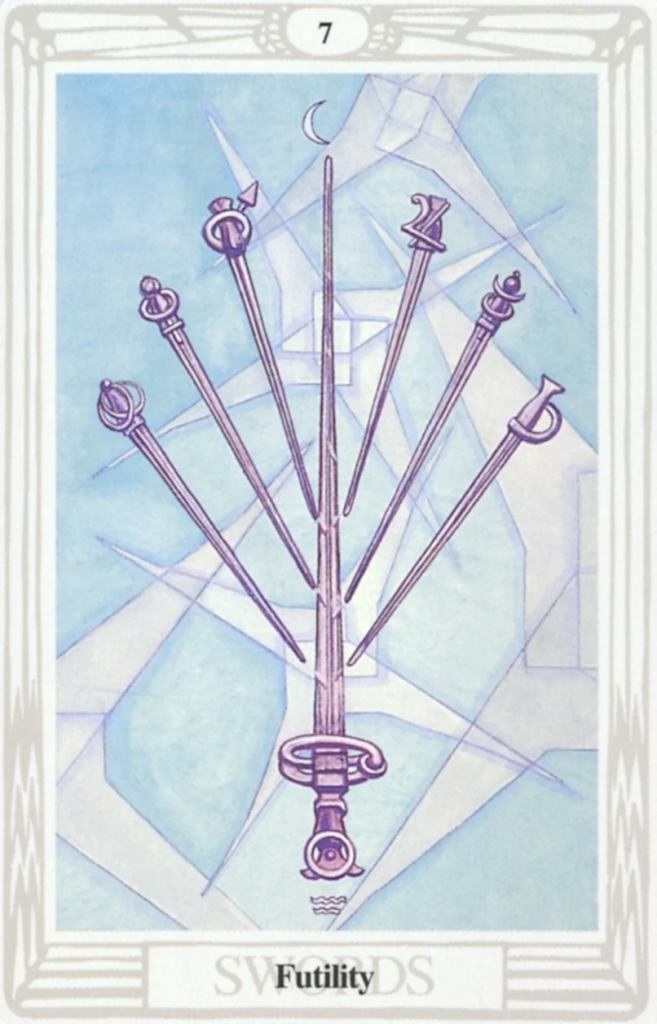
The Lord of Futility represents the times in life where we feel too overwhelmed and doubtful to act decisively toward our problems. It will usually appear when there are difficult decisions to be made, or when situations arise that require we take action. Because we are weary, feeling over-stressed and helpless, we do nothing. As a result, of course, things inevitably get worse.Sometimes the card will come up because we have such a poor view of ourselves. We start to believe that nothing we do could possibly make a difference to the unhappy circumstances we find ourselves in. If not challenged, this attitude will lead us into being poor-little-me’s, when we adopt a victim mentality, and secretly expect everybody else to sort things out for us.When feeling the effects of the Lord of Futility, we are often ready to make unsuitable compromises in order to try to ease the pressure we experience. We can be more easily impressed by other people’s opinions, seeking to please them – often at our own expense. We vacillate, unable to stick to any decision we make. And all of this does nothing much more than increase our problems.Neither of these options is viable, if we are to live a happy love-filled life, is it? So when this card appears in a reading for ourselves, we need to be prepared to commit ourselves to a course of action and then follow through. Even if it transpires that the choice we make could have been bettered, any choice is better than no choice at all, when the alternative is total inertia.Often fear will be a big issue – fear of doing something wrong, fear of taking responsibility, fear of being even more hurt and feeling worse than we already do. In the end, we simply have to take our courage in both hands and, like The Fool, take that leap forward. The fact that we have acted will help us to break from of the Lord of Futility and to move on.
Just as a flower bends toward the sun, I bend toward the lure of spirit. In my heart I am restless, for I know I am called to the greatness of my true being. Let me not tarry in my weaker places.
I am given otherworldly help today as I reach for what is possible. Angels herald my birth into the glory of who I really am. A mere nod in their direction, the slightest invitation for Spirit to enter, and my mind becomes a touchstone for the thoughts that take me there.
I pray for guidance and strength today, to become the person I long to be and do the things I long to do. I honor the imprint of God upon my soul, and the yearning of my heart to follow the path He lays before me.
My soul is imprinted with the yearning to be more
Consciousness, spirituality, biography, sexuality, androgyny, futurism, space, the arts, science, astrology, democracy, humor, books, movies and more







 Ah! how could I possibly quit the world before bringing forth all that I felt it was my vocation to produce?