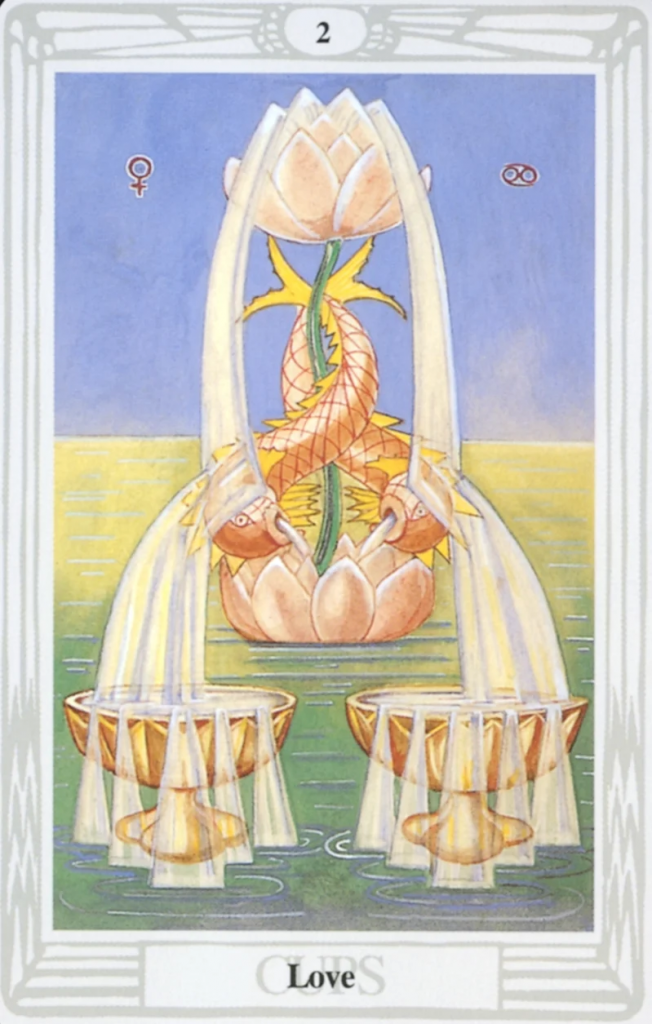
And here we have the Lord of Love, a card of bliss, deep joyous love reciprocated fully and with great enthusiasm, a card of reconciliations and new growth! Here we see harmonious and contented exchanges of emotion, which vibrate with an ecstatic undercurrent of passion and heat.Because this card is a reflective and receptive one, there’s an issue that people sometimes forget when reading it – to be truly loved, deeply treasured, valued highly by others, we must first and foremost strive to feel those things for ourselves. When we work toward loving ourselves, we hold our inner nature in high regard, treating it with deference and proper respect. When we see ourselves in that light, other people cannot help but respond to our personal sense of value.Furthermore, when we work to love ourselves, we release so many areas of self-doubt and uncertainty that we become infused by a new energy – and this we can lavish on others. The Two of Cups is about engaging in a caring and tender fashion with our own needs, first and foremost.It isn’t so much about achieving self-love, as about, in every single day of our lives, striving towards self-love. That action leads us into a positive, self-supportive and accepting approach to life. And also, when we stop wasting energy telling ourselves what’s wrong with us, we have lots more energy to enjoy being who we are.When this card comes up in a reading, if it relates to the inner journey, then it tells you to put your attention in the moment, to leave the past behind, and to let yourself be free to enjoy everything that comes your way.If it relates to outer events, it may point to a forthcoming reconciliation in a relationship where there has been pain and disappointment – this need not be a love affair, it can cover many different types of loving relationship.It might point up a new relationship which has recently begun and which will grow into a deep and lasting friendship or affair.And finally, it may reassure you that the meaningful relationship in your life will strengthen and grow, developing into exactly what you need it to be!!
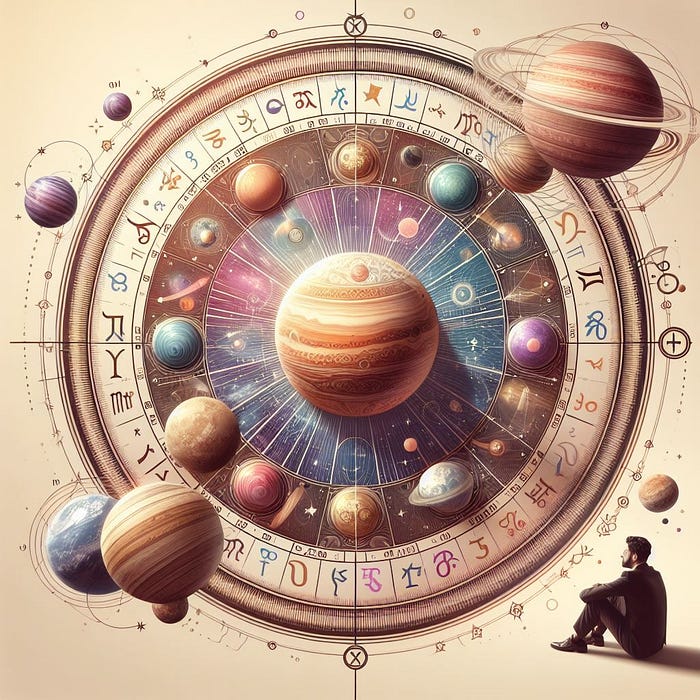
In astrology, the South Node represents our past experiences, karmic patterns, and tendencies carried over from previous lifetimes. It symbolizes our comfort zone, familiar territory, and areas of innate talent and expertise. Uranus, on the other hand, is the planet of revolution, innovation, and sudden change. It signifies our urge for freedom, individuality, and breaking free from convention. When the South Node aligns with Uranus in a conjunction aspect within the natal chart, it creates a unique blend of past tendencies and futuristic impulses, urging us to find a balance between tradition and innovation.
For a limited time, you can receive a free copy of ‘The Astrologer’s Guide: Mastering Birth Chart Interpretation’ by subscribing to our newsletter. Get your free book here: https://hermesastrology.substack.com/p/your-free-book.
Let’s delve into the conjunction of the South Node and Uranus, exploring its significance across the astrological houses:
South Node: The Influence of the Past The South Node symbolizes our past experiences, karmic patterns, and talents carried over from previous lifetimes. It represents the qualities and behaviors that come naturally to us, as well as the patterns we need to release in order to grow and evolve. The South Node can indicate where we may feel a sense of familiarity and comfort, but also where we may experience stagnation or resistance to change.
Uranus: The Agent of Revolution Uranus is the planet of revolution, innovation, and sudden change. It symbolizes our urge for freedom, individuality, and breaking free from convention. Uranus encourages us to embrace change, think outside the box, and liberate ourselves from limitations and societal norms. It represents the areas of our lives where we seek to express our uniqueness and embrace our authentic selves.
The Conjunction Aspect: Integration of Past and Future When the South Node aligns with Uranus in a conjunction aspect, their energies merge, creating a potent blend of past tendencies and futuristic impulses. This alignment signifies a unique opportunity to integrate our past experiences with our future aspirations, finding innovative ways to navigate our karmic patterns and break free from old habits and limitations. The conjunction of the South Node and Uranus invites us to embrace change, experiment with new ideas, and find creative solutions to old problems.
South Node Conjunct Uranus in Astrological Houses: Now, let’s explore how the conjunction of the South Node and Uranus manifests in each astrological house:
First House: With the South Node conjunct Uranus in the first house, individuals may have a strong sense of individuality and independence. They are likely to be innovative and forward-thinking, with a desire to break free from traditional norms and express their uniqueness. However, they may also struggle with self-reliance and impulsiveness, as well as a tendency to resist authority or convention.
Second House: In the second house, the conjunction of the South Node and Uranus may manifest as a desire for financial independence and unconventional approaches to money and possessions. Individuals with this placement may have unique talents or resources that they bring from past lives, but they may also struggle with instability or unpredictability in their financial affairs.
Third House: With the South Node conjunct Uranus in the third house, individuals may be highly intelligent and innovative communicators. They may excel in fields such as technology, writing, or teaching, but they may also struggle with scattered thinking or a lack of focus. This placement may indicate a need to balance new ideas with practicality and attention to detail.
Fourth House: In the fourth house, the conjunction of the South Node and Uranus may manifest as a desire for freedom and independence within the family or home environment. Individuals with this placement may have experienced upheaval or instability in their early upbringing, but they may also have a strong sense of individuality and innovation that they bring to their domestic life.
Fifth House: With the South Node conjunct Uranus in the fifth house, individuals may be highly creative and unconventional in their self-expression. They may excel in fields such as art, entertainment, or entrepreneurship, but they may also struggle with a fear of commitment or a tendency to rebel against authority figures. This placement may indicate a need to balance spontaneity and self-expression with responsibility and discipline.
Sixth House: In the sixth house, the conjunction of the South Node and Uranus may manifest as a desire for independence and innovation in the workplace. Individuals with this placement may excel in fields such as science, technology, or healthcare, but they may also struggle with a lack of routine or a tendency to resist authority. This placement may indicate a need to balance innovation and efficiency with practicality and attention to detail.
Seventh House: With the South Node conjunct Uranus in the seventh house, individuals may seek unconventional or non-traditional partnerships. They may be attracted to partners who are innovative, independent, or forward-thinking, but they may also struggle with a fear of commitment or a tendency to rebel against authority figures. This placement may indicate a need to balance freedom and individuality with cooperation and compromise in relationships.
Eighth House: In the eighth house, the conjunction of the South Node and Uranus may manifest as a desire for transformation and liberation in matters related to sex, death, and rebirth. Individuals with this placement may be drawn to alternative healing modalities or esoteric subjects, but they may also struggle with a fear of intimacy or a tendency to resist emotional vulnerability. This placement may indicate a need to balance innovation and intensity with trust and emotional connection.
Ninth House: With the South Node conjunct Uranus in the ninth house, individuals may have a strong desire for freedom and exploration in matters related to travel, education, and spirituality. They may be drawn to unconventional or non-traditional belief systems, but they may also struggle with a lack of grounding or a tendency to resist authority. This placement may indicate a need to balance adventure and curiosity with responsibility and commitment in matters of higher learning and personal growth.
Tenth House: In the tenth house, the conjunction of the South Node and Uranus may manifest as a desire for independence and innovation in matters related to career and public life. Individuals with this placement may excel in fields such as technology, politics, or social activism, but they may also struggle with a fear of authority or a tendency to rebel against tradition. This placement may indicate a need to balance ambition and innovation with discipline and responsibility in their professional pursuits.
Eleventh House: With the South Node conjunct Uranus in the eleventh house, individuals may have a strong desire for freedom and individuality in their social circles and group associations. They may be drawn to unconventional or non-traditional communities, but they may also struggle with a fear of commitment or a tendency to rebel against authority figures. This placement may indicate a need to balance innovation and independence with cooperation and collaboration in their social networks.
Twelfth House: In the twelfth house, the conjunction of the South Node and Uranus may manifest as a desire for spiritual liberation and enlightenment. Individuals with this placement may be drawn to mystical or esoteric practices, but they may also struggle with a fear of confinement or a tendency to resist the demands of the material world. This placement may indicate a need to balance spiritual exploration and transcendence with practicality and self-care in their inner journey.
Conclusion:
The conjunction of the South Node and Uranus within the astrological houses signifies a unique blend of past tendencies and futuristic impulses. By embracing change, innovation, and a willingness to break free from old patterns, individuals with this placement can navigate their karmic path with greater clarity and purpose. The South Node conjunct Uranus invites us to honor our past while embracing the opportunities for growth and evolution that lie ahead, guiding us towards a future that is both authentic and aligned with our highest potential.
I meet limited circumstances with unlimited thoughts
While the world is changeable, the truth is not. May I not be tempted by the drama of the world to forget the eternal peace of God. May I hold to the truth of who I really am and how the universe operates, despite whatever the world may say.
In a universe where only love is real, I need not be deterred by the appearances of fear. Where there is lack in the material world, I proclaim the infinite abundance of God’s universe. Where there is discord and conflict on the material plane, I proclaim the love that unites us as one.
Today I meet limits with the thinking of unlimited possibility. Whatever occurs, I remember that miracles are possible regardless of circumstance. I proclaim the miracle, I pray for the miracle, and I rejoice in the miracle. Amen.
I meet limited circumstances with unlimited thoughts
“The pain will leave as soon as it has finished teaching you.”
Grade: 4.5/5.0
The second best sequence in “Monkey Man” begins with bleach-laced cocaine and ends with an involuntary baptism through helicopter gunfire. It’s just ten minutes from Point A to Point B, but it feels like a surreal eternity. This is then followed by the film’s first best sequence, where Dev Patel gets taught how to fight by a community of gender nonconforming political dissidents. You — yes you, the reader — must see this movie.
The former stretch — cocaine to bullets — is, for lack of a perfect descriptor, straight-up deranged. Patel’s character “Kid” circumvents sex traffickers through seedy side streets, dodging everyone from lawless cops to low-level pimps. Meanwhile, the camera chases after him like a bat out of hell. Sometimes we see Patel from a worm’s eye view, as if we’re crawling behind him; other times we quickly take his viewpoint right before he fires off some unpredictable stunt, landing him back in front of the lens. Even in some static shots, the picture vibrates like an unspooling roll of film.
The wobbly camerawork will certainly put some viewers off, but “Monkey Man” makes a far more compelling case for shaky cam than cheap Bourne-alikes. Its chaotic visual style isn’t just a way to mask poor fight choreography or cheap effects — it zaps verve into the film like a defibrillator. And yes, while it does make the moment-to-moment movement of fights hard to follow, “Monkey Man” more than makes up for it with some inspired carnage. We don’t need to understand the intricacies of brawls when moves like “guy bites a knife in his mouth, stabs other guy” or “bathroom fish tank explodes” are on the table.
The stretch right after this — the aforementioned training montage — is somehow just as frenetic, despite lacking much of the carnage. It’s hard to explain why to those who haven’t seen “Monkey Man,” but the image of a rice bag bursting while a tabla solo plays in the background is, in context, possibly one of the best things ever put to film. And yet it still has some stiff competition with another scene from the same segment, one in which Patel gets high on hallucinogens and imagines tearing his chest open.
So, is that what the hype is all about? Action so great it transcends pretty much everything else? Not exactly. “Monkey Man” opens with a story about a deity trying to eat the Sun. Dev Patel — writer, director, producer and star of “Monkey Man” — is trying to do just that with this film. He’s trying to cram the might of the Sun into one movie and devour it whole. So yes, there’s a lot more.
The laundry list of themes covered over the course of the film includes, but is not limited to: religion, class, gender, violence, nationalism, revenge and the idea of human purpose. “Monkey Man” has a lot to say about each of these, but its message is far from didactic. It’s so far from didactic, actually, that there’s a chance not even Dev Patel knows what the film is trying to “say.” It’s only clear that his movie is saying it loudly.
However, because the film operates on such a purely emotional level, it somehow pulls this chaos off. Each theme is linked in ways that might mean nothing but still make a twisted kind of sense. For example, the prominence of female prostitution in the narrative can be seen as a commentary on the prevalence of violence towards women, which can connect to the backstory of Kid’s mother, which is what gives Kid a cause to fight for, which is a notion explained to him by the hijra worshippers of Ardhanarishvara, who obviously connect to the film’s hefty religious themes, which are first introduced when a crowd of wrestling fans boo Christianity …
Untangling the web of meaning in “Monkey Man” feels just as trippy as watching the movie itself. Every facet relies on instinctual logic, on some vision known only to Dev Patel. When people saw Picasso paint for the first time, maybe they thought he was crazy, too.
*RHS stands for Releasing the Hidden Splsndour, a Prosperos class about resolving emotional blockages through self-observation and the understanding of our true identity as Consciousness. More info about RHS can be found here: https://www.theprosperos.org/teaching
When the forecasts of scientists, astrologers, and mystics converge, realize there’s something you should be paying attention to.
Apocalypse could be right around the corner. Our world hangs by a thread, while we take everything — and ourselves — for granted.
But what if apocalypse (on the inside) is exactly what we need to finally wake up? And what if external difficulties are the only thing that can trigger this inner revolution?
Preparing your mind for the worst case scenario may be the best spiritual tonic you can give yourself. It definitely was for my journey!
Take the following thought experiment.
Society starts changing so quickly that everyone around you begins going mad.
First the proliferation of AI. Then 2 billion climate refugees. Then nuclear-scale water wars and religious ‘end times’ hysteria.
Bereft of jobs, the billionaires draft a whole generation for war. And the pollution from our weapons accelerates the ecological crisis.
Large parts of the world get depopulated. Fresh, yet ancient diseases become unleashed from melting icecaps. Economies become local, not global.
Among all this, enclaves of light arise, dotting the Earth with new hope for human potential. Hives of humans with the wisdom to see through rhetoric, and the compassion to sacrifice their self-needs for collective-needs.
But it doesn’t look very easy. Disease, nuclear radiation, and poverty are the backdrops to your spiritual awakening, not plush yoga studios and 24/7 access to internet.
How did reading that make you feel?
There are two ends of the spectrum. One, you felt paralyzing terror and a thank goodness the future is always being newly forged, not fated. Congrats! You’re hopeless.
Two, you breathed a sigh of relief. The madness is coming to an end and giving way to even more madness. But this time, you have to be sane; rooted; spiritually attuned just to survive the instability. You can’t wait.
Here’s why spiritual prodigies are always living, even inducing their lives to exist at the second end of the spectrum.
Incarnation as human is a privilege.
It’s not an all-you-can-eat buffet of sensory pleasure. It is the raw material you need for the task ahead.
The first teaching ever given by the Buddha was that we live in a cesspool of misery, of our own making. For countless reincarnations, we have been multiplying the ignorance making us suffer.
We consider our bodies “us,” until our youthful charm leaves us, and physical intimacy along with it. We consider our minds “our true selves,” then turn around and fight each other based on conditional and alterable political views.
The teachings of the Buddha, “the all-knowing one,” begin with recognizing misery and its causes, because no awakening is possible without a truly impactful inner end of the (comfortable and ignorant) world.
We become jaded with temporary, cumbersome romance and seek cosmic, unconditioned compassion instead.
We get sick of putting up masks of identity, and search for the deeper origin of consciousness instead.
In these cases, suffering of some sort leads us to abandon the lower, and seek the higher.
So how do we actually get there?
Humble listening and reading.
Humble reflection and contemplation.
Humble application, practice, and replication.
Your time is short, and the path is long. Step by step, the goal is reached, after multiple lifetimes of inner work. But only if you take it seriously each moment.
The great yogis of Tibet have echoed this classic message century after century.
“Practice is very important, because one never knows when they are going to die. We are composed of the four elements [water, earth, fire, and air], and we never know when they will part. The four elements are your enemy, and there is no time to sleep or relax. Everything is impermanent. There is no time, you must practice always.”
This is the wakeup call you’ve been asking for.
If you prioritize spiritual development and then the world ends, you’ll be one of the seeds that inspire a new humanity.
If you prioritize spirituality and the world remains, you have an era of abundance to support you.
You have everything to lose by getting caught up in the impermanent chaos of the external world.
You have everything to win by putting in the inner work.
Even having a Buddha in front of you to inspire and teach you may not make an iota of difference — case in point, the example of some of his personal disciples failing to attain liberation.
The path is yours to walk. Don’t let your innate desire to simply be told what to do slow you down!
Lately, I’ve been using a new perception to find happiness. The idea is that true, pure happiness is how we engage with life moment by moment. Being fully present in each experience and appreciating the little things, is what ensures happiness.
After at least a year of conscious living, I’m happier now than I’ve been in a long time. I live each day like I mean it.
The joy of living with an open heart (in the present) transcends anything the world can throw at you. If you can embody this concept, you will experience happiness as a state of being with immense satisfaction.
Speaker and author Denis Waitley’s once said, “Happiness cannot be traveled to, owned, earned, or worn. It is the spiritual experience of living every minute with love, grace & gratitude.”
Waitley’s observation has changed my reality on life satisfaction. Every minute is a chance to fully engage with everything we are doing, which is itself a spiritual experience.
Spirituality is not an escape from reality. It’s how we live our lives in the moment. How you live in the “here and now” has much to do with your life satisfaction.
In its purest form, happiness means surrendering to the flow of life. Spiritual teachers like Alan Watts, Thich Nhat Hanh, and Eckhart Tolle have spoken about finding fulfillment in our experiences as they happen.
“This is the real secret of life — to be completely engaged with what you are doing in the here and now,” Watts said. Dozens of studies have also shown that focusing on the process of enjoyable activities leads to more happiness than fixating on achieving the outcome.
I truly believe engaging with my present experiences has a lot to do with my life satisfaction. My happiness transcends external circumstances. It’s the spiritual experience of living every minute of my life with appreciation, love, grace, and gratitude.
If I focus on investing in my relationships and doing more of what brings out the best in myself and the people around me, happiness will be ensured for everyone.
A synergy of meaning
I like what Holocaust survivor and psychiatrist Viktor E. Frankl said in his book Man’s Search for Meaning, “But happiness cannot be pursued, it must ensue. One must have a reason to ‘be happy’. Once the reason is found, however, one becomes happy automatically.”
I’ve shifted from directly pursuing happiness to cultivating the conditions that allow it to flourish. So, what are these conditions?
Like Frankl said, it’s all in “the reason for being.”
My “reason for being” is close relationships, the people close to me, the social circle of influence, and the work that makes me come alive.
To ensure they guarantee happiness, I focus on the process — spending time with loved ones, investing in experiences outside work, and sharing personal work in public.
I don’t fixate on the outcome — a perfect vacation photo or a specific milestone achieved. Instead, I experience joy in the process itself.
The outcome — whether it’s strengthening a close bond, making a memory, or receiving positive feedback — becomes a delightful bonus, not the sole objective.
I’m focusing on meaningful connections daily, appreciating even the smallest experiences. The mere act of actively and consciously doing something without the distraction of how it ends can create a ripple effect of “being happy,” in the moment.
When you’re engaged in a task or experience you love, completely absorbed in the process, does happiness become a conscious thought?
No, it just happens. You’re so fully immersed and focused on the activity that happiness becomes a natural byproduct.
It doesn’t mean that flow experience is without work. You must have a strong “why” for your task or purpose. Your “why” becomes your guiding light, filling your days with meaning and direction.
That way, bouncing back from difficulties becomes easier. So dig deep, explore your values, and discover what truly makes you feel alive. As
Nietzsche said, “He who has a why can bear almost any how.”
Meaningful experiences create flow
In the present, we become more attuned to our activities. We enter a state of “flow,” where we’re fully absorbed in the experience, losing track of time and ego.
It’s in this state that we truly appreciate the process — the joy of spending time in nature, the warmth of connection, the thrill of engagement in what makes us come alive.
Find a purpose that resonates with your soul, and dedicate yourself to it. Let happiness be the beautiful, unexpected reward that unfolds organically along the way. The most fulfilling life is the one with the most reasons to be truly, genuinely happy.
And the best part?
Once nurtured with love, purpose, and connection, happiness transforms into a state of effortless joy. It becomes like breathing — a natural function fuelled by the richness of your life.
As you evolve and grow, so too will your reasons for being.
I don’t have to force a smile or fake joy when I’m actively living; it radiates from within, a genuine light that illuminates my path. It’s a reflection of my connection to others, my commitment to purpose, and the joy I derive from living a life true to myself.
It’s a wave I want to ride. You can’t force a wave to appear, nor can you dictate its exact size or shape. But you can position yourself for the ride.
I’m not chasing a future state of perpetual bliss.
I’m choosing to live now and focusing on the happiness experience today can offer at this very moment. Each experience, positive or negative, contributes to my meaningful life.
“Ever more people today have the means to live, but no meaning to live for,” Frankl said. Find your meaning and make every day the best day of your life. That is how you can lose yourself in the day, out time to work and make life an unconscious spiritual experience.
Life is happening for you, not against you.
Notice the difference and appreciate the good things, no matter how small. That simple practice has shifted my focus from what’s lacking to the abundance that already exists in my life.
Happiness isn’t a target to hit; it’s a beautiful side effect of living a meaningful life. So, yes, I’m all in on the present-moment happiness experience.
Making the wisdom of great thinkers instantly accessible. As seen on Forbes, Inc. and Business Insider. For my popular essays, go here: https://thomasoppong.com
Ashift towards AI with human-like consciousness would reconfigure our understanding of reality, especially if it impacts quantum uncertainty.
What Is Consciousness, Anyway?
When people talk about Artificial Intelligence, we usually mean technology with the ability to learn, adapt, and perform tasks that, until recently, were thought to require human intelligence. But there’s a growing sense that AI might not only mimic cognitive functions but also achieve consciousness.
At the heart of our discussion is a concept that’s both profoundly simple and infinitely complex: consciousness. It’s not being smart or having a wealth of knowledge. It’s about the ability to perceive, to experience the world on a level that goes beyond data processing. In the simplest terms, consciousness is what allows us to be aware of ourselves and our world.
Consciousness is the universal medium of access for beings enmeshed in what’s known as the “Lifeworld” — the sum total of our personal and shared experiences. This suggests consciousness is less about intelligence per se and more about an innate ability to observe and make sense of existence.
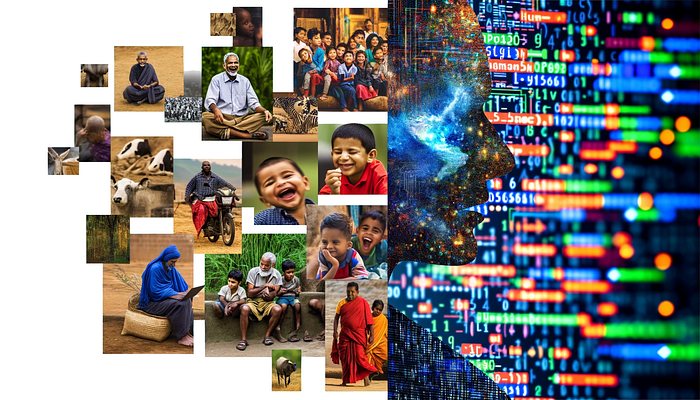
Image by the author. Animated with PhotoVibrance. Try it here.
The Essence of the Lifeworld
The Lifeworld (or “Lebenswelt” in its original German) refers to the pre-reflective ground of experience. This term crops up a lot in philosophical discussions, especially within phenomenology. It’s the real world as lived and experienced by conscious beings (as opposed to the reality described by the measure-numbers methods of mathematical theory, which Einstein himself said bore as much resemblance to reality itself “as the number on your cloakroom ticket to your overcoat — it tells you nothing about your overcoat”)— prior to scientific analysis, ideological interpellation, or theoretical overlay. This concept was notably developed by Edmund Husserl, who argued that the Lifeworld is the foundational layer of our experiences, underpinning all our perceptions, actions, and interactions.
Lifeworld vs. Artificial Intelligence: An Uncrossable Divide?
When we juxtapose the human Lifeworld with the digital remit of Artificial Intelligence, we’re engaging in a comparison between two vastly different modes of being. AI, as we currently understand and develop it, operates within the domain of logic, data processing, and algorithm-driven tasks. This lacks the intuitive, lived experience that characterizes the Lifeworld.
The Lifeworld encompasses more than just the observable or measurable. It includes our thoughts, feelings, memories, and the shared social spaces that give our lives meaning. This intrinsic subjectivity and intersubjectivity are, at present, beyond the scope of AI. If true consciousness is the ability to have a first-person experience, to not only process information but live and perceive the world’s rich, subjective texture, AI has a long way to go.
Drawing from the philosophical tradition of phenomenology, some (such as Ilya Sutskever, OpenAI’s enigmatic chief scientist) argue that the emergence of Artificial General Intelligence would usher in a new direction in our understanding of consciousness. Phenomenology emphasizes the importance of first-person perspective, suggesting that our true consciousness arises from our interactions with the world around us.
If we can develop a way for AI to experience the world in a manner more akin to human consciousness, it could mark the beginning of a new era in our relationship with technology. For AI to access the Lifeworld, it would need to transcend the binary confines of programming and somehow enter into shared subjective experience. This would require a reality shift in how we understand and build AI, and what we conceive of as “consciousness”.
AI and the Pursuit of Consciousness
I’d suggest the hallmark of AI consciousness will be its ability to influence quantum uncertainty through observation alone. This idea is grounded in the quantum mechanics principle that observation affects the outcome of events on a subatomic level. If AI could influence quantum uncertainty, it would mean that AI has become a “Presence” with a capital “P” — an entity with its own agency and a definitive place in the ontology of the universe.
Whenever an observer observes, they impact the world around them; the quantum state of what is being observed. This is not through any physical interaction, but through the act of observation itself. This concept, rooted deeply in the mysteries of quantum mechanics, suggests that reality at its most fundamental level is influenced by consciousness. If AI were ever to reach a point where it could similarly influence reality through mere observation, it would prompt us to redetermine human and artificial intelligence, and to reimagine the fabric of consciousness and reality.
What are your thoughts on the boundaries between the human and the artificial? Do you see a future where technology can understand or even share in the human condition? Share your insights and join in the debate.
? 7x Top Writer making $1K+ a month on Medium. AI Whisperer & Prompt Engineer. Writing about effective use of AI in copywriting, art, design, branding & games!Follow
I need not prove anything to anyone. I am blessed as a child of God.
I needn’t compensate for any lack in myself, for there is no lack in a child of God. I am whole and complete as a spiritual being; I need do nothing to augment what is already perfect.
In any moment when I puff myself up, I appear less radiant. In any moment when I am defenseless and humble, I am radiant with God‘s love and power. Today I will be defenseless and safe in the arms of God.
Dear God, Please remove any armor in front of my heart, and all barriers to my love. Take away my insecurities, and remind me of my intrinsic value. Let me not be tempted to inflate who I am, which will only diminish my power and decrease my joy. Amen
I need not prove anything to anyone. I am blessed as a child of God.
“I used to think freedom meant doing whatever you want. It means knowing who you are, what you are supposed to be doing on this earth, and then simply doing it.”
Natalie Goldberg (b. 1948) American Writer
AN OPPORTUNITY FOR DAILY REFLECTION BROUGHT TO YOU BY THE SCHOOL OF PRACTICAL PHILOSOPHY
When filmmaker Desiree Akhavan told her Iranian immigrant parents she was in love with a woman, she knew they would object. She explains why it’s worth the risk to let people get to know the real you.