In 1857, members of the Philological Society of London, frustrated with the omissions and inaccuracies of the prominent dictionaries of the day, established a “Committee to collect unregistered words in English.” At first, their aim was only to create a supplementary dictionary, but the project soon expanded. The original committee consisted of Herbert Coleridge, Frederick Furnivall, and Richard Chenevix Trench; but the project didn’t really take flight until James Murray joined as editor in the 1870s—which was also when the Oxford University Press bought the rights to publish the massive dictionary on which they were now at work. Murray built an iron shed in his back garden and called it the “scriptorium”; it was outfitted with over a thousand “pigeon holes,” where Murray and his team collected quotation slips submitted by volunteer readers from all around the world, each of which contained evidence of words, their usage and meanings. “It is akin to mapping the human genome. It was that big an enterprise,” said author and researcher Pip Williams. Murray hoped to finish the dictionary in ten years; it would take fifty. The first fascicle—which was entitled A New English Dictionary on Historical Principles; Founded Mainly on the Materials Collected by The Philological Society, and covered “A” to “ant” in 352 pages, was finally published on February 1, 1884. It wasn’t until 1928, 13 years after Murray’s death, that the final fascicle (the 125th) was completed, and the dictionary was published in its full form—and even then, it wouldn’t actually be finished; after all, as the English language evolves, so must the dictionary. Today, many editions and supplements later, the OED is the gold standard of dictionaries, but it’s safe to say it will never really be completed—until humans finally give up making up words for things, that is. Here’s hoping we don’t.
People in Tel Aviv walking past posters showing hostages held by Hamas in the Gaza Strip. Prime Minister Benjamin Netanyahu is under pressure to secure their release. (photo: Amir Levy/Getty)
28 january 24 (RSN.org)
A written draft agreement calls for the phased release of captives held by Hamas in exchange for a cessation in Israel’s military offensive for about two months.
American-led negotiators are edging closer to an agreement in which Israel would suspend its war in Gaza for about two months in exchange for the release of more than 100 hostages still held by Hamas, a deal that could be sealed in the next two weeks and would transform the conflict consuming the region.
Negotiators have developed a written draft agreement merging proposals offered by Israel and Hamas in the last 10 days into a basic framework that will be the subject of talks in Paris on Sunday. While there are still important disagreements to be worked out, negotiators are cautiously optimistic that a final accord is within reach, according to U.S. officials who insisted on anonymity to discuss sensitive talks.
President Biden spoke by phone separately Friday with the leaders of Egypt and Qatar, who have served as intermediaries with Hamas, to narrow the remaining differences. He is also sending his C.I.A. director, William J. Burns, to Paris for Sunday’s talks with Israeli, Egyptian and Qatari officials. If Mr. Burns makes enough progress, Mr. Biden may then send his Middle East coordinator, Brett McGurk, who just returned to Washington, back to the region to help finalize the agreement.
“Both leaders affirmed that a hostage deal is central to establishing a prolonged humanitarian pause in the fighting and ensure additional lifesaving humanitarian assistance reaches civilians in need throughout Gaza,” the White House said in a statement Friday night summarizing the president’s conversation with Sheikh Mohammed bin Abdulrahman al-Thani, Qatar’s prime minister. “They underscored the urgency of the situation and welcomed the close cooperation among their teams to advance recent discussions.”
In a statement in Israel on Saturday, Prime Minister Benjamin Netanyahu reaffirmed his commitment to securing the release of those hostages who were not freed as part of a more limited agreement in November. “As of today, we have returned 110 of our hostages and we are committed to returning all of them home,” he said. “We are dealing with this and we are doing so around the clock, including now.”
The hostages have been in captivity since Oct. 7, when Hamas gunmen stormed into Israel and killed an estimated 1,200 people and seized about 240 more in the worst terrorist attack in the country’s history. Israel’s military retaliation since then has killed more than 25,000 people, most of them women and children, according to Gaza’s health ministry. It is not clear how many of those killed in Gaza were Hamas combatants.
The short-lived truce in November, brokered by Mr. Biden along with Qatar and Egypt, resulted in a seven-day pause in the fighting in exchange for the release of more than 100 hostages by Hamas and about 240 Palestinian prisoners and detainees held by Israel. About 136 people seized on Oct. 7 remain unaccounted for, including six American citizens, although about two dozen of those are presumed to be dead.
The deal now coming together would be more expansive in scope than the previous one, officials say. In the first phase, fighting would stop for about 30 days while women, elderly and wounded hostages were released by Hamas. During that period, the two sides would work out details of a second phase that would suspend military operations for roughly another 30 days in exchange for Israeli soldiers and male civilians being held. The ratio of Palestinians to be released from Israeli prisons is still to be negotiated but that is viewed as a solvable issue. The deal would also allow for more humanitarian aid into Gaza.
While the agreement would not be the permanent cease-fire that Hamas has demanded for the release of all hostages, officials close to the talks believe that if Israel halts the war for two months, it would likely not resume it in the same way that it has waged it until now. The truce would provide a window for further diplomacy that could lead to a broader resolution of the conflict.
Such a deal would provide welcome breathing space for Mr. Biden, who has taken a great deal of heat from the left wing of his own party for supporting Israel’s response to the Oct. 7 attack. Mr. Netanyahu too has come under considerable pressure to secure the hostages’ release, even as he has vowed to press the military operation to destroy Hamas.
But he also has resisted American and international pressure to ease the military campaign against Hamas and repeated his resolve in his statement on Saturday. “We are determined to finish the task, to eliminate Hamas,” he said. “And if it takes time, we will not relent in the mission.”
Not only might a new deal ease some of the tension for Mr. Biden at home, it could de-escalate the volatile situation in the broader Middle East. During the seven-day pause in November, other Iranian proxy groups like the Houthis and Hezbollah also held back on the low-level attacks they had been mounting against American, Israeli and other targets.
After the November pause collapsed, Hamas and Israel effectively stopped communicating through their intermediaries. But the ice was broken by a more limited deal announced on Jan. 16 to allow medicine to be delivered to Israeli hostages in return for more medicine and aid to Palestinian civilians in Gaza. That became what some called a proof of concept.
From that point, both Israel and Hamas provided proposals on paper for a wider agreement and American intermediaries knitted them together into a single draft agreement. Mr. Biden spoke by phone with Mr. Netanyahu on Jan. 19, their first talk in nearly a month, and the two discussed how to proceed with the hostages.
Two days later, the president sent Mr. McGurk to the region, where he met with Gen. Abbas Kamel, the chief of Egypt’s General Intelligence Service and the nation’s second most powerful official, as well as Sheikh Mohammed of Qatar. The talks were complicated when Israeli media played a tape apparently of Mr. Netanyahu privately calling Qatar’s role as mediator “problematic” because of its relationship to Hamas, prompting Qatar to call the remarks “irresponsible and destructive.”
Mr. McGurk returned to Washington on Friday and met with Mr. Biden in the Oval Office along with Mr. Burns and Secretary of State Antony J. Blinken, who has also been traveling in the region. With his advisers next to him, Mr. Biden then separately called President Abdel Fattah el-Sisi of Egypt and Sheikh Mohammed.
“They affirmed that all efforts must now be made to conclude a deal that would result in the release of all hostages together with a prolonged humanitarian pause in the fighting,” the White House said in its summary of the call with Mr. Sisi.
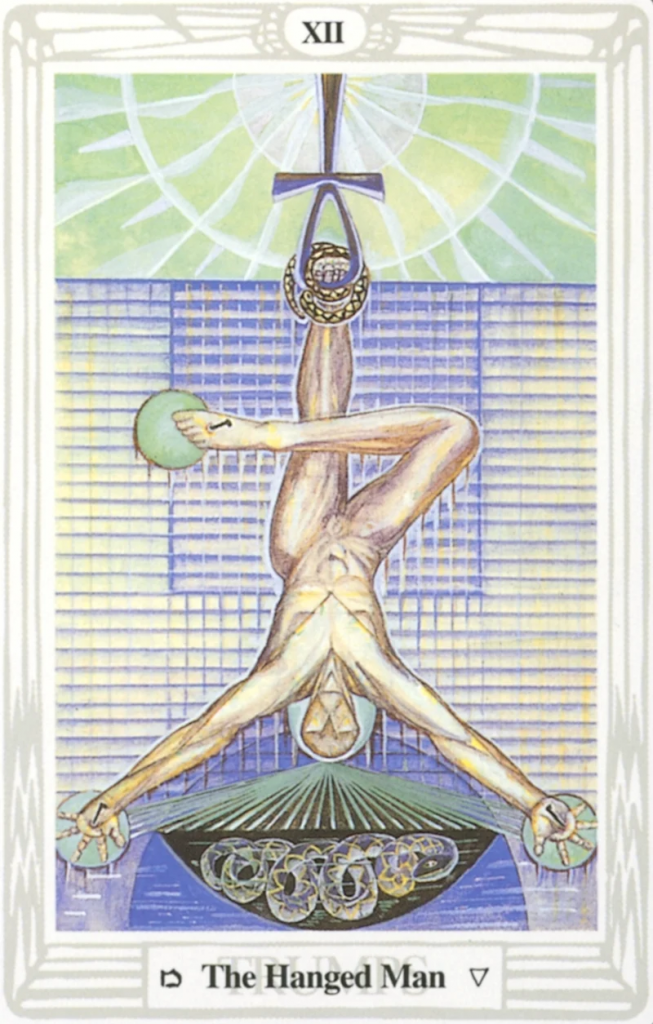
The Hanged Man is numbered twelve and is depicted as a figure, usually male, hanging upside down from a tree or branch. He often has his hands behind his back, as though tied (though as you can see the Thoth interpretation moves away from this aspect of apparent helpnessness). Usually one leg is tucked behind the other to form a triangle shape. Strangely though, he tends to look quite happy and content with his situation.Not a very popular card, the Hanged Man deals with sacrifice, delays and waiting – and also being bogged down and helplessness. We sacrifice every time we make a choice – reading this web page means you have sacrificed reading the alternatives. Since sacrifice can mean giving up one thing of value for another thing of equal or greater value, this card can easily be seen as representing the natural and normal function of disposing of something that no longer suits its purpose as well as its replacement will.The Hanged Man is totally vulnerable, his attitude is “whatever will be, will be”. He accepts everything that happens with equanimity and courage – he is, after all, simply giving in to his destiny. He can sometimes represent the person who has waited too long, who is perhaps scared to change. We should endure with strength and inner peace, but also be courageous enough to take action when destiny calls.
New Thinking Allowed with Jeffrey Mishlove • Jan 28, 2024 Tod Desmond, PhD, is an adjunct professor of philosophy at the University of Southern Maryland. He is author of Psyche and Singularity: Jungian Psychology and Holographic String Theory. Here he shares his work that is essentially an update of the efforts of Carl Jung and Wolfgang Pauli to discover the principles that link the psyche with the physical universe. 00:00 Introduction 05:56 Carl Jung, Wolfgang Pauli, and Leonard Suskind 14:17 Are we one with everything? 20:07 Jung’s near-death experience 26:50 Why holographic string theory? 34:26 Materialism and physics 39:46 Souls and black holes 48:28 Conservation of information 56:03 The soul and the mandala 59:21 Conclusion New Thinking Allowed host, Jeffrey Mishlove, PhD, is author of The Roots of Consciousness, Psi Development Systems, and The PK Man. Between 1986 and 2002 he hosted and co-produced the original Thinking Allowed public television series. He is the recipient of the only doctoral diploma in “parapsychology” ever awarded by an accredited university (University of California, Berkeley, 1980). He is also the Grand Prize winner of the 2021 Bigelow Institute essay competition regarding the best evidence for survival of human consciousness after permanent bodily death. (Recorded on January 6, 2024)
The Astrology Podcast • An overview of the month ahead astrology forecast for February 2024, discussing planetary alignments and key events that will occur during the month, with astrologers Chris Brennan and Austin Coppock. The main planetary alignment this month is that Mercury, Venus, and Mars all conjoin Pluto in Aquarius for the first time, giving us a preview of what those conjunctions will be like over the next 20 years that Pluto is in Aquarius. We spend the first 45 minutes talking about the astrology of news and recent events since our last forecast, and then in the second hour we get into the forecast for February. This episode was recorded on Thursday, January 25, 2024. This is episode 434 of The Astrology Podcast:
Madonna del cardellino (“Madonna of the Goldfinch”) (1506) by Raphael. Oil on panel. 107 × 77 cm. Uffizi Gallery, Florence, Italy. Image source Wikimedia Commons
The language of art can sometimes be an enigmatic business. Allusions in the form of flowers, fruit, animals and other objects might sit in plain sight, yet their meaning is only “readable” if you know what signals to look for.
For me, this is one of the great joys of looking at art: to uncover a hidden intention in a painting, apparent only when the symbols have been identified and unravelled.
Here, I‘d like to share three surprising symbols from art history that might make you think twice about the next artwork you look at.
Lemons
For artists, lemons have long been an appealing subject due to their ability to play a dual role. Plump and vibrant on the outside, yet holding sourness within, they carry something of a sting in the tale.
Still Life with Two Lemons, a Facon de Venise Glass, Roemer, Knife and Olives on a Table (1629) by Pieter Claesz. Oil on panel. 44.5 × 61 cm. Private collection. Image source Wikimedia Commons
Therefore, the presence of a lemon in a painting should alert us principally to two conflicting ideas: that life can be a splendid, succulent thing, yet it can also be laced with bitterness.
To emphasise the point, lemons in painting are often shown in a part-peeled state, with their rind winding over the edge of a reflective pewter plate, glistening and withering in the same instant — as in Pieter Claesz’s superb Still Life with Two Lemons shown above.
Overwhelmingly, it was the Dutch still life tradition that favoured lemons as a subject matter. The fruit seemed to have a specific level of ubiquity in 17th-century Dutch society to make it both rare and familiar. Sufficiently exotic, lemons naturally indicated luxury and prosperity, whilst also being not too rare as to be obscure: lemons were both imported and grown in orangeries and hothouses in ample numbers to become a popular recipe ingredient in food and drink, as contemporary cookbooks attest.
Still Life with a Glass and Oysters (c.1640) by Jan Davidsz de Heem. Oil on wood. 25.1 × 19.1 cm. The Metropolitan Museum of Art, New York, U.S. Image source The Met
In Dutch art, lemons crop up often. Another painting, Still Life with a Glass and Oysters by Jan Davidsz de Heem, shows us a partly-peeled lemon draped somewhat provocatively over a wine glass, ready to add zest to a pile of oysters and a bunch of grapes.
The arrangement perhaps suggests a Carpe Diem principle — fresh, sparkling food that should be eaten in the here and now, representing a sophisticated sense of pleasure and also its short-lived time span.
Beware of Luxury (“In Weelde Siet Toe”) (1663) by Jan Steen. Oil on canvas. 105 × 145.5 cm. Kunsthistorisches Museum, Vienna, Austria. Image source Wikimedia Commons
And so lemons tend to carry a bitter warning, as in this somewhat riotous scene painted by Jan Steen in 1663, titled Beware of Luxury.
The image gives us a whole series of indulgent practices, excesses of food, drink and philandering that threaten to capsize into chaos and lawlessness if they go on for much longer.
Detail of ‘Beware of Luxury’ (“In Weelde Siet Toe”) (1663) by Jan Steen. Oil on canvas. 105 × 145.5 cm. Kunsthistorisches Museum, Vienna, Austria. Image source Wikimedia Commons
And on the far right of the painting is a lemon, again with its rind spiralling over a ledge. It sits alongside a type of drinking glass known as a roemer, and becomes emblematic of the idea that good times can sour if you take them too far.
Musca depicta
It’s not uncommon in the history of paintings to find a representation of a life-size fly or bluebottle resting somewhere on the canvas as if it had landed there just moments ago.
Detail of ‘Madonna and Child’ (c.1480) by Carlo Crivelli. Tempera and gold on wood. 36.5 × 23.5 cm. The Metropolitan Museum of Art, New York, U.S. Image source The Met
The first thing to consider about these unusual symbols is that they tend to trick the eye, having been painted to deliberately look like a component of the viewer’s reality rather than the painting’s.
This layering of reality is a sort of game: a playful trompe-l’oeil, a sleight of hand on the part of the artist to make us think again about the nature of paintings and our willingness to believe in the world they present.
Portrait of a Woman of the Hofer Family (c.1470) by anonymous. 53.7 × 40.8 cm. National Gallery, London, UK. Image source Wikimedia Commons
A fine example occurs in this portrait, painted in about 1470 by an unknown artist, in which a fly can be seen perched on the folds of the woman’s prominent headdress. She seems to be unaware of its presence, whereas for us, the viewer, the fly is marvellously conspicuous.
The artistic conceit became known as a musca depicta (“painted fly” in Latin) and was especially in vogue during the mid-1400s, in both northern and southern traditions of European art.
Madonna and Child (c.1480) by Carlo Crivelli. Tempera and gold on wood. 36.5 × 23.5 cm. The Metropolitan Museum of Art, New York, U.S. Image source The Met
A memorable musca depicta appears in this 1480 painting by the Venetian artist Carlo Crivelli, which shows Mary and the Christ Child together, with Christ sitting on a stone ledge.
Sharing the shelf with Christ is a fly, which appears to have caught the Madonna’s eye — thereby providing another instance of the layers of reality overlapping, and also an indication of the painter’s ability to deceive.
Portrait of a Carthusian (1446) by Petrus Christus. Oil on wood. 29.2 × 18.7 cm. The Metropolitan Museum of Art, New York, U.S. Images source The Met (open access)
There may also be an underlying symbolic meaning to the appearance of flies in a painting, as a protective talisman against real life insects, bugs and other adversities marring the venerated person depicted.
The idea seems to have come from the homeopathic tendency of medieval medicine, expressed in the Latin phrase similia similibus curantur, or “let likes be cured by likes”.
And so, when a painted fly appears on what looks like the picture frame in this 1446 painting Portrait of a Carthusian by Petrus Christus, it might be best understood as an amulet against misfortune.
Goldfinches
In the splendid Crivelli painting above, you may have also noticed that the baby Christ is holding a small bird, specifically a goldfinch. This is another fascinating symbol that’s worth digging deeper into.
Detail of ‘Madonna and Child’ (c.1480) by Carlo Crivelli. Tempera and gold on wood. 36.5 × 23.5 cm. The Metropolitan Museum of Art, New York, U.S. Image source The Met
Unusual for a European species of bird, goldfinches are brightly coloured birds. Their black wings are specked with white, and have a burst of vivid yellow on the edges, whilst their head is marked with a splash of deep red.
European Goldfinch (Carduelis carduelis) illustrated by the von Wright brothers. Image source Rawpixel
Thanks to its vibrant plumage, the goldfinch became a common sight in urban households during the Renaissance era. As a favourite plaything of children, it tended to be kept uncaged but tethered to long strings. These birds could be trained to perform tricks, including opening feeding boxes, retrieving water with tiny buckets and ringing bells.
When carried over to paintings, the goldfinch was fused with the wider traditions of avian symbolism, which had been a long-standing symbol of the soul: to the ancient pagans, the image of a bird in flight signified the path of the soul at the point of death.
Madonna del cardellino (“Madonna of the Goldfinch”) (1506) by Raphael. Oil on panel. 107 × 77 cm. Uffizi Gallery, Florence, Italy. Image source Wikimedia Commons
In Christian symbolism, we find something of the same meaning applied to goldfinches, with the specific indication of Christ’s crucifixion.
And so in a painting like Raphael’s Madonna of the Goldfinch, made in 1506, the goldfinch held between the young John the Baptist and the Christ Child is supposed to foreshadow Christ’s later sacrifice.
Detail of Madonna del cardellino (“Madonna of the Goldfinch”) (1506) by Raphael. Oil on panel. 107 × 77 cm. Uffizi Gallery, Florence, Italy. Image source Wikimedia Commons
Popular legend connected the bird’s bright colours with the Passion: legend told of Christ’s journey to Calvary carrying the cross when a compassionate goldfinch alighted upon his crown of thorns. In an act of mercy, the bird attempted to remove a piercing thorn, causing a drop of blood to fall and forever staining its head red.
Thus, like the lemon and the fly, the goldfinch transcends its role as a commonplace object, becoming a symbol of something more allegorical and portentous.
And as with all the symbols mentioned here, the lesson worth taking is that there’s nearly always more to a painting than meets the eye.
If you enjoyed this you may like my latest book Great Paintings that Tell Stories, an examination of some of art’s most enthralling images.
Would you like to get…
A free guide to the Essential Styles in Western Art History, plus updates and exclusive news about me and my writing? Download for free here.
This article is drawn from Chapter 9 of my book, Make Sleep Your Superpower. It has been revised and updated to better stand alone here.
You don’t need to become an expert on rapid-eye-movement (REM) sleep to figure out how to get some, but a cursory understanding of the primary stages of sleep will illuminate why it’s so important to cherish efficient slumber, and why good daytime habits are crucial to successful nighttime sleep.
Yet because sleep remains somewhat mysterious, experts describe the stages, and what exactly occurs during each phase, differently. I’ve researched the many different explanations and whittled things down to the essentials.
For practical purposes, a general summary goes like this:
After your head hits the pillow, it might take anywhere from five to 20 minutes to nod off. There’s no correct amount of time, but it’s considered unusual if you fall asleep instantly or take hours. Then, at some point, the transition is nearly instantaneous: You’re awake, you’re awake, you’re awake, blink, you’re out.
On a good night, you’ll go through the following four stages in this order, anywhere from about four to seven times, with each making up the very rough estimate of total sleep time noted.
Stage 1: Transition
This is a short period lasting just one minute to perhaps several minutes. Sleep is light. Breathing and heart rates slow but remain near normal. Muscles relax. Core body temperature, which has been falling during the evening, drops further. Brain waves slow, too. You can be easily awakened, perhaps peeved but likely without the grogginess you might feel if woken during other stages.
Estimated fraction of the total: 5%
Stage 2: Light sleep
Sleep begins to deepen. The heart and breath slow further. Body temperature falls and eye movement stops. Brief bursts of brain-wave activity occur. This stage lasts anywhere from 10 to 25 minutes, but after repeating all the stages multiple times. It’s thought that some memory consolidation begins, but that the brain remains somewhat vigilant for any threats. Think of Stage 2 as one you have to go through to get to the most important two stages. And on a bad night—if you drank too much or you’re packing a lot of anxiety—you might waffle in this stage longer than ideal.
Estimated fraction of the total: 45%
Stage 3: Deep sleep (also called slow-wave sleep)
The most restorative phase finally comes. Breathing is slow but regular, and the pulse has fallen off significantly. Muscles are relaxed. Body temperature has now fallen by 2 to 3 degrees Fahrenheit compared to its peak in late afternoon. Brain waves slow even further, hence this phase is referred to as slow-wave sleep.
It’s hard to wake you up during deep, slow-wave sleep, and you won’t like it if someone does — you may be foggy with sleep inertia—a sluggishness of mind and body—for up to an hour.
The first round of this relatively brief stage typically lasts longer than later rounds, so it’s crucial that when you fall asleep, your mind and body are ready to settle into this initial around of deep, restorative slumber.
The overall time spent in this slow-wave stage is crucial, since it’s when the brain’s glymphatic system—which removes misfolded proteins and other toxins and waste from the brain to literally clear your head—is most active, and the body gets to work repairing its tissues by releasing growth hormones and a whole suite of other chemicals critical to fixing, patching and sprucing up muscles, bones, organs, skin, the immune system and everything else you need to stay healthy and avoid aging faster than what’s natural.
Estimated fraction of the total: 25%
Stage 4: REM sleep
About 90 minutes after falling asleep, if all goes according to nature’s plan, the initial version of rapid-eye-movement (REM) kicks in. Breathing picks up and becomes irregular. Heart rate rises.
You’re doing most of your dreaming now—dreams that you might or might not remember. Your limbs become effectively paralyzed so that you don’t kick someone or punch yourself in the face. It’s thought that bones, muscles and other tissues continue to undergo repair during this phase. But most importantly, memories are consolidated—effectively stored on your brain’s hard drive—while extraneous information is cleared from the mind and emotions are processed and settled. This stage is crucial for managing stress and anxiety.
The initial round of REM might be 10 minutes, with later rounds lasting up to an hour, so the bulk of REM sleep happens in the second half of the night. That’s why sleeping long enough is so important, and why being woken by an alarm before you are ready can be so disorienting and leave you unrefreshed.
Estimated fraction of the total: 25%
It’s common to wake up after each round of the four sleep stages—often right after a dream—and perhaps roll over or otherwise shift position and go right back to sleep, and not even realize it.
If you need to pee, you should go—that’s normal. Going back to sleep is obviously good, because you want to keep those four stages cycling through their ideal four to seven sets. Likewise, waking up during the rounds — cutting a stage short, even if you don’t realize it — is bad.
Depth, quality and continuity of sleep through the stages — what I like to call overall efficiency — determines how restorative a night can be.
Further reading
Now that you understand the importance of the various stages, you may wish to learn how to sink blissfully into them and emerge well-rested the next day. I’ve written several other Medium articles to help with that. You can find them, along with more sleep stories by other Wise & Well writers, on our Sleep Topic Page. Here’s a selection to get you started:
Thanks for your support, which makes my reporting and writing possible. To make your days better, check out my book: Make Sleep Your Superpower. And if you’re a writer, sign up for my Writer’s Guide newsletter.
Is love something you fall into? It is if you let it.
–Mike Zonta, BB editor
What is the purpose of love? Is the storm of ecstasy that we call love simply a biological urge that eventually passes–or the first stage in something much more? Is it possible for love to last, literally, forever?
This philosophical examination of love asks the meaning of sustained love and the source and intention of love in the world.
Needleman explores the greatest works of philosophy, myth, and sacred wisdom to offer a bold new interpretation of why two people are brought together in the first place. The radiant poetry of the great Sufi mystic Rumi, the revelations of St. Paul, the moving tale of Philemon and Baucis, and the words of the world’s sages become, with Needleman’s gentle guidance, an enthralling journey of discovery–one that reveals the secret to finding love…and staying together for a lifetime. Resonating with hope and wisdom, The Wisdom of Love shows us how true love can transcend time and the difficulties of daily life. It is a precious resource for anyone who wants a relationship to last a lifetime–and beyond.
This noteworthy book not only summarizes a new form of psychotherapy and emotional reeducation, which many professionals today consider to be the most effective and safest form of therapy, but presents Albert Pesso’s logical philosophy of human emotional developmental needs. Here he elaborates on a theoretical approach to the place and use of movement as a psychotherapeutic technique, while developing an interesting philosophical frame of reference as an overview. Psychomotor Therapy evolved out of two the isolation of movement into three modalities (reflex, voluntary, emotional) and the providing of polarized (negative, positive) accommodators. The accommodators provide an appropriate responding environment that encourages emotional (verbal and motoric) free association. Since most of the material that emerges in the emotional modality relates to the past and to parents, the negative accommodators represent negative aspects of the parents, while the positive accommodators represent new archetypical parents. This provides a “structure” within which catharsis may be achieved, followed by new, more appropriate emotional learning/conditioning experience. Albert Pesso and Diane Boyden-Pesso developed their theories out of thousands of hours of experience with hundreds of subjects using the Psychomotor method. presents many new Psychomotor theories, illustrating them with examples from actual Psycho-motor sessions. Experience in Action is written so that it can be understood by the layman as well as the professional. It will be of special interest to all those in the helping psychotherapists, ministers, teachers, social workers, nurses, and others dealing with interpersonal relationships.
Topics covered On Being Human, Toward a Universal Culture, Acting Versus Thinking in Learning about Emotional Desires, Developmental Needs, Memory, Dreaming, Autism Versus Autonomy, Negative Nurturance, Support Needs, Protection Needs, Limit Needs, Interactive Energy, Concept of Identity, Ego Deficiencies, Impotence and Omnipotence, Negative Voices, Verbal Paradoxes and Contradictions, Head Tensions, Eye Pain, Back Pain , Legs Apart, Legs Together, The Ear, The Mouth, Knees, Calves, Feet, Kissing, Smiling, Hand to Mouth, and Feelings Throat, Neck, Shoulder, Upper Back, Arms, Hand, Stomach, and Thighs.
Created in 1961 by Albert Pesso and Diane Boyden-Pesso, Pesso Boyden System Psychotherapy (PBSP) is the most advanced therapeutic system available for emotional re-education or reprogramming. PBSP heals past emotional deficits using unique processes called ‘Structures’ and ‘Microtracking™’ that help clients to identify emotional deficits and create ‘new memories’. These ‘new memories’ provide symbolic fulfillment of the basic developmental needs of place, nurture, support, protection and limits. With the inclusion of ‘Holes and Roles,’ the latest innovation in PBSP theory and technique, therapists learn how to provide a highly effective and streamlined approach to reducing resistance, negative transference, and somatic overload. Many aspects of PBSP theories and techniques have close parallels in recent neuroscience findings about mirror neurons, empathy, morality, and the impact of language on the theory of mind.
Albert Pesso has been called one of the three living masters of body-based psychotherapy and was chosen to receive a Lifetime Achievement Award by the United States Association For Body Psychotherapy in 2012.
(Goodreads.com)
Consciousness, spirituality, biography, sexuality, androgyny, futurism, space, the arts, science, astrology, democracy, humor, books, movies and more

 People in Tel Aviv walking past posters showing hostages held by Hamas in the Gaza Strip. Prime Minister Benjamin Netanyahu is under pressure to secure their release. (photo: Amir Levy/Getty)