
Monthly Archives: January 2024

Fight for justice — even if you don’t live to see it
Golriz Lucina | TED Immigrant Diaspora: Iranian
• December 2023
Storyteller Golriz Lucina recounts how the historic sacrifice of Iranian 19th-century poet and mystic Táhirih planted the seeds for the “Woman, Life, Freedom” protests today, offering an inspiring lesson in the value of acting with conviction — even if we don’t live to see the results.
About the speaker
Storyteller, producerSee speaker profile
Golriz Lucina believes in the power of storytelling to open minds, connect hearts and create a shared vision for the future of humanity.
49ers’ Brandon Aiyuk describes omen that foretold his unbelievable catch
By Gabe Lehman
Jan 28, 2024 (SFGate.com)


According to wide receiver Brandon Aiyuk, a good omen foretold his game-changing catch in the 49ers win over the Detroit Lions in the NFC title game on Sunday.
“Before the game, a ladybug landed on my shoe. And you know what that means,” said Aiyuk to Fox sideline reporter Erin Andrews immediately after the final whistle.
“Just great luck. God was with us today. Great win. Bang bang Niner gang. It’s crazy,” continued Aiyuk, who still seemed a bit shocked by what happened.
"Before the game, a ladybug landed on my shoe… Just great luck, God was with us today, great win, bang bang Niner gang."
— NFL on FOX Podcast (@NFLonFOXPod) January 29, 2024
Brandon Aiyuk joined @ErinAndrews to talk about his crazy catch and the @49ers win! pic.twitter.com/XWKLPoVK2H
The play in question is one likely to live on in 49ers lore for generations to come.
Trailing 24-10 midway through the 3rd quarter, Aiyuk cut deep from the 49ers’ 45-yard line. Quarterback Brock Purdy launched it up for him but appeared to miss the mark. Lions defender Kindle Vildor seemed like he should have had an interception, but the ball went through his hands and bounced off his facemask. Somehow, Aiyuk dove and caught the ricochet, securing it for an astonishing 51-yard completion.
Purdy connected with Aiyuk again three plays later for a touchdown, the final snag on his three-catch, 68-yard day.
OH MY WORD!? Brandon Aiyuk are you kidding me??
— FOX Sports: NFL (@NFLonFOX) January 29, 2024
?: FOX pic.twitter.com/JD6tw9M02f
The play completely swung the momentum of the game, with the Niners scoring on their next three drives en route to a 34-31 comeback victory. And for all we know, 49ers fans can give thanks to a lucky ladybug.
Many cultures believe ladybugs bring good fortune. Different theories explain the idea, including that ladybugs are known to eat crop-destroying pests.
Whatever the reason, it wouldn’t be a shock if ladybug costumes start popping up all over Northern California. And maybe even some in Las Vegas next month.
“Well, you better take the ladybug to the Super Bowl because you’re going to be going there to see the Kansas City Chiefs,” Andrews said.
Jan 28, 2024
By Gabe Lehman
Gabe Lehman is a Homepage Editor with SFGATE and can be reached at Gabriel.Lehman@sfgate.com.
American Jews Have Fought for Palestinian Rights Since Israel Was Born
Geoffrey Levin/Slate
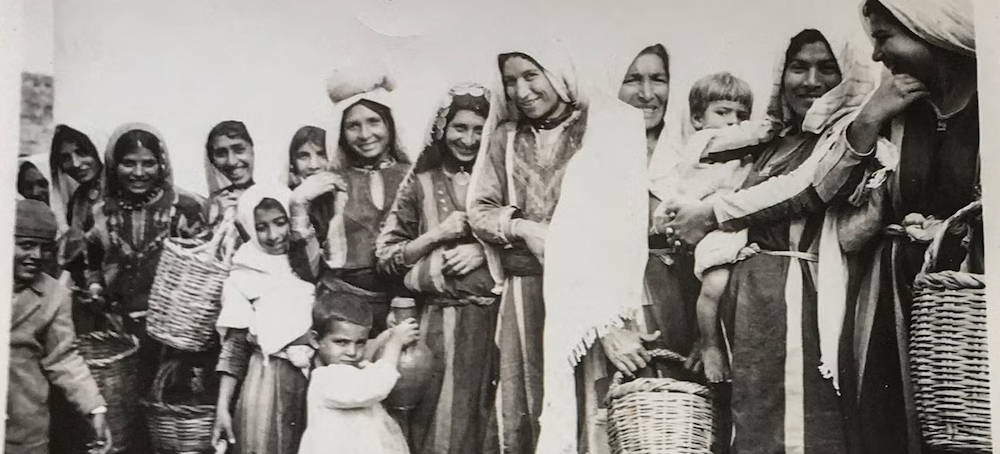 A photo taken by Don Peretz of Palestinian Arab women in a village where he distributed food and clothes in northern Israel, 1949. (photo: Deborah Peretz)
29 january 24 (RSN.org)
My research shows this tradition runs deep.
On a cold and rainy November day, a 65-year-old American rabbi trudged down the muddy roads of a Palestinian refugee camp. When the rabbi and his colleagues stopped, refugees gathered around them in a scene of “disappointment, frustration, [and] despair.” Gaunt men and “children, big-eyed and thin,” walked up and clutched the rabbi’s raincoat. Several began chanting, in Arabic, “We want to go home!” Weary, broken women watched silently from their tents as rain and wind chilled their bare feet. Guilt overcame the rabbi. “In my deepest heart, I said the prayer of confession,” the rabbi wrote, referring to a prayer recited on Yom Kippur, the fast of atonement. “Anachnu Chatanu.” We have sinned.
One could imagine this scene taking place recently. Yet it was 1953 when Rabbi Morris Lazaron walked through the refugee camp—Shatila, located in Lebanon—where he witnessed firsthand the suffering of Palestinian families who had lost their homes during the war that accompanied Israel’s creation in 1948. The “illimitable misery” of the refugees, to use Lazaron’s words, had a decisive impact on the former head rabbi of the prestigious Baltimore Hebrew Congregation. After his trip, Rabbi Lazaron began calling on the Israeli government to recognize the right of Palestine’s Arab refugees to return to their prewar homes and urged the Jewish state to admit 100,000 of them into the country immediately.
Lazaron felt that the Jewish historical experience should compel all Jews to support the Palestinian refugees. As members of what he called “the tribe of the wandering feet,” Lazaron pressed fellow American Jews to remember that they, too, were once “strangers in the land of Egypt.” Jewish identity weighed heavily on the rabbi’s mind as he considered how to respond to Palestinian suffering. Yet the hidden context of the rabbi’s trip reveals that the stakes of his response extended far beyond the realm of Jewish ethics. Lazaron’s visit to Lebanon had been organized and financed by a secretly CIA-funded advocacy organization called American Friends of the Middle East, a group created to give Americans a more sympathetic picture of the Arab side of the Israeli-Arab conflict. AFME published Lazaron’s book about the trip in 1955, apparently as part of a broader public relations effort that aimed to make it easier for United States officials to pressure Israel to accept the return of 75,000 Palestinian refugees.
The CIA was far from the only government body interested in American Jewish responses to the Palestinian refugee crisis. Lazaron articulated his lament on a playing field where various governmental actors—Israeli, American, and Arab—all jockeyed to shape U.S. public opinion surrounding the Palestinian refugee question. Just as AFME was organizing Lazaron’s trip, Israeli diplomats were quietly working to undermine both the Jewish newspaper that Lazaron wrote for and the anti-Zionist Jewish group he represented, the American Council for Judaism, which in turn had begun fostering warm ties with Arab officials. The American Jewish debate over Palestinian rights involved a struggle over Jewish identity, as Lazaron’s words reflect. But as his broader story shows, the debate also is, and always has been, part of a high-stakes political struggle between government officials and others over the future of Israel, the fate of the Palestinians, and the orientation of American foreign policy toward the Middle East.
There is a narrative about the trajectory of the American Jewish relationship with Israel that pervades all corners of the organized Jewish community today. “For millions of secular-minded American Jews, Israel was the glue. Israel was the cause,” declared conservative commentator Bret Stephens at the American Jewish Committee’s 2022 Global Forum. “Zionism was an effective and powerful and emotionally satisfying substitute for religious observance,” he continued, bemoaning that in contrast, “at the height of last year’s war [the 2021 Gaza crisis], so many young American Jews were eagerly signing letters denouncing Israeli behavior.”
While young American Jewish letter-signers may not appreciate Stephens’ tone, they probably would not dispute the gist of his historical observation, which is considered common knowledge both in Jewish political commentary and in scholarly works. For decades, American Jews had rallied around the Jewish state, with Israel uniting American Jewry in a way that nothing else could, including religion. But then at some point, according to this telling, young left-wing Jews began criticizing Israel over its policies toward the Palestinians, breaking with past generations to shatter this once-sacred consensus and imperil any semblance of Jewish unity.
Despite its ubiquity, this narrative is flawed in its basic assumptions. Ever since an estimated 750,000 Palestinians lost their homes amidst Israel’s birth in 1948, there have been American Jews deeply unsettled by Israeli policies toward both the Palestinian refugees and Arabs living under Israeli rule. These critics of old consisted not only of a few stray rabbis like Morris Lazaron, but in fact extended well into the American Jewish establishment—including leaders and staff members of the AJC. The collective amnesia with regard to this history has been complete: None of the over 1,000 AJC members in Stephens’ audience likely had any idea that in 1957 their organization’s president confronted Prime Minister David Ben-Gurion, urging him to liberalize Israel’s policies toward its Arab citizens. The audience would not have known that at an AJC gala 66 years before their own, the Jewish advocacy organization announced a plan to aid Palestinian refugees that it ultimately shelved in response to Israeli pressure. And unless they had sifted through faded yellow papers in their archives, they could not have known that the first Middle East expert on the AJC’s staff, Don Peretz, lost his job because Israeli diplomats did not like his research on the Palestinian refugee issue.
Stephens and his audience cannot be faulted for being unaware of these past events because they are, more or less, unknown. Histories of American Jewish life make almost no mention of any communal concern for the Palestinians in the years after Israel’s creation, implying that it emerged, at the earliest, in the 1970s. Even studies of Jewish anti-Zionism and non-Zionism during Israel’s early years have tended to neglect the Palestinian question, focusing instead on debates over the role of nationalism in Jewish identity.
The fact that this historical undercurrent is so unknown is, to some extent, the result of concerted campaigns. From the beginning, Israeli diplomats watched American Jewish interest in Palestinian rights issues with deep suspicion. Declassified Israeli foreign ministry files reveal that some of Israel’s most celebrated diplomats secretly plotted to undermine American Jews who wrote about the sensitive question of Palestinian refugees, often succeeding in getting them removed from positions of influence. These diplomats persuaded reluctant employers to drop “troublesome” employees whom they had once trusted, quietly sidelining various American Jewish efforts to highlight or resolve Palestinian rights issues in the 1950s, 1960s, and 1970s.
These findings call for a rethinking of the very nature of the early Israel-American Jewish relationship. So much written about this era focuses on the emotional affinities that American Jews held for Israel, but far less has been written on Israel’s views of American Jewry. Rather than acting from a place of emotional connection and intracommunal kinship, Israeli officials acted in pragmatic ways toward the American Jewish community in the context of a wider public relations battle that raged between them and pro-Arab voices, which included Arab diplomats and some in the U.S. government. Israel during its early years was in a precarious place as it faced an economic crisis, high security costs, and the expense of resettling hundreds of thousands of Jewish immigrants. To meet these budgetary needs, the Israeli government turned to American Jews, who between 1948 and 1956 sent Israel more than $700 million in charitable donations and over $270 million in cash from bond sales, a combined sum that would total over $10 billion in 2022 dollars. American supporters of Israel, including Jews, also lobbied elected officials on diplomatic issues and successfully urged the government to send economic aid to Israel, which totaled $450 million (around $5 billion today) in combined loans and grants during that same eight-year stretch. Since the young country was reliant on American Jewish support in so many ways, perhaps it should be expected that its officials acted to ensure that the question of Palestinian rights did not weaken American Jewry’s commitment to Israel, harm Israel’s public image, and damage the U.S.–Israel relationship more broadly. Israel was, in short, acting as any state might, given the circumstances.
To a certain extent, my new book shows that Israeli leaders instrumentalized American Jewish organizations, which highlights the power of the young state and the political savvy of its diplomats. But to focus only on that would be an oversimplification. American Jewish organizations first had to yield some of their autonomy to the Jewish state. Doing so involved American Jews beginning to conceptualize their interests and ideals not as distinct from those of Israel but as identical to them—a process that blurred crucial differences between the community and the state. This required that these organizations turn away from a distinctive American Jewish identity as a historically dispossessed minority that has thrived in a liberal secular state and instead adopt the values of Israel, a country premised on meeting the needs of an ethno-national majority. To frame the question underlying this shift in biblical terms, as Lazaron might have: Is the core of Jewish identity remembering that “we were once strangers in the land of Egypt”? Or is it all about maintaining a restored Kingdom of David?
American Jews of the 1940s, 1950s, and beyond often had remarkably deep conversations about the meaning of Israel’s power over Palestinians. In recovering this history, Our Palestine Question serves not so much as a starting point for discussion as a medium that will inform conversations that are already taking place today and engage them with lost voices from the past. From there, one can see how the path to the present involved not fate but crucial decisions made over the course of decades that have shaped the politics of today surrounding Israel, the Palestinians, and the nature of transnational Jewish politics.
This history sheds light on political dynamics that at times feel very distant from those of the present. The American Jewish establishment did not always view anti-Zionism as inherently antisemitic. Some Jewish community leaders considered themselves “non-Zionist” until years after Israel’s founding. American Jewish institutions that had been established long before 1948 took time to accommodate themselves to the reality of Jewish statehood, a process that involved countless discussions about what Jewish sovereignty overseas meant for Jewish citizens of the United States. Jews had been a perpetual minority, so many American Jewish institutions had mobilized around liberal and left-leaning ideologies designed to protect minority groups and those seeking refuge. Suddenly, after 1948, there was a Jewish state that not only ruled over a non-Jewish minority group but also denied the right of refugees to return to their homes on the basis of their ethnicity and religion. Israel’s birth created a sense of cognitive dissonance for these American Jewish organizations as they attempted to come to terms with Israel’s power over the Palestinians without abandoning the ideologies that they regularly used to protect the rights of Jews outside the Jewish state.
More than 75 years later, American Jews are grappling with new aspects of these same crises, an internal struggle that the bloody Israel-Hamas war in Gaza has made all that more urgent. These dilemmas will not be resolved easily, but perhaps the only way to start working through them is by reflecting on their long, forgotten history.
Tarot Card for January 30: The Star

| The Star The Star (or Daughter of the Firmament) is numbered seventeen and is probably the most optimistic and beautiful card in the deck. A beautiful young woman, often naked, is depicted pouring water from a jug into the ground or into a pool by her feet. There are stars in the sky above her.Stars have long been seen as symbols of hope, regeneration, vision and new life. When this card appears, you know somehow that life is just about to become easier and brighter. Life’s forces combine to assist rather than hinder.Here is the truth about our power – we can join the solid earth of material existence with the flowing waters of spirit and create within ourselves a Universe. We have removed self-criticism and concentrated instead on our skills and strengths. When we regard ourselves with love, humour, tenderness and sympathy, we access the God and Goddess within and we are transformed.”Every man and woman is a star” A. Crowley |
The News Business Really Is Cratering
The state of the industry is more dire than ever.
Twenty percent of the Los Angeles Times’ newsroom was laid off in January. What does that mean for the future of journalism? | Mario Tama/Getty Images
By JACK SHAFER
01/27/2024 07:00 AM EST (politico.com)
Jack Shafer is Politico’s senior media writer. He has written commentary about the media industry and politics for decades and was previously a columnist for Reuters and Slate.
Journalists across the country burst into flames of panic this week, as bad news for the news business crested and erupted everywhere all at once.
Patrick Soon-Shiong, the billionaire publisher of the Los Angeles Times, laid off 20 percent of his newsroom. Over at Time magazine, its billionaire owners, Marc and Lynne Benioff, did the same for 15 percent of their unionized editorial employees. This latest conflagration had ignited at Sports Illustrated the previous week as catastrophic layoffs were dispensed via email to most staffers. Business Insider (whose parent company Axel Springer also owns POLITICO) jettisoned 8 percent of its staff while workers at Condé Nast, Forbes, the New York Daily News and elsewhere walked out to protest forthcoming cuts at their shops.
The news business has always been cyclical, dipping during economic downturns and then improving on the upswing. But not so anymore, as our economy has been surprisingly strong of late. Nearly everywhere you look — the Washington Post, NPR, Vice, Vox, NBC News, Texas Tribune, WNYC, Barstool Sports, just to name a few — companies have axed huge swathes of staff. Newsroom employment is down more than 26 percent since 2008. Buzzfeed News is dead. The magazine business has atrophied, too, as newsstand revenues have fallen from $6.8 billion in 2006 to $1 billion in 2022. Looking on as the media business bleeds out, journalism professor Jeff Jarvis, a man who once evangelized for the industry’s electronic future, folded his hands in his lap like a mortician and asked in his blog if it was time to give up on old news. Citing the dark layoff news, Jarvis tidied the corpse-in-the-making. Trust in journalism has melted, he noted, and private equity shops like Alden Global Capital are cannibalizing their newspapers.
It would be far too dramatic to extrapolate from the disastrous week that journalism itself is dying. The New York Times is healthy. Thanks to good management and demographically vigorous readerships, the Boston Globe and Minneapolis Star Tribune carry on. Cable, network and local TV news still toss off profits. But no matter how many heroic nonprofit newsrooms like the Baltimore Banner and Daily Memphian take root, no matter how many Substack-like newsletters blossom or creators emerge to drop their videos on YouTube, you can’t deny the journalism business’ decline.
The cause of the business’ decline is simple. As tech analyst Benedict Evans succinctly put it in a post this week, “There’s very little you can say about the finances of the newspaper industry that you couldn’t have said 15 or 20 years ago. The old model went away: you had an oligopoly over both advertisers & readers, and real-estate agents and car dealers paid for your social purpose. Now they don’t need you.” Targeted advertising on the web has diminished the old advertisers’ complaint that 50 percent of their ad budgets are wasted and they just didn’t know which half. Now they do, and they avoid newspapers and magazines. Unless a publisher creates something so essential that readers are willing to pay for it — like the New York Times, the Wall Street Journal or POLITICO, which gets more than half of its revenue from paid subscribers — the sledding will be more than rough. It will be ruinous.

Want to read more stories like this? POLITICO Weekend delivers gripping reads, smart analysis and a bit of high-minded fun every Friday. Sign up for the newsletter.
As journalism falls into eclipse but does not completely vanish, newsrooms will continue to contract. This is terrible for the workers who will be discarded. But worse still, it sends a market signal to aspiring journalists that they should avoid the profession because there are no vacancies to fill.
With fewer entry-level jobs and fewer outlets for freelancers, the pipeline of talent that has long watered larger publications with experienced journalists might dry up. Where will aspiring nonfiction book authors learn their trade? The alternative weeklies realm, from which I hail and which trampolined many young journalists into larger, more prestigious news organizations, are a much diminished force. Once healthy papers folded in places like New York, San Francisco, Boston and Minneapolis; suspended printing in cities like Washington; went biweekly, as in Chicago and Seattle; or otherwise trimmed their page counts down from the early 21st century boom days.
Isn’t there any optimism out there? Certainly not from Harvard’s Nieman Reports, which published Katherine Reynolds Lewis’ obituary in October titled “Hey Journalists, Nobody Is Coming to Save Us.”
There has been no shortage of commentary about the harm that will befall democracy as the watchdogs get sacked, but should we believe them? Writing in the 1880s, Ambrose Bierce pierced this pretention. “From whom, my friends, do you hear all this talk about the great good wrought by the press, its vigilant guardianship of the public interest, its conservation of the public morals? From the newspapers, and from those who accept their word without analysis,” he wrote. No matter which side you stand on the democracy-requires-a-free-and-vigorous-press proposition, we’re about to test it.
The ongoing flood obviously won’t sweep all journalism away. But except for a few big players, will it become more of a cottage industry than an economic and cultural force? If great cities like Los Angeles, with its many prosperous, educated and engaged citizens, can’t support a decent daily newspaper, what hope is there for the rest of the country? Are we belatedly learning that the great journalism empires — the Times-Mirror chain, Knight Ridder, Gannett, Scripps-Howard, Tribune, McClatchy, Advance Publications, Hearst, Freedom Communications and the rest — weren’t journalism empires as much as they were advertising colossuses, and that they became doomed when they lost status as the best advertising vehicle?
MOST READ
- ‘F—ing lunatics’: Deadly Jordan attacks spur open GOP feud
- The Trump defense industrial complex goes a bit quiet after Carroll verdict
- The huge wedge between McConnell and Johnson: Donald Trump
- Trump Can’t Be Dictator on ‘Day One’ — Or in a Second Term. Here’s Why.
- Trump calls UAW president a ‘dope’ after union endorses Biden
Journalism will survive, of course, even if the business falters as the advertising subsidy that made it viable erodes. Publications for readers who depend on market-moving news like you find in the Wall Street Journal, Bloomberg News and other business titles will endure. So will the aforementioned New York Times, which provides news that moves political markets and has established itself as a national voice worth paying for. So, too, will the gossip and lifestyle magazines remain, as will publications like the New York Review of Books and the New Yorker, which serve, boutique-style, a loyal, educated readership. But like the animals that persisted after the great comet struck the earth, most publications will be tiny and eke out an existence in the shadows. Perhaps organized labor and political parties will step forward to sponsor news. But could you trust either to produce real news? That would be like expecting General Motors or Citibank to give you the honest lowdown on the automotive and financial goings-on.
Will journalism become a hobby like scrapbooking or street busking, done on the cheap or for donations, but one without much of a career path? Will we become increasingly dependent on solo, opinionated practitioners on Substack like Matthew Yglesias and Glenn Greenwald and city newsletters like the ones from Axios to keep abreast of news not produced by the giants?
The journalism party might not be completely over. It’s human nature to interpret any bad news as the coming apocalypse. But let’s get drunk anyway and then sober up for what’s to come next.
It took all my powers as a typist not to write, “Winter is coming.” Send cliches to Shafer.Politico@gmail.com. No new email alert subscriptions are being honored at this time. My X and Threads accounts are the tiny voles that will evolve to become mastodons (no pun inferred) after the comet hits. My RSS feed died before journalism did.
Book: “Defying Hitler: A Memoir”
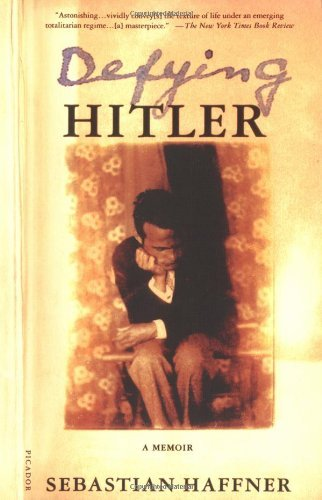
Defying Hitler: A Memoir
by Sebastian Haffner (Author), Oliver Pretzel (Translator)
Written in 1939 and unpublished until 2000, Sebastian Haffner’s memoir of the rise of Nazism in Germany offers a unique portrait of the lives of ordinary German citizens between the wars. Covering 1907 to 1933, his eyewitness account provides a portrait of a country in constant flux: from the rise of the First Corps, the right-wing voluntary military force set up in 1918 to suppress Communism and precursor to the Nazi storm troopers, to the Hitler Youth movement; from the apocalyptic year of 1923 when inflation crippled the country to Hitler’s rise to power. This fascinating personal history elucidates how the average German grappled with a rapidly changing society, while chronicling day-to-day changes in attitudes, beliefs, politics, and prejudices.
(Amazon.com)
Yes: William Stafford’s Poetic Calibration of Perspective
By Maria Popova (themarginalian.org)

When a recent bout of illness sent me sulking with indignant disappointment at the ruin of long laid plans, I had to remind myself that we were never promised any of this; that it is hubris and self-importance and almost touching delusion to expect an indifferent cosmos to bend to our will, our wishes, and our plans; that meeting the universe on its own terms is the end of suffering.
Through the haze of what Virginia Woolf called the “wastes and deserts of the soul” exposed by being ill, I remembered a lovely calibration of perspective by the poet and peace activist William Stafford (January 17, 1914–August 28, 1993), found in the posthumous collection The Way It Is: New and Selected Poems (public library).

YES
by William StaffordIt could happen any time, tornado,
earthquake, Armageddon. It could happen.
Or sunshine, love, salvation.It could, you know. That’s why we wake
and look out — no guarantees
in this life.But some bonuses, like morning,
like right now, like noon,
like evening.
Stafford had a late start as a poet — his first major collection was published when he was 48. And then the poems that had been writing themselves in him all his life came pouring out, spare and stunning. Within eight years, he was elected Poet Laureate of the United Staes.
The morning before he died in the final year of his seventies, he drafted a poem containing these lines:
will happen. I’m [still] here writing it down
just the way it was. “You don’t have to
prove anything,” my mother said. “Just be ready
for what God sends.” I listened and put my hand
out in the sun again. It was all easy.
Complement with Viktor Frankl, writing shortly after his release from the concentration camps, on saying “yes” to life in spite of everything and Henry James on how to stop waiting and start living, then revisit Barbara Ras’s kindred poem “You Can’t Have It All” and Hannah Emerson’s cosmic howl of yes yes yes.
The Bird in the Heart: Terry Tempest Williams on the Paradox of Transformation and How to Live with Uncertainty
By Maria Popova (themarginalian.org)

It is strange how, in a universe governed by relentless change, human beings hunger for constancy — our bodies wired for homeostasis, our minds hooked on habit, our hearts yearning for everlasting love. We live as patterns unaware of perpetuating themselves, our aching resistance to change reflected in the routines and rituals and relationship formulae out of which we build the superstructure of belief that houses all of our actions, reactions, and choices.
It is not easy, reconfiguring this superstructure to fit something new — a new practice, a new person, a new way of being. The more transformative the new element, the more challenging it is to figure it into the pattern of life as we know it — a pattern shaped by what we believe about love, that deepest sinew of the self.
This delicate, difficult, wildly rewarding reconfiguration is what Terry Tempest Williams explores in When Women Were Birds: Fifty-four Variations on Voice (public library) — a soaring meditation on life, love, and the stories we tell ourselves about who we are, sparked by an unexpected revelation: When, in her mid-fifties, at the exact age her mother was when she died, Williams finally opened the journals her mother had bequeathed her, she was staggered to find them all blank — a kind of “second death” that catalyzed a profound reckoning with the meaning of voice, of words, of how we write the story of who we are and how we revise it, lensed through the love of birds she shared with her mother.
Art by Sophie Blackall from If You Come to Earth
Williams writes:
Because we suffer a congenital blindness to what lies on the other side of transformation — a blindness brilliantly illustrated by the Vampire Problem thought experiment — it is often chance, not choice, that brings about the profoundest change. Life sweeps us off course — a terrible diagnosis arrives, an unimagined opportunity emerges, an unexpected person enters the heart — and suddenly we must begin again, rebuilding the superstructure of being on this new terrain. (“It could happen any time…”)
Williams finds improbable consolation for the challenge of change in her encounter with a bird out of place. The painted bunting — the most exuberantly colored bird north of Mexico, which so confused Linnaeus with its exotic plumage that he falsely classified it as native to India; a species now thought to orient by the pole star during migration — “had flown in on the tail of a blizzard, been blown off course, and stayed,” making a new life in Maine, a new pattern of being: Each day just before dawn, the painted bunting alighted to a neighbor’s bird feeder like clockwork.
Painted bunting by Mark Catesby, 1729-1731. (Available as an art print and as stationery cards, benefitting The Nature Conservancy.)
Watching the bird one snowy morning, Williams writes:
[…]
The bunting got caught in a storm and stayed. I have been seized in a storm of my own making. Whirlwind. World-wind. Distracted and displaced. In the wounding of becoming lost, I can correct myself.
Echoing Emerson’s indictment that “people wish to be settled [but] only as far as they are unsettled is there any hope for them,” Williams adds:
A century after Virginia Woolf contemplated finding beauty in the uncertainty of being in the interlude between two world wars, Williams adds:
This vascular malformation could bleed and burst. Or I can simply go on living, appreciating my condition as a vulnerable human being in a vulnerable world, guided by the songs of birds. What is time, sacred time, but the acceleration of consciousness? There are so many ways to change the sentences we have been given.
Complement these fragments of the entirely wonderful When Women Were Birds with Milan Kundera on life’s central ambivalence of knowing what we really want, Rebecca Solnit on how we find ourselves by getting lost, and George Saunders on the courage of uncertainty, then revisit Williams on our responsibility to awe.
War, Peace, and Our Possible Futures: George Saunders on Storytelling the World’s Fate and the Antidote to Media Manipulation
By Maria Popova (themarginalian.org)

“All the goodness and the heroisms will rise up again, then be cut down again and rise up,” John Steinbeck wrote to his best friend at the peak of WWII. “It isn’t that the evil thing wins — it never will — but that it doesn’t die.”
This is a story many believe to be true — a story about human nature, written into the scripture of original sin, ensuring that we will go on perpetrating evil for as long as we keep telling and believing that story.
We — as individuals, as a culture, as a species — rise and fall to the expectations placed upon us, most of all to the expectations we place upon ourselves. After all, our very minds are model-fulfillment machines. Bruce Lee understood this: “You will never get any more out of life than you expect,” he wrote to himself. All expectation is a story — a story about what is true and what is possible — and a story is a model of reality. But the history of our species is the history of mistaking our models for reality, only to find them unmasoned by the sudden revelation of another region of reality, another possibility — our mathematical models of how the universe works (Einstein’s relativity upends Newton’s clockwork cosmos, and suddenly space and time are new, are one), our political models of how the world works (the French Revolution upends the feudal system, and suddenly a constellation of people’s republics lights up the possibility of liberal democracy), our personal models of how the self works (you fall in love with the most improbable person, and suddenly your entire story of who you are and what you want is rewritten).

All models of reality are drawn by an imagination filtered through our fears and our hopes in a proportion mediated by our conditioning, which is always the function of story. It is the stories we believe that shape what we become, shape what the world is. In an age when commercial media have become the great conditioning engine of society, selling models of reality because they are profitable and not because they are true, it matters all the more what stories we believe, and what we resist.
That is what George Saunders explores throughout his prophetic 2007 essay collection The Braindead Megaphone (public library), composed in the wake of the American invasion of Iraq and in the infancy of social media. He writes:
Because the idea is always only an approximation of the world, whether that action will be catastrophic or beneficial depends on the distance between the idea and the world.
Mass media’s job is to provide this simulacra of the world, upon which we build our ideas. There’s another name for this simulacra-building: storytelling.
He considers the antidote to the sensationalist, manipulative, and altogether reality-warping stories comprising the basic business model of modern media — a model built on marketable antagonism and othering:

Art from The Three Astronauts — Umberto Eco’s vintage semiotic children’s book about world peace
The challenge of telling better stories about the possibilities between us and within us is all the more urgent under the realities of war, when the aperture of compassion and understanding so dangerously narrows. All war, Saunders observes, requires “awareness of the law of unintended consequences” and “familiarity with the world’s tendency to throw aggressive energy back at the aggressor in ways he did not expect” — nuanced complexities absent from the sensationalist headlines of mass media and the fanged soundbites of social media.
With an eye to the murderous models of reality that incite the energies of war, he envisions an alternative for our culture’s story of itself:

Art by Olivier Tallec from What If…
In another essay, Saunders finds himself rereading Kurt Vonnegut’s Slaughterhouse Five — a book written decades earlier in the middle of another war — and contemplating the power of storytelling, with all its capacity for nuance and complexity absent from the media model, as our best mechanism for bridging reality and possibility. An epoch after Steinbeck lamented that the evil of war will never go away, Saunders celebrates Vonnegut’s enduring gift to the world:
[…]
The book didn’t stop the current war, and won’t stop the next one, or the one after that. But something in me rose to the truth in it, and I was put in proper relation to the war going on now. I was, if you will, forbidden to misunderstand it. It is what it is: massacre and screaming and confusion and blood and death. It is the mammoth projection outward of the confused inner life of a handful of men. When someone says war is inevitable, or unavoidable, or unfortunate but necessary, they may be right. Vonnegut’s war was necessary. And yet it was massacre and screaming and confusion and blood and death. It was the mammoth projection outward of the confused inner life of men. In war, the sad tidy constructs we make to help us believe life is orderly and controllable are roughly thrown aside like the delusions they are. In war, love is outed as an insane, insupportable emotion, a kind of luxury emotion, because everywhere you look, someone beloved to someone is being slaughtered, by someone whose own beloved has been slaughtered, or will be, or could be. There’s something sacred about reading a book like Slaughterhouse Five, even if nothing changes but what’s going on inside our minds. We leave such a book restored, if only briefly, to a proper relation with the truth, reminded of what is what, temporarily undeluded, our better nature set back on its feet.
Although a novel and a news story may deal with the same subject matter drawn from the same facts of life, there is a universe of difference between the stories of reality and possibility each seeds into the world. It is within our power, Saunders reminds us, to resist the media manipulation machine — the “braindead megaphone” telling us that the world is broken, war inevitable, and human beings doomed by their own nature. Urging us to “insist that what’s said through it be as precise, intelligent, and humane as possible,” he writes:
Couple with Saunders on how to love the world more, then revisit Richard Powers on rewriting the history of our future, May Sarton on how to live openheartedly in a harsh world, and Maya Angelou’s cosmos-bound poem about rising to our human potential.