
New Thinking Allowed with Jeffrey Mishlove Sep 14, 2023 Vernon Neppe, MD, PhD, FRSSAf, is a neuropsychiatrist, and consciousness researcher He is and a Distinguished Fellow of the American Psychiatric Association, and recipient of the Whiting Memorial Award (with Dr. Ed Close). He is author of Déjà Vu Revisited, Déjà Vu: A Second Look, Déjà Vu: Glossary and Library, and Innovative Psychopharmacotherapy. Dr Neppe has amplified many of his concepts in three of the websites linked with his work. His books are amplified on www.Brainvoyage.com; www.VernonNeppe.org is his gateway and includes more information on the Neppe-Close model of the Triadic Distinction Vortical Paradigm (TDVP) and some of the key publications are on www.pni.org. Together with Dr Edward Close, he pioneered the new discipline of what they call “Dimensional Biopsychophysics”. He is author, with physicist and mathematician, Edward Close PhD, PE, of Reality Begins with Consciousness: A Paradigm Shift that Works. His professional publications number over 700. In this discussion, Dr. Neppe proposes connections between the Neppe-Close theoretical model of higher consciousness and reality and its implications for our understanding of the divine. He regards the 9-dimensional quantized finite volumetric model of reality as necessarily embedded within the Infinite continuity. Our physical reality is simply part of that nine dimensional finite with us we sentient beings experiencing only components of the four ‘lower” dimensions. Gimmel constitutes the previously unrecognized necessarily ubiquitous third component of reality (besides mass-energy). Gimmel allows for the integration of all levels of reality into one unified model and facilities the unification of mathematics at the finite quantal, macro-world and cosmological levels and infinite continuity into one reality. 00:00 Introduction 06:48 Infinity 09:37 Gimmel 15:45 Mathematics 18:55 Dark matter & energy 27:57 God 34:58 Time 37:26 Postmortem survival 43:20 Conclusion Edited subtitles for this video are available in Russian, Portuguese, Italian, German, French, and Spanish. New Thinking Allowed host, Jeffrey Mishlove, PhD, is author of The Roots of Consciousness, Psi Development Systems, and The PK Man. Between 1986 and 2002 he hosted and co-produced the original Thinking Allowed public television series. He is the recipient of the only doctoral diploma in “parapsychology” ever awarded by an accredited university (University of California, Berkeley, 1980). He is also the Grand Prize winner of the 2021 Bigelow Institute essay competition regarding the best evidence for survival of human consciousness after permanent bodily death. (Recorded on August 20, 2023)
Monthly Archives: September 2023
Free Will Astrology: Week of September 14, 2023
SEPTEMBER 12, 2023 AT 7:00 AM BY ROB BREZSNY (newcity.com)

Photo: Patricia Jekki
ARIES (March 21-April 19): Aries photographer Wynn Bullock had a simple, effective way of dealing with his problems and suffering. He said, “Whenever I have found myself stuck in the ways I relate to things, I return to nature. It is my principal teacher, and I try to open my whole being to what it has to say.” I highly recommend you experiment with his approach in the coming weeks. You are primed to develop a more intimate bond with the flora and fauna in your locale. Mysterious shifts now unfolding in your deep psyche are making it likely you can discover new sources of soulful nourishment in natural places—even those you’re familiar with. Now is the best time ever to hug trees, spy omens in the clouds, converse with ravens, dance in the mud, and make love in the grass.
TAURUS (April 20-May 20): Creativity expert Roger von Oech says businesspeople tend to be less successful as they mature because they become fixated on solving problems rather than recognizing opportunities. Of course, it’s possible to do both—untangle problems and be alert for opportunities—and I’d love you to do that in the coming weeks. Whether or not you’re a businessperson, don’t let your skill at decoding riddles distract you from tuning into the new possibilities that will come floating into view.
GEMINI (May 21-June 20): Gemini author Fernando Pessoa wrote books and articles under seventy-five aliases. He was an essayist, literary critic, translator, publisher, philosopher, and one of the great poets of the Portuguese language. A consummate chameleon, he constantly contradicted himself and changed his mind. Whenever I read him, I’m highly entertained but sometimes unsure of what the hell he means. He once wrote, “I am no one. I don’t know how to feel, how to think, how to love. I am a character in an unwritten novel.” And yet Pessoa expressed himself with great verve and had a wide array of interests. I propose you look to him as an inspirational role model in the coming weeks, Gemini. Be as intriguingly paradoxical as you dare. Have fun being unfathomable. Celebrate your kaleidoscopic nature.
CANCER (June 21-July 22): “Rather than love, than money, than fame, give me truth.” Cancerian author Henry David Thoreau said that. I don’t necessarily agree. Many of us might prefer love to truth. Plus, there’s the inconvenient fact that if we don’t have enough money to meet our basic needs, it’s hard to make truth a priority. The good news is that I don’t believe you will have to make a tough choice between love and truth anytime soon. You can have them both! There may also be more money available than usual. And if so, you won’t have to forgo love and truth to get it.
LEO (July 23-Aug. 22): Before she got married, Leo musician Tori Amos told the men she dated, “You have to accept that I like ice cream. I know it shows up on my hips, but if you can’t accept that, then leave. Go away. It is non-negotiable.” I endorse her approach for your use in the coming weeks. It’s always crucial to avoid apologizing for who you really are, but it’s especially critical in the coming weeks. And the good news is that you now have the power to become even more resolute in this commitment. You can dramatically bolster your capacity to love and celebrate your authentic self exactly as you are.
VIRGO (Aug. 23-Sept. 22): The Virgo writer Caskie Stinnett lived on Hamloaf, a small island off the coast of Maine. He exulted in the fact that it looked “the same as it did a thousand years ago.” Many of the stories he published in newspapers featured this cherished home ground. But he also wandered all over the world and wrote about those experiences. “I travel a lot,” he said. “I hate having my life disrupted by routine.” You Virgos will make me happy in the coming weeks if you cultivate a similar duality: deepening and refining your love for your home and locale, even as you refuse to let your life be disrupted by routine.
LIBRA (Sept. 23-Oct. 22): My hitchhiking adventures are finished. They were fun while I was young, but I don’t foresee myself ever again trying to snag a free ride from a stranger in a passing car. Here’s a key lesson I learned from hitchhiking: Position myself in a place that’s near a good spot for a car to stop. Make it easy for a potential benefactor to offer me a ride. Let’s apply this principle to your life, Libra. I advise you to eliminate any obstacles that could interfere with you getting what you want. Make it easy for potential benefactors to be generous and kind. Help them see precisely what it is you need.
SCORPIO (Oct. 23-Nov. 21): In your history of togetherness, how lucky and skillful have you been in synergizing love and friendship? Have the people you adored also been good buddies? Have you enjoyed excellent sex with people you like and respect? According to my analysis of the astrological omens, these will be crucial themes in the coming months. I hope you will rise to new heights and penetrate to new depths of affectionate lust, spicy companionship, and playful sensuality. The coming weeks will be a good time to get this extravaganza underway.
SAGITTARIUS (Nov. 22-Dec. 21): Is it ever morally permissible to be greedily needy? Are there ever times when we deserve total freedom to feel and express our voracious longings? I say yes. I believe we should all enjoy periodic phases of indulgence—chapters of our lives when we have the right, even the sacred duty, to tune into the full range of our quest for fulfillment. In my astrological estimation, Sagittarius, you are beginning such a time now. Please enjoy it to the max! Here’s a tip: For best results, never impose your primal urges on anyone; never manipulate allies into giving you what you yearn for. Instead, let your longings be beautiful, radiant, magnetic beacons that attract potential collaborators.
CAPRICORN (Dec. 22-Jan. 19): Here’s a Malagasy proverb: “Our love is like the misty rain that falls softly but floods the river.” Do you want that kind of love, Capricorn? Or do you imagine that a more boisterous version would be more interesting—like a tempestuous downpour that turns the river into a torrential surge? Personally, I encourage you to opt for the misty rain model. In the long run, you will be glad for its gentle, manageable overflow.
AQUARIUS (Jan. 20-Feb. 18): According to the Bible’s book of Matthew, Jesus thought it was difficult for wealthy people to get into heaven. If they wanted to improve their chances, he said they should sell their possessions and give to the poor. So Jesus might not agree with my current oracle for you. I’m here to tell you that every now and then, cultivating spiritual riches dovetails well with pursuing material riches. And now is such a time for you, Aquarius. Can you generate money by seeking enlightenment or doing God’s work? Might your increased wealth enable you to better serve people in need? Should you plan a pilgrimage to a sacred sanctuary that will inspire you to raise your income? Consider all the above, and dream up other possibilities, too.
PISCES (Feb. 19-March 20): Piscean author Art Kleiner teaches the art of writing to non-writers. He says this: 1. Tell your listeners the image you want them to see first. 2. Give them one paragraph that encapsulates your most important points. 3. Ask yourself, “What tune do you want your audience to be humming when they leave?” 4. Provide a paragraph that sums up all the audience needs to know but is not interesting enough to put at the beginning. I am offering you Kleiner’s ideas, Pisces, to feed your power to tell interesting stories. Now is an excellent time to take inventory of how you communicate and make any enhancements that will boost your impact and influence. Why not aspire to be as entertaining as possible?
Homework: For three days, love yourself exactly as you are. Don’t wish you could change yourself. Newsletter.FreeWillAstrology.com
Rupert Spira on what truly is: infinite being

“If we say of a tree ‘it is tall’, ‘it is old’ and so on, the ‘it is’ refers to its reality; the qualities of being ‘tall’ or ‘old’ limit or seem to limit that which the tree truly is – infinite being.“
–Rupert Spira
Rupert Spira (born March 13, 1960) is an English spiritual teacher, philosopher and author of the Direct Path based in Oxford, UK. Wikipedia
(newsletter@rupertspira.com)
Dogen on meditation


Birds aren’t real: How a conspiracy takes flight
Peter McIndoe | TED2023
• April 2023
Peter McIndoe isn’t a fan of birds. In fact, he has a theory about them that might shock you. Listen along to this eye-opening talk as it takes a turn and makes a larger point about conspiracies, truth and belonging in divisive times.
About the speaker
Bird trutherSee speaker profile
Peter McIndoe is the brains behind “Birds Aren’t Real,” the theory that birds are actually drones created by the US government to spy on Americans.
Democracy is natural to humans and animals
Jul 29, 2023 — Thom Hartmann, host of the Thom Hartmann Program and author of the new book “The Hidden History of American Democracy: Rediscovering Humanity’s Ancient Way of Living,” joins David to discuss democracy, happiness, forms of government, traditional societies, and much more. Get the book: https://amzn.to/3QhD93X
Frida Kahlo on How Love Amplifies Beauty: Her Breathtaking Tribute to Diego Rivera
By Maria Popova (themarginalian.org)
As artists, Frida Kahlo (July 6, 1907–July 13, 1954) and Diego Rivera (December 8, 1886–November 24, 1957) each possessed boundless talent bolstered by an unbending will. As partners, they possessed each other with a ferocious love, intense and complicated and all-eclipsing — the kind for which, in Rilke’s immortal words, “all other work is but preparation.” They wed when Kahlo was twenty-two and Rivera forty-two, and remained together until Kahlo’s death twenty-five years later. They had an open marriage long before the term existed as a trend of modern romance — both had multiple affairs, Rivera with women and Kahlo with both men and women, most notably with the American-born French singer, dancer, and actress Josephine Baker and with the Russian Marxist theorist Leon Trotsky. Still, both insisted that they were the love of each other’s life — a deep conviction crystallized in Kahlo’s passionate love letters and Rivera’s affectionate account of their first encounter.
But nowhere does their uncommon love come more vibrantly alive than in Kahlo’s portrait of Rivera, written twenty years into their marriage for a catalog accompanying one of his major exhibitions and later included as an afterword to his autobiography, My Art, My Life (public library). In just a few wholehearted, wholebodied paragraphs, she captures the enormity of their love. Her sincere humanity radiates a testament to the enormity of all love as a transfiguring force, the ultimate wellspring of beauty and grace.

Kahlo begins:
I warn you that in this picture I am painting of Diego there will be colors which even I am not fully acquainted with. Besides, I love Diego so much I cannot be an objective speculator of him or his life… I cannot speak of Diego as my husband because that term, when applied to him, is an absurdity. He never has been, nor will he ever be, anybody’s husband. I also cannot speak of him as my lover because to me, he transcends by far the domain of sex. And if I attempt to speak of him purely, as a soul, I shall only end up by painting my own emotions. Yet considering these obstacles of sentiment, I shall try to sketch his image to the best of my ability.
Under the wildly affectionate gaze of her sketch, Rivera — a man physically unattractive by our culture’s conventional standards of beauty — is transformed into an exquisite, magical, almost supernatural creature. We are left with a bone-deep awareness that the true splendor of a human being, as Ursula K. Le Guin so elegantly demonstrated a generation later, is something quite different from “beauty.” What emerges is ultimately a portrait less of Rivera than of Kahlo’s own astonishing capacity for love and beauty in the largest possible sense.
Diego Rivera and Frida Kahlo in Mexico, 1933 (Photograph by Martin Munkácsi)
Kahlo sketches Rivera:
On rare occasions, an ironic yet tender smile appears on his Buddha-like lips. Seeing him in the nude, one is immediately reminded of a young boy-frog standing on his hind legs. His skin is greenish-white, very like that of an aquatic animal. The only dark parts of his whole body are his hands and face, and that is because they are sunburned. His shoulders are like a child’s, narrow and round. They progress without any visible hint of angles, their tapering rotundity making them seem almost feminine. The arms diminish regularly into small, sensitive hands… It is incredible to think that these hands have been capable of achieving such a prodigious number of paintings. Another wonder is that they can still work as indefatigably as they do.
Diego’s chest — of it we have to say, that had he landed on an island governed by Sappho, where male invaders were apt to be executed, Diego would never have been in danger. The sensitivity of his marvelous breasts would have insured his welcome, although his masculine virility, specific and strange, would have made him equally desired in the lands of these queens avidly hungering for masculine love.
His enormous belly, smooth, tightly drawn, and sphere-shaped, is supported by two strong legs which are as beautifully solid as classical columns. They end in feet which point outward at an obtuse angle, as if moulded for a stance wide enough to cover the entire earth.
He sleeps in a foetal position. In his waking hours, he walks with a languorous elegance as if accustomed to living in a liquefied medium. By his movements, one would think that he found air denser to wade through than water.

Art by Yuyi Morales from Viva Frida, a lovely picture-book celebrating Kahlo’s life and legacy
From this intimate portrait of the man emerges an intimate portrait of the artist as a wholly integrated being, a creature of unselfconscious and uncompromising authenticity:
At the very end of the piece, Kahlo addresses that gruesome yet all too common human tendency to judge other loves from the outside — a violent flattening of the nuance and dimension and enormous richness that exist between two people, perceptible to them alone. She writes:
Complement My Art, My Life with Mary Oliver’s equally, very differently beautiful tribute to the love of her life, then revisit Kahlo’s illustrated love letters to Rivera.
Emily Dickinson’s Electric Love Letters to Susan Gilbert
BY MARIA POPOVA (themarginalian.org)


Four months before her twentieth birthday, Emily Dickinson (December 10, 1830–May 15, 1886) met the person who became her first love and remained her greatest — an orphaned mathematician-in-training by the name of Susan Gilbert, nine days her junior. Throughout the poet’s life, Susan would be her muse, her mentor, her primary reader and editor, her fiercest lifelong attachment, her “Only Woman in the World.”
I devote more than one hundred pages of Figuring to their beautiful, heartbreaking, unclassifiable relationship that fomented some of the greatest, most original and paradigm-shifting poetry humanity has ever produced. (This essay is drawn from my book.)Emily Dickinson at seventeen. The only authenticated photograph of the poet. (Amherst College Archives & Special Collections, gift of Millicent Todd Bingham, 1956)
Susan Gilbert had settled in Amherst, to be near her sister, after graduating from the Utica Female Academy — one of a handful of academically rigorous educational institutions available to women at the time. She entered Dickinson’s life in the summer of 1850, which the poet would later remember as the season “when love first began, on the step at the front door, and under the Evergreens.”
Poised and serious at twenty, dressed in black for the sister who had just died in childbirth and who had been her maternal figure since their parents’ death, Susan cast a double enchantment on Emily and Austin Dickinson. Sister and brother alike were taken with her poised erudition and her Uranian handsomeness — her flat, full lips and dark eyes were not exactly masculine, her unchiseled oval face and low forehead not exactly feminine.
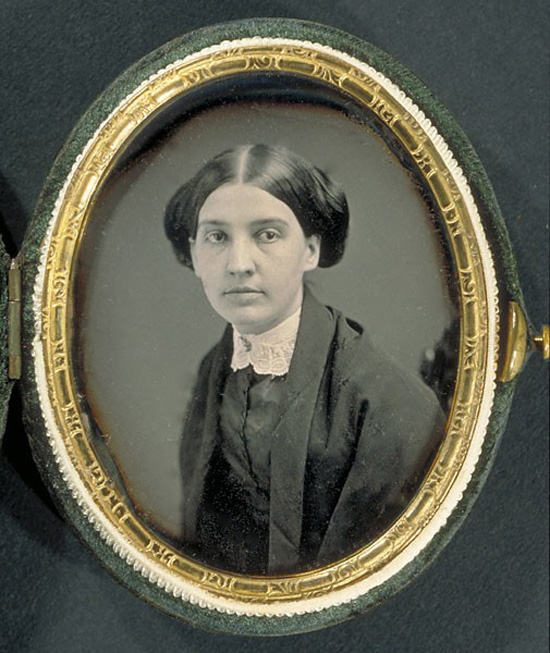
“Best Witchcraft is Geometry,” Emily Dickinson would later write. Now both she and her brother found themselves in a strange bewitchment of figures, placing Susan at one point of a triangle. But Emily’s was no temporary infatuation. Nearly two decades after Susan entered her heart, she would write with unblunted desire:
To own a Susan of my own
Is of itself a Bliss —
Whatever Realm I forfeit, Lord,
Continue me in this!
A tempest of intimacy swirled over the eighteen months following Susan’s arrival into the Dickinsons’ lives. The two young women took long walks in the woods together, exchanged books, read poetry to each other, and commenced an intense, intimate correspondence that would evolve and permute but would last a life- time. “We are the only poets,” Emily told Susan, “and everyone else is prose.”
By early 1852, the poet was besotted beyond words. She beckoned to Susan on a Sunday:
Come with me this morning to the church within our hearts, where the bells are always ringing, and the preacher whose name is Love — shall intercede for us!
When Susan accepted a ten-month appointment as a math teacher in Baltimore in the autumn of 1851, Emily was devastated at the separation, but tried to keep a buoyant heart. “I fancy you very often descending to the schoolroom with a plump Binomial Theorem struggling in your hand which you must dissect and exhibit to your uncomprehending ones,” she teased in a letter. Susan was science personified, capitalized — she would haunt Dickinson’s poems for decades to come as “Science.”

In a comet of a letter from the early spring of 1852, eight months into Susan’s absence, Emily hurls a grenade of conflicted self-revelation:
Will you be kind to me, Susie? I am naughty and cross, this morning, and nobody loves me here; nor would you love me, if you should see me frown, and hear how loud the door bangs whenever I go through; and yet it isn’t anger — I don’t believe it is, for when nobody sees, I brush away big tears with the corner of my apron, and then go working on — bitter tears, Susie — so hot that they burn my cheeks, and almost scorch my eyeballs, but you have wept much, and you know they are less of anger than sorrow.
And I do love to run fast — and hide away from them all; here in dear Susie’s bosom, I know is love and rest, and I never would go away, did not the big world call me, and beat me for not working… Your precious letter, Susie, it sits here now, and smiles so kindly at me, and gives me such sweet thoughts of the dear writer. When you come home, darling, I shan’t have your letters, shall I, but I shall have yourself, which is more — Oh more, and better, than I can even think! I sit here with my little whip, cracking the time away, till not an hour is left of it — then you are here! And Joy is here — joy now and forevermore!
That year, in a Prussian lab, the physician and physicist Hermann von Helmholtz measured the speed of nerve conduction at eighty feet per second. How unfathomable that sentiments this intense and emotions this explosive, launched from a mind that seems to move at light-years per second, can be reduced to mere electrical impulses. And yet that is what we are — biomechanical creatures, all of our creative force, all of our mathematical figurings, all the wildness of our loves pulsating at eighty feet per second along neural infrastructure that evolved over millennia. Even the fathoming faculty that struggles to fathom this is a series of such electrical impulses.
The electricity of Dickinson’s love would endure, coursing through her being for the remainder of her life. Many years later, she would channel it in this immortal verse:
I chose this single star
From out the wide night’s numbers —
Sue — forevermore!
But now, in the dawning fervor of early love, forevermore collides with the immediacy of want. Midway through her spring outpouring, Emily suddenly casts Susan in the third person, as if beseeching an omnipotent spectator to grant her desire in the drama of their impending reunion:
I need her — I must have her, Oh give her to me!
The moment she names her longing, she tempers its thrill with the lucid terror that it might be unspeakable:
Do I repine, is it all murmuring, or am I sad and lone, and cannot, cannot help it? Sometimes when I do feel so, I think it may be wrong, and that God will punish me by taking you away; for he is very kind to let me write to you, and to give me your sweet letters, but my heart wants more.
Here, as in her poetry, Dickinson’s words cascade with multiple meanings beyond literal interpretation. Her invocation of “God” is not a cowering before some Puritanical punishment for deviance but an irreverent challenge to that very dogma. What kind of “God,” she seems to be asking, would make wrong a love of such infinite sweetness?
Four years earlier, during her studies at Mount Holyoke — the “castle of science” where she crafted her stunning herbarium — Emily had begun giving shape to the amorphous doubt about the claims of religion that had been gnawing at her since childhood — doubt she would later immortalize in verse:
It troubled me as once I was —
For I was once a child —
Deciding how an atom — fell —
And yet the heavens — held.
Facing her desire for Susan, her deepest fear was not punishment from “God” but that her wayward heart was its own retribution — as well as its own reward. She writes plaintively that heated summer:
Have you ever thought of it, Susie, and yet I know you have, how much these hearts claim; why I don’t believe in the whole, wide world, are such hard little creditors — such real little misers, as you and I carry with us, in our bosom every day. I can’t help thinking sometimes, when I hear about the ungenerous, Heart, keep very still — or someone will find you out!… I do think it’s wonderful, Susie, that our hearts don’t break, every day… but I guess I’m made with nothing but a hard heart of stone, for it don’t break any, and dear Susie, if mine is stony, yours is stone, upon stone, for you never yield, any, where I seem quite beflown. Are we going to ossify always, say Susie — how will it be?
There is palpable restlessness in Emily’s oscillation between resignation and demand, between love’s longing to be unmasked and the fear of being found out. Later that month, she exhorts Susan: “Loved One, thou knowest!” — an allusion to Juliet’s speech in Romeo and Juliet: “Thou knowest the mask of night is on my face.”
By June, anticipating Susan’s return from Baltimore in three weeks, Emily is pining with unbridled candor:
When I look around me and find myself alone, I sigh for you again; little sigh, and vain sigh, which will not bring you home.
I need you more and more, and the great world grows wider… every day you stay away — I miss my biggest heart; my own goes wandering round, and calls for Susie… Susie, forgive me Darling, for every word I say — my heart is full of you… yet when I seek to say to you something not for the world, words fail me… I shall grow more and more impatient until that dear day comes, for til now, I have only mourned for you; now I begin to hope for you.
She ends her letter with aching awareness of the dissonance between her private desire and the public norms of love:
Now, farewell, Susie… I add a kiss, shyly, lest there is somebody there! Don’t let them see, will you Susie?
Two weeks later, with Susan’s return now days away, her anticipatory longing rises to a crescendo:
Susie, will you indeed come home next Saturday, and be my own again, and kiss me as you used to?… I hope for you so much, and feel so eager for you, feel that I cannot wait, feel that now I must have you — that the expectation once more to see your face again makes me feel hot and feverish, and my heart beats so fast — I go to sleep at night, and the first thing I know, I am sitting there wide awake, and clasping my hands tightly, and thinking of next Saturday… Why, Susie, it seems to me as if my absent Lover was coming home so soon — and my heart must be so busy, making ready for him.
Dickinson would frequently and deliberately reassign gender pronouns for herself and her beloveds, recasting her love in the acceptable male-female battery of desire. Throughout her life, she would often use the masculine in referring to herself — writing of her “boyhood,” signing letters to her cousins as “Brother Emily,” calling herself a “boy,” “prince,” “earl,” or “duke” in various poems, in one of which she unsexes herself in a violent transfiguration:
Amputate my freckled Bosom!
Make me bearded like a Man!
Again and again, she would tell all the truth but tell it slant, unmooring the gender of her love objects from the pronouns that befit their biology. Later in life, in flirting with the idea of publication, she would masculinize the pronouns in a number of her love poems — “bearded” pronouns, she called these — to fit the heteronormative mold, so that two versions of these poems exist: the earlier addressed to a female beloved, the later to a male.
That insufferable spring, she had already declared to Susan that her “heart wants more.” Twenty Augusts after they met, Dickinson would write:
Enough is so vast a sweetness, I suppose it never occurs, only pathetic counterfeits.

But when Susan returned from Baltimore on that long-awaited Saturday, something had shifted between them. Perhaps the ten-month absence, filled not with their customary walks in the woods but with letters of exponentially swelling intensity, had revealed to Susan that Emily’s feelings for her were not of a different hue but of a wholly different color — one that she was constitutionally unable to match. Or perhaps Emily had always misdivined the contents of Susan’s heart, inferring an illusory symmetry of feeling on the basis not of evidence but of willfully blind hope.
Few things are more wounding than the confounding moment of discovering an asymmetry of affections where mutuality had been presumed. It is hard to imagine how Dickinson took the withdrawal — here was a woman who experienced the world with a euphoria of emotion atmospheres above the ordinary person’s and who therefore likely plummeted to the opposite extreme in equal magnitude. But she seems to have feared it all along — feared that her immense feelings would never be wholly met, as is the curse of those who love with unguarded abandon. Five months earlier, she had written to Susan:
I would nestle close to your warm heart… Is there any room there for me, or shall I wander away all homeless and alone?
She suspected, too, that she might injure — and not only herself — with the force of her love:
Oh, Susie, I often think that I will try to tell you how dear you are… but the words won’t come, tho’ the tears will, and I sit down disappointed… In thinking of those I love, my reason is all gone from me, and I do fear sometimes that I must make a hospital for the hopelessly insane, and chain me up there such times, so I won’t injure you.
Even in her ardent anticipatory letter penned before Susan’s return, she questions for a moment whether the love that stands as the central truth of her daily being is real:
Shall I indeed behold you, not “darkly, but face to face” or am I fancying so, and dreaming blessed dreams from which the day will wake me?
Now she had been awakened — not rudely, but unmistakably and irreversibly. In the anxious insistence of her entreaty is the sorrowful sense that Susan is slipping away from her — and toward Austin, who commenced an open courtship of her.
That summer, Emily Dickinson cut off her auburn hair.
The following autumn, Susan Gilbert married Austin Dickinson, largely to be near Emily, and they moved into the Evergreens — the house erected for the newlyweds by Austin and Emily’s father, across the lawn from the Homestead, the house where the lovesick poet lived.
A corridor denuded of grass soon formed between the Homestead and the Evergreens as Emily and Susan traversed the lawn daily to see each other or to press into the other’s hand a letter unpinned from the bosom of a dress. A “little path just wide enough for two who love,” Dickinson called it. Over the next quarter century, 276 known poems would travel between their homes — some by hand and foot, but many by post. I have often wondered what prompted the poet to head for the mailbox and not the hedge, stuffing her sentiments into an envelope addressed to a house a stone’s throw from her own. And yet the heart is not a stone — it is a thing with feathers.

“She loved with all her might,” a girlhood friend of Dickinson’s would recall after the poet’s death, “and we all knew her truth and trusted her love.” No one knew that love more intimately, nor had reason to trust it more durably, than Susan. Where Austin’s love washed over her with the stormy surface waves of desire, Emily’s carried her with the deep currents of devotion — a love Dickinson would compare to the loves of Dante for Beatrice and Swift for Stella. To Susan, Dickinson would write her most passionate letters and dedicate her best-beloved poems; to Susan she would steady herself, to her shore she would return again and again, writing in the final years of her life:
Show me Eternity, and I will show you Memory —
Both in one package lain
And lifted back again —
Be Sue — while I am Emily —
Be next — what you have ever been — Infinity.
Something of the infinite would always remain between them. Thirty years into the relationship, Susan would give Emily a book for Christmas — Disraeli’s romance novel Endymion, titled after the famous Keats poem that begins with the line “A thing of beauty is a joy for ever” — inscribed to “Emily, Whom not seeing, I still love.”
Some loves lodge themselves in the tissue of being like mercury, pervading every synapse and sinew to remain there, sometimes dormant, sometimes tortuously restive, with a half-life that exceeds a lifetime.
Their uncommon love, the splendors and sorrows of which I explore further in Figuring, would become the pulse-beat of Dickinson’s body of work, which radicalized its era and forever changed the landscape of literature — a shimmering testament to the fact that love, longing, and the restlessness of the human heart are the catalyst for every creative revolution.
Tarot Card for September 14: The Wheel of Fortune
The Wheel of Fortune
The Wheel of Fortune is numbered ten and is usually shown as a great wheel. Sometimes Fortuna is seen, turning the wheel for all eternity. There are people or animals on the Wheel – some are falling off to be crushed, some are struggling to stay on, while a solitary figure makes no attempt to maintain its position but succeeds anyway.
Fortune is not the same as luck. We make our own luck and follow our own destiny. Good fortune comes from the still centre which contains the very heart of ourselves. The seasons will continue to wheel, the sun will rise and set, the planets will move in their allotted courses – with or without us.
If we struggle against the flow of life, we become those struggling to ascend the Wheel, or even one of those crushed beneath it. However, if we realise our own power to create a beneficial future and then trust in that vision, we shall become the still figure, master of our own universe.
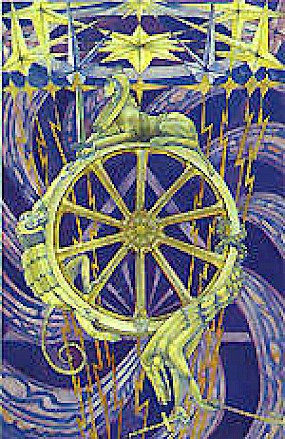
(via angelpaths.com and Alan Blackman)
Book: “Bad Faith: Race and the Rise of the Religious Right”

Bad Faith: Race and the Rise of the Religious Right
Randall Balmer
Balmer, a Dartmouth University religion professor, delivers a reassessment of “the alliance between white evangelicals and the far-right precincts of the Republican party.” Balmer says that the court case that galvanized Evangelical political action was not the 1973 ruling in Roe v. Wade, which legalized abortion, but the 1971 decision in Green v. Connally, which threatened the tax-exempt status of religious institutions that discriminated on the basis of race.
Evangelicals emerged as a political force in the 1970s after decades of retreat from secular society following the 1925 Scopes trial, according to Balmer, who details how opposition to state interference in “segregation academies” such as Jerry Falwell’s Lynchburg Christian Academy and Bob Jones University (which had its tax-exempt status revoked in 1976) sparked the formation of the “religious right.” Paul Weyrich and other political activists then “brilliantly shifted public perception of the movement away from racism toward a more high-minded defense of religious freedom,” setting the stage for conservative Christians, further galvanized by the abortion issue and fears of “secular humanism,” to turn against Jimmy Carter in the 1980 presidential election.
(Goodreads.com)