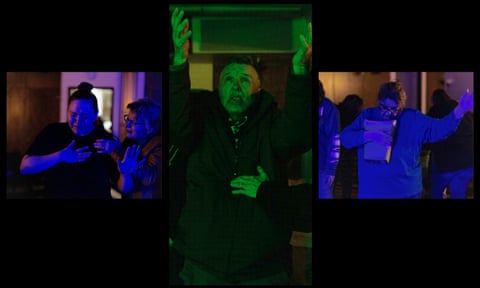
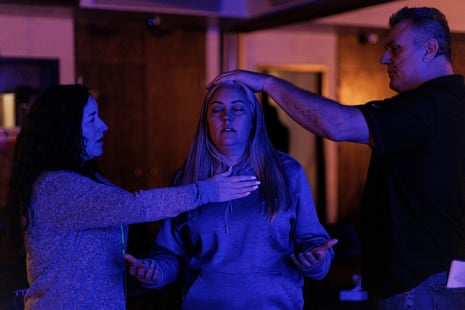
Deliverance warriors believe that problems such as illness and poverty are the result of spiritual sickness, not earthly afflictions. Photograph: Adriana Zehbrauskas/The Guardian
Deliverance from demons is a booming practice among evangelical Christians, promising freedom from afflictions ranging from addiction to cancer. Elle Hardy reports from a session in Arizona
by Elle Hardy with photographs by Adriana Zehbrauskas
Fri 21 Apr 2023 01.00 EDT (TheGuardian.com)
There are only three things you need to get Satan out of your life: a bucket, a pen and Brother Mike’s two-page questionnaire.
Unlike those megachurch preachers and their plastic smiles, Brother Mike Smith doesn’t make outlandish claims – not in his mind, at least. He’s not peddling “crap”, he says. As the leader of a modest ministry he calls Hardcore Christianity in downtown Phoenix, Arizona, he only claims that he can set you free from demons 100% of the time – if you follow his instructions to the letter.
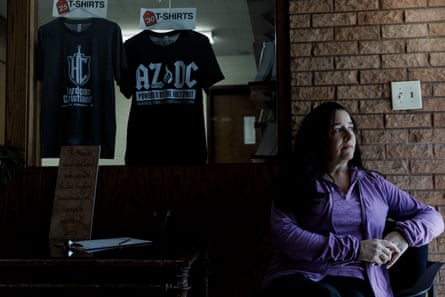
Step into his headquarters, and you’ll see a dusty trophy cabinet displaying the evidence of his work with people who fought their “demonic infections”: packets of Marlboro cigarettes, empty bottles of liquor, an asthma inhaler, medical certificates proclaiming good health.
Brother Mike practices deliverance, also known as spiritual warfare. Ask most people what they think about casting out demons, and you’ll probably get cinematic references to spinning heads and flaming crucifixes. But among evangelical Christians, deliverance is serious business – and it’s big business too. Commercially minded megachurches getting in on the act is a reliable indication that it has gained real popularity, and books on the topic are now mainstays in the $1.2bn religion publishing industry. A deliverance map put together by the California preacher Isaiah Saldivar shows 1,402 practitioners operating in the US alone – an impressive feat for a concept that only reached mainstream Christianity in the 1980s.
Deliverance warriors believe that problems such as illness and poverty are the result of spiritual sickness, not earthly afflictions. Healing is sought through people like Brother Mike and his band of volunteer acolytes, who often have no theological training but welcome souls from all over the country.
Not hailing from the tradition myself, but having spent the last few years writing about Pentecostals around the world, I had some sense of what I was getting into. Because I’m an agnostic, and therefore an outsider, I was tolerated rather than welcomed with open arms, a potential soul to be saved among a broad cross-section of people who desperately wanted help.
I was a world away from the staid Catholicism I’d grown up with – and, as I came to discover, that’s entirely the point.
Most spiritual warriors preach the idea that demons occupy “strategic” places and institutions, such as school boards and, of course, the Democratic party. Not Brother Mike. Instead, he focuses on the evil spirits inside the individual.
The concept of spiritual warfare was brought back to the US by the late prominent theologian C Peter Wagner after his time as a missionary in Latin America. Wagner is the godfather of the Neocharismatic Pentecostal movement, which kicked off in the 1980s and claims to use the powers of the Holy Spirit to take on the darkness, transforming Earth into God’s kingdom as we move towards the End Times.
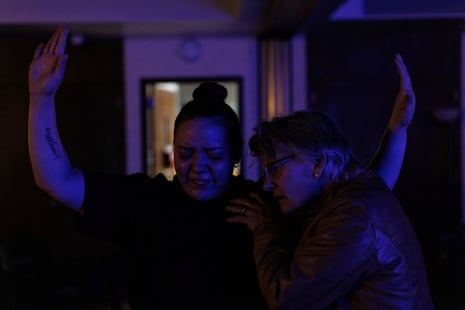
Amped-up Pentecostalism is a global affair, drawing significant teachings from places such as Brazil and Nigeria, where populations have a far more spiritual conception of the world and where good and evil are understood as operating in everyday lives. This view is gaining traction in the US, where the changing social and political landscape has led many evangelicals to feel increasingly besieged by the growing secular, liberal world around them.
Spiritual warfare may sound like a fringe idea, but it’s making headway within the radical right of the Republican party. Introducing a bill to ban gender-affirming care for trans children and teens last year, the far-right politician Marjorie Taylor Greene said that her controversial views were symbolic of something greater at play. “I think it just shows we’re in a true spiritual war in America,” she said, “and you can see the attacks on me are proof of it.”
Most people seeking deliverance at Brother Mike’s Arizona Deliverance Center could cite conventional politics as one of the forces that sent them here in the first place, but outside of vaccine skepticism, they share little political cohesion. They’re best summed up in the understanding that Christianity is in decline – with those who still believe becoming increasingly fervent in their faith.
The Concordia University theology professor André Gagné says that deliverance is a growing practice due to its experiential dimension. It promotes spiritual gifts such as healing, which gives believers supernatural abilities to respond to certain people’s needs. “It’s about Christianity with power, and exercising that power over sickness and demons,” says Gagné. “For some, going to church and reading from a hymn book is deadening – this is about feeling a connection.”
The fact that it’s not always taking place in traditional churches is also significant; Gagné points to ministries manifesting themselves in events such as the Reawaken America tour, and a growing proliferation of online prophets. Leading publications such as Charisma magazine run daily articles about spiritual warfare that offer a host of solutions; it usually involves selling self-help infused prayer in the form of a book or online course.
If you want to “learn the enemy’s war to wage victorious warfare”, one ad says, you can do it in 21 video lessons. It’s usually $199, but it’s only $49 if you sign up right now.
Asecular counselor of 25 years, Mike W Smith thought he knew a fair bit about the demons of despair that people battle daily. Raised in the Pentecostal Assemblies of God, Brother Mike had a fraught relationship with the Holy Spirit-led faith. He was “struggling with anger and lust terribly”, but nothing the church said would help him manage it. “I had a lust scanner in my eye, and going to the mall really set it off,” he says. “All the women, I would scan everything about them – their breasts, their legs, the color of their skin.”
He had returned to church after his daughter was born again in 1996 at the age of 15, after she recovered from a car accident that had left her in a coma. Jesus came to her and asked her if she wanted to live. She said yes, and woke up Christmas morning.
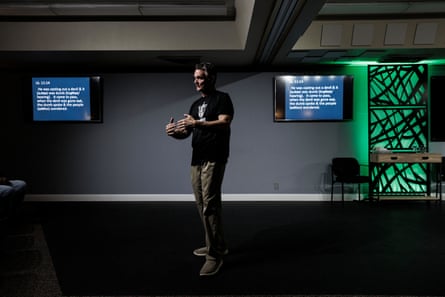
Still, Brother Mike would beat himself up. He would go to church and pray studiously, but he kept backsliding. Then one day, he stumbled on a book on spiritual warfare. “I had no idea that a Christian could have demons in them,” he says, blaming the misguided teachings of his former spiritual advisers for his ignorance.
Weeping at the altar of a local church in 2004, he felt a strange energy leave his stomach and chest, and at once he was set free from the anger and lust demons that had infected him for all those years. He began observing that bad spirits could leave an infected person through breath, and crucially, on demand. “The acceleration in our society now is the mental illness demons,” he says, pointing out that America has a huge problem with homelessness and addiction.
As he began applying his theories in a prison ministry and then at the church he attended, word of his unique methods spread. Soon, he was kicked out of both establishments.
A self-described millionaire thanks to property investments, Brother Mike shuttered his rehabilitation counseling center that worked closely with people with disabilities, converting it into a Christian healing home in 2005, which eventually became the Arizona Deliverance Center.
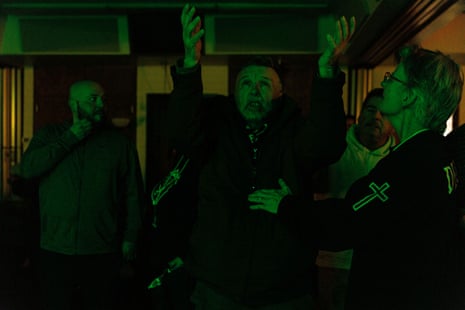
There, donations are accepted but – somewhat unusually for the movement – not heavily courted. Volunteers, success stories themselves, are true believers with regular jobs, giving their time to the cause out of genuine conviction. The narrative strength of Brother Mike’s theology is formidable; their belief is totalizing in only the way that a world defined by good and evil can be.
The center’s politics are best described as a few degrees removed from everyday Maga-ism and closer to QAnon. For example, I heard one of Brother Mike’s warriors describe bitcoin as a plot to install “a one-world currency” while voicing his support for Ukraine’s “Jewish president” in the same breath. Brother Mike keenly avoids my questions about his political views, but his radio shows leave little doubt that he’s firmly on what’s been called the “cosmic right” – the conspiracy-fueled edge of conservative politics that fuses the material and spiritual worlds.
Fear is Satan’s number one weapon, Brother Mike says, and all conflicts arise because humans are scared of things that they don’t understand. “Confusion and fear,” he adds, “caused the church to throw people like me out.”
It didn’t take long for faithful outcasts from all over the country to start coming to the center for help. People with all kinds of problems.
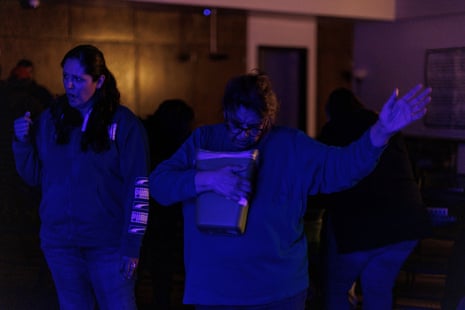
To wrestle yourself free, you need a strong stomach and to be prepared to hear the sound of dozens of people vomiting, spitting, retching, belching and calling out their demons by name.
I was to witness this on the third morning of my visit, when 25 of us were sent to a nearby building for the center’s flagship self-deliverance program. We sat on a ring of chairs, buckets between our legs and Brother Mike’s questionnaire in hand. Roaming helpers sat down next to us to examine our answers. The list of demons to cast out in Jesus’s name was long, spanning from garden-variety issues (sarcasm, doubt, minor health concerns) to the serious stuff (cancer, poverty, abuse).
Julie Andrews, an intense volunteer counselor, explains that you only need to see the problems with pedophilia in the Catholic church to see that exorcism, Rome’s version of deliverance, rarely works. The practice – with the sprinkling of holy water and recitation of litanies – is “a bunch of rituals from a book”, she says. “Deliverance – the way we do it – is repentance, forgiveness and the power of the Holy Spirit.”
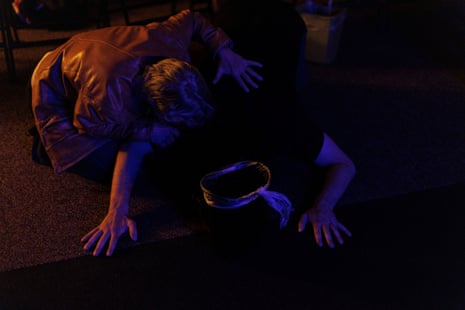
To do that, the center uses a relentlessly optimistic tone – but only those who stay the course will benefit. “The philosophy we learn from Mike is that you have to be very motivated yourself,” Andrews says. At one point in her own journey of deliverance from severe depression, she stopped turning up at the center. “Nobody called me, nobody said, I wonder what happened to her.” Stopping short of saying that people are on their own, she says simply: “You have to want this.”
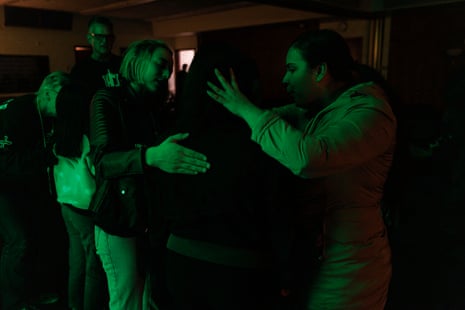
In the purging room, a helper about my mother’s age sensed that I was uneasy about the exercise. Dispensing with the demons I’d circled on the sheet, she used the light of the Holy Spirit to guide her into the depths of my darkness. “Fornication!” she said loudly and began slapping me on the back. A surprising charge, given this was our first meeting and I was buttoned up like a choir girl. “It’s gotta come out in the breath, honey.” I yawned, spat and coughed my way through her divining a pornographer’s list of deeds.
The demons I was willing to confess to, however, were rather dull in comparison. Anxiety, self-doubt, fear of failure: the kind of stuff that, even though I was there to cast a skeptical eye over the whole thing, I secretly hoped to receive deliverance from, too. Of course, this kind of quick-fix salvation is precisely what Mike and co counsel against: you have to be truly repentant, and not simply confessing. You have to be willing to change your life.
Huffing and puffing, spitting and screaming, I began hyperventilating. But it seemed a more physical than spiritual reaction, and feeling as uncomfortable as I was feeling unwell, my eyes wandered around the room. Soon enough, my embarrassment paled into insignificance compared with the problems of some of my classmates.
Two seats over, a heavily tattooed young guy was undergoing his deliverance in Spanish. “Esquizofrénico!” he and his helper yelled, commanding the psychosis demons to leave him as he rocked back and forth. Their cries drifted into a clamor of shouts against painkillers, video games, abuse and chronic illness. Feeling a moment was imminent, volunteers gathered around my neighbor.
He stopped rocking and vomited violently into his bucket.
I first came across Brother Mike and his disciples as most lost souls do: via a Facebook group dedicated to spiritual warfare.
For months, I joined the center’s weekly Zoom call to experience deliverance “hardcore”. Every Wednesday night, 100 or so people gathered in their digital squares, a kind of wayward Brady Bunch.
The Zoom sessions were led by Brother Mike’s key lieutenant Rick Katt, a real estate investor and former college football player who charges through everyday problems, conspiracy theories and biblical inspiration in an unceasing monologue against evil forces. We had to call out our demons in the chat, typing the things that were tormenting us. Only Katt had the mic, but the rest of us were commanded to keep our cameras on.
Last February, on my first night attending a deliverance Zoom session, I met a Canadian teenager whom we’ll call Connor.
“When I go for runs it’s really painful,” he complained in the chat sidebar about the lung pain he was experiencing. “O,” Connor added in rushed text-speak, “almost forgot lots of hatred towards people especially Muslims. Racism demons.”
Connor’s problems evaporated into the chat as the demons we were encouraged to share racked up. Cyndi wrote she suffered from “Slumber; Apathy; Passivity; Laziness”; Karen said that the devil had been waging war against her. Mary-Ann wanted her “diabetes GONE”, and Ryan had fallen off the wagon after nine months of sobriety and hit a meth pipe the day before; he hadn’t been to sleep since.
Brother Rick conducted the session like an auctioneer thrust into a bidding war against the demonic, calling out bad spirits as fast as they were typed in the chat.
“Tweaker spirit, I’m coming to get you!” he growled.
“Come out of there right now, the financial destroyer, the financial despair and the financial confusion!”
“Masturbation demons – sex with yourself is sex out of marriage, I hate to break it to you!”
Connor’s cries for help had seemingly disappeared into some Silicon Valley server, but Brother Joshua Owens, a disciple of Mike’s from Ohio, replied to Connor’s plea for help.
Brother Joshua knows a thing or two about wayward young men: he’s a formerly incarcerated drug dealer who came to the Lord in prison just as he was thinking about ending his life. “Satan and his crew” had a longstanding interest in him, and he’d fallen off the rails after getting out of prison in 2013. But he had found the courage to travel to the Arizona Deliverance Center for help, where he “fully healed”. Later that year, he set up his own ministry, TeamJesus MostHope, with the slogan “setting the captives free”.
If the neck tattoos and harrowing life story of abuse and neglect didn’t already cut it, Brother Joshua’s rawness and realness has a way of chiming with troubled young men. Along with Julie Andrews and others, he regularly logs into the Zoom deliverance sessions to find people he can help on their journey.
“My heart was just pure hatred,” Connor explained after several months under Brother Joshua’s tutelage. The teenager, whose father first discovered the center and encouraged his family to undergo deliverance, was hooked on violent war video games and fantasized about killing people. “That’s where my hatred started coming from,” he says of his shooter fantasies. “But now, I have forgiveness in my heart, so I had to forgive them and I had to stop playing video games.”
After a young woman left him heartbroken, he fell under the influence of “bad people”. That’s when Connor agreed to undergo online deliverance. “When you get really hurt bad by someone, what happens is it practically engraves a marking into your soul,” he told me. “You have to break down, you have to forgive the person, and you have to cry.”
Men, he added, “don’t really talk about their feelings, emotions. We are really suppressed.”
After Brother Joshua began regularly counseling him over the phone, Connor says, he could sense he was delivered from evil, but not entirely set free. He now recognizes that his impulses, which came from a place of “pure hatred”, were “selfish spirits” that have been conquered by finding forgiveness in his heart. He still struggles with anger, but now he has a focal point to get his life back on track. “I’m still dealing with transfer spirits, which you get from people that are non-believers,” he says, adding that video games and secular music were an ongoing problem. “You can get them if you’ve been hanging out with these people.”
Brother Joshua believes that the root of Connor’s problems came from his practice of martial arts (which he says is a particularly pernicious form of witchcraft), as well as early childhood trauma. For Brother Joshua, who spent his life being failed by everything around him, tough love and his absolute conviction about the evils of the spiritual world offers some mooring. “America is going to hell in a handbag very quick,” he says. “We gotta wage warfare. We gotta put on the whole armor of God.”
To wage that warfare successfully, Brother Mike uses apathy as a weapon to get people in the tent. He offers a tantalizing and shocking experience compared with “boring” churches.
On that front, he’s not wrong. The leading church researcher Scott Thumma found that most congregations saw attendance decline by about a quarter during the height of the pandemic. Many people went online to receive their spiritual nourishment – and they haven’t returned. We already know that social media echo chambers exist, more often than not pushing people to extreme ends of ideological spectrums.
It’s something that I observed during countless hours spent in spiritual warfare Facebook groups, watching people go further and further down rabbit holes in the dark hours, without families or church friends to discuss these issues in real life. It was apparent that people wanted to embrace ideas about the ways of the spirit rather than be lectured to by their local pastors.
Indeed, most of the practitioners – and leaders, like Julie Andrews – don’t attend regular church services, having either fallen out over their newfound radical beliefs, or preferring to watch a favored preacher via YouTube.
Brother Joshua still attends a local church, but he agrees that undergoing deliverance online is something more – and it seems to work. “I personally find it easier over the phone or remotely,” he says. “Fear or rejection demons will get people to clam up, so they’ll withhold – they’ll fear manifesting or vomiting.”
Spiritual warriors speak to concerns in the here and now, particularly when it comes to conventional medical and mental health treatment.
“I got a slew of credentials, and I count them all as dung,” Brother Joshua says, reeling off training he’s attended in cognitive behavioral therapy and chiropractic health, among others. “People are held captive by medications, doctor’s appointments, counseling,” he continues. It’s only through the power of the Holy Ghost and Jesus Christ that he sees people truly set free from “the bondage of mental health and other health conditions”.
It’s those complaints I heard most often: participants wanted to wean themselves or loved ones off medications like antidepressants and insulin. The promotion of anti-vax ideas in cosmic right and prophetic Christian circles is almost a given, but it seems that increasingly, so too is a rejection of conventional, life-saving treatments.
Denominational categories can be slippery, particularly since so many believers are now online, but people who identify as different strains of Pentecostal tend to have the lowest median income of America’s religious groups. There is undoubtedly a strong racial correlation here, but make no mistake: while Arizona Deliverance Center’s leadership is predominantly white, its congregation is largely made up of Native American, African American and Latino believers.
All too often, the center is preaching to a choir who can’t afford health insurance and prescriptions. In this light, deliverance from evil takes on a whole new meaning. People have to have faith because they can’t afford not to.
In trying to track down the center’s few critics, I encountered several obituaries: people with terminal illness who appeared to have given deliverance a last throw of the dice, and found no relief.
One of those was a woman named Lily Blackwater, who had written a Google review of the center a year earlier. “Never thought I would cheat on my church and come here,” she wrote. “What was I thinking.”
Lily died from cancer last year, but Don Blackwater, her husband of five years, was willing to share their experience. A friend had recommended he and Lily undergo deliverance to help with her depression and anxiety, which she had developed after her diagnosis. Don, a recently recovered heroin addict of 17 years, blamed the demons haunting Lily on himself, believing that evil spirits were “latched on to” him.
Recounting his experience at the deliverance center that day, he said they had been called while a recording of demons roaring and growling started playing. The lights dimmed, and volunteers gathered around the couple with buckets. “One of them pulled our hands apart,” he said. “A lot of people got around me and said, the demon in this one is really strong. He doesn’t want to come out. Come out, demon!”
Don had tried sweat lodges and other traditional cures in the past; Lily had brought him to the Lord away from his traditional beliefs, against the wishes of his family who hail from the Oglala Sioux Tribe. As the vomit failed to come out of him, Don felt he was under “holy assault” by what he called “a circus church”. Looking around the room, he only saw desperate souls just like them. “People are just doing it because it’s the last resort,” he says.
Lily died several months later. Her parents and sisters took her house and car, leaving Don homeless and thinking about returning to the streets and drugs and alcohol. But friends of the couple intervened, and encouraged him to return to the church where he had been born again, the church that Lily felt she had cheated on with the deliverance center. Don didn’t want the pastor to know that he was coming, believing that, if he was “truly anointed”, he would “see my pain or see my hurt”.
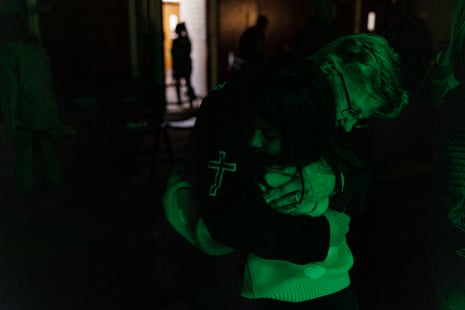
Before she died, Lily had said she would speak to him in the next life with a secret word that only they knew. During the service, the pastor called on him and whispered in his ear: “Lily says you’re gonna be all right. It’s not your fault.” He then said the word – which Don wishes to be kept private – and blew on Don’s face.
Don promptly passed out; when he woke up, he remembers staring at the ceiling, lying down on the floor, when a bright light shone on him. “And all I heard was, get up, my son.”
Then and there, Don was “taken out of bondage” and delivered from the depression that had gripped him since Lily’s passing. As he saw others thrashing around on the floor, he not only found God again, but something more immediate. The vomiting and spitting and finger-pointing that had once freaked him out suddenly made sense. “It made me a believer,” he says.
Reflecting on his time with Brother Mike’s “circus church” that he and Lily had rejected, he now wants to recant his statement. “I think I’m gonna go back, out of respect.” His words about the center have been weighing heavily on him. “I could just go, maybe to deliver me from some of the things that I still deal with.”
As Don tells me about friends with meth addictions, fentanyl “all over the streets” and widespread homelessness, I put it to him that demonic infection looks a lot like problems far closer to home. Perhaps they are all seeking deliverance from America itself, and a life that has been stacked against them at every turn.
“We are in the devil’s playground here,” he concedes. “But the flesh is weak, you know?”