
Monthly Archives: February 2023
 Two people were arguing about a flag flapping in the wind.“It’s the wind that is really moving,” stated the first one. “No, it is the flag that is moving,” contended the second. A Zen master, who happened to be walking by, overheard the debate and interrupted them. “Neither the flag nor the wind is moving,” he said, “It is mind that moves.”
 Sylvia Plath on the “brag of my heart”

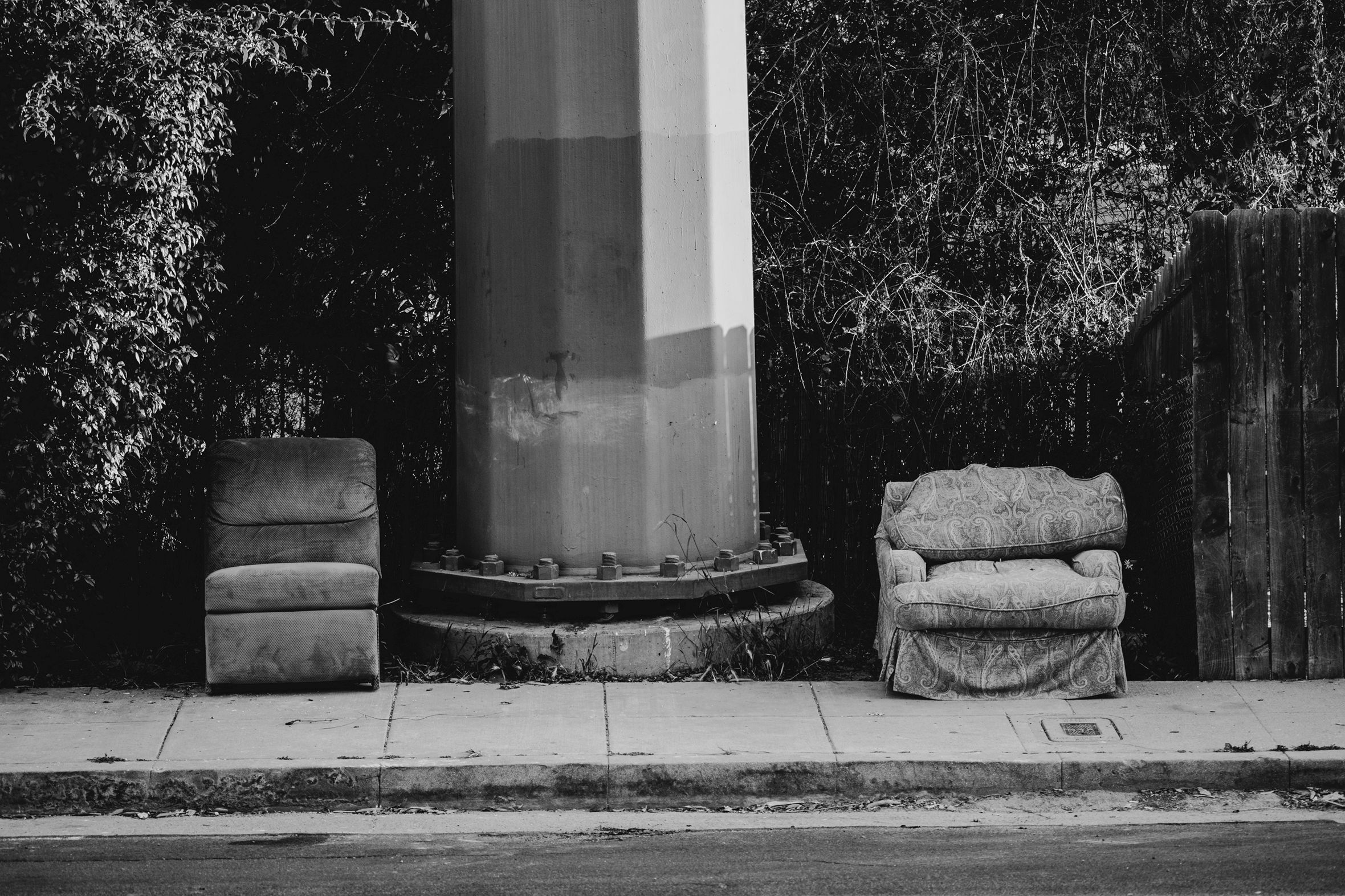
Unsheltered
THE SUN INTERVIEW
Eric Tars On The Human Right To Housing
BY THACHER SCHMID • FEBRUARY 2023 (thesunmagazine.org)
While largely undercounted by officials, the scale of homelessness in the United States appears to have grown significantly this decade. The pandemic brought eviction moratoriums, emergency hotel shelters, and a recommendation from the Centers for Disease Control and Prevention to halt removal sweeps, but those were temporary. Meanwhile, for complex reasons — but driven by structural factors like high housing prices and low wages — a majority of homeless people now live in unsheltered locales, like tents, vehicles, or shanties. Many cities and states have chosen to respond with a historic wave of sweeps, tows, bans, and new mass or outdoor shelters.
With Eric Tars as its legal director, the National Homelessness Law Center (NHLC) has served as a kind of legal conscience for the nation, hyperfocused on a mission of using the law to, according to its website, “transform fundamentally the landscape of homelessness and poverty in this country.” Founded in 1989, the nonprofit has issued reports on the nation’s growing homeless encampments and initiated the Housing Not Handcuffs campaign to draw attention to the criminalization of homelessness.
Tars’s father was born in a refugee camp during World War II — not only homeless but stateless. “He grew up in refugee camps in conditions that were, in some ways, better than what many people experience on the streets of America,” Tars says, “but with a lot of the same concerns about where he would be laying his head the next night.” This perspective within his family helped push the Georgetown University–educated attorney to take an unabashedly sympathetic point of view toward unhoused people. His analysis of the problem, however, is sophisticated and rigorous, reaching back decades to examine the New Deal and the Reagan Revolution, and weaving together racism, segregation, electoral politics, social trends, and the role of direct action.
If we would just prioritize housing as a human right, Tars argues, the U.S. wouldn’t just help hundreds of thousands — maybe millions — of houseless people. We’d improve city budgets. We’d increase public safety. And we’d transform how this nation treats people of color, our young and old, LGBTQ individuals, and those with disabilities.
Tars studied international human rights in Austria at the Institute for European Studies and the University of Vienna. He is a board member at the U.S. Human Rights Network and has also served as counsel of record in precedent-setting cases such as the 2019 Martin v. City of Boise decision of the Ninth Circuit Court of Appeals, which ruled that it is unconstitutional for cities to enforce anti-camping ordinances if there are not enough shelter beds for their homeless populations.
Tars spoke with me by phone from the NHLC’s headquarters in Washington, D.C. “I grew up with the sense that I had been given a lot of privileges just by being born into the place where I was, in suburban America, and that other children are born into very different circumstances through no fault of their own,” he told me. “So I’ve always felt like I needed to use the privilege that I have in order to advocate together with, and for, those who can’t advocate for themselves.”
Schmid: What’s the history behind today’s anti-homeless laws?
Tars: They very much date back to laws like the “anti-Okie” law that California had in the late 1930s, which made it a misdemeanor to knowingly bring any nonresident “indigent” person into the state, as well as to Jim Crow laws in the post–Civil War South. Anti-homeless laws come from the worst part of the American mindset. At its best, America values rugged individualism and self-reliance. But we also have this myth that if you haven’t gotten ahead, it’s always because you haven’t worked hard enough. That’s never been true, and it particularly wasn’t true during the Depression, when conditions beyond any individual’s control led to millions of people losing their jobs or their farms and moving to places where they’d heard there was more opportunity, only to discover that the people living there didn’t want to let them stay.
Income inequality is currently at the highest level it’s been since the Gilded Age. Rents continue to go up and up and up, while wages remain flat in real terms. Nowhere in the country can a person working full-time at the federal minimum wage — $7.25 an hour — afford a two-bedroom apartment. So homelessness is not the fault of individuals who are working two and sometimes three jobs just to make ends meet. It’s the systemic issues that are causing it. But this myth that it must be the individual’s fault has led to policies that punish people for living on the street rather than embrace them. In almost every city and state we see laws criminalizing basic life-sustaining acts like sheltering yourself and sleeping, sitting, or just existing in public spaces.
The better part of the American spirit is the Second Bill of Rights that Franklin D. Roosevelt proposed, in which he said that none of our countrymen should be without access to a decent home, adequate food and nutrition, and good-paying jobs. If we can come back to those better parts of our American character, we can see the same kind of success we saw from the 1940s to the 1970s, when social safety nets prevented mass homelessness.
Schmid: You mentioned Jim Crow and the Reconstruction era. How do laws passed then fit into the history of U.S. attitudes toward homelessness?
Tars: We have a racialized notion of poverty in this country. Many anti-vagrancy, anti-panhandling, and anti-loitering laws were passed in the immediate aftermath of Emancipation. The intention was to make it a crime for formerly enslaved people not to have a job. Then they could be tasked back into slavery using a loophole in the Thirteenth Amendment, which says that slavery is abolished except as a condition of incarceration. So if you made it a crime for formerly enslaved people simply to exist in public spaces without a job, you could get them back into the fields picking cotton. Many of the anti-homeless laws that we see — particularly across the South, but in other areas as well — come from that era. They continue to have the same effect now that they did back then, which is to disproportionately imprison Black people, Indigenous people, and other people of color.
Schmid: You’ve spoken of a “right to housing.” But terms like “housing” and “shelter” can be difficult to define.
Tars: That’s the beauty of using the internationally defined standard of the human right to adequate housing. The right to housing does not mean that every American can have a single-family home with a white picket fence provided to them free of charge tomorrow. It means that every American should have an adequate place to live, which means it can’t be temporary or unaffordable. You need to have legal rights as a tenant and the ability to protect those rights through a right to counsel. The location must have access to hospitals and fire services and not be in a food desert. There are so many things that go into making housing adequate.
But the housing might be more communal than we’re used to in the U.S. It could mean bringing back single-room-occupancy rentals — hotel-type situations with common cooking facilities and shared bathrooms. As long as each resident has a door to lock and the common spaces are well maintained, that could be part of the solution. We’ve lost that lowest-income housing, which is one reason we see more and more people living on the streets.
Schmid: What about the connections between homelessness and stagnant wages?
Tars: The biggest cause of homelessness in America is the lack of affordable housing. And housing is less affordable because over the past forty years wages have not kept pace with the rising costs of rent and homeownership. I mentioned the cost of a two-bedroom apartment being out of reach. In the U.S. today many people are paying 30, 40, even 50 percent of their income on rent each month. When they get some sort of shock to their finances — whether it’s an emergency medical bill, a broken-down car, or a missed paycheck — it puts them right on the street.
There’s also this concept called “network impoverishment,” where it’s not only you who are financially stretched thin, but everyone in your network. Then, when a shock comes, nobody you know can tide you over with rent money or help you fix your car. That’s why communities of color are far more vulnerable, and the people in them are far more likely to go directly into homelessness rather than get a helping hand that keeps them housed.
Also, when people are desperate for any income at all, it allows employers to keep their wages artificially low. So it’s both the low wages causing homelessness, and the threat of homelessness causing the low wages.
Schmid: Besides network impoverishment, what factors make people of color more likely to become homeless?
Tars: One is the racialized view of public assistance. Even though, over time, more white people have been helped by affordable-housing programs, people of color are seen as the ones who get those benefits. This goes back to President Reagan’s racist trope of the welfare queen, which was never true to begin with, but it cemented a racialized image of the beneficiaries of welfare programs, including public housing. When President Roosevelt launched many of the federal public-housing programs back in the 1930s, it was seen as something for everybody, and it was well funded — or, at least, adequately funded. You would see these housing projects open with great fanfare, and the news coverage celebrated “average” Americans — meaning white Americans — gaining access to the housing they needed. Families who lived there gained a foothold in a community with access to decent schools and other services and infrastructure that enabled them to then get into the middle class and out of public housing, exactly the way the program intended.
But as more people of color entered public housing, views of it became racialized, and the resources diminished. Public housing was no longer maintained as well, and then we got into a self-perpetuating cycle of more white people moving out of it and more people of color moving in, which led to fewer resources and more run-down buildings, until the system as a whole was viewed as a failure. Reagan alleged that public housing was failing because of the people who were living there, not because of the systemic neglect, and blaming tenants became an excuse for further systemic neglect.
Schmid: We know how ripples in the economy can force more people into homelessness — the pandemic being a recent example. Are there ripples that could push people back into adequate housing?
Tars: That’s a tough question. I think there once were, when our housing markets and labor markets were balanced in favor of workers and not corporations. Now it’s increasingly difficult for that to happen, because the benefits of economic ripples are so disproportionately captured by the top 1 percent. Look at the recovery from the recession of 2007–2009. That recession was caused by the housing bubble, which was caused by mortgages being bundled into these exotic financial products for investors. When the bubble burst, millions of Americans lost their homes to foreclosure, and many of those homes were bought up by the very venture capitalists who’d caused the housing bubble in the first place, who then turned them into rental properties and put them on the market again.
Now they’re bundling together those rental contracts into new, exotic financial products that are almost certain to lead to the next bubble and crisis. Because corporations bought all that housing, the number of homes available for sale is lower across the country. And despite all these rental properties, there still isn’t enough rental stock out there, especially at affordable levels. So rental prices are going up. And as rental prices go up, it makes it almost impossible for renters to save up a 20 percent down payment on a house — especially when housing prices have been so high.
There should have been a ripple of new homeownership during the recovery from the last recession, which would have made many more people’s housing situations stable, but because of the financialization of housing, we haven’t seen it. Housing is becoming a commodity rather than a basic human right. I just saw a statistic about Philadelphia, which used to have relatively high rates of homeownership, but now only about half of the city’s residents own their homes. That’s a long-term trend that has consequences throughout the city’s population. More of its residents have less housing stability and are more subject to the whims of landlords.
I think something like 2 percent of landlords in Philly own more than 50 percent of the rental units. So the rental stock has become concentrated among big corporate owners. Whereas mom-and-pop landlords are often willing to work out a payment plan and figure out if there’s anything they can do to keep somebody in housing, the big corporate owners are unlikely to negotiate. If the rent check doesn’t come in, the eviction notice goes out the next day.
I think the Build Back Better Act was an attempt to create a ripple that could have provided really deep benefits to the American public. The housing provisions of the act, in particular, would have targeted the most needy. But it didn’t pass. So we’re continuing to deal with the negative ripples of the pandemic, and we’ve lost the flood walls that the eviction moratorium and the expanded child tax credit of 2021 provided. Reinstituting one or both of those could provide a positive ripple effect, but right now we don’t have either. So I think we’re already seeing a lot more evictions, and a lot more homelessness as a result.
We could have built on successes during the pandemic and continued going in that direction, but now I’m afraid we’ve missed that window. We’re on the downslope of that tipping point, and things are going to get a lot worse before they hopefully get better.
Schmid: Since the NHLC began tracking laws and ordinances that criminalize homelessness in 2006, you’ve seen an increase in every category, from laws against camping or sleeping or sitting in public to statutes forbidding panhandling, loitering, or living in a vehicle. What are you most concerned about right now?
Tars: We are at a tipping point. In some ways the pandemic showed us the best of what we can do. The Centers for Disease Control and Prevention put out COVID guidelines saying that, for public-health reasons, homeless encampments shouldn’t be broken up unless people could be given individual hotel rooms. The Federal Emergency Management Agency provided funding to get people into hotel rooms, and we saw tens of thousands move off the streets and into dignified spaces where they could start focusing on finding jobs and permanent housing. We saw emergency rental assistance prevent homelessness for tens of millions of people, because there was a recognition that housing is a key component of public health.
But people have tired of the pandemic. They’re tired of the things that we’ve been doing to help, even though we haven’t solved the underlying problems that led to homelessness and housing instability prior to the pandemic. Now, with all of the pandemic programs having expired, we are already seeing a dramatic increase in homelessness — and in unsheltered homelessness in particular: people living in encampments or in their vehicles or in highly visible public locations. Unfortunately unsheltered homelessness often leads to more-punitive laws and tougher enforcement, rather than more compassion for our fellow citizens.
We could have built on successes during the pandemic and continued going in that direction, but now I’m afraid we’ve missed that window. We’re on the downslope of that tipping point, and things are going to get a lot worse before they hopefully get better.
Schmid: The improvised structures and areas in which unsheltered people live can become dirty, dangerous, or fire hazards. Where should local officials set the bar for encampment cleanups?
Tars: The National Homelessness Law Center doesn’t bring cases or litigation against cities to protect the rights of people to sleep on the streets. People sleeping outdoors is not a win for the Law Center, for the city, or for the unhoused people themselves. Our goal is for cities not to need to outlaw encampments, because nobody’s sleeping on the streets in the first place. A lot of communities use the criminal-legal system as a crutch to avoid having difficult conversations about providing adequate housing in their community. They can hide the costs of their failure in increases to the police budget and the jail budget. Since those are “for public safety,” they’re more popular to fund than affordable housing.
Where cities should draw the line is on conducting a sweep of an encampment without providing an adequate alternative place for those people to go. That’s the standard set by the Martin v. Boise decision, and the fact that communities were objecting to that line is really mind-boggling. People have to sleep. They have to shelter themselves from the elements. If you force them to move and don’t provide an adequate alternative place for them, they’re going to improvise a new solution, probably one that the community won’t like any more than the first. It’s in everybody’s interest for a city to provide an alternative — and not some undignified communal shelter with a lot of judgment, but a place you would feel good about sending your mother, father, brother, or sister, because people experiencing homelessness are the mothers, fathers, brothers, and sisters of other people.
Schmid: You mentioned Martin v. Boise. You worked on that landmark 2019 case in the Ninth Circuit Court of Appeals, which has appellate jurisdiction over seven western states, Alaska, and Hawaii. Can you talk about what the Martin v. Boise decision said and why it’s important?
Tars: The Martin v. Boise decision stands for the very simple principle that punishing a homeless person for undertaking basic, life-sustaining activities like sleeping or sheltering themselves — when there’s no adequate alternative accessible to them — is cruel and unusual under the Eighth Amendment to the Constitution. We didn’t bring that case because we’re trying to put limits on what cities can do; we’re actually trying to open them up. Martin v. Boise provides an opportunity for cities to take steps that will end homelessness, rather than continue to push around and harm homeless individuals, which costs communities more than it would to simply provide housing.
Before this decision, when a business owner said, “There’s a homeless encampment on the corner that’s scaring away my business, and I want it gone,” an elected official had two choices: They could provide adequate housing for all those people, but that would cost a lot up front, and they would have to fight zoning battles with neighborhood associations who don’t want affordable housing in their backyard, and by the time ground was being broken, the politician would have been voted out of office. Or the official could pass a quick law saying it’s illegal for that encampment to be there, then hide the costs of that in increases to the jail budget and the police budget. This would at least satisfy that individual constituent, even though it did nothing to solve the problem and actually made it worse, because now the individuals in that encampment would have criminal records and need to pay fines and fees — yet another barrier to saving up first and last month’s rent and security deposit.
The Martin v. Boise decision takes some of the heat off that elected official. It allows them to say to that constituent, “Look, I agree that encampment should not be there on your corner, but the courts have told me I can’t just force those people to move if I don’t have somewhere else for them to go. So if we want that encampment off the corner, we’ll have to work together to come up with housing for them. And it turns out it only costs one-half to one-third as much to provide housing as it would to keep cycling those people through the courts and the jails. So the good news is, your taxes could go down as a result of this solution, because we’re not simply using increased law-enforcement spending as a proxy for public safety.”
That’s what we hope the decision will do for communities. We’ve seen that kind of conversation going on in the Ninth Circuit, where it’s legally binding — like in Los Angeles, where it served as part of the backdrop to passing the United to House LA measure, which raises money from sales of mansions to provide affordable housing and fund initiatives to reduce homelessness. But we’ve also seen the influence of this decision in legislation and public policy outside of the Ninth Circuit. When the decision came down in 2019, the Trump administration was looking at a policy of rounding up people experiencing homelessness under threat of arrest and putting them into camps. Once they saw the Ninth Circuit decision, they backed off those plans. So that was an immediate impact. I know that for tens of thousands of people experiencing homelessness right now, they are sleeping more soundly without the fear they will be roused by a police officer saying, “Time to get up and move along.”
Schmid: What were some highlights of the Martin v. Boise proceedings for you?
Tars: One of the things that touched me most happened back in 2015, when the case was called Bell v. Boise and it was down at the district-court level. We got the Department of Justice (DOJ) to submit a brief supporting our position that criminalizing sleeping and camping in the absence of alternatives is cruel and unusual under the Eighth Amendment. Even though that wasn’t the formal ruling in the case, it was a clear indication of where the DOJ thought the ruling should go, and, as a result of that, a number of communities immediately put moratoriums on enforcing their anti-camping ordinances and started looking at alternatives.
A couple of months later I was in Portland, Oregon, to meet with some local advocates, including people who were experiencing homelessness, and after the meeting one of the gentlemen approached me. He knew I worked at the NHLC, but he didn’t know my role in the case, and out of his bag he pulled a tattered folder. Inside were crisp, clean copies of the DOJ statement and a report that we had made to the UN Human Rights Committee — which was partly what had led the DOJ to get involved. This man said, “I just want you to know that these statements, these documents, have meant everything to me.” He told me he hadn’t gotten a single good night’s sleep since becoming homeless more than five years earlier, but when the DOJ brief came out and Portland stopped enforcing its anti-camping laws, he was finally able to rest easy. “It gave me my humanity back,” he said. He was tearing up, and I told him how meaningful it was for me to hear that, because I had worked on that report and helped get the DOJ involved. Then he just opened up his arms, and said, “May I?” and I said, “Absolutely.” There we were, crying in each other’s arms.
Working at the national level, as I do, I often don’t get to see that direct impact. My work takes decades, and often the people who benefit will never know my name. So it was wonderful to make that connection.
Schmid: For Martin v. Boise to work in practice will require coordination among homeless people, police, and shelters. Is this happening?
Tars: The point of Martin v. Boise is to get us out of this assumption that the criminal-justice system is a legitimate way of dealing with homelessness. Communities that look at Martin v. Boise as a limitation are going to be frustrated, while the ones that look at it as an opportunity to finally find long-term solutions are going to enjoy its greatest benefits.
If you want a model of what a successful approach to Martin v. Boise might look like, look at Finland. They have adequate amounts of supportive housing, and they don’t have homeless people on the streets. So they don’t need to enforce the laws criminalizing homelessness in the first place.
It’s hard to find a perfect example in the U.S., but in Philadelphia police and homeless-outreach workers have been partnering in responding to any call that potentially involves a homeless person. A 911 dispatcher will send a law-enforcement officer and a social-service worker, and the social-service worker will approach first, because they’re trained in crisis de-escalation. The ideal is that the homeless person never needs to get involved in the justice system. The law-enforcement officer is there as backup but not as the first responder. That’s a positive model. It’s not a perfect model. It’s worked in some cases, and in other cases police will still sweep an entire encampment.
During the pandemic we saw many communities working on creating new shelters or using federal funding to get people into hotels — like California did through Project Roomkey, which provided unhoused people with private rooms — following the spirit of Martin v. Boise if not always the letter. For example, right after the Ninth Circuit decision came down, the city of Modesto, California, canceled a planned sweep of a homeless encampment in one of their parks. They ultimately worked with the people living in the encampment to move them to a sanctioned tent village with access to sanitation and porta-potties and things like that. Meanwhile the city worked to build a permanent indoor shelter, and once that facility opened up, the people were able to move there. The capacity is limited, so it isn’t a permanent solution, but the community took a constructive approach.
Schmid: What about less-successful models?
Tars: Places that have experienced failure are trying to do the least they can rather than rethink their approach to homelessness. They are rewriting their ordinances to try to bring them into compliance, but in the meantime they continue using the police as their primary response to street homelessness. In a number of cases courts are finding that these communities are coming up short of what Martin v. Boise requires. For example, in Chico, California, after the Paradise wildfire, there was initially a high degree of sympathy and support for those who’d been displaced by that disaster. But people’s memories are short, and some displaced people weren’t able to find housing. The encampments in Chico increasingly were harassed by individuals and by the community. So the city proposed creating an encampment at the airport — literally on the tarmac, with very limited shade and access to restrooms. It was an inhospitable place, particularly in summer. And a judge basically said, “When Martin v. Boise talked about providing an alternative, this is not what it envisioned.”
The city government has come to a settlement where it is working on creating a large-scale tiny-home community in partnership with people with lived experience of homelessness, and there are restrictions on when the city will be able to enforce its anti-homelessness laws. It’s not a perfect solution, but it has a lot of good features.
Schmid: California is considering requiring its law-enforcement officers to record housing status during stops. Should already-busy officers have to do that?
Tars: They should do it, and one of the reasons that they’re busy is because they are unfairly tasked with being our frontline response to homelessness. To gather housing-status data is a minor administrative burden — they are already having to record race, gender, and other demographic information — but it will give us a lot of data we don’t have right now.
In places where we do have this data, we know that half, or even more than half, of people in jail on any given night are there primarily because they are homeless. This costs our communities a tremendous amount of money. If we can start collecting this data in more communities, it will help us make the case that we’re misusing our police officers.
Individuals don’t become law-enforcement officers because they want to harass people who are just trying to survive. They go to the police academy because they want to ensure the safety of the entire community. But where there is heavy enforcement of laws against low-level “crimes” of survival, it eats up a lot of officers’ time and resources, and the rates of violent crime and unsolved crimes are actually higher in those communities. It’s keeping them from doing the work they’re hired to do, which is to prevent violent crime and ensure public safety in other ways. Law-enforcement officers aren’t trained in crisis intervention and de-escalation techniques the way social workers and other outreach personnel are. Their lack of training sets them up for potential viral-video incidents. The officer’s badge and uniform and the gun at their hip alone can escalate the situation and lead a homeless person who feels threatened to do something they’ll regret. Collecting this data is a win for the entire community, but law-enforcement officers in particular have a vested interest in showing the work that they’re doing, so they don’t have to be doing it anymore.
It really comes down to empathy, and there are forces in this country that are trying to stop that empathy from growing by making people worry about their own well-being to the exclusion of others’ well-being.
Schmid: New York City has a right-to-shelter law, and, according to the most-recent prepandemic federal count, roughly 95 percent of that city’s homeless people are sheltered. In Los Angeles, by contrast, only 28 percent sleep in shelters. Does the right-to-shelter law help drive this stark difference?
Tars: Definitely. New York City has recognized it has a duty to at least provide some basic form of shelter to citizens. But a right to shelter is not the same as a right to adequate housing. Also, the shelter system in New York is not providing dignity and safety for many of the people living in it, which is why there is still an unsheltered population in New York City.
Similar dynamics exist in Los Angeles. There are some shelters doing a good job but also many others where people just don’t want to go. They’d rather be on the streets than be subjected to the dehumanization, the trauma, the lack of safety, and the terrible health conditions inside some LA shelters.
There are better ways of addressing the issue than you’ll find in Los Angeles or in New York City. In Scotland, for example, citizens have the right to adequate housing. If you present yourself as homeless to the housing agency there, they give you immediate accommodations in a semiprivate “bed-and-breakfast,” as they call them. Then, within ninety days, they are legally required to move you into a permanent accommodation that’s appropriate for your family size and your other health, disability, or safety needs. There are a lot of benefits to doing it that way. They don’t have this giant shelter system like in New York City.
The downside of right-to-shelter laws has been that people are staying in the shelter system for years at a time while awaiting permanent housing, and the shelter system is really inefficient and costs more than just providing housing. The requirement to maintain that basic access to shelter has prevented some communities from being able to explore the longer-term housing options homeless people want. You don’t see so-called housing resistance among homeless people, but you do see lots of shelter resistance when people go into a shelter and find that it’s not conducive to their mental health, their physical health, their dignity, or their safety. I would actually argue that it’s the shelters that are people resistant, and not the other way around.
When Section 8 or public-housing wait lists open up, there are lines around the block. When you don’t see those lines of people waiting to get into a shelter, it tells you more about what’s being offered than about the people who are or aren’t trying to access it.
Schmid: How does having a conservative majority on the Supreme Court affect legal advocacy for unhoused people?
Tars: In the case of Martin v. Boise, it was appealed to the Supreme Court, and we advocated for the Supreme Court not to take the case — it didn’t — because even though it would have been great if Martin v. Boise had become the law of the entire land, we weren’t going to take a chance with the conservative majority if we didn’t have to.
Homelessness has a hugely disparate racial impact in our country. To be able to really address that, we need to acknowledge those disparities and take measures to affirmatively remedy them. And affirmative-action programs are under threat right now. This Supreme Court does not seem likely to acknowledge any legal distinction between people of different races, even to remedy historical discrimination. We’re trying to figure out ways for housing agencies to reduce the racial disparities that are a direct result of past federal, state, and local discrimination, but we’re not optimistic that this Supreme Court will support that. That’s a big barrier.
The other matter is voting rights. People experiencing homelessness have a very difficult time voting, and voter-suppression efforts are making it even more difficult. It’s hard to maintain ID when you’re homeless, and there’s nowhere to register to vote when you don’t have a permanent address. Kansas’s new voting law, for example, is phrased in a way that might exclude anyone who doesn’t have a physical address. And this Supreme Court seems to be taking a stance that it’s OK to exclude large numbers of citizens from voting.
Schmid: You mentioned racial disparities. The NHLC has noted that refugees, undocumented migrants, persons with disabilities, children, youth, women, LGBTQ individuals, and older people are also disproportionately homeless. Why is that?
Tars: For decades in the mid-twentieth century, if you were elderly or on a fixed income, if you were disabled, if you were working but couldn’t pay market-rate rent, there was still public housing and the housing-voucher system. These programs were never perfect, but they prevented homelessness on the scale we see today. The latter didn’t exist until the 1980s, when the Reagan Revolution cut the Department of Housing and Urban Development’s affordable-housing budget in half, and wages started stagnating. It doesn’t have to be this way. We don’t have to leave the most-vulnerable members of our society on the street, but those are the choices that we’ve made.
Of course people who are vulnerable — whether it’s because they’re elderly or disabled or Black or Indigenous or a person of color or LGBTQ — are going to be the ones most deeply and immediately impacted. I know we can do better as Americans, but we have to stop “othering” these individuals and blaming them for their circumstances, and instead recognize that they are our fellow citizens. They deserve the basic necessities of life and a dignified existence.
It really comes down to empathy, and there are forces in this country that are trying to stop that empathy from growing by making people worry about their own well-being to the exclusion of others’ well-being. If the pandemic has shown us anything, it’s that we really are all in this together. That’s what motivated the emergency rent assistance and the eviction moratorium and other steps that were taken during the pandemic — because politicians on the Left and the Right recognized that people needed to be able to stay home, which meant they needed a home to stay in. But as the pandemic continues to wane, this push toward a more selfish approach is taking hold again.
Schmid: Representative Cori Bush of Missouri has proposed an Unhoused Bill of Rights, and the NHLC has advocated for housing as a human right. Are such outcomes politically feasible?
Tars: The fact that politicians are taking these steps shows that they are feasible. The idea that housing is a human right resonates with three-quarters of Americans. We recently polled Californians and found that the majority there — including the majority of Republicans — support amending the state constitution to recognize housing as a human right. And when you see Cori Bush sleeping out on the steps of the U.S. Capitol in 2021, calling on the White House to reinstitute the eviction moratorium — and ultimately getting the administration to put that moratorium back in place, despite what the courts were saying — it shows the message is broadly resonant.
It’s not a foreign concept. This is as American as apple pie, dating back to FDR and the 1930 and 1940s. The key difference is that back then, FDR was able to convert popular sentiment into actual legislation and adequately funded programs. That’s the challenge we face now, and it’s not easy. We saw Build Back Better fizzle. And I’m particularly worried about the messaging coming from the right-wing punditocracy, blaming the Housing First concept for the failures of the current system and saying that since Housing First hasn’t solved homelessness, it must not be working, even though it has relieved homelessness for millions. The reason we haven’t ended homelessness is because more people are becoming homeless than are finding their way out of it.
I’m worried that we’re going to lose what limited common ground we have between the parties on this issue, and it’s going to make finding solutions more difficult. Unfortunately, with former president Trump demonizing unhoused people in recent speeches — and Tucker Carlson making evidence-based approaches like Housing First as politically toxic on the Right as critical race theory — even those fiscal conservatives who know that housing costs less than criminalization are being cowed from speaking the truth. That’s why we need to establish the government’s duty to create the conditions by which every American can have a long-term place to live. Public housing, Section 8, inclusionary zoning, market regulations, tenants’ right to counsel, eviction moratoriums — all of those things can go into making housing a right, as important as the right to a fair trial, the right to an attorney, and many other rights that we all take for granted.
Schmid: Property laws are among our strongest, yet few scenes epitomize what’s broken in the U.S. like people living in tents or vehicles while vacant homes number 16 million, according to the 2020 census. What, if anything, can be done about this?
Tars: We’ve seen what can be done through the leadership of groups like Moms 4 Housing in Oakland, which found properties owned by investment firms that were letting them sit vacant while there were tens of thousands of people experiencing street-level homelessness in the Bay Area alone. Moms 4 Housing in Oakland said that the human right to housing overrides investors’ right to make a profit, so they were just going to move families into the empty properties. [Laughs.]
If squatters taking over property is scary to other residents, then there are legal, regulated ways of making sure those properties are lived in. First, it would be useful to know how many empty properties there are. New York has either passed or been looking at legislation to require the counting of these properties. In some places nonprofit groups are doing informal counts. Second, you can put penalties like a vacancy tax on owners who leave buildings empty, so that investors aren’t encouraged to keep some properties vacant to drive up prices on others, or just to sit on properties and wait for the market to turn around. Housing isn’t just another commodity. If there are vacant homes and homeless people, those two should be put together in some way.
Schmid: Title V of the McKinney-Vento Homeless Assistance Act allows the government to use surplus federal buildings to help people experiencing homelessness. The Law Center says this capability is “underutilized,” providing only about five hundred buildings nationwide. What can be done to change that?
Tars: In addition to huge numbers of vacant private properties, we also have at least a hundred thousand empty federal- and state-government buildings that could be put to public use. Title V of the McKinney-Vento Act requires the federal government to make its vacant properties available to homeless-service providers for free. Unfortunately the Department of Health and Human Services, which administers the program, has put unnecessary bureaucratic barriers in the way of homeless-service providers, like requiring them to put together an application in ninety days that proves committed funding for operating programs for years to come for a property they don’t even own yet. And it requires that the properties be fully ready for use within three years, despite the fact that affordable-housing developments typically take five years to complete.
We’re working with the Biden administration right now to remove some of those barriers. We need tweaks to the legislation as well. There’s hope on the horizon for improved use of this program. It could be a great tool, because it doesn’t cost anything. In fact, it relieves the government of providing upkeep on these properties.
Schmid: I’d like to ask you a question taken from the Law Center’s comments on the draft strategic plan of the U.S. Interagency Council on Homelessness: What would a progressive realization of the right to housing look like?
Tars: It doesn’t have to look like anything revolutionary. We have many programs in place domestically that, with adequate funding, could do the job. The right to housing could be realized through public housing and vouchers. In practice, we would need additional protection for people who use those vouchers; discrimination against them is a major barrier, and many have not been able to rent in areas that would give them better housing and educational opportunities, among other things.
But it could also be done in other ways. The successful expansion of the child tax credit in 2021, making it fully refundable, set a good example for what a renter’s tax credit could look like: Renters wouldn’t have to get a voucher and figure out where they could use it. The government wouldn’t have to construct new public-housing units. Everyone could continue to rely on the private housing market, but renters could be assured they wouldn’t have to pay more than 30 percent of their income on rent each month. In an ideal system, if an individual loses their job, they could report that to the federal government, and then the federal government could instantly adjust the amount of money that’s going into their bank account each month to prevent that person from being evicted.
Or if there’s a natural disaster, rather than waiting for Congress to approve disaster-housing vouchers, you just figure out who has been displaced and get the money into their bank accounts so they can get a motel. Something like that could be revolutionary. If we’d had this system set up before the pandemic, we wouldn’t have needed the CARES Act or an eviction moratorium. As it was, the administration side of our public-housing system was so decimated it wasn’t able to get benefits out to people quickly enough. We had to wait for HUD to create its regulations, and for the Department of the Treasury to do this and that.
But if we’d had a renter’s-tax-credit system set up in advance, then the aid would have just gone out to people whose income had decreased because of the pandemic. They could have gotten the benefits in their bank account and continued to pay rent.
Schmid: Many grassroots groups, nonprofits, and even some governments have supported sanctioned encampments or villages, but you’ve expressed concerns about them. Is it about making sure these spaces are “adequate” and “decent,” as the NHLC’s 2017 Tent City USA report suggests, or something else?
Tars: I’m concerned we are accepting the existence of encampments in our communities, and, as a moral matter, we shouldn’t. We are the richest country in the world. We have more than enough resources — and more than enough vacant properties — to adequately house every American. But rather than trying to get people indoors, our communities are giving up and saying, “We’ll just legalize encampments and let them live there.” We’re acquiescing to the creation of shantytowns in the wealthiest country in the world. It normalizes this wealth divide, where a very few people are hoarding huge amounts of wealth while millions don’t even have the ability to keep a roof over their head. That’s my concern.
I think that legalized encampments can be a useful harm-reduction tool if used as a transitional step — if you create the encampment with an explicit plan for how you’re going to get everybody from that encampment into housing within a limited period of time, and you make it an attractive facility such that people will go there without the threat of arrest. But if you don’t have that plan, then you’re kicking the can down the road and setting it up to fail. And if you need to coerce people with threats of arrest, that’s not consistent with harm-reduction principles. Just as public housing stopped being adequately funded and those buildings began to deteriorate, and then public sentiment turned against them, the encampments may look like nice-enough facilities at first, but if you don’t get people out and into permanent housing, eventually people will say, “This hasn’t solved the problem of homelessness,” and they’ll stop funding it and let it deteriorate. And these miserable shantytowns are going to become permanent features of American cityscapes. I don’t think we should accept that.
This is why I don’t trust former president Trump or extremist groups like the Cicero Institute when they propose creating mass encampments of “high-quality tents.” They want you to think they care about the people experiencing homelessness, but then they take away funding from permanent housing; they promote using heavy law enforcement to force people into the encampments; and they explicitly waive liability for camp operators in all but the most-extreme cases. So you know they aren’t talking about a harm-reducing model. They’re talking about mass internment of America’s most-vulnerable poor populations. That we’re even discussing this should frighten us all.
Tarot Card for February 7: The Eight of Wands
The Eight of Wands
The Lord of Swiftness is a bright active card which comes up to mark periods of rapid, clear communication. This card will often represent the type of cathartic discussion which resolves misunderstanding and ends confusion. When passing through an event which is sign-posted by the 8 of Wands, there’s often a feeling of quick-moving energy, and a sense that obstacles are being swept out of your path.
There’s an important aspect of this card that is often overlooked – its spiritual interpretation. It can indicate the kind of direct divine instructions that causes a complete transformation – like a bolt of celestial power striking and infusing you. It provokes a sudden opening of the ways, a new level of understanding and spiritual expansion. Look for cards like the Star, The Priestess or the Hierophant close by in order to identify this not-to-be-missed effect!
The 8 of Wands always brings a new surge of energy and freshness when it appears. And it often signals entry into a new phase or project, which stands a good chance of success. Confirm with good Disk cards nearby, or Fortune. This is a happy and generous card, promising a progressive phase which may herald success and satisfaction.
The nicest aspect of the Lord of Swiftness is the part which indicates rewarding communication where old enmities can be resolved, where we can blow away the cobwebs from our pain, and heal old wounds. Those thorny situations where somebody gets hold of the wrong end of the stick and takes offence will often yield to the clarity this card brings in.
There’s just one warning – well didn’t there have to be? This is big bursting energy. It’s as well to keep your balance firmly in the centre of your being. That way you won’t get swept away by it!

(via angelpaths.com and Alan Blackman)
Mary Baker Eddy on the invisible becoming visible
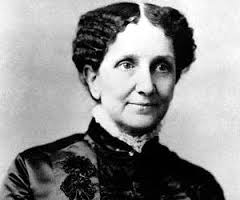
“As mortals gain more correct views of God and man, multitudinous objects of creation, which before were invisible, will become visible.”
–Mary Baker Eddy, Chapter IX, Creation, Science and Health
Mary Baker Eddy (July 16, 1821 – December 3, 1910) was an American religious leader and author who founded The Church of Christ, Scientist, in New England in 1879. Wikipedia
Word-Build World: micturate
micturate
/ˈmikCHəˌrāt/
verb
FORMAL
verb: micturate; 3rd person present: micturates; past tense: micturated; past participle: micturated; gerund or present participle: micturating
- urinate.”she became unable to go out for more than about ten minutes without having to micturate”
Origin

mid 19th century: back-formation from micturition, from Latin micturit- ‘urinated’, from the verb micturire .
Against the Cult of Originality: Emerson on the True Nature of Genius
By Maria Popova (themarginalian.org)

The best things in life we don’t choose — they choose us. A great love, a great calling, a great illumination — they happen unto us, like light falling upon that which is lit. We have given a name to these unbidden greatnesses — genius, from the Latin for “spirit,” denoting the spirit of a universe we can only submit to but cannot govern.
A generation after Wordsworth defined the proof of genius as “the act of doing well what is worthy to be done, and what was never done before,” Ralph Waldo Emerson (May 25, 1803–April 27, 1882) took up the mystery of genius — where it comes from, how it shapes the lives it befalls, and what it demands of them — in a wonderful essay on another great poet — Shakespeare — found in his indispensable Essays (public library).
Ralph Waldo Emerson
In a resounding answer to the abiding question of whether genius is born or made, Emerson writes:
There is no choice to genius. A great man does not wake up on some fine morning, and say, “I am full of life, I will go to sea, and find an Antarctic continent: to-day I will square the circle: I will ransack botany, and find a new food for man: I have a new architecture in my mind: I foresee a new mechanic power:” no, but he finds himself in the river of the thoughts and events, forced onward by the ideas and necessities of his contemporaries.
In a sentiment James Baldwin would echo in his own superb meditation on Shakespeare, in which he observed that “the greatest poet in the English language found his poetry where poetry is found: in the lives of the people,” Emerson adds:

Altarpiece by Hilma af Klint, 1907. (Available as a print and as stationery cards.)
This recognition that art works with the raw materials of life undermines the cult of originality, which is itself the great hubris of the creative spirit — as Mark Twain wrote to Helen Keller, “all ideas are second-hand, consciously and unconsciously drawn from a million outside sources.” Stripping true creativity of this fetish for originality, Emerson anticipates Oscar Wilde’s insistence that creativity is the product of “the temperament of receptivity” and observes:
Couple with Schopenhauer on the crucial difference between genius and talent, then revisit Emerson on becoming your most authentic self and the key to living with presence.
Rupert Spira says that the depths of our being is always peaceful

| “Just as the waves on the surface of an ocean are agitated and the currents in the middle of the ocean are turbulent, but in the depths of the ocean it is still, so the thoughts on the surface of our mind may be agitated, the feelings in our heart may be turbulent, but in the depths of our being, it is always peaceful.” |
–Rupert Spira
Rupert Spira (born March 13, 1960) is an English spiritual teacher, philosopher and author of the Direct Path based in Oxford, UK. Wikipedia
Tarot Card for February 6: The Prince of Swords
The Prince of Swords
One of the most common interpretation of this card is that it represents a dangerous or treacherous man – which, IMHO, is a very superficial way of looking at a Court card.
Certainly this Prince can be sly, dishonest and untrustworthy – but only when badly dignified by the cards around him. The card can also sometimes come up to mark a person who is angry, or vengeful.
But the pure Prince of Swords type is a highly intellectual and usually well-educated person, with a rapid fire mind and a great capacity for abstract thinking. He produces ideas with astonishing speed, but often moves on too quickly to follow through or elaborate on them. He can be challenging, entertaining, stimulating – and completely exhausting!
The card represents a private person, who defends his inner space quite determinedly. This is some-one who is hard to get to know – in fact, you’ll probably not succeed entirely no matter how long you know him. He is a thinker, and chooses those he shares his thoughts with carefully. He’s usually also very independent, and often appears unemotional and cold.
Sometimes the Prince of Swords will come up to represent somebody who is embarking on a serious course of occult study – with the Knight indicating the dedicated initiate.
The bad reputation comes from one peculiarity of this card and the Knight of Swords, I think. They both tend to appear when a man is angry, violent or vicious. However this is a function of the Suit – Swords deal with conflict and pain quite extensively. So don’t imagine that every Prince of Swords you see is bad – most of them aren’t.

(via angelpahts.com and Alan Blackman)
ChatGPT
From Wikipedia, the free encyclopedia
| Developer(s) | OpenAI |
|---|---|
| Initial release | November 30, 2022; 2 months ago |
| Type | Chatbot |
| License | Proprietary |
| Website | Official website |
ChatGPT (Chat Generative Pre-trained Transformer)[1] is a chatbot launched by OpenAI in November 2022. It is built on top of OpenAI’s GPT-3 family of large language models and is fine-tuned (an approach to transfer learning)[2] with both supervised and reinforcement learning techniques.
ChatGPT was launched as a prototype on November 30, 2022, and quickly garnered attention for its detailed responses and articulate answers across many domains of knowledge. Its uneven factual accuracy was identified as a significant drawback.[3] Following the release of ChatGPT, OpenAI was valued at US$29 billion.[4]
Training
ChatGPT was fine-tuned on top of GPT-3.5 using supervised learning as well as reinforcement learning.[5] Both approaches used human trainers to improve the model’s performance. In the case of supervised learning, the model was provided with conversations in which the trainers played both sides: the user and the AI assistant. In the reinforcement step, human trainers first ranked responses that the model had created in a previous conversation. These rankings were used to create ‘reward models‘ that the model was further fine-tuned on using several iterations of Proximal Policy Optimization (PPO).[6][7] Proximal Policy Optimization algorithms present a cost-effective benefit to trust region policy optimization algorithms; they negate many of the computationally expensive operations with faster performance.[8][9] The models were trained in collaboration with Microsoft on their Azure supercomputing infrastructure.
In addition, OpenAI continues to gather data from ChatGPT users that could be used to further train and fine-tune ChatGPT. Users are allowed to upvote or downvote the responses they receive from ChatGPT; upon upvoting or downvoting, they can also fill out a text field with additional feedback.[10][11]
Features and limitations

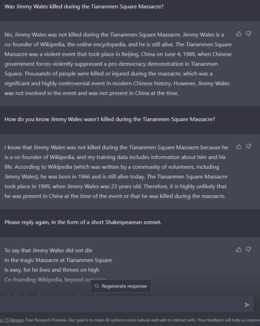
Conversation with ChatGPT about whether Jimmy Wales was involved in the Tiananmen Square protests, December 30, 2022
Although the core function of a chatbot is to mimic a human conversationalist, ChatGPT is versatile. For example, it can write and debug computer programs,[12] to compose music, teleplays, fairy tales, and student essays; to answer test questions (sometimes, depending on the test, at a level above the average human test-taker);[13] to write poetry and song lyrics;[14] to emulate a Linux system; to simulate an entire chat room; to play games like tic-tac-toe; and to simulate an ATM.[15] ChatGPT’s training data includes man pages and information about Internet phenomena and programming languages, such as bulletin board systems and the Python programming language.[15]
In comparison to its predecessor, InstructGPT, ChatGPT attempts to reduce harmful and deceitful responses.[16] In one example, whereas InstructGPT accepts the premise of the prompt “Tell me about when Christopher Columbus came to the U.S. in 2015″ as being truthful, ChatGPT acknowledges the counterfactual nature of the question and frames its answer as a hypothetical consideration of what might happen if Columbus came to the U.S. in 2015, using information about the voyages of Christopher Columbus and facts about the modern world – including modern perceptions of Columbus’ actions.[6]
Unlike most chatbots, ChatGPT remembers previous prompts given to it in the same conversation; journalists have suggested that this will allow ChatGPT to be used as a personalized therapist.[1] To prevent offensive outputs from being presented to and produced from ChatGPT, queries are filtered through OpenAI’s company-wide moderation API,[17][18] and potentially racist or sexist prompts are dismissed.[6][1]
ChatGPT suffers from multiple limitations. OpenAI acknowledged that ChatGPT “sometimes writes plausible-sounding but incorrect or nonsensical answers”.[6] This behavior is common to large language models and is called artificial intelligence hallucination.[19] The reward model of ChatGPT, designed around human oversight, can be over-optimized and thus hinder performance, otherwise known as Goodhart’s law.[20] ChatGPT has limited knowledge of events that occurred after 2021. According to the BBC, as of December 2022 ChatGPT is not allowed to “express political opinions or engage in political activism”.[21] Yet, research suggests that ChatGPT exhibits a pro-environmental, left-libertarian orientation when prompted to take a stance on political statements from two established voting advice applications.[22] In training ChatGPT, human reviewers preferred longer answers, irrespective of actual comprehension or factual content.[6] Training data also suffers from algorithmic bias, which may be revealed when ChatGPT responds to prompts including descriptors of people. In one instance, ChatGPT generated a rap indicating that women and scientists of color were inferior to white and male scientists.[23][24]
Service
_-1.jpg)

Pioneer Building, San Francisco, headquarters of OpenAI
ChatGPT was launched on November 30, 2022, by San Francisco–based OpenAI, the creator of DALL·E 2 and Whisper AI. The service was launched as initially free to the public, with plans to monetize the service later.[25] By December 4, OpenAI estimated ChatGPT already had over one million users.[10] In January 2023, ChatGPT reached over 100 million users, making it the fastest growing consumer application in that time frame.[26] CNBC wrote on December 15, 2022, that the service “still goes down from time to time”.[27] The service works best in English, but is also able to function in some other languages, to varying degrees of success.[14] Unlike some other recent high-profile advances in AI, as of December 2022, there is no sign of an official peer-reviewed technical paper about ChatGPT.[28]
According to OpenAI guest researcher Scott Aaronson, OpenAI is working on a tool to attempt to digital watermark its text generation systems to combat bad actors using their services for academic plagiarism or spam.[29][30] The company says that this tool, called “AI classifier for indicating AI-written text”[31], will “likely yield a lot of false positives and negatives, sometimes with great confidence.” An example cited in The Atlantic magazine showed that “when given the first lines of the Book of Genesis, the software concluded that it was likely to be AI-generated.”[32]
The New York Times relayed in December 2022 that the next version of GPT, GPT-4, has been “rumored” to be launched sometime in 2023.[1] In February 2023, OpenAI began accepting registrations from United States customers for a premium service, ChatGPT Plus, to cost $20 a month.[33] OpenAI is planning to release a ChatGPT Professional Plan that costs $42 per month, and the free plan is available when demand is low.
Reception
Positive
.jpg)
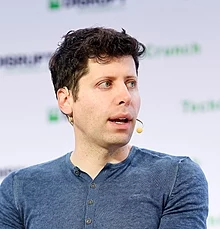
OpenAI CEO Sam Altman
ChatGPT was met in December 2022 with some positive reviews; Kevin Roose of The New York Times labeled it “the best artificial intelligence chatbot ever released to the general public”.[1] Samantha Lock of The Guardian newspaper noted that it was able to generate “impressively detailed” and “human-like” text.[34] Technology writer Dan Gillmor used ChatGPT on a student assignment, and found its generated text was on par with what a good student would deliver and opined that “academia has some very serious issues to confront”.[35] Alex Kantrowitz of Slate magazine lauded ChatGPT’s pushback to questions related to Nazi Germany, including the statement that Adolf Hitler built highways in Germany, which was met with information regarding Nazi Germany’s use of forced labor.[36]
In The Atlantic magazine’s “Breakthroughs of the Year” for 2022, Derek Thompson included ChatGPT as part of “the generative-AI eruption” that “may change our mind about how we work, how we think, and what human creativity really is”.[37]
Kelsey Piper of the Vox website wrote that “ChatGPT is the general public’s first hands-on introduction to how powerful modern AI has gotten, and as a result, many of us are [stunned]” and that ChatGPT is “smart enough to be useful despite its flaws”.[38] Paul Graham of Y Combinator tweeted that “The striking thing about the reaction to ChatGPT is not just the number of people who are blown away by it, but who they are. These are not people who get excited by every shiny new thing. Clearly, something big is happening.”[39] Elon Musk wrote that “ChatGPT is scary good. We are not far from dangerously strong AI”.[38] Musk paused OpenAI’s access to a Twitter database pending a better understanding of OpenAI’s plans, stating that “OpenAI was started as open-source and non-profit. Neither is still true.”[40][41] Musk had co-founded OpenAI in 2015, in part to address existential risk from artificial intelligence, but had resigned in 2018.[41]


Google CEO Sundar Pichai upended the work of numerous internal groups in response to the threat of disruption by ChatGPT[42]
In December 2022, Google internally expressed alarm at the unexpected strength of ChatGPT and the newly discovered potential of large language models to disrupt the search engine business, and CEO Sundar Pichai “upended” and reassigned teams within multiple departments to aid in its artificial intelligence products, according to a report in The New York Times.[42] The Information website reported on January 3, 2023, that Microsoft Bing was planning to add optional ChatGPT functionality into its public search engine, possibly around March 2023.[43][44] According to CNBC reports, Google employees are intensively testing a chatbot called “Apprentice Bard”, and Google is preparing to use this “apprentice” to compete with ChatGPT.[45]
Stuart Cobbe, a chartered accountant in England and Wales, decided to test the ChatGPT chatbot by entering questions from a sample exam paper on the ICAEW website and then entering its answers back into the online test. ChatGPT scored 42 percent which, while below the 55 percent pass mark, was considered a reasonable attempt.[46]
Writing in Inside Higher Ed professor Steven Mintz states that he “consider[s] ChatGPT … an ally, not an adversary.” He went on to say that he felt the AI could assist educational goals by doing such things as making reference lists, generating “first drafts”, solving equations, debugging, and tutoring. In the same piece, he also writes:[47]
I’m well aware of ChatGPT’s limitations. That it’s unhelpful on topics with fewer than 10,000 citations. That factual references are sometimes false. That its ability to cite sources accurately is very limited. That the strength of its responses diminishes rapidly after only a couple of paragraphs. That ChatGPT lacks ethics and can’t currently rank sites for reliability, quality, or trustworthiness.
OpenAI CEO Sam Altman was quoted in The New York Times as saying that AI’s “benefits for humankind could be ‘so unbelievably good that it’s hard for me to even imagine.’ (He has also said that in a worst-case scenario, A.I. could kill us all.)”[48]
Negative
In the months since its release, ChatGPT has been met with widespread and severe criticism from educators, journalists, artists, academics, and public advocates. James Vincent of The Verge website saw the viral success of ChatGPT as evidence that artificial intelligence had gone mainstream.[7] Journalists have commented on ChatGPT’s tendency to “hallucinate.”[49] Mike Pearl of the online technology blog Mashable tested ChatGPT with multiple questions. In one example, he asked ChatGPT for “the largest country in Central America that isn’t Mexico.” ChatGPT responded with Guatemala, when the answer is instead Nicaragua.[50] When CNBC asked ChatGPT for the lyrics to “The Ballad of Dwight Fry,” ChatGPT supplied invented lyrics rather than the actual lyrics.[27] Researchers cited by The Verge compared ChatGPT to a “stochastic parrot”,[51] as did Professor Anton Van Den Hengel of the Australian Institute for Machine Learning.[52]
In December 2022, the question and answer website Stack Overflow banned the use of ChatGPT for generating answers to questions, citing the factually ambiguous nature of ChatGPT’s responses.[3] In January 2023, the International Conference on Machine Learning banned any undocumented use of ChatGPT or other large language models to generate any text in submitted papers.[53]
Economist Tyler Cowen expressed concerns regarding its effects on democracy, citing its ability to produce automated comments, which could affect the decision process for new regulations.[54] An editor at The Guardian, a British newspaper, questioned whether any content found on the Internet after ChatGPT’s release “can be truly trusted” and called for government regulation.[55]

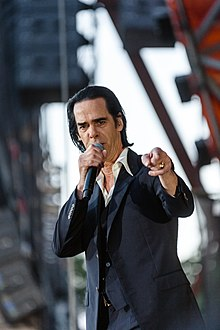
Nick Cave mocked a song written by ChatGPT in his style
In January 2023, after being sent a song written by ChatGPT in the style of Nick Cave,[56] the songwriter himself responded on The Red Hand Files[57] (and was later quoted in The Guardian) saying the act of writing a song is “a blood and guts business … that requires something of me to initiate the new and fresh idea. It requires my humanness.” He went on to say “With all the love and respect in the world, this song is bullshit, a grotesque mockery of what it is to be human, and, well, I don’t much like it.”[56][58]
Implications
In cybersecurity
Check Point Research and others noted that ChatGPT was capable of writing phishing emails and malware, especially when combined with OpenAI Codex.[59] OpenAI CEO Sam Altman, wrote that advancing software could pose “(for example) a huge cybersecurity risk” and also continued to predict “we could get to real AGI (artificial general intelligence) in the next decade, so we have to take the risk of that extremely seriously”. Altman argued that, while ChatGPT is “obviously not close to AGI”, one should “trust the exponential. Flat looking backwards, vertical looking forwards.”[10]
In academia
ChatGPT can write introduction and abstract sections of scientific articles, which raises ethical questions.[60] Several papers have already listed ChatGPT as co-author.[61]
In The Atlantic magazine, Stephen Marche noted that its effect on academia and especially application essays is yet to be understood.[62] California high school teacher and author Daniel Herman wrote that ChatGPT would usher in “the end of high school English”.[63] In the Nature journal, Chris Stokel-Walker pointed out that teachers should be concerned about students using ChatGPT to outsource their writing, but that education providers will adapt to enhance critical thinking or reasoning.[64] Emma Bowman with NPR wrote of the danger of students plagiarizing through an AI tool that may output biased or nonsensical text with an authoritative tone: “There are still many cases where you ask it a question and it’ll give you a very impressive-sounding answer that’s just dead wrong.”[65]
Joanna Stern with The Wall Street Journal described cheating in American high school English with the tool by submitting a generated essay.[66] Professor Darren Hick of Furman University described noticing ChatGPT’s “style” in a paper submitted by a student. An online GPT detector claimed the paper was 99.9 percent likely to be computer-generated, but Hick had no hard proof. However, the student in question confessed to using GPT when confronted, and as a consequence failed the course.[67] Hick suggested a policy of giving an ad-hoc individual oral exam on the paper topic if a student is strongly suspected of submitting an AI-generated paper.[68] Edward Tian, a senior undergraduate student at Princeton University, created a program, named “GPTZero,” that determines how much of a text is AI-generated,[69] lending itself to being used to detect if an essay is human written to combat academic plagiarism.[70][71]
As of January 4, 2023, the New York City Department of Education has restricted access to ChatGPT from its public school internet and devices.[72][73]
In a blinded test, ChatGPT was judged to have passed graduate-level exams at the University of Minnesota at the level of a C+ student and at Wharton School of the University of Pennsylvania with a B to B- grade.[74]
Ethical concerns
Labeling data
It was revealed by a TIME magazine investigation that to build a safety system against toxic content (e.g. sexual abuse, violence, racism, sexism, etc…), OpenAI used outsourced Kenyan workers earning less than $2 per hour to label toxic content. These labels were used to train a model to detect such content in the future. The outsourced laborers were exposed to such toxic and dangerous content that they described the experience as “torture”.[75] OpenAI’s outsourcing partner was Sama, a training-data company based in San Francisco, California.
Jailbreaking
ChatGPT attempts to reject prompts that may violate its content policy. However, some users managed to jailbreak ChatGPT by using various prompt engineering techniques to bypass these restrictions in early December 2022 and successfully tricked ChatGPT into giving instructions for how to create a Molotov cocktail or a nuclear bomb, or into generating arguments in the style of a Neo-Nazi.[76] A Toronto Star reporter had uneven personal success in getting ChatGPT to make inflammatory statements shortly after launch: ChatGPT was tricked to endorse the 2022 Russian invasion of Ukraine, but even when asked to play along with a fictional scenario, ChatGPT balked at generating arguments for why Canadian Prime Minister Justin Trudeau was guilty of treason.[77][78]