If the Queen of Cups appears in a reading to indicate a woman, she will be a gentle and tranquil woman, romantic by nature, generous with her tenderness. She will be something of a day-dreamer – perhaps a bit unrealistic, but creative and hopeful.
She is often involved in creative or literary pursuits, and enjoys art, good music, literature and things of beauty. She is unstinting in her readiness to nurture others, sometimes to her own detriment. She’s often connected with motherhood, and mothering.
She is often intuitive, and psychic. Her foremost ability in this area is a talent for simply absorbing energies around her and reflecting them back, unchanged. In this aspect she can often be a revealer for those around her.
If she is badly aspected, however, another aspect of her personality shows through. The gentleness and tranquillity convert to weakness and unspoken resentment. She nurtures for the sake of inducing dependancy, and places undue importance on being in a relationship, no matter what its quality. She will believe herself unable to stand alone.
Her reflective quality backfires so that she begins to take on the attitudes and thoughts of others. When this happens she begins to show signs of feeling victimised. She might present to the world with a poor-little-me attitude.
When the card comes up to indicate a change in some-one’s response, we see the woman in love – entering into the deepest and most emotional realms of her personality, and returning refreshed and invigorated.
Sometimes the card will come up to indicate a woman acting as priestess of the Goddess.
This is the story of the Global Consciousness Project, a unique 20-year scientific collaboration of researchers recording the effects of mass consciousness in response to major global events. Its findings are consistent with the wisdom traditions of many cultures and speak of humanity’s unity and deep connections through love, compassion, and the creative impulse.
ROGER NELSON runs the Global Consciousness Project (GCP), an international collaboration studying mass consciousness. He conducted psi research at the Princeton Engineering Anomalies Research (PEAR) laboratory from 1980 to 2002 and, while at Princeton, created the GCP in 1997. Interests in psychology, physics, philosophy, and the arts facilitate his research at the edges of what we know. His focus is the subtle interconnections that define an emerging humanity. Nelson is the author with Georg Kindel of Der Welt Geist: wie wir alle miteinander verbunden sind, published in 2018.
New Thinking Allowed with Jeffrey Mishlove Jul 3, 2022 Stephan A. Schwartz is a Distinguished Consulting Faculty of Saybrook University. He is the columnist for the journal Explore, and editor of the daily web publication Schwartzreport.net in both of which he covers trends that are affecting the future. His other academic and research appointments include: Senior Fellow for Brain, Mind and Healing of the Samueli Institute; founder and Research Director of the Mobius laboratory. Government appointments include Special Assistant for Research and Analysis to the Chief of Naval Operations. Schwartz was the principal researcher studying the use of Remote Viewing in archaeology. Using Remote Viewing he discovered Cleopatra’s Palace, Marc Antony’s Timonium, ruins of the Lighthouse of Pharos, and sunken ships along the California coast, and in the Bahamas. He is the author of more than 130 technical reports and papers. He has written The Secret Vaults of Time, The Alexandria Project, Mind Rover, Opening to the Infinite, and The 8 Laws of Change. Here he reviews his earlier project, starting in 1978, of asking remote viewers to describe life in the year 2050. Recently he initiated a new project to look at the year 2060, so that it could be compared to his 2050 results. He describes his careful use of consensus methodology in remote viewing. Furthermore, he is now able to take advantage of several analytical tools involving “big data” that were not available for the earlier research. Preliminary results suggest that, by 2060, society will have adjusted to an enormous transformating occuring between 2040 and 2045. New Thinking Allowed host, Jeffrey Mishlove, PhD, is author of The Roots of Consciousness, Psi Development Systems, and The PK Man. Between 1986 and 2002 he hosted and co-produced the original Thinking Allowed public television series. He is the recipient of the only doctoral diploma in “parapsychology” ever awarded by an accredited university (University of California, Berkeley, 1980). He is also the Grand Prize winner of the 2021 Bigelow Institute essay competition regarding the best evidence for survival of human consciousness after permanent bodily death. (Recorded on June 14, 2022)
In 1863 Jules Verne, famed author of 20,000 Leagues Under the Sea and Around the World in Eighty Days, wrote a novel that his literary agent deemed too farfetched to be published. More than one hundred years later, his great-grandson found the handwritten, never-before published manuscript in a safe. That manuscript was Paris in the Twentieth Century, an astonishingly prophetic view into the future by one of the most renowned science fiction writers of our time . . .
“The teaching is fulfilled, not when it’s aped or mimicked, but when it becomes somebody’s own.”
“The truth needs to be reformatted for every generation.”
–Henry Shukman and Rupert Spira
Rupert Spira Jun 26, 2022 Each one of us goes through a unique journey in the revelation of the truth or search for lasting happiness. In this wonderful conversation, Rupert Spira and acclaimed English poet and writer Henry Shukman discuss the process of surrender, or giving yourself to something utterly impersonal, that is experienced through spiritual and other traditions. “The forms that we inherit in the different traditions, such as koans and mantras are the repositories of generations of understanding, and if you subject yourself to that form you are opening yourself to receiving the generations of understanding that have impregnated that form. That’s why practices and trainings are so powerful and why they last generation after generation.” This conversation is moderated by Guru Viking.
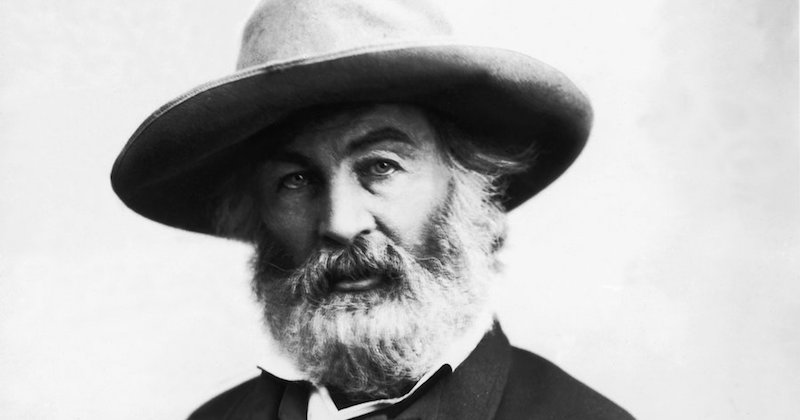
Toward the end of Walt Whitman’s life, the writer Horace Traubel visited him often at his home in Camden, New Jersey, and recorded their conversations on friendship, family, the Civil War, literature, and other topics, producing thousands of pages of transcripts in total. In Walt Whitman Speaks, editor Brenda Wineapple offers selections from their conversations, including these on sex.
*
Damn the expurgated books! I say damn ’em! The dirtiest book in all the world is the expurgated book!
Sex is a red rag to most people. It takes some time to get accustomed to me, but if the folks will only persevere they will finally feel right comfortable in my presence. “Children of Adam”—the poems—are very innocent: they will not shake down a house. A man was here the other day who asked me: “Don’t you feel rather sorry on the whole that you wrote the sex poems?” I answered him by asking another question: “Don’t you feel rather sorry on the whole that I am Walt Whitman?”
Authors in the Tent: David L. Ulin on How Walking Is an Act of Recreation
All this fear of indecency, all this noise about purity and sex and the social order and the Comstockism particular and general is nasty—too nasty to make any compromise with. I never come up against it but I think of what [Heinrich] Heine said to a woman who had expressed to him some suspicion about the body. “Madame,” said Heine, “are we not all naked under our clothes?”
*
We have got so in our civilization, so-called (which is no civilization at all) that we are afraid to face the body and its issues—when we shrink from the realities of our bodily life: when we refer the functions of the man and the woman, their sex, their passion, their normal necessary desires, to something which is to be kept in the dark and lied about instead of being avowed and gloried in.
*
The body is stubborn: it craves bodily presences: it has its own peculiar tenacities—we might say aspirations as well as desires.
*
Obscenity? Obscene? Oh! Is the surgeon’s knife obscene? It might just as well be said of the one as the other. This is a picture to the life, a cut to the bone. It is not a pleasant book: it is horrible, horrible, in its truth, its graphic power.
*
There was one of the department heads at Washington who conceived a great dislike for the word virile—gave out orders that it should not be used in any of the documents issuing from that department. I was very curious about it, and asked him once how his antipathy (and it was a virile antipathy!) arose. He said that he hated the word—that it called up in him images of everything filthy, nasty, vile. It was very amusing. I remarked to him: “Did it never occur to you that the fault is in you and not in the word? I use the word—like it—and am never once brought by it into touch with the images you speak of.” But he was obdurate—remarking only: “Well—whatever: I won’t have it! I hate the word!” And yet he was a man of force, filled his place well, in all the usual ways was sound and sensible.
*
I often say to myself about Calamus—perhaps it means more or less than what I thought myself—means different: perhaps I don’t know what it all means—perhaps never did know.
*
Any demonstration between men—any: it is always misjudged: people come to conclusions about it: they know nothing, there is nothing to be known; nothing except what might just as well be known: yet they shake their wise heads—they meet, gossip, generate slander: they know what is not to be known—they see what is not to be seen: so they confide in each other, tell the awful truth: the old women men, the old men women, the guessers, the false-witnesses—the whole caboodle of liars and fools.
*
“Calamus” is a Latin word—much used in Old English writing, however. I like it much—it is to me, for my intentions, indispensible—the sun revolves about it, it is a timber of the ship—not there alone in that one series of poems, but in all, belonging to all. It is one of the United States—it is the quality which makes the states whole—it is the thin thread—but, oh! the significant thread!—by which the nation is held together, a chain of comrades; it could no more be dispensed with than the ship entire.
*
I have heard nothing but expurgate, expurgate, expurgate, from the day I started. Everybody wants to expurgate something—this, that, the other thing. If I accepted all the suggestions there wouldn’t be one leaf of the Leaves left—and if I accepted one why shouldn’t I accept all? Expurgate, expurgate, expurgate! I’ve heard that till I’m deaf with it. Who didn’t say expurgate? Rossetti said expurgate and I yielded. Rossetti was honest, I was honest—we both made a mistake. It is damnable and vulgar—the mere suggestion is an outrage. Expurgation is apology—yes, surrender—yes, an admission that something or other was wrong. Emerson said expurgate—I said no, no. I have lived to regret my Rossetti yes—I have not lived to regret my Emerson no. Expurgate, expurgate, expurgate—apologize, apologize: get down on your knees.
*
Emerson was quite vigorous in talking about the critics—talking with me: he said: “I seem to mystify them—rather mystify than antagonize them”: which I guess was true. I seem to make them mad—rile them: I mystify them, too, but they don’t know it: they only know I am vile, indecent, perverted, adulterous.
*
The world now can have no idea of the bitterness of the feeling against me in those early days. I was a tough—obscene: indeed, it was my obscenity, libidinousness, all that, upon which they made up their charges.
*
It has always been a puzzle to me why people think that because I wrote “Children of Adam,” Leaves of Grass, I must perforce be interested in all the literature of rape, all the pornography of vile minds. I have not only been made a target by those who despised me but a victim of violent interpretation by those who condoned me.
*
What do you call free love? There’s no other kind of love, is there? As to the next step—who knows what it means? I only feel sure of one thing: that we won’t go back: that the women will take care of sex things—make them what they choose: man has very little to do with it except to conform.
*
I think Swedenborg was right when he said there was a close connection—a very close connection—between the state we call religious ecstasy and the desire to copulate. I find Swedenborg confirmed in all my experience. It is a peculiar discovery. It was Burns—Whittier’s friend Burns—who said in a couple of lines of one of his poems, I’d rather cause the birth of one than the death of 20! And that would be my doctrine, too!
*
We have gone on for so long hurting the body that the job of rehabilitating it seems prodigious if not impossible. The time will come when the whole affair of sex—copulation, reproduction—will be treated with the respect to which it is entitled. Instead of meaning shame and being apologized for, it will mean purity and will be glorified.
*
The woman who has denied the best of herself—the woman who has discredited the animal want, the eager physical hunger, the wish of that which though we will not allow it to be freely spoken of is still the basis of all that makes life worth while and advances the horizon of discovery. Sex: sex: sex: whether you sing or make a machine, or go to the North Pole, or love your mother, or build a house, or black shoes, or anything—anything at all—it’s sex, sex, sex: sex is the root of it all: sex—the coming together of men and women: sex: sex.
__________________________________
Walt Whitman Speaks: His Final Thoughts on Life, Writing, Spirituality, and the Promise of America as told to Horace Traubel, edited by Brenda Wineapple (Library of America).
Brenda Wineapple was born in Boston, raised in northern Massachusetts (on the New Hampshire border), and now lives in New York. She has received such numerous honors as a Literature Award from the American Academy of Arts and Letters, a Pushcart Prize, a Guggenheim Fellowship, an American Council of Learned Societies Fellowship, two National Endowment Fellowships in the Humanities, and most recently an NEH Public Scholars Award for The Impeachers. She is also an elected member of the American Academy of Arts and Sciences and of the Society of American Historians and regularly contributes to major publications such as the New York Times Book Review, The New York Review of Books, and The Nation.
Life Process Program Jan 30, 2022 NYT Best-Selling Author Johann Hari, In his new book, “Stolen Focus”, explains why and how our ability to pay attention is diminishing; he explains why that matters; and he offers potential solutions to those of us who wish to improve our focus and live better lives. Johann Hari is a British journalist who has written for The Guardian, New York Times, The Independent, Le Monde, and many others. His Ted Talks have been viewed by tens of millions. He has written two international best-selling books (one of which has been adapted into a Hollywood film), and he has spoken to audiences around the globe. Today, Hari joins Sundays With Stories to discuss the themes from his most recent book, “Stolen Focus” and discuss the solutions to one of our most daunting cultural issues to date. TIME STAMPS 0:00 Dumb Banter 2:30 Who (or what) is stealing focus from whom? 5:07 Taking on the forces that have stolen our attention 6:33 Precommitment 9:00 Multi-tasking is harming creativity 15:52: How do we prioritize our attention? 20:03 Individual solutions and cultural solutions 22:20 Mind wandering and flow states 27:40 Reinforcement on social media 33:25 Humans are not one-dimensional 35:29 Tristan Harris / Reasons for optimism? 46:00 Can we persuade Facebook and Instagram to be ethical? 48:30 Why do we hyper-focus on doom and gloom? 54:50 Overprotecting our children 1:03:11 Anxiety versus mastery and motivation 1:06:10 ADHD OVER-diagnosis in kids 1:07:21 Schools ask kids to focus on meaningless work 1:09:31 Zone of proximal development 1:11:08 How can we get out attention back? 1:15:30 We have to understand the problem before we can solve it
Stolen Focus: Why You Can’t Pay Attention- and How to Think Deeply Again
Our ability to pay attention is collapsing. From the New York Times bestselling author of Chasing the Scream and Lost Connections comes a groundbreaking examination of why this is happening–and how to get our attention back.
In the United States, teenagers can focus on one task for only sixty-five seconds at a time, and office workers average only three minutes. Like so many of us, Johann Hari was finding that constantly switching from device to device and tab to tab was a diminishing and depressing way to live. He tried all sorts of self-help solutions–even abandoning his phone for three months–but nothing seemed to work. So Hari went on an epic journey across the world to interview the leading experts on human attention–and he discovered that everything we think we know about this crisis is wrong.
We think our inability to focus is a personal failure to exert enough willpower over our devices. The truth is even more disturbing: our focus has been stolen by powerful external forces that have left us uniquely vulnerable to corporations determined to raid our attention for profit. Hari found that there are twelve deep causes of this crisis, from the decline of mind-wandering to rising pollution, all of which have robbed some of our attention. In Stolen Focus, he introduces readers to Silicon Valley dissidents who learned to hack human attention, and veterinarians who diagnose dogs with ADHD. He explores a favela in Rio de Janeiro where everyone lost their attention in a particularly surreal way, and an office in New Zealand that discovered a remarkable technique to restore workers’ productivity.
Crucially, Hari learned how we can reclaim our focus–as individuals, and as a society–if we are determined to fight for it. Stolen Focus will transform the debate about attention and finally show us how to get it back.
The third and final volume of All Over Coffee presents some of the most beloved and never before collected pieces from the weekly series. Originally published in the San Francisco Chronicle, this timeless work, which includes collaborations with many prize-winning authors, is now collected for the first time into a new gorgeous hardcover edition.
You Know Exactly enigmatically melds art, story, and travel to capture the profundity reflected outside and resting deep within the soul. With original writings plus collaborations with award-winning writers including Lawrence Ferlinghetti, Cheryl Strayed, Andrew Sean Greer, Robert Olen Butler, Kristen Tracy, Daniel Handler (otherwise known as Lemony Snicket), and more, artist and writer Paul Madonna pairs words with exquisitely rendered cityscapes to create a poignant, thought-provoking showpiece. Each page offers something unique: short stories, poems, fleeting thoughts, and one-liners displayed alongside pen and ink drawings that travel from San Francisco to New York, from Paris to Tokyo. The effect coalesces into a mesmerizing work that you’ll want to return to again and again.
A Sudbury man known as the ‘Old Hippie on a Bike’ is embarking on his third mammoth bike ride to raise money for British-Ukrainian Aid. – Credit: Alan Deakins
A Sudbury man known as the ‘Old Hippie on a Bike’ is embarking on his third mammoth bike ride to raise money for British-Ukrainian Aid.
Alan Deakins, 76, will be starting a 4,000km ride from his home in Sudbury, across Europe and back.
Alan Deakins, known as the ‘Old Hippie on a Bike’, is embarking on a 4,000km bike ride. – Credit: Alan Deakins
He will be visiting four former Nazi concentration camps to show his “respect for the millions of innocent souls who lost their lives there”.
Alan added: “Unfortunately today, the horrors of war are once again inflicted upon Europe. But unlike 75 years ago, it is possible to get aid and comfort to the victims of the Ukrainian war.”
His trip starts on Monday, July 18 and he will be setting off with just an old bike he purchased from eBay for £80 and a tent as company.
He is starting his mammoth journey on Monday, July 18. – Credit: Alan Deakins
Alan was inspired to start his bike ride missions after he suffered a stroke in 2016.
In 2018, he raised £9,000 for the Samaritans by undertaking a trip from St Petersburg, Russia, back to the Samaritans branch in Bury St Edmunds.
The ride took 42 days in total and he covered a huge distance of 3,200km.
Previously, Alan has undertaken two other missions in 2018 and 2019. – Credit: Alan Deakins
One year later, he rode what he describes as a “short” two week stint through Holland and the western edge of Germany to raise a further £1,200.
Alan said: “Covid robbed me of two summers of travels, but now I’m returning with my longest journey yet.”
Alan is hoping to raise £8,000 in donations through his JustGiving page for British-Ukrainian Aid, a charity funded entirely by voluntary contributions.
He said: “British-Ukrainian Aid is a unique charity as it is run by volunteers, so 100% of a donation goes directly to Ukraine’s innocent civilians caught up in the devastating war.”
Alan will be updating his ‘Old Hippie on a Bike’ Facebook and Instagram pages with daily blogs and pictures from his 4,000km journey.
Alan hopes to raise £8,000 and will be updating his Facebook and Instagram pages with daily blogs. – Credit: Alan Deakins
He added: “Please join me. It will be a trip of poignancy, discovery, fun, and the unexpected… and hopefully, we will meet wonderful people along the way.”
NEW YORK—In an effort to raise awareness of the medical procedure after the Supreme Court’s overturning of Roe v. Wade, Sesame Workshop released a public service announcement Thursday on preventing unwanted pregnancies that featured Elmo receiving a vasectomy. “There was a little pinch, but that was okay,” said Elmo, who explained to viewers that the elective surgical procedure for male sterilization was safe and over 99% effective in preventing pregnancy, making it a great option for people who don’t currently want to have children. “Elmo was real scared at first, but the nice nurse told Elmo that the doctor can reverse the vasectomy when I’m ready to be a daddy. It only took 15 minutes to make the two incisions on my scrotum, and then snip! Elmo’s infertile now!” Elmo then asked some local children to help him count up to seven to show viewers how many days of recovery he would need before being able to have sex again.
Consciousness, spirituality, biography, sexuality, androgyny, futurism, space, the arts, science, astrology, democracy, humor, books, movies and more