Bio: David Chalmers

From Wikipedia, the free encyclopedia

David Chalmers
Chalmers in 2008
BornDavid John Chalmers
20 April 1966 (age 55)
SydneyNew South Wales, Australia
Alma materUniversity of Adelaide
Lincoln College, Oxford
Indiana University Bloomington (PhD, 1993)
EraContemporary philosophy
RegionWestern philosophy
SchoolAnalytic
ThesisToward a Theory of Consciousness (1993)
Doctoral advisorDouglas Hofstadter
Main interestsPhilosophy of mind
Consciousness
Philosophy of language
Notable ideasHard problem of consciousnessextended mindtwo-dimensional semanticsnaturalistic dualismphilosophical zombie
showInfluences
showInfluenced
WebsiteOfficial website

David John Chalmers (/ˈtʃælmərz/;[1] born 20 April 1966) is an Australian philosopher and cognitive scientist specializing in the areas of philosophy of mind and philosophy of language. He is a Professor of Philosophy and Neural Science at New York University, as well as co-director of NYU’s Center for Mind, Brain and Consciousness (along with Ned Block).[2][3] In 2006, he was elected a Fellow of the Australian Academy of the Humanities.[4] In 2013, he was elected a Fellow of the American Academy of Arts & Sciences.[5]

Chalmers is best known for formulating the hard problem of consciousness. He is the cofounder of PhilPapers (a database of journal articles for professionals and students in philosophy) along with David Bourget.

Early life and education

Chalmers was born in SydneyNew South Wales, in 1966, and subsequently grew up in AdelaideSouth Australia.[6] As a child, he experienced synesthesia.[6] He also performed exceptionally in mathematics, and secured a bronze medal in the International Mathematical Olympiad.[6]

Chalmers received his undergraduate degree in pure mathematics from the University of Adelaide in Australia[7] and continued his studies at the University of Oxford,[7] where he was a Rhodes Scholar.[8] In 1993, Chalmers received his PhD in philosophy and cognitive science from Indiana University Bloomington under Douglas Hofstadter,[9] writing a doctoral thesis entitled Toward a Theory of Consciousness.[8] He was a postdoctoral fellow in the Philosophy-Neuroscience-Psychology program directed by Andy Clark at Washington University in St. Louis from 1993 to 1995.

Career

In 1994, Chalmers presented a lecture at the inaugural Toward a Science of Consciousness conference.[9] According to an article in the Chronicle of Higher Education, this “lecture established Chalmers as a thinker to be reckoned with and goosed a nascent field into greater prominence.”[9] He went on to coorganize the conference (now renamed “The Science of Consciousness”) for some years with Stuart Hameroff, but stepped away when it became too divergent from mainstream science.[9] Chalmers is also a founding member of the Association for the Scientific Study of Consciousness, as well as one of its past presidents.[10]

Having established his reputation, Chalmers received his first professorship the following year, at UC Santa Cruz, from August 1995 to December 1998. In 1996, while teaching there, he published the widely cited book The Conscious Mind. Chalmers was subsequently appointed Professor of Philosophy (1999–2004) and, subsequently, Director of the Center for Consciousness Studies (2002–2004) at the University of Arizona, sponsor of the conference that had first brought him to prominence. In 2004, Chalmers returned to Australia, encouraged by an ARC Federation Fellowship, becoming Professor of Philosophy and Director of the Center for Consciousness at the Australian National University.[citation needed] Chalmers accepted a part-time professorship at the philosophy department of New York University in 2009, and then a full-time professorship there in 2014.[11]

In 2013, Chalmers was elected a Fellow of the American Academy of Arts & Sciences.[5] He is an editor on topics in the philosophy of mind for the Stanford Encyclopedia of Philosophy.[12] In May 2018, it was announced that he would serve on the jury for the Berggruen Prize.[13]

Philosophical work

Philosophy of mind

Chalmers on stage for an Alan Turing Year event at De La Salle University, Manila, March 27, 2012

Chalmers is best known for formulating what he calls the “hard problem of consciousness,” in both his 1995 paper “Facing Up to the Problem of Consciousness” and his 1996 book The Conscious Mind. He makes a distinction between “easy” problems of consciousness, such as explaining object discrimination or verbal reports, and the single hard problem, which could be stated “why does the feeling which accompanies awareness of sensory information exist at all?” The essential difference between the (cognitive) easy problems and the (phenomenal) hard problem is that the former are at least theoretically answerable via the dominant strategy in the philosophy of mind: physicalism. Chalmers argues for an “explanatory gap” from the objective to the subjective, and criticizes physicalist explanations of mental experience, making him a dualist. Chalmers characterizes his view as “naturalistic dualism”: naturalistic because he believes mental states supervene “naturally” on physical systems (such as brains); dualist because he believes mental states are ontologically distinct from and not reducible to physical systems. He has also characterized his view by more traditional formulations such as property dualism.

In support of this, Chalmers is famous for his commitment to the logical (though, not natural) possibility of philosophical zombies.[14] These zombies are complete physical duplicates of human beings, lacking only qualitative experience. Chalmers argues that since such zombies are conceivable to us, they must therefore be logically possible. Since they are logically possible, then qualia and sentience are not fully explained by physical properties alone; the facts about them are further facts. Instead, Chalmers argues that consciousness is a fundamental property ontologically autonomous of any known (or even possible) physical properties,[15] and that there may be lawlike rules which he terms “psychophysical laws” that determine which physical systems are associated with which types of qualia. He further speculates that all information-bearing systems may be conscious, leading him to entertain the possibility of conscious thermostats and a qualified panpsychism he calls panprotopsychism. Chalmers maintains a formal agnosticism on the issue, even conceding that the viability of panpsychism places him at odds with the majority of his contemporaries. According to Chalmers, his arguments are similar to a line of thought that goes back to Leibniz‘s 1714 “mill” argument; the first substantial use of philosophical “zombie” terminology may be Robert Kirk‘s 1974 “Zombies vs. Materialists”.[16]

After the publication of Chalmers’ landmark paper, more than twenty papers in response were published in the Journal of Consciousness Studies. These papers (by Daniel DennettColin McGinnFrancisco VarelaFrancis Crick, and Roger Penrose, among others) were collected and published in the book Explaining Consciousness: The Hard Problem.[17] John Searle critiqued Chalmers’ views in The New York Review of Books.[18][19]

With Andy Clark, Chalmers has written “The Extended Mind“, an article about the borders of the mind.[20]

Philosophy of language

Chalmers has published works on the “theory of reference” concerning how words secure their referents. He, together with others such as Frank Jackson, proposes a kind of theory called two dimensionalism arguing against Saul Kripke. Before Kripke delivered the famous lecture series Naming and Necessity in 1970, the descriptivism advocated by Gottlob Frege and Bertrand Russell was the orthodoxy. Descriptivism suggests that a name is indeed an abbreviation of a description, which is a set of properties or, as later modified by John Searle, a disjunction of properties. This name secures its reference by a process of properties fitting: whichever object fits the description most, then it is the referent of the name. Therefore, the description is seen as the connotation, or, in Fregean terms, the sense of the name, and it is via this sense by which the denotation of the name is determined.

However, as Kripke argued in Naming and Necessity, a name does not secure its reference via any process of description fitting. Rather, a name determines its reference via a historical-causal link tracing back to the process of naming. And thus, Kripke thinks that a name does not have a sense, or, at least, does not have a sense which is rich enough to play the reference-determining role. Moreover, a name, in Kripke’s view, is a rigid designator, which refers to the same object in all possible worlds. Following this line of thought, Kripke suggests that any scientific identity statement such as “Water is H2O” is also a necessary statement, i.e. true in all possible worlds. Kripke thinks that this is a phenomenon that the descriptivist cannot explain.

And, as also proposed by Hilary Putnam and Kripke himself, Kripke’s view on names can also be applied to the reference of natural kind terms. The kind of theory of reference that is advocated by Kripke and Putnam is called the direct reference theory.

However, Chalmers disagrees with Kripke, and all the direct reference theorists in general. He thinks that there are two kinds of intension of a natural kind term, a stance which is now called two dimensionalism. For example, the words,”Water is H2O”

are taken to express two distinct propositions, often referred to as a primary intension and a secondary intension, which together compose its meaning.[21]

The primary intension of a word or sentence is its sense, i.e., is the idea or method by which we find its referent. The primary intension of “water” might be a description, such as watery stuff. The thing picked out by the primary intension of “water” could have been otherwise. For example, on some other world where the inhabitants take “water” to mean watery stuff, but where the chemical make-up of watery stuff is not H2O, it is not the case that water is H2O for that world.

The secondary intension of “water” is whatever thing “water” happens to pick out in this world, whatever that world happens to be. So if we assign “water” the primary intension watery stuff then the secondary intension of “water” is H2O, since H2O is watery stuff in this world. The secondary intension of “water” in our world is H2O, and is H2O in every world because unlike watery stuff it is impossible for H2O to be other than H2O. When considered according to its secondary intension, water means H2O in every world. Via this secondary intension, Chalmers proposes a way simultaneously to explain the necessity of the identity statement and to preserve the role of intension/sense in determining the reference.

More at: https://en.wikipedia.org/wiki/David_Chalmers

Book: “Avesta”

Blank 133x176

Avesta

by Avesta 

This historic book may have numerous typos and missing text. Purchasers can usually download a free scanned copy of the original book (without typos) from the publisher. Not indexed. Not illustrated. 1864 edition. Excerpt: … Be it with the hands inflicts, or gives good to the body, He gives according to the wish and will of Ahura-Mazda. 3. Whoso is the best for the pure, be it through relationship or deeds, 0r through obedience, 0 Ahura, caring for the cattle with activity, He finds himself in the service of Asha and of Vohu-mand. 4. I curse, 0 Mazda, disobedience against Thee and the evil mindedness, The despising of relationship, the Drukhs nearest to the work.f The disdainer of obedience, the bad measure of the fodder of the cattle. 5. I to thy Qraosha.J as the greatest of all, call for help: Give us long life in the kingdom of Vohu-mano, Unto the pure paths of purity, in which Ahura-Mazda dwells. 6. What Zaota (walks) in the pure (paths) of purity he desires after the heavenly Paradise, From him has he help through the Spirit, who thinks the works which are to be done, These are desired by Thee, Ahura-Mazda, for seeing and conversation. 7. Come to me ye best, of Himself may Mazda show to us, Together with Asha and Vohu-mano, who are to be praised before the greatest; May the manifest offerings be manifest to us the worshippers. 8. Teach me to know both laws that I may walk with Vohu-mano. (Teach me to know) the offering of Thy equal Mazda, then your laudable sayings, 0 Asha, Which were made by you as help for Ameretat, as reward for Haurvat. 9. May the dominion greatly increase to Thee, Mazda, (and) to this heavenly (Vohu-mand); May there come brightness, enduring, wisdom through the’ best spirit, Accomplishment of that whereby the souls cohere. 10. All the enjoyments of life, which were and still are, And which will be, these distribute according to Thy will; May I increase through Vohu-mand, Khshathra and Asha in happiness for the body. 11….

(Goodreads.com)

Salvator Mundi (by Leonardo da Vinci)

From Wikipedia, the free encyclopedia

Salvator Mundi
ArtistLeonardo da Vinci (alone) or Leonardo with workshop participation
Yearc. 1499–1510[n 1]
TypeOil on walnut panel
Dimensions45.4 cm × 65.6 cm (25.8 in × 19.2 in)
OwnerAcquired by Abu Dhabi’s Department of Culture and Tourism for the Louvre Abu Dhabi. Currently owned by Mohammad bin Salman.[1]

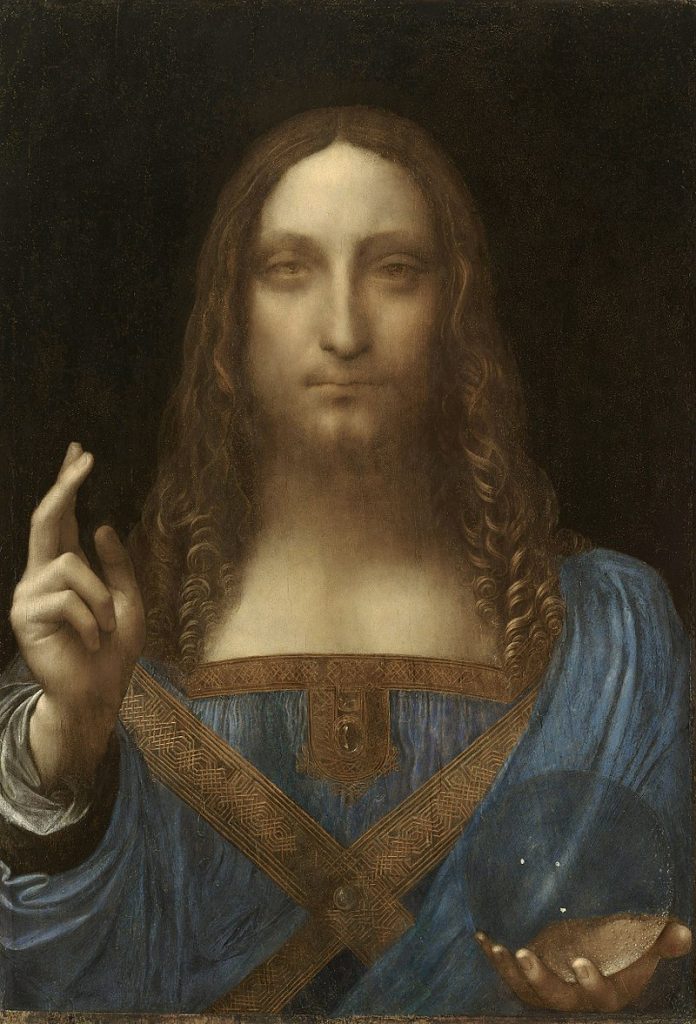
Salvator Mundi (Latin for ”Savior of the World”) is a painting attributed in whole or in part to the Italian High Renaissance artist Leonardo da Vinci, dated to c. 1499–1510.[n 1] Long thought to be a copy of a lost original veiled with overpainting, it was rediscovered, restored, and included in a major exhibition of Leonardo’s work at the National Gallery, London, in 2011–2012.[2] Christie’s claimed just after selling the work that most leading scholars consider it to be an original work by Leonardo, but this attribution has been disputed by other specialists, some of whom posit that he only contributed certain elements.

The painting depicts Christ in an anachronistic blue Renaissance dress, making the sign of the cross with his right hand, while holding a transparent, non-refracting crystal orb in his left, signaling his role as Salvator Mundi and representing the ‘celestial sphere‘ of the heavens. Approximately thirty copies and variations of the work by pupils and followers of Leonardo have been identified.[3] Proposed preparatory chalk and ink drawings of the drapery by Leonardo are held in the British Royal Collection.

The painting was sold at auction for US$450.3 million on 15 November 2017 by Christie’s in New York to Prince Badr bin Abdullah, setting a new record for the most expensive painting ever sold at public auction. Prince Badr allegedly made the purchase on behalf of Abu Dhabi’s Department of Culture and Tourism,[4][5] but it has since been posited that he may have been a stand-in bidder for his close ally, the Saudi Arabian crown prince Mohammed bin Salman.[6] This follows reports in late 2017 that the painting would be put on display at the Louvre Abu Dhabi[7][8] and the unexplained cancellation of its scheduled unveiling in September 2018.[9] The current location of the painting has been reported as unknown,[6] but a report in June 2019 stated that it was being stored on bin Salman’s yacht, pending the completion of a cultural center in Al-‘Ula,[10] and a report of October 2019 indicated that it may be in storage in Switzerland.[11]

Mofe at: https://en.wikipedia.org/wiki/Salvator_Mundi_(Leonardo)

The Astrology Of April 2022 – Jupiter Conjunct Neptune

by Astro Butterfly (astrobutterfly.com)

April 2022 is perhaps the most anticipated month of the year. That’s of course, because Jupiter, the great benefic, joins Neptune in the sign of Pisces.

This is a unique event: Jupiter-Neptune conjunctions happen only once every 13 years, and Jupiter-Neptune conjunctions happen in Pisces only every 200 years or so on average.

What makes this conjunction so special is that Pisces is the ruling sign of both Jupiter (traditional ruler) and Neptune (modern ruler). So we have both rules of Pisces coming together in a once-in-a-lifetime, magical astrological event.

And what makes April even more special, is that Venus joins in during the last week of April. Talk about magic ? 

Keep in mind that conjunctions (just like New Moons) are not necessarily times when things happen – it’s when new seeds are planted.

So instead of waiting for something to ‘happen’ pay attention to what’s initiating, to what’s shifting, to what’s coming into existence. Pay attention to subtle shifts. Neptune transits are not as obvious as Saturn, Uranus or Pluto transits for example, but they nevertheless shape and change us in profound ways. 

April is also when the Eclipse season starts. On April 30h, we have an incredible Uranus-flavored Solar Eclipse in Taurus. This is perhaps the most important New Moon and Eclipse of the year and will come with unexpected changes and opportunities.

The Jupiter-Neptune conjunction and the eclipse promise a month to remember. While changes can sometimes be destabilizing, the changes we will be witnessing in April are those types of changes that will uplevel our lives in ways we can’t even imagine yet. 

Let’s have a look at the most important transits of the month: 

April 3rd, 2022 – Mercury Conjunct Sun And Chiron In Aries

On April 3rd, Mercury is conjunct the Sun, so we are in the “Full Moon” phase of the current Mercury cycle. To make things interesting, Chiron is also conjunct Sun and Mercury.

Pay attention to news, thoughts, insights and revelations. This is our opportunity to gain awareness of something very important about yourself – and re-write that pattern so you can live a more authentic, wholesome life. 

April 5th, 2022 – Venus Enters Pisces

On April 5th, Venus leaves Aquarius and enters Pisces. Venus loves Pisces – Pisces is the sign of Venus’ exaltation after all.

In the last few weeks, Venus was not at her best. It is not that she doesn’t like being in Aquarius, but this time she shared the sign with Saturn, who made her feel a bit too serious for her liking.

Not anymore! In Pisces, with the support of Jupiter and Nepute, Venus will have a blast! And so will you. This is your time to connect with your heart and let it whisper its truth. 

April 5th, 2022 – Mars Conjunct Saturn 

April is a truly magical month, but on April 5th it may not feel this way. On April 5th, Mars is conjunct Saturn at 23° Aquarius.

Saturn is a very serious planet, and whenever Saturn is conjunct a personal planet, we are reminded of our responsibilities.

Mars wants to act NOW, but Saturn wants to do things LATER – not because he’s lazy (on the contrary) but because he wants to think things through and make sure something of lasting value is built.

The Mars-Saturn conjunction may feel very frustrating – but it will also give us that extra push and determination to get things done, by finding a good compromise between impulse-driven action and practicality. 

April 11th, 2022 – Mercury Enters Taurus

After a speedy drive through Aries, Mercury enters Taurus, changing the Ferrari for a Bentley. Yes, he’ll still get you to the destination, but instead of getting dopamine hits from speeding, he’ll now get to enjoy the leather couch… and the box of chocolates in the glove compartment. 

April 12th, 2022 – Jupiter Conjunct Neptune 

Today is the day. On April 12th, Jupiter and Neptune meet at 24° Pisces.

Jupiter conjunct Neptune in Pisces has the power to make our dreams come true and to awaken us to the simplest truth of life: that there is magic everywhere. I will write a detailed report for this exquisite event – stay tuned! 

April 15th, 2022 – Mars Enters Pisces

Just when you thought things can’t get more morphy and wavy, Mars enters Pisces. Mars is like a chameleon in Pisces – he’s still doing the Mars thing – he still takes action, but in a Piscean way.

This means he will act according to circumstances. It means he can easily change his mind, or do one thing now, and another thing later.

Is not that he’s flaky, but from the Piscean angle he has perspective – he can see how everything is connected… how the flap of the butterfly’s wings can cause a tornado. 

April 16th, 2022 – Full Moon In Libra

On April 16th, we have a Full Moon at 26° Libra. The Full Moon is square Pluto in Capricorn and trine Mars and Saturn.

Every Full Moon in Libra is an opportunity to put ourselves into other people’s shoes and understand where they’re coming from.

This Full Moon in Libra will not only help us have better relationships, but will also help us understand ourselves better – understand how we are unconsciously projecting some of our qualities onto others.

With Pluto, Saturn and Mars engaged, there is a strong pull to do the work – even if that means having some serious conversations or taking an ego blow here and there. 

April 18th, 2022 – Mercury Conjunct Uranus 

On April 18th, 2022, Mercury conjuncts Uranus at 13° Taurus and our antennas are up! Mercury-Uranus aspects are those “lightbulb moments”. Something becomes clear – crystal clear. There’s nothing ambiguous about Taurus. What you see is what you get. 

April 27th-30th, 2022 – Venus Conjunct Jupiter And Neptune

On April 27th, Venus conjuncts Neptune at 24° Pisces, and 3 days later Jupiter, at 27° Pisces for a few days of magic.

Jupiter and Neptune are collective planets. Venus is a personal planet. If the influence of the Jupiter-Neptune conjunction has been somewhat abstract, this is your opportunity to understand what it means for you.

With Jupiter’s help, Venus will translate Neptune’s foggy messages, and make the intangible, tangible. Listen to your heart – it will give you all the answers.

This is not a Uranian lightbulb moment of clarity – this is a deep knowing of what’s right, of what makes you truly happy, what kind of person you want to be, and what kind of life you want to live going forward. 

April 29th, 2022 – Mercury Enters Gemini

On April 29th, 2022 Mercury leaves the Taurus Bentley for a Gemini bicycle. His goal now is to be as flexible and as agile as possible.

On a bike, he can beat traffic and sneak between other cars, and reach his destination faster. Or, he can stop because he’s seen a friend he hasn’t seen in ages. Or, he can change destination altogether because he got a phone call and something more important popped up.

Mercury in Gemini is a great transit for all of us – Mercury is in its home sign in Gemini. When Mercury is in Gemini, we can see things for what they are, without bias or misjudgement, and seize opportunities better. Our mind becomes more agile, our communication more fluent, and our conversations more enjoyable. 

April 30th, 2022 – Solar Eclipse In Taurus

On April 30th, we have a North Node Solar Eclipse at 10° Taurus.

There are so many incredible astrological line-ups at this Eclipse that I don’t even know where to start: I’ll just mention that this is a North Node eclipse conjunct Uranus, and that the ruler of the Eclipse, Venus, is conjunct Jupiter.

There’s so much potential with this Eclipse – the world is our oyster. I’ll write a more extensive report closer to the date – stay tuned for more details. 

Scientists Speculate Universe May Be Simulation After ‘Trial Version Expired’ Appears Across Sky

Friday 7:00AM (theonion.com)

COLLEGE PARK, MD—In what is being hailed as the first empirical evidence in support of a hypothesis that has gained popularity in recent years, top scientists speculated Friday that the universe may indeed be a simulation controlled by an unseen entity after the words “trial version expired” appeared in the sky. “When we can look overhead and see what appears to be an error message from a computer operating system, it certainly lends new credence to the argument that we’re living in an artificial reality,” said University of Maryland physicist Harold M. Cramer, adding that from what he and his colleagues could glean from the airborne phenomenon, human consciousness would be terminated in five days if no further action was taken. “Though it’s possible we are witnessing an optical illusion caused by some kind of atmospheric distortion, the request for a verification code that keeps popping up suggests that our reality may indeed have a specific, singular subscriber, and that this entity must upgrade to a premium subscription in order to avoid any interruption to our experience of consciousness. We can only hope this cosmic account holder can guide us though the two-factor authentication process so that our simulacrum of life remains operational.” At press time, a team of leading cosmologists announced it had successfully renewed the free trial period for another 14 billion years by simply signing up again with a different email address.

The chords of the Universe

The chords of the Universe | Aeon

It’s no surprise that mathematics has influenced music. But did you know that the influence goes both ways?Photo by Edward Webb/Gallery StockEli Maor

is a former professor of the history of mathematics at Loyola University Chicago. He is the author of eight previous books, the latest of which is Music by the Numbers: From Pythagoras to Shoenberg (2018).

Edited by Marina Benjamin

Published in association with Princeton University Press an Aeon Strategic Partner

30 May 2018 (aeon.co)

Love Aeon?

Support our workDONATE

My interest in the relations between music and mathematics started at an early age. My grandfather played his violin for me when I was about five years old, and I still remember it clearly. Later he explained to me various topics in his physics book, from which he himself had studied when he was young. In the chapter on sound there was a musical staff with the note A, and next to it the number 440, the frequency of that note. That image must have engraved itself on my mind – my first glimpse into the role that numbers play in music. While my grandfather’s violin is no more with us, his tuning fork did survive; although rusted, it still faithfully vibrates at 440 cycles per second. I recently gave it to my percussionist grandson. I hope he will one day pass it on to his grandchildren.

But it is not enough just to study music: one must play it. I started my musical journey playing a recorder. There are numerous Baroque-era works for this simple instrument, but for an appreciation of classical music (‘classical’ here meaning the era of Haydn, Mozart and Beethoven, roughly 1750 to 1830), a recorder just won’t do, so I took up the clarinet. This instrument was Mozart’s favourite wind instrument, and he wrote for it – or rather for his friend, the clarinetist Anton Stadler – some of his most sublime music. The clarinet has the unusual feature that when you open the thumb hole on the back of the instrument, the sound goes up not by an octave, as with most woodwinds, but by a twelfth – an octave and a fifth. This greatly intrigued me and made me dwell into the acoustics of wind instruments. I was fascinated – and still am – by the fact that a column of air can vibrate and produce a musical sound just like a violin string, even though the vibrations are totally invisible: you can hear them, but you cannot see them.

Music and mathematics have always been intimately intertwined. Anyone who has ever played a musical instrument is aware of the presence of mathematics on every page of the score – from the time signature that sets a piece’s rhythm, to the metronome number that determines the speed at which the piece should be played; and, of course, the very act of playing music requires us to count 1, 2, 3… and arrange these numbers into groups, called bars or measures. So it comes as no surprise that mathematics has had a significant influence on music. Much less known is that the influence extends both ways.

The Greek philosopher Pythagoras, active during the 6th century BCE, might have been the first to uncover a quantitative relation between music and mathematics. Experimenting with taut strings, he found that shortening the effective length of a string to one-half its original length raises the pitch of its sound by an agreeable interval, an octave. Other ratios of string lengths produce smaller intervals: 2:3 corresponds to the musical interval of a fifth (so called because it is the fifth note up the scale from the base note); 3:4 corresponded to a fourth; and so on. Pythagoras also discovered that multiplying two ratios is equivalent to adding their intervals: (2:3) x (3:4) = 1:2, so a fifth plus a fourth equals an octave. In doing so, he unknowingly came up with the first logarithmic law in history.

The octave, the fifth and the fourth produced pleasing combinations of tones, or consonants, whereas more complicated ratios, such as 9:8 or 15:16, led to dissonances. This revelation made a deep impression on the Pythagoreans, prompting their belief that everything in the Universe – from the laws of musical harmony to the motion of the Sun, Moon and the five planets – was governed by simple ratios of whole numbers. Number rules the Universe was the Pythagorean motto. It would dominate scientific thought for the next two millennia.

In Greek tradition, music ranked equal in status to arithmetic, geometry and spherics (astronomy), which together comprised the quadrivium, the core curriculum of four disciplines that a learned person was expected to master. We should note, however, that the word ‘arithmetic’ had a different meaning to the Pythagoreans than it has today: it meant number theory, the study of the properties of integers, rather than the practical skills needed to compute with numbers. Likewise, Pythagoreans regarded the music component of the quadrivium as referring to music theory – the study of harmony – rather than the practice of playing music. This was typical of the aloof attitude of the Pythagoreans to all things practical. Theirs was a perfect universe, governed by notions of beauty, symmetry and harmony, but removed from mundane considerations. It might have been one reason why they kept all their discussions secret, fearing that they would be ridiculed by their fellow citizens, the vast majority of whom had to toil daily to eke out a living.

Though no Pythagorean writings survive – if they left any at all (everything we know about them comes from much later writers) – the Pythagorean legacy lasted well over 2,000 years. Number rules the Universe became a rallying motto to generations of scientists and philosophers, who sought to explain the mysteries of the cosmos on the basis of musical ratios or simple, elegant geometric figures. The planets, for example, had to move around the Earth in perfect circular orbits; it was inconceivable to the Greeks that any shape other than the perfectly symmetric circle could rule. It was all part of their grand view of a Universe ruled by beauty and harmony – their musica universalis, or music of the spheres.

Among the last Pythagoreans was the eminent German astronomer Johannes Kepler (1571-1630), considered one of the fathers of modern astronomy. At once a devout mystic and an ardent believer in Copernicus’s heliocentric system, Kepler spent more than half his life trying to derive the laws of planetary motion from those of musical harmony. He believed that each planet, in its motion around the Sun, plays a melody that our ears are unable to hear, being below the range of audible frequencies (not to mention that it was produced in the vacuum of space, where sound cannot propagate). He even assigned each planet a celestial tune and wrote it down on the musical staff – resurrecting the celebrated musica universalis. It was only after decades of following this blind path that Kepler finally abandoned the Greek circular orbits and replaced them with ellipses.

Every periodic function can be written as an infinite sum of pure sine waves

Half a century after Kepler, Isaac Newton formulated his universal law of gravitation, thereby providing a rational, mathematical explanation for the planetary orbits, and adding the parabola and hyperbola to the possible orbits of the celestial bodies. But he too was obsessed with musical ratios, devising a ‘palindromic scale’ in which the intervals were the same whether you went up or down: 9:8, 16:15, 10:9, 9:8, 10:9, 16:15, 9:8. He compared it to the seven rainbow colours of the spectrum.

The newly invented differential and integral calculus, developed independently by Newton and G W Leibniz in the decade 1666-1676, made it finally possible to put the relations between numerical ratios and musical harmony on a firm mathematical basis. One of the outstanding problems that the calculus was able to tackle was to find the exact shape of a vibrating string and the nature of the sound it produces. Was it the sum of many – perhaps infinitely many – sine waves or pure tones, each with its own frequency and amplitude? Or was it a combination of waves propagating back and forth along the string’s length? In what became known as the ‘Great String Debate’, four of Europe’s foremost mathematicians – Daniel Bernoulli, Leonhard Euler, Jean le Rond D’Alembert and Joseph Louis Lagrange – argued passionately over this issue, and laid the foundation of post-calculus analysis along the way.

But the definitive solution to the string problem had to wait another half-century, when the eminent French mathematical physicist Jean Baptiste Joseph Fourier (1768-1830) showed that every periodic function, subject to certain restrictions, can be written as an infinite sum of pure sine waves, whose frequencies are integral multiples of the fundamental, lowest frequency of the function. These individual sine waves are known as overtones or harmonics; they are the building blocks of all sound, and they give each sound its characteristic tone colour, or timbre – the quality that distinguished the sound of a violin from that of a clarinet, even when they play the same note.

As my musical interests expanded, I gradually ventured beyond the Baroque-Classical-Romantic period (roughly 1600 to 1900), and turned to modern music. In the 1960s there was still much talk about Arnold Schoenberg and his atonal or serial music. He devised it in the early 1900s, convinced that it should replace a sacred cornerstone of classical music: the principle of tonality. Tonality required that a piece of music should centre around a given key, called the tonic, such as C major or G minor. Granted, as the piece developed, it could stray from its designated key to related or even remote keys, but ultimately it would return to its home key, the tonic. The key thus served as a musical frame of reference, in which every note had a specific relation to the tonic; for example, in the key of C major, the note G (a fifth above C) was the ‘dominant’ note, while the note F below C was the ‘subdominant’.

But in the second half of the 19th century, composers gradually began to deviate from a strict adherence to the principle of tonality, making it difficult to sense where the music stood in relation to the tonic. Schoenberg, believing that tonality had run its course, was determined to supplant it with the series, or tone row. In a series, each of the 12 notes of the chromatic scale of semitones appears exactly once; a note could be repeated only after the series had been completed. This gave a composer a staggering number of combinations to choose from: 1 x 2 x 3 x … x 12 = 479,001,600, to be exact (not counting shifts by octaves, which Schoenberg allowed). In serial music, complete democracy ruled: no single note held any preferred status over the others. Every note was related only to its immediate predecessor in the series; gone were the roles that different notes had played in relation to the tonic. At its heart it was a mathematical system, and Schoenberg was determined to impose it on music.

Leopold Godowsky, Albert Einstein and Arnold Schönberg at Carnegie Hall, New York, 1 April 1934. Photo courtesy the Arnold Schonberg Centre, Vienna

As a mathematician, I see a striking similarity between Schoenberg’s serial music and Albert Einstein’s general theory of relativity, as though a parallel dismantling of the canonical structures of music and physics were happening simultaneously. In 1905, Einstein gave the ether its coup de grâce: there is no ether, no single universal frame of reference at absolute rest; rather, every observer has his or her own reference system, related only to its infinitesimally close neighbouring system in spacetime. One cannot fail to note the similarity to Schoenberg’s atonal music, in which each note is related only to its immediate predecessor in the series. You might call it relativistic music.

Schoenberg worked on the design of a musical typewriter; Einstein invented a refrigerator

Schoenberg and Einstein were almost exact contemporaries, born within five years of each other to middle-class Jewish families. Their mothers, both named Pauline, were steeped in classical music, so the two youngsters were raised in music-loving homes. They started their careers as low-level employees – Schoenberg as a bank clerk in Vienna, Einstein as a clerk at the Swiss Patent Office in Bern. At a young age, both turned their backs on traditional Judaism, only to return to it late in life, having been deeply affected by the rise of anti-Semitism and the Holocaust that followed. Both men were essentially self-taught: Schoenberg never got a formal musical education, while Einstein (though he graduated from the University of Zurich) got his education by studying the great physics treatises of the 19th century on his own.

Following the Nazi rise to power in 1933, both men emigrated to the United States. Schoenberg immediately got rid of the German umlaut of his original name, Schönberg, while Einstein had to get used to the American pronunciation of his name (pronounced ‘Einshtein’ in German). Both passionately pursued their hobbies – Schoenberg as a painter and avid tennis player, Einstein playing his iconic violin and enjoying an outing on his little sailboat. They also liked to tinker with gadgets: Schoenberg worked on the design of a musical typewriter, while Einstein, with his fellow physicist Leo Szilard, invented and patented a refrigerator. Following the Nazi dismissal of all Jewish professors from German universities, both men worked tirelessly to help displaced academics find jobs in their countries of refuge. Neither Schoenberg nor Einstein ever set foot on European soil again (although Schoenberg’s remains were buried in his native Vienna), and they died within the same time-span that separated them at birth, in their 76th year.

The revolutionary ideas of Einstein and Schoenberg came against the backdrop of groundbreaking changes in other fields, all happening as the 19th century turned into the 20th. Gustav Mahler premiered his First Symphony, Titan (1889), conducted by the composer himself. Sigmund Freud published his first major work, The Interpretation of Dreams (1900), Pablo Picasso entered his ‘Blue Period’ (1901-1904), and Max Planck introduced into physics a new concept that would soon revolutionise all of science: the quantum of energy. If all that weren’t enough, David Hilbert, Germany’s foremost mathematician at the turn of the century, challenged the Second International Congress of Mathematicians, held in Paris in 1900, with a list of 23 unsolved problems whose solutions he regarded as of utmost importance to the future growth of mathematics – as indeed they would prove to be.

Whether these developments had any effect on Einstein’s and Schoenberg’s work is difficult to say, but it is revealing that several of the actors in this new world were actively involved with music: Einstein’s violin immediately comes to mind; Planck was an accomplished pianist; and the Nobel Prize-winning physicist Werner Heisenberg seriously considered pursuing a career in music before turning to quantum mechanics.

In his quest to unify music and mathematics under a single universal umbrella, perhaps Pythagoras was right after all.

Music By The Numbers: From Pythagoras to Schoenberg by Eli Maor is out now via Princeton University Press.

If you’re in New York and would like to learn more about how music relates to mysticism, join us for an evening of Live Philosophy on May 10 2022 at the Sophia Club, a new events program of immersive ideas and artistic performance from the publishers of Aeon and Psyche.

Mathematics Music History of science

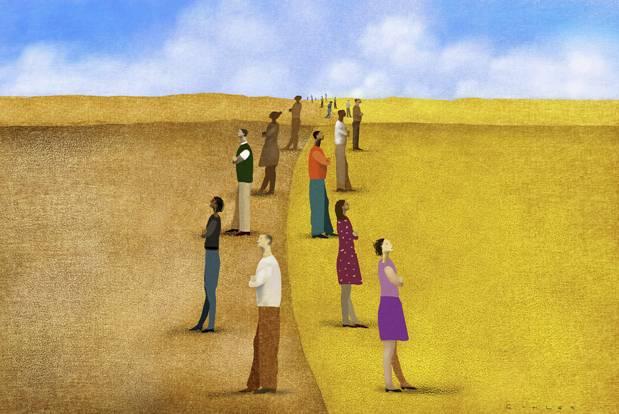
How To Empathy Circle

Elie Wiesel (1928-2016), prolific writer and Holocaust survivor famously said: “the opposite of love is not hate, it is indifference

Indifference can lead to polarization, tearing the social fabric of families and societies. 

Faith communities can help bridge our differences and heal social polarization.
Image credit: Dave Cutler (artist).

We invite all faith traditions with love at the heart of your practice to a virtual event:  “How do we bridge social, religious, and political divides in our communities?”

Come share ideas, insights and actions to bridge our differences. 

These Online Empathy Cafes are open to all faith-based communities (or no faith tradition)

Everyone is welcome to participate!

TIME: (2 hours) starting at: 1:00 pm PT (4:00 pm ET) 

DATES:  (Choose any calendar date(s) that work for you)

* Saturday, April 9
* Sunday, April 24: Part of National Week of Conversation https://tinyurl.com/bddbtc6k
* Saturday, April 30 (Part of National Week of Conversation)
* Saturday, May 7
* TBA

LOCATION: Zoom: https://zoom.us/j/9896109339

RSVP: https://bit.ly/RSVPInterFaithCafe
DROP-IN: No RSVP needed but recommended, just drop in as you can. Do come on time since the room will be locked after the circles start.
RECORDING: the cafes will be recorded for documentation, education and promotional purposes.
INTERFAITH CAFÉ WEBSITEhttps://sites.google.com/view/interfaithcafe/

THE PROBLEM
============

* Personal, social, religious and political conflict and polarization are tearing apart our families and communities.

* Diversity and differences are constructive, unless we normalize not listening to “the other side.”

BENEFITS FOR PARTICIPANTS
============

1). Learn constructive dialogue practices that your faith-based community can use for personal support, conflict resolution and community building.

2). Learn how faith communities and families can create sacred space to share whatever is alive for you (i.e, what is on your mind and heart.)

3). Share best practices for supporting families in your communities.

4). Share resources for interfaith contribution to civic cohesion, harmony and well being.

HOW
============

1. We will use the Empathy Circle process to dialogue in small break-out groups. An Empathy Circle is a structured listening process that effectively supports meaningful and constructive dialogue.

2. We will document our dialogues to collect group wisdom.

     A. Some sessions are recorded and transcribed.
     B. Participants may submit and edit notes in a shared google doc.

     C. Cumulative notes are synthesized in reports to share with the wider world as we help create a culture of empathy.


PREPARATION

============

1. Review the HOW TO EMPATHY CIRCLE process http://bit.ly/EC-How

2. Explore Empathy Circle website. https://EmpathyCircle.com
     A. What is an Empathy Circle? http://bit.ly/EC-WhatIs
     B. Why Participate? http://bit.ly/EC-Benefits

Here Are Some Different Versions of the “How To Empathy Circle” Instructions.

Video: How To Take Part in a Basic Empathy Circle (9 min)
(View On Facebook or On YouTube)


Short instructions for how to take part in an Empathy Circle. Add 3 minutes of benefits of the Empathy Circle:

https://www.youtube.com/embed/wyKW7Jebgck

More info at: https://www.empathycircle.com/how-to-empathy-circle

Margaret Wise Brown and the Puzzle of What Makes a Thing Itself (or You Yourself)

By Maria Popova (themarginalian.org)

“What is essential is invisible to the eye,” Antoine de Saint-Exupéry wrote as he contemplated the meaning of life in one of humanity’s greatest works of philosophy disguised as a children’s book.

The challenge, of course, is that what is essential — about the totality of life, as about every littlest thing in it — is not easily visible, largely because nothing is actually reducible, or should be reduced, to an essence: to a single point of truth, a particular attribute or quality that makes it what it is.

And yet we have betrayed the complexity of life with our longing for the shorthand of essences at least since Ancient Greece. The crucible of democracy was also the crucible of its antipode in essentialism — the idea that everything has an innate potentiality, which predetermines (and therefore limits) its possible development, and that, no matter what external forces are exerted on it, this innate essence remains immutable.

Even the deep-fathoming, far-seeing Aristotle fell under the spell of essentialism and, bamboozled by its dangerous implications, came to believe that women belonged lower on the social ladder than men because their essential nature was to be subordinate and slaves were enslaved because their essential nature was lacking a certain faculty of reason necessary for freedom.

All prejudice is at bottom essentialism: Some animals are more equal than others because it is their essential nature to be oppressor or oppressed; all entitlement is at bottom essentialism: I am owed something just by virtue of being me.

Essentialism is the human animal’s faulty coping mechanism for the fact that the world and everything in it is multifaceted and mutable, often dizzyingly so — something Chinua Achebe captured in his astute observation that “there is no one way to anything,” because nothing is one thing only, to be grasped by only one dimension and to serve only one possible purpose.

While Saint-Exupéry’s Little Prince was making his otherworldly way into our mutable and multifarious world, Margaret Wise Brown (May 23, 1910–November 13, 1952) was taking up the question of what is essential from a very different angle in The Important Book (public library) — a minimalist, subversively conceptual, maximally delightful inquiry into the essence of a thing.

Published two years after Brown’s iconic Goodnight Moon and illustrated by the prolific Leonard Weisgard (December 13, 1916–January 14, 2000) — who had reimagined Alice in Wonderland that same year and who would go on to illustrate Brown’s final books before her untimely death a couple of years later — the book unfolds as a spare, poetic catalogue of everyday things (spoons and daisies, the rain and the snow, the grass and the sky), each occupying a single spread, each following the same conceptual formula:

The important thing about X is Y.
X is also A, B, and C.
But the important thing about it is Y.

Brown — a woman of uncommon genius and nonconformity — begins with things that seem obvious, even banal. But her singular sensibility quickly becomes apparent: In telling us that the most important thing about the grass is its greenness, she lists among its other attributes the uncommon perception, stated as a common fact, that the grass is “tender,” imbuing so indifferent a life-form with so essentially human a quality. Instantly your mind bursts with scenes of lovers kissing in the grass and children playing in the grass — a single word-choice, and suddenly a universe of feeling.

About the snow — which is, most importantly, white — she observes with the same matter-of-factly nonchalance the poetic truth that it has “the shape of tiny stars.”

She moves through the most essential things about other common objects and phenomena: a spoon, an apple, the wind. But as the book progresses, there arises the strange and lovely awareness that you are being guided through the ordinary world by an extraordinary mind who sees the commonest things in uncommon ways.

By the time Brown arrives at the sky, she chooses as its most important attribute not the standard attributes — its blueness, its airy expanse — but that “it is always there.”

It must have been a comfort to her, to write these words in 1949, as her longtime lover Blanche — a poet and playwright, who wrote under the masculine pen name Michael Strange — was dying of leukemia.

Brown ends the book with the ultimate question of essences, which has puzzled philosophers since the ship of Theseus in Aristotle’s day: what makes you you — a constellation of atoms made of the selfsame stardust as every other person, yet singular, irreducible, unrepeated in any past configuration of matter and unrepeatable in any future.

Whatever changes you might undergo in your growth and becoming, Brown intimates, the important thing about you remains the same:

But to me (being the particular person I am) the loveliest and most important thing about The Important Book, radiating the essence of Brown’s personhood, is what appears on the back flap in place of the standard author and artist “about” text:

The important thing about
THE IMPORTANT BOOK
is that you let your child
tell you what is important
about the sun and the moon
and the wind and the rain
and a bug and a bee
and a chair and a table
and a pencil and a bear
and a rainbow and a cat
(if he wants to)
For the important thing about
THE IMPORTANT BOOK
is that the book goes on
long after it is closed.

Against the Gods: Iris Murdoch on Truth, the Meaning of Goodness, and How Attention Unmasks the Universe

By Maria Popova (themarginalian.org)

When Nietzsche weighed our human notion of truth, he regarded it as “a movable host of metaphors, metonymies, and anthropomorphisms: in short, a sum of human relations which have been poetically and rhetorically intensified, transferred, and embellished.” This is true of truth in the human world, and this is where science and society differ. The disparity is the reason why the scientific perspective can offer such gladsome calibration and consolation for our human struggles.

In the world of science, we endeavor to uncover fundamental laws and elemental truths indifferent to our opinions of them — those selfsame truths and laws that made us and govern the electrical impulses coursing through our cortices at 100 meters per second to forge the thought-patterns of opinion. But in the human world where we live, we swirl in the movable host of human relations and rationalizations, vaguely aware that there is no universal truth and therefore no universal good, because every utopia is built on some else’s back. We devise frameworks for righting our relations, which we call morality, but in our helpless confusion about what goodness is, we too readily mistake certainty for truth and self-righteousness for truth, then lash one another with our certitudes and rightneousnesses, mistaking the lashing for the light of morality.

When our species was younger and more frightened of reality, myths and religions have provided the comfort of easy causalities and easy moralities to salve the confusions of complexity. But as the epoch of scientific discovery began disproving some of those sacred certainties — first ejecting us from the placid plane of the flat Earth, then from our self-soothing centrality in the Solar System, then from our grandiose exceptionalism in the order of living things, then from our galactic exceptionalism — the moral certitudes about goodness also came unloosed, for they too were built upon the same self-righteous foundation as the old delusions about the geometry of the universe and the immutability of life-forms.

Art from Thomas Wright’s An Original Theory or New Hypothesis of the Universe, 1750. (Available as a print.)

The dazzling-minded Iris Murdoch (July 15, 1919–February 8, 1999) took up these questions in her play Above the Gods — one of two Platonic dialogues she wrote in the 1980s, later included in the posthumous Murdoch anthology Existentialists and Mystics: Writings on Philosophy and Literature (public library), which remains one of the finest works of writing and thinking I have encountered.

Set in Athens in the late fifth century B.C. and structured as a conversation between a sixty-something Socrates, a twenty-something Plato, and four fictional Greek youths, the dialogue tussles with the question of whether the age of science has knelled the death toll of religion and, if so, where this leaves our search for truth and our longing for goodness — that elemental hunger for the ultimate meaning of reality, for our responsibility to reality.

When Murdoch’s Socrates observes that a distinction between religion and morality is yet to be made, without which the central question of reality and truth cannot be answered, an impassioned Plato responds:

Religion isn’t just a feeling, it isn’t just a hypothesis, it’s not like something we happen not to know, a God who might perhaps be there isn’t a God, it’s got to be necessary, it’s got to be certain, it’s got to be proved by the whole of life, it’s got to be the magnetic centre of everything.

Plate from An Original Theory or New Hypothesis of the Universe by Thomas Wright, 1750. (Available as a print, as a face mask, and as stationery cards.)

And yet this more-than-feeling aims at something beyond religion, beyond even explicit knowledge, at the center of which is the idea — the existence — of goodness:

In a way, goodness and truth seem to come out of the depths of the soul, and when we really know something we feel we’ve always known it. Yet also it’s terribly distant, farther than any star… beyond the world, not in the clouds or in heaven, but a light that shows the world, this world, as it really is… In spite of all wickedness, and in all misery, we are certain that there really is goodness and that it matters absolutely.

Goodness, in Murdoch’s lovely conception, emerges as both object and background, both knower and known. This renders moot the objectifying question, voiced by one of Plato’s sparring partners — a young Sophist — of where goodness resides in relation to reality: either outside us, existing in something like a god, or within us, as an internal image we refer to. Observing that it is both inside and outside, Murdoch’s Plato responds:

Of course Good doesn’t exist like chairs and tables, it’s not… either outside or inside. It’s in our whole way of living, it’s fundamental like truth. If we have the idea of value we necessarily have the idea of perfection as something real… People know that good is real and absolute, not optional and relative, all their life proves it. And when they choose false goods they really know they’re false. We can think everything else away out of life, but not value, that’s in the very ground of things.

Art by Rockwell Kent from Wilderness, 1919. (Available as a print and as stationery cards.)

The question of goodness permeates Murdoch’s entire body of work, but she plumbs this particular aspect of it — its bearing on truth and morality, lensed through Plato — in greater depth in an essay titled On “God” and “Good,” also included in Existentialists and Mystics. With an eye to the relationship between the good and “the real which is the proper object of love, and of knowledge which is freedom,” she considers what it takes for us to purify our attention in order to take in reality on its own terms, unalloyed with our attachments and ideas.

What it takes, she suggests, is “something analogous to prayer, though it is something difficult to describe, and which the higher subtleties of the self can often falsify” — not some “quasi-religious meditative technique,” but “something which belongs to the moral life of the ordinary person.” Half a century after the existentialist and mystic Simone Weil liberated this raw mindfulness from the strict captivity of religion with her lovely observation that “attention, taken to its highest degree, is the same thing as prayer,” for it “presupposes faith and love,” Murdoch writes:

The idea of contemplation is hard to understand and maintain in a world increasingly without sacraments and ritual and in which philosophy has (in many respects rightly) destroyed the old substantial conception of the self. A sacrament provides an external visible place for an internal invisible act of the spirit.

Jacob’s Dream by William Blake, 1805. (Available as a print and as stationery cards.)

Beholding beauty in nature and in art, Murdoch argues, can serve as a sort of sacrament for the spirit — the experience provides (in one of her loveliest phrases, and one of the loveliest concepts ever committed to words) “an occasion for unselfing.” But this experience, she cautions, is not easily extended into matters of people and actions — the matters morality aims to negotiate — “since clarity of thought and purity of attention become harder and more ambiguous when the object of attention is something moral. With an eye to Plato and his conception of beauty as the visible dimension of goodness, which is inherently invisible, she writes:

It is here that it seems to me to be important to retain the idea of Good as a central point of reflection, and here too we may see the significance of its indefinable and non-representable character. Good, not will, is transcendent. Will is the natural energy of the psyche which is sometimes employable for a worthy purpose. Good is the focus of attention when an intent to be virtuous co-exists (as perhaps it almost always does) with some unclarity of vision.

She invokes Plato’s famous allegory of the cave — humanity’s first great thought experiment about the nature of consciousness and its blind spots, in which the prisoners of unreality mistake the flickering shadows cast by the fire on the cave wall for the light of reality; but then, once set free by goodness and knowledge (and here is another exquisite formulation of Murdoch’s) “the moral pilgrim emerges from the cave and begins to see the real world in the light of the sun, and last of all is able to look at the sun itself.”

Shining the sunbeam of her own intellect on Plato’s blind spot to reveal the deepest meaning of morality, she writes:

Plato pictured the good man as eventually able to look at the sun. I have never been sure what to make of this part of the myth. While it seems proper to represent the Good as a centre or focus of attention, yet it cannot quite be thought of as a “visible” one in that it cannot be experienced or represented or defined. We can certainly know more or less where the sun is; it is not so easy to imagine what it would be like to look at it. Perhaps indeed only the good man knows what this is like; or perhaps to look at the sun is to be gloriously dazzled and to see nothing. What does seem to make perfect sense in the Platonic myth is the idea of the Good as the source of light which reveals to us all things as they really are. All just vision, even in the strictest problems of the intellect, and a fortiori when suffering or wickedness have to be perceived, is a moral matter.

Dame Iris Murdoch by Ida Kar (National Portrait Gallery)

In consonance with her famous assertion that “love is the extremely difficult realisation that something other than oneself is real” — a realization that is both the basis of morality and the motive force of science — she adds:

The same virtues, in the end the same virtue (love), are required throughout, and fantasy (self) can prevent us from seeing a blade of grass just as it can prevent us from seeing another person. An increasing awareness of “goods” and the attempt (usually only partially successful) to attend to them purely, without self, brings with it an increasing awareness of the unity and interdependence of the moral world. One-seeking intelligence is the image of ‘faith’. Consider what it is like to increase one’s understanding of a great work of art.

Complement these fragments from the wholly indispensable Existentialists and Mystics — which also gave us Murdoch on what love really meansart as a force of resistance, and the key to great storytelling — with philosopher Martha Nussbaum (who, is in many ways, Murdoch’s intellectual heir) on what it means to be a good human being and physicist Alan Lightman on our search for the meaning beyond reality’s truths.