The Art of Choosing Love Over Not-Love: Rumi’s Antidote to Our Human Tragedy

By Maria Popova (themarginalian.org)

“What exists, exists so that it can be lost and become precious,” Lisel Mueller wrote in her short, stunning poem about what gives meaning to our mortal lives.

To become precious — that is the work of love, the task of love, the great reward of love. The recompense of death. The human miracle that makes the transience of life not only bearable but beautiful.

It is heartbreaking enough that we do lose everything that exists, everything and everyone we love, until we lose life itself — for we are a function of a universe in which it cannot be otherwise. But it is our singular human-made heartbreak that we often cope with our terror of loss — that deepest awareness of our own mortality — by losing sight of just how precious we are to each other, squandering in less-than-love the chance-miracle of our time alive together, only to recover our vision when entropy has taken its toll, when it is too late. We write poems and pop songs about our self-made tragedy — “The art of losing isn’t hard to master“; “Don’t it always seem to go that you don’t know what you’ve got till it’s gone.” — and we go on living it.

Eight centuries before Mueller lived and died, an impassioned invitation to transcend our self-made tragedy took shape in another short, stunning poem by another poet of uncommon contact with the deepest strata of life-truth: Rumi (September 30, 1207–December 17, 1273), who believed that you must “gamble everything for love, if you are a true human being.” Rumi, ancient and eternal. Magnetic in his eloquent devotion and his soulful intelligence. Majestic in his whirling silk robe and his defiant disdain for his culture’s worship of status. Volcanic with poetry.

Rumi (detail from a 16th-century Persian illuminated manuscript, Mortan Library & Museum)

In his sixty-six years, Rumi composed nearly sixty-six thousand verses, animated by an ecstatic devotion to living more fully and loving more deeply. Having mastered the mathematical musicality of the quatrain, he became a virtuoso of the ghazal with its series of couplets, each invoking a different poetic image, each crowned with the same refrain — a kind of kinetic sculpture of surprise, rapturous with rhythm.

A dazzling selection of his poetry, including some never previously alive in English, appears in Gold (public library), newly translated and inspirited by poet and musician Haleh Liza Gafori.

Reflecting on the creative challenge of invoking the poetic truth of one epoch and culture into another, she writes:

The languages of Farsi and English possess quite different poetic resources and habits. In English, it is impossible to reproduce the rich interplay of sound and rhyme (internal as well as terminal) and the wordplay that characterize and even drive Rumi’s poems. Meanwhile, the tropes, abstractions, and hyperbole that are so abundant in Persian poetry contrast with the spareness and concreteness characteristic of poetry in English, especially in the modern tradition. I have sought to honor the demands of contemporary American poetry and conjure its music while, I hope, carrying over the whirling movement and leaping progression of thought and imagery in Rumi’s poetry… I have chosen poems that seem to me beautiful, meaningful, and central to Rumi’s vision, poems that I felt I could successfully translate and that speak to our times.

Haleh Liza Gafori

What emerges is a testament to the Nobel-winning Polish poet Wisława Szymborska’s lovely of “that rare miracle when a translation stops being a translation and becomes… a second original.”

Here is Haleh Liza Gafori reading for us her translation of Rumi’s lens-clearing invitation to step beyond our self-made tragedy and into the deepest, perhaps the only, truth of life:

LET’S LOVE EACH OTHER
by Rumi (translated by Haleh Liza Gafori)

Let’s love each other,
let’s cherish each other, my friend,
before we lose each other.

You’ll long for me when I’m gone.
You’ll make a truce with me.
So why put me on trial while I’m alive?

Why adore the dead but battle the living?

You’ll kiss the headstone of my grave.
Look, I’m lying here still as a corpse,
dead as a stone. Kiss my face instead!

Complement this fragment of Gold with James Baldwin on how separation illuminates the power of love and Thich Nhat Hanh on the art of deep listening — a practice also central to Rumi’s life — as the root of loving relationship, then revisit poet Jane Hirshfield’s timeless hymn to love and loss.

Metonymy

From Wikipedia, the free encyclopedia

Metonymy (/mɛˈtɒnəmi/)[1] is a figure of speech in which a thing or concept is referred to by the name of something closely associated with that thing or concept.[2]

Etymology

The words metonymy and metonym come from the Greek μετωνυμία, metōnymía, “a change of name”, from μετά, metá, “after, post, beyond”, and -ωνυμία, -ōnymía, a suffix that names figures of speech, from ὄνυμα, ónyma or ὄνομα, ónoma, “name”.[3]

Background

Metonymy and related figures of speech are common in everyday speech and writing. Synecdoche and metalepsis are considered specific types of metonymy. Polysemy, the capacity for a word or phrase to have multiple meanings, sometimes results from relations of metonymy. Both metonymy and metaphor involve the substitution of one term for another.[4] In metaphor, this substitution is based on some specific analogy between two things, whereas in metonymy the substitution is based on some understood association or contiguity.[5][6]

American literary theorist Kenneth Burke considers metonymy as one of four “master tropes“: metaphor, metonymy, synecdoche, and irony. He discusses them in particular ways in his book A Grammar of Motives. Whereas Roman Jakobson argued that the fundamental dichotomy in trope was between metaphor and metonymy, Burke argues that the fundamental dichotomy is between irony and synecdoche, which he also describes as the dichotomy between dialectic and representation, or again between reduction and perspective.[7]

In addition to its use in everyday speech, metonymy is a figure of speech in some poetry and in much rhetoric. Greek and Latin scholars of rhetoric made significant contributions to the study of metonymy.

Meaning relationships

Metonymy takes many different forms.

Synecdoche uses a part to refer to the whole, or the whole to refer to the part.[8][9][10]

Metalepsis uses a familiar word or a phrase in a new context.[11] For example, “lead foot” may describe a fast driver; lead is heavy, and a heavy foot on the accelerator causes a vehicle to go fast.[12] The figure of speech is a “metonymy of a metonymy”.[11]

Many cases of polysemy originate as metonyms: for example “chicken” meaning the meat as well as the animal; “crown” for the object, as well as the institution.[13][14]

Metaphor and metonymy

Main article: Metaphor and metonymy

Metonymy works by the contiguity (association) between two concepts, whereas the term “metaphor” is based upon their analogous similarity. When people use metonymy, they do not typically wish to transfer qualities from one referent to another as they do with metaphor.[15] There is nothing press-like about reporters or crown-like about a monarch, but “the press” and “the crown” are both common metonyms.

Some uses of figurative language may be understood as both metonymy and metaphor; for example, the relationship between “a crown” and a “king” could be interpreted metaphorically (i.e., the king, like his gold crown, could be seemingly stiff yet ultimately malleable, over-ornate, and consistently immobile). However, in the phrase “lands belonging to the crown”, the word “crown” is definitely a metonymy. The reason is that monarchs by and large indeed wear a crown, physically. In other words, there is a pre-existent link between “crown” and “monarchy”. On the other hand, when Ghil’ad Zuckermann argues that the Israeli language is a “phoenicuckoo cross with some magpie characteristics”, he is definitely using metaphors.[16]: 4  There is no physical link between a language and a bird. The reason the metaphors “phoenix” and “cuckoo” are used is that on the one hand hybridic “Israeli” is based on Hebrew, which, like a phoenix, rises from the ashes; and on the other hand, hybridic “Israeli” is based on Yiddish, which like a cuckoo, lays its egg in the nest of another bird, tricking it to believe that it is its own egg. Furthermore, the metaphor “magpie” is employed because, according to Zuckermann, hybridic “Israeli” displays the characteristics of a magpie, “stealing” from languages such as Arabic and English.[16]: 4–6 

Two examples using the term “fishing” help clarify the distinction.[17] The phrase “to fish pearls” uses metonymy, drawing from “fishing” the idea of taking things from the ocean. What is carried across from “fishing fish” to “fishing pearls” is the domain of metonymy. In contrast, the metaphorical phrase “fishing for information” transfers the concept of fishing into a new domain. If someone is “fishing” for information, we do not imagine that the person is anywhere near the ocean; rather, we transpose elements of the action of fishing (waiting, hoping to catch something that cannot be seen, probing) into a new domain (a conversation). Thus, metaphor works by presenting a target set of meanings and using them to suggest a similarity between items, actions, or events in two domains, whereas metonymy calls up or references a specific domain (here, removing items from the sea).

Sometimes, metaphor and metonymy may both be at work in the same figure of speech, or one could interpret a phrase metaphorically or metonymically. For example, the phrase “lend me your ear” could be analyzed in a number of ways. One could imagine the following interpretations:

  • Analyze “ear” metonymically first – “ear” means “attention” (because people use ears to pay attention to each other’s speech). Now, when we hear the phrase “Talk to him; you have his ear”, it symbolizes he will listen to you or that he will pay attention to you. Another phrase “lending an ear (attention)”, we stretch the base meaning of “lend” (to let someone borrow an object) to include the “lending” of non-material things (attention), but, beyond this slight extension of the verb, no metaphor is at work.
  • Imagine the whole phrase literally – imagine that the speaker literally borrows the listener’s ear as a physical object (and the person’s head with it). Then the speaker has temporary possession of the listener’s ear, so the listener has granted the speaker temporary control over what the listener hears. The phrase “lend me your ear” is interpreted to metaphorically mean that the speaker wants the listener to grant the speaker temporary control over what the listener hears.
  • First, analyze the verb phrase “lend me your ear” metaphorically to mean “turn your ear in my direction,” since it is known that, literally lending a body part is nonsensical. Then, analyze the motion of ears metonymically – we associate “turning ears” with “paying attention,” which is what the speaker wants the listeners to do.

It is difficult to say which analysis above most closely represents the way a listener interprets the expression, and it is possible that different listeners analyse the phrase in different ways, or even in different ways at different times. Regardless, all three analyses yield the same interpretation. Thus, metaphor and metonymy, though different in their mechanism, work together seamlessly.[18]

Examples

Main article: List of metonyms

Here are some broad kinds of relationships where metonymy is frequently used:

  • Containment: When one thing contains another, it can frequently be used metonymically, as when “dish” is used to refer not to a plate but to the food it contains, or as when the name of a building is used to refer to the entity it contains, as when “the White House” or “the Pentagon” are used to refer to the Administration of the United States, or the U.S. Department of Defense, respectively.
  • A physical item, place, or body part used to refer to a related concept, such as “the bench” for the judicial profession, “stomach” or “belly” for appetite or hunger, “mouth” for speech, being “in diapers” for infancy, “palate” for taste, “the altar” or “the aisle” for marriage, “hand” for someone’s responsibility for something (“he had a hand in it”), “head” or “brain” for mind or intelligence, or “nose” for concern about someone else’s affairs, (as in “keep your nose out of my business”). A reference to Timbuktu, as in “from here to Timbuktu,” usually means a place or idea is too far away or mysterious. Metonymy of objects or body parts for concepts is common in dreams.[19]
  • Tools/instruments: Often a tool is used to signify the job it does or the person who does the job, as in the phrase “his Rolodex is long and valuable” (referring to the Rolodex instrument, which keeps contact business cards, meaning he has a lot of contacts and knows many people). Also “the press” (referring to the printing press), or as in the proverb, “The pen is mightier than the sword.”
  • Product for process: This is a type of metonymy where the product of the activity stands for the activity itself. For example, in “The book is moving right along,” the book refers to the process of writing or publishing.[20]
  • Punctuation marks often stand metonymically for a meaning expressed by the punctuation mark. For example, “He’s a big question mark to me” indicates that something is unknown.[21] In the same way, ‘period’ can be used to emphasise that a point is concluded or not to be challenged.
  • Synecdoche: A part of something is often used for the whole, as when people refer to “head” of cattle or assistants are referred to as “hands.” An example of this is the Canadian dollar, referred to as the loonie for the image of a bird on the one-dollar coin. United States one hundred-dollar bills are often referred to as “Bens”, “Benjamins” or “Franklins” because they bear a portrait of Benjamin Franklin. Also, the whole of something is used for a part, as when people refer to a municipal employee as “the city” or police officers as “the law”.
  • Toponyms: A country’s capital city or some location within the city is frequently used as a metonym for the country’s government, such as Washington, D.C., in the United States; Ottawa in Canada; Tokyo in JapanNew Delhi in IndiaDowning Street or Whitehall in the United Kingdom; and the Kremlin in Russia. Similarly, other important places, such as Wall StreetMadison AvenueSilicon ValleyHollywoodVegas, and Detroit are commonly used to refer to the industries that are located there (financeadvertisinghigh technologyentertainmentgambling, and motor vehicles, respectively). Such usage may persist even when the industries in question have moved elsewhere,[citation needed] for example, Fleet Street continues to be used as a metonymy for the British national press, though many national publications are no longer headquartered on the street of that name.[22]

More at: https://en.wikipedia.org/wiki/Metonymy

April 2022 Astrology Forecast

The Astrology Podcast A look ahead at the astrology forecast for April 2022, with astrologers Chris Brennan, Austin Coppock, and special guest co-host Samuel F. Reynolds. The astrology of April features a Mars-Saturn conjunction in Aquarius, plus Jupiter conjoining Neptune in Pisces. There is also a New Moon in Aries early in the month on April 1, and a Full Moon in Libra on April 16. Late in the month there is a solar eclipse in Taurus, although since it occurs on the last day of the month we are going to save most of that discussion for the next forecast. We open the episode by talking about recent world events and how the astrology has played over the past four weeks since our last forecast. This is episode 345 of The Astrology Podcast: https://theastrologypodcast.com/2022/… Archetypal Explorer https://www.archetypalexplorer.com About the Astrologers https://www.chrisbrennanastrologer.comhttps://austincoppock.comhttps://unlockastrology.com Patreon https://www.patreon.com/astrologypodcast Auspicious Date for April The most auspicious astrological date for April is: April 26, 2022 at 4:25 AM (Pisces rising) or 10:15 PM (Sagittarius rising). For more lucky dates in April see our electional astrology podcast: https://theastrologypodcast.com/auspi… For good dates later in the year see our 2022 Year Ahead Electional Astrology Report: https://courses.theastrologyschool.co… Please be sure to like and subscribe! #TheAstrologyPodcast Timestamps: 00:00:00 Intro and overview of April 00:03:25 The astrology of current events 00:41:01 Mars-Saturn + Jupiter-Neptune conjunctions 00:56:42 Venus enters Pisces on April 5 01:04:12 Jupiter in Pisces 01:14:06 Archetypal Explorer 01:18:05 New Moon in Aries on April 1 01:26:09 Mars enters Pisces on April 14 01:33:03 Full Moon in Libra on April 16 01:35:06 Build up to solar eclipse in Taurus 01:44:20 Saturn in Aquarius 01:47:15 Auspicious electional chart for April 01:54:19 Venus-Neptune conjunction on April 24 01:57:40 Religious aspect of Jupiter and Neptune 02:16:33 Sam’s upcoming events and website 02:18:19 Austin’s upcoming classes and Sphere & Sundry series 02:20:13 Zodiac Buzzed Kickstarter 02:21:13 Chris’ upcoming classes and podcast episodes 02:22:35 Concluding remarks, sponsors, and patrons

How African Indigenous knowledge helped shape modern medicine

In the 1700s, an enslaved man named Onesimus shared a novel way to stave off smallpox during the Boston epidemic. Here’s his little-told story, and how the Atlantic slave trade and Indigenous medicine influenced early modern science.

BY KARA NORTON WEDNESDAY, MARCH 30, 2022 (pbs.org)

No images or monuments of Onesimus exist in the public record, yet his contributions, and those of Africans across the diaspora expanded medical knowledge. Image Credit: Jean Baptiste Debret/slaveryimages.org/CC BY-NC 4.0

In 1721, the smallpox virus was spreading rapidly through Boston, ultimately infecting nearly half of the city’s 11,000 inhabitants and claiming the lives of some 850 people. Many Bostonians survived the deadly virus thanks to variolation, a method of deliberately infecting individuals with small amounts of smallpox pus through cuts in the skin or nasal inhalation.

While the New England preacher Cotton Mather, a prominent figure in the Salem witch trials, has largely been credited with introducing the process of variolation to the colonies, it was actually an enslaved West African man named Onesiumus who instructed Mather on this procedure. Although Onesiumus was not credited with the discovery publicly, Mather disclosed in a diary entry that it was in fact Onesimus who first suggested this method. Variolated against the virus in West Africa, Onesmius shared the knowledge that intentionally infecting a healthy person with a small amount of smallpox pus from an infected patient was a common practice that helped stave off a deadly infection as the body built a resistance to the disease. Onesimus’s knowledge of smallpox led to one of the first known inoculation campaigns in American history, according to a journal article in BMJ Quality & Safety.

Successful variolation treatments had also been achieved in Turkey, China and India by 1721. Lady Mary Wortley Montague is largely credited for bringing smallpox variolation to Great Britain after she learned of the medical therapy in Turkey.

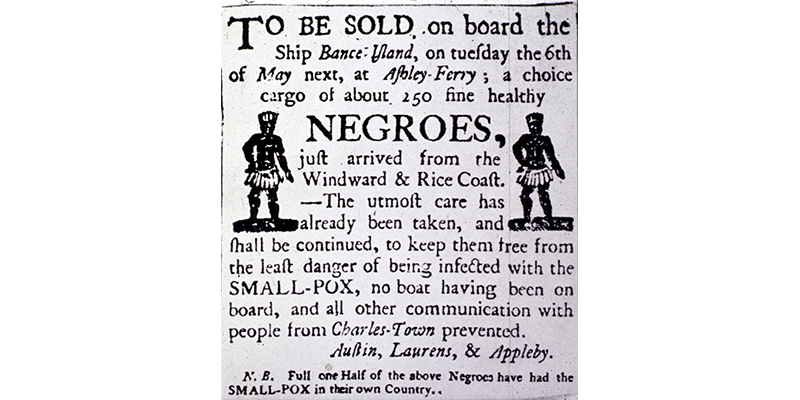
An advertisement from 1760 announces the sale of Africans from the Upper Guinea Coast region, and stresses they are free of smallpox, a common disease on the Atlantic crossing
An advertisement from 1760 announces the sale of Africans from the Upper Guinea Coast region, and stresses they are free of smallpox, a common disease on the Atlantic crossing. Image Credit: Library of Congress, Prints and Photographs Division, LC-USZ62-10293

Although Onesimus’s medical experience saved countless lives during the Boston epidemic, he was omitted from medical history for centuries. In 1932, during a speech to the Massachusetts Medical Society, Dr. Samuel Bayard Woodward announced that the idea of variolation “came then from Cotton Mather and from Cotton Mather only.”

Today, there is a movement among historians of science to confront the erasure of these contributions — especially among historians of color who have long fought to correct public understanding.

“I would say that one thing to learn from Onesimus’s story is that medicine advances thanks to the knowledge, labor, and experience of people that often go unrecognized due to racial and other biases,” Reed College history professor Margot Minardi told NBC Boston.

While Onesimus introduced the process of variolation to the Americas, many students are not aware of the history of Onesimus, or the role that enslaved Africans played in shaping early modern science in the Americas.

In contrast to math and reading, there are no nationally agreed upon content standards for teaching social studies and United States history. That means that every state teaches the history of slavery differently, and what public school students do learn is largely influenced by where they grow up.

“One of the things that I hear frequently from undergraduate students is that they feel lied to,” says Carolyn Roberts, a professor and historian at Yale University who researches medicine and slavery in the Atlantic world. “They want to know why they didn’t learn about this history earlier, and the different influences and people who contributed to science.”

In an effort to develop a baseline understanding of how slavery is taught and what is learned in the United States, the Southern Poverty Law Center examined 12 widely used U.S. history books and conducted surveys with more than 1,700 history teachers and 1,000 high school seniors. Their findings revealed that many educators are not sufficiently equipped to teach the history of American slavery, with over 50% reporting that their textbook’s coverage of of the topic was inadequate.

“The best textbooks maybe have 20 pages, and that’s in an 800-page textbook,” Maureen Costello, director of Teaching Tolerance, a program at the Southern Poverty Law Center that promotes diversity education, told The New York Times Magazine. “At its best, slavery is taught because we have to explain the Civil War. We tend to teach it like a Southern problem and a backward economic institution.”

Onesimus’s story raises an important question about our understanding of the history of science in the United States: What kinds of medical and botanical knowledge did African and African-descended people possess, and how did they contribute to early modern science? Even as they were brutally forced from their homelands, enslaved Africans passed on valuable medical knowledge in Britain, Europe, and the Americas.

“African Indigenous medicine is one of the most well developed medical systems in the world, along with India and China,” says Roberts. “People don’t know this when they think about Africa, they think of medical humanitarianism, but 80% of people around the world use traditional medicine.” (Indigenous medicine in the Americas has also had a significant influence on global medical knowledge.)

According to documents sent to the Royal Society, a “Mr. Floyd” and a “Mr. John Smyth” served as ministers at Cape Coast Castle in what is now Ghana, overseeing the enslaved people who were held in dungeons prior to being transported to the Americas. As the life expectancy for Royal African Company employees was just four to five years, the ministers were also searching for traditional methods to minimize deaths and improve the health of employees, while also searching for new botanicals for commercial drugs.

This engraving shows the top plan of Cape Coast Castle and other features surrounding the castle, e.g., the town, various paths.
Throughout the 18th century, Cape Coast Castle in present-day Ghana operated as Britain’s slave trading headquarters in West Africa. Illustration credit: Thomas Astley/CC BY-NC 4.0

Henry Oldenburg, a scientific correspondent for the society was particularly interested in the “diseases ye Inhabitants are most subject to” and what medicines they used to treat these illnesses. He also wanted to know what poisons and antidotes West African healers used, and what tree bark kept their teeth healthy and white.

John Smyth described how he observed the anti-inflammatory properties of the “unnena plant” which could be boiled and then applied to swollen body parts to decrease water retention. Both palm oil and palm wine were used for a variety of purposes. Palm wine could be mixed with boiled unnena plants to ease constipation, and ointments could be derived from pounding the plant’s leaves and mixing them with palm oil to treat sores and wounds. It was from the enslaved Africans that Smyth also procured a treatment for dysentery by pounding, drying, baking, and consuming the “pocumma plant.” Treatments for stomach aches, smallpox, worms, venereal disease, toothaches, scurvy and hemorrhaging were among the lengthy list of cures Smyth learned from West African experts, according to Roberts. However, the names of the West African botanical and medical experts who informed the minister’s correspondence are absent from these accounts to the Royal Society.

The flow of Indigenous knowledge from Cape Coast Castle to the Royal Society would continue for more than a century, noted Roberts. West African medical practices were of primary importance to James Phipps, chief merchant at Cape Coast Castle, in his writings to his London employers: “We should be glad to have the assistance of an able Gardener, one that is well acquainted with Herbs, as we believe there may be many Simples found here, of very great benefit, being observed to be made use of by the Natives in Pharmacy, as well as Surgery and who succeed in many good Cures in both.”

“The violent trafficking of millions of African people to the Americas has left our world with legacies we are reckoning with today,” Roberts wrote in a blog post for the Royal Society. “One such legacy is the lack of historical acknowledgement of West African people as scientists, botanical experts and medical practitioners, despite their presence in the archives.”

In the book “Bitter Roots” Abena Dove Osseo-Asare describes how for over a century, conflicts over rights to medicinal plants found in African countries have existed between healers and scientists.

“Specifically new medications made from rosy periwinkle, Asiatic pennywort, grains of paradise, Strophanthus Crytolepis, and hoodia,” writes Osseo-Asare. “Some of the pharmaceuticals have been profitable, most have led to patents, and all have resulted in controversies among the many people who have claimed rights to the plants and their biochemical constituents.”

Pink hoodia plant and thorns growing in the Kalahari Desert
The Hoodia gordonii plant (known locally as Xhoba) grows wild in the vast Kalahari Desert of Southern Africa. Used by the San people to suppress appetite during long hunting excursions and times of famine, extracts from this plant are now used in weight loss supplements. Image Credit: Flickr/CC BY-NC-SA 2.0

While past historians neglected the stories of enslaved people like Onesimus and the West African botanical and medical experts of Cape Coast Castle, there has been an increase in journal articles and news coverage around Onesimus’s contributions, with Boston Magazine naming him one of the 100 best Bostonians of all time.

“I think that educators can begin teaching these histories from a very young age, and talk about stories like Onesimus’ so that children will be able to see themselves as scientists,” says Roberts. “One of the ways that can happen is by understanding that they, the Black students, are part of a long legacy of healers.”

DO YOU HAVE EMPTY HOUSES IN YOUR BIRTH CHART? HERE’S WHAT IT MEANS….

Posted on March 30, 2022
Updated on April 01, 2022  (astrologyanswers.com)

An illustration of a white house on a light blue background.

Are you new to astrology? Maybe your curiosity made you dig your head into understanding how to read your birth chart?

And slowly but surely, perhaps the following astrology jargon will start to make sense:

Psst: We’re super excited for you and are cheering you on! Congrats on the progress you’ve made!

But then, you run into empty houses in your birth chart! And start to panic? Quite often, a classic case of FOMO sets in for many newbie astrology junkies.

“Oh No! My 2nd house is empty, am I doomed? Will I never make enough money?

“I’ve an empty 7th house! Maybe I won’t have luck with marriage!”

Hold it right there! It’s not all doom and gloom! Don’t panic over empty houses in your natal chart.

Today we’re here to clear the confusion on this topic. Scroll down to learn more about empty houses.

Empty Houses in Astrology – What Are They?

To make things simpler, what exactly is an empty house? Let’s re-iterate.

Each quadrant of your birth chart has astrological houses 1-12. These are populated by planets at certain degrees.

There are13 planets (including Chiron and lunar nodes) form the crux of a full astrological evaluation. Interestingly, these 13 planets are NOT distributed uniformly across zodiac signs, meaning each zodiac sign by default does not necessarily have a planet.

This unique medley of planets and astrological houses is precisely why each of us has a unique personality. No two birth charts are ever 100% identical!

Think of your birth chart to be your exclusive cosmic fingerprint.

  • What happens if a house has no planet in it?
  • Does an empty house mean a deficiency in that area of your life?

Not sure if you have empty houses in your chart? Use our free birth chart calculator now!

What Does An Empty House Mean?

The lack of a planet in a house (empty house) simply means that you do not have to pertain to the aspect of life governed by the empty house.

  • Struggle
  • Learn karmic lessons (or)
  • Pay karma

Empty 1st House

The 1st house is all about the self, your physical body, and vitality. An empty 1st house can actually be a good thing. It shows that health and vitality are your strong points.

It can also show that you are sure of yourself and have a positive personality and mindset.

Empty 2nd House

Empty 2nd house worries a lot of people and for good reason. The 2nd house is all about your cha-ching. Anytime there’s money talk, it’s natural to seek security. Your capacity to earn income and amass wealth is seen through the 2nd house.

Additionally, we can access information about your value system – what do you value most – materially and spiritually?

Is an empty 2nd house, an indicator of scarcity? Absolutely not!

In fact, contrary to popular belief, this shows that wealth comes to you without much struggle.

Empty 3rd House

An empty 3rd house can show an easy relationship with your neighbors, siblings, extended family/cousins. Interestingly, other 3rd house related areas of your life (social media, communication, writing, courage, hands-on skills, etc) are relatively effortless for you.

Empty 4th House

An empty 4th house isn’t a bad thing – it shows that all-things home, dwelling, relationship with mother flow easily for you.

Additionally, there’s a good chance that you have a nurturing nature. What’s more, your happiness could be closely tied to your inherent ability to nurture others.

Empty 5th House

Is your 5th house empty? This needlessly worries people. It’s a misconception that an empty 5th house means a person fares poorly in romance, children, and creative hobbies.

Devoid of any other planetary aspect, an empty 5th house shows that you could be having a natural artistic and creative flair in life. And maybe you even like to live life king size – Can’t be a bad thing right!?

Empty 6th House

Empty 6th house? Boy oh boy! You lucked out! No karma with work, colleagues, enemies at work, and health habits. It also means there’s a good chance that dangerous diseases of the medical world may not be part of your life struggle!

Empty 7th House

Yes! A happy marriage can be a reality with an empty 7th house! Bet that’s what you wanted to hear? An empty 7th house may actually point out that you’ve come into this lifetime with very little or no relationship baggage from past lives!

Did we hear you say “Yippie” yet? Hop onto the +1 train already!

Empty 8th House

The 8th house is where we dig into the dark trenches of our psyche and alchemize ourselves to high vibe-ing beings.

Can you imagine if you have a malefic planet here like PlutoSaturn, or the lunar nodes? It screams of transformation through turmoil! Brace yourself for some pretty heavy karma to be paid in this lifetime.

Do you have an empty 8th housePop some champagne and do a happy dance because the heavens have made it easier for you in this lifetime. Not much of drudging through invisible crevices of your subconscious.

Empty 9th House

An empty 9th house can show that higher learning, philosophical thinking, writing, publishing, travel, and adventure could be your all-time fav things to do! Good for you!

Empty 10th House

Okay! Before you freak out, your career will NOT be negatively impacted by having an empty 10th house unless it also happens to be aspected by malefic planets.

Read next: Career Astrology Using the 2nd, 6th, & 10th Houses

Empty 11th House

An empty 11th house can show that monetary gains, network circles, technology, social media are all areas that could feel like a breeze for you!

Want to know extra deets about an empty 11th house? There’s a good chance that you secretly obsess about aliens, space travel, metaphysical mysteries, star seeds, Pleiadians, and/or occult healing techniques! Sshh! We won’t tell anyone your best-kept secret!

Empty 12th House

Did you know? 12th house much like the 8th is all about diving deep into the depths of the subconscious. It also shows losses, expenditure, enemies, isolation, addictions, past life karmas, divinity, and Universal consciousness.

An empty 12th indicates there isn’t much debt from past lives. You might not incur heavy expenditure or financial loss and spirituality could be your strength.

Exceptions to Empty House Analysis

There is nothing to worry about if you have stand-alone empty houses. However, planetary aspects like oppositions and squares, or if the house ruler is conjunct with a malefic planet most certainly can negatively influence the outcome of an empty house.

Empty Houses – Not the End of the World!

Are you beginning to see how having empty relationship houses (1,5,7,8) does not mean you are destined for bad (or) no relationships or marriage?

Similarly, all you ambitious, career-oriented go-getters of the zodiac, empty work/wealth houses (1,2,6,10,11) do not make you a procrastinator! And no—you will not be poor purely on the basis of an empty 2nd house.

In conclusion, empty houses or not – say no to panic! And remember that you are the creator of your own life!

Did this article help you finally get over the initial FOMO of empty houses? Write to us about any empty houses in your birth chart and how you interpreted them. And don’t forget to share this article with fellow astrology junkies.

Related article: Dive deep into what each astrological house means with this 5-minute Astrological Houses Overview

Anu Sataluri

About The Author

Anu is an inquisitive Gemini Sun, Aquarius Rising, and Pisces Moon headlining as a clinical researcher turned chakra energy healer and content writer. Through her writing, she… Learn More About The Author »

The Midas Disease

The Midas Disease | Aeon

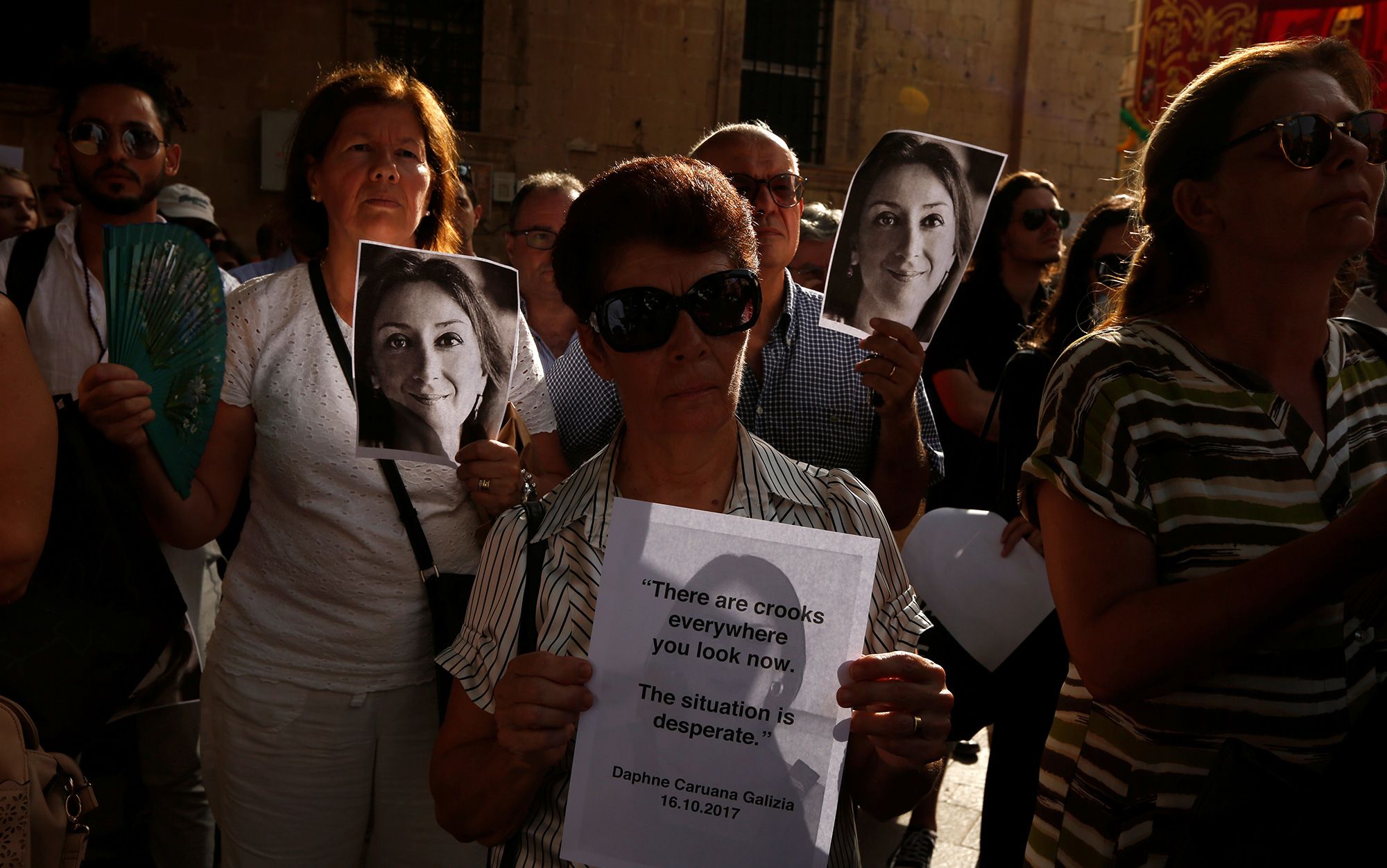
A vigil in Valletta, Malta, on 16 July 2018, marking nine months since the assassination of the anti-corruption investigative journalist Daphne Caruana Galizia in a car bomb. Photo by Darrin Zammit Lupi/Reuters

Corruption is a truly global crisis and the wealth addiction that feeds it is hiding in plain sight

Sarah Chayes is the author of On Corruption in America: And What Is at Stake (2020), published in the UK as Everybody Knows: Corruption in America, the Los Angeles Times Book Prize winner Thieves of State: Why Corruption Threatens Global Security (2015) and The Punishment of Virtue: Inside Afghanistan After the Taliban (2006). She lives in Paris and Paw Paw, West Virginia.

Edited by Sam Haselby

31 March 2022 (aeon.co)

Love Aeon?

Support our workDONATE

In Kandahar, Afghanistan, in late 2001, I watched a girl of about nine strip a Kalashnikov rifle, inspect the bullets and reload the sound ones in a matter of minutes. That child lived in a mud-brick house in the middle of a graveyard. I lived there, too. I was staying with her family as I covered the fall of the Taliban regime for National Public Radio in the United States. I thought I’d learn more in the company of ordinary Afghans than in the single hotel in the capital formerly held by the terrorists, where the other Western journalists were. So I asked a militia friend to find me a host family.

That scene in our rug-strewn sitting room, where I slept at night and we gathered by day, stayed with me throughout the decade I remained in Afghanistan. It has stayed with me ever since.

Here is its significance. Afghans know how to fight. Once back in control of their country, that girl’s people did not need close air support to beat off a resurgent Taliban, or armoured vehicles packed with delicate electronics that could be maintained only by highly trained mechanics. What they needed was to be proud of their government. But Afghan government officials began stealing their money. And US government officials ignored – even enabled – the crimes.

This issue, corruption, was not on my mind at all when I decided to quit journalism and move to Afghanistan. I was not thinking about it as I set about rebuilding a village that had been reduced to rubble in the US bombing campaign, or setting up the country’s first independent radio station. I was not trying to impose some Western norm.

It was Afghans who brought the problem to me. Young people I asked about what they wanted to hear on the radio complained of shakedowns by the new governor’s militiamen – who wore US combat fatigues. A quarryman told me he couldn’t sell stone for the houses I was rebuilding: the governor had awarded himself a monopoly. Then he crushed it to gravel and sold it at an exorbitant markup to the US military base outside town.

When I learned Pashtu and moved to an unguarded compound in the middle of town, and the Taliban were filtering back into the region, delegations of elders would come calling. ‘The Taliban hit us on this cheek,’ a dignified spokesman would say, setting down his cup of green tea to deliver a slap to his own face, ‘and the government hits us on this one!’

So I started working on corruption: because I knew that if the US government kept helping it flourish, we – and the Afghan people – would lose the war. And we did.

But the loss of the longest war the US ever fought was hardly the first time corruption has shaped history.

‘They preach only human doctrines’ – not Holy Writ – ‘who say that as soon as the money clinks in the money chest, the soul flies out of purgatory.’ So reads Thesis 27 in a carefully sequenced series of statements that a law student-turned-priest and theology professor named Martin Luther wrote in 1517. At the time, the Catholic Church, the dominant power in Europe from the edge of Ireland nearly to Moscow, was engaged in a vast extortion racket. Worshippers could avoid the torments of a ghastly pre-Judgement Day refugee camp called Purgatory, if they just shelled out the price of an ‘indulgence’, a papal safe-conduct.

In 1517, a sales push was launched in Germany. Half the proceeds were earmarked to cover the staggering debt a young cleric had taken on to buy a powerful archbishopric from the pope. A bling-loving scion of the Medici dynasty, that pope routinely auctioned off Church offices and waivers of canon law. The rest of the return on indulgence sales would go straight to Leo X himself, to help pay for a gaudy piece of real estate.

Thesis 66: ‘The treasures of indulgences are nets with which one now fishes for the wealth of men.’ Why, wonders Luther’s Thesis 86, did the stupendously rich pope not ‘build this one basilica of St Peter with his own money rather than with the money of poor believers?’

Without the outraged Indigenous allies who joined him, could Cortés have brought down that great empire?

Nearly all 95 of those epoch-making premises are taken up with aspects of what we would call corruption: harnessing public office to the purpose of self-enrichment. In this egregious case, the offices in question were sacred and the stakes eternal. Public indignation burst across Europe in a shockwave that dramatically reshaped the continent’s politics, culture and economy.

History lurches with such turning points, in which systemic corruption, or the reaction against it, changed the course of world events.

Three years after Luther’s propositions went viral, a mixed army of Spaniards and Native Americans laid siege to a metropolis. In terms of population, and cultural and architectural sophistication, the Aztec capital of Tenochtitlan rivalled any city in Europe. Evidence in accounts written both by the commander of that army, Hernán Cortés, and Indigenous scholars, suggests that much of its magnificence derived from the Aztec elite’s abuse of public power for personal gain. So arises a question: without the outraged Indigenous allies who joined him, could Cortés have brought down that great empire?

In Corruption and the Decline of Rome (1988)  to offer a final example – Ramsay MacMullen devotes a chapter to the system that would become Pope Leo X’s default 1,000 years later: ‘Power for Sale’. Assessing its impact on the fortunes of Rome, MacMullen wonders how it was possible for a rowdy, materially and technologically inferior coalition of untutored tribesmen ‘so quickly and effortlessly [to] gain control of Germany, Gaul, and Spain’. The question mirrors the general astonishment when, last summer, gangs of shaggy-haired fighters mounted on motorcycles overran Afghanistan in a matter of days.

In both cases, a fatal impact of ‘power for sale’ was the hollowing-out of defence forces. ‘The size of Rome’s armies was contemptible,’ writes MacMullen. And the disgruntled, ill-equipped soldiers who remained on the front did not stand and fight. ‘We are told of a field of battle, a district, an entire province simply abandoned.’ Just what happened in Afghanistan in August 2021.

For corrupt elites, defence budgets represent an enticing opportunity for pillage. Citizens rarely question investments they think will protect them, and the details of expenditures are usually classified.

A common technique is for officers to pad the payroll with what The Guardian in 2016 identified as ‘fake names or dead men’, then pocket the excess salaries. That’s how districts end up ill-defended by units of contemptible size.

Or why not loot the equipment budget, by failing to buy materiel for which funds have been allocated, or by selling supplies – including to the enemy – or by purchasing shoddy alternatives to the reliable food, shelter and weaponry that those who put their lives on the line for their community deserve? That’s how soldiers run out of ammunition in the middle of a firefight with raggedy foes.

Sums of money, weapons and weatherproof tents can be counted; they help quantify corruption’s toll. But to think only in numbers is to overlook the greater harm and the real danger: the moral injury corruption inflicts.

How do you suppose Roman or Afghan soldiers felt, in their scattered handfuls, stomachs empty because of the stench of their putrid breakfast, as they offered themselves up on behalf of their ruling authorities? What sensations scalded their flesh as they realised that their privations were perpetrated by the representatives of those very authorities – by superiors they longed to admire? Can you imagine the pain? The shame?

And when the soldiers put their minds to their predicament? What if the only purpose they could find in this sadism was the accumulation of more gold or dollars than the supposed superiors or their progeny could ever spend?

How are souls deformed under the obligation to violate cherished values in order to survive?

The word that comes to my mind is ‘betrayal’. Have you ever experienced betrayal? Is there a more searing psychic wound? Psychic wounds – betrayal and pain and shame – are powerful goads to action, not always considered.

And what about such a country’s civilians? What breeds in their hearts when, as an Afghan colleague bitterly noted, ‘the very people who are supposed to be upholding the law are the ones breaking it’?

Once, members of the cooperative I set up in 2005 needed to retrieve a piece of equipment from customs. I was away. They could not extract the item without offering an ‘emolument’, as the US constitution calls it. In disgust – partly at themselves – they paid.

What is the impact of having to do something like that day after day? How are souls deformed under the obligation to violate cherished values in order to survive?

The way some react may look like secession. Soldiers abandon their posts. Voters withhold their ballots. Caravans set forth in an exodus of biblical proportions. Or a whole people ‘dissolve[s] the political bands which have connected them with another’, to quote the US Declaration of Independence.

The pain of betrayal and disrespect can also spark violent rage or a desire for revenge. And not just in Afghanistan or ancient Rome.

Pick any country that is beset by crisis today: huge public protests that mow down a president and metastasise into war; attacks by insurrectionists mouthing ideological slogans. Now look at the government of the country in question. Is justice under orders or for sale? Do top officials’ close relatives hold key government jobs? Are petty bribes for low-level officials ‘just the way things get done’?

Yet the violent reactions corruption often prompts may be the lesser of its evils. The greater harm may result from the betrayal itself: a natural or human-made disaster that does irreparable harm – like a chemical explosion in an ancient port city, or a region wrecked by a hurricane; a financial implosion brought on by systemic fraud. Or, let’s take the greatest calamity looming over our species today: the ruin of the natural world.

Since just 2018, for a single example, thousands of square miles of Amazon rainforest – the wettest, lushest and most biodiverse region on this lumpy planet – have burned. To call the Amazon a carbon sink does not begin to encompass the magnitude of this disaster. Think of that place as not just a lung, but as more vital organs of the living Earth than current human knowledge can even identify.

What happens without it? If a single comet slamming into the Gulf of Mexico exterminated 80 per cent of species, ending the age of the dinosaurs, then it doesn’t bear thinking about. Yet, under the current notoriously corrupt governments of Bolivia and Brazil, the race is on to sack it.

Betrayal. No wonder the Earth is lashing out.

How is it, then, that in the West we pay so little attention to corruption? We brush it away, as an innate feature of the human condition, or of the culture of certain foreign countries. Or – sometimes and – as a distasteful aberration, a scandal beneath notice.

Writing in 2016 for a unanimous US Supreme Court, chief justice John Roberts voiced that disregard. ‘[O]ur concern is not with tawdry tales of Ferraris, Rolexes, and ball gowns,’ pooh-poohs his opinion overturning the corruption conviction of Bob McDonnell, a former governor of the state of Virginia, for accepting nearly $200,000-worth of presents from a businessman seeking his help.

The real concern, all eight sitting justices agreed, isn’t corruption, it’s the fight to curb it. Prosecutorial overreach against government officials and corporate executives, that’s what endangers the US.

Really?

Within weeks of that ruling, two very different mavericks blasted US presidential politics apart. One started chanting ‘Drain the swamp!’ The other called for a ‘political revolution’. Voters came running. Traditional politicians stood there, agape. The revolution happened, but not the one that guy was hoping for.

Corruption, in other words, unmoored the US political system, with the ultimate consequences still unknown. Yet, here and in other Western countries, it is easier to ignore than it is in Afghanistan. Here in the US, citizens are not regularly shaken down in the street. Corruption is cloaked in legal abracadabras. The safe is cracked with velvet gloves.

A handful of US defence industry giants, for example, all with long rap sheets, garner the vast bulk of Pentagon procurement and service contracts. Those contractors peddle armoured vehicles packed with delicate electronics. They sell defective weapons systems. They submit budgets whose line-items are inflated or even left blank: TBD. US soldiers don’t go hungry. But the wars are lost just the same.

In the US today, such comments imply, bribery is just the way things get done

The perpetrators of this brand of war profiteering wear business suits and enjoy respect. They have embroidered an elaborate fabric of connections with government officials who decide on the size of the defence budget and the uses to which the money will be put. These connections are not just purchased via campaign contributions. Personnel shuttle back and forth between private industry and the Pentagon, to weave a dynamic and powerful network. Its objectives routinely trump the public interest.

Does your country’s defence ministry exhibit a similar pattern? How do banking industry leaders and your government’s finance ministry officials interact? How did those officials and executives fare last time a financial bubble upended your or your neighbours’ lives? Who controls your energy and mining sectors? Have any of those individuals deliberately crippled government agencies tasked with protecting the health of citizens or landscapes?

Now consider how we, the victims – at least in the comfortable classes – often react. Instead of objecting and demanding that such practices cease, we are tempted to explain them away. The pose can seem deliciously counterculture, a sign of realism.

When I interviewed Washington lawyers and veteran court-watchers about the unanimous reversal of McDonnell’s corruption conviction, I got such rationalisations. ‘If that conviction were allowed to stand,’ the chorus went, ‘it would amount to criminalising politics.’ In the US today, such comments imply, bribery is just the way things get done.

Often, we gloss over the phenomenon altogether. We devise purely metaphysical understandings of Luther’s revolt, or of the violent act committed 1,500 years before that by a young rabbi from Nazareth. Surrounded by a rabble of his neighbours, he strode into the august government complex where the corrupt ruling elite of his day stole people’s money. And Jesus started throwing the furniture around.

Did this insurrection truly contain no commentary about the political economy of the earthly kingdom of Herod the Great?

Whose interest does it serve to downplay the corruption that outraged Jesus and Luther? What is lost when it becomes fashionable to insist that the human values of integrity and fairness are phoney, not sacred? Who wins when we work to identify useful functions corruption might serve, or shrug and call it ‘human nature?’ In whose interest is it to presume that people who amass staggering fortunes must be smarter or better than the rest of us, rather than dangerous criminals?

With these questions in mind – and begging Martin Luther’s indulgence – I offer up the following propositions for dispute:

  1. Current usage is wrong to suggest that ‘the Midas touch’ is a positive thing. On the contrary, the compulsion to reduce everything of beauty and value to gold – or to electronic signals in virtual bank vaults – is a disease that threatens our very societies.
  2. Competition among elites afflicted with this Midas Disease is a race with no finish line. There is never enough.
  3. To feed their compulsion, they build powerful (though informal and flexible) coalitions.
  4. These groupings cross social categories. They include government officials, executives of businesses and supposedly benevolent charities, and out-and-out criminals.
  5. Attaining public power in order to maximise their personal wealth is the primary aim of such coalitions. Corruption, in other words, is basic to their operations.
  6. Members often take up different roles in the different sectors of activity, moving from government office to industries they oversaw, and back into government.
  7. Members who occupy government office use its levers to enrich themselves and their fellows, ahead or instead of advancing the good of the citizens at large.
  8. Such abuse includes absconding with public funds or property, or steering a disproportionate share of government expenditures towards the coalition.
  9. Another and greater abuse consists in repurposing government itself to serve the coalition’s money-maximising interests (and even rival coalitions of a similar stripe).
  10. This abusive repurposing includes writing the rules to benefit coalition-members’ private business activities, dismantling rules or neglecting to write them at all, or prioritising enforcement in ways that advantage coalition-members and their interests.
  11. The endless competition for zeroes in bank accounts rages among and even within these groups, fuelling the drive to abuse public office.
  12. The rewards of corrupt practices are not dispersed in one-to-one transactions only. More effectively, they are spread through the coalition in an ongoing process of indirect exchanges.
  13. Law courts are therefore wrong to define the crime of corruption in minimal terms as a standalone exchange between only two parties.
  14. They are wrong to suggest that citizens have no legal right to the honest and good-faith performance of duties on the part of government officials and the executives of businesses whose activities shape their lives.
  15. Investigators, prosecutors and judges are wrong to prioritise violent crime over corporate crime and corruption, for the latter causes more harm to citizens and society.
  16. If corruption is criminal, those who enable it are guilty of complicity.
  17. Examples of such enabling include helping to hide ill-gotten wealth in untraceable bank accounts, or converting it into poorly regulated real assets such as real estate or football teams, or pleading in favour of corrupt practices in court or the public square.
  18. The wealth-addicted and their enablers are adept at exploiting crises – including those wrought by their own practices – at the expense of those worst affected.
  19. Corrupt capture of political and economic institutions and the culture at large is not a historical constant. Victims have reversed it by penalising perpetrators and enacting systemic reforms. Or by establishing new forms of government.
  20. But corrupt networks are resilient. When challenged – and even after suffering such blows as the fall of a government or the prosecution of leading members – they usually succeed in maintaining or reinstating the corrupt system.
  21. Corrupt networks deftly use complexity and impenetrable language to confuse citizens and gain cover for their activities.
  22. Another technique they employ to confound proponents of ethical values is to exacerbate antagonisms among different groups within the population.
  23. Citizens who are manipulated into allowing identity divides to overshadow their shared interest in curbing corruption will continue to suffer harm.
  24. For corruption is not a victimless offence. Victims include people left impoverished or homeless by financial crises; people dispossessed of ancestral lands; people whose air or water is unfit for consumption, or whose soil is too toxic to farm; people disproportionately harmed by fire or flood or construction failures or other natural or human-made disasters; people who go unhealed or even poisoned by dangerous ‘medicines’; citizens whose own lives and those of their descendants are stunted by diminished access to public goods, such as education, healthcare, law enforcement protection, and opportunities to launch businesses or buy or rent property; people whose jobs are eradicated by the imposition of other economic activities that benefit only a few coalition-members; people whose dignity is robbed by these and other practices; human society as a whole; thousands of species of nonhuman beings whose right to life is extinguished in order to further enrich Homo sapiens infected with the Midas Disease; the miraculous planet that gave us birth; and future human generations who will be condemned to live on a vastly damaged and destabilised incarnation of that planet – if they are able to keep living there at all.

EthicsHuman rights and justice Economic history

Bohm Dialogue

Bohm Dialogue (also known as Bohmian Dialogue or “Dialogue in the Spirit of David Bohm”) is a freely flowing group conversation in which participants attempt to reach a common understanding, experiencing everyone’s point of view fully, equally and nonjudgmentally. This can lead to new and deeper understanding. (en.wikipedia.org)

Prerequisite Concepts

Knowledge Is Active

As I said, knowledge is not just an accumulation of information waiting passively. It is an active and often dominant process that controls the general operation of the mind, without our being conscious of it. And it takes a high level of mental energy to be aware of this activity. Otherwise, it takes over, which is what it has done.

Knowledge Must Yield Yet It Does Not

It’s clear that any form of knowledge has to be able to yield to fresh perception or, rational behavior is impossible. Knowledge with absolute necessity cannot yield so it distorts, rationalizes, and pushes aside undesired facts so that nothing disturbs the general framework. This means that we are caught in self-deception.

Thought Runs You

Thought has produced tremendous effects outwardly. And, as we’ll discuss further on, it produces tremendous effects inwardly in each person. Yet the general tacit assumption in thought is that it’s just telling you the way things are and that is not doing anything—that ‘you’ are inside there, deciding what to do with the information. But I want to say that you don’t decide what to do with the information. The information takes over. It runs you. Thought runs you. Thought, however, gives the false information that you are running it, that you are the one who controls thought, whereas actually thought is the one which controls each one of us. Until thought is understood—better yet, more than understood, perceived—it will actually control us; but it will create the impression that it is our servant, that it is just doing what we want it to do. That’s the difficulty. Thought is participating and then saying it’s not participating. But it is taking part in everything. Fragmentation is a particular case of that. Thought is creating divisions out of itself and then saying that they are there naturally.

We have the picture that there is ‘somebody’ inside us who is given all this information and then decides to have the intetnion to do something based on that. I’m suggesting, however, that that is not so.

But in fact you can get evidence that thoughts and feelings move as a processes on their own; they are not being run by “me.” They are not being produced by the “me”, and they are not being experienced by the “me”.

Thought Produces Chaos

We started out saying that the trouble is that the world is in chaos, but I think we und up by saying that thought is in chaos. That’s each one of us. And that is the cause of the world being in chaos. The chaos of the world comes back and adds to the chaos of thought.

Thought Creates the Thinker

Thought creates the thinker; it is the thinking process that brings the thinker into being. Thought comes first, and later the thinker; it is not the other way round. If we do not see this to be a fact, we shall be led into all kinds of confusion.

Jiddu Krishnamurti

We Don’t See the Fact Because of Thought’s Movements of Which We Are Mostly Unaware of

That is the fact: that we don’t see the fact. There is a higher order of fact – which is that we are not seeing the direct fact. As I said, that is the fact from which we must start.

There is No Necessity to Belief

No belief. No, don’t control anything. Observe that you have belief, you cling to the belief, belief gives you a sense of security and so on. And that belief is an illusion, it has no reality.

Jiddu Krishnamurti

Thought is A Set Reflexes That Move On Their Own

I’m proposing that this whole system works by a set of reflexes – that thought is a very subtle set of reflexes which is potentially unlimited; you can add more and more and you can modify your reflexes. A reflex just operates, as we’ve seen in the case of the knee-jerk. However, we don’t usually think that thought is liek the knee-jerk reflex. We think we are controlling thought and producing thought. That way of thinking is part of our whole background. But I’m suggesting that it’s not generally so – that a vast part of our thought just comes out from the reflex system. You can only find out what the thought is after it comes out.

Thought is One Giant System That Organizes Society

All our systems of organizing society are an extension of thought. There’s hardly anything in the world that we see or experience that is not an organization of thought. So it’s all part of the system. There’s one system. It doesn’t stop inside a human being. It goes from one person to another, all through society, all through history, all over the world. The ecological problem is the result of the way we have been thinking about the world, that it’s something we can exploit indefinitely and we’re still thinking that way.

We Must Give Sustained Attention to the Process of Thought

We’ve been discussing dialogue and thought, and the importance of giving attention to the whole process – not merely to the content of all the different opinions and views – and to how we hold it all together. Also we’re all watching the process of how it affects us, our feelings and states of the body, and how other people are affected. This is really something of crucial importance, to be listening and watching, observing, to give attention to the actual process of thought and the order in which it happens, and to watch for its incoherence, where it’s not working properly and so on. We are not trying to change anything, but just being aware of it.

Thought is Primarily Tacit

“Tacit” means that which is unspoken, which cannot be described—like the tacit knowledge required to ride a bicycle. It is the actual knowledge, and it may be coherent or not. Thinking is actually a subtle tacit process. We do almost everything by this sort of tacit knowledge. Thought is emerging from the tacit ground, and any fundamental change in thought will come from the tacit ground. So if we are communicating at the tacit level, then maybe thought is changing.

The tacit process is common. It is shared. The sharing is not merely the explicit communication and the body language. There is also a deeper tacit process which is common. The whole human race knew this for a million years, but now we have lost it, because our societies got too big. We have to get started again, because it has become urgent that we communicate, to share our consciousness. We must be able to think together, in order to do intelligently whatever is necessary.

We Need a Coherent World-View That Reflects Wholeness

Man’s general way of thinking of the totality, i.e. his general world view, is crucial for overall order of the human mind itself. If he thinks of the totality as constituted of independent fragments, then that is how his mind will tend to operate, but if he can include everything coherently and harmoniously in an overall whole that is undivided, unbroken and without border (for every border is a division or break) then his mind will tend to move in a similar way, and from this will flow an orderly action within the whole.

Insight Brings Order to Thought

I propose that the essence of insight is this mental energy which perceives these subtle and powerful forces of knowledge, the emotional, social, intellectual, and still others that are beyond description, which make us very reluctant to give up fixed beliefs. When this energy is present we could say that the mind is free of certain blocks that are inherent in knowledge. I want to emphasize that the general action of insight is in dissolving blocks and barriers, which allows the ordinary faculties of the mind, such as reason, to give rise to new ideas and approaches.

The Mind Must Be Freed from the Dominance of Thought

Now the question is: can the mind be free of this egocentric activity? Right? That is really the question, not whether it is so or not. Which means can the mind stand alone, uninfluenced? Alone, being alone does not mean isolation. Sir, look: when one rejects completely all the absurdities of nationality, the absurdities of propaganda, of religious propaganda, rejects conclusions of any kind, actually, not theoretically, completely put aside, has understood very deeply the question of pleasure and fear, and division – the `me’ and `not me’ – is there any form of the self at all?

Jiddu Krishnamurti

Science Will Not Save Us as Long as Thought Dominates

On the other hand, it has become evident that because of the general incoherence of society and the individual that I just described the further progress of science along its current lines cannot resolve these crises and may indeed tend to aggravate them. Thus for example it seems clear that science cannot make it possible for us to act together with the coherence and general good will needed to provide everyone with an adequate physical and social basis for life and at the same time to avoid destroying the planet through ecological disasters, climate changes, and so on. Nor can it help us deal with the forces of nationalism and religious divisions so these will no longer prevent us from getting together to meet all these problems which are evidently of a world-wide nature.

History

North American Indian Tribes

One of the first notions I ever had of Dialogue was many years ago when I read of about an anthropologist who visited a North American Indian tribe, probably hunter-gatherers, of about 20 to 40 people. He saw that they frequently gathered together in a circle, and they talked and talked. Nobody seemed to be in authority, and they didn’t have any particular agenda or any particular purpose. They made no decisions – they just talked. But at the end they separated and seemed to know what to do. They had established a relationship with each other so that they could then deal with their practical problems and really communicate, and not get into the state we are often in where we are fighting over the problems and not communicating.

So, that is really the sort of thing I have in mind for Dialogue. It may prove very hard for us to do this, because for thousands of years our tradition has been otherwise. So when we get together we have a purpose; we have authority and hierarchy with some people having more value than others and their word counting more; and also we want to achieve something and we don’t want to waste our time. So I am suggesting something that seems quite different. You may ask, if we have such pressing problems, why should we waste our time just talking. But I say that our problems originate because we can’t engage in this activity of just talking, and therefore when we try to deal with our serious problems we find that we are not meeting.

(bohmdialogue.org)

Trauma to Transcendence: Using Life’s Wounds to Grow

Integral Life In this episode of the Shrink and the Pundit, Dr. Keith Witt and I discuss a powerful realization emerging at the leading edge of culture regarding the role of trauma in our lives. Dr. Keith is writing a book on the subject and has mined various psychotherapeutic modalities to create an integral approach to using trauma as a portal to health and higher consciousness. In our wide-ranging conversation we address: Trauma and resilience as forms of memory * The differences – and similarities – between ongoing trauma and “major event” traumas such as accidents, violence and illness * Trauma through human history * Sensitive vs sensitized: the healthy and unhealthy poles of postmodern consciousness * What child-centered parenting misses * The biological drive to have a spiritually-awakened brain * Updating your autobiographical narratives * Trauma and the self-transforming mind. I really loved this conversation and I hope you do, too! – Jeff Salzman

(Contributed by John Atwater, H.W.)