
 |
  |
| Conversations with Calvin Dr. Mara Pennell, H.W. The Prosperos Sunday Meeting is offering another chance to gain insights that happen through interviews with interesting and provocative people in the podcasts called “Conversations With Calvin.” This meetup features a conversation between Dr. Mara Pennell, H.W., and your host Calvin Harris H.W., M. This conversation will feature Mara’s involvement within the first year of the Advance Mentors Workshop and working within its Group Dynamic Team experience to draw from within each of the students their innate potential. Included are some fun highlights of Mara’s life journey, Tidbits about Education, Calling, Purpose, Goals. and her path to the Prosperos. The event is free, one hour beginning at 11:00 a.m. Pacific time- Sunday 27, March 2022 (check against your local time for viewing). Follow the link and I will see you there. Sunday, March 27, 2022, 11:00 am Pacific Time Go to The Prosperos Sunday Meeting on Zoom: https://us02web.zoom.us/j/332275676 Interesting people + Fun Conversation + Important Insights |
Monthly Archives: March 2022
Scepticism as a way of life

The desire for certainty is often foolish and sometimes dangerous. Scepticism undermines it, both in oneself and in othersPhoto by Enrique Diaz/7cero/Getty
Nicholas Tampio is professor of political science at Fordham University in New York. He is the author of Kantian Courage (2012), Deleuze’s Political Vision (2015), and Common Core: National Education Standards and the Threat to Democracy (2018). In September 2022, Edward Elgar will publish his book, Teaching Political Theory: A Pluralist Approach.
Edited bySam Haselby
25 March 2022 (aeon.co)
Love Aeon?
Support our workDONATE
Think about a time when you changed your mind. Maybe you heard about a crime, and rushed to judgment about the guilt or innocence of the accused. Perhaps you wanted your country to go to war, and realise now that maybe that was a bad idea. Or possibly you grew up in a religious or partisan household, and switched allegiances when you got older. Part of maturing is developing intellectual humility. You’ve been wrong before; you could be wrong now.
We all are familiar, I take it, with people who refuse to admit mistakes. What do you think about such people? Do you admire their tenacity? Or do you wish that they would acknowledge that they jumped to conclusions, misread the evidence, or saw what they wanted to see? Stubborn people are not just wrong about facts. They can also be mean. Living in society means making compromises and tolerating people with whom you disagree.
Fortunately, we have a work of philosophy from antiquity filled with strategies to counter dogmatic tendencies, whether in ourselves or in other people. The book makes one laugh out loud with questions about whether we know that grass is green, that scorpion stings are deadly, or if it is wrong for parents to tattoo their babies. The French writer Michel de Montaigne read the book in the 16th century and used the strategies in his essay ‘An Apology for Raymond Sebond’. Through Montaigne, many European Enlightenment philosophers came to see a link between scepticism and toleration. Plato’s Republic is more renowned, but the book from antiquity that people ought to read right now is Sextus Empiricus’ Outlines of Pyrrhonism.
Sextus was a physician who wrote in Greek and lived in the 2nd or 3rd century CE. He worked in a tradition that originated with the Greek philosopher Pyrrho, a contemporary of Aristotle. Outlines of Pyrrhonism, according to the Stanford Encyclopedia of Philosophy, is ‘the best and fullest account we have of Pyrrhonian scepticism’. In The History of Scepticism (1960), Richard Popkin identifies the beginning of modern scepticism with the Dominican friar Girolamo Savonarola’s decision to have Sextus translated from Greek to Latin. Sceptics could dethrone pagan philosophers who extolled the powers of reason; sceptics could also, it became clear, raise doubts about religious claims.
The sceptical way of life, on Sextus’ presentation, follows a certain rhythm. You feel puzzlement about something. You search for knowledge about it. You arrive at two equally weighty considerations about what is happening. You let go trying to find an answer. And once you recognise that you might not find a solution, it brings some mental tranquility.
An early biographer said that Pyrrho needed his friends to help him avoid wagons, dogs and cliffs because he would not commit to the knowledge of his senses. Diogenes Laertius also said Pyrrho would not help a friend who had fallen into a pond, suggesting that sceptics doubt our moral commitments. A perennial objection to scepticism is that one cannot live a recognisably human life and doubt the existence of physical objects or moral criteria. In his book Sextus, Montaigne, Hume: Pyrrhonizers (2021), the philosopher Brian C Ribeiro reveals how sceptics throughout history have responded to this charge. Sceptics acknowledge that human beings perceive things with their senses, feel bodily impulses, learn useful skills, and follow laws and customs. Sceptical philosophers make different ‘sceptical cartographies’ – that is, maps of the boundary between sceptical doubts and the bedrock of human life that repels doubt. Sceptics work for a living, participate in family and community life, and can be as kind and generous as anyone else. What sceptics strive to avoid is making claims about the nature of reality beyond how things appear to them.
Here are a few of Sextus’ modes to undermine certainty in yourself and others.
Say that you identify yourself in the school of thought associated with a preeminent person, for example Sir Isaac Newton or Albert Einstein. If you were alive before they were born, then you would not have known that your thinking would have changed upon reading, say, Newton’s Principia (1687) or Einstein’s articles of 1905. ‘In like manner,’ Sextus writes, ‘it is possible, as far as nature is concerned, that an argument antithetical to the one now set forth by you is in existence, though as yet unknown to us.’ Another scientific revolution may be around the corner. Somebody in the past or alive right now might have an argument that would weaken a belief that you take for granted.
Are you smarter than a dog? It seems obvious that humans have capabilities that dogs lack. However, Sextus notes, dogs can reason which path to pursue their prey by eliminating the paths that do not have a scent. Dogs can be brave and loyal friends, have the power to choose whether and what to eat, and can convey subtle emotions and messages through sounds. Not only do dogs resemble humans in intelligence, virtue, freedom and communication, they perceive things that humans cannot. After all, it was Odysseus’ dog, Argus, who recognised his disguised master when he returned to the household. Upon reflection, we appreciate that octopi, whales, bats, spiders and so forth sense all sorts of things in the world that we apparently cannot.
Honey tastes sweet but appears unpleasant to the eyes. Perfume smells nice but tastes disgusting. Olive oil soothes the skin but irritates the windpipe. Paintings can be of mountains, but to the touch they are flat. What is the true quality of honey, perfume, olive oil, paintings? One cannot say for sure; the senses conflict with one another. We see an apple using our five senses. But, says Sextus, ‘it is possible that there exist other qualities that fall within the province of other organs of sense.’ The intellect works with material provided by the senses, and the senses conflict and may be incomplete. Our intellect might not be able to know the true story.
We cannot say that other people are wrong. We are a party to the dispute
When we sleep, we have dreams that give us a distorted portrait of reality. But maybe dreams can give us a heightened sense of reality? Perhaps we have access to truths that are accessible only when we are sleeping, drunk or sick. René Descartes used a similar thought experiment but identified an escape route in our knowledge that we are, at the minimum, a thinking subject. Descartes brought in God to assure us that most of our perceptions correspond to something out there in the world. Sextus does not resort to theology. He does not want us to look for a foundation for certain knowledge or, at least, to claim that we possess it before we do. Rather, Sextus invites us to exercise humility that human beings can transcend their circumstances and discover reality.
Sceptics hesitate to make categorical pronouncements about whether, say, a medical procedure is safe. Its safety depends on such things as the age, gender, body mass index and circumstances of each individual. It is also possible that the side-effects of a procedure will take years, or generations, to manifest. In short, writes Sextus: ‘We shall not be able to say what each object is in its own nature and absolutely, but what it appears to be under the aspect of relativity.’
Some people around the world think it is appropriate to copulate in public, for men to wear one-piece tunics, for parents to tattoo their babies, and for men to marry their sisters. We, Sextus explains, do not think that these things are appropriate, but we cannot say that other people are wrong. We are a party to the dispute.
Outlines of Pyrrhonism provides readers with a list of argumentative strategies to use whenever anybody claims to know how things really are. Maybe you, the subject, are influencing your judgment, like when you comment on a meal at the end of a frustrating day. Maybe the object changes appearance depending on whether it is isolated or compounded, like when a grain of sand feels sharp, but a sand dune feels soft. Maybe both subjective and objective factors are at work, as when you notice a small comet because it is rare but do not notice the Sun because it rises every day.
After reading Outlines of Pyrrhonism, you might fold modesty into your speech and say things such as ‘This is how things appear to me’ and ‘Nothing more’ (ouden mallon).
But scepticism is not simply about knowledge or language. It is a way of life. Sextus invites you to become an open-minded, calm person who seeks out knowledge but does not become angry when certainty eludes your grasp or when others don’t see things the same way.
In a blog on ‘Epistemic Relativism’ (2021), Francis Fukuyama writes: ‘We who live in modern liberal societies have necessarily accepted a certain degree of moral relativism.’ Fukuyama does not comment on whether this is a good or bad thing but chastises postmodernist writers who espouse relativism regarding ‘assertions of fact concerning the outside world’. Fukuyama identifies the rise of epistemic relativism with writers who followed Friedrich Nietzsche, but these themes are present in Outlines of Pyrrhonism. Bracketing from the question of chronology, is Fukuyama right that relativism is a problem?
A quick reply is that sceptics eschew the term relativism. Sceptics do not maintain that truth changes depending on time or place. In 1933, the German philosopher Martin Heidegger believed in the inner truth and greatness of the National Socialist cause. Heidegger is a relativist but not a sceptic.
To the larger point that epistemic relativism is a problem, sceptics maintain that they do have criteria to make decisions about facts in the world or how to treat other people. These are, according to Sextus, ‘the guidance of nature, the compulsion of the feelings, the tradition of laws and customs, and the instruction of the arts’. For Sextus, nature and culture are the soil from which our ethical dispositions grow. Sceptics may be kind to children, help their neighbours, and build institutions that reflect the values of their culture. And there are many examples of cruel dogmatists.
Grass is green. Except at night, when it appears black. Sceptics can make arguments like that for a long time
In one of Sextus’ surviving manuscripts titled Against the Ethicists, he addresses the question of what a sceptic will do if a tyrant commands a forbidden act. The sceptic ‘will choose one thing, perhaps, and avoid the other by the preconception which accords with his ancestral laws and customs’ and will ‘bear the harsh situation more easily compared with the dogmatist’. Aha! For critics of scepticism such as Martha Nussbaum, this seems like evidence that sceptics are passive in the face of injustice. They don’t even know whether they will fight tyrants!
Rising to Sextus’ defence, the political scientist John Christian Laursen argues that sceptics can grow up in cultures that believe in watering the tree of liberty with the blood of tyrants, and sceptics can have a burning hatred for tyrants. Sceptics can possess energy, commitments and concern about the political order. ‘One can be committed without a chain of truths to support one’s actions.’ And, of course, dogmatists can also support tyrants who murder people who disagree with them.
Fukuyama wants people to agree on facts about the outside world. But intelligent people can look at those supposed facts in a variety of ways. Grass is green. Except at night, when it appears black. Sceptics can make arguments like that for a long time. Sceptics encourage us to live our lives in less frustrating ways than demanding something that humans do not and may not ever possess: truth.
One reason that it is important to read Sextus now is because people are considering proposals to tamper free speech in the name of combating post-truth politics. One such proposal is made by Sophia Rosenfeld in her book Democracy and Truth: A Short History (2018).
According to Rosenfeld, contemporary democracies have inherited a regime of truth from the European and American Enlightenment. Figures such as Jean-Jacques Rousseau and Thomas Jefferson envisioned a mutually supportive relationship between democracy, or republicanism, and truth. From one side, the entire reading public, and not just monarchs and bureaucrats, would have access to knowledge and would be able to debate issues of common concern. From the other side, educating the public through schools, universities and newspapers would accelerate the creation and dissemination of knowledge. ‘A moral and epistemic commitment to truth would undergird the establishment of the new political order,’ writes Rosenfeld.
This new social order committed to truth would depend, historically and conceptually, on a balance of power between experts and ordinary people. Experts would be responsible for using their training and institutional power to make discoveries that amateurs could not. You need specialists to design railroad systems and to measure climate change. Ordinary people play a part in this system by engaging in a running dialogue with experts about whether their plans are helping or hurting the common good. People can march and complain on social media when they think that experts have forgotten about them.
Populist leaders share stories that they and just about everybody else know are false
Democracy, Rosenfeld explains, requires a fine-tuned relationship between expertise and scepticism. Experts use methods, jargon, journals, conferences and so forth to acquire knowledge. But researchers express scepticism about each other’s work in peer review, and the public raises doubts about what experts are up to. ‘Pluralism,’ she argues, ‘along with a dose of scepticism inherited from the ancients, has, in theory, been a key characteristic of modern experiments with popular rule from the start.’
The problem today, according to Rosenfeld, is that expertise and scepticism are out of balance. Postmodernists writing arcane books do not help matters, though they are not the main culprit. Populist leaders share stories that they and just about everybody else know are false. People live in social media bubbles, and outlets cater to this development by publishing sensationalist stories. Like Jonathan Rauch in The Constitution of Knowledge (2021), Rosenfeld does not want experts to impose their dogmas on the public. Rauch and Rosenfeld envision a contentious public sphere in which experts and laypeople debate ideas and proposals. That said, they worry about the rise of ‘post-truth’ politics dominated by tribalism rather than a commitment to seek the truth. They both share a Platonic sense that the wise should have the final say about what stories may circulate in society.
If democrats are to combat post-truth politics, Rosenfeld suggests, we may need to rethink free-speech absolutism. The First Amendment may have meant one thing in the 18th century, but the American Founders could not have imagined how people would use electronic social media to coordinate neo-Nazi rallies or claims that mass shootings are fake news. ‘It may well be time,’ according to Rosenfeld, ‘to consider modifying free speech laws to limit the damage that free speech can do.’
Rosenfeld is a historian and does not give specifics about how to limit the damage of free speech. But she does say that democracy requires ‘shared convictions’ and ‘useful facts’ to craft government policy and bind us ‘all together in some minimal way’. As I write, politicians and academics are pressuring social media companies to censor posts about fake news and conspiracy theories and to revise, in the United States context, the First Amendment to make individuals subject to responsibility for the abuses of free speech. What is the problem with requiring social media companies to permit posts only based on facts or to reign in the abuses of free speech?
Here is where Sextus helps us pose objections to anybody who wants to censor fake news. What if the fake news is right? There are plenty of instances when people scoffed at an idea that was later widely adopted. Perhaps the piece of evidence to support the conspiracy theory has not yet come to light. Maybe people have seen things but have not yet been able to find their voice, or an outlet, to provide the missing piece of the puzzle. If you visit a seminar at a research university, you will find highly credentialed people raising their voices with one another over theories, methods, relevant evidence and so forth. Anybody who claims to shut down somebody by appealing to facts will be likely ignored. You will also find philosophers entertaining ideas that many people would think are simply wrong, such as that one can ‘discern a life in metal’, as Jane Bennett puts it in Vibrant Matter (2010). Anybody who speaks about facts should add qualifiers such as ‘these look like the germane facts to me’, or ‘this is how the situation appears to me, and no more’.
Pyrrhonian sceptics might have no problem with social media companies censoring, say, images of violence. They tend to go along with the laws and customs of the community, and they likely feel, as most of us do, revulsion at images of people hurting one another. But the sceptical tradition poses a recurrent challenge to anybody who claims to censor in the name of the reality-based community or objective truth. The sceptical tradition gives us reason to have doubts about anybody who speaks for the truth.
Part of being intellectually honest is admitting the limits and flaws of one’s knowledge
But what about Rosenfeld’s point that democracy and truth support one another? Won’t questioning the drive to truth make democracy vulnerable to populist leaders who share fake news? Sextus’ sceptical predecessor Carneades responded to this kind of objection by developing a doctrine of the pithanon, or the probable. Sextus said that this notion was too much of a compromise with dogmatism. You use the word probable if you have a sense of what is closer to the truth, which assumes that we know what the truth is. Sextus wants to get away from truth talk.
Sceptics still want to learn about things. The word ‘sceptic’ comes from the Greek word skepsis, meaning ‘enquiry’. Sceptics run experiments, test hypotheses, submit and do peer review, and the like. Sceptics follow the rules and methods of science and scholarship, and they laugh with their scholarly friends at the unfounded pronouncements of populists. But sceptics think that part of being intellectually honest is admitting the limits and flaws of one’s knowledge.
Looking back in time, we see that people should have been more sceptical about, say, the risks and rewards of using certain chemicals. In the 1960s, doctors prescribed thalidomide to treat morning sickness, and subsequently discovered that the drug caused birth defects. Americans sprayed more than a billion tons of the insecticide DDT on crops and lawns before the US government banned it in 1972; a recent study has shown that DDT’s health effects can persist for generations. In 2009, the US pharmaceutical company Pfizer had to pay a $2.3 billion fine for illegally promoting drugs such as Geodon, an anti-psychotic, and Zyvox, an antibiotic. Scientific consensus and common sense have been mistaken in the past. Sceptics press us to consider the possibility that experts and the majority of the public might be wrong today.
We cannot say that sceptics always favour democracy over other political regimes, yet scepticism has an egalitarian impulse insofar as it withholds from anybody the status of sage or philosopher-king. Democratic societies cultivate a healthy scepticism of political, scientific or cultural verities. Reading Sextus Empiricus today gives us argumentative strategies, and confidence, to resist anybody who claims to speak on behalf of truth or reality.
Astrological Update for April 2022
Wendy Cicchetti | Twixt Earth and Sky TO CONNECT WITH WENDY FOR AN ASTROLOGICAL SESSION: https://bit.ly/3jQU3Fn
Wendy Cicchetti is an internationally known astrologer with over 25 years of experience blessing the lives of thousands of people worldwide. GET SOCIAL WITH US! INSTAGRAM: https://www.instagram.com/wendy_cicch… FACEBOOK: https://www.facebook.com/WendyCicchetti
Wendy Cicchetti | Twixt Earth and Sky Are you experiencing any of the ASCENSION SYMPTOMS in this video? If so, we’ve got TWO remedies to share with you including COLOR THERAPY ???and BACH FLOWER REMEDIES?! TO GET A CUSTOMIZED ASCENSION REMEDY READING (Based on your personal astrological signature): https://bit.ly/WendysServices * USE DISCOUNT CODE REMEDY FOR 20% OFF BLUE STONES to help you stay calm and connected: Lapis Lazuli, Blue Calcite, Celestite and Kyanite. GREEN STONES for calm and healing: Jade, Malachite, Green Calcite, Labradorite, Green Fluorite. TO CONNECT WITH WENDY FOR AN ASTROLOGICAL SESSION: https://bit.ly/3jQU3Fn
BACH FLOWER REMEDIES CAN BE FOUND AT YOUR LOCAL HEALTH FOOD GROCER OR YOU CAN RESEARCH BACH FLOWER REMEDIES ONLINE AT https://www.bachremedies.com/en-us/ Wendy Cicchetti is an internationally known astrologer with over 25 years of experience blessing the lives of thousands of people worldwide. GET SOCIAL WITH US! INSTAGRAM: https://www.instagram.com/wendy_cicch… FACEBOOK: https://www.facebook.com/WendyCicchetti Wendy Cicchetti is an internationally known astrologer with over 25 years of experience blessing the lives of thousands around the world.
Chiron – The Wounded Healer, The Shaman, The Alchemist
| by Astro Butterfly (astrobutterfly.com) |
You may wonder what’s all this fuss about Chiron. If you are familiar with Chiron in your natal chart, or have been following your Chiron transits, you already know how powerful Chiron is. Its influence is undeniable.
Just like Pluto, Chiron is tiny but mighty.
Because of its strategic placement – between Saturn and Uranus – Chiron plays a key role in our natal chart. In fact, Chiron’s symbol is a “key” – and not by coincidence. Chiron is the KEY that can unlock our chart.
In Astrology, Chiron stands for:
- Our Deepest Wound
- Holistic Healing – which only happens when we integrate the wound
- Our greatest gifts and talents – which only become gifts when the initial wound is healed
You may already be familiar with the “Wounded Healer” archetype. However, there are three archetypes associated with Chiron: the Wounded Healer, the Shaman, and the Alchemist.
These 3 archetypes represent the transcendental journey of the soul: we firstly suffer and explore our primal wound (the Wounded Healer). We then embrace it and heal it (the Shaman). Only after we explore the first 2 Chiron archetypes can we then transcend the wound and transform it into a gift (the Alchemist).

1. The Wounded Healer
The Wounded Healer describes our first experiences with the primal wound. At this stage, the wound is not yet acknowledged.
Some people brush their wounds off for their entire lives. Lurking in the background of their unconscious, the wound sabotages them in unconscious ways.
Most of us continue living with the wound, because we’re not even aware that there’s ‘another way’.
2. The Shaman
There comes a time when the wound is so painful, so acute, that it can no longer be ignored. This integration of the Chiron wound corresponds with the 2nd Chiron archetype, the Shaman.
We call this stage the Shaman, because a Shaman, or the Medicine Man or Medicine Woman, has the ability to travel between worlds.
This extraordinary ability bestows them with healing powers. This ability to ‘travel between worlds’ is a metaphor for the integration of the different areas of our psyche: the good, the bad, and the ugly.
When we hate our bodies, are ashamed of our secret desires, or are disturbed by our anger, envy, greed, or other ‘undesirable’ traits, we can never be whole, we can never fully be ourselves.
When all the different parts of ourselves are integrated, then, and only then, healing is found. The Shaman is the most intense Chiron developmental stage, but it’s critical to embrace it if we want to eventually alchemize our wounds into gifts and live wholesome lives.
3. The Alchemist
Finally, the 3rd developmental stage, the Alchemist, corresponds to the gift that naturally emerges when we heal and integrate our wound.
Our fear of public speaking transforms into great communication skills.
Fighting chronic illness eventually helps us discover a unique, holistic approach to healing.
The unexplained longings that make us feel spiritually sick eventually help us guide others on their own journey to greatness.
But how do we transform the wound into a gift? How do we do “the Chiron work”?
Chiron – Your Deepest Wound, Your Greatest Gift
In the “Chiron – Your Deepest Wound, Your Greatest Gift” we follow a 3-step framework that is designed after the 3 Chiron archetypes, 1) the “Wounded Healer”, 2) the “Shaman” and 3) the “Alchemist”.
In the 1st module of the course, the “Wounded Healer” we explore our natal Chiron placement. Our Chiron sign, the aspects to other planets, and especially our Chiron house placement, all describe our “wounding profile”.
The Chiron chart placement, as well as a series of inquiry exercises, will help you to identify your Chiron wound.
If in the 1st module of the course is the “What”, in the 2nd module of the course, the “Shaman” we explore the “How” – how we personally ‘respond’ to Chiron.
Our Chiron wound can stay dormant until a Chiron transit activates it. That’s why in this module we look at different Chiron transits from our past (some Chiron transits are, of course, more relevant than others) so we can identify how we “do” Chiron, and what healing looks like for us.
Finally, the 3rd module of the course, the “Alchemist” is the “Why”.
Our pain and suffering is not in vain. To achieve our greatest human potential we first need the experience of the wound. It’s our initial attempts to heal the wound that eventually alchemize into healing gifts.
We are not here by chance. We are all here for a reason, and when we do the Chiron work, things finally start to fall into place.
When Chiron travels through different signs (now it’s in Aries), it activates different houses in our natal chart, asking us to alchemize the wounding that corresponds to that area of our life, and transform it into a gift.
If you resonate with this 3-stage approach, join us in the “Chiron – Your Deepest Wound, Your Greatest Gift” 3-week transformation journey.
Each week, we dive into each of these 3 Chiron archetypes with astrology, psychology and healing tools so you can get a holistic understanding of your Chiron wound and of the precious gift behind it.
Learn more about the program, and join us here:
https://astrobutterfly.lpages.co/chiron/
3 reasons for optimism in difficult times
Kevin Kelly”Every great and difficult thing has required a strong sense of optimism,” says editor and author Kevin Kelly, who believes that we have a moral obligation to be optimistic. Tracing humanity’s progress throughout history, he’s observed that a positive outlook helps us solve problems and empowers us to forge a path forward. In this illuminating talk, he shares three reasons for optimism during challenging times, explaining how it can help us become better ancestors and create the world we want to see for ourselves and future generations.
About the speaker
Kevin KellyEditor, authorSee speaker profile Kevin Kelly packages ideas — both other people’s and his own.
Russia Will Remake Itself. But It Has to Crumble First.
March 20, 2022 (NYTimes.com)

By Varia Bortsova
Ms. Bortsova is the founder of Soviet Visuals, an online archive of images from across the former U.S.S.R.
When the first McDonald’s restaurant appeared in the Soviet Union in 1990, my parents bundled my 9-month-old sister up and waited in line for hours in the brisk Russian winter so that they could get their first taste of a Big Mac and those famed French fries. The line snaked all around Moscow’s iconic Pushkin Square: Reports say that 30,000 people showed up on opening day alone.
It was a very exciting moment, my parents tell me: the first taste of liberty, a glimpse of what eating out could be like beyond the Iron Curtain, a symbol of bigger change to come.
Less than two years later, the U.S.S.R. ceased to exist, opening the door to all kinds of democratic freedoms. The Russia I grew up in came with dubbed Disney cartoons and Argentine soap operas. Everyone suddenly had a crush on Leonardo DiCaprio. My mom’s new eye-shadow palette encompassed every shade of neon. I went to concerts, bought posters and cassette tapes and, unlike my parents, did not have to wear a five-pointed-star badge with a portrait of Vladimir Lenin on my chest every day at school.
Of course, there was an insidious side. With new freedoms came new challenges: a deep economic crisis, a sharp rise in inequality and an explosion of organized crime. After decades in which the state dictated nearly every decision for its subjects, from housing to place of work to taste in movies and music, the new era also brought with it uncertainty and chaos.
Still, I felt lucky to grow up in a vibrant, thriving society; I certainly didn’t want to go back to Soviet times. The stories my family told me were bleak.
They spoke about prohibited literature (anything perceived to go against Soviet values or written by émigré writers who had fled Soviet Russia), the difficulties of travel (impossible without the party committee’s blessings), the incessant shortages of food and consumer goods. I’m too young to remember, but my parents would line up for hours for the rare furniture supply that appeared at shops every few months. In 1990, when consumer items were still only sporadically available, my mom bought us a pair of tights sized for every age up to 16 because she assumed they would no longer be in supply as we grew older. Films were censored, foreign radio stations jammed.
I was fascinated by these stories but also relieved I never had to experience them. I was eager to unearth the trivial elements of Soviet people’s day-to-day existence, the ones that did not make it into the history books: a long-forgotten home music video, an awkward wedding photo, a leaflet, a questionable fashion choice. I started collecting remnants of the Soviet era, rummaging through old VHS tapes, friends’ photo albums, magazine cutouts and obscure flea markets to gather visual artifacts from a country that was no more.
In 2016, while living in Singapore, I created a Twitter account, @sovietvisuals, to share my makeshift Soviet archive with the world. Others started contributing their own photographs, videos and personal stories, and the project became a repository for our shared past. It also provided an opportunity to reflect critically on the social and cultural norms of the time while acknowledging the brutalities of the U.S.S.R.’s ideological constructs and oppressive practices. I never imagined how prescient it would be.
Vladimir Putin’s cynically named “special military operation” on Ukraine has thrust my country into pariah status — rightly, given the atrocities, human rights violations and brazen disregard for sovereignty that he has unleashed on Ukraine. Impossibly, in the past few weeks it’s felt as if we’d been yanked back to the Soviet era, except this time it’s even more horrifying, more repressive than we could have imagined. Russia is not just losing the comforts that Western capitalism offered, owing to severe sanctions, but Mr. Putin is also doubling down on closing off any expression of dissent.
For Ukrainians, the war has meant hell on earth. Countless lives shattered. I watch in horror as my friends there hide out in bomb shelters. Schools, hospitals, residential buildings destroyed by bombs, innocent people reportedly shot dead in the street as they attempt to escape to safety. It is immeasurably cruel, unfair and devastating.
For Russians, there is the fear and disgust at watching Mr. Putin’s ruthless campaign, which will inevitably raise the civilian death toll. There’s also the feeling of helplessness of not having been able to stop it and the shame of being from the country of the aggressor.
And unsurprisingly, Russia has been catapulted into a dark hole. Many foreign companies — clothing and credit card brands, car manufacturers and tech corporations, fast food and retail chains — have suspended operations, affecting every corner of the economy. The West’s sanctions have mostly cut Russian civilians off from the global economy.
Meanwhile, Mr. Putin has ensured that Russians who express opposition to the invasion face persecution: A new law punishes anyone spreading anything it deems “false information” about the war with up to 15 years in prison. This crackdown on freedom is not new to Russians, but it has reached a peak of absurdity: Standing in the street with a flower or a blank sign now gets you loaded into a police van.
Between arrests for speaking out, censorship, rumors of martial law and relentless propaganda, it’s as though we had landed straight in the Stalin era.
The Russia I knew has been erased. What’s coming next is dark. The U.S.S.R. gives us some clues of what it might be like — but even then, there were some flickers of hope.
As my parents’ stories and my archive show, many Soviet citizens found ways to thrive in what was essentially a giant social experiment. Yes, they had to deal with bread lines, news (and propaganda) supplied by the state-controlled, Orwellian-named Pravda (Truth) newspaper and a persistent fear of nuclear war. But they continued to create art, make scientific discoveries and build families and architectural masterpieces. There was a great deal of humor, beauty and creativity behind the Iron Curtain.
When l learned that McDonald’s had joined the long list of international companies suspending operations in Russia, I couldn’t help but think about my family’s first visit to the burger joint. Could any of the people lining up for their first cheeseburger in 1990 have imagined that modern Russia would find itself sliding all the way back to where it started?
We will remake Russia, of course, slowly and patiently, just like the generation before us. But not before this one crumbles first.
Varia Bortsova (@variainayurt) is the founder of Soviet Visuals, an online archive of images from across the former U.S.S.R. She was born in Moscow a year before the fall of the Soviet Union.
UKRAINE SHOWS US THE POWER OF THE 21ST-CENTURY CITIZEN
From Crowdsourced Community Organizing to DIY Weapons, Ordinary People Are Waging a New Kind of War
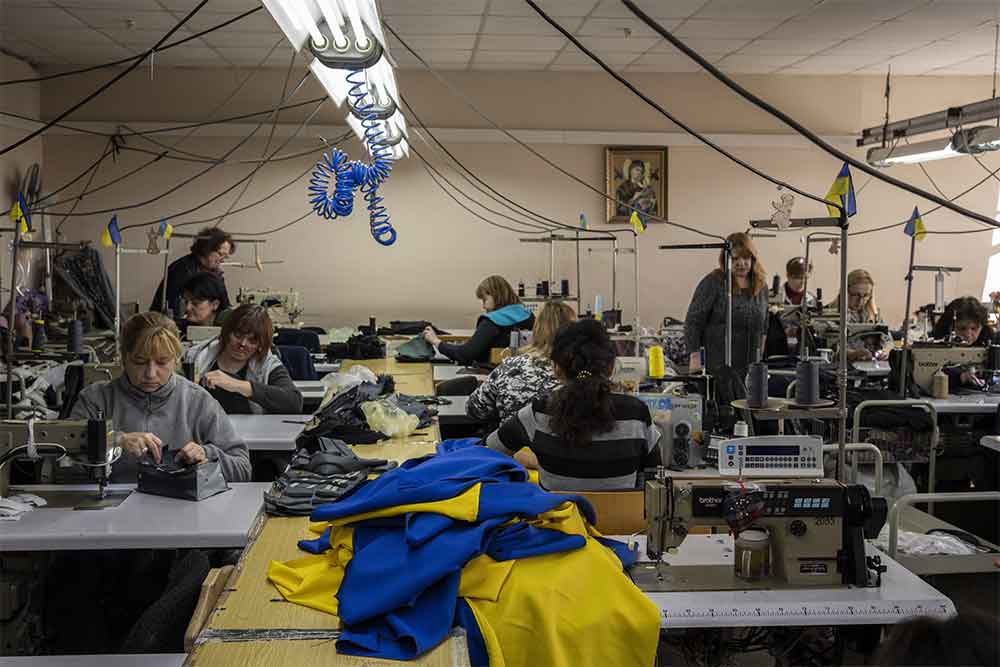
Volunteers sew Ukrainian flags and first aid kits at a workshop in Lviv, western Ukraine, Monday, March 14, 2022. (AP Photo/Bernat Armangue)
by MATT LEIGHNINGER | MARCH 24, 2022 (zocalopublicsquare.org)
This is a new kind of war, waged by a new kind of citizen.
The failure of the Russian forces to subdue Ukraine quickly has astonished experts, officials, and journalists worldwide. It shouldn’t. The Ukrainian resistance is just the latest example of the new attitudes and abilities of 21st century citizens.
While social media has been getting a lot of attention in this “TikTok War,” the real story is the growing determination and capacity of ordinary people. Around the world, ordinary people are fundamentally different from people of generations past. They have dramatically higher levels of education, far less deference to authority figures, and much greater facility with technology.
These trends have changed citizenship itself. We need to understand this shift so that societies, especially democratic ones, can figure out how to adapt, both in war and peace.
The war in Ukraine is instructive, in at least four ways.
First, citizens now have the ability to make their own media; Ukrainians, under attack, are mass-producing reality TV. Thanks to footage produced by thousands of people and viewed by millions, the war has a constantly unfolding cast of characters. Ukrainian farmers towing Russian vehicles, a soldier moonwalking in a field, people joyriding on a captured Russian tank, and a little girl singing “Let It Go” in a Kiev bomb shelter have become relatable, inspiring figures in the conflict. Seemingly every time Ukrainians have success on the battlefield, they upload videos of burned tanks and downed planes.
Perhaps most poignant are the videos of Russian POWs—young, hungry, and confused—being fed by their captors and allowed to call their mothers. These conversations, in which they tell their parents they are OK and aren’t sure why they ended up in a war, may be the best hope for affecting Russian public opinion. The Ukrainian hotline set up for Russians trying to get information on their loved ones on the front lines has also produced heartrending recordings. These videos expose the one thing Putin can’t easily hide: Russian deaths on the battlefield.
All that citizen-made media has been fuel for a second major trend of 21st century citizenship: crowdsourced community organizing.
Nonviolent protests have sprung up around the world, both on the internet and on the streets, including in Russia and in occupied Ukrainian cities. The capacity of citizens to make this civil disobedience visible has rallied millions of others to their cause. People are filming the crowds that slow Russian convoys, and mapping protests around the world in precise geo-located detail, so that others can join in.But the war in Ukraine is revealing how much things have advanced in the last 20 years: the full flowering of a gigantic global network of person-to-person connections; the blurring of the lines between professionals and amateurs; the ability of almost everyone to make their experiences visible and immediate to millions of other people.
This organizing happens rapidly and shows advanced collective thinking. People aren’t simply protesting the war, they are focusing on specific priorities and pressuring Western governments to move on them: singling out Russian oligarchs, denying SWIFT access to Russian banks, banning Russian oil, and shaming international corporations into halting their Russian operations. Community organizers call this “finding winnable issues.” Many of these economic sanctions are unprecedented, and it seems unlikely that Western governments and businesses would have taken all of these drastic steps if not for large-scale public pressure.
In addition to pressuring governments, many citizens are also sidestepping civil society institutions. They are supporting Ukrainians not just through traditional means like donating money to the Red Cross, but by using networks like AirBnB to send money directly to Ukrainian families. This is international aid without institutional intermediaries.
It isn’t just the aid that is do-it-yourself. The warfare is DIY, too.
The contributions of Ukrainian citizens to the war effort includes all generations: grandmothers making Molotov cocktails, mothers brandishing assault rifles, young couples getting married at the front, schoolchildren sewing camouflage nets.
Some of the combatants aren’t even in Ukraine: a small army of hackers is helping to disrupt Russian technologies, interfere with defense communications, and broadcast news about the war to Russian citizens. In an interview with Politico, Ukraine’s deputy digital minister Alex Bornyakov reported that there are 300,000 people worldwide contributing to these efforts.
“We don’t have a chain of command or any structure at all,” Bornyakov said. “So, [Russia] can’t fight it. It’s impossible to disrupt it or break it down. You can’t bomb it or cut off connections or take down a top person—because there is no top person.”
Of course, such warfare isn’t entirely new. For thousands of years ordinary people have taken up scythes and muskets against invading armies; for hundreds of years there have been propaganda campaigns; for decades people have been able to see in real time events happening on the other side of the world.
But the war in Ukraine is revealing how much things have advanced in the last 20 years: the full flowering of a gigantic global network of person-to-person connections; the blurring of the lines between professionals and amateurs; the ability of almost everyone to make their experiences visible and immediate to millions of other people.
Five years ago, the American writer and democracy advocate Eric Liu wrote that “We are in the midst of a profound global Great Push Back against concentrated, monopolized, hoarded power.” Today in Ukraine, we are witnessing not just the decentralization of power—along with knowledge, skill, and authority—but the ability of the “crowd” to wield those decentralized resources in coordinated ways.
The changes in citizen attitudes and capacities are not all positive. Just like previous generations, 21st century citizens can be selfish and unwilling to compromise, saddled with bias and racist assumptions, and fundamentally misinformed. There is no guarantee that the crowd will wield power in ways that are wise, equitable, or just.
But these dangers are unavoidable when people are empowered. And the best way to reckon with them is to seize the related opportunities that this change in citizenship creates for democracy.
We are already seeing what is possible when democratic governments support, inform, and collaborate with 21st century citizens. Countries like Colombia, Iceland, Taiwan, and Brazil have been leaders in democracy innovation: reforms and practices that strengthen relationships between people, give them a meaningful say in decisions, and support their volunteer efforts. Many of these ideas, like participatory budgeting and citizen’s assemblies, create situations where people can learn about an issue, talk with people who have different views, and make decisions together. (Some Ukrainian cities have also been hotbeds of this kind of democratic experimentation.) Others, like crowd-resourcing, inspire and coordinate volunteer efforts to solve public problems.
The desire of citizens to connect, be heard, and get things done seems universal. Even in Russia, the “demand for democratic input” in governance has been on the rise.
Governments should adapt to the shift in citizenship by explaining these potential democracy innovations to their citizens, offering different democracy options and working with citizens to implement them, and measuring their impacts.
Putin’s regime seems more like a criminal institution than a political or military one. And it still may be effective enough to win the war, because of the overwhelming Russian advantage in traditional military resources. But even if the Russian military is victorious on the battlefield, it seems unlikely that the Russians can occupy, let alone govern, Ukraine for long.
Whenever peace comes to Ukraine, and the rest of the world, we need to appreciate the new realities of what citizens want and can do. The greatest hope for democracy, justice, and peace is for leaders and institutions to interact more productively with the people they serve.MATT LEIGHNINGERis the head of democracy innovation at the National Conference on Citizenship, a Congressionally-chartered nonprofit organization dedicated to strengthening civic life in America. He and Tina Nabatchi are the authors of Public Participation for 21st Century Democracy.
Tarot Card for March 25: The Six of Disks
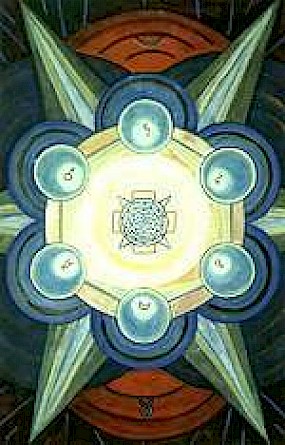
The Six of Disks
The Lord of Success is a card full of the promise of bounty. When we have achieved a degree of inner confidence and self-belief, we release new streams of energy which create a powerful and rewarding reality around ourselves. New ideas are easy to implement. New projects are fruitful. We are energised and enthusiastic about the work we have in hand.
This level of productive harmony comes from a deep-rooted trust in the self. Once we simply allow our power to flow, we find ourselves capable of high levels of success and fulfilment. These things flow naturally as a reward for the hard work we have invested in ourselves.
When the card comes up in a reading to indicate everyday matters, it promises that projects currently in hand will be lucrative and abundant. We will do exactly what we had hoped we might – and probably receive even more than we had hoped for. Financial and material matters will be positive and prosperous, allowing us to gain a stable and comfortable position.
There is often, during a period like this, such good fortune that we end up with more than we actually need. If this happens to you, make sure that you continue to allow money (which is after all only energy) to keep flowing. Use the abundance that comes to you, and be generous with your bounty. Ensure that others benefit appropriately from your abundance. That’s the best way that you can thank the Universe for flowing with you.
(via angelpaths.com and Alan Blackman)
Lucid Dreaming With HughJohn on March 26
|
 |
| LUCID DREAMING Saturday, March 26, 2022, 10:00 AM to 2:00 P.M. Pacific Presented on Zoom We’re all swimming in our subconscious mind when we dream. With Lucid Dreaming, we bring the conscious mind to be aware that we’re dreaming (while we’re in the subconscious mind) and amazing things can happen. Come to class and learn the process of becoming a Lucid Dreamer. Releasing the power of your Dreams • Accelerate your Personal Growth • Understand the route to your conscious evolving • Solve Problems • Realize those “not so secret” messages in your unconscious mind. • Gain ideas to help in waking life • Turn up your creativity • Learn to interpret your dreams • Practice methods to remember dreams • Review of the Latest scientific information on sleep, dreaming and health What you’ll receive with the Class • 4 hour class delivered via an online webinar. • Class Notes • Workshop • Invitation to weekly Dream Group • Dream interpretation session with HughJohn Class Fees: New to Class $ 50.00 Review 25.00 After registering you will be sent a Zoom meeting link to join. Looking forward to seeing you in class Call 310-899-9453 or email hughjohnm@gmail.com Register NOW |
The Origins of Gnosticism | Richard Smoley
Theosophical Society Scholars have long wondered about the origins of the Gnostic movement in early Christianity, but have come to no clear conclusions. In this groundbreaking lecture, Richard Smoley, author of “”Forbidden Faith: The Secret History of Gnosticism,”” presents a radical new theory. He argues that Gnosticism arose out of the failure of apocalyptic expectations in early Christianity: the first Christians believed that the end of the world was coming soon, but it did not. Gnosticism arose out of this disappointment. Richard also explains the basics of Gnosticism. Take this opportunity to hear his bold new thesis. Richard Smoley is the author of twelve books on spirituality, philosophy, and religion. His latest book, “”Introduction to the Occult,”” was published in January 2022 by GD Media. Richard’s book A Theology of Love: Reimagining Christianity through “A Course in Miracles” was published in November 2019 by Inner Traditions International. His other works include Inner Christianity: A Guide to the Esoteric Tradition; Supernatural: Writings on an Unknown History; The Dice Game of Shiva: How Consciousness Creates the Universe: Conscious Love: Insights from Mystical Christianity; The Essential Nostradamus; and Hidden Wisdom: A Guide to the Western Inner Traditions (with Jay Kinney). Formerly editor of Gnosis: A Journal of the Western Inner Traditions, Richard lectures nationwide and has been featured on many online videos. Richard is also editor of Quest: Journal of the Theosophical Society in America. His website is innerchristianity.com. Buy Forbidden Faith: The Secret History of Gnosticism: https://amzn.to/3BM1nd2 Watch more lectures on Christianity & Western Spirituality: https://www.youtube.com/playlist?list…