Freud’s discovery that the dream is the means by which the unconscious can be explored is undoubtedly the most revolutionary step forward in the entire history of psychology. Dreams, according to his theory, represent the hidden fulfillment of our unconscious wishes.
The Marriage of Heaven and Hell is a book by the English poet and printmaker William Blake. It is a series of texts written in imitation of biblical prophecy but expressing Blake’s own intensely personal Romantic and revolutionary beliefs. Like his other books, it was published as printed sheets from etched plates containing prose, poetry, and illustrations. The plates were then coloured by Blake and his wife Catherine.
It opens with an introduction of a short poem entitled “Rintrah roars and shakes his fires in the burden’d air”.
William Blake claims that John Milton was a true poet and his epic poem Paradise Lost was “of the Devil’s party without knowing it.” He also claims that Milton’s Satan was truly his Messiah.[2]
The work was composed between 1790 and 1793, in the period of radical ferment and political conflict during the French Revolution. The title is an ironic reference to Emanuel Swedenborg‘s theological work Heaven and Hell, published in Latin 33 years earlier. Swedenborg is directly cited and criticized by Blake in several places in the Marriage. Though Blake was influenced by his grand and mystical cosmic conception, Swedenborg’s conventional moral strictures and his Manichaean view of good and evil led Blake to express a deliberately depolarized and unified vision of the cosmos in which the material world and physical desire are equally part of the divine order; hence, a marriage of heaven and hell. The book is written in prose, except for the opening “Argument” and the “Song of Liberty”. The book describes the poet’s visit to Hell, a device adopted by Blake from Dante‘s Divine Comedy and Milton’s Paradise Lost.
Proverbs of Hell
Plate from Marriage of Heaven and Hell, depicting Nebuchadnezzar.
Unlike those of Milton and Dante, Blake’s conception of Hell begins not as a place of punishment, but as a source of unrepressed, somewhat Dionysian energy, opposed to the authoritarian and regulated perception of Heaven. Blake’s purpose is to create what he called a “memorable fancy” in order to reveal the repressive nature of conventional morality and institutional religion, which he describes thus:
The ancient Poets animated all sensible objects with Gods or Geniuses, calling them by the names and adorning them with the properties of woods, rivers, mountains, lakes, cities, nations, and whatever their enlarged & numerous senses could perceive.
And particularly they studied the genius of each city & country, placing it under its mental deity.
Till a system was formed, which some took advantage of & enslav’d the vulgar by attempting to realize or abstract the mental deities from their objects: thus began Priesthood.
Choosing forms of worship from poetic tales.
And at length they pronounced that the Gods had orderd such things.
Thus men forgot that All deities reside in the human breast.[3]— Plate 11
In the most famous part of the book, Blake reveals the Proverbs of Hell. These display a very different kind of wisdom from the Biblical Book of Proverbs. The diabolical proverbs are provocative and paradoxical. Their purpose is to energise thought. Several of Blake’s proverbs have become famous:
The road of excess leads to the palace of wisdom.[4]— ”Proverbs of Hell” line 3 (Plate 7)
The tygers of wrath are wiser than the horses of instruction[5]— ”Proverbs of Hell” line 44 (Plate 9)
Blake explains that,
Without Contraries is no progression. Attraction and Repulsion, Reason and Energy, Love and Hate, are necessary to Human existence.
From these contraries spring what the religious call Good & Evil. Good is the passive that obeys Reason. Evil is the active springing from Energy.
Blake’s theory of contraries was not a belief in opposites but rather a belief that each person reflects the contrary nature of God, and that progression in life is impossible without contraries. Moreover, he explores the contrary nature of reason and of energy, believing that two types of people existed: the “energetic creators” and the “rational organizers”, or, as he calls them in The Marriage of Heaven and Hell, the “devils” and “angels”. Both are necessary to life according to Blake.[7]
Blake’s text has been interpreted in many ways. It certainly forms part of the revolutionary culture of the period. The references to the printing-house suggest the underground radical printers producing revolutionary pamphlets at the time. Ink-blackened printworkers were comically referred to as a “printer’s devil“, and revolutionary publications were regularly denounced from the pulpits as the work of the devil.
Doors of Perception
The book includes “If the doors of perception were cleansed every thing would appear to man as it is, Infinite. For man has closed himself up, till he sees all things thro’ narrow chinks of his cavern”.[8] This has similarities with Huxley‘s concept of “Mind at Large“.
Influence
The Marriage of Heaven and Hell is probably the most influential of Blake’s works.[citation needed] Its vision of a dynamic relationship between a stable “Heaven” and an energized “Hell” has fascinated theologians, aestheticians and psychologists.
Aldous Huxley took the name of one of his most famous works, The Doors of Perception, from this work. The Doors of Perception, in turn, inspired the name of the American rock band The Doors.[9] Huxley’s contemporary C. S. Lewis wrote The Great Divorce about the divorce of Heaven and Hell, in response to Blake’s Marriage.
An allusion from The Marriage of Heaven and Hell, depicting Aristotle’s skeleton, is present in Wallace Stevens‘s poem “Less and Less Human, O Savage Spirit”.
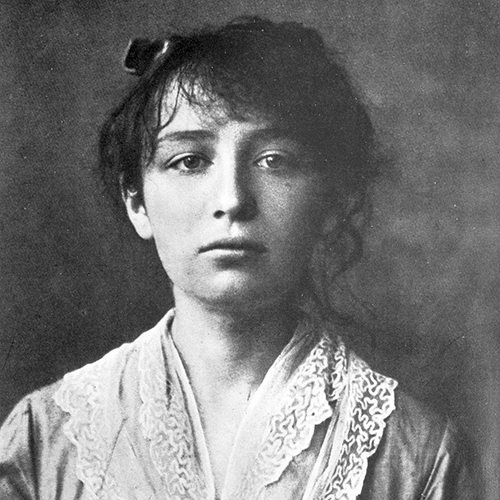
Camille Rosalie Claudel (French pronunciation: [kamij klodɛl] (listen); 8 December 1864 – 19 October 1943) was a French sculptor known for her figurative works in bronze and marble. She died in relative obscurity, but later gained recognition for the originality and quality of her work.[1][2] The subject of several biographies and films, Claudel is well known for her sculptures including The Waltz and The Mature Age.[3]
Camille Claudel was born in Fère-en-Tardenois, Aisne,[6] in northern France, the first child of a family of farmers and gentry. Her father, Louis-Prosper Claudel, dealt in mortgages and bank transactions. Her mother, the former Louise-Athanaïse Cécile Cerveaux, came from a Champagne family of Catholic farmers and priests. The family moved to Villeneuve-sur-Fère while Camille was still a baby. Her younger brother Paul Claudel was born there in 1868. Subsequently, they moved to Bar-le-Duc (1870), Nogent-sur-Seine (1876), and Wassy-sur-Blaise (1879), although they continued to spend summers in Villeneuve-sur-Fère, and the stark landscape of that region made a deep impression on the children.
From the ages of 5 to 12, Claudel was educated by the Sisters of Christian Doctrine.[7] While living in Nogent-sur-Seine at age 12, Claudel began working with the local clay, regularly sculpting the human form.[3][8]
As Camille grew older, she enriched her artistic education with literature and old engravings.[9]
Her mother Louise did not approve of Claudel’s “unladylike desire to become an artist.”[3] Her father was more supportive and took examples of her artwork to their artist neighbor Alfred Boucher, to assess her abilities.[8] Boucher confirmed that Claudel was a capable, talented artist and encouraged her family to support her study of sculpture.[10][8] Camille moved with her mother, brother, and younger sister to the Montparnasse area of Paris in 1881. Her father remained behind, working to support them.[10]
Creative period
Study with Alfred Boucher
Claudel was fascinated with stone and soil as a child, and as a young woman she studied at the Académie Colarossi, one of the few places open to female students.[11] Once in Paris, she studied with sculptor Alfred Boucher.[12] The Académie Colarossi was more progressive than other arts institutions in that it not only allowed female students at the school but also permitted them to work from nude male models.[10] At the time, the École des Beaux-Arts barred women from enrolling to study.Camille Claudel (left) and sculptor Jessie Lipscomb in their Paris studio in the mid-1880s
In 1882, Claudel rented a studio workshop on rue Notre-Dames des Champs in Paris that she shared with three British sculptors: Jessie Lipscomb, Emily Fawcett and Amy Singer (daughter of John Webb Singer, whose foundry in Frome, Somerset, made large-scale bronze statues.) Several prominent Frome works are in London, including the Boadicea group on the Embankment, Cromwell, which graces the lawn in front of the Houses of Parliament, and the figure of Justice atop the Old Bailey. General Gordon on his camel at Chatham Barracks was also cast in Frome, as were the eight lions that form part of the Rhodes Memorial in Cape Town. Claudel visited Frome and the families of her fellow sculptors. All of these English friends had studied at the South Kensington Schools – that would become the Royal College of Art – before moving to Paris to be at the Academie Colarossi, where they had all met. Claudel prolonged her stay with Singer’s family in Frome.[13]
Alfred Boucher had become Claudel’s mentor, and provided inspiration and encouragement to the next generation of sculptors such as Laure Coutan. Claudel was depicted by Boucher in Camille Claudel lisant,[14] and later she sculpted a bust of her mentor.
After teaching Claudel and the other sculptors for over three years, Boucher moved to Florence following an award for the Grand Prix du Salon. Before he left he asked Auguste Rodin to take over the instruction of his pupils. Rodin and Claudel met, and their artistic association and the tumultuous and passionate relationship soon began.
Auguste Rodin
Claudel started working in Rodin’s workshop in 1883[10] and became a source of inspiration for him. She acted as his model, his confidante, and his lover. She never lived with Rodin, who was reluctant to end his 20-year relationship with Rose Beuret.
Knowledge of the affair agitated her family, especially her mother, who already detested her for not being a boy and never approved of Claudel’s involvement in the arts.[15][16][17] As a consequence, Claudel was forced to leave the family home.[10]
In 1891, Claudel served as a jurist at the National Society of Fine Arts, reported to be “something of a boys’ club at the time.”[18]
In 1892, after an abortion, Claudel ended the intimate aspect of her relationship with Rodin, although they saw each other regularly until 1898.[19]
Le Cornec and Pollock state that after the sculptors’ physical relationship ended, she was not able to get the funding to realise many of her daring ideas – because of sex-based censorship and the sexual element of her work. Claudel thus had to either depend on Rodin, or to collaborate with him and see him get the credit as the lionised figure of French sculpture. She also depended on him financially, especially after her loving and wealthy father’s death, which allowed her mother and brother, who disapproved of her lifestyle, to maintain control of the family fortune and leave her to wander the streets dressed in beggars’ clothing.[20]
Claudel’s reputation survived not because of her once notorious association with Rodin, but because of her work. The novelist and art critic Octave Mirbeau described her as “A revolt against nature: a woman genius.”[21] Her early work is similar to Rodin’s in spirit but shows imagination and lyricism quite her own, particularly in the famous The Waltz (1893).The Waltz, conceived in 1889 and cast in 1905
Louis Vauxcelles states that Claudel was the only sculptress on whose forehead shone the sign of genius like Berthe Morisot, the only well-known female painter of the century, and that Claudel’s style was more virile than many of her male colleagues’. Others, like Morhardt and Caranfa, concurred, saying that their styles had become so different, with Rodin being more suave and delicate and Claudel being vehement with vigorous contrasts, which might have been one reason for their break up, with her becoming ultimately his rival.[22][full citation needed][23][24]
Claudel’s onyx and bronze small-scale La Vague (The Wave) (1897) was a conscious break in style from her Rodin period. It has a decorative quality quite different from the “heroic” feeling of her earlier work.
The Mature Age and other works
The Mature Age, 1913 bronze casting in the Claudel room at the Musée Rodin in Paris. (The figure standing behind, ensnared in her own hair, is Clotho, 1893)
After Rodin saw Claudel’s The Mature Age for the first time, in 1899, he reacted with shock and anger. He suddenly and completely stopped his support for Claudel. According to Ayral-Clause, Rodin might have put pressure on the ministry of fine arts to cancel the funding for the bronze commission.
The Mature Age (1900) is usually interpreted as an allegory of the three stages of life: the man who represents Maturity is drawn into the hands of the old woman who represents Old Age and Death, while the young woman who represents Youth tries to save him.[25][26] Her brother interpreted it as an allegory of her break with Rodin. Angelo Caranfa comments that “The life that was, is, and will be in Maturity contains within its movement both the relentless movement of Clotho and the rhythmic, graceful, whirling movement of Fortune, generating a single and sustaining movement or image out of the differences within” .[27] According to Caranfa, Clotho (1893) and Fortune (1905) represent the two ideas of life: life in Clotho is portrayed as closed, hopeless existence and “consummated in an unending death”; life in Fortune is celebrated as the madness of eternal present with ups and downs, its “rapture or total harmony” (Fortune itself is a variation of the dancing woman in The Waltz).[28][27]
One of Claudel’s figures, The Implorer, was produced as an edition of its own and has been interpreted not as purely autobiographical but as an even more powerful representation of change and purpose in the human condition.[29] Modelled for in 1898 and cast in 1905, Claudel didn’t actually cast her own bronze for this work, but instead The Implorer was cast in Paris by Eugene Blot.[30]
Sakuntala, 1888, is described by Angelo Caranfa as expressing Claudel’s desire to reach the sacred, the fruit of the lifelong search of her artistic identity, free from Rodin’s constraints. Caranfa suggests that Claudel’s impressions of Rodin’s deceptions and exploitation of her, as someone who could not become obedient as he wanted her to be and who was expected to conform to society’s expectation of what women should be, were not false. Thus Sakuntala could be called a clear expression of her solitary existence and her inner search, her journey within.[31]La Vague (“The Wave”) (1897), exhibited in the Claudel room of the Musée Rodin
Ayral-Clause says that even though Rodin clearly signed some of her works, he was not treating her as different because of her gender; artists at this time generally signed their apprentices’ work.[32] Others also criticise Rodin for not giving her the acknowledgment or support she deserved.[33][34] Walker argues that most historians believe Rodin did what he could to help her after their separation, and that her destruction of her own oeuvre was partly responsible for the long-time neglect the art world showed her. Walker also says that what truly defeated Camille, who was already recognised as a leading sculptor by many, were the sheer difficulties of the medium and the market: sculpting was an expensive art, and she did not receive many official commissions because her style was highly unusual for the contemporary conservative tastes.[35] Despite this, Le Cornec and Pollock believe she changed the history of arts.Head of Camille Claudel, 1884, by Auguste Rodin, portrays Claudel wearing a Phrygian cap, on exhibit at the Museo SoumayaClaudel’s Bust of Rodin (1888-89), in the Musée Rodin
Other authors write that it is still unclear how much Rodin influenced Claudel – and vice versa, how much credit has been taken away from her, or how much he was responsible for her woes. Most modern authors agree that she was an outstanding genius who, starting with wealth, beauty, iron will and a brilliant future even before meeting Rodin, was never rewarded and died in loneliness, poverty, and obscurity.[1][2][36][37][self-published source?][38] Others like Elsen, Matthews and Flemming suggest it was not Rodin, but her brother Paul who was jealous of her genius, and that he conspired with her mother, who never forgave her for her supposed immorality, to later ruin her and keep her confined to a mental hospital.[39][40][41][full citation needed][42] Kavaler-Adler notes that her younger sister Louise, who desired Camille’s inheritance and was also jealous of her, was delighted at her sister’s downfall.[43]
Less well known than her love affair with Rodin, the nature of her relationship with Claude Debussy has also been the object of much speculation. Stephen Barr reports that Debussy pursued her: it was unknown whether they ever became lovers.[44] They both admired Degas and Hokusai, and shared an interest in childhood and death themes.[45] When Claudel ended the relationship, Debussy wrote: “I weep for the disappearance of the Dream of this Dream.” Debussy admired her as a great artist and kept a copy of The Waltz in his studio until his death. By thirty, Claudel’s romantic life had ended.[46][47]
Alleged illness and confinement
After 1905 Claudel appeared to be mentally ill. She destroyed many of her statues, disappeared for long periods of time, exhibited signs of paranoia and was diagnosed as having schizophrenia.[48] She accused Rodin of stealing her ideas and of leading a conspiracy to kill her.[49]
After the wedding of her brother in 1906 and his return to China, she lived secluded in her workshop.[48][49]Paul Claudel aged sixteen by Camille Claudel, modeled in 1884 and cast in 1893, Musée des Augustins, Toulouse
Claudel’s father approved of her career choice, and he tried to help and support her financially. But when he died on 2 March 1913, Claudel was not informed of his death. Instead, eight days later, on 10 March 1913, at the request of her younger brother Paul, she was admitted to the psychiatric hospital of Ville-Évrard in Neuilly-sur-Marne.
The form read that she had been “voluntarily” committed, although her admission was signed only by a doctor and her brother. There are records to show that, while she did have mental outbursts,[clarification needed] she was clear-headed while working on her art. Doctors tried to convince Paul and their mother that Claudel did not need to be in the institution, but they still kept her there.[50] According to Cécile Bertran, a curator from the Musée Camille Claudel, the situation was not easy to judge, because modern experts who have looked at her records say she was indeed ill.[8]
In 1914, to be safe from advancing German troops, the patients at Ville-Évrard were at first relocated to Enghien. On 7 September 1914 Claudel was transferred with a number of other women, to the Montdevergues Asylum, at Montfavet, six kilometres from Avignon. Her certificate of admittance to Montdevergues was signed on 22 September 1914; it reported that she suffered “from a systematic persecution delirium mostly based upon false interpretations and imagination”.[51]
For a while, the press accused her family of committing a sculptor of genius. Her mother forbade her to receive mail from anyone other than her brother. The hospital staff regularly proposed to her family that Claudel be released, but her mother adamantly refused each time.[50] On 1 June 1920, physician Dr. Brunet sent a letter advising her mother to try to reintegrate her daughter into the family environment. Nothing came of this.Paul Claudel in 1927
Paul Claudel visited his confined older sister seven times in 30 years, in 1913, 1920, 1925, 1927, 1933, 1936, and 1943. He always referred to her in the past tense. Their sister Louise visited her just one time in 1929. Her mother, who died in June 1929, never visited Claudel.[52]
In 1929 sculptor and Claudel’s former friend Jessie Lipscomb visited her, and afterwards insisted “it was not true” that Claudel was insane. Rodin’s friend, Mathias Morhardt, insisted that Paul was a “simpleton” who had “shut away” his sister of genius.[53]
Camille Claudel died on 19 October 1943, after having lived 30 years in the asylum at Montfavet (known then as the Asile de Montdevergues, now the modern psychiatric hospital Centre hospitalier de Montfavet). Her brother Paul had been informed of his sister’s terminal illness in September and, with some difficulty, had crossed Occupied France to see her, although he was not present at her death or funeral.[54] Her sister did not make the journey to Montfavet.
Claudel was interred in the cemetery of Montfavet, and eventually her remains were buried in a communal grave at the asylum.[50][51] From the 2002 book, Camille Claudel, A Life: “Ten years after her death, Camille’s bones had been transferred to a communal grave, where they were mixed with the bones of the most destitute. Joined forever to the ground she tried to escape for so long, Camille never, ever, returned to her beloved Villeneuve. Paul’s neglect regarding his sister’s grave is hard to forgive…while Paul decided not to be burdened with his sister’s grave, he took great pains, on the contrary, in choosing his own final resting place, naming the exact location – in Brangues, under a tree, next to his grandchild – and citing the precise words to be written on the stone. Today his admirers pay homage to his memory at his noble grave; but of Camille there is not a trace. In Villeneuve, a simple plaque reminds the curious visitor that Camille Claudel once lived there, but her remains are still in exile, somewhere, just a few steps away from the place where she was sequestered for thirty years.”[55]
The Musée Camille Claudel was opened in March, 2017, as a French national museum dedicated to Claudel’s work. It is located in her teenage home town of Nogent-sur-Seine.[56] The Musée Camille Claudel displays approximately half of Claudel’s 90 surviving works.[57][58]
Plans to turn the Claudel family home at Nogent-sur-Seine into a museum were announced in 2003, and the museum negotiated with the Claudel family to buy Camille’s works. These include 70 pieces, including a bust of Rodin.[59]
Though she destroyed much of her work, about 90 statues, sketches and drawings survive. She was at first censored as she portrayed sexuality in her work. Her response was a symbolic, intellectual style as opposed to the “expressive” approach normally attributed to women artists.[60]
In 1951, Paul Claudel organised an exhibition at the Musée Rodin, which continues to display her sculptures. A large exhibition of her works was organised in 1984. In 2005 a large art display featuring the works of Rodin and Claudel was exhibited in Quebec City (Canada), and Detroit, Michigan, in the US. In 2008, the Musée Rodin organised a retrospective exhibition including more than 80 of her works.
The publication of several biographies in the 1980s sparked a resurgence of interest in her work.
Composer Jeremy Beck‘s Death of a Little Girl with Doves (1998), an operatic soliloquy for soprano and orchestra, is based on the life and letters of Camille Claudel. This composition has been recorded by Rayanne Dupuis, soprano, with the Slovak Radio Symphony Orchestra.[65] Beck’s composition has been described as “a deeply attractive and touching piece of writing … [demonstrating] imperious melodic confidence, fluent emotional command and yielding tenderness.”[66]
Seattle playwright S.P. Miskowski’s La Valse (2000) is a well-researched look at Claudel’s life.[67][68]
Composer Frank Wildhorn and lyricist Nan Knighton’s musical Camille Claudel was produced by Goodspeed Musicals at The Norma Terris Theatre in Chester, Connecticut in 2003.[69]
In 2005, Sotheby’s sold a second edition La Valse (1905, Blot, number 21) for $932,500.[70] In a 2009 Paris auction, Claudel’s Le Dieu Envolé (1894/1998, foundry Valsuani, signed and numbered 6/8) had a high estimate of $180,000,[71] while a comparable Rodin sculpture, L’éternelle Idole (1889/1930, Rudier, signed) had a high estimate of $75,000.[72]
In 2011, the world premiere of Boris Eifman‘s new ballet Rodin took place in St Petersburg, Russia. The ballet is dedicated to the life and creative work sculptor Auguste Rodin and his apprentice, lover and muse, Camille Claudel.[73]
In 2012, the world premiere of the play Camille Claudel took place. Written, performed and directed by Gaël Le Cornec, premiered at the Pleasance Courtyard Edinburgh Festival, the play looks at the relationship of master and muse from the perspective of Camille at different stages in her life.[74]
In 2014, the Columbus Dance Theatre and the Carpe Diem String Quartet performed the premiere of Claudel, with music by Korine Fujiwara, original poetry by Kathleen Kirk, and choreography by Tim Veach.[75]
In 2019, to mark the 155th anniversary of Claudel’s birth, Google released a Google Doodle commemorating her.[76]
Luciano Pavarotti, The John Alldis Choir, Wandsworth School Boys Choir, London Philharmonic Orchestra, Zubin Mehta
Album
“Nessun dorma!”
Writers
Giuseppe Adami, Renato Simoni, Franco Alfano, Giacomo Puccini
Licensed to YouTube by
UMG (on behalf of Decca Music Group Ltd.); LatinAutor – UMPG, LatinAutor, Kobalt Music Publishing, AMRA, UNIAO BRASILEIRA DE EDITORAS DE MUSICA – UBEM, UMPI, Public Domain Compositions, União Brasileira de Compositores, BMI – Broadcast Music Inc., LatinAutorPerf, Polaris Hub AB, Sony ATV Publishing, and 11 Music Rights Societies
Andrea Bocelli, Academy Of Choir Art Of Russia, Moscow Radio Symphony Orchestra, Vladimir Fedoseyev
Album
“Nessun dorma!”
Writers
Giuseppe Adami, Renato Simoni, Franco Alfano, Giacomo Puccini
Licensed to YouTube by
UMG (on behalf of Universal Music Group International); LatinAutor, BMI – Broadcast Music Inc., Public Domain Compositions, Sony ATV Publishing, UNIAO BRASILEIRA DE EDITORAS DE MUSICA – UBEM, Kobalt Music Publishing, LatinAutor – UMPG, União Brasileira de Compositores, LatinAutorPerf, and 12 Music Rights Societies
Wendy Cicchetti | Twixt Earth and Sky Find out why March energies are so stressful and how to navigate them. Also more reported ascension symptoms. CONNECT WITH WENDY- ASTROLOGICAL and AKASHIC SESSIONS and SPIRITUAL COACHING: https://bit.ly/3jQU3Fn – – – – – – – – – – – – – – – – – – – – – – – – – – – – – – Sheri Pettoni’s marketing services: spettoni@inneractstrategies.com Wendy Cicchetti is an internationally known astrologer with over 25 years of experience blessing the lives of thousands of people worldwide. GET SOCIAL WITH US! INSTAGRAM: https://www.instagram.com/wendy_cicch… FACEBOOK: https://www.facebook.com/WendyCicchetti
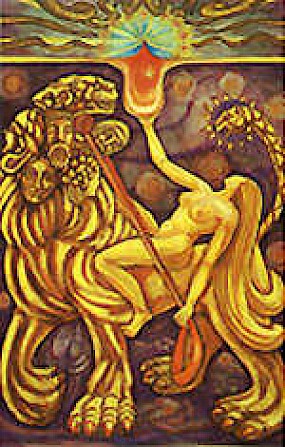
Lust (or Strength, Fortitude, Lust for Life) is numbered eleven and is a card of spontaneity and enthusiasm. This is the card which gives us the strength and nourishment we need to get through.
We usually see a young innocent girl opening the jaws of a lion and peering in. She must be reasonably certain she can cope with the results of her actions! There is no sense of competition between the two. Here we see the literal meaning of the card – walking straight into the jaws of danger and relying upon our own experiences and quick-wittedness to see us through.
Lust tells us to joyously accept life – to trust ourselves to make the right choices and to be able to deal with whatever happens. With trust and self-belief we can grow and work towards happiness and fulfilment.
(via angelpaths.com and Alan Blackman)
Consciousness, spirituality, biography, sexuality, androgyny, futurism, space, the arts, science, astrology, democracy, humor, books, movies and more



_(4921654776).jpg)


_(8026456955).jpg)


_(43980921631).jpg)
