
scienceandnonduality https://www.scienceandnonduality.com This panel discussion features Bonnie Greenwell, Vera de Chalambert and Ted Esser, moderated by Julie Yau. It addresses the mystery and myriad expressions of kundalini energy. Kundalini is reframed as the energetic component of spiritual awakening, as a natural part of the human journey. Surprises and difficulties that may arise during the appearance of this energy are acknowledged, and resources listed for help in understanding and safely navigating its expression. For more information visit http://www.kundaliniguide.com and http://www.spiritualemergence.org Science And NonDuality is a community inspired by timeless wisdom, informed by cutting-edge science, and grounded in personal experience. We come together in an openhearted exploration to further our individual and collective evolution. New ways of being emerge. We embody our interconnectedness and celebrate our humanity.
Monthly Archives: February 2022
Superhuman: The Invisible Made Visible (subtitulada al español)
New Thinking Allowed with Jeffrey Mishlove Caroline Cory is a filmmaker, author, teacher, and healer. Her most recent film is Superhuman: From the Invisible to the Visible. Other films include E.T. Contact: They Are Here, I Am The Universe/I Am Love, and Among Us. Her books include Holy Crocodile: Stories of Saints and the Animals Who Helped Them, The Visible and Invisible Worlds of God, God Among Us: Inside the Mind of Divine Masters, and The Divine Plan: Now and Beyond 2250. Her website is https://www.omniumuniverse.com/. Here she explains that, since early childhood, she has experienced beings of light as well as energy patterns around people. This led her to search for both answers and practical applications. Her new film, Superhuman, which premiers on July 14, 2020, offers a synthesis of scientific and philosophical interpretations — as well as on-camera practical demonstrations of extrasensory perception and psychokinesis. This documentary can be ordered at https://www.superhumanfilm.com/. New Thinking Allowed host, Jeffrey Mishlove, PhD, is author of The Roots of Consciousness, Psi Development Systems, and The PK Man. Between 1986 and 2002 he hosted and co-produced the original Thinking Allowed public television series. He is the recipient of the only doctoral diploma in “parapsychology” ever awarded by an accredited university (University of California, Berkeley, 1980). (Recorded on July 4, 2020)
Why Truth Died and Nothing Matters Anymore
Our Societies are Dying Because Truth Did
umair haque · Feb 17 · Medium.com
I read recently that people are selling their kidneys. Not because they want to. To feed their starving kids. Which people? It shouldn’t matter, should it? Later, I’ll tell you who.
Nobody should have to do that. Stop and think about that for a second. Think about being so desperate you sell your kidney to feed your kid because otherwise, they’ll starve. Think about the cold terror in your stomach. Your veins turning to ice. Think about the way your kid smiles.
It’s a vivid example of a trend that bears thinking about. One which reflects a dark age. Nothing matters. We should — all of us, I mean — care about people who must sell their kidneys to feed their kids. But we don’t. We, the big we, care about…superhero movies…more than that. I’m not kidding. The average person in our societies literally cares more about…another Batman movie…another Marvel Avengers part 74…than people selling their organs to feed their starving kids. And worse, funnily, if you challenge them, they’ll fight you. The World Really Needs Another Batman Movie!!
Something is very, very wrong with our societies. They are sick now. They have been infected by a virus, and it’s not (just) Covid. Nothing matters anymore. Nothing real. Nothing urgent, true, decent, sane. Batman movies matter more than anything — anything — vaguely real.
And that’s putting it kindly, because it only gets worse from there. Batman movies are innocuous. They’re not harmful, just dumb. Adults watching superhero movies is a literal example of infantile narcissistic regression. And it’s an understandable one when the world is burning up and collapsing into fascism. Hello, adults, the world does not need another Batman movie, and Batman isn’t coming to save us.
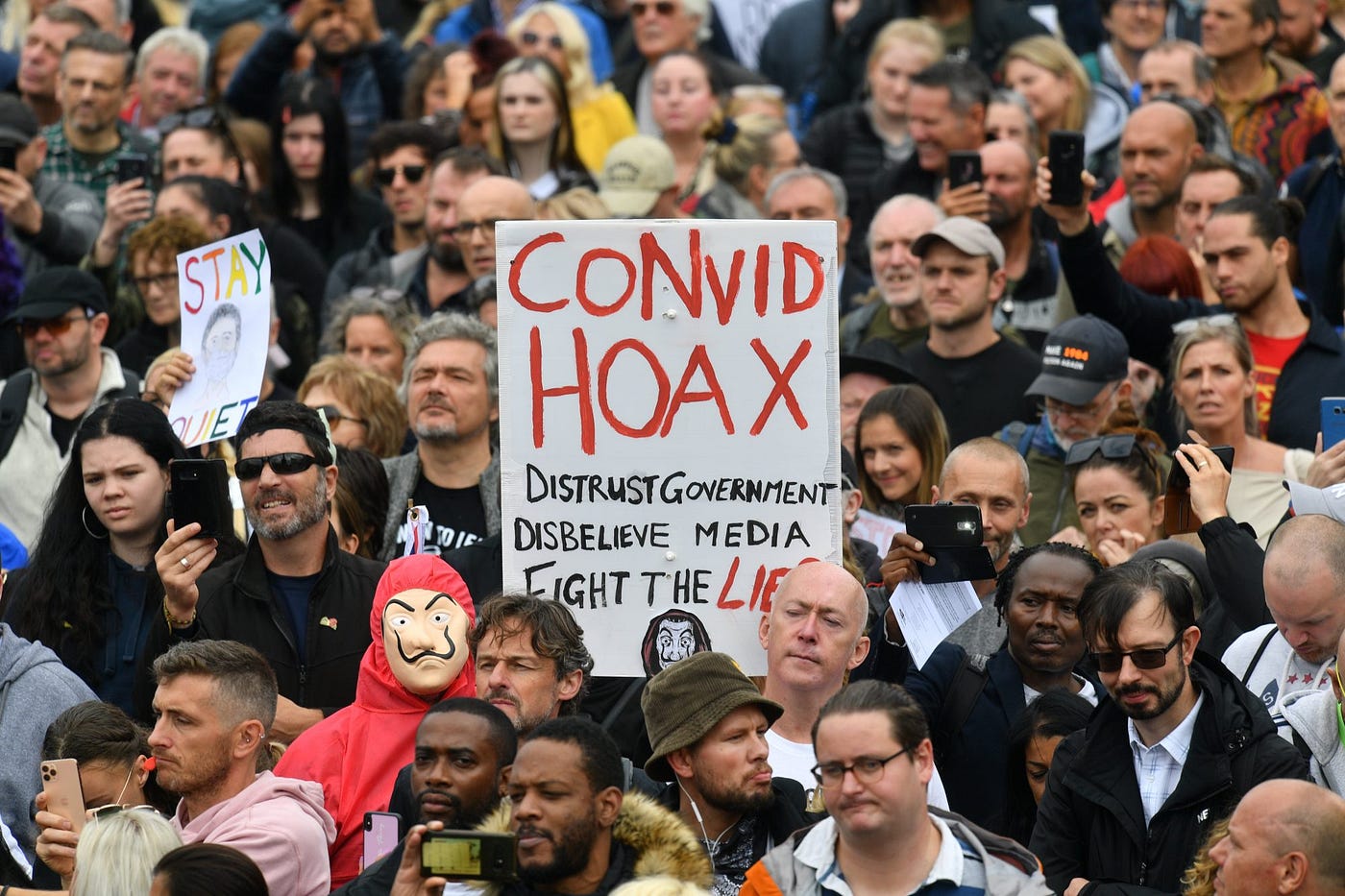
But nothing mattering — nothing except my own infantile narcissistic regression to tantrums, rage, defensiveness, glee, fury — takes much worse forms. Anti vaxxing. Covid denial. Climate change denial. Nationalism and extremism. The outright fascism rising across the globe.
The death of the truth goes by another name, too — the Age of the Big Lie. They’re two ways of saying the same thing. A Big Lie is a dead truth. And so to really understand this age of Big Lies, the question that needs to be asked is this: why and how did truth die? Why does nothing matter anymore?
The death of truth is a virus now spreading around the world. It’s an “infodemic,” as Maria Van Kerkhove very incisively pointed out. It began in America — and yet it’s spreading even to countries once rich in truth, like Canada, France, Germany, Britain, and beyond.
The truth dying and nothing mattering is a global issue. An urgent one, because quite obviously, we can hardly solve our bigger problems, from pandemic to climate change, when nothing real or urgent or serious matters, and the average person cares more about superhero movies than people selling their kidneys to feed their kids, the planet melting down, the mass extinction of life on earth (which, yes, is really happening), widespread political destabilization, simmering social implosion, Covid mutating into something worse, or any multitude of existential threats humanity now faces.
How did we get here, to this awful and dire place where nothing matters?
The finger’s often pointed at social media. That amplifies untruths, yes. But the etiology of this illness — the death of truth, the rise of nothing mattering — goes deeper than that. The pathogenesis of this virus began in America, and then spread worldwide, and while social media is a necessary condition for it, a proximal cause, it’s not the ultimate cause.
I stopped reading American newspapers around 2010. By then, I’d realised that they had nothing much to say that was true. I don’t mean to malign good journalists — I mean that in a slightly different way. They barely bothered to cover serious and urgent issues, especially global ones. And something even more disturbing was true. Their pundits were always wrong. So I stopped reading those — and kept reading papers and journalism from around the world instead. My brain was much better for it.
These days, I check American newspapers — only for perverse reasons. To chuckle. What are the pundits wrong about today? I can give you endless examples. David Leonhardt from the New York Times has pronounced Covid “in retreat” what…five times? He doesn’t even bother to change the words. Surprising? Hardly, from a newspaper whose columnists include a climate change denier, and a youngish man who essentially proposed women should be forced into sexual slavery.
You can see why I thought American culture is bad for my brain. This is America’s most “renowned” newspaper. And it’s pundits are always wrong. Always. It’s almost a rule at this point. With maybe the exception of Paul Krugman, you could make a fortune betting against what these jokers have to say. That sounds harsh, but think about it.
If your doctor was always wrong…you’d get a new doctor. If your accountant was wrong, you’d go broke, and sue him. But America’s pundits have been wrong for decades. And there they are, still being wrong. About everything from Covid to climate change.
It’s a little amazing. Let me come to the point.
When the death of truth is examined in a little more detail, it should become apparent that truth stopped mattering a long time ago. And the first culpable party in this mega trend of the death of truth are pundits. They are serially wrong. And yet they never, ever face any consequences. Take Leonhardt. You’d think he’d at least apologise, for getting it wrong, for literally saying Covid was the flu. But he’s, I guess, shameless. The New York Times isn’t interested in correcting this shoddy take. And it’s the best America has. It gets worse from there. So if the “real” newspapers are that bad, how much worse is Fox allowed to be? You see my point, perhaps.
Americans don’t quite understand that punditry is a uniquely American invention. It isn’t like this in most of the rest of the world — or at least it didn’t used to be. America invented these figures called “pundits.” They have no real experience or credentials. They are fake public intellectuals. In the rest of the world, at least once upon a time until not so long ago, there weren’t “pundits,” there were actual public intellectuals. People with boatloads of degrees who’d studied subjects intensely and intently, academics, professors, artists, scientists, thinkers of a serious and studied calibre.
The pundit is completely different from such a figure. Pundits don’t have advanced degrees, they haven’t studied the subjects they opine on, they have no real world experience of them, not to mention experience in a lab, with the theory, the science, the art, the craft of a thing. They are just…empty puppets. They literally don’t know the first thing about most of the things they write about. Take me for example. I studied economics intensely, only to be attacked (I still am) by journalists who couldn’t tell you Marx’s theory of primitive accumulation from Kalecki’s theories of effective demand. I want you see the point, which is that pundits are fake public intellectuals.
That is why they have no interest in truth. The point of being a thinker — a serious one, a careful one — or just a thoughtful person is truth. We are trying to discover what is real, actual, solid, maybe even immutable and eternal. To think seriously is to care intensely about not just “the” truth, but what truth is. Pundits don’t care whatsoever about truth. That’s why there they are, spouting this fabulist nonsense today — the economy’s booming, Covid’s over, whatever — and getting it wrong, over and over again, and not even having the courage or decency to say, “Sorry guys, I was wrong.” That in itself is the admission that they’re not interested in the truth.
So what is the average person to believe? What norms does it create when a society has a class of pseudo-intellectuals totally disinterested in truth? Totally uninvested in it, to the point of not even bothering to care or understand what the idea of “truth” is? Who never face any consequences for not telling it?
Quite obviously a society with an elite class of pundits, figures are not serious public intellectuals, just pretending to be ones, which is a society disinterested in truth — it learns that truth doesn’t matter. It develops the idea that truth isn’t worth very much. It can’t be, if you can earn a million dollars plus as a pundit at the most prestigious publications — not even, LOL, Spotify — for never having to tell it, respect it, know it, spread it, say it, but for saying things like women should be sex slaves or climate change doesn’t exist. Come on. A society like that does not develop healthy norms regarding truth. Instead, truth itself has been delegitimized. And the atmosphere is now ripe for Big Lies.
In other words, littler lies pave the way for Big Ones. When a Ross Douthat who’s a New York Times essentially suggests women should be sex slaves…should we be surprised that millions of Americans want to ban books and even theories?
The road on which truth died was paved by the hands of pundits. The truth ceases to matter when punditry replaced real intellect as the mind of a society, because pundits are not interested in the truth in the first place. They delegimitize and destabilise it. A society never develops a healthy respect for, interest in, attachment to truth. Why should it, when the people whose job it is, purportedly, to safeguard are the very ones who snatch it away from you?
Sadly, this is no longer just an American issue. Punditry is replacing real intellect as the mind of a society across the globe. And wherever it spreads, if you watch carefully, you can see something happen, in short order. Truth begins to die. It isn’t just social media which is beginning to kill truth even in Canada and Europe and beyond — it’s that these societies once had vibrant public intellect, and now, more and more, that is being replaced by American style punditry.
The American style of “cable news talk shows” and “talk radio” and newspaper “columnists” is spreading around the globe. And wherever it goes, the truth begins to die. Let’s take two diametrical opposite countries, India and Canada. One rich, one poor. Truth is beginning to suffer terribly in both countries. Why is that? American style punditry arrived about a decade or so ago. And from that development alone, you could have predicted that the truth would begin to die.
The second culpable party in the death of truth is politicians. It’s not just the hard right who is telling Big Lies these days. It’s also the centre left, sadly. Even in sophisticated and gentle places like Canada and Europe. The hard right’s Big Lies are well known: hate is the answer to the woes of the true of blood and pure of faith, cleanse your societies of the hated subhumans, and you will be Great Again.
But the Big Lies of the centre left are no less dangerous. What are they? Covid’s over. Don’t worry, the planet isn’t dying. No, we don’t have just a handful of years left to stop climate change from hitting irreversible tipping points, like ocean currents slowing and boreal forests burning and ice sheets melting. Everything’s fine — austerity’s a good thing, just like the right says, and societies should never increase their levels of investment. No, there’s not a mass extinction of life on planet earth — and no, we’re not a part of it anyways, so why should it matter? We don’t face the cataclysmic problem of rapidly declining living standards on a dying planet. We can keep on choosing “lifestyles” that please us, and ignore everything else, while overconsuming ourselves and the planet into swift oblivion.
Those are Big Lies, too. It pains me to say it. Because the centre left is hurting these days, and I don’t like to kick someone when they’re down. But it can’t not be said, either. The Big Lies of the centre left, at this juncture in history, are just as dangerous and ubiquitous as those of the hard right. One is about fascism, the other is about ignoring a dying planet, and a declining civilization, sobbing and screaming in terrible pain. Which is worse? Does it even matter?
Both sides of our politics are now made of Big Lies. I don’t mean to sound like Alex Jones, the very kinds of fanatics I’m condemning. I mean it in a calm and reasoned way, if a sad and disappointed one.
But when politics itself is only made of Big Lies…then what happens to truth? The average person, taking their cues from all this, comes to understand that truth doesn’t matter. They exist in a state where truth itself has no meaning, purpose, point, value. After all, if the leaders of their societies don’t think it does, then…why should they?
And if the leaders of societies — political ones and intellectuals ones both — are disinterested in truth to the point that both politics and public debate is now just made of Big Lies on both sides…then in what way can the average person ever be interested in the truth? Know it? Cherish it? Even come into contact with it?
So the average person gets on social media, and just begins opining. Like a pundit. Like a politician. They are just modelling their behaviour on the leaders of their societies. The truth doesn’t matter to them, the average person thinks, so what difference can it possibly make to me? I will just say what I “believe.” I won’t bother to know. Learn, enlighten myself, understand, reason, think. I don’t need to use my mind. I just need to let all these terrible feelings out. Rage, pain, despair, neglect, abandonment by failed systems and institutions. I need to express this loneliness and humiliation. Bang.
Nothing matters.
Our societies are made of Big Lies now. From littler ones — like Covid is over, or inflation will go away, or American style capitalism is a wonderful success, or social democracy is “debatable,” as if it’s not an empirical fact that it’s history’s most successful form of political economy — to really big ones, like climate change is some distant problem, and large regions of the world aren’t going to be uninhabitable in a few years, Fire Belts, Flood Belts, sunk, drowned, burned — to really, really big ones, like life on the planet isn’t in an existential crisis of annihilation, and we’re part of life on this planet.
Our societies are made of Big Lies. Both sides of politics repeat their own Big Lies, ad nauseam. Pundits repeat theirs, without fear of repercussion, consequences. Taking their cues from this, the average person now has the tool of social media, to express their own disinterest in and contempt for truth, to shatter it with a scream of rage, or laugh at it with mockery, or neglect it with some stupid discussion of how the World Really Needs Another Batman Movie.
Our societies’ minds have stopped working. Norms of healthy respect, interest in, cherishment of truth have withered as a result. Truth as in serious and real truth, like gravity exists, like causes and effects are real, like logic works, like empirical facts exist.
Nothing matters. We live in societies where people care more about another superhero movie than those selling their kidneys to feed their starving kids. But you know what? Societies that indifferent, that pathetically numb, that thoughtless…they can’t stay democracies, or even functioning ones, for very long.
Our societies are dying because the truth is. Nothing matters anymore, at least not to the average person, having taken their cues from politicians and pundits, to whom nothing matters either. That leaves the dwindling numbers of sane and thoughtful in a difficult place. One called a Dark Age.
Umair
February 2022
WRITTEN BY
umair haque
vampire.
Eudaimonia and Co
Eudaimonia & Co
AP Ontology
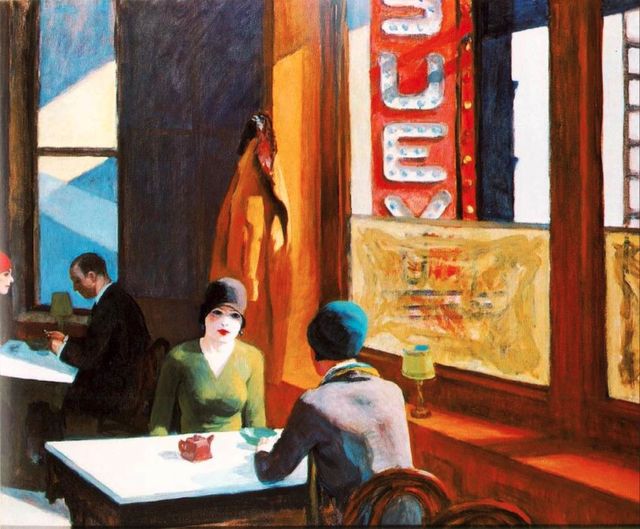
“Chop Suey” by Edward Hopper
Book: “Flatland: A Romance of Many Dimensions”

Flatland: A Romance of Many Dimensions
Edwin A. Abbott, Banesh Hoffmann (Introduction), Masolino D’Amico (Translator) …more
This masterpiece of science (and mathematical) fiction is a delightfully unique and highly entertaining satire that has charmed readers for more than 100 years. The work of English clergyman, educator and Shakespearean scholar Edwin A. Abbott (1838-1926), it describes the journeys of A. Square [sic – ed.], a mathematician and resident of the two-dimensional Flatland, where women-thin, straight lines-are the lowliest of shapes, and where men may have any number of sides, depending on their social status.
Through strange occurrences that bring him into contact with a host of geometric forms, Square has adventures in Spaceland (three dimensions), Lineland (one dimension) and Pointland (no dimensions) and ultimately entertains thoughts of visiting a land of four dimensions—a revolutionary idea for which he is returned to his two-dimensional world. Charmingly illustrated by the author, Flatland is not only fascinating reading, it is still a first-rate fictional introduction to the concept of the multiple dimensions of space. “Instructive, entertaining, and stimulating to the imagination.” — Mathematics Teacher.
(Goodreads.com)
Tarot Card for February 18: The Emperor
The Emperor
The Emperor is numbered four and is the Empress’s other half. Here is a man in the prime of life – successful, confident, secure and well-established. Where the Empress is allied with the Moon, the Emperor is aligned with the Sun.
The Emperor is quick and energetic, exerting dynamic control over his life. He feels born to rule and at his best is a thoughtful and sensitive leader. He listens to others but always the final decision is his own.
This is a man who has proved himself worthy. He has won most of his battles and now is the time to rule over a rich and bountiful land. He is the King Arthur type. He also represents fatherhood – fertile man, protector and providor.
When we are the Emperor, we are taking hold of our power. We are prepared to protect and defend the vulnerable, as well as to shed the lazy and weak. Finally, we are willing and ready to pass on what we have discovered to others who are ready to learn.

(via angelpaths.com and Alan Blackman)
Tchaikovsky on Depression and Finding Beauty Amid the Wreckage of the Soul
By Maria Popova (brainpickings.org)
“An artist needs a certain amount of turmoil and confusion,” Joni Mitchell once told an interviewer. Indeed, the history of the arts is the history of the complex relationship between creativity and mental illness. But while psychologists have found that a low dose of melancholy enhances creativity, its clinical extreme in depression can be creatively debilitating.
Few artists have walked that fine line with more tenacity and self-awareness than the great Russian composer Pyotr Ilyich Tchaikovsky (May 7, 1840–November 6, 1893). Frequently throughout his correspondence with family and friends, collected in The Life and Letters of Pyotr Ilyich Tchaikovsky (public library; public domain) — the source of his enduring ideas on work ethic vs. inspiration, the paradox of client work, and why you should never allow interruptions in your creative process — Tchaikovsky notes his cyclical lapses into depression, undergirded by a dogged dedication to looking for beauty and meaning amid the spiritual wreckage. This intimate tango of sadness and radiance is ultimately what gives his music its timeless edge in penetrating the soul.

In a letter from the spring of 1870, shortly after his thirtieth birthday, Tchaikovsky writes:
I am sitting at the open window (at four a.m.) and breathing the lovely air of a spring morning… Life is still good, [and] it is worth living on a May morning… I assert that life is beautiful in spite of everything! This “everything” includes the following items: 1. Illness; I am getting much too stout, and my nerves are all to pieces. 2. The Conservatoire oppresses me to extinction; I am more and more convinced that I am absolutely unfitted to teach the theory of music. 3. My pecuniary situation is very bad. 4. I am very doubtful if Undine will be performed. I have heard that they are likely to throw me over.
In a word, there are many thorns, but the roses are there too.
Even though Tchaikovsky frequently lamented his “wearing, maddening depression,” perhaps most remarkable yet quintessentially human about his disposition was the ability to assure his loved ones of the very things he was unable to internalize himself — for who among us hasn’t found that it is far easier to offer light to our dearest humans in situations that leave our own inner worlds shrouded in impenetrable darkness?
In the fall of 1876, Tchaikovsky consoles his beloved nephew through a period of dejection and melancholy:
The Life and Letters of Pyotr Ilyich Tchaikovsky remains a wonderful and abidingly rewarding read in its entirety. Complement this particular fragment with Charles Dickens’s beautiful missive of consolation to his bereaved sister and E.B. White’s assuring letter to a man who had lost faith in life.
Republicans have dropped the mask — they openly support fascism. What do we do about it?
Are we so numb we can’t see what just happened? Republicans don’t even pretend to believe in democracy anymore
By CHAUNCEY DEVEGA
FEBRUARY 14, 2022 (theguardian.com)
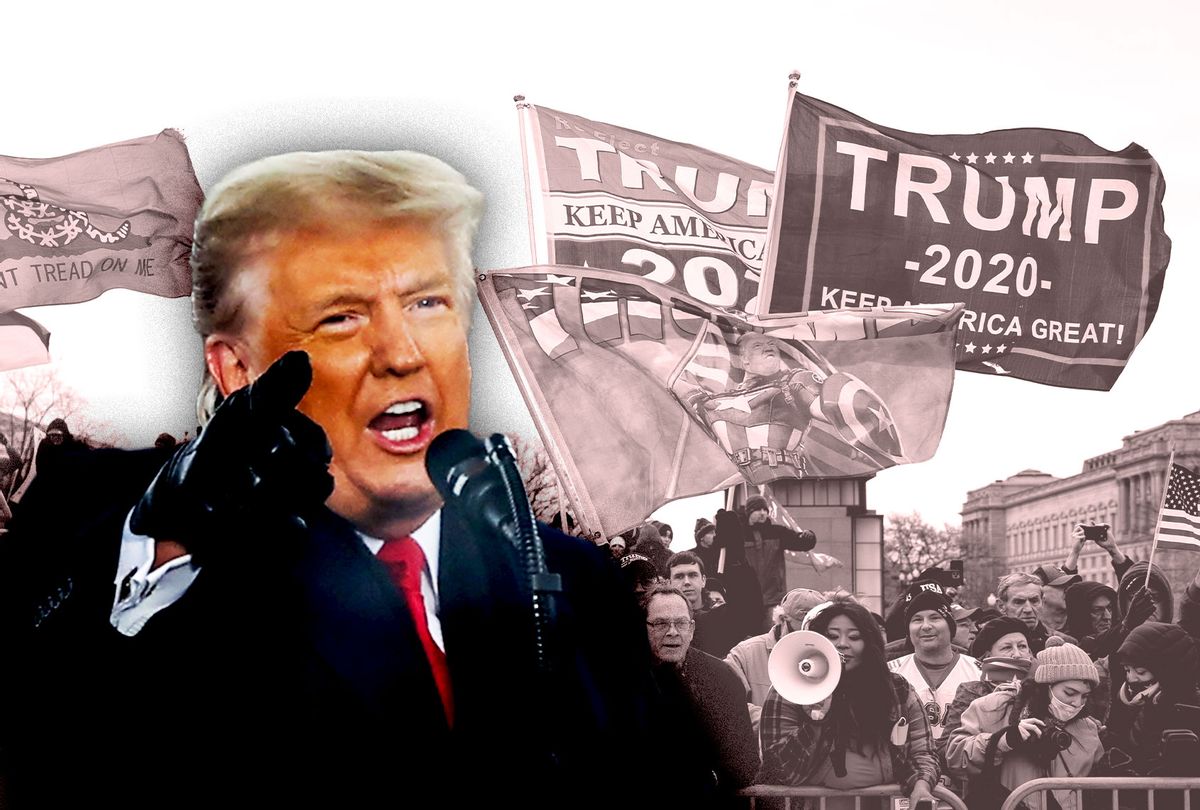 Donald Trump | The US Capitol Riot on January 6, 2021 (Photo illustration by Salon/Getty Images)
Those of us who have repeatedly sounded the alarm about the Republican Party’s threat to democracy and American society have often been told we were exaggerating or being ridiculous. We were hyperbolic, attention-seeking or just plain wrong — because, after all, the Republican Party’s leaders and voters really do love America.
Last week the Republican National Committee dropped any remaining pretexts of patriotism or love of democracy with its now-infamous statement that those who attacked the U.S. Capitol on Jan. 6, 2021, were “ordinary citizens engaged in legitimate political discourse.” Reports suggest that a draft version of that RNC statement was even bolder in its embrace of right-wing terrorism.
Last Friday’s statement of support for fascism announced that the Republican Party has birthed a monster that will ultimately eat it alive. But looking beyond outrage and disgust, what does this tell us about America in this moment of existential crisis?
In terms of the mainstream news media and America’s political class, it reveals how deep the capacity for denial goes. Many of the same voices who insisted that the Republicans were not fascists and did not pose an existential threat to democracy also downplayed or outright dismissed the obvious evidence that Donald Trump and his cabal were going to attempt a coup to nullify the 2020 presidential election.
RELATED: If America really surrenders to fascism, then what? Painful questions lie ahead
Many of these same gatekeepers and boundary keepers then claimed that the Jan. 6 coup was a one-off, a disorganized and spontaneous “riot,” and that the long-term existential dangers were exaggerated. Why? Because they were invested in the idea that “the institutions” had worked, and that Trump’s coup was doomed to fail from the beginning, thanks to “democratic norms” and the “rule of law.”
Now, more than a year after the attack on the Capitol, there is a mountain of evidence that confirms what was obvious at the time, and even before: Trump’s coup attempt was a highly coordinated nationwide effort, whose ultimate goal was to overthrow multiracial democracy and install Trump as de facto dictator.
Ultimately, the Republican Party’s embrace of fascism as a now-indispensable part of its identity should not be a surprise. This devolution was years in the making. In a recent essay for the New Republic, Michael Tomasky summarizes this:
The conservative movement that started in Barry Goldwater’s time was once an element within the GOP. Then along came Newt Gingrich, the key figure who intensified the culture war, and in time the conservative movement swallowed the party whole — and moved hard to the right while doing it.
And now, in the Trump era, it has become what it’s been in process of becoming for some time: an extremist, pro-violence party. The Anti-Defamation League recently released a report finding that more than 100 Republican candidates on various ballots in 2022 have explicitly embraced extremism or violence — House candidates boasting about having the backing of white supremacist leaders, at least 45 candidates giving credence to QAnon conspiracy theories.
This is not some aberration that time will correct. It is a storm that will continue to gather strength, because it’s where the action and the money are, and no one in the GOP is opposing it — except the two people who were just essentially read out of the party (Kinzinger is retiring after his current House term).
The Republican Party, like Michael Palin’s parrot, has ceased to be. It has become an appendage of Trump dedicated to doing his will and smiting his enemies.
A week or so after the fact, the mainstream news media has already moved on from the Republican National Committee’s embrace of fascism. If the American mainstream news media was truly the “guardian of democracy,” it would explain how the Republican fascist movement is an indictment of the country’s political culture.
The headlines of the month and central narrative of the year should be grappling with the following damning question: How did one of the country’s two main institutional political parties come to embrace fascism and right-wing terrorism? What does this mean for the future of the country? These questions are not being asked in a sustained way. Instead, the media is defaulting to the story of the day: “hot takes,” horserace reporting, Beltway gossip and both-sides-ism, amounting to a refusal to take any moral stand on the country’s democracy crisis and the Republicans’ responsibility for creating it.
More than 50 years ago. Hannah Arendt described the role that today’s Republican Party plays as a front organization for fascism and authoritarianism in her essential work “The Origins of Totalitarianism“:
The front organizations surround the movements’ membership with a protective wall which separates them from the outside, normal world; at the same time, they form a bridge back into normalcy, without which the members in the prepower stage would feel too sharply the differences between their beliefs and those of normal people, between the lying fictitiousness of their own and the reality of the normal world.
The ingeniousness of this device during the movements’ struggle for power is that the front organizations not only isolate the members but offer them a semblance of outside normalcy which wards off the impact of true reality more effectively than mere indoctrination….
The world at large, on the other side, usually gets its first glimpse of a totalitarian movement through its front organizations. The sympathizers, who are to all appearances still innocuous fellow-citizens in a nontotalitarian society, can hardly be called single-minded fanatics; through them, the movements make their fantastic lies more generally acceptable, can spread their propaganda in milder, more respectable forms, until the whole atmosphere is poisoned with totalitarian elements which are hardly recognizable as such but appear to be normal political reactions or opinions.
As a front organization for American neofascism, the Republican Party’s long-term strategy and goal is to normalize right-wing violence as a means of creating a “state of exception,” in which they can impose their will on others without restraint by usurping civil and human rights, free speech, the rule of law, the Constitution and finally democracy itself.
The Republican Party’s open declaration that it supports terrorism and other political violence offers an opportunity to remind the American people of the power of lists and keeping accurate records and accounts of this crisis. What is fascism, on its most fundamental level? An assault on reality, time, facts and truth. Correctly documenting reality and the facts are a practical way of staying grounded and refusing to be overwhelmed by this tsunami of events.
Americans who support democracy must now accept that elites and other political leaders will not save them. In fact, they must pressure the country’s elites through a range of actions, perhaps including national strikes, boycotts, civil disobedience and other forms of direct action. They should consider joining (or even forming) local organizations and other civil society groups to make possible the grassroots organizing that can resist and then defeat American neofascism. Those who have the material resources to support such efforts must consider how best to use them.Advertisement:
Pro-democracy Americans need to understand that the struggle against American neofascism will be long and difficult. There is no rapid or easy solution to this crisis. Defeating fascism will require personal and collective sacrifice.
Writing at the Atlantic, Linda Hirshman offers these lessons from American history and the Black Freedom Struggle, which merit being quoted at length:
The fault lines of today’s political chasm go back to the decades that preceded the Civil War. One can see them in our geography — most of the states that will recriminalize abortion, for example, are in the old Confederacy and the rural or deindustrialized regions it influenced — and in our racial division, which continues to render the country into, more or less, two camps. …
Today’s challenges are different — and no offense can be compared with the slavocracy of the antebellum period — but anyone who cares about basic principles of democracy can see that our struggle is much the same. In 2013, the Supreme Court put the Democrats at an enormous disadvantage by gutting the Voting Rights Act and handing back elections to the minority-party-dominated rural-state legislatures. Despite repeated efforts of most of the Democratic senators, Congress has refused to pass a new voting-rights act. In several key states, Republican legislatures have set up new systems that may overturn future election results. Sometime in June, the Supreme Court is likely to rule that American women no longer have a constitutional right to refuse to bear a child, despite the fact that polls regularly show that the overwhelming majority of Americans support some level of abortion rights.
These are dark times, but dark times do not always prevail. Four decades after Black spokesmen told their white so-called friends in the execrable American Colonization Society that they would not be returned to Africa, and just 30-plus years after the Black activist David Walker published an “appeal to the Colored Citizens of the World” promising that “the blacks,” once started, would form a “gang of tigers and lions,” the newborn Republican Party won the presidency on a platform of restricting slavery. Ten years after Garrison torched his copy of the Constitution, Abraham Lincoln signed the Emancipation Proclamation. How did they do it?
The specifics of their fight are not identical to what prodemocracy Americans now face. But the work of the abolitionist movement is comprehensible and replicable. It is the closest thing we have to a blueprint for how to rescue our democracy.
Almost every tactic the mostly white abolitionists used derived from methods that Black organizers tried first. Walker’s appeal, published in 1829, inspired Garrison. There was a Black convention and Lodge movement well before the first white or interracial antislavery society. But one lesson emerges loudly from history: Neither Black nor white Americans could have done it alone.
They made an alliance, and they dug in for the long haul. And they left a playbook.
Americans who believe in democracy must balance optimism and realism, but without succumbing to fatalism. The fight has hardly begun, and too many people are exhausted and have preemptively surrendered. Most important of all, pro-democracy Americans should resist the temptation or urge to compromise with their enemies or appease them. There is no room for “bipartisanship,” compromise or truce with the Republican fascists and their allies. That only normalizes evil and all but guarantees the fascists an eventual victory.
Unfortunately, the leaders of the Democratic Party have not learned this lesson. President Biden recently spoke at the National Prayer Breakfast, one day before the Republican National Committee’s official embrace of the Jan. 6 insurrection. At the breakfast, Biden spoke directly to Senate Republican leader Mitch McConnell, saying, “Mitch, I don’t want to hurt your reputation, but we really are friends. And that is not an epiphany we’re having at the moment. You’re a man of your word, you’re a man of honor. Thank you for being my friend.”
RELATED: Biden pleads for unity — in speech at anti-LGBTQ, faux-bipartisan Prayer Breakfast
In the midst of an existential threat brought on by the Republicans and their followers, the president of the United States told the most powerful Republican legislator, with evident sincerity, that he was a friend. That crystallizes all the ways the Democratic leadership is not reacting with the urgency of now to save American democracy. Biden’s words suggest that he and his party are simply not up to the challenge of defending American democracy from the fascist onslaught.
As so often occurs in moments of great struggle and challenge, the few must save the many. And that salvation, if it comes, will not come from the so-called leaders in Washington. Who will step forward?
CHAUNCEY DEVEGA
Chauncey DeVega is a senior politics writer for Salon. His essays can also be found at Chaunceydevega.com. He also hosts a weekly podcast, The Chauncey DeVega Show. Chauncey can be followed on Twitter and Facebook.
Pressure on Italian Catholic church to face child sexual abuse reckoning
Unofficial estimates say country may have highest number of victims of paedophile priests in world
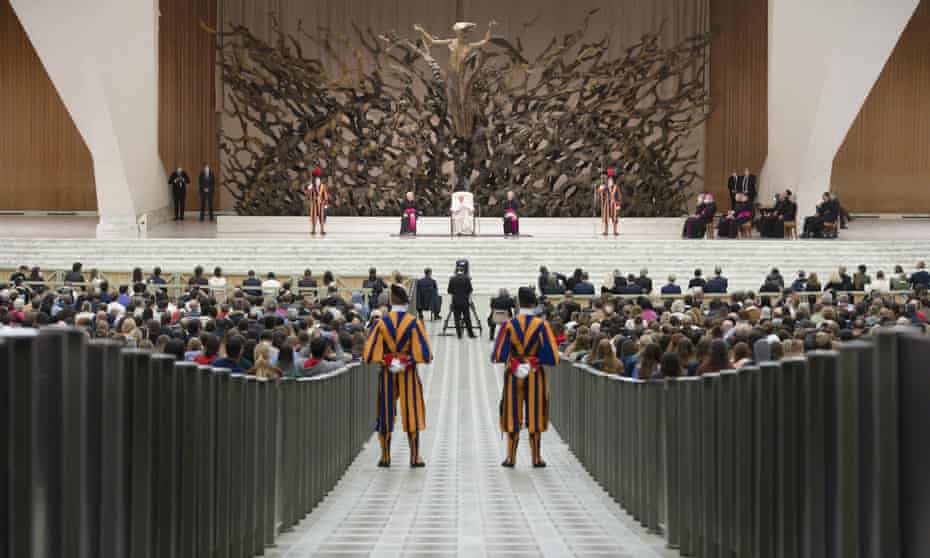
Angela Giuffrida in Rome Fri 11 Feb 2022 (theguardian.com)
Pressure is mounting on the Catholic church in Italy to face a reckoning on child sexual abuse amid unofficial estimates that the country could have the highest number of victims of paedophile priests in the world.
Damning investigations into the scale of sexual abuse and cover-up allegations have dealt a severe blow to the church’s reputation in the US, Ireland, Chile, France and, more recently, Germany. But in Italy the issue has been mostly buried.
A group of religious and lay associations have now come together to push for an independent inquiry and to urge the Italian state to enact tougher laws to bring paedophile priests to justice and come up with a plan to protect children from sexual abuse by clergy. The group is using the hashtag #ItalyChurchToo and will outline its objectives during an online event on 15 February.
“The problem in Italy is enormous but it has been hidden,” said Cristina Balestrini, who leads a group for abuse victims and their families. “For example, two of the priests who celebrated my marriage turned out to be paedophiles. Then there was the priest who … raped my son. So that makes three paedophile priests, just in my small world.”
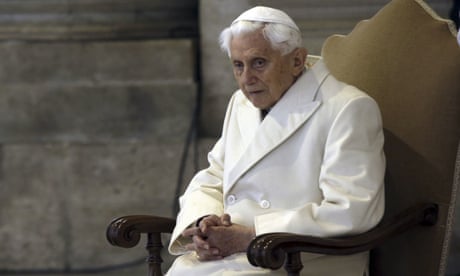
The appeal has been given impetus by the publication of independent reports in France and Germany, where the former pope Benedict was criticised for allegedly failing to take action against four priests accused of child sexual abuse when he was archbishop of Munich between 1977 and 1982. Benedict this week apologised for “grievous faults” in his handling of those sexual abuse cases, but his legal team denied any personal wrongdoing, provoking fury from victims.
Hans Zollner, a German priest on Pope Francis’s commission to protect minors, has on several occasions in recent months called for the spotlight to be turned to Italy. “We need these investigations to be done and published in an objective way,” he told La Stampa. “And we need it in Italy too, that way we can look reality in the face and not continue to deny something that gets continuously denied.”Advertisementhttps://7a01e7eec997f1754115ed024827e2e7.safeframe.googlesyndication.com/safeframe/1-0-38/html/container.html
Although the issue is being discussed by the Italian church, bishops are divided over whether the investigation should be independently commissioned. Gualtiero Bassetti, who steps down as president of the Italian Episcopal Conference in May, has spoken in favour of an investigation, as have two of his potential successors, albeit an internal one.
“The reason they’re now saying ‘oh, we’re thinking about doing something’ is because they want to control the narrative,” said Robert Mickens, the Rome-based editor of the English-language edition of the Catholic daily newspaper La Croix. “The initiative by the associations is scaring them to death, and they’re thinking ‘let’s do something that we can contain’, because they know that if they open it up to the outside world, they’re screwed.”
There are no official figures on the number of clerical abuse victims in Italy, but the main victims’ association, Rete L’Abuso, has recorded 360 cases of priests accused or convicted over the last 15 years. A treaty between the Italian government and the Vatican means the majority of child abuse investigations in Italy are carried out behind a wall of secrecy within the Holy See’s jurisdiction. If found guilty by a Vatican court, most priests end up being transferred to a new diocese rather than being defrocked or jailed. Of those found guilty by an Italian court, few are imprisoned.
France’s inquiry found that 216,000 children had been abused by clergy over seven decades. By comparing the number of priests in France, about 21,000, with Italy’s 52,000, Francesco Zanardi, who set up Rete L’Abuso, said the number of victims in Italy could be three times that of France.
“It’s obvious that Italy is the country where the scandal could be worse, because it’s one of the countries with the highest number of priests in the world,” said Zanardi, who says he was abused by a parish priest from the age of 11 to 15. “There are also many foreign priests accused of paedophilia who have been given shelter in Italy. We need an independent inquiry; if the church does an internal one, it won’t be credible.”
Meanwhile, the Italian government is yet to deliver on a request by a UN commission, which in 2019 accused it of being complicit in protecting paedophile priests from criminal charges, to devise a national plan preventing the sexual abuse of children. Campaigners are asking the government to enact a law, similar to one in France, that obliges citizens to report knowledge of clergy abuse.
Although the number of churchgoers in Italy has been in steadily declining, the Catholic church still wields a considerable influence in society. The topic of clerical sexual abuse, at least when it comes to Italy, is rarely covered in the press. An Italian TV talkshow was criticised for failing to question Pope Francis about the issue during the pontiff’s first interview on Italian TV last week.
“I think Italians might be able to accept an inquiry, but the media would have more difficulty as there’s this kind of reverential fear, especially in state TV, in terms of the Vatican and in general the pontificate,” said Emiliano Fittipaldi, a journalist whose 2017 book Lussuria accused Pope Francis of doing “close to nothing” to stop clerical sexual abuse in Italy. “The only way for an inquiry to happen would be if Francis orders it.”
The Vatican has been contacted for comment.