
New Thinking Allowed with Jeffrey Mishlove Ben Goertzel, PhD, is author of many books on artificial intelligence including Ten Years to the Singularity if We Really Really Try; Engineering General Intelligence, Vols. 1 and 2; The Hidden Pattern: A Patternist Philosophy of Mind; and The Path to Posthumanity. He is also editor (with Damien Broderick) of an anthology about parapsychology titled, Evidence for Psi: Thirteen Empirical Research Reports. He is chief scientific officer for Hanson Robotics in Hong Kong. In this 2016 interview, he points out that, while the question of consciousness in robots is problematic, there are similar problems when exploring the question of consciousness in humans. He postulates that AI machines will develop some forms of awareness; and suggests thought experiments involving plugging the human brain directly into computers. He discusses credible research on extrasensory perception and suggests that people working in artificial intelligence and cognitive science will need to confront this data. He then speculates about the prospects for telepathic robots.
Monthly Archives: December 2021
Executed for Treason on December 2, 1859
On this day (December 2) in 1859, the U.S. government executed John Brown for his failed raid on a federal armory in Harpers Ferry, Virginia. For attempting to liberate enslaved people, Brown became the first American to be executed for treason.
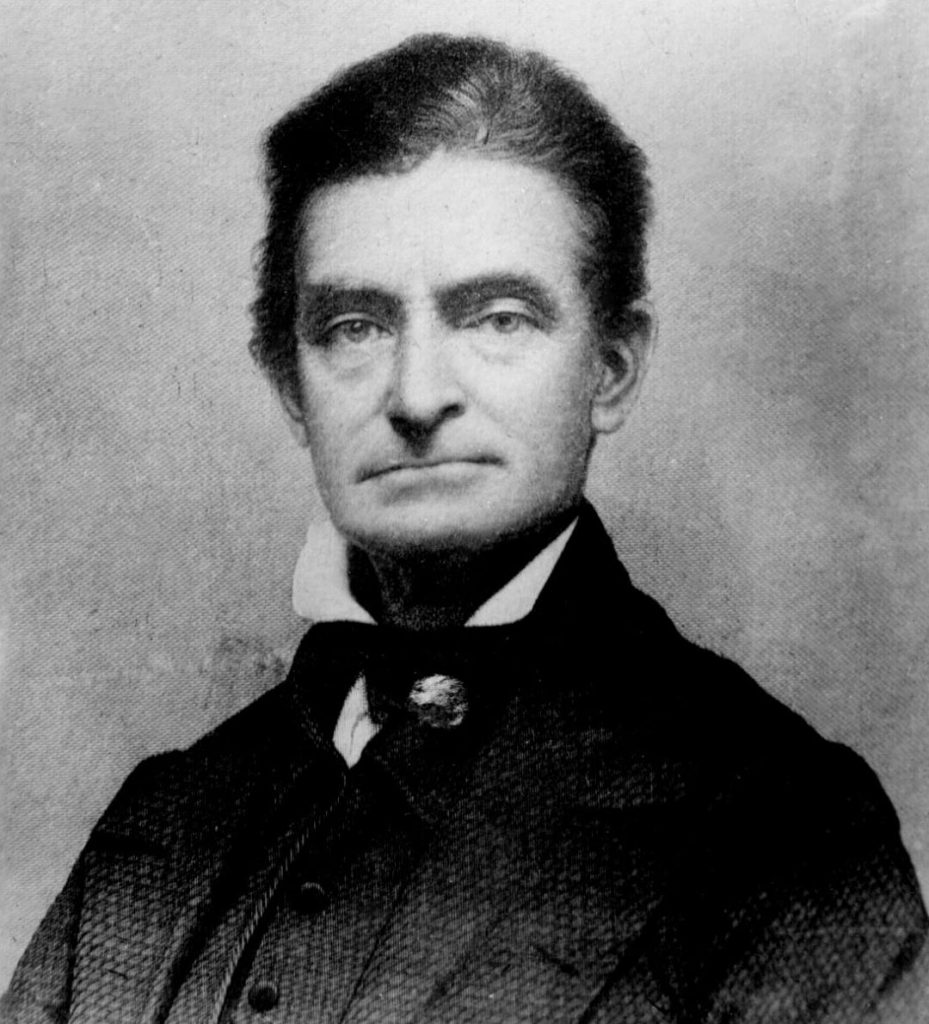
John Brown (May 9, 1800 – December 2, 1859) was an American abolitionist leader. First reaching national prominence for his radical abolitionism and fighting in Bleeding Kansas, he was eventually captured and executed for a failed incitement of a slave rebellion at Harpers Ferry preceding the American Civil War. Wikipedia
(Courtesy of Gwyllm Llwydd)
Tarot Card for December 3: The Nine of Wands
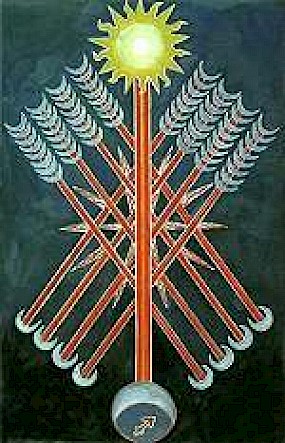
The Nine of Wands
When we reach deep inside ourselves, with a heart that is unafraid and accepting, we will discover new depths of strength and power. These deep reaches of wisdom, which lay dormant with in the subconscious until we are brave enough to search them out, will bring balance and equilibrium. And from new centredness will arise an unshakeable trust in ourselves that will carry us forward through life.
It’s true that when we travel deep inside ourselves, we will also find material that we might prefer to leave unacknowledged – but the Nine of Wands, Lord of Strength, reminds us that in being true to ourselves we release energies that will help us to deal with whatever we find within. And after all, whatever lies inside our own subconscious is, for better or for worse, a part of us.
When the Nine of Wands turns up in a reading, we can be re-assured that we have what it takes to get by. Even in times of stress and difficulty, inner strength will rise up to guide us forward toward our goals. And in the process we shall learn more about ourselves and our abilities, gaining a new all-round perspective which brings security and self-confidence.
This card tells us to trust ourselves. We have everything we need. There is no necessity to analyse nor question. And absolutely no excuse to give in to doubt!
(via angelpaths.com and Alan Blackman)
Plato writes about near-death experience

Near-Death Experiences: Understanding Visions of the Afterlife
- BY BENJAMIN MITCHELL-YELLIN
- SEPTEMBER 12TH 2016 (blog.oup.com)
One of the first great philosophical books, Plato’s Republic, concludes with the recounting of a near-death experience. Socrates relates the myth of Er, a soldier who died in battle but came back to tell what he saw in the other world. Like other myths in Plato’s works, this is meant to supplement Socrates’ philosophical arguments and to help instill noble beliefs. It’s a last ditch effort at making the case for living a just life.
The transformative power of near-death experiences is not lost on us in the 21st century. But Plato’s use of Er’s story stands apart from the way near-death experiences are presented nowadays. We have books with titles like Proof of Heaven: A Neurosurgeon’s Journey into the Afterlife, Heaven Is for Real: A Little Boy’s Astounding Story of His Trip to Heaven and Back, and Evidence of the Afterlife: The Science of Near-Death Experiences. The idea no longer seems to be that near-death experiences are stories that serve to prepare us for rational argumentation. Rather, the idea seems to be that near-death experiences are arguments. Or perhaps the idea is that there is no need for arguments—a sincere report is all it takes.

This shift in emphasis raises the rather obvious question of whether we should be convinced of the content of a report simply in light of its sincerity. In some contexts the answer is clearly ‘No.’ Even sincere testimony may be faulty. False memories appear real to the subject reporting them, even though they do not correspond to actual events. This is one reason why the testimony of young children is not simply taken at face value in court. They are especially vulnerable to suggestion, and so their accounts of past events, no matter how sincere, may not be the best guides to what actually took place. Religious convictions provide a second example of why sincerity should not be taken as evidence of truth. Members of different faiths often sincerely believe in conflicting tenets. But the fact that they conflict means that not all of them can be true. Though particular religious convictions may be true, the sincerity of those who hold them is not evidence that they are. In general, it seems, sincerity is not a sure guide to truth. And yet this is what we are asked to accept when it comes to near-death experiences.
As someone who thinks that near-death experiences do not prove that there is a heaven, I commonly hear that am failing to let the scales drop from my eyes. I have been told that what I need to do is go out and hear the stories of those who have had these experiences. Then I will see the light.

I think this advice is misguided. But the motivations behind it may be noble. Near-death experiences often transform those who have them for the better. They become more compassionate, less afraid of death, and more understanding and loving of others. One might feel as if a naturalistic account of near-death experiences would undermine these transformations. Such an account might seek to explain why someone experienced seeing deceased relatives in heaven by appealing to the comforting psychological effects this would have in the context of a brush with death. By citing them as causes of the experience, however, this explanation may seem to risk eliminating these comforting effects. Even worse, it may do so not just for the subject of this experience, but also for all those who found hope and optimism in a sincere account of heaven. Books on near-death experiences are best sellers because people find great hope in them. One motivation for simply accepting people’s sincere reports of what they’ve experienced may be to save the power and meaning of these experiences from the deflating explanations of psychology and neuroscience.
Even if this motivation displays a heart in the right place, it rests on a mistaken assumption. Naturalistic explanations of the causes of phenomena associated with near-death experiences need not undermine their transformative effects. Consider the life review, a characteristic element in many near-death experiences. Watching one’s life unfold as if it were a movie provides one with a detached perspective from which to witness one’s choices and actions. It involves adopting another standpoint on what one has done. Taking up different standpoints is often cited as a means to improved moral thinking. The familiar thought is that one might begin to make better choices, to be more compassionate and loving towards others, if only one could get outside one’s narrow point of view and see things as others do. The life review affords just this possibility, no matter how it’s caused.
At the end of the day, there is no inherent conflict between naturalistic explanations of near-death experiences and the preservation of their power to transform people for the better. The tools of science can allow us to make sense of these experiences in a manner that preserves their deep significance and positive effects. We are not forced to choose between a better understanding and a better world.
Featured image credit: “Stars and Lights” by Ed Dunens. CC BY 2.0 via Flickr.
Benjamin Mitchell-Yellin is Assistant Professor of Philosophy at Sam Houston State University. Previously, he was the Postdoctoral Fellow for the Immortality Project (2012-2015), sponsored by The John Templeton Foundation. Benjamin, along with John Martin Fischer, are co-authors of Near-Death Experiences: Understanding Visions of the Afterlife.
Enhanced Crown Mysteries December 10-12
 |
| REMINDER! Special Event for Translators! Enhanced Crown Mysteries    December 10 – 12, 2021 Friday Evening, Saturday & Sunday Thane’s rarely taught pinnacle lessons For advanced* practitioners of Translation® and Releasing the Hidden SplendourTM, this is the alchemical creative process generated within the psyche of the individual that looses something NEW in the world. “ECM” makes understandable the formerly esoteric teachings of mystics of the ages. Learn of the phenomenally powerful Truth of “In the beginning was the word….” This understanding will enable you to “speak the word” and use this power that is your birthright. Thane also expands upon the symbolic meaning of the SEVEN DAYS OF CREATION. . . building the sixth and seventh steps of Translation®. A new and deeper understanding of Translation® awaits you in the Crown Mysteries. All lessons recorded by Thane and monitored by Al Haferkamp, H.W., M. Class Fees: $195 New or Review; $125 Life Members *Translation® and Releasing the Hidden SplendourTM are prerequisites for ECM. Register/More information |
Good news for Oreo cookie lovers
New Thinking Allowed with Jeffrey Mishlove Kenneth R. Pelletier, MD, PhD, is professor of medicine at the University of California, San Francisco, Medical Center. He is author of Longevity, Mind As Healer – Mind As Slayer, Toward a Science of Consciousness, Sound Mind – Sound Body, The Best Alternative Medicine, Healthy People in Unhealthy Places, and Change Your Genes – Change Your Life. Here he describes progress in the emerging new scientific field of epigenetics. He points out that the manner in which genes express themselves is determined by diet, exercise, and mental state, in addition to other biochemical factors. Alterations to epigenetic markers can be passed on to one’s descendants — in effect, supporting the once discredited notion of Lamarckian genetics. We are at the brink of a new era of personalized medicine. New Thinking Allowed host, Jeffrey Mishlove, PhD, is author of The Roots of Consciousness, Psi Development Systems, and The PK Man. Between 1986 and 2002 he hosted and co-produced the original Thinking Allowed public television series. He is the recipient of the only doctoral diploma in “parapsychology” ever awarded by an accredited university (University of California, Berkeley, 1980). (Recorded on May 4, 2019)
Merging With the Universe with Kenneth R. Pelletier
New Thinking Allowed with Jeffrey Mishlove Kenneth R. Pelletier, MD, PhD, Clinical Professor of Medicine, is author of Longevity, Mind As Healer – Mind As Slayer, Toward a Science of Consciousness, Sound Mind – Sound Body, The Best Alternative Medicine, Healthy People in Unhealthy Places, and Change Your Genes – Change Your Life. This conversation focuses on an out-of-body experience in 1967 that involved a state of cosmic consciousness as well as “future memory”. Essentially, it set the pattern for Ken’s subsequent career as a pioneer of mind-body medicine and integrative health. The experience was so powerful that Ken felt disoriented for weeks afterward; and he has been hesitant to discuss it publicly until now. New Thinking Allowed host, Jeffrey Mishlove, PhD, is author of The Roots of Consciousness, Psi Development Systems, and The PK Man. Between 1986 and 2002 he hosted and co-produced the original Thinking Allowed public television series. He is the recipient of the only doctoral diploma in “parapsychology” ever awarded by an accredited university (University of California, Berkeley, 1980). (Recorded on May 18, 2021)
Sagittarius Solar Eclipse, December 4th, 2021

Sagittarius Solar Eclipse
The Sagittarius solar eclipse is a total eclipse and indicates that stronger changes may occur than we imagined were possible — whether for better or worse. How we perceive such changes may depend quite a lot on what we were expecting in the fi rst place, of course. It can be easy to assume that a planned course of action will emerge in exactly the linear way that the imagination fi rst painted it. Yet life is not always so straightforward. Besides, what we think we want may be easily replaced by what we truly need, ultimately. Only once a little more time has passed might we then see the very clear picture of why it was so necessary that things ended up the way they did.
For some people, the eclipse will bring a revelation that helps to make more sense of a situation — but for others, what is shown may now seem more confusing. This could be especially relevant when dealing with a relationship where strains and tensions start to tilt behavior in a peculiar direction. It could be important to remind ourselves that this is not quite the whole picture — or that we cannot yet appreciate the depth and breadth of the entire situation. Having this heightened sense of awareness may help us cope with a greater understanding if someone else’s behavior seems out of sorts. And it might even help to explain if we, personally, feel off-kilter for a while too.
Since Mercury is conjunct the eclipse, it could seem that someone’s thinking is far from straightforward. Rationale may appear to have gone out the window temporarily — or worse still, someone is convinced that what they believe is real and makes sense, when to another the opposite is true. If we can see that something is amiss, then we can perhaps cut some slack and avoid getting caught up in a panic or otherwise overreacting.
On a more practical note, this can be a time when Mercury operates in frustrating ways on a mundane level. It may be that information is not fully revealed — whether intentionally or unwittingly — and the net effect, either way, is that we are at something of a disadvantage, at least temporarily. It could be important, therefore, to check specific details — almost as we might do under the rays of a retrograde Mercury. This can mean checking with more than one source, because one version of the so-called truth, or set of facts, may not match another.
Asteroid Vesta is on the other side of the eclipse pair, reminding us of the importance of holding on to ideas and inspirations. We may be in the middle of a creative process that doesn’t feel as progressive and awe-inspiring as we’d at fi rst hoped for. Yet we’re probably making progress — of a sort. If we struggle to spot this, then we can perhaps cast our thoughts back to previous times — maybe involving other people — to see how we have, in reality, already advanced. This could be as simple as having more resources available to us now than we or others had access to in previous scenarios.
A sextile of Saturn to Vesta, the Sun, and Moon lends a sobering, steadying inf uence. Saturn in Aquarius reafl ects strong principles, including fairness. If we stress this point in our dealings with others, we may be able to mitigate certain excesses that the planets in Sagittarius could want to lead us toward. Expansion can, of course, be a great bonus — but we may have a reminder soon that not everyone can handle changes, expansion, or progress equally well or at the same speed. A little emotional catch-up may be required on certain fronts — and any patience we can demonstrate may support us, as well.
This article is from the Mountain Astrologer written by Diana McMahon Collis
A Spiritual Renaissance – Interview with Betty Kovacs
Anthony Chene production Betty Kovacs, PhD explains how the myths, the shamanic traditions and the ancient wisdom held a blueprint for our evolution and our connection to the divine. She shows how these attempts to reconnect with our cosmic consciousness were brutally repressed throughout History, and why we are now in a special period of time, where a bridge between science and spirituality can help us finally reconnect to who we really are. Her website: https://www.kamlak.comhttp://www.anthonychene.comhttps://www.facebook.com/anthonychene…https://www.instagram.com/anthonychene Support me for my next videos : https://www.paypal.me/anthonychenehttps://www.patreon.com/anthonychene
A Course in Miracles: Lesson 133
 |
| Lesson 133: I will not value what is valueless. Sometimes in teaching there is benefit, particularly after you have gone through what seems theoretical and far from what the student has already learned, to bring him back to practical concerns. This we will do today. We will not speak of lofty, world-encompassing ideas, but dwell instead on benefits to you. You do not ask too much of life, but far too little. When you let your mind be drawn to bodily concerns, to things you buy, to eminence as valued by the world, you ask for sorrow, not for happiness. This course does not attempt to take from you the little that you have. It does not try to substitute utopian ideas for satisfactions which the world contains. There are no satisfactions in the world. Today we list the real criteria by which to test all things you think you want. Unless they meet these sound requirements, they are not worth desiring at all, for they can but replace what offers more. The laws that govern choice you cannot make, no more than you can make alternatives from which to choose. The choosing you can do; indeed, you must. But it is wise to learn the laws you set in motion when you choose, and what alternatives you choose between. We have already stressed there are but two, however many there appear to be. The range is set, and this we cannot change. It would be most ungenerous to you to let alternatives be limitless, and thus delay your final choice until you had considered all of them in time; and not been brought so clearly to the place where there is but one choice that must be made. Another kindly and related law is that there is no compromise in what your choice must bring. It cannot give you just a little, for there is no in between. Each choice you make brings everything to you or nothing. Therefore, if you learn the tests by which you can distinguish everything from nothing, you will make the better choice. First, if you choose a thing that will not last forever, what you chose is valueless. A temporary value is without all value. Time can never take away a value that is real. What fades and dies was never there, and makes no offering to him who chooses it. He is deceived by nothing in a form he thinks he likes. Next, if you choose to take a thing away from someone else, you will have nothing left. This is because, when you deny his right to everything, you have denied your own. You therefore will not recognize the things you really have, denying they are there. Who seeks to take away has been deceived by the illusion loss can offer gain. Yet loss must offer loss, and nothing more. Your next consideration is the one on which the others rest. Why is the choice you make of value to you? What attracts your mind to it? What purpose does it serve? Here it is easiest of all to be deceived. For what the ego wants it fails to recognize. It does not even tell the truth as it perceives it, for it needs to keep the halo which it uses to protect its goals from tarnish and from rust, that you may see how “innocent” it is. Yet is its camouflage a thin veneer, which could deceive but those who are content to be deceived. Its goals are obvious to anyone who cares to look for them. Here is deception doubled, for the one who is deceived will not perceive that he has merely failed to gain. He will believe that he has served the ego’s hidden goals. Yet though he tries to keep its halo clear within his vision, still must he perceive its tarnished edges and its rusted core. His ineffectual mistakes appear as sins to him, because he looks upon the tarnish as his own; the rust a sign of deep unworthiness within himself. He who would still preserve the ego’s goals and serve them as his own makes no mistakes, according to the dictates of his guide. This guidance teaches it is error to believe that sins are but mistakes, for who would suffer for his sins if this were so? And so we come to the criterion for choice that is the hardest to believe, because its obviousness is overlaid with many levels of obscurity. If you feel any guilt about your choice, you have allowed the ego’s goals to come between the real alternatives. And thus you do not realize there are but two, and the alternative you think you chose seems fearful, and too dangerous to be the nothingness it actually is. All things are valuable or valueless, worthy or not of being sought at all, entirely desirable or not worth the slightest effort to obtain. Choosing is easy just because of this. Complexity is nothing but a screen of smoke, which hides the very simple fact that no decision can be difficult. What is the gain to you in learning this? It is far more than merely letting you make choices easily and without pain. Heaven itself is reached with empty hands and open minds, which come with nothing to find everything and claim it as their own. We will attempt to reach this state today, with self-deception laid aside, and with an honest willingness to value but the truly valuable and the real. Our two extended practice periods of fifteen minutes each begin with this: I will not value what is valueless, and only what has value do I seek, for only that do I desire to find. And then receive what waits for everyone who reaches, unencumbered, to the gate of Heaven, which swings open as he comes. Should you begin to let yourself collect some needless burdens, or believe you see some difficult decisions facing you, be quick to answer with this simple thought: I will not value what is valueless, for what is valuable belongs to me. |