What Everyone Gets Wrong About Manhood and Masculinity

Jordan Shapiro 6 days ago· Medium.com

Photo by Jennifer Lim-Tamkican on Unsplash

The poet Robert Bly — who died on Nov. 21, at the age of 94 — was best-known for his controversial work of archetypal psychology, Iron John: A Book About Men.
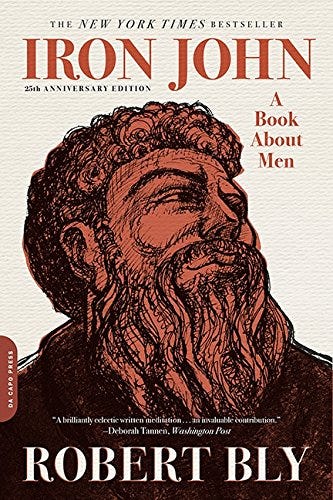
In the 1990s, Americans weren’t nearly as polarized on gender as we are now; Bly’s work had broad crossover appeal. It spent 62 weeks on the bestseller list. I can still remember my father passing a worn hardcover edition to my older brother. The book became a cultural phenomenon, launching a “mythopoetic men’s movement.”

Bly and his colleagues were advocating for a men’s movement that would complement, not oppose, second wave feminism. Nonetheless, he was widely criticized by folks who recognized the movement’s latent misogyny. They were correct. A good argument can be made that Bly’s work laid the foundation for incels, the manosphere, and Jordan Peterson’s 12 Rules for Life.

According to the New York Times obituary, Bly’s work “drew on myths, legends, poetry and science of a sort to make the case that American men had grown soft and feminized and needed to rediscover their primitive virtues of ferocity and audacity and thus regain the self-confidence to be nurturing fathers and mentors.” Hence, nobody who is well acquainted with Iron John should’ve been surprised last month when Sen. Josh Hawley complained about “the deconstruction of American men” and called for “a revival of strong and healthy manhood” at the National Conservatism Conference in Orlando. This perspective is part of long tradition: men whining about how emasculated they feel while living a culture that’s progressing — at an appallingly sluggish pace — toward gender parity.

Nobody who is well acquainted with IRON JOHN should’ve been surprised last month when Sen. Josh Hawley complained at about “the deconstruction of American men.”

Hawley doubled-down on his politically-divisive iteration of Bly’s original message in a follow-up interview with Axios on HBO. He complained that “the Left” devalues masculinity and drives young men to withdraw “into the enclave of idleness and porn and video games.” Folks on Twitter were outraged. Writers on Substack went ballistic. But I suspect most people’s consternation had more to do with residual ire about Hawley’s January 6 fist pump than his actual comments. After all, while his take on manhood is undoubtedly misguided, it’s not uniquely contemporary, or even partisan.

When it comes to stereotypical rhetoric about men and women, progressives and conservatives are more alike than dissimilar. Folks on both sides of political spectrum struggle to think beyond familiar conceptions of gender. When confronted with troublesome trends, like the decline in men’s college enrollment and completion, and a rising suicide rate among middle age white men, both gravitate toward pop-psychology and pseudoscience for answers. Most pundits conclude that feelings of inferiority have made today’s men more apathetic and rageful than ever before. Liberals blame it on economic disenfranchisement and changing socio-cultural norms. Conservatives blame it on elite liberal academic jargon and fragile millennials.

When it comes to stereotypical rhetoric about men and women, progressives and conservatives are more alike than dissimilar. Folks on both sides of political spectrum struggle to think beyond familiar conceptions of gender.

Either way, the explanations are ineffectual. They’re the equivalent of an over-protective mom assuring her son that the other kids only tease him because they’re jealous. This is the real “coddling” that should worry everyone. Again and again, we frame problematic trends in masculinity as understandable recompense. These are feeble attempts to shield boys and men from discomfort, by validating and reinforcing male entitlement. It doesn’t help. What boys and men really need is not more excuses and scapegoating, but rather honest and meaningful support as they confront the inevitable disruption of the patriarchal status quo.

The truth is most boys and men are just as unprepared for the 2020s as Robert Bly’s contemporaries were for the 1990s. They don’t have the vocabulary, social-emotional acumen, or cognitive tools necessary to adequately confront feminist movement. They don’t know how to imagine themselves without the privileges and entitlements of patriarchy. And as a result, some men have become reactionary. They blame women, mothers, and the “identity politics” of elite liberal college professors like me. They fight political battles against women’s reproductive rights because they unconsciously mistake non-cisgender-male bodies as a threat. Of course, the only real threat is a lack of meaningful symbolic grounding, a dearth of aspirational imagery that has been adequately updated to align with the current cultural ethos.

This becomes clear when you consider what Sen. Hawley gets right. For instance, it’s true that video games are often a place where kids go to find refuge. But it’s not to escape so-called woke ideology. Instead, it’s where they find alternatives to the locker room bullying and status-jockeying that typically characterizes male comradery. Contrary to the mainstream anti-screen time rhetoric, studies have consistently debunked the notion that digital media has an adverse effect on teen mental health; most dependable research indicates the opposite; many teens turn online when looking for supportive outlets for dealing with emotional tension. They not only find like-minded communities on social media and multiplayer games, but also alternative hierarchies that tend to be based more on digital and/or in-game merit than stereotypical identity signifiers. In other words, gamers have their own pecking order that’s not necessarily akin to what Television’s mean-girl and jock-bully teen soap-operas have conditioned us to expect. Still, different is not necessarily better. Video games are often just another arena in which teen boys act out the ritual violence and competition that has long been at the core of ordinary American manhood.

Porn helps boys compensate for the feelings of inferiority which are a well-documented and endemic characteristic of “precarious manhood.”

Sen. Hawley may also be correct that teen boys are watching porn to deal with feelings of insecurity and marginalization. But it’s absurd to say that it’s because they feel like masculinity has been devalued. More likely, the opposite is true. Porn thrives because boys have been socialized — under patriarchy — to equate misogynist sexual domination with status and power. It’s a way to make themselves feel more assertive. They turn to fantasy to act out a more individualistic identity; it’s playing make-believe to fortify a sense of self. Porn helps boys compensate for the feelings of inferiority which are a well-documented and endemic characteristic of “precarious manhood.” That’s the term experts use to describe how men constantly need to prove their masculine status. As Liz Plank writes in her book, For the Love of Men: A New Vision of Mindful Masculinity, “Masculinity is procured through ritualized and often-public social behaviors.” And one defining characteristic of American manhood is that, for individuals, it’s always threatened.

The use of both porn and video games has nothing to do with the proliferation of progressive gender theory or the supposed devaluation of masculinity. Instead, these are well-worn instruments of patriarchal socialization. Just like the old Iron John concern that manhood has lost its mojo, commodified sex and brutal competition are not new. They are products created by and for a culture that values — rather than devalues — patriarchal manhood. These are not the symptoms of masculine decline, but rather indications that American manhood remains entrenched.

Jordan Shapiro’s new book, Father Figure: How to be a Feminist Dad is available now. For more information, visit: www.FeministDadBook.com

Enhanced Crown Mysteries December 10-12

REMINDER!
Special Event for Translators!

Enhanced Crown Mysteries
December 10 – 12, 2021
Friday Evening, Saturday & Sunday

Thane’s rarely taught pinnacle lessons For advanced* practitioners of Translation® and Releasing the Hidden SplendourTM, this is the alchemical creative process generated within the psyche of the individual that looses something NEW in the world.
 
“ECM” makes understandable the formerly esoteric teachings of mystics of the ages.

Learn of the phenomenally powerful Truth of “In the beginning was the word….”  This understanding will enable  you to “speak the word” and use this power that is your birthright.

Thane also expands upon the symbolic meaning of the SEVEN DAYS OF CREATION. . . building the sixth and seventh steps of Translation®.  A new and deeper understanding of Translation® awaits you in the Crown Mysteries.

All lessons recorded by Thane and monitored by Al Haferkamp, H.W., M.

 Class Fees:  $195 New or Review; $125 Life Members

 *Translation® and Releasing the Hidden SplendourTM are prerequisites for ECM.  

Register/More information

I’m an Android Now

For three days now, I have had a pacemaker installed inside my body near the left side of my shoulder above the heart.  It makes my heartbeat exactly 60 times a minute.  They put it in because my heartbeat was around 20 – 30 times a minute, which was bad for the organs in the body.  

I feel much better now, of course.  But an interesting surprise is this: I had “stage 3 kidney failure,” but immediately after the pacemaker was put in my body, my kidney function tested as perfectly normal! 

So, technically, I’m no longer a human, but an android! Since the part of my body that runs my heart is a small internal computer! With a battery in it! With wires attached to two or three places on my actual heart (I can’t remember how many). And get this: The battery only has to be replaced every 14 years!

Maybe it’s only a matter of time (maybe a few thousand years) when humans will all be total androids with all internal organs installed as, and run by, internal computers!

Tarot Card for December 10: The Queen of Wands


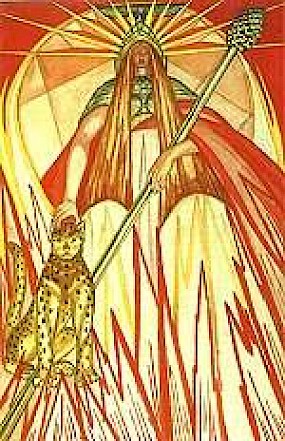
The Queen of Wands

As a suit, Wands are direct, determined and connected to Will and its appropriate application. The Queen of Wands represents a woman who knows exactly what she wants out of life, and aims at her goals with great dedication.

She is often a woman who has experienced conflict and trauma, and learned from these. She’s usually independent, forthright and self-motivated. As a friend she will be loyal and honest, though sometimes given to handing out unwelcome advice, and taking over.

As a parent she can be quite dominant, claiming that she wants her off spring to be self-reliant and confident, but sometimes tending to become impatient, and do things on their behalf in her own way, rather than allowing her children to make up their own minds.

She’s a fighter, who does not suffer fools gladly. She will support and assist those who are vulnerable and needy, offering unceasing energy and determination. She takes up causes readily, and proves herself a worthy adversary. However she has a tendency not to know when to stop, and enjoys being at the forefront of the battle, rather than beavering away on the more routine aspects of any campaign.

This is a forceful and proud woman. She applies high standards to everything she becomes involved in. As a result, she can sometimes be somewhat intolerant of people who do things differently.

So – The Queen of Wands – a fine ally, and a dangerous enemy!

The Queen of Wands

(via angelpaths.com and Alan Blackman)

Starbucks Workers Vote for Democracy!

The Rational National In a historic vote, Starbucks workers in Buffalo, New York voted to unionize! === Support the show at http://TheRationalNational.com/Join Donate Directly at http://PayPal.me/daviddoel Tip at https://streamlabs.com/therationalnat… ‘Join’ on YouTube: https://www.youtube.com/channel/UCo9o… Follow David Doel at http://twitter.com/DavidDoel Follow The Rational National at http://twitter.com/TRNshow Follow on Twitch at http://twitch.tv/TheRationalNational Follow on Facebook: https://facebook.com/trnshow === Sources: https://bit.ly/3IB3NhP (clip 1) https://bit.ly/3oEDYoW (Dave Jamieson thread) https://bit.ly/3yppwVr (Starbucks Workers United) https://bit.ly/3pFm70I (C.M. Lewis thread) https://bit.ly/31K8WDF (Vancouver Island Free Daily) https://youtu.be/Yolib6O7xhU (Bernie Sanders talks with Starbucks workers) https://bit.ly/3Gum12z (Truthout) https://bit.ly/31SIBDe (More Perfect Union video)

How to end the pandemic — and prepare for the next

Maria Van Kerkhove|TEDWomen 2021 (Ted.com)

We will get out of this pandemic, says Maria Van Kerkhove, the COVID-19 Technical Lead of the World Health Organization (WHO). The question is how fast — and if we’ll take what we’ve learned from the past two years and apply it to the next emerging pathogen. In conversation with TED current affairs curator Whitney Pennington Rodgers, Van Kerkhove provides insights on the Omicron variant, details a pandemic preparedness protocol under development at WHO and shares what we all can do to bring the pandemic to a speedy end. “Remain vigilant,” Van Kerkhove says. “Everything you do … will either get us closer to ending this pandemic — or it will prolong it.” (This conversation was recorded on December 3, 2021.)

This talk was presented at an official TED conference, and was featured by our editors on the home page.

ABOUT THE SPEAKERS

Maria Van Kerkhove · Infectious disease epidemiologistDr. Maria Van Kerkhove is the COVID-19 Technical Lead of the World Health Organization (WHO), as well as the Head of the Emerging Diseases and Zoonoses Unit in the WHO’s Health Emergencies Programme.

Whitney Pennington Rodgers · TED current affairs curatorWhitney Pennington Rodgers is an award-winning journalist and media professional.

A Course in Miracles: Lesson 140

Lesson 140:  Only salvation can be said to cure.

“Cure” is a word that cannot be applied to any remedy the world accepts as beneficial. What the world perceives as therapeutic is but what will make the body “better.” When it tries to heal the mind, it sees no separation from the body, where it thinks the mind exists. Its forms of healing thus must substitute illusion for illusion. One belief in sickness takes another form, and so the patient now perceives himself as well.

He is not healed. He merely had a dream that he was sick, and in the dream he found a magic formula to make him well. Yet he has not awakened from the dream, and so his mind remains exactly as it was before. He has not seen the light that would awaken him and end the dream. What difference does the content of a dream make in reality? One either sleeps or wakens. There is nothing in between.

The happy dreams the Holy Spirit brings are different from the dreaming of the world, where one can merely dream he is awake. The dreams forgiveness lets the mind perceive do not induce another form of sleep, so that the dreamer dreams another dream. His happy dreams are heralds of the dawn of truth upon the mind. They lead from sleep to gentle waking, so that dreams are gone. And thus they cure for all eternity.

Atonement heals with certainty, and cures all sickness. For the mind which understands that sickness can be nothing but a dream is not deceived by forms the dream may take. Sickness where guilt is absent cannot come, for it is but another form of guilt. Atonement does not heal the sick, for that is not a cure. It takes away the guilt that makes the sickness possible. And that is cure indeed. For sickness now is gone, with nothing left to which it can return.

Peace be to you who have been cured in God, and not in idle dreams. For cure must come from holiness, and holiness can not be found where sin is cherished. God abides in holy temples. He is barred where sin has entered. Yet there is no place where He is not. And therefore sin can have no home in which to hide from His beneficence. There is no place where holiness is not, and nowhere sin and sickness can abide.

This is the thought that cures. It does not make distinctions among unrealities. Nor does it seek to heal what is not sick, unmindful where the need for healing is. This is no magic. It is merely an appeal to truth, which cannot fail to heal and heal forever. It is not a thought that judges an illusion by its size, its seeming gravity, or anything that is related to the form it takes. It merely focuses on what it is, and knows that no illusion can be real.

Let us not try today to seek to cure what cannot suffer sickness. Healing must be sought but where it is, and then applied to what is sick, so that it can be cured. There is no remedy the world provides that can effect a change in anything. The mind that brings illusions to the truth is really changed. There is no change but this. For how can one illusion differ from another but in attributes that have no substance, no reality, no core, and nothing that is truly different?

Today we seek to change our minds about the source of sickness, for we seek a cure for all illusions, not another shift among them. We will try today to find the source of healing, which is in our minds because our Father placed it there for us. It is not farther from us than ourselves. It is as near to us as our own thoughts; so close it is impossible to lose. We need but seek it and it must be found.

We will not be misled today by what appears to us as sick. We go beyond appearances today and reach the source of healing, from which nothing is exempt. We will succeed to the extent to which we realize that there can never be a meaningful distinction made between what is untrue and equally untrue. Here there are no degrees, and no beliefs that what does not exist is truer in some forms than others. All of them are false, and can be cured because they are not true.

So do we lay aside our amulets, our charms and medicines, our chants and bits of magic in whatever form they take. We will be still and listen for the Voice of healing, which will cure all ills as one, restoring saneness to the Son of God. No voice but this can cure. Today we hear a single Voice which speaks to us of truth, where all illusions end, and peace returns to the eternal, quiet home of God.

We waken hearing Him, and let Him speak to us five minutes as the day begins, and end the day by listening again five minutes more before we go to sleep. Our only preparation is to let our interfering thoughts be laid aside, not separately, but all of them as one. They are the same. We have no need to make them different, and thus delay the time when we can hear our Father speak to us. We hear Him now. We come to Him today.

With nothing in our hands to which we cling, with lifted hearts and listening minds we pray:

Only salvation can be said to cure.
Speak to us, Father, that we may be healed.

And we will feel salvation cover us with soft protection, and with peace so deep that no illusion can disturb our minds, nor offer proof to us that it is real. This will we learn today. And we will say our prayer for healing hourly, and take a minute as the hour strikes, to hear the answer to our prayer be given us as we attend in silence and in joy. This is the day when healing comes to us. This is the day when separation ends, and we remember Who we really are. 

Free Will Astrology: Week of December 9, 2021

DECEMBER 7, 2021 AT 7:00 AM BY ROB BREZSNY (newcity.com)

“No such thing, the queen said, as too many sequins.”

ARIES (March 21-April 19): Aries filmmaker Andrei Tarkovsky (1932–1986) was experimental and innovative and influential. His imagery was often dreamlike, and his themes were metaphysical. He felt that the most crucial aspect of his creative process was his faith. If he could genuinely believe in the work he was doing, he was sure he’d succeed at even the most improbable projects. But that was a challenge for him. “There is nothing more difficult to achieve than a passionate, sincere, quiet faith,” he said. In accordance with your astrological omens during the next twelve months, Aries, I suggest you draw inspiration from his approach. Cultivating a passionate, sincere, quiet faith will be more attainable than it has ever been.

TAURUS (April 20-May 20): “All journeys have secret destinations of which the traveler is unaware,” said philosopher Martin Buber. How true! I would add that the traveler is wise to prepare for the challenges and opportunities of those secret destinations…and be alert for them if they appear…and treat them with welcome and respect, not resistance and avoidance. When travelers follow those protocols, they are far more likely to be delightfully surprised than disappointingly surprised. Everything I just said will apply to you in the coming weeks, Taurus.

GEMINI (May 21-June 20): Gemini sleight-of-hand artist Apollo Robbins may be the best and most famous pickpocket in the world. Fortunately, he uses his skill for entertainment purposes only. He doesn’t steal strangers’ money and valuables from their pockets and purses and jackets. On one occasion, while in the company of former US President Jimmy Carter, he pilfered multiple items from a secret service agent assigned to protect Carter. He gave the items back, of course. It was an amusing and humbling lesson that inspired many law-enforcement officials to seek him out as a consultant. I suspect that in the coming weeks, you may have comparable abilities to trick, fool, beguile and enchant. I hope you will use your superpowers exclusively to carry out good deeds and attract inviting possibilities.

CANCER (June 21-July 22): Many sportswriters regard Michael Jordan as the greatest basketball player ever. He was the Most Valuable Player five times and had a higher scoring average than anyone else who has ever played. And yet he confesses, “I have missed more than 9,000 shots in my career. I have lost almost 300 games. And I have failed over and over and over again in my life.” He says the keys to his success are his familiarity with bungles and his determination to keep going despite his bungles. I invite you to meditate on Jordan’s example in the coming days.

LEO (July 23-Aug. 22): In his poem “Song of Poplars,” Leo author Aldous Huxley speaks to a stand of poplar trees. He asks them if they are an “agony of undefined desires.” Now I will pose the same question to you, Leo. Are you an agony of undefined desires? Or are you a treasury of well-defined desires? I hope it’s the latter. But if it’s not, the coming weeks will be an excellent time to fix the problem. Learning to be precise about the nature of your longings is your growing edge, your frontier. Find out more about what you want, please.

VIRGO (Aug. 23-Sept. 22): Black is your lucky color for the foreseeable future. I invite you to delve further than ever before into its mysteries and meanings and powers. I encourage you to celebrate blackness and honor blackness and nurture blackness in every way you can imagine. For inspiration, meditate on how, in art, black is the presence of all colors. In printing, black is a color needed to produce other colors. In mythology, blackness is the primal source of all life and possibility. In psychology, blackness symbolizes the rich unconscious core from which all vitality emerges.

LIBRA (Sept. 23-Oct. 22): In the first season of the animated TV series “South Park,” its two creators produced an episode called “Make Love, Not Warcraft.” The story lovingly mocked nerds and the culture of online gaming. Soon after sending his handiwork to executive producers, Libran co-creator Trey Parker decided it was a terrible show that would wreck his career. He begged for it to be withheld from broadcast. But the producers ignored his pleas. That turned out to be a lucky break. The episode ultimately won an Emmy Award and became popular with fans. I foresee the possibility of comparable events in your life, Libra. Don’t be too sure you know which of your efforts will work best.

SCORPIO (Oct. 23-Nov. 21): Nobel Prize-winning Scorpio author André Gide (1869–1951) had an unusual relationship with his wife Madeleine Rondeaux. Although married for forty-three years, they never had sex. As long as she was alive, he never mentioned her in his extensive writings. But after she died, he wrote a book about their complex relationship. Here’s the best thing he ever said about her: “I believe it was through her that I drew the need for truthfulness and sincerity.” I’d love for you to be lit up by an influence like Madeleine Rondeaux, Scorpio. I’d be excited for you to cultivate a bond with a person who will inspire your longing to be disarmingly candid and refreshingly genuine. If there are no such characters in your life, go looking for them. If there are, deepen your connection.

SAGITTARIUS (Nov. 22-Dec. 21): A fashion company called Tibi sells a silver mini dress that features thousands of sequins. It’s also available in gold. I wonder if the designers were inspired by poet Mark Doty’s line: “No such thing, the queen said, as too many sequins.” In my astrological estimation, the coming weeks will be a fun time to make this one of your mottoes. You will have a poetic license to be flashy, shiny, bold, swanky, glittery, splashy, sparkling and extravagant. If expressing such themes in the way you dress isn’t appealing, embody more metaphorical versions.

CAPRICORN (Dec. 22-Jan. 19): “I have pasts inside me I did not bury properly,” writes Nigerian poet Ijeoma Umebinyuo. Isn’t that true for each of us? Don’t we all carry around painful memories as if they were still fresh and current? With a little work, we could depotentize at least some of them and consign them to a final resting place where they wouldn’t nag and sting us anymore. The good news, Capricorn, is that the coming weeks will be an excellent time to do just that: bury any pasts that you have not properly buried before now.

AQUARIUS (Jan. 20-Feb. 18): In February 1967, the Beatles recorded their album “Sgt. Pepper’s Lonely Hearts Club Band” in London. A man claiming to be Jesus Christ convinced Paul McCartney to let him weasel his way into the studio. McCartney later said that he was pretty sure it wasn’t the real Jesus. But if by some remote chance it was, he said, he didn’t want to make a big mistake. I bring this to your attention, Aquarius, because I suspect that comparable events may be brewing in your vicinity. My advice: Don’t assume you already know who your teachers and helpers are. Here’s the relevant verse from the Bible: “Do not neglect to show hospitality to strangers, for by so doing some people have entertained angels without knowing it.

PISCES (Feb. 19-March 20): According to Professor of Classics Anne Carson, ancient Greek author Homer “suggested we stand in time with our backs to the future, face to the past.” And why would we do that? To “search for the meaning of the present—scanning history and myth for a precedent.” I bring this to your attention, Pisces, because I think you should avoid such an approach in the coming months. In my view, the next chapter of your life story will be so new, so unpredicted, that it will have no antecedents, no precursory roots that might illuminate its plot and meaning. Your future is unprecedented.

Homework: Send your predictions for the new year—both for yourself and the world. Newsletter.FreeWillAstrology

Nietzsche and the Nazis by Stephen R. C. Hicks

CEE Video Channel *****See timestamps below for easy browsing***** This audiobook edition of Nietzsche and the Nazis is read by the author, Dr. Stephen Hicks. To listen to more of the audiobook on YouTube, visit: https://www.youtube.com/user/NNAudiobook To purchase the book on Amazon: https://www.amazon.com/Nietzsche-Nazi… To download MP3s of the audiobook or for more information, visit Dr. Stephen Hicks’s Nietzsche and the Nazis page: http://www.stephenhicks.org/publicati…00:00 Part 1. Introduction: Philosophy and History/1. Fascinated by history 03:36 2. What is philosophy of history? 04:46 Part 2. Explaining Nazism Philosophically/3. How could Nazism happen? 06:17 4. Five weak explanations for National Socialism 14:31 5. Explaining Nazism philosophically 21:40 Part 3. National Socialist Philosophy/6. The Nazi Party Program 22:44 7. Collectivism, not individualism 24:01 8. Economic socialism, not capitalism 27:40 9. Nationalism, not internationalism or cosmopolitanism 32:25 10. Authoritarianism, not liberal democracy 35:21 11. Idealism, not politics as usual 38:42 12. Nazi democratic success 41:05 Part 4. The Nazis in Power/13. Political controls 43:27 14. Education 51:28 15. Censorship 55:32 16. Eugenics 1:05:16 17. Economic controls 1:11:37 18. Militarization 1:15:55 19. The Holocaust 1:20:31 20. The question of Nazism’s philosophical roots 1:24:58 Part 5. Nietzsche’s Life and Influence/21. Who was Friedrich Nietzsche? 1:27:56 22. God is dead 1:30:27 23. Nihilism’s symptoms 1:34:20 24. Masters and slaves 1:46:05 25. The origin of slave morality 2:01:53 26. The Overman 2:10:44 Part 6. Nietzsche against the Nazis/27. Five differences 2:12:08 28. On the “blond beast” and racism 2:15:19 29. On contemporary Germans 2:16:53 30. On anti-Semitism 2:18:36 31. On the Jews 2:21:10 32. On Judaism and Christianity 2:24:27 33. Summary of the five differences 2:26:06 Part 7. Nietzsche as a Proto-Nazi/34. Anti-individualism and collectivism 2:36:38 35. Conflict of groups 2:39:31 36. Instinct, passion, and anti-reason 2:43:42 37. Conquest and war 2:48:36 38. Authoritarianism 2:52:00 39. Summary of the five similarities 2:53:18 Part 8. Conclusion: Nazi and Anti-Nazi Philosophies/40. Hindsight and future resolve 2:57:34 41. Principled anti-Nazism

Poet and Philosopher David Whyte on Anger, Forgiveness, and What Maturity Really Means

By Maria Popova (newsletter@brainpickings.org)

“Our emotional life maps our incompleteness,” philosopher Martha Nussbaum wrote in her luminous letter of advice to the young“A creature without any needs would never have reasons for fear, or grief, or hope, or anger.” Anger, indeed, is one of the emotions we judge most harshly — in others, as well as in ourselves — and yet understanding anger is central to mapping out the landscape of our interior lives. Aristotle, in planting the civilizational seed for practical wisdom, recognized this when he asked not whether anger is “good” or “bad” but how it shall be used: directed at whom, manifested how, for how long and to what end.

This undervalued soul-mapping quality of anger is what English poet and philosopher David Whyte explores in a section of Consolations: The Solace, Nourishment and Underlying Meaning of Everyday Words (public library) — the same breathtaking volume “dedicated to words and their beautiful hidden and beckoning uncertainty,” which gave us Whyte on the deeper meanings of friendship, love, and heartbreak.

David Whyte (Nicol Ragland Photography)

Many of Whyte’s meditations invert the common understanding of each word and peel off the superficial to reveal the deeper, often counterintuitive meaning — but nowhere more so than in his essay on anger. Whyte writes:

ANGER is the deepest form of compassion, for another, for the world, for the self, for a life, for the body, for a family and for all our ideals, all vulnerable and all, possibly about to be hurt. Stripped of physical imprisonment and violent reaction, anger is the purest form of care, the internal living flame of anger always illuminates what we belong to, what we wish to protect and what we are willing to hazard ourselves for. What we usually call anger is only what is left of its essence when we are overwhelmed by its accompanying vulnerability, when it reaches the lost surface of our mind or our body’s incapacity to hold it, or when it touches the limits of our understanding. What we name as anger is actually only the incoherent physical incapacity to sustain this deep form of care in our outer daily life; the unwillingness to be large enough and generous enough to hold what we love helplessly in our bodies or our mind with the clarity and breadth of our whole being.
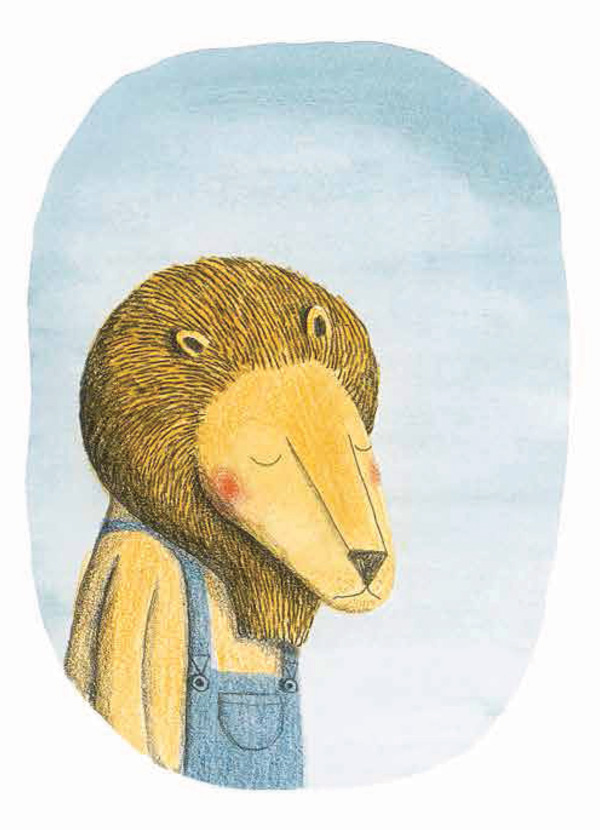
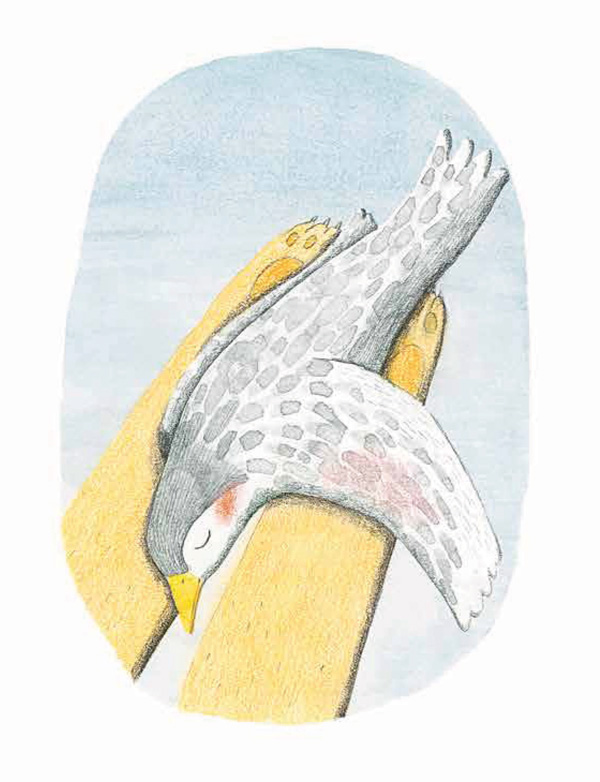
Illustration by Maurice Sendak for a special edition of E.T.A. Hoffmann’s Nutcracker

Such a reconsideration renders Whyte not an apologist for anger but a peacemaker in our eternal war with its underlying vulnerability, which is essentially an eternal war with ourselves — for at its source lies our tenderest, timidest humanity. In a sentiment that calls to mind Brené Brown’s masterful and culturally necessary manifesto for vulnerability — “Vulnerability,” she wrote, “is the birthplace of love, belonging, joy, courage, empathy, accountability, and authenticity.” — Whyte adds:

What we have named as anger on the surface is the violent outer response to our own inner powerlessness, a powerlessness connected to such a profound sense of rawness and care that it can find no proper outer body or identity or voice, or way of life to hold it. What we call anger is often simply the unwillingness to live the full measure of our fears or of our not knowing, in the face of our love for a wife, in the depth of our caring for a son, in our wanting the best, in the face of simply being alive and loving those with whom we live.

Our anger breaks to the surface most often through our feeling there is something profoundly wrong with this powerlessness and vulnerability… Anger in its pure state is the measure of the way we are implicated in the world and made vulnerable through love in all its specifics.

One need only think of Van Gogh — “I am so angry with myself because I cannot do what I should like to do,” he wrote in a letter as he tussled with mental illness — to appreciate Whyte’s expedition beyond anger’s surface tumults and into its innermost core: profound frustration swelling with a sense of personal failure. (Hannah Arendt captured another facet of this in her brilliant essay on how bureaucracy breeds violence — for what is bureaucracy if not the supreme institutionalization of helplessness?)

With remarkable intellectual elegance and a sensitivity to the full dimension of the human spirit, Whyte illuminates the vitalizing underbelly of anger:

Anger truly felt at its center is the essential living flame of being fully alive and fully here; it is a quality to be followed to its source, to be prized, to be tended, and an invitation to finding a way to bring that source fully into the world through making the mind clearer and more generous, the heart more compassionate and the body larger and strong enough to hold it. What we call anger on the surface only serves to define its true underlying quality by being a complete but absolute mirror-opposite of its true internal essence.

Illustration by Marianne Dubuc from The Lion and the Bird

In a related meditation, Whyte considers the nature of forgiveness:

FORGIVENESS is a heartache and difficult to achieve because strangely, it not only refuses to eliminate the original wound, but actually draws us closer to its source. To approach forgiveness is to close in on the nature of the hurt itself, the only remedy being, as we approach its raw center, to reimagine our relation to it.

Echoing Margaret Mead and James Baldwin’s historic dialogue on forgiveness, Whyte — who has also asserted that “all friendships of any length are based on a continued, mutual forgiveness” — explores the true source of forgiveness:

Strangely, forgiveness never arises from the part of us that was actually wounded. The wounded self may be the part of us incapable of forgetting, and perhaps, not actually meant to forget, as if, like the foundational dynamics of the physiological immune system our psychological defenses must remember and organize against any future attacks — after all, the identity of the one who must forgive is actually founded on the very fact of having been wounded.

Stranger still, it is that wounded, branded, un-forgetting part of us that eventually makes forgiveness an act of compassion rather than one of simple forgetting. To forgive is to assume a larger identity than the person who was first hurt, to mature and bring to fruition an identity that can put its arm, not only around the afflicted one within but also around the memories seared within us by the original blow and through a kind of psychological virtuosity, extend our understanding to one who first delivered it. Forgiveness is a skill, a way of preserving clarity, sanity and generosity in an individual life, a beautiful way of shaping the mind to a future we want for ourselves; an admittance that if forgiveness comes through understanding, and if understanding is just a matter of time and application then we might as well begin forgiving right at the beginning of any drama rather than put ourselves through the full cycle of festering, incapacitation, reluctant healing and eventual blessing.

To forgive is to put oneself in a larger gravitational field of experience than the one that first seemed to hurt us. We reimagine ourselves in the light of our maturity and we reimagine the past in the light of our new identity, we allow ourselves to be gifted by a story larger than the story that first hurt us and left us bereft.

Illustration by Marianne Dubuc from The Lion and the Bird

This question of maturity, so intimately tied to forgiveness, is the subject of another of Whyte’s short essays. Echoing Anaïs Nin’s assertion that maturity is a matter of “unifying” and “integrating,” he writes:

MATURITY is the ability to live fully and equally in multiple contexts; most especially, the ability, despite our grief and losses, to courageously inhabit the past the present and the future all at once. The wisdom that comes from maturity is recognized through a disciplined refusal to choose between or isolate three powerful dynamics that form human identity: what has happened, what is happening now and what is about to occur.

Immaturity is shown by making false choices: living only in the past, or only in the present, or only in the future, or even, living only two out of the three.

Maturity is not a static arrived platform, where life is viewed from a calm, untouched oasis of wisdom, but a living elemental frontier between what has happened, what is happening now and the consequences of that past and present; first imagined and then lived into the waiting future.

Maturity calls us to risk ourselves as much as immaturity, but for a bigger picture, a larger horizon; for a powerfully generous outward incarnation of our inward qualities and not for gains that make us smaller, even in the winning.

Maturity, Whyte seems to suggest, becomes a kind of arrival at a sense of enoughness — a willingness to enact what Kurt Vonnegut considered one of the great human virtues: the ability to say, “If this isn’t nice, what is?” Whyte writes:

Maturity beckons also, asking us to be larger, more fluid, more elemental, less cornered, less unilateral, a living conversational intuition between the inherited story, the one we are privileged to inhabit and the one, if we are large enough and broad enough, moveable enough and even, here enough, just, astonishingly, about to occur.

Consolations, it bears repeating, is an absolutely magnificent read — the kind that reorients your world and remains a compass for a lifetime. Complement it with Whyte on ending relationships and breaking the tyranny of work-life balance.