
New Thinking Allowed with Jeffrey Mishlove Jason Reza Jorjani, PhD, is a philosopher and author of Prometheus and Atlas, World State of Emergency, Lovers of Sophia, and Novel Folklore: The Blind Owl of Sadegh Hedayat. Here he maintains that Martin Heidegger is the father of postmodern philosophy — and Friedrich Nietzsche is its grandfather. As a reaction against association with Naziism, French postmodern philosophers made an effort to derive postmodern theories from the work of Karl Marx. In virtually all variations, the central theme of postmodernism is that there are no bedrock nor central truths. Jorjani describes how his own work has been influenced by postmodern thought. (Recorded on April 6, 2018)
Monthly Archives: December 2021
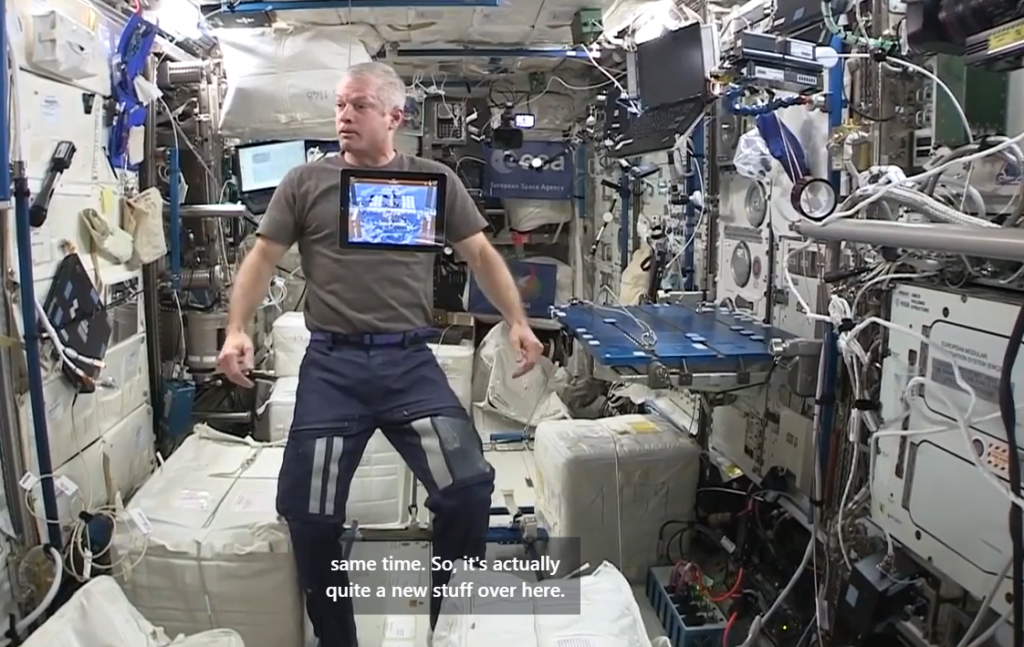
Complete Tour of the International Space Station
Venus Retrograde In Capricorn 2021-2022 – The Power Of Love
| by Astro Butterfly (astrobutterfly.com) |
On December 19th, 2021 Venus goes retrograde in Capricorn.
Venus goes direct on January 29th, 2022. You have 40 days to review, revisit, re-evaluate – and ultimately reset your emotional and relationship patterns so that you find out what you truly want.
There’s no coincidence that Venus is retrograde for exactly 40 days. The number 40 is a sacred number in pretty much every religion and is usually associated with the fulfillment of promises, BUT ONLY after a period of testing, trial and probation.
The purpose of this “trial” or Venus retrograde period is to guide you back to your heart, to allow you to release what is false and no longer serves your path, so that you can experience a rebirth of the heart.

Venus Retrograde in Capricorn – Slave To Love
Venus is what we subjectively value, what is important to us, what feels right. We are in love with someone and loving them is a personal experience – it is the meaning we place on them that makes them special – in our eyes only.
In Capricorn, Venus embodies Capricorn qualities: ambition, determination, and a drive for excellence.
Capricorn is a cardinal sign – if Venus in Capricorn wants something, she will go and get it!
She will not rush in like Venus in Aries, nor listen to what other people have to say like Venus in Libra does – she will take her time and concoct a strategy of how to get from point A to point B and reach her target. Venus in Capricorn knows what she wants!
But there is a small ‘problem’.
Pluto.
Pluto has been in Capricorn since 2008 and he’s not leaving anytime soon, so Venus will spend her entire 40-day retrograde journey in the same room with Pluto!
There are 3 Venus-Pluto conjunctions – we had the first on December 11th, the 2nd December the last one will be happening in March 2022… so this is a lengthy love affair.
Why is there a problem with Venus in Capricorn sharing the same room with Pluto?
If it was not for Pluto, Venus in Capricorn would do what she knows best: achieve, get what she wants, be on top of things.
But Pluto doesn’t work this way.
Pluto represents the Ego death and humbling, the profound process of transformation when we get to accept that there are higher forces at play that we can’t control.
For Venus in Capricorn this doesn’t come easy. Venus in Capricorn is the feminist, the female CEO, the woman who has worked hard her entire life to get what she wants, has worked hard to earn other people’s respect.
But hard work, discipline and all those things that make Capricorn a Capricorn, don’t impress Pluto much.
Pluto doesn’t care how much work we did to get on our hard-earned paths – because his goal is to show us that there are things that we can’t get when we follow the non-Plutonic way, no matter how much we want them. With Pluto, the harder you try, the deeper you sink.

That’s not because Pluto wants to deny us what we want. Pluto has a big heart(and we will get to this aspect a bit later). Pluto only cares about what is real and stripped of ego.
Pluto will destroy everything that is not authentic. The promotion? The successful spouse? The designer bag?
These are things that Venus in Capricorn may work hard for, but as long as they are driven by some sort of societal ideal “I want this because everyone else wants it”, “I want this because it makes me look successful and accomplished”, then Pluto will expose it for what it is – a lack of self-love, or an inability to connect with other humans from an authentic, vulnerable place.
And this is where Pluto comes in. How do we get out of our personal gratification bubble and have a real exchange? How do we allow another human being in? How do we get real about what we want?
“I’m just true to my feelings”. We may think that we know what we want but Pluto comes to show us that we don’t. What we really want, what we value is so primal, so rooted in our identity, that it is directing our life in a way that leaves us powerless – until we become aware of the underlying dynamic.
We are slaves to our desires, our addictions, to instant gratifications, our primal emotional pathways. We know something is not quite right but we can’t help ourselves – we go for it, running on our emotional default mode.
Whether that’s emptying the fridge, binge shopping or meaningless sex – our primal emotional pathways, the dopamine kick, the reward is driving our actions and enslaves us. We may crave connection, a higher love, but how do we get there when all we know is what we’ve been doing all our lives?
There’s always something brutal about Pluto’s revelations, no matter how much shadow work we have done in the past.
The first step of the Plutonic emotional deconditioning process is to become aware of the default mode of our feelings.
The first part of Venus retrograde (from now until January 9th, when Venus meets up with the Sun) will expose “the problem”.
The more we try to resist Pluto’s messages, the harder Pluto will hit us. Pluto always wins, even if it has to wipe out everything that we value in our lives.
It is only then that Pluto can show us what truly holds value for us.
Venus Retrograde in Capricorn – Aspects And Dates
What makes this Venus retrograde cycle so intense, is not only the connection Venus makes with Pluto, but also Chiron in the retrogradation chart.
When Venus goes retrograde, she is in a tight 1-degree conjunction with Pluto. And on the very same day Venus goes retrograde, Chiron goes direct.
Pluto and Chiron are very intense energies to work with – both Pluto and Chiron are interested in shadow work. Neither Pluto, nor Chiron shy away from the dark side. They go as deep as needed, they excavate whatever needs to be brought to the surface, so that whatever needs transforming is transformed.
When Venus goes retrograde, a very powerful emotional revelation will unveil a hidden wound, and at the same time, will set in motion the necessary healing process.
We may suddenly become aware of what we want, of what we value, and we will also suddenly become aware that this time, there’s no “doing the same things over and over again” – we must go to the Underworld first.
Venus retrograde is by definition a journey into the Underworld. Venus slows down, rising lower and lower each day, closer and closer to the horizon, and at some point she just disappears, she just vanishes into the glaring rays of the Sun.
There are many myths around Venus’ disappearance from the evening sky, including the Inanna’s descent into the Underworld. When Venus is retrograde, we too need to go deep within ourselves to do the required emotional work.
In the middle of the Venus retrograde cycle, Venus meets Ereshkigal, her sister – a metaphor for her shadow, for the dark, unintegrated part of her psyche. When that happens, when we embrace our shadow, we experience a rebirth of the heart.
Once the union is completed (when we have the Venus-Sun conjunction) Venus is now ready to rise again, this time as a morning star – with more self awareness, connected to her heart, and to what really matters.
Let’s have a look at the most important aspects Venus makes while in retrograde:
- December 19th, 2021 – Venus goes retrograde at 26° Capricorn
- December 25th, 2021 – Venus retrograde is conjunct Pluto at 25° Capricorn
- January 9th, 2021 – Venus conjunct Sun at 18° Capricorn (a new Venus cycle begins)
- January 29th, 2021 – Venus goes direct at 11° Capricorn
If you have planets and angles between 11°-26° Capricorn you will be especially influenced by this retrogradation. If you’re a Millennial born in the late 80s’ or early 90s’ then you have at least 2 outer planets in Capricorn so this Venus retrograde will influence your generation.
Even if every Venus retrograde is different, Venus retrograde cycles follow a clear pattern.
Venus cycles repeat 5 times over a period of 8 years. Venus goes retrograde in the same 5 signs for approximately 100 years.
Each Venus retrograde is a repetition of the Venus Retrograde that happened 8 years ago, 16 years ago, and so on. Every 8 years Venus goes back to the same area of your chart.
The last time Venus was retrograde in Capricorn was in December 2013 – January 2014. What was going on in your life back then?
Venus Retrograde In Capricorn – The Power Of Love
But wait – there’s more.
The story doesn’t end when Venus goes direct on January 29th, 2022. The whole Venus retrograde cycle, the intense affair with Pluto, has only been a prelude to the great adventure of love. Venus and Pluto will meet again (for the 3rd time) on March 3rd.
Venus is not alone, and this time she’s holding hands with Mars. In fact, we have an incredibly passionate triple conjunction on March 3rd, 2022 – Venus, Mars and Pluto all align at the 27th degree of Capricorn!
If while retrograde, Pluto showed Venus where she is enslaved by her desires and default emotional patterns, when Venus gets to meet Pluto again, she is not the same Persephone-Venus from the dungeons.
Venus is now in touch with her heart and knows what she wants. Venus is now ready to start again – with no emotional conditionings nor expectations of how things “should” be – but with an awareness that what we want, only matters as long as it is in alignment with what Pluto wants.
There’s something magical in being honest and vulnerable. Opening your heart from that place of truth is the most powerful energy in the universe.
Being truly connected with our feelings doesn’t mean whining if we don’t get what we want. Emotional honesty always has a vulnerable, cathartic feel to it. When we open ourselves up, we don’t know how the world will respond – we may win, or we may lose.
There’s an element of surrendering to the feeling, to allowing the feeling to emerge without expectations of particular outcomes.
Opening our hearts is always scary – but thankfully Mars is there to support us. Mars will make sure that Venus doesn’t just bat her lashes and wait for things to come toher – instead, she will go and get them.
When we’re in touch with our heart (Venus), when we act in alignment with what we want (Mars), and with what the universe wants (Pluto), then we’re unstoppable. There is nothing that we cannot put into motion.
The Universe’s frequency is Truth. Anything that is not in alignment with the Source will die. Everything that is in frequency with this Truth, will not only stay, but will flourish and grow to make the impossible possible. That’s the silver lining of this Venus retrograde cycle: the power of love.
Nietzsche on Walking and Creativity
By Maria Popova (brainpickings.org)

Almost everything I write, I “write” in the notebook of the mind, with the foot in motion — what happens at the keyboard upon returning from the long daily walks that sustain me is mostly the work of transcription.
I am far from alone in the reliance on ambulatory solitude as an anchor of creative practice — there is Rebecca Solnit’s lovely definition of walking as “a state in which the mind, the body, and the world are aligned,” and Thomas Bernhard’s insight that “there is nothing more revealing than to see a thinking person walking, just as there is nothing more revealing than to see a walking person thinking,” and Wind in the Willows author Kenneth Grahame’s insistence that solitary walks “set the mind jogging… make it garrulous, exalted, a little mad maybe — certainly creative and suprasensitive,” and of course Thoreau, always Thoreau, who believed that “every walk is a sort of crusade” for returning to our senses.
But hardly any thinker has been shaped and saved by walking more powerfully than Friedrich Nietzsche (October 15, 1844–August 25, 1900).
Friedrich Nietzsche
In his early thirties, intellectually alienated by an academic world unripe for his ideas, romantically deflated after one too many hasty marriage proposals spurned, Nietzsche was leveled by spells of nausea and increasingly debilitating migraines that left him bedridden in a darkened chamber for days at a time, unable to read or write, his eyes daggers of pain. He found only one remedy — long solitary walks.
In the summer of his thirty-third year, having exiled himself to a succession of temporary lodgings across Europe, he wrote from amid the pines of the Black Forest:
I am walking a lot, through the forest, and having tremendous conversations with myself.
A fellow looper, Nietzsche walked the same routes one hour every morning and three every afternoon, half-blind, dreaming of having a small house of his own someplace solitary and walkable:
That summer, he composed The Wanderer and His Shadow — the third and final installment in his aphoristic roadmap to becoming oneself — almost entirely on foot, filling six small notebooks with penciled-in peripatetic thoughts. In it, he considered “the wanderings of the reason and the imagination” by which one becomes a truly free spirit — wanderings that, for him, took place with the mind afoot across mountains and meadows. Long before modern science shed light on the role of the hippocampus in how landscapes shape us, Nietzsche became himself in his wanderings.
Major rivers and mountains of the world compared by length and height, from Atlas de Choix, 1829. (Available as a print, a face mask, stationery cards, and a backpack, benefitting The Nature Conservancy.)
Even in his exile, even in the agony of his social ostracism and the agony between his temples, Nietzsche never lost sight of how provisional and relative privilege is, how lucky he was to have this lifeline:
By his mid-thirties, he was doing “ten hours a day of hermit’s walking.” This was his personal Golden Age, his decade of walking and writing the books that would leave his immortal trail: Zarathustra, The Dawn, Beyond Good and Evil, The Joyous Science, On the Genealogy of Morality. In one of them, he wrote:

Spring Moon at Ninomiya Beach, 1931 — one of Hasui Kawase’s vintage Japanese woodblocks. (Available as a print.)
A virtuoso of metaphor, he adds:
Good books, Nietzsche believed, are spacious books — books that breathe the same open air in which the ideas set down in them forged; bad books exude the cramped smallness in which they were written — works of “closet air, closet ceilings, closet narrowness.” We write, he believed, “only with our feet.” Having declaimed that “without music life would be a mistake,” he held his most cherished art to the same standard:
And so it comes as no surprise that he made walking a centerpiece of his philosophy, manifested in his most fertile thought experiment — the Eternal Return, or Eternal Recurrence. In A Philosophy of Walking (public library), where Nietzsche’s relationship with the mind in motion figures prominently, Frédéric Gros writes:

Afoot by Maria Popova
In his final book, Nietzsche bequeathed his life-tested advice on the life of the mind and the life of the spirit:
Complement with the great Scottish mountaineer and poet Nan Shepherd on the moving body as an instrument of the mind and Lauren Elkin’s splendid contemporary manifesto for walking as creative empowerment, then revisit Nietzsche on love and perseverance, how to find yourself, why a fulfilling life requires embracing rather than running from difficulty, depression and the rehabilitation of hope, and the power of music, the power of language.
Siri, Alexa, Google … what comes next?
Karen Lellouche Tordjman|TED@BCG | September 2021
From Siri to Alexa to Google, virtual assistants already permeate our lives. What will the next generation of these digital helpers look and sound like? Customer experience professional Karen Lellouche Tordjman gives us a glimpse of where they’re headed — and breaks down the two key challenges engineers need to crack in order to usher in a new age of truly smart voice assistants.
This talk was presented at an official TED conference, and was featured by our editors on the home page.
ABOUT THE SPEAKER
Human life span may have no limit, analysis of supercentenarians suggests
Statistical methods predict that old-age record could reach 130 by century’s end
By Tom Siegfried 12.18.2021 (knowablemagazine.org)
In 1875, Harper’s Weekly declared one Lomer Griffin of Lodi, Ohio, to be, “in all probability,” the oldest man in the union. His age, allegedly, was 116.
There were doubters. Lomer’s own wife, for instance, said he was only 103. And William John Thoms, an English author and demographer who had just written a book on human longevity, expressed skepticism of all such centenarian claims. A human’s maximum life span was about 100, Thoms asserted. Certainly no claim of an age over 110 had ever been verified.
“Evidence of any human being having attained the age, not of 130 or 140, but of 110 years … will be found upon examination utterly worthless,” he wrote.
Centuries of expert testimony (not to mention insurance company data) had established 100 years as the longest possible human lifetime, Thoms insisted — apart from a few “extremely rare” exceptions. He expressed bewilderment that some medical authorities still believed that a lifetime might exceed nature’s rigorously imposed limit.
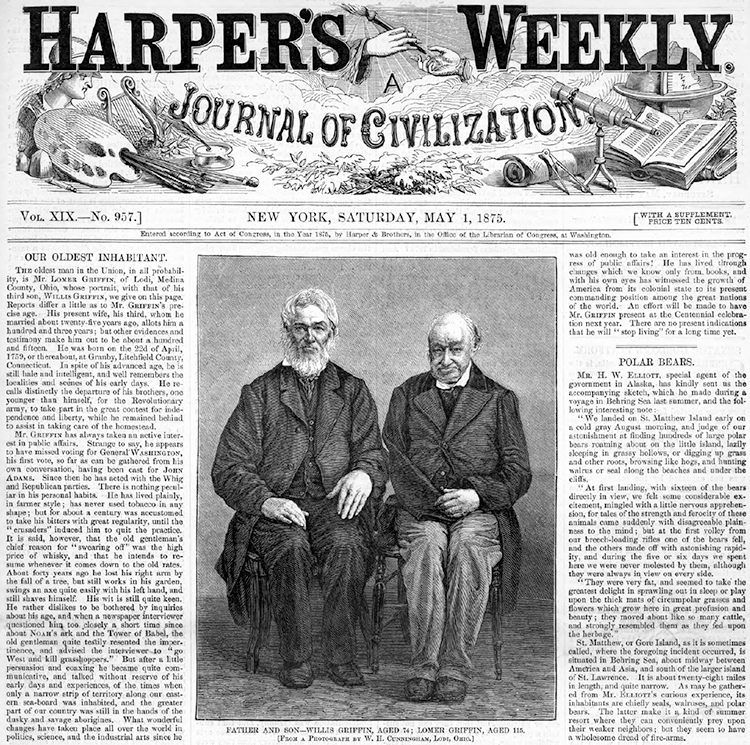
Yet even today, almost a century and a half after Lomer Griffin’s death in 1878 (at age 119 by some accounts), scientists still dispute what the oldest human age could ever be — and whether there is any limit at all. After all, more than a dozen people are alive today with validated ages over 110 (and many more that old are still around, just not documented). Yet in only one verified case has anyone lived beyond 120 — the French woman Jeanne Calment, who died in 1997 at age 122.
“The possible existence of a hard upper limit, a cap, on human lifetimes is hotly debated,” write Léo Belzile and coauthors in a paper to appear in Annual Review of Statistics and Its Application. “There is sustained and widespread interest in understanding the limit, if there is any, to the human life span.”
It’s a question with importance beyond just whether people lie about their age to get recognized by Guinness World Records. For one thing, absence of an upper age limit could affect the viability of social security and pension systems. And determining whether human lifetimes have an inviolate maximum might offer clues to understanding aging, as well as aiding research on prolonging life.
But recent studies have not yet resolved the issue, instead producing controversy arising from competing claims, note Belzile, a statistician at the business university HEC Montréal in Canada, and colleagues. Some of that controversy, they suggest, stems from incorrect methods of statistical analysis. Their own reanalysis of data on extreme lifetimes indicates that any longevity cap would be at least 130 years and possibly exceed 180. And some datasets, the authors report, “put no limit on the human life span.”
These analyses “suggest that the human life span lies well beyond any individual lifetime yet observed or that could be observed in the absence of major medical advances.”
Such conclusions contradict the old claims of Thoms and others that nature imposed a strict limit to lifetime. Thoms supported that view by quoting the 18th century French naturalist Georges-Louis Leclerc, Comte de Buffon. Lifetime extremes did not seem to vary much from culture to culture despite differences in lifestyles or diets, Buffon pointed out. “It will at once be seen that the duration of life depends neither upon habits, nor customs, nor the quality of food, that nothing can change the fixed laws which regulate the number of our years,” he wrote.
Thoms’ own investigation into reports of superlong lifetimes found that in every instance mistakes had been made — a father confused with a son, for instance, or a birth record identified with the wrong child. And of course, some people simply lied.
Even today, the lack of high-quality data confounds statistical attempts to estimate a maximum life span. “Age overstatement is all too frequent, as a very long life is highly respected, so data on supercentenarians must be carefully and individually validated to ascertain that the reported age at death is correct,” write Belzile and coauthors.
Fortunately, some collections provide verified data on the oldest of the old. One such collection, the International Data Base on Longevity, includes information from 13 countries on supercentenarians (those living to age 110 or beyond) and for 10 countries on semisupercentenarians (those reaching 105 but not making it to 110).
Analyzing such datasets requires skillful use of multiple statistical tools to infer maximum longevity. A key concept in that regard is called the “force of mortality,” or “hazard function,” a measure of how likely someone reaching a given age is to live a year longer. (A 70-year-old American male, for instance, has about a 2 percent chance of dying before reaching 71.)
Of course, the hazard of dying changes over time — youngsters are generally much more likely to live another year than a centenarian is, for instance. By establishing how death rates change with age, statistical methods can then be applied to estimate the maximum possible life span.
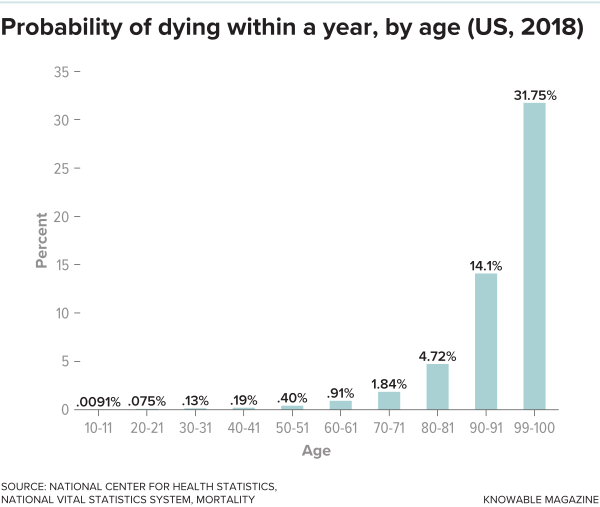
From age 50 or so onward, statistics show, the risk of death increases year by year. In fact, the death rate rises exponentially over much of the adult life span. But after age 80 or so, the rate of mortality increase begins to slow down (an effect referred to as late-life mortality deceleration). Equations that quantify changes in the hazard function show that it levels off at some age between 105 and 110. That means equations derived from lower age groups are unreliable for estimating life span limits; proper analysis requires statistics derived from those aged 105 and up.
Analyses of those groups suggest that by age 110 or so, the rate of dying in each succeeding year is roughly 50 percent (about the same for men as for women). And the data so far do not rule out an even smaller annual chance of death after that.
Depending on the details of the dataset (such as what age ranges are included, and for what country), a possible longevity cap is estimated in the range of 130–180. But in some cases the statistics imply a cap of at least 130, with no upper limit. Mathematically, that means the highest ages in a big enough population would be infinite — implying immortality.
But in reality, there’s no chance that anybody will beat Methuselah’s Biblical old age record of 969. The lack of a mathematical upper bound does not actually allow a potentially infinite life span.
“Every observed lifetime has been and always will be finite,” Belzile and coauthors write, “so careful translation of mathematical truths into everyday language is required.”
Stay in the Know
Sign up for the Knowable newsletter today
For one thing, a 50 percent chance of living to the next year makes the odds pretty slim that a 110-year-old will live to 130 — about one chance in a million. (That’s the equivalent of tossing coins and getting 20 heads in a row). Nevertheless, if the math is correct in indicating no true longevity cap, the old-age record could continue to climb to ages now unimaginable. Other researchers have pointed out that, with an increasing number of supercentenarians around, it’s conceivable that someone will reach 130 in this century. “But a record much above this will remain highly unlikely,” Belzile and colleagues note.
As for Lomer Griffin, claims of reaching age 119 were clearly exaggerated. By his (third) wife’s reckoning he was 106 when he died, and his tombstone agrees, giving his dates as 1772–1878. Alas, his birth record (recorded in Simsbury, Connecticut) shows that Lomer (short for his birth name, Chedorlaomer) didn’t really reach 106 at all. He was born April 22, 1774, making him a mere 104 at death. But he still may very well have been the nation’s oldest citizen, because anyone claiming to be older was probably lying about their age as well.
Editor’s note: Lomer Griffin is the writer’s great-great-great-great grandfather.
Tom Siegfried is a science writer and editor in the Washington, DC, area. His book The Number of the Heavens, about the history of the multiverse, was published in 2019 by Harvard University Press.
James Webb Space Telescope
From Wikipedia, the free encyclopedia.
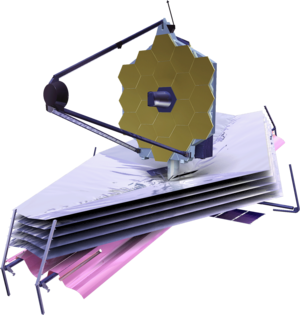
| A rendering of the James Webb Space Telescope with its components fully deployed | |
| Names | Next Generation Space Telescope (NGST) |
|---|---|
| Mission type | Astronomy |
| Operator | NASA / ESA / Canadian Space Agency / STScI[1] |
| Website | webbtelescope.org |
| Mission duration | 10 years (planned) |
| Spacecraft properties | |
| Manufacturer | Northrop Grumman Ball Aerospace & Technologies |
| Launch mass | 6,500 kg (14,300 lb)[2] |
| Dimensions | 20.197 m × 14.162 m (66.26 ft × 46.46 ft), sunshield |
| Power | 2 kW |
| Start of mission | |
| Launch date | 24 December 2021, 12:20 UTC[3][4] |
| Rocket | Ariane 5 ECA (Ariane flight VA256) |
| Launch site | Centre Spatial Guyanais, ELA-3 |
| Contractor | Arianespace |
| Orbital parameters | |
| Reference system | Sun–Earth L2 orbit |
| Regime | Halo orbit |
| Perigee altitude | 374,000 km (232,000 mi)[5] |
| Apogee altitude | 1,500,000 km (930,000 mi) |
| Period | 6 months |
| Main telescope | |
| Type | Korsch telescope |
| Diameter | 6.5 m (21 ft) |
| Focal length | 131.4 m (431 ft) |
| Focal ratio | f/20.2 |
| Collecting area | 25.4 m2 (273 sq ft)[6] |
| Wavelengths | 0.6–28.3 μm (orange to mid-infrared) |
| Transponders | |
| Band | S-band, telemetry, tracking, and controlKa-band, data acquisition |
| Bandwidth | S-band up: 16 kbit/sS-band down: 40 kbit/sKa-band down: up to 28 Mbit/s |
| showInstruments | |
James Webb Space Telescope mission patch |
The James Webb Space Telescope (JWST) is a space telescope being jointly developed by NASA, the European Space Agency (ESA), and the Canadian Space Agency (CSA). It is planned to succeed the Hubble Space Telescope as NASA’s flagship astrophysics mission.[7][8] JWST is scheduled to be launched no earlier than Friday 24 December 2021 during Ariane flight VA256. It will provide improved infrared resolution and sensitivity over Hubble, and will enable a broad range of investigations across the fields of astronomy and cosmology, including observing some of the most distant events and objects in the universe, such as the formation of the first galaxies, and detailed atmospheric characterization of potentially habitable exoplanets.
The primary mirror of JWST, the Optical Telescope Element, consists of 18 hexagonal mirror segments made of gold-plated beryllium which combine to create a 6.5 m (21 ft) diameter mirror — considerably larger than Hubble’s 2.4 m (7 ft 10 in) mirror. Unlike the Hubble telescope, which observes in the near ultraviolet, visible, and near infrared (0.1 to 1 μm) spectra, JWST will observe in a lower frequency range, from long-wavelength visible light through mid-infrared (0.6 to 28.3 μm), which will allow it to observe high redshift objects that are too old and too distant for Hubble to observe.[9][10] The telescope must be kept very cold in order to observe in the infrared without interference, so it will be deployed in space near the Sun–Earth L2 Lagrange point (which is 0.010 au – or 3.9 times the Lunar distance – away from Earth)[11] and a large sunshield made of silicon– and aluminum-coated Kapton will keep its mirror and instruments below 50 K (−223 °C; −370 °F).[12]
The NASA Goddard Space Flight Center (GSFC) is managing the development effort, and the Space Telescope Science Institute will operate Webb after launch.[13] The prime contractor is Northrop Grumman.[14] It is named after James E. Webb,[15] who was the administrator of NASA from 1961 to 1968 and played an integral role in the Apollo program.[16][17]
Development began in 1996 for a launch that was initially planned for 2007 and a US$500 million budget,[18] but the project had numerous delays and cost overruns and underwent a major redesign in 2005.[19] Construction was completed in late 2016, after which its extensive testing phase began.[20][21] In March 2018, NASA further delayed the launch after the telescope’s sunshield ripped during a practice deployment.[22] Launch was delayed again in June 2018 following recommendations from an independent review board.[23][24][25] Work on integration and testing of the telescope was suspended in March 2020 due to the COVID-19 pandemic,[26] adding further delays. Following work resumption, the launch date was delayed to 31 October 2021.[27][28] Problems with the Ariane 5 launch vehicle and the telescope itself subsequently pushed the launch date to 22 December 2021.[29][30][31]
On being mounted on the launch vehicle, a communication problem between the telescope and the launch vehicle led to a further delay to “no earlier than 24 December 2021”.[4] Concerns among the involved scientists and engineers about the launch and deployment of the telescope have been well described.[32][33] On 18 December 2021, NASA announced that JWST is scheduled to be launched at 6:20 am Central(UTC−05:00) on Friday, 24 December 2021 by an Ariane 5 rocket from Kourou, French Guiana, on the northeastern coast of South America.[3][34]
Features
Rough plot of Earth’s atmospheric transmittance (or opacity) to various wavelengths of electromagnetic radiation, including visible light
The James Webb Space Telescope has an expected mass about half of Hubble Space Telescope‘s, but its primary mirror, a 6.5 m (21 ft) diameter gold-coated beryllium reflector will have a collecting area over six times as large, 25.4 m2 (273 sq ft), using 18 hexagonal mirrors with 0.9 m2 (9.7 sq ft) obscuration for the secondary support struts.[35]
JWST is designed primarily for near-infrared astronomy, but can also see orange and red visible light, as well as the mid-infrared region, depending on the instrument. The design emphasizes the near to mid-infrared for three main reasons:
- high-redshift objects have their visible emissions shifted into the infrared
- cold objects such as debris disks and planets emit most strongly in the infrared
- this band is difficult to study from the ground or by existing space telescopes such as Hubble
Ground-based telescopes must look through Earth’s atmosphere, which is opaque in many infrared bands (see figure of atmospheric absorption). Even where the atmosphere is transparent, many of the target chemical compounds, such as water, carbon dioxide, and methane, also exist in the Earth’s atmosphere, vastly complicating analysis. Existing space telescopes such as Hubble cannot study these bands since their mirrors are insufficiently cool (the Hubble mirror is maintained at about 15 °C (288 K; 59 °F)) thus the telescope itself radiates strongly in the infrared bands.[36]
JWST will operate near the Earth–Sun L2 (Lagrange point), approximately 1,500,000 km (930,000 mi) beyond Earth’s orbit. By way of comparison, Hubble orbits 550 km (340 mi) above Earth’s surface, and the Moon is roughly 400,000 km (250,000 mi) from Earth. This distance made post-launch repair or upgrade of JWST hardware virtually impossible with the spaceships available during the telescope design and fabrication stage. Objects near this Lagrange point can orbit the Sun in synchrony with the Earth, allowing the telescope to remain at a roughly constant distance[37] and with constant orientation of the single heatshield and the Bus toward the earth and the sun to block heat and light from the Sun and Earth and maintain communications. This arrangement will keep the temperature of the spacecraft below 50 K (−223 °C; −370 °F), necessary for infrared observations.[12][38]
Sunshield protection
Main article: Sunshield (JWST)Test unit of the sunshield stacked and expanded at the Northrop Grumman facility in California, 2014
To make observations in the infrared spectrum, JWST must be kept under 50 K (−223.2 °C; −369.7 °F); otherwise, infrared radiation from the telescope itself would overwhelm its instruments. It therefore uses a large sunshield to block light and heat from the Sun, Earth, and Moon, and its position near the Earth–Sun L2 point keeps all three bodies on the same side of the spacecraft at all times.[39] Its halo orbit around the L2 point avoids the shadow of the Earth and Moon, maintaining a constant environment for the sunshield and solar arrays.[37] The shielding maintains a stable temperature for the structures on the dark side, which is critical to maintaining precise alignment of the primary mirror segments.[citation needed]
The five-layer sunshield, each layer as thin as a human hair,[40] is constructed from Kapton E, a commercially available polyimide film from DuPont, with membranes specially coated with aluminum on both sides and doped silicon on the Sun-facing side of the two hottest layers to reflect the Sun’s heat back into space.[41] Accidental tears of the delicate film structure during testing in 2018 were among the factors delaying the project.[42]
The sunshield is designed to be folded twelve times so that it will fit within the Ariane 5 rocket’s payload fairing, which is 4.57 m (15.0 ft) in diameter, and 16.19 m (53.1 ft) long. Once deployed at the L2 point, it will unfold to 14.162 m × 21.197 m (46.46 ft × 69.54 ft). The sunshield was hand-assembled at ManTech (NeXolve) in Huntsville, Alabama, before it was delivered to Northrop Grumman in Redondo Beach, California, for testing.[43]
Optics
Main article: Optical Telescope ElementEngineers cleaning a test mirror with carbon dioxide snow, 2015Main mirror assembled at Goddard Space Flight Center, May 2016
JWST’s primary mirror is a 6.5 m (21 ft)-diameter gold-coated beryllium reflector with a collecting area of 25.4 m2 (273 sq ft). If it were built as a single large mirror, this would have been too large for existing launch vehicles. The mirror is therefore composed of 18 hexagonal segments which will unfold after the telescope is launched. Image plane wavefront sensing through phase retrieval will be used to position the mirror segments in the correct location using very precise micro-motors. Subsequent to this initial configuration, they will only need occasional updates every few days to retain optimal focus.[44] This is unlike terrestrial telescopes, for example the Keck telescopes, which continually adjust their mirror segments using active optics to overcome the effects of gravitational and wind loading. The Webb telescope will use 126 small motors to occasionally adjust the optics as there are few environmental disturbances of a telescope in space.[45]
JWST’s optical design is a three-mirror anastigmat,[46] which makes use of curved secondary and tertiary mirrors to deliver images that are free from optical aberrations over a wide field. In addition, there is a fine steering mirror which can adjust its position many times per second to provide image stabilization.
Ball Aerospace & Technologies is the principal optical subcontractor for the JWST project, led by prime contractor Northrop Grumman Aerospace Systems, under a contract from the NASA Goddard Space Flight Center, in Greenbelt, Maryland.[2][47] Eighteen primary mirror segments, secondary, tertiary and fine steering mirrors, plus flight spares have been fabricated and polished by Ball Aerospace & Technologies based on beryllium segment blanks manufactured by several companies including Axsys, Brush Wellman, and Tinsley Laboratories.[citation needed]
The final segment of the primary mirror was installed on 3 February 2016,[48] and the secondary mirror was installed on 3 March 2016.[49]
More at: https://en.wikipedia.org/wiki/James_Webb_Space_Telescope
(Contributed by Sarah Flynn)
Physicists Prove Anyons Exist, a Third Type of Particle in the Universe
Craig Hamilton on evolutionary morality
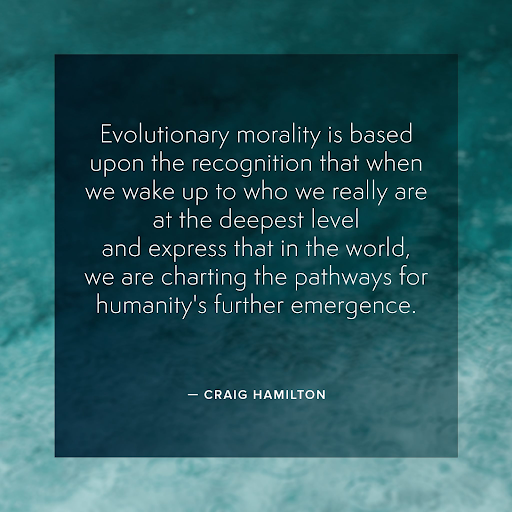


.jpg)
The Secret Commonwealth with James Tunney
New Thinking Allowed with Jeffrey Mishlove James Tunney, LLM, is an Irish barrister who has lectured on legal matters throughout the world. He is a poet, a scholar, and author of The Mystery of the Trapped Light: Mystical Thoughts in the Dark Age of Scientism plus The Mystical Accord: Sutras to Suit Our Times, Lines for Spiritual Evolution; also Empire of Scientism: The Dispiriting Conspiracy and Inevitable Tyranny of Scientocracy, TechBondAge: Slavery of the Human Spirit, and Human Entrance to Transhumanism: Machine Merger and the End of Humanity. His website is http://www.jamestunney.com. Here he describes the context in which Rev. Robert Kirk wrote his classic book about faeries in 1691. He emphasizes that Kirk was not intending to write a book of folklore, but rather an accurate description of experienced phenomena. He points out that interaction with such beings appears to be dependent upon the common gift known in Scotland and Ireland as “second sight” – a form of clairvoyance. He remarks upon the influence of Robert Kirk’s book on psychical research as well as science fiction. New Thinking Allowed host, Jeffrey Mishlove, PhD, is author of The Roots of Consciousness, Psi Development Systems, and The PK Man. Between 1986 and 2002 he hosted and co-produced the original Thinking Allowed public television series. He is the recipient of the only doctoral diploma in “parapsychology” ever awarded by an accredited university (University of California, Berkeley, 1980). He is also the 1st Prize winner of the 2021 Bigelow Institute essay competition regarding the best evidence for survival of human consciousness after permanent bodily death. (Recorded on November 29, 2021) For a complete, updated list with links to all of our videos, see https://newthinkingallowed.com/Listin…. If you would like to join our team of volunteers, helping to promote the New Thinking Allowed YouTube channel on social media, editing and translating videos, creating short video trailers based on our interviews, helping to upgrade our website, or contributing in other ways (we may not even have thought of), please send an email to friends@newthinkingallowed.com. Check out our new website for the New Thinking Allowed Foundation at http://www.newthinkingallowed.org. There you will find our incredible, searchable database as well as opportunities to shop and to support our video productions. There, you can also subscribe to our free, weekly Newsletter! To download and listen to audio versions of the New Thinking Allowed videos, please visit our podcast at https://itunes.apple.com/us/podcast/n…. You can help support our video productions while enjoying a good book. To order The Mystery of the Trapped Light by James Tunney, click here: https://amzn.to/3cPLRR4. OTHER BOOKS : James Tunney, The Mystical Accord: Sutras to Suit Our Times, Lines for Spiritual Evolution – https://amzn.to/2ugamVh James Tunney, Ireland I Don’t Recognize Who She Is — https://amzn.to/2UZfExY James Tunney, Blue Lies September – https://amzn.to/3ak4NFt (As an Amazon Associate we earn from qualifying purchases.) Our Facebook page: https://www.facebook.com/newthinkinga… Our Twitter page: https://twitter.com/newthinkallowed Our Instagram page: https://www.instagram.com/jeffreymish… Our LinkedIn discussion group: https://www.linkedin.com/groups/13860…