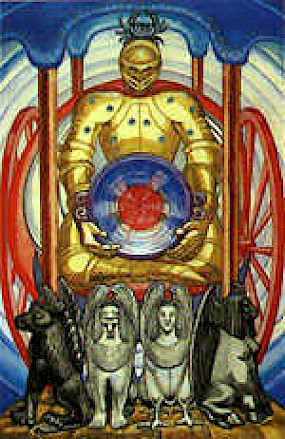
The Chariot is numbered seven and usually depicts a warrior driving a chariot triumphantly home. The chariot is drawn by powerful and wild creatures. These creatures are our Will – a wayward beast to control at the best of times!
The Chariot represents the principle that the human Will functions only when the whole being is behind it. This card is about the struggles we have with ourselves and with life. It promises that with diligence, honesty and perseverence we can overcome the most insurmountable of obstacles.
This is a hopeful and encouraging card, reminding us that we can climb to the heights if we want to. Here we are taught how to master the opposing forces within us, in order to bring them and thus ourselves into harmony. We are cosmic warriors, unfurling, learning and growing – divine and vital parts of the Universe.
The season of winter celebration is upon us. This year it is marked by challenges that continue to ask us to bring our attention to bear on the sacred, the good or, simply, the turning.
Alfred Haferkamp, H.W., M., is a long-time student of The Prosperos and teacher of certain Tai Chi forms. He has served as Dean of The Prosperos since 2009.
This presentation is about 42 minutes long; the introduction is by Ben Gilberti, H.W., M.
Aretha Franklin The official audio of “You’ll Never Walk Alone” by Aretha Franklin with James Cleveland and The Southern California Community Choir from the album ‘Amazing Grace’ (1972). ‘Amazing Grace’ earned Aretha a Grammy in 1973 for Best Soul Gospel Performance and remains the best selling Gospel album of all time. Find a copy of ‘Amazing Grace: The Complete Recordings’ on 4LP and 2CD here: https://rh-ino.co/amazinggrace4lp ? Subscribe to the Aretha Franklin channel and ring the bell to turn on notifications https://lnk.to/SubscribetoArethaFranklin Watch all of Aretha Franklin’s official videos here https://lnk.to/ArethaFranklinVideosID Listen to more Aretha Franklin here https://lnk.to/ArethaFranklinStreamAY Stay In Touch with the Queen of Soul… ? Website https://www.arethafranklin.net/ ? Facebook https://www.facebook.com/arethafranklin/ ? Twitter https://twitter.com/ArethaFranklin ⭐ Instagram https://www.instagram.com/arethasings/ ******************* An icon of 20th and 21st century music, the voice of the civil rights movement, and the undisputed Queen of Soul—there is only one Aretha Franklin. In her incredible six-decade career, Aretha evolved from teenage gospel star to reigning pop and R&B diva, recording classics like “(You Make Me Feel Like) A Natural Woman,” “Chain Of Fools”, “Think” (lyrics by Aretha Franklin), definitive versions of the songs “Respect” and “I Say a Little Prayer”, and global hits like “Freeway Of Love,” “I Knew You Were Waiting (For Me)”, and “A Rose Is Still A Rose.” Altogether, 112 of her singles reached the charts, with 20 No. 1 R&B singles, the most ever by a female artist. She won 18 Grammy Awards (including the first eight trophies for Best Female R&B Vocal Performance) and, out of recognition for her for indelible contribution to American music and culture, received both the Presidential Medal of Freedom and a Pulitzer Prize.
malacomg Paul Porter & Carolyn Traylor – “Peace Be Still” from the DVD “Gospel Legends” available at www.malaco.com. Listen now: https://VA.lnk.to/fSnUCID
Rev. Lawerence Roberts, Paul Porter, Carolyn Traylor
Album
Gospel Legends
Licensed to YouTube by
[Merlin] The Malaco Music Group (on behalf of Malaco Records); Sony ATV Publishing, LatinAutor – SonyATV, LatinAutorPerf, UNIAO BRASILEIRA DE EDITORAS DE MUSICA – UBEM, SOLAR Music Rights Management, and 6 Music Rights Societies
Inez Andrews, Albertina Walker, Dorothy Norwood, The Caravans
Licensed to YouTube by
UMG (on behalf of Gaither Music Group, LLC); UNIAO BRASILEIRA DE EDITORAS DE MUSICA – UBEM, SOLAR Music Rights Management, LatinAutor – SonyATV, Sony ATV Publishing, LatinAutorPerf, and 3 Music Rights Societies
It’s hard to imagine America without cars. Today, almost every family has one. Things as simple as going to the store, going to school, and commuting to work are all but impossible without a car in many places. But about 100 years ago, cars were a rarity.
Prior to the 1920s, streets were considered public spaces. Vendors hawked their wares in them from tables and carts, horse-drawn vehicles clopped up and down them, and pedestrians milled about freely. As cars began to make their appearance on city streets, it was generally understood that it was their responsibility to watch out for pedestrians, not the other way around.
When an automobile hit a pedestrian—as often happened in those early days—the public response was outrage. Cars were seen as interlopers in streets that were considered the domain of pedestrians, and newspapers typically put the blame on drivers when reporting on pedestrian injuries and deaths. Anti-car groups advocated for governors that would limit the speed of automobiles to help make streets safer. The city of Cincinnati OH even attempted a ballot initiative to ban cars without governors from the city.
Auto industry groups responded with a campaign to legally redefine the streets, giving cars the right of way and restricting pedestrians. They offered a service that provided local newspapers with prewritten accounts of traffic accidents, which painted pedestrians as the ones in the wrong. They staged safety campaigns teaching children to stay out of the streets, and they lobbied for cities to pass new laws to control pedestrians.
Los Angeles adopted strict traffic laws for pedestrians in 1925, and these laws were used as the basis of the federal government’s 1928 Model Municipal Traffic Ordinance. This ordinance said pedestrians could only cross the street at crosswalks and at right angles.
In order to train the public to comply with this new way of seeing the streets, auto industry groups relied heavily on public shaming. Tactics included mounting safety campaigns with unruly pedestrians dressed as clowns, encouraging police to whistle and shout at pedestrians, and carrying women back to the sidewalk if they stepped into the street.
The very name “jaywalking” was part of this campaign of shame. During the 1920s, a “jay” was a rube or a hick. So when auto groups called pedestrians who strayed from sidewalks “jaywalkers,” it was quite insulting.
Today, pedestrian accidents are still greeted with outrage in many cases, especially considering that many pedestrian accidents are caused by inattentive drivers. However, we now recognize that pedestrians can be to blame for accidents as well—particularly when they violate the rules of the road and commit the offense of jaywalking, as established way back in the 1920s by those auto industry groups.
jdd2000 Recorded in jan/1972 – at New Temple Missionary Baptist Church in Los Angeles Aretha Franklin 29 years old and Rev James Cleveland YOU’VE GOT A FRIEND (Carole King) PRECIOUS LORD, TAKE MY HAND (Rev. Thomas A. Dorsey) Gravado em jan/1972 – na New Temple Missionary Baptist Church – Los Angeles Aretha Franklin com 29 anos de idade e Rev James Cleveland YOU’VE GOT A FRIEND (Carole King) PRECIOUS LORD, TAKE MY HAND (Rev. Thomas A. Dorsey)
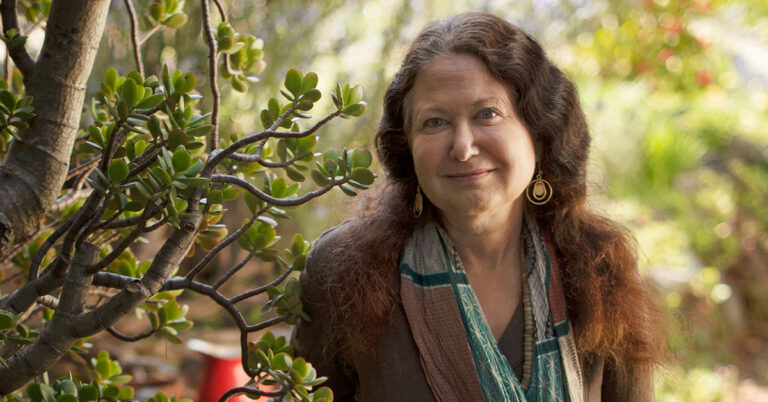
The esteemed writer Jane Hirshfield has been a Zen monk and a visiting artist among neuroscientists. She has said this: “It’s my nature to question, to look at the opposite side. I believe that the best writing also does this … It tells us that where there is sorrow, there will be joy; where there is joy, there will be sorrow … The acknowledgement of the fully complex scope of being is why good art thrills … Acknowledging the fullness of things,” she insists, “is our human task.” And that’s the ground Krista meanders with Jane Hirshfield in this conversation: the fullness of things — through the interplay of Zen and science, poetry and ecology — in her life and writing.
Krista Tippett:The esteemed poet Jane Hirshfield has been a Zen monk and a visiting artist among neuroscientists. She’s said this: “It’s my nature to question, to look at the opposite side. I believe that the best writing also does this … It tells us that where there is sorrow, there will be joy; where there is joy, there will be sorrow … The acknowledgement of the fully complex scope of being is why good art thrills … Acknowledging the fullness of things,” she insists, “is our human task.”
And that’s the ground I meander with Jane Hirshfield in this conversation: the fullness of things, through the interplay of Zen and science, poetry and ecology, in her life and writing.
[Music: “Seven League Boots” by Zoë Keating]
Jane Hirshfield:I have been given this existence, these years on this Earth, to accept what has come into my lifetime — wars, loves, trucks, betrayals, kindness. I must take them. I must find a way to live in this world. You can’t refuse it. And along with the difficult is the radiant, the beautiful, the intimacy with which each one of us enters the life of all of us and figures out, what is our conversation? What is my responsibility? What must be suffered? What can be changed? How can I meet this in a way which both lets me open my eyes the next day and also, perhaps, if I’m lucky, can be of service?
[Music: “Seven League Boots” by Zoë Keating]
Tippett:I’m Krista Tippett, and this is On Being.
Jane Hirshfield’s books of essays and poetry include The Beauty, Come, Thief, and in 2020, Ledger. She lives in California. She grew up on East 20th Street in New York City, in a housing project built for World War II veterans and their families.
You know I’m always interested in the religious and spiritual background of a childhood, and it’s so interesting, because you spent time as a Zen monk. You grew up — and tell me if this is not right — Jewish, but with no religious instruction, although you had a grandfather who was a mystic.
Hirshfield:Yes. [laughs] As always, you’ve done your background reading.
So my parents, I think of it now as, they seemed very surprised when I didn’t turn out to be particularly Jewish. And they never trained me; they sort of forgot to tell me anything. And when I was a child, that vision of what lies behind reality — the Judeo-Christian, basic setup of a divine person as a child understands it — it never made the least bit of sense to me. So it never took.
And yet, one of my few memories from childhood, which must reflect the expression on my mother’s face when I said this to her, is that we were walking along, you know, inside the project, and I suddenly turned to her and looked up and said, “You know, it’s a real pity we aren’t Catholic, because now I can never be a nun.”
[laughs] And you can imagine, you know, how that must have sounded to her.
Tippett:And also it sounds like it, for her, probably came out of nowhere.
Hirshfield:Well, right. And for me, it obviously came out of nowhere. And what I think is kind of remarkable is that, you know, maybe 20 years after that, I was in fact living in a monastery, having a life of dedicated, concentrated, singular focus on something that mattered a great deal to me. It just didn’t happen to be Catholic.
I’m quite baffled in retrospect, when I look at everything that interested me throughout my life, from childhood on. It is almost as though I was dowsing for the worldview and the life that I ended up entering, because, for example, the first book that I ever bought, when I was about eight years old, with my own allowance, was one of those Peter Pauper Press, $1 books of Japanese haiku. What does an eight-year-old understand when she reads Japanese haiku? It can’t be what I find in them now. And yet, something magnetized me.
Tippett:You know, sometimes people call you a Zen poet. And I think you also kind of resist that label. It seems to me, and I don’t think this quite gets at it, either, but it seems to me that a better way to say it might be that the kind of sensibility and values of Zen and of the enterprise of poetry [laughs] converge so elegantly and winsomely, kind of in your person, in your voice. So let me ask the question this way. That essence of reality that you were dowsing for even as a very, very young girl, how would you start to talk about what it was that you found in Zen that met that search in you?
Hirshfield:I think what I was looking for was an unmediated intimacy with things as they actually are, and perhaps an accurate understanding of what is the place of this self that we all walk around inside of and know the world through? It is indispensable and radiant and opulent and comic. But I was looking for a way of being in the world that didn’t make my own skin such an important thing. I wanted to know the world. I wanted to be permeable.
And the actual practice of Zen, for me, all those years when I was in formal training, a great deal of that, I think, was about the courage and the experimentation to simply sit down and be permeable to the world — the inner world, the outer world, the world of events and stories, the world of a single birdsong as the light comes up becoming the entirety of existence.
Tippett:So in March 2020, your book of poetry called Ledger was published by Knopf. It was published on March 10, which, you’ve written, “the day that everything after was cancelled.”
Hirshfield:Yes. [laughs]
Tippett:And what I would really like to do for the rest of our time here is play around and speak around in the poetry, here. You know, it’s pretty fascinating to think about — so yes, of course, it was published on March 10, 2020. But what that means is that it was written before that, right, and yet emerged with a moment that is going to be with us for the rest of our lifetimes and speaks to this world we’ve entered, this world we’re in. And, you know, somewhere you wrote, you were pondering what art, what a poem can probe. And these were two questions you named, and I just feel like they were two questions so alive. They’re so alive in me, they’re so alive in our world. How can we navigate? And also, how can we open our eyes to the next day?
And I would love to just start by two very distinct ways into that, two kind of different directional entryways into that. But I actually want to start by asking you to just read the second poem in the book, not the first — we’re going to read the second and then the first — but “The Bowl.” To me, this feels so — it just captures the synergy we were talking about between the spirit of Zen, the spirit of the urge to write poetry, all of that.
Hirshfield:Yes, and the spirit of trying to figure out a way to take the next breath and enter the next day very much was behind the writing of this.
“The Bowl”
“If meat is put into the bowl, meat is eaten.
“If rice is put into the bowl, it may be cooked.
“If a shoe is put into the bowl, the leather is chewed and chewed over, a sentence that cannot be taken in or forgotten.
“A day, if a day could feel, must feel like a bowl. Wars, loves, trucks, betrayals, kindness, it eats them.
“Then the next day comes, spotless and hungry.
“The bowl cannot be thrown away. It cannot be broken.
“It is calm, uneclipsable, rindless, and, big though it seems, fits exactly in two human hands.
“Hands with ten fingers, fifty-four bones, capacities strange to us almost past measure. Scented—as the curve of the bowl is— with cardamom, star anise, long pepper, cinnamon, hyssop.”
Tippett:So you said that this, for you, was about walking into the next day.
Hirshfield:Yeah. You know, this poem of the bowl, that is our existence. That is our life. Slightly behind it is the idea of the bowl that Buddhist monks in Asian countries carry, in what in Japan is called takuhatsu, the practice of begging. So you would go out from the monastery every morning with your empty bowl, go from household to household, and if the community in which your temple existed, if people didn’t think you were worth feeding, you would go hungry. And so that is, you know, so Buddhist monks are supposed to be vegetarian, but if meat is put into the bowl, meat is eaten.
But that then becomes, far beyond that, my sense of, I have been given this life. I have been given this existence, these years on this Earth, to accept what has come into my lifetime: wars, loves, trucks, betrayals, kindness. I must take them. I must find a way to live in this world. You can’t refuse it. And along with the difficult is the radiant, the beautiful, the scent of the herbs, the “cardamom, star anise, long pepper, cinnamon, hyssop” that cover all of the spices of the globe, and our hands, our 54 bones, our 10 fingers, the intimacy with which each one of us enters the life of all of us and takes what comes to our own door and figures out, what is our conversation? What is my responsibility? What must be suffered? What can be changed? What can I know? How can I meet this in a way which both lets me open my eyes the next day and also, perhaps, if I’m lucky, can be of service to a changed future?
Tippett:Which is a perfect way into, as you say, the poem that is the prologue of the book, “Let Them Not Say.” And I wonder if you would allow me to read this one, and I’d like to ask you to read it at the end.
Hirshfield:Oh, thank you. I’d love that. I’d love to hear it in your voice.
Tippett:It almost feels liturgical, to me. It feels like a confession that I also want to make, that you put into words. [laughs] So present, again — this was true years ago, when you wrote it. When did you say? 2014?
Hirshfield:Yes.
Tippett:I just think there’s a way in which some of this is just more vivid, more unavoidable, un-unseeable, and it feels like it speaks directly to the present. So yeah, “Let Them Not Say.”
“Let them not say: we did not see it. We saw.
“Let them not say: we did not hear it. We heard.
“Let them not say: they did not taste it. We ate, we trembled.
“Let them not say: it was not spoken, not written. We spoke, we witnessed with voices and hands.
“Let them not say: they did nothing. We did not-enough.
“Let them say, as they must say something:
“A kerosene beauty. It burned.
“Let them say we warmed ourselves by it, read by its light, praised, and it burned.”
Hirshfield:You can give all of my readings for me, from now on. That was beautifully read, thank you.
Tippett:Can I just say that when I read this, I said it out loud to myself? I — yeah.
Hirshfield:So it is a poem very much imagining the future looking back on our generation, our time, and seeing, how did it turn out? What did we do? What did we not do? And it is a prayer — it is a poem hoping to make itself someday incomprehensible. But the writing of the poem was my own way of engaging my own heart, mind, body, intentions, vow to have this poem not be true. And so, yes, very much a poem of this moment of great uncertainty. We don’t know yet, how it will turn out, and I do not want them to say we did not-enough.
[music: “McCarthy” by Blue Dot Sessions]
Tippett:I’m Krista Tippett, and this is On Being, today with the poet Jane Hirshfield.
[music: “McCarthy” by Blue Dot Sessions]
You know, what this spoke to very immediately for me is, I’ve recently been having some conversations about trauma. And I’m sure you’re familiar with this phrase, “moral injury,” that comes from — it emerged, I believe, it’s originally used out of a situation of war; this deep, deep distress that can be caused when human beings witness or participate in something that profoundly goes against their own beliefs and values. And I have been pondering that and feeling like, to be alive now, to be a person with the kind of safety and comfort I have — even in a time which I would describe as very hard and unpleasant and frightening, but to be alive now, to be an American now, is to be in a constant state of moral injury, in terms of what is happening to the natural world, the distorted relationship we’ve had to it, which is now coming full circle; also, in terms of just — I mean, you know. You know what I’m saying. I …
Hirshfield:Oh, I know completely what you are saying.
Tippett:[laughs] The racial reckoning that is yet really to happen, and even, and especially, this — what I think of as late capitalism, you know? I want to think that 200 years from now — I know that this is not sustainable, where we are now, that we have an economy that doesn’t work for most people.
Hirshfield:Yes, yes. We need to find a way for the dignity inherent in every human being to not be smothered by a system that chooses some and lets others fall by the wayside. And, you know, this poem became, for me, it changed my life to have written it, because — so I wrote it thinking of the crisis of the biosphere, thinking of the creatures and beings and plants and beauty of the living world. But it was published — I held onto it. I knew it had work to do, and so I didn’t just send it out. I held onto it for two years.
And then the Academy of American Poets got in touch with me, in the end of 2016, and they said, you know, We’d like to run a special poem for our poem of the day, for New Year’s. Do you have something? And I answered, I don’t think I have a New Year’s poem. But nobody has seen this, you know — let me know what you think, but I think I have a poem that would be right for the inauguration day.
And they ran it that day. And I was told that no poem they’d ever run had circulated as widely as that did. So it became a political poem, as well as an environmental poem.
Tippett:But you know, I feel like this poem, “Let Them Not Say,” as it has come into the world, published in this book in March 2020, it’s so much bigger than a political poem, right? It speaks to so much more. This is a species moment, and this poem speaks to our species. And it speaks to this century and the existential challenge of this century.
Hirshfield:Very much so. I have an earlier book with a poem in it which is called “My Species.” So I love that you use that word, because I think about our species a lot, and I think about how absolutely necessary it is that our species proceed in our cultural evolution a little faster than we are.
Tippett:Even, I think, our spiritual evolution, growing into our consciousness, which we also are being given to understand, you know, in a new way at the very same time that there’s so much to lose.
Hirshfield:And in the sense of seeing, you know, not just both sides of the fabric but perhaps all sides of the fabric, because if you’re small enough, you’re inside the threads, looking at them sideways. You know, I think part of that spiritual enlargening that we must find our way to, and I myself must continually, every day, find my way to, has to do with never feeling rage without feeling, equally, tenderness and kinship, because division is not going to be the path towards a viable planet or a viable social compact.
Tippett:That is also such a theme that runs all the way through your poems. I’m just looking — you know, there’s this poem, “Some Questions,” page 23. Would you read that one?
Hirshfield:Sure. “Some Questions”
“Who first asked it? The sand or the footprint, the remembering or the forgetting?
“A house, a door, an hour— which is frame, which picture?
“Where found, old grief-joy, your salvage-yard windows and shutters, your emergency, your emergence?
“Me, you / us, them— What molecule cell creature came first to feel it?
“Was it painful?
“How came separation to chisel, to cherish, to chafe?
“Hammock of burning carbon life wove from, hammock life slept in, unraveling—
did you find us useful, interesting, comic?
“Will you miss them, the cruelty and hunger, the manatees and spoonbills,
awe’s inexplicable swaying?”
Tippett:“Me, you / us, them— What / molecule cell creature came first to feel it? // Was it painful? // How came separation to chisel, to cherish, to chafe?”
Hirshfield:And I think if we enter the world with this sense of inseparable kinship, it gives us a little more tenderness towards our own failures — our failures of separation, our failures of chiseling against one another when we could be cherishing one another. We are a species capable of so many different ways of perceiving our connection and interdependence, and also of perceiving our own transience, because we are transient. Time will continue.
[music:“A Couple Swim” by Bibio]
Tippett;After a short break, more with Jane Hirshfield.
And this week, I have an invitation for you. Please come to On Being’s virtual Midwinter Gathering. It’s happening on the Winter Solstice, Dec. 21, at 5 p.m. Eastern. We have all been given so much to carry, and so much to learn, in an enduringly strange and uncertain 2021. So we’ll gather for a calm hour of reflection, ritual, and poetry. All are welcome. Go to onbeing.org/events to learn more and sign up.
[music:“A Couple Swim” by Bibio]
I’m Krista Tippett, and this is On Being, today exploring the fullness of things by way of the poet Jane Hirshfield’s intersecting passions for Zen and poetry, the natural world and science. In March 2020 she published a work of beauty and prescience called Ledger, and I’ve been asking her to read from its poems.
There’s also the poem “Cataclysm.” You know, something you’ve said is that good poems water hope, that they hold the knowledge of our shared fate.
Hirshfield:“Shared fate” is a very important phrase for me. I’ve been thinking about it since I was 17.
Tippett:What was it when you were 17 that made you start thinking about that?
Hirshfield:You know, I only remember one line of a poem I wrote then, but the line was, “To define the meaning of we is to find a life of a kind, but who is to say?”
You know, that to me has always — who do we think of, when we use the pronoun “we”? And I want my “we” to be absolutely continuous amongst my fellow humans, amongst living beings, amongst the largeness of the expanding universe, down to the tiniest physics and particle. I want — I want to feel like part of a single fabric and to behave as if my responsibility is to the entire fabric. And I know there are many people for whom the pronoun “we” has become quite problematic. And I respect and honor the pain and the history behind that, but I cannot give up the pronoun “we.”
So would you like me to read “Cataclysm”? I can.
Tippett:Would you like to? Why don’t you, yes.
Hirshfield:Sure. OK.
“Cataclysm”
“It begins subtly: the maple withdraws an inch from the birch tree.
“The porcupine wants nothing to do with the skink.
“Fish unschool, sheep unflock to separately graze.
“Clouds meanwhile declare to the sky they have nothing to do with the sky, which is not visible as they are,
“nor knows the trick of turning into infant, tumbling pterodactyls.
“The turtles and moonlight? Their long arrangement is over.
“As for the humans. Let us not speak of the humans. Let us speak of their language.
“The first-person singular condemns the second-person plural for betrayals neither has words left to name.
“The fed consider the hungry and stay silent.”
Tippett:You know, there’s such richness in all the words you have written and are reading, and something that is so deep in this convergent Zen and poetic sensibility is a real reverence for the limits and boundaries of words, right? — that you’re pointing at what words in fact cannot touch. I think what it also highlights and that’s in that poem that you just read — the “Let us not speak of the humans. Let us speak of their language” — the blunt force of words used carelessly, recklessly, even violently.
Hirshfield:I think that all our language is a story. If you say “I,” you are not saying “we.” If you say “you,” you can mean nine different things by the word “you.” And I have an hourlong lecture sort of tracing out all the different yous that you can find in different poems. And some of them are intimate, and some of them are accusatory, and one of them is the capitalized you of the divine, the you between lovers, the you where you’re talking to yourself. And these stories hypnotize and entrance. And part of the job of poetry is to both entrance and, at the same time, break entrancement.
I think reading poems well makes a person not only wiser, but smarter, because the words are being used with such precision. They’re like a well-tuned racing car where every tiny jutting of the material in it is working towards the end of an understanding both what is being said and what is just outside the words. And so if you read a poem with your whole being and your whole attention, which is the only way to read poems, really, you will hear all the unsaid in the white space. It’s one reason why poems on the page look strange, why they don’t fill the page. They don’t fill the page because in that silence around the words, in the white space around the words, is the wisdom. And the completion of the poem is in the person reading it. Whether that’s the writer or the reader, someone else, a poem is nothing unless it is completed with all of the ingredients of the human heart and soul and spirit and language knowledge and the history that is embedded in every word — in its etymological roots, in its usages, in its tone, whether it’s colloquial and jolly or formal or, you know, skeptical.
All of that, when we engage in this way of language that we call poetry, I am able to think thoughts I am unable to have any other way, which is the only reason that I write a poem. I write a poem because I am unable to answer whatever the fracture or bewilderment or question or provocation or even radiance has come to me that I feel I do not completely yet understand or inhabit. And if I cannot figure it out, if I can’t feel — if something does not feel sufficient, if my understanding or my saturation of experience does not yet feel complete and it’s something that matters, that will send me to poetry.
Tippett:And, you know, two things — I think what you just said helps explain why poetry is being consumed — sought and consumed and appreciated with this whole new magnitude, including by young people, in this world now. The internet, which we don’t think of as a place where wisdom proliferates necessarily, is full of poetry, right, also.
Hirshfield:Yes, it is.
Tippett:Alongside a lot of careless use of language, there’s lots of poetry.
Hirshfield:[laughs] Well, the internet is sort of like the world — it offers everything.
Tippett:It’s everything. It’s the canvas — a new canvas for the human condition. And the other thing that I heard in what you just said and that just speaks to something I’ve been thinking about, really in the last years — there’s so much conversation and hand-wringing around our crisis of facts, right? — that how can anything get better if we don’t agree on the facts, which to me points at, in fact, that we’ve had a truth crisis that’s been building because we thought we could depend on facts to be the same thing as truth. And what you just described, which is that truth is not just about the thing that’s said or the words that are used or the facts that are employed, deployed — it is about how those things land in bodies and their wounds and their delights and their fears and their hopes.
Hirshfield:Yes, precisely so. And when I said the internet had everything, I immediately thought afterwards, oh, it does not have touch. It does not have taste. It does not have the senses. And yet, of course, neither does a poem’s ink on the page have any of those things. We bring them to it.
And your very astute distinction between, you know, facts will not take any grip in the world unless the human being in whom they are living finds in them a useful and usable truth. And it’s not about purpose, it’s not about engineering, because what is often the most useful and usable truth is what answers the questions that cannot be solved by means of engineering or facts. You know, if you want to bake a cake, you go to a recipe. If you want to understand something about the last cake your mother ever made, you go to a poem.
[music: “Glinting Giant” by Blue Dot Sessions]
Tippett:I’m Krista Tippett, and this is On Being, today with the poet Jane Hirshfield.
[music: “Glinting Giant” by Blue Dot Sessions]
[laughs] You have this video on TED about the art of the metaphor, which is so delightful.
Hirshfield:[laughs] Thank you.
Tippett:And I guess it’s been passed around a lot. It’s gone around the world. And, you know, there’s something you say in there, which is that you kind of describe a metaphor talking in a way you say conjures up a scene, a new way to talk about one thing, by describing something else. But you make the point that — I remember Elizabeth Alexander saying this to me years and years ago, in one of the first poetry conversations I had. You know, she said, and you say, a poem is not literally true, right? So here’s also part of the problem. Sometimes, when we’re saying the most important things, we’re not dealing in facts at all. And that’s partly the point. It’s not about literal truth. But you said, “It gets under our skin by ghosting right past the logical mind,” which gets us into a lot of trouble — by thinking that facts alone can convey truth, for example. And you said metaphors are “like handles on the door of what we can know and what we can imagine.”
Hirshfield:Yes. Yes. So there’s an example poem in there, which I love. It’s by the Japanese poet Issa. And he says, “On a branch / floating downriver / a cricket, singing.” And that is both, I think, you know, a portrait of something probably actually seen, but it is also a portrait of our entire existence. This is our situation. We are probably in peril. We’re on a branch in the middle of a river. It’s not a good place for a cricket to be, especially if there are some rapids ahead. And yet, what does the cricket do? It sings, because that is its nature, because that is what it has to offer, because it delights in this moment in the sun, because it is on a branch and not yet drowned. And so I feel like our entire lives are in, you know, that haiku, 17 syllables in the Japanese. And I have never forgotten that.
And I’ve never forgotten another haiku by Issa, very different, but equally, profoundly addressing our human condition in this moment, now — written, you know, hundreds of years ago in a different language, a different culture, a different set of crises. He says, “In this world we walk on the roof of hell gathering blossoms.” And when I first encountered that haiku, I thought it was a portrait of a kind of bitterness; that, you know, here we are on the roof of hell, and what do we do? And my feeling about it has completely changed over the years, because I now feel, you know, every inch of ground on this Earth has seen unfathomable suffering, some of it human, some of it not human, but there is no inch of Earth which is not soaked in suffering. But there is also no inch of Earth which is not soaked in joy and in beauty and in radiance.
Tippett:I want to ask you about something — I believe this was also something you said in another interview. It spoke to me, so this is kind of a personal question, but you spoke of “the sense of exile I have always felt.” And I also wonder if that speaks to holding a sense of the fullness of things — even that image of the cricket, right? — that there’s a cost to that, or — “cost” is not the right word. But there’s a way in which holding that or just desiring or committing to hold that, it separates you from the world’s — from what is so around us, what we’re so trained to want, which is a drive to ease and clarity and convenience.
Hirshfield:I often think of the emotions as being information. They are needed information. They are our internal weather, but they are also our weathervane. And if you feel a sense of exile, it is telling you that there is something you need to do to find your right home, to find your sense of your own fullness of life. We are creatures who long for beauty. We are creatures who long for connection. We are creatures who long for largeness. You know, every ploy of the cheapest-trick advertisement is based on a genuine longing. And of course, the practice of Zen has a very interesting relationship to longing, because it both works with it and also holds it a little lightly.
Within the worldview of Buddhism, both are true: there is suffering, and it is our job to try to end it; and the perfection of things as they are is already here around us. We cannot escape from perfection, we cannot escape from suffering, most of the time. And they are not separate. How we feel them is the weather of this moment and the spiritual tenor of who we are at this moment in our lives.
But I hope there is no human being who has not had one moment, at least, when they stood in the world, undone by awe and radiance, and the small self vanishes, and you understand the world as immense and yours, and not yours.
Tippett:Let me ask you, I mean, that brings us really full-circle back to the notion of the human task being to acknowledge the fullness of things, even if in moments and glimpses. As you look at our world now — so I want to kind of ask you this hopeful question. I mean, do you — are there ways — where do you look, or maybe even you’re just going to tell me about something that happened yesterday for 10 minutes. But are there ways in which you see a capacity that is emergent or that is trustworthy, to know that fullness, to acknowledge it despite all the ways we flee it and deny it and shortchange it? Are there ways in which we, this “we” of now, that there’s — that this sense of the fullness of things is sneaking up on us?
Hirshfield:Well, an odd word rose to my mind as you were asking that, which was “vulnerability” — that the great gate to abundance is simply to feel yourself able to be porous, to be open to whatever is put in the bowl that is yours to hold with your 10 fingers and 54 bones. And that is abundance.
And I remember, some years ago, there was the enormous earthquake in Haiti. And I remember watching a news anchor, an American news anchor speaking about the fear of chaos and looting and cultural breakdown. And as that anchor said those words, what you could hear and see behind them was people who were sleeping out in the dark because there were being aftershocks, and they weren’t safe in the buildings. And what were they doing? They were singing. What the reality was, behind that newsperson’s back, was so completely different from what was being evoked by the description. They were singing. They were singing in the dark together.
Tippett:I would like for you to read — for you to read, this time — “Let Them Not Say,” but I want to ask you if there’s anything else you’d like to read, as well.
Hirshfield:Well, can I offer — I don’t know if you’ll be able to slip this in, because it’s so out of the flow of the conversation for me to offer it. But there is a one-line poem, which I think does speak, perhaps, to what we were just talking about. It speaks to the magnitude of our human hearts, spirits, souls, lives …
Tippett:Yes, please, read it.
Hirshfield:… in any circumstance. So the poem is one sentence long, and its title is “Sentence,” in both the grammatical and the judicial sense. And it says: “The body of a starving horse does not forget the size it was born to.” “The body of a starving horse does not forget the size it was born to.”
And, you know, that is biologically true. The skeleton does not grow smaller. But in writing it, even though I thought I was writing what the words say, something in me understood, even as they came from my pen, that what I was trying to evoke was the sense of the magnitude of a human being, under any circumstance, is there. It cannot be erased, cannot be erased.
So I will read “Let Them Not Say.” But your reading will be so much better. [laughs]
Tippett:[laughs] It was a gift from you to me, and everybody who reads it.
Hirshfield:[laughs] And a gift from you to me.
“Let Them Not Say.”
“Let them not say: we did not see it. We saw.
“Let them not say: we did not hear it. We heard.
“Let them not say: they did not taste it. We ate, we trembled.
“Let them not say: it was not spoken, not written. We spoke, we witnessed with voices and hands.
“Let them not say: they did nothing. We did not-enough.
“Let them say, as they must say something:
“A kerosene beauty. It burned.
“Let them say we warmed ourselves by it, read by its light, praised, and it burned.”
Tippett:Thank you.
Hirshfield:Thank you, Krista. I’m so grateful. You know, we could’ve had this conversation at a friend’s house or in a park or in a restaurant, and I would be so happy just to be able to have such a conversation.
[music: “Palms Down” by Blue Dot Sessions]
Tippett:Jane Hirshfield is the author of books of poetry including The Beauty, Come, Thief, and most recently, Ledger, from which we read this hour. She’s also written two books of essays, Nine Gates: Entering the Mind of Poetry and Ten Windows: How Great Poems Transform the World.
[music: “Palms Down” by Blue Dot Sessions]
The On Being Project is: Chris Heagle, Laurén Drommerhausen, Erin Colasacco, Eddie Gonzalez, Lilian Vo, Lucas Johnson, Suzette Burley, Zack Rose, Colleen Scheck, Julie Siple, Gretchen Honnold, Jhaleh Akhavan, Pádraig Ó Tuama, Ben Katt, Gautam Srikishan, Lillie Benowitz, April Adamson, Ashley Her, Matt Martinez, and Amy Chatelaine.
The On Being Project is located on Dakota land. Our lovely theme music is provided and composed by Zoë Keating. And the last voice that you hear, singing at the end of our show, is Cameron Kinghorn.
On Being is an independent, nonprofit production of The On Being Project. It is distributed to public radio stations by WNYC Studios. I created this show at American Public Media.
Our funding partners include:
The Fetzer Institute, helping to build the spiritual foundation for a loving world. Find them at fetzer.org;
Kalliopeia Foundation, dedicated to reconnecting ecology, culture, and spirituality, supporting organizations and initiatives that uphold a sacred relationship with life on Earth. Learn more at kalliopeia.org;
The Osprey Foundation, a catalyst for empowered, healthy, and fulfilled lives;
The Charles Koch Institute’s Courageous Collaborations initiative, discovering and elevating tools to cure intolerance and bridge differences;
The Lilly Endowment, an Indianapolis-based, private family foundation dedicated to its founders’ interests in religion, community development, and education;
And the Ford Foundation, working to strengthen democratic values, reduce poverty and injustice, promote international cooperation, and advance human achievement worldwide.
To the wise person, there are no longer any views concerning what is seen, heard, or sensed. How could one judge or have an opinion concerning such a pure being who has let go of all views? – The Paramatthaka SuttaTweet
Gustav Flaubert said, ‘There is no truth, there is only perception.’ Clinging to views, according to Buddhist teaching, is an empty and futile way of interfacing with the world. The Paramatthaka Sutta, a text from the larger Sutta Nipata, is written as an octet about truth and wisdom that characterizes adherence to points of view and dogmatic thinking as ‘bondage, as the absence of freedom.’ The story of the sutta is that it was presented by the Buddha in response to the story of the blind men and the elephant, as a means of warning against the spiritual inefficacy of dogma and ideology.
He who still abides by a dogmatic view, considering it as the highest in the world, thinking “this is the most excellent” and disparaging other views as inferior, is still considered not to be free from disputes.
When seeing, hearing, or sensing something and considering it as the only thing that can bring comfort and advantage to self, one is always inclined to get caught in it and rule out everything else as inferior.
Caught in one’s view and considering all other views as inferior—this attitude is considered by the wise as bondage, as the absence of freedom. A good practitioner is never too quick to believe what is seen, heard, and sensed, including rules and rites.
A good practitioner has no need to set up a new theory for the world, using the knowledge he has picked up or the rules and rites he is practicing. He does not consider himself as “superior”, “inferior”, or “equal” to anyone.
A good practitioner abandons the notion of self and the tendency to cling to views. He is free and does not depend on anything, even on knowledge. He does not take sides in controversies and does not hold on to any view or dogma.
He does not seek for anything or cling to anything, either this extreme or the other extreme, either in this world or in the other world. He has abandoned all views and no longer has the need to seek for comfort or refuge in any theory or ideology.
To the wise person, there are no longer any views concerning what is seen, heard, or sensed. How could one judge or have an opinion concerning such a pure being who has let go of all views?
A wise person no longer feels the need to set up dogmas or choosing an ideology. All dogmas and ideologies have been abandoned by such a person. A real noble one is never caught in rules or rites. He or she is advancing steadfastly to the shore of liberation and will never return to the realm of bondage.
From the Paramatthaka Sutta Translated by Thich Nhat Hanh Featured in: Chanting from the Heart
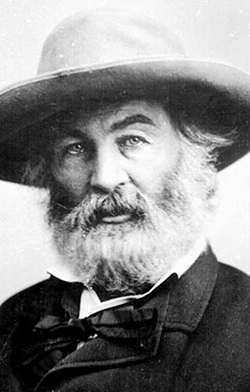
After Walt Whitman suffered a stroke at the age of 54, he spent his time immersed in nature as he slowly recovered his health. This passage from the collection of his notes and sketches called Specimen Days is a beautiful meditation on trees and their eloquence, endurance and imperturbability. ‘It is, yet says nothing,’ he writes admiringly of the 90-foot high poplar he encounters, elevating the tree to a heroic status relative to ‘this gusty-temper’d little whiffet, man.’ He goes on to touch on the deep state of ‘inherency’ embodied by trees; an existence unto itself, lived without regard for the superficial preferences of others. His musings reflect Herman Hesse’s ode to trees, as well as the more recent passage about uselessness as survival from Jenny Odell. For an ancient Chinese poem about the holiness of pines, read Ch’i-chi’s 9th century verse here.
Sept. 1. — I should not take either the biggest or the most picturesque tree to illustrate it. Here is one of my favorites now before me, a fine yellow poplar, quite straight, perhaps 90 feet high, and four thick at the butt. How strong, vital, enduring! how dumbly eloquent! What suggestions of imperturbability and being, as against the human trait of mere seeming. Then the qualities, almost emotional, palpably artistic, heroic, of a tree; so innocent and harmless, yet so savage. It is, yet says nothing. How it rebukes by its tough and equable serenity all weathers, this gusty-temper’d little whiffet, man, that runs indoors at a mite of rain or snow. Science (or rather half-way science) scoffs at reminiscence of dryad and hamadryad, and of trees speaking. But, if they don’t, they do as well as most speaking, writing, poetry, sermons — or rather they do a great deal better. I should say indeed that those old dryad-reminiscences are quite as true as any, and profounder than most reminiscences we get. (“Cut this out,” as the quack mediciners say, and keep by you.) Go and sit in a grove or woods, with one or more of those voiceless companions, and read the foregoing, and think.
One lesson from affiliating a tree — perhaps the greatest moral lesson anyhow from earth, rocks, animals, is that same lesson of inherency, of what is, without the least regard to what the looker-on (the critic) supposes or says, or whether he likes or dislikes. What worse — what more general malady pervades each and all of us, our literature, education, attitude toward each other, (even toward ourselves,) than a morbid trouble about seems, (generally temporarily seems too,) and no trouble at all, or hardly any, about the sane, slow-growing, perennial, real parts of character, books, friendship, marriage — humanity’s invisible foundations and hold-together? (As the all-basis, the nerve, the great-sympathetic, the plenum within humanity, giving stamp to everything, is necessarily invisible.)
Aug. 4, 6 P.M. — Lights and shades and rare effects on tree-foliage and grass — transparent greens, grays, &c., all in sunset pomp and dazzle. The clear beams are now thrown in many new places, on the quilted, seam’d, bronze-drab, lower tree-trunks, shadow’d except at this hour — now flooding their young and old columnar ruggedness with strong light, unfolding to my sense new amazing features of silent, shaggy charm, the solid bark, the expression of harmless impassiveness, with many a bulge and gnarl unreck’d before. In the revealings of such light, such exceptional hour, such mood, one does not wonder at the old story fables, (indeed, why fables?) of people falling into love-sickness with trees, seiz’d extatic with the mystic realism of the resistless silent strength in them — strength, which after all is perhaps the last, completest, highest beauty.