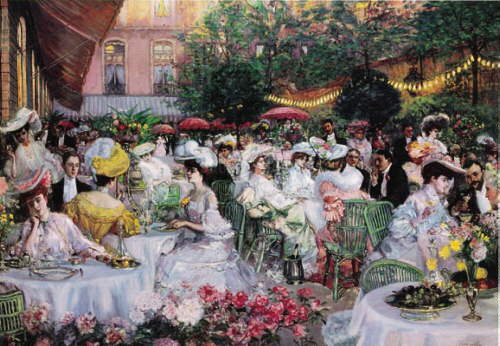
The Dinner in the Hotel Ritz in Paris, 1904
Art: Pierre-Georges Jeanniot

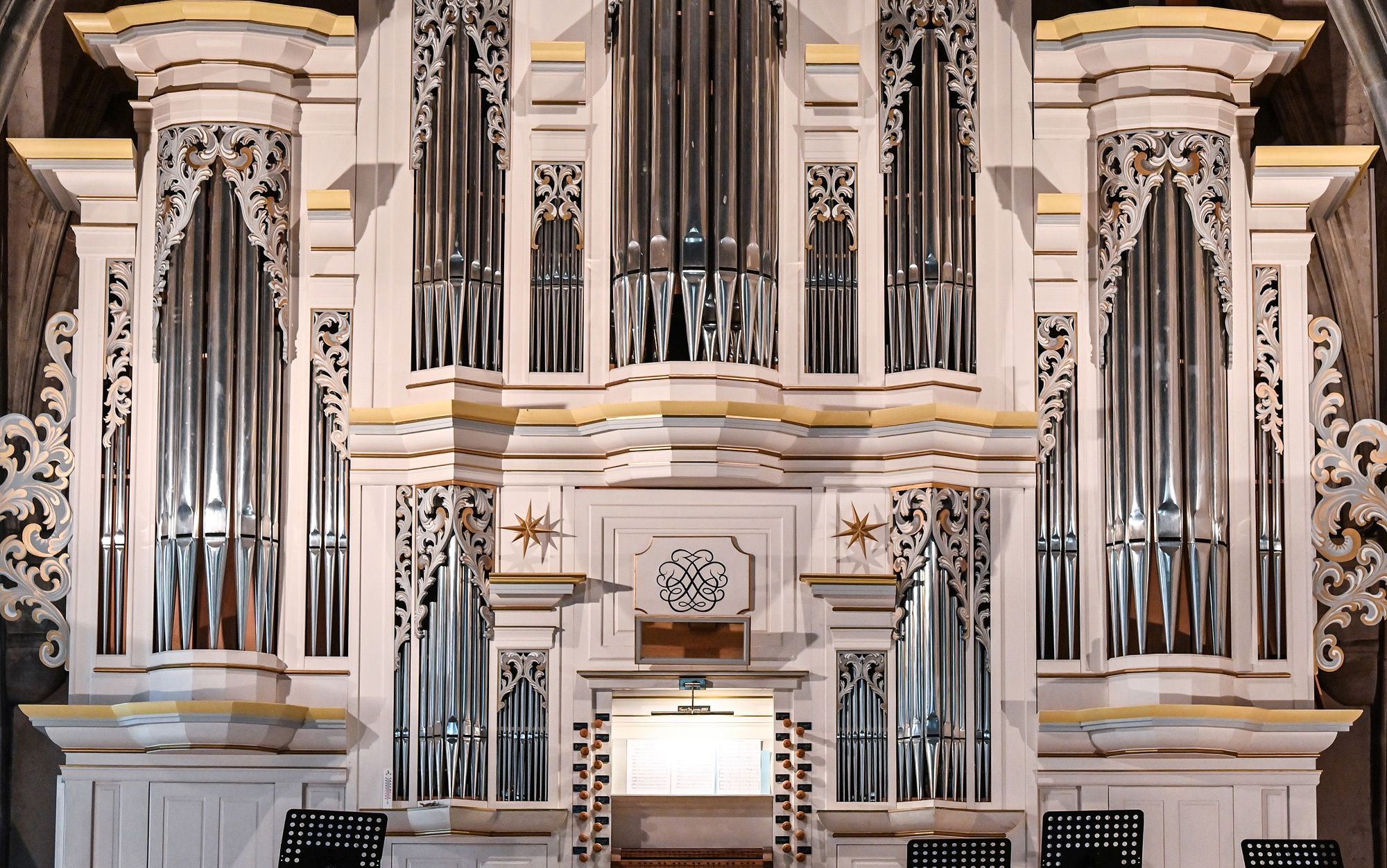
Look beneath the surface of Bach’s music and you will find a fascinating hidden world of numerology and cunning craftThe church of Pontaumur in the Auvergne, France, houses the only replica in Europe of the Arnstadt organ on which Bach composed in his early days. Photo by Philippe Dezmazes/AfP/Getty
Milton Mermikides is reader in music at the University of Surrey, professor of jazz guitar at the Royal College of Music, and deputy director of the International Guitar Research Centre. He is also a composer, producer, electronic musician, illustrator and guitarist, and has collaborated with Tim Minchin, John Williams, Brian Eno and Sam Brown, among others. He lives in London.
Edited byNigel Warburton
10 September 2021 (aeon.co)
Some 14 billion miles from here floats a 12-inch gold-plated record. This artefact was placed onboard the Voyager 1 space probe in 1977 (and another on the Voyager 2 sister vessel) and now, having long completed its scheduled planetary flybys, it hurtles at nearly 500 times the speed of sound into deep space. Created to communicate the story of human civilisation to any extraterrestrial who happens to encounter it, the Golden Record includes images, mathematical equations, astronomical coordinates and sounds. Its aim is to convey – in the absence of a common language – not just the facts of human existence, but also evidence of our intelligence.
One elegant method of how this might be possible is through the medium of music, which – aside from lyrical content – has the advantages of neither needing visual representation nor a lexicon of phonic objects. It speaks for itself through the common fabric of frequencies – amplitude over time – which can be etched directly and unfiltered into the surface of the disc. The importance of music to the project is clear: hand-etched on the record’s surface is the inscription ‘To the makers of music – all worlds, all times.’

When deciding which music could represent the pinnacle of human spirit and intelligence, Johann Sebastian Bach was inevitably suggested but – according to an unverified but irresistible anecdote – there was some dissent, because presenting music of such beauty and intelligence to any extraterrestrial listener would be ‘just showing off’.
Ultimately, among the commendably diverse 27 pieces of music included on the record, a full three are by Bach, suggesting perhaps that he alone represents more than 11 per cent of the value of our entire musical history. This vision of Bach’s music floating above the Earth as a symbol of musical perfection resonates with a prevailing perception of Bach’s art: somehow transcendent, timeless, and not of this world. His music represents the pinnacle of the Baroque era’s concerns with counterpoint but also can be readily adopted for a wide range of instrumentations, eras and styles, from ‘classical’ to jazz, pop and electronic. Bach’s music, it seems, is untroubled by the boundaries of instrument, style or era.
Musicians and music lovers rapidly run out of superlatives to describe his purported genius. To Beethoven, he was ‘the immortal god of harmony’; to Wagner ‘the most stupendous miracle in all music’; to Max Reger ‘the beginning and end of all music’. And Brahms declared, in a letter to Clara Schumann in reference to Bach’s Chaconne:
On one stave, for a small instrument, the man writes a whole world of the deepest thoughts and most powerful feelings. If I imagined that I could have created, even conceived the piece, I am quite certain that the excess of excitement and earth-shattering experience would have driven me out of my mind.
Connections to the divine are never far off, as in Mauricio Kagel’s quip that no one believes in God anymore but everyone believes in Bach, or even – in the words of a contemporary atheist philosopher – that Bach is the best argument for the existence of God.
With his music’s reputation of some kind of ‘eternal truth’ and implications of their divine transcription, it can be easy to forget that such heavenly work was the result of earthly toils. By blind luck of technological history, we are left with the beautiful manuscripts, but minimal record of the real-world stress, training, limited time and inky mess of putting quill to page. If indeed Bach’s talent was God-given, then it was a gift that demanded a reimbursement of decades of constant study, pouring over Vivaldi scores by candlelight with failing eyes, walking 280 miles just to watch one organist perform, the re-use of compositional material, adaptation to changing tastes, all amid a dizzying array of professional demands, awkward taskmasters, petulant critics, vain royalty and personal tragedies.
To appreciate the music of Bach (which I, like many others, find staggeringly beautiful), it can be instructive to understand both the mechanics and the mechanic: the musical systems, and the man himself – setting aside any received wisdom about his purported brilliance.
One can immediately learn something of Bach from his portraits, or in fact their scarcity – given his lack of time and reluctance to engage in self-aggrandisement. Artists complained that he never stayed still long enough to capture a likeness, and the few portraits we have of him say more about his music than about his appearance and character: he is a prop to hold up a fragment of a work, or to wear a hidden musical code on his clothing; it’s the music in the foreground, rather than the musician.
Above all, Bach was crafty both in his music and life, and he adored puzzles, games and general inventive mischief. His monogram on his wax seal and his goblet was his own design, and at first glance it looks like an ornate decorative symmetrical crest of interlocking swirls. It is in fact built up from his initials JSB overlaid and mirrored, which is apt, as his music uses mirror-like reversals, and is, like the monogram, something immediately beautiful but with hidden meaning.

Another example of Bach encoding information into decoration might be found in the title page of his 24 preludes and fugues for The Well-tempered Clavier (the first prelude of which is included on the Golden Record). Often this series of works (one for each major and minor key) – is mistakenly taken to have been written for the now-ubiquitous even-tempered system. In an even-tempered system, the pitch difference between each chromatic note (for example, each adjacent note on a piano) is identical. With a well-tempered system, however, the gaps differ slightly, and are set up to provide sonorities in some keys closer to those that emerge from the ‘natural’ harmonic series. Choirs, string ensembles and other instruments unfettered by a fixed pitch system tend to converge upon these ‘purer’ intervals in performance – string ensembles and choirs make subtle but precise adjustments so that chords resonate, and these deviate from the fixed 12-note grid-lines of an even-tempered instrument such as the modern piano.
Bach’s name in the German notation system happens to spell out a haunting chromatic melody
There are countless well-tempered systems possible, and several at Bach’s time, however it was a question for centuries which system Bach used for The Well-tempered Clavier, and how each of those keys would have sounded. It was not until 2005, a quarter of a millennium after its composition, that the musicologist Bradley Lehman made an argument that the decorative symbol at the top of the page, which for generations had been dismissed as an ornamental ‘meaningless’ series of loops, contained coded instructions for how to construct the temperament, hidden in plain sight. Lehman suggests that the three types of loop (plain, knotted, and double-knotted) represent the variously tuned gaps between the notes, and one has been identified with a ‘C’:

But Bach not only hid messages in decorative shapes but sometimes within his music itself. His name in the German notation system – which, unlike the rest of the Western world, runs from A to H – happens to spell out a haunting chromatic melody. Bach enjoyed embedding this motif in his music, and generations of composers from Liszt to Brahms to Schoenberg to Arvo Pärt have written homages to Bach using this melody:

Audio of the BACH Motif, performed by Bridget Mermikides
These four notes can even be represented as one, at the intersection of four clefs, in a crucifix symbolisation – reading clockwise from the top, the clefs are tenor, alto, treble in the key of C major (or A minor), treble in F major (or D minor):

Bach, who was obsessed with numerology, took the codification of his name further, and by adding up the alphabetic placement of these letters came up with the ‘Bach number’ of 14 (2 + 1 + 3 + 8), a number that would recur encoded in many of his compositions. It also appears in the so-called Volbach portrait of 1750, in which Bach wears 14 (unnaturally close) buttons on his waistcoat. The biblical number of buttons on his coat (seven, for the Sabbath day, and the seven original divisions of the Bible) are also unlikely to be accidental. Indeed, Bach’s engagement with numerology has invited furtive (and often overzealous) hunting of numerical meaning throughout his music.
In an earlier portrait from 1748, by Elias Gottlob Haussmann, Bach holds a short piece, Canon Triplex in Six Voices, his entry piece to the Society of Musical Sciences – a collective of elite composers that included Handel and Telemann, who believed that music was deeply linked with the sciences and the cosmos, a sentiment shared by Pythagoras’ concept of the ‘Harmony of the Spheres’. Bach was of course accepted, but allowed Handel to take his place before him, so that Bach could be the 14th member. The piece itself is from The Goldberg Variations, the first of Bach’s four major late collections of compositions (or ‘summation works’) and an important contribution to keyboard repertoire. Published in 1741, it features an aria with a set of variations. After their, completion Bach – the constant tinkerer – could not resist adding a set of canons on the last page based on the aria’s bassline. How many of these canons did he write? Fourteen, of course.

The three short lines in the 1748 portrait are not a fragment or cartoon of the work – they are in fact the entire piece. To understand better why a piece can fit in a handful of bars and why Bach would pose proudly and submit it to his esteemed peers requires a little understanding of canonic principles. That he could embody his complex musical thoughts in such an economical way reveals his technical and musical mastery.
The simplest form of canon is known as a round – or ‘perpetual’ canon – think ‘Frère Jacques’). It involves a melody played identically in multiple voices (instrumental layers), starting at different time intervals. This ‘phasing’ of one melodic line builds a more complex texture and interaction from this simple component. Its underlying mechanics are shown in an example below. The first voice sings a looped melody made up of three phrases (A-C), the second and third voices sing the three-phrase melody but displaced by one and two phrases respectively:

This results in all the phrases being heard together, distributed between the voices, in a theoretically infinite loop. To compose such a simple canon might involve starting with Phrase A and then composing material for additional layers above it. However, some more sophisticated reverse-engineering could be employed: if we start with the complete stack of complementary phrases that work well together in terms of rhythmic interest and harmonic agreement, then we can slice up the constituent phrases and rejoin them in a preferred linear order. The voices then rebuild this stack through the canonic process.
But the craft of canonic writing – particularly in the case of Bach – runs much deeper than this simple example. Some canons involve phrases that, when delayed, are transposed to different intervals or stretched rhythmically. They can be turned upside down (‘inverted’), run backwards (‘retrograde’, as in Bach’s ‘crab canons’) or even both, as in ‘table canons’ that can be read simultaneously from one stave by musicians from their own perspectives at either side of a table. Multiple canons can even be superimposed upon one another and played simultaneously – even on a single (usually keyboard) instrument. These offer greater compositional complexity and constraint than the simple round presented above, and Bach revelled in such challenges. Take Bach’s Canon Triplex in Six Voices from the 1748 portrait.

Audio of the Canon Triplex, performed by Bridget Mermikides
Here, although only three voices are notated, Bach sneaks in some ‘decorative clues’ as to how they are to be manipulated into a canon. Some of these ‘hacked notations’ are outlined below, and show additional key signatures, phrase re-entry points, upside-down suggestions and a hint that each voice is doubled. Why is Bach so obtuse in his instructions? This is an example of a ‘puzzle canon’ or ‘riddle canon’ where the ‘solution’ to the canon has to be deduced from clues in the score, or solely from the reader’s invention. The musician is not simply given the music: it has to be earned.
We should also acknowledge that the piece involved some careful tinkering
The music depicted in the Canon Triplex portrait is not just one canon, where one melody is overlaid against itself, but three simultaneous canons. In addition, each of these canons isn’t a simple delay of material, but involves turning the melody upside down against a delayed version of itself.

Unlike in a simple round, here each canon obliges an internal consistency (eg, A1 and A2 make a pleasing phrase, and A1 and A2 work together if either is inverted). Furthermore, this collective stack must work with two other similarly constrained stacks. We should, of course, marvel at Bach’s skill in achieving such canonic delights and communicating these musical ideas with such elegance. However, we should also acknowledge that the piece involved some careful tinkering, even though it stays entirely in one key and is structurally static (or infinite). Musical output is somehow limited by the constraints imposed.
However, Bach thought enough of the Canon Triplex – a postcard rather than grand work – to be immortalised with it in his portrait. This reveals some profound aspects of Bach’s musical craft and conception that are not commonly understood musical devices, even in our contemporary music culture. These might be termed:
This latter device – multiplicity – is the DNA of the musical discipline of counterpoint – the interaction of multiple musical lines that are both independent melodies and collectively harmonically coherent. Bach is rightfully held up as a master of counterpoint. This is evident – perhaps a defining feature – across all his works. Most directly in his canons, which act – and are sometimes unfairly dismissed – as musical toys: like a Newton’s cradle, they are set in motion and quickly form a mesmerising but short repetitive pattern until manually stopped. However, where such canonic and contrapuntal mechanics meet more conventional (and complete) compositional structure is in his craft of the fugue.
Afugue (from the Latin fugere, meaning ‘to flee’ or ‘to chase’) is a musical form that – though variable in tempo, metre, duration and harmony – always follows a set script. At its centre is a single melodic phrase (the ‘subject’) that forms the basis of the fugue’s thematic material, across multiple independent musical voices (or ‘parts’). The first voice starts alone stating the subject, and then continues with ‘counter-subject’ material complementing a second voice that reintroduces the subject (usually at a different interval). This pattern continues until all (commonly, three or four voices) are introduced and the piece develops, exploring more distant harmony and variations – extending, shortening and reworking the thematic material while maintaining a familial connection.
Finally, the voices return to the original key and restate the subject to conclude. This conversation between multiple and equal voices, independently coherent, are linked by thematic material and mutual harmonic agreement in service of an overarching structure. Again, we see here the pluripotency of the fugue’s subject in its multiple variations and contexts. We also witness the multiplicity of each of the voices that act both as independent and equally important melodies (a horizontal coherence) and as accompaniments and harmonisations of each other (a vertical coherence).
Bach was a master of such a subtle juggling act, and he selected or designed subjects that had melodic identity and interest, as well as being malleable enough for multiple functions. In so doing, he produced with a staggering industry many sophisticated fugues – each one a highly expressive musical work in its own right, as well as a logical solution to a self-imposed puzzle. In The Well-tempered Clavier alone, he completed fugues (some with as many as five voices) for every one of the 24 major and minor keys, and then some 20 years afterwards repeated the entire exercise again in a second book. Bach gained such experience, skill and fluency in fugal writing that he was allegedly able to improvise them even on demand.
It was reports of Bach’s prowess that led King Frederick II of Prussia to invite him repeatedly to his palace. Frederick the Great was a keen flautist who employed Bach’s son Carl Philipp Emanuel as the harpsichordist in his private orchestra, and had a genuine passion for music, composing many works for himself and for his ensemble, reportedly practising for four hours a day and taking his flute and a collapsible harpsichord with him on military campaigns. As is often the case with those privileged with wealth and power, he liked to surround and associate himself with the finest musicians, artists and poets. Despite several requests for Bach’s company, they met only once and for a matter of hours, when Bach made the onerous journey from Leipzig to Frederick’s magnificent town palace Stadtschloss in Berlin. Bach – always keen for patronage – also used the opportunity to see his new grandson for the first time.
Bach’s ‘failure’ to fulfil the king’s requests is a significant and profound moment in music history
The meeting – for which we have an eyewitness report and supporting documents – gives a rare insight into Bach’s compositional process and to both the extent – and limits – of his craft. After Bach had sampled Frederick’s collection of keyboards, the king arrived at what was clearly a planned attack. As much as Frederick had a genuine admiration and earned appreciation for musical skill, he also enjoyed demonstrating his power and putting his subjects in their place. Voltaire claimed that, for Frederick, a friend was as a ‘slave’, and an invitation to dinner was an opportunity to ‘make a jest of you all evening long’. Enquiring after Bach’s reported skills, he asked the master if he wouldn’t mind improvising a fugue on a subject of the king’s own creation, and immediately presented him with the following theme:

Audio of The Royal Theme
This is a cunningly crafted challenge. It fulfils the overt features of a fugal subject, with a clear tonal centre, and logical phrasing – it is melodically coherent. However, in all other ways, it is fiendishly difficult: the use of chromatic notes and their rhythmic placement across its long duration make them a beast to negotiate in a contrapuntal setting, requiring significant sophisticated harmonic skill. Frederick might well have conspired with musical experts (perhaps even Bach’s son) to set this trap for the virtuoso, and so the request to extemporise a three-part fugue was probably born as much from mischief as from innocent curiosity about the limits of Bach’s compositional genius. However, despite being weary and unrested from the long journey, and under the gaze of the king and a company of distinguished musicians, Bach somehow managed to corral this knotty melody into a beautifully crafted three-part fugue, introducing the three voices with the devilish subject and then letting them fly independently while collectively exploring yet more distant and labyrinthian harmonies. Bach even – under all these constraints – employed melodic and rhythmic features of a more ‘pop’ late-Baroque style that he knew Frederick enjoyed.

Audio of Bach’s Ricercar à 3 (three-part fugue) on the Royal Theme
Perhaps as much irritated as impressed, Frederick was not satisfied with this remarkable performance. He immediately demanded that Bach now concoct a six-part fugue on the same subject. This was no small ask – in both books of The Well-tempered Clavier, Bach had only occasionally used as many as five voices – and these were with far more accommodating self-selected fugal subjects, and with the luxury of composing at leisure rather than extemporising in front of an audience. Instead of accepting this challenge, Bach improvised a six-part fugue on a theme of his own choosing.
Bach’s ‘failure’ to fulfil the king’s requests is a significant and profound moment in music history. He might have found a stunningly elegant ‘solution’ to the six-part puzzle on the Royal Theme soon after his return to Leipzig but, in that moment with the king, it was beyond his inspiration and real-time skills. So Bach’s inability to meet the task on 7 May 1747 in fact brings all his musical achievements into sharper definition: the convenient myth of the divinely inspired composer dissipates to reveal the perhaps more miraculous real-world and hard-won craft. Bach was a quite remarkable human craftsman with limits, not someone with a hotline to God.
Bach quickly collated a transcription (or adaptation) of his three-part improvisation and the six-part fugue, alongside a staggering collection of ingenious canons, pieces crafted for Frederick’s playing ability, taste and ensemble, all revealing the pluripotency of the awkward Royal Theme. This Musical Offering demonstrated mirror structures, endlessly rising or lengthening canons (to reflect the king’s growing glory and fortunes), intricate puzzles, deep fugal craft, biblical and numerological references, and encoded acronymic messages within the titles of the works. Layers of external and musical meaning co-existing and entangled in an elaborate fugue of fugues.
Within weeks of their meeting, Bach dispatched The Musical Offering to the king, but – as is often the case with those of privilege of power – we have no record of Frederick thanking Bach, acknowledging receipt, or performing or in any way engaging with this extraordinary work. Still, we get to enjoy and admire it to this day, and the gift of Frederick’s trap is not just in provoking one of the last of Bach’s major works, but also in giving us a uniquely valuable insight into Bach’s craft – a frozen moment of his process and not just its inscribed remnants.
The Musical Offering also formed the impetus to Bach’s last (uncompleted) work, The Art of the Fugue – a similar thesis of motivic pluripotency in canonic and fugal forms, but this time on a theme of Bach’s own choosing. By this time, Bach’s eyesight and writing arm were in poor shape from years of constant work, and a series of surgical eye operations (one shudders to imagine what those involved) left him with intermittent blindness until his death from a stroke on 28 July 1750.
The Art of the Fugue was left unfinished. In the last (incomplete) fugue that he wrote (here termed Contrapunctus), the independent voices come to an end abruptly, not together but in succession. An inscription below the fugue translates as: ‘At the point where the composer introduces the name BACH [for which the English notation would be B♭–A–C–B♮] in the countersubject to this fugue, the composer died.’ A profound silence is experienced when the fugue is heard in this incomplete (yet, in a sense, complete) form. But this poignant and apt resolution of Bach’s life and music might be, to some extent, a fiction.

This conceit of Bach returning to the Lord as he entraps his own name into his ‘divinely inspired’ music is too beguiling to resist retelling. However, it’s a version of events that does not withstand scrutiny well. The manuscript appears to be in Bach’s own hand, which would suggest it predates his final deterioration of health, and was not – as we are led to believe – dictated to Carl Philipp Emanuel in his blindness. This is likely a ‘staged’ profundity, particularly when we notice the number of the fugue in the collection – 14, of course. It is, yet again, rather than divine intervention, an example of Bach’s craft – and craftiness – operating on multiple levels, for musical and extra-musical expressive effect.
To read more about Bach, visit Psyche, a digital magazine from Aeon that illuminates the human condition through psychology, philosophy and the arts.
MusicBiography and memoir Beauty and aesthetics
Link to original article with audio: https://aeon.co/essays/look-into-the-secret-world-of-numerology-and-puzzles-in-bach?utm_source=Aeon+Newsletter&utm_campaign=dc83a34503-EMAIL_CAMPAIGN_2021_09_06_06_11&utm_medium=email&utm_term=0_411a82e59d-dc83a34503-72012996
by Rabbi Rami Shapiro (spiritualityhealth.com)

Getty Images/dvulikaia
A kōan is a question or statement used by a Zen master to test the quality of a student’s awakening. What is the sound of one hand clapping; show me your face before your parents were born; where is the hole after the donut is eaten? are three classic examples. Well, not all three are classics: The last one I made up. But I like it, so let’s go into it nonetheless.
For argument’s sake, let’s put aside the kōan’s implied and somewhat controversial notion that a donut without a hole isn’t a donut: It may be a cruller, a Bismark, a beignet, a churro, a sufganiyah, or any other named piece of fried dough, but it isn’t a donut. Not everyone agrees with me on this, but since the kōan doesn’t work without it, I will ignore these donut skeptics and move on to another crucial aspect of the kōan. That is, which comes first: the ring or the hole?
Since a donut without a hole isn’t a donut (remember we are ignoring all donut skeptics) you might say the hole comes first. Yet, since the hole without the ring of dough isn’t a hole but simply unbounded empty space, you might say the ring comes first. But, since a ring without a hole is a slab of dough and not a ring you might say the hole comes first. The truth is neither comes first. Since the ring needs the hole to be a ring, and the hole needs the ring to be a hole, the ring and hole arise together. In Buddhism this is called pratītyasamutpāda or “dependent co–arising.” What is true of a donut is true of you as well.
Your ring of dough is your brain with its endless chatter of thoughts, feelings, and sensations. Your hole is your ego with its endless commentary on those thoughts, feelings, and sensations. Given this, you are confronted with a second kōan: Where does the ego go when the brain is silent? Whether we are talking about a donut hole when the ring of dough is eaten or an ego when the brain is silent, the answer is the same: nowhere.
When the brain is silent, when thoughts, feelings, and sensations cease, the ego ceases as well. When there is nothing to comment upon, the commentator fails to arise.
My own “experience”* of silent brain, necessarily constructed after the event had passed, tells me that when the brain is silent, the ego is absent and yet consciousness continues. There is consciousness without any comment; a profound stillness when life simply happens without me. And when “me” does return it is always accompanied by a deeper connection to and compassion for all life.
My “experiences” of silent brain have always been serendipitous. In the most recent case, I was talking with my teacher, Prasanna. Apropos of nothing, he asked me a question—Are you?—and the donut was consumed and the hole erased.
Since I know of no surefire method for silencing the brain, I suggest you do the following: The next time you sit down to eat a donut, notice the dough and the hole co-arising. Then take a bite and ask yourself: Where is the hole after the donut is eaten?
*Experience is in quotes because experience implies an experiencer, and there was no experiencer in this “experience.” Limits of language.
Want more? Read about the link between spirituality and prayer.
I want to be a Buddhist, yet I don’t want to shave my head or trade in my torn jeans for robes. Is there a way around this?
Sure: Be a Buddha rather than a Buddhist. The Buddha wasn’t a Buddhist; the Buddha was awake: awake to the interdependence of all life, awake to the impermanence of all living, awake to the suffering that arises when we desire things to be independent and permanent, and awake to how we can end that suffering by embracing interdependence and impermanence. Wake up to reality as it is and you can wear your jeans as tattered as you like, and grow your hair as long as you wish.BuddhismSilence
About the Author

Rabbi Rami Shapiro is an award-winning author, essayist, poet, and teacher. In the print version of our magazine, he has an advice column, “Roadside Assistance for the Spiritual Traveler,” addressing reader questions…
“Apodictic”, also spelled “apodeictic”, is an adjectival expression from Aristotelean logic that refers to propositions that are demonstrably, necessarily or self-evidently true. Apodicticity or apodixis is the corresponding abstract noun, referring to logical certainty. Wikipedia
ap·o·dic·tic/ˌapəˈdiktik/Learn to pronounce
adjective: apodeictic
Origin

mid 17th century: via Latin from Greek apodeiktikos, from apodeiknunai ‘show off, demonstrate’.
(Contributed by Julia Yepez-Macbeth)

BY MARISSA EVANS, GREGORY YEE SEP. 9, 2021 (LATimes.com)
The neatly folded suicide note was written in pencil in the uncertain hand of a 12-year-old.
“Dear Mother and Dad, I know you don’t love me,“ it began.
Carl Bean had just confided to his foster parents that he had known he was gay since childhood when he had a crush on a boy “with soft waves in his hair, eyes like brown embers, coal black skin and a smile that warmed my heart.” His foster mother responded by taking him to her minister, who seemed puzzled by the disclosure. Back home, he took everything he could find in the medicine cabinet and waited for his isolation and lack of self-worth to fade out.
Yet he lived, and at 16 he hopped a Greyhound bus to Harlem and then to Detroit where he rode the crest of the disco era with the Motown hit “Born This Way,” an eventual LGBTQ anthem that later inspired Lady Gaga to write her own version of the song.
More than a gospel and disco star, Bean soon established himself as a towering and compassionate figure in South Los Angeles where he led a church that was a haven for the Black LGBTQ community and founded an organization that brought care and attention to people of color living with HIV and AIDS at a time when most of the nation’s resources were being directed to white neighborhoods.
A jovial and charismatic man who was known as “pops” to many, Bean died Tuesday in Los Angeles after a lengthy illness, according to an announcement from the Unity Fellowship Church Movement. He was 77.
“He became a beacon of light to those who needed support and attention at a time when people looked down upon those who had HIV or AIDS and were members of the LGBTQ community,” said Najee Ali, a Los Angeles community activist and former employee with the Minority AIDS Project.
He called Bean “an icon and game changer” in South L.A.
Lady Gaga tweeted her respect and admiration for Bean in May on the 10th anniversary of her Grammy-nominated album “Born This Way.”
“Thank you for decades of relentless love, bravery, and a reason to sing,” she tweeted. “So we can all feel joy, because we deserve joy. Because we deserve the right to inspire tolerance, acceptance, and freedom for all.”
Bean’s spiritual journey was complex but by the time he came to L.A. he was at peace as a gay man and determined to focus attention on the rising specter of the AIDS crisis. In 1982, he began serving as an ordained minister who was gay and went on to become founder and pastor of Unity Fellowship of Christ Church, considered the mother church of the Unity Fellowship Church Movement. His work spurred the creation of new churches across the U.S.
In 1992, Bean told the Los Angeles Times that Unity Fellowship Church began small — just a few people gathered in a home for Bible study. From the start, Bean intended the church to be a haven for LGBTQ people, people dealing with addiction, incest survivors and others.
“My ministry will always be a continuum of dealing with the disenfranchised, providing for the poorest of the poor, the undocumented person, persons who can’t speak the language, persons in and out of the prison system, kids out of the gangs … to touch those who are considered the untouchables,” Bean said.
Beatitude Bishop Zachary G. Jones, the presiding prelate of the Unity Fellowship Church Movement, said it’s vital that the church continue its work and expand its efforts to help older adults living with HIV and AIDS, advocate for improved medications and help people deal with poverty.
Jones, who had worked with Bean since 1982, said he remembers his friend’s “powerful moments of advocacy.” He pointed to a hunger strike where he sought to bring attention to how “very broken and very traumatized” the Black LGBTQ communities were by HIV in the years before medications, support groups and other services arrived.
“He wanted to destigmatize that oppression that we were experiencing as people in hiding, people without a voice, as people at that particular time that were dying,” Jones said. “He used his connections and his affluence through Motown and the entertainment world to lift our community … they found their faith and they found their self-identify through his work.”
Bean’s legacy also includes founding the Minority AIDS Project as part of the church’s outreach ministry. The nonprofit was established in 1985 and was the first community HIV/AIDS organization managed by people of color in the U.S.
Born May 26, 1944, in Baltimore, Bean was involved in church life from an early age, according to his memoir, “I Was Born This Way: A Gay Preacher’s Journey Through Gospel Music, Disco Stardom and a Ministry in Christ. But when he realized he was gay, there was no one to turn to, not even the church.
When he tried to kill himself, Bean figured death would take care of the loneliness he felt when everything he loved — his foster parents, his schoolmates and his church — shunned him, he said in an interview with The Times in 1992. He later reunited with his birth mother, who accepted his sexuality.
In 1992, Bean was consecrated as the first presiding bishop of the Unity Fellowship Church Movement and in 1999, was made its first archbishop.
The United Fellowship Church Movement is a denomination of Progressive Christian Churches and is based on liberation theology — a Christian approach to theology that doesn’t oppress women, isn’t based on male hierarchy, lifts up LGBTQ people, fights for social justice, and “teaches that all people have the right to question, to study, and interpret the Bible in a manner that frees from oppression,” according to the church’s website.
More than 30 years on, the Minority AIDS Project continues it work to provide free HIV and AIDS resources and services, particularly to Black and Latino communities in central and south Los Angeles.
Services include outreach to men who have sex with men, free HIV counseling and testing, staff training in HIV/AIDS issues for social services agencies and in-home medical case management for people living with HIV and AIDS.
Ali said that Bean’s work with the Minority AIDS Project came at a time when Black people and other people of color were “completely shut out” from HIV and AIDS funding, even as cases were exploding.
While Ali was one of the few heterosexual people working with the Minority AIDS Project at the time, he said Bean told him: “We love you just as you are so we hope you’ll love us and accept us just as we are.”
Copyright © 2021, Los Angeles Times | Terms of Service | Privacy Policy | CA Notice of Collection | Do Not Sell My Personal Information
(Submitted by Janet Cornwell, H.W., m.)
A Prosperos Sunday Meeting
Zoom Presentation

For this free, one-hour event beginning at 11: 00 a.m. Pacific time- Sunday, September 26, 2021, on Zoom.
LINK
https://us02web.zoom.us/j/332275676
Interesting people + Fun Conversation + Important Insights
My Conversations are not about being just informational. It is about people who are transformational in their outlook on life and Being. What insights might you gain by listening in on this interview with William Fennie H. W., M.
This Conversation will include some fun highlights of William’s life journey touching on career choices; Tidbits about Education, Having a Calling, Purpose, Goals, and a journey path from and to the Prosperos.
From Wikipedia, the free encyclopedi

| Max Jacob | |
|---|---|
| Max Jacob, photographed by Carl van Vechten | |
| Born | 12 July 1876 Quimper, Finistère, Brittany, France |
| Died | 5 March 1944 (aged 67) Drancy Deportation Camp, France |
| Pen name | Léon David Morven le Gaëlique |
| Nationality | French |
| Signature |
Max Jacob, by Modigliani, 1916
Max Jacob (French: [maks ʒakɔb]; 12 July 1876 – 5 March 1944) was a French poet, painter, writer, and critic.
After spending his childhood in Quimper, Brittany, he enrolled in the Paris Colonial School, which he left in 1897 for an artistic career. He was one of the first friends Pablo Picasso made in Paris. They met in the summer of 1901, and it was Jacob who helped the young artist learn French.[1] Later, on the Boulevard Voltaire, he shared a room with Picasso,[2] who remained a lifelong friend (and was included in his artwork Three Musicians). Jacob introduced him to Guillaume Apollinaire, who in turn introduced Picasso to Georges Braque. He would become close friends with Jean Cocteau, Jean Hugo, Christopher Wood and Amedeo Modigliani, who painted his portrait in 1916. He also befriended and encouraged the artist Romanin, otherwise known as French politician and future Resistance leader Jean Moulin. Moulin’s famous nom de guerre Max is presumed to be selected in honor of Jacob.
Jacob, who was Jewish, claimed to have had a vision of Christ in 1909, and converted to Catholicism. He was hopeful that this conversion would alleviate his homosexual tendencies.[3]
Max Jacob is regarded as an important link between the symbolists and the surrealists, as can be seen in his prose poems Le cornet à dés (The Dice Box, 1917 – the 1948 Gallimard edition was illustrated by Jean Hugo) and in his paintings, exhibitions of which were held in New York City in 1930 and 1938.
His writings include the novel Saint Matorel (1911), the free verses Le laboratoire central (1921), and La défense de Tartuffe (1919), which expounds his philosophical and religious attitudes.
The famous psychoanalyst Jacques Lacan attributed the quote “The truth is always new” to Jacob.[4]
Having moved outside of Paris in May 1936, to settle in Saint-Benoît-sur-Loire, Loiret, Max Jacob was arrested on 24 February 1944 by the Gestapo, and interned at Orléans prison (prisoner #15872).[5] Jewish by birth, Jacob’s brother Gaston had been previously arrested in January 1944, and deported to the concentration camp Auschwitz along with his sister Myrthe-Lea; her husband was also deported by the Nazis at this time. Following his incarceration at Orléans, Max was then transferred to Drancy internment camp from where he was to be transported in the next convoy to Auschwitz. However, said to be suffering from bronchial pneumonia, Max Jacob died in the infirmary of La Cité de la Muette, a former housing block which served as the internment camp known as Drancy[6] on 5 March.[7]
First interred in Ivry after the war ended, his remains were transferred in 1949 by his artist friends Jean Cassou and René Iché (who sculpted the tomb of the poet) to the cemetery at Saint-Benoît-sur-Loire in the Loiret département.
Dec 4, 2017 Ivana Andonovska (thevintagenew.com)
The iconic Spanish artist Pablo Picasso is one of those rare artists to have gained fame and wealth while he was still alive.
Born on October 25, 1881, in Malaga, the co-founder of Cubism moved around a lot during his early life. His family shifted to A Coruna when he was ten years old and stayed there four years, before moving to Barcelona.
Only two years later, the young artist moved to Madrid, where he studied at the most prestigious art school in Spain, the Real Academia de Bellas Artes de San Fernando. Then a poor student, Picasso returned to Barcelona in 1899 and remained there until the beginning of the 20th century. His new home? Paris, where he spent the majority of his adult life.
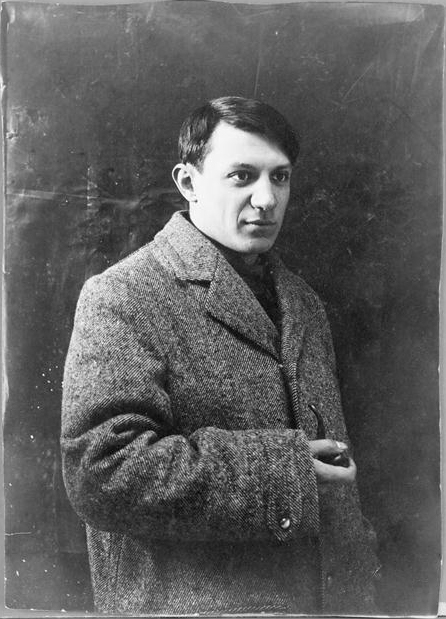
Portrait photograph of Pablo Picasso, 1908.
Picasso opened a studio in the French capital and created most of his marvelous paintings. Although best known as a painter, his art included ceramics, sculpting, playwriting, and poetry. Constantly experimenting, Picasso changed style many times during his incredibly rich and fruitful career.
When the Second World War came to France, Pablo chose to remain in Paris, unlike many other artists who fled from the German occupation. As his artistic style was considered to be degenerate by the Nazi regime, Picasso did not exhibit his work publically during the war.
With the city under curfew, Parisians were constantly arrested and interrogated, and the artist was no exception. Picasso was particularly harassed by the Gestapo, the Nazi secret police. On one occasion, while the Nazis searched his apartment, a Gestapo officer saw a photograph of one of Picasso’s most famous works, Guernica. The 1937 painting depicts the bombing of Guernica, a city in Spain attacked by the German and Italian fascists at the direction of Francisco Franco and the Spanish nationalists. When the Gestapo officer spotted the photograph, he asked Picasso, “Did you do that?” only to receive the artist’s answer: “No, you did.”

A tiled wall in Gernika claims “Guernica” Gernikara, “The Guernica (painting) to Gernika.” Author: Papamanila – CC BY-SA 3.0
During the war, Picasso created several major pieces, including the Still Life With Guitar in 1942 and The Charnel House in 1944. At the same time, he was creating sculptures with bronze, even though the Germans forbade bronze casting. His friends within the French Resistance supplied him with smuggled bronze. A dozen of these pieces, as well as prints and drawings, were donated to Warsaw’s art museum by the artist himself. He also wrote poems and plays during the war years, most of them scatological and erotic. It is estimated that Picasso wrote more than 300 poems in his career.
Picasso returned the favors of the French Resistance by providing shelter to anyone who was sent by them. A part of his defiance of the occupation was the reading of one of his plays in 1944, with Albert Camus as director and the acting performed by the likes of Jean-Paul Sartre and Simone de Beauvoir.
The famous artist remained in Paris until it was liberated in 1944. Treated as a hero, the 63-year-old painter was constantly visited by friends and admirers who were delighted by his acts during the war. However, the fact that Spain was still under the command of Franco upset him and led Picasso to join the French Communist Party. Even though the Communists had radical views towards art, preferring realism, they allowed the artist to continue with his unconventional approach.
Only six weeks after Paris was liberated, an art exhibition was organized in the reopened Salon d’Automne, and Picasso was one of the honored participants. His works were not accepted by the more conservative and right-wing-oriented youth, whose members even tried to destroy his paintings. Luckily for the artist, the police intervened and guarded the entire exhibition.
Guernica in ruins, 1937. Author: Bundesarchiv, Bild CC BY-SA 3.0 de
Pablo Picasso was incredibly prolific. The total number of artworks created by him is estimated to be more than 50,000, including 1,885 paintings, 2,880 ceramics, 12,000 drawings, and 1,228 sculptures. In his later life, Picasso moved to the South of France. The infamous womanizer and father of four children died on April 8, 1973, in Mougins, France.
Even at 91 years of age, Picasso was actively painting, and he was working hours before the heart attack that killed him. He remains the most influential artist of the first half of the 20th century. He even holds the record for the most expensive painting ever sold, when his piece Nude, Green Leaves and Bust was auctioned for $106.5 million.
PRONUNCIATION:(JAY-nuhs-fayst)
MEANING:adjective:
1. Looking in two different directions.
2. Having two contrasting aspects.
3. Hypocritical or deceitful.
ETYMOLOGY:After Janus, the Roman god of doors, gates, and transitions. Earliest documented use: 1682. The month of January is named after Janus.
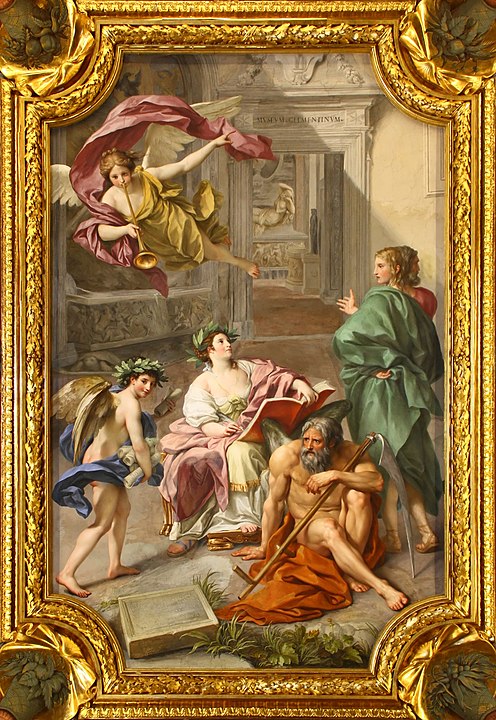
_-_1934_-_Foto_Carl_van_Vechten,_Library_of_Congress.jpg)

_-_Ritratto_di_Max_Jacob_(1876-1944)_2.jpg)