
Monthly Archives: August 2021
Common Symptoms of Spiritual Awakening
by Nicole Guillaume | Oct 24, 2016 | Life Lessons, Nicole’s Blog | 4 comments
A spiritual awakening, which is sometimes referred to as a psychic awakening, is an event that happens on a soul level. When your spirit begins to expand, it’s a signal that you are ready to build a relationship with the REAL you, otherwise known as your Higher Self or Higher Consciousness.
When this happens, you will begin to experience some interesting symptoms. Some of them can be uncomfortable (headache, fatigue, loss of sleep) and others can be fascinating (increased clairvoyance or clairaudience, increased intuition). This happens because your spirit is attempting to form a relationship with your body, so that your body, soul, mind and emotional self can all work in harmony to begin your ‘spiritual’ work.
Here are a few of the most common symptoms:
- You don’t feel like yourself anymore. You may feel happier than you’ve ever felt before, or you may feel unsatisfied with your life. Both of these are simply awareness points that help you to gage where you currently are. Neither one is good nor bad. They are both designed to get your attention, so that you can begin to figure out where to go next.
- You can no longer tolerate violence on tv, movies or video games. You have become sensitive to violent acts, thoughts or deeds (regardless of whether they are real or imagined) because you can not stand the thought of one person harming another.
- You get tingling sensations on the top of your head, palms of your hands or bottom of your feet. These are the doorways of very powerful energy centers. When you experience this tingling (or itching or pressure) in these areas, it’s an indication that Universal or Earth energy is moving through you.
- You seriously question the religious beliefs that you grew up with. You develop an inner knowing that what you have heard and what you were taught all of your life isn’t correct. You may begin to feel upset at unfair or unjust ideas perpetuated by that belief system, especially if it was a fear-based system designed to keep people in check.
- You have dreams and premonitions that come true.
- You have dreams of meeting angels or wise sages who give you good advice and spiritual knowledge. After a dream meeting with one of these beings, you find that you have the answer to a problem, or you feel elated with the new spiritual insight you have gained.
- You get headaches often, and there doesn’t seem to be a medical explanation for this. It’s been proven that our bodies are mostly water, and water is a powerful conduit for spirit. When we become aligned with the Universe, that energy affects our body, and this is what can cause ongoing tension headaches. Combat this by eating lots of fruits and vegetables, drinking plenty of water and adding chelated magnesium supplements to your diet.

- You’re always tired. When your spirit awakens, it begins to fine-tune your body so that the vibration of your soul and the vibration of your body are in harmony. The process can take a while, and it can leave you feeling very exhausted. During this time, be sure to indulge in some extra self-care.
- You are no longer satisfied with shallow friendships, and you crave deep and meaningful relationships. In short, you develop a short tolerance for acquaintances. You want to spend your time with people who you can have deep conversations with. You want to talk about religion, spirituality, philosophies, politics, and other important topics that are often deemed as ‘taboo.’
- You feel a strong urge to help this planet and the beings on it. Environmental and social justice issues begin to move up the list of priorities for you, and you feel the need to help in some way, shape or form. You may decide to donate to a non-profit organization that aligns with your main concerns for the planet, people or animals. Or you may wish to take a more hands on approach, such as volunteering for a non-profit or becoming more of an activist by spreading awareness through social media.
- You are more open minded and fascinated by spiritual concepts. You find yourself picking up books or watching videos that introduce you to spiritual ideas you’ve never heard before, and though you’re not sure you agree with them, you feel this drive to learn more about them. You practically form an addiction to learning about religions and spiritual practices from all over the world.
- You feel excited or anxious about making big, positive changes in your life. You’re life might be very difficult right now, and although you should be scared, you find that you are actually quite happy. Though there is no evidence that anything good is on it’s way to you, somehow you know that something wonderful is coming to you, and you can’t wait to see what that will be.
If you are experiencing a spiritual awakening, and have questions about where it is taking you, and where you should go from here, a tarot reading with me can help. Through the guidance of a tarot reading, we can figure out what your next step is, and how your spiritual awakening will continue to unfold for you. Click here: https://guidingechoes.com/schedule-your-reading/ to schedule your reading with me.
The Spiritual Meaning of Lower Back Pain
Seeking and acknowledging the spiritual meaning of lower back pain can set you on a course for recovery.
Lower back pain can be debilitating. When this part of your body is in crisis, it creates a sense of desperation. Along with physical issues, many people only find relief when they tend to the emotional and spiritual meaning of lower back pain.
The lower back, including the lumbar spine and sacrum, is a storehouse for emotion. Unless you are exploring the deeper emotional and psychological roots of back pain, you are missing an opportunity to heal.
In the maze of treatments for chronic back pain, the spiritual meaning of lower back pain is one that is often overlooked. Jeana Naluai, Director of Ho’omana Spa on the island of Maui and kumu (teacher) of indigenous Hawaiian wisdom and practices, explains that back pain is the most common complaint from people who, “having tried everything else,” show up on her table desperate for relief.
The Sacrum and L5: The Spiritual Source of Lower Back Pain
“Low back pain, at the area of the lumbar spine,” explains Naluai, “has to do with genealogy. Each vertebra of the lumbar spine has a different focus.” In the lineage teachings Naluai received, it is important to consider pain at the level of each vertebra and the one above and below it and to consider where the back meets the hips as well.
The sacrum, that triangular bone that sits at the base of your spine, represents your roots and where you are on the planet. The spine articulates with the pelvis at the sacroiliac joints. The pelvis has to do with drive and power and the ability to move towards choices and directions. “It’s how we move through our time here,” explains Naluai. “People who are not grounded, not rooted energetically or spiritually, typically have pain in the sacrum or pelvis.”
L5 is the lowest vertebrae. It articulates with your sacrum and involves flexibility in your relationship to your time on Earth. In Naluai’s lineage teachings, “It has a lot to do with genetic history and ancestral lineage. How you walk forward in life with, or without, the support of family or ancestors.”
A great deal of emotional upset can occur for people who are living somewhere they don’t feel that they belong. Pain in this area is often associated with not feeling that you are “planted where you are supposed to be.” That might show up as not feeling that you belong in your family, that your family doesn’t relate to you on some level, or that you just can’t find your tribe, the people who understand and accept you on a deep level.
L4: Emotions, Acceptance, and Ancestral Support as a Spiritual Source of Lower Back Pain
Moving up the spine, L4 is the seat of emotion, especially grief. It’s also your center for creativity, how you hold joy with your family, community, and world around you.
For people who grew up with the belief that it was not okay to express strong emotion, specifically around loss and tragedy, pain will often show up here. Likewise, if celebrations were not honored, or there was not a true outlet for expressing joy and connection, this part of the lower back can cause problems.
L3 is about acceptance from our family. People who don’t feel accepted for their choice of a partner or for their sexual orientation may develop pain in this area of the low back. According to Naluai, pain here also represents “not having familial support towards the decisions that you make and how that lineage conversation affects your attitudes towards communities. It’s about interrelationships that can be from the past, present, and future in your understanding.”
L3: The Spiritual Meaning of Low Back Pain and Digesting Life Experience
L3 is about digestion on all levels: digesting beliefs, digesting choices. The spiritual roots of back pain here wrap around to the front side. Naluai explains, “If you were raised with a certain belief system that had been passed down for generations and then you veered off in your decision towards another system of beliefs, such as religion or career choice that created a break or separation with what your ancestors were doing or what are the rest of your family is doing, you might find a challenge in this area until you heal that break within yourself.”
“This part of the spine,” she says, “has to do with the digestion of these kinds of life choices. It is possible to heal the spiritual root of back pain in this area. There is a great deal of healing when they stand in their truth and power with regards to their own beliefs and choices. Sometimes that’s what ends up motivating a shift for the whole family. You can make a change with a choice for yourself that heals not just you, but something in your family line that needed to shift because that was a limited belief system or limiting pattern.”
[Read “Breaking the Cycle of Intergenerational Trauma.”]
L2: Finding Spiritual Stability and Flexibility in the Lower Back
L2 has to do with your physical capability to support yourself and how you flex backward and forward. This relates to movement within your work and your capacity to support yourself physically.
Naluai shares: “I notice that men end up having more issues with their lower back. I think that has to do with the role of men being the financial support for the family in a traditional sense, even though a lot of us are shifting outside of that traditional sense at this point.”
Naluai sees pain in this area in “men who start a family very quickly and don’t excel in the education that they wanted for themselves or in the direction that they wanted. Instead they had to hunker down and do what they need to do to support the family, and maybe weren’t able to follow their true dream.”
The top lumbar vertebra, L1, has to do with stability. Pain here is often associated with changes in financial, relationship, or career stability. Naluai says this is a result of one of the “foundational aspects of a person’s life being rocked.” It is connected to L2 and often involves having aspirations for what you want to do that are different from your family or ancestral obligations.
Healing the Spiritual Roots of Lower Back Pain
Many people show up on Naluai’s table after having tried a whole host of therapeutic and pharmaceutical remedies. Her first step is having a conversation about what was going on in the person’s life when the pain started.
She describes the process she witnesses of people who get stuck in chronic pain cycles: They go on medication to numb out because it’s too painful to explore sensitive issues with family. “These are often not easy conversations to have, especially when there are issues that are deeply rooted in your genealogy. People think they have to just live with it because it’s how it’s always been. But then, explains Naluai, “You realize that your dad had the same thing that your grandfather had that his grandfather had; that it’s been going on for generations. Ultimately it has to do with this one belief system that’s severely limiting.”
Naluai says: “What you find is that when you take care of the emotional roots or spiritual meaning of lower back pain, through practices like ho’oponopono, counseling, self-reflection or meditation or through some kind of ceremony of release, the pain will begin to ease. When you align spiritually and emotionally, the physical body falls back into alignment. You could go to 10,000 massage therapists and just barely scratch the surface if you’re not willing to look at the full picture.”
While looking at these types of ancestral wounds can be painful and difficult emotionally, ultimately it is by addressing the spiritual meaning of lower back pain that you can begin to find true relief.
For more on the spiritual meaning of lower back pain, read: “Releasing the Emotional Roots of Back Pain.”
About the Author

Kalia Kelmenson is the founder of Maui Mind and Body, a curator of well-being, and has worked and played in the health and wellness field for over twenty years. She works with clients at the intersection of mind-body…
Samuel Johnson on patriotism

“Patriotism is the last refuge of a scoundrel.”
― Samuel Johnson
Samuel Johnson, often called Dr Johnson (September 18, 1709 – December 13, 1784), was an English writer who made lasting contributions to English literature as a poet, playwright, essayist, moralist, critic, biographer, editor and lexicographer. He was a devout Anglican, and a committed Tory. Wikipedia
Pineal gland
From Wikipedia, the free encyclopedia
| Pineal gland | |
|---|---|
| Diagram of pituitary and pineal glands in the human brain | |
| Details | |
| Precursor | Neural ectoderm, roof of diencephalon |
| Artery | Posterior cerebral artery |
| Identifiers | |
| Latin | Glandula pinealis |
| MeSH | D010870 |
| NeuroNames | 297 |
| NeuroLex ID | birnlex_1184 |
| TA98 | A11.2.00.001 |
| TA2 | 3862 |
| FMA | 62033 |
| Anatomical terms of neuroanatomy[edit on Wikidata] |

Pineal gland or epiphysis (in red when viewing the brain from behind). Expand the image to an animated version

The pineal gland, conarium, or epiphysis cerebri, is a small endocrine gland in the brain of most vertebrates. The pineal gland produces melatonin, a serotonin-derived hormone which modulates sleep patterns in both circadian and seasonal cycles. The shape of the gland resembles a pine cone, which gives it its name.[1] The pineal gland is located in the epithalamus, near the center of the brain, between the two hemispheres, tucked in a groove where the two halves of the thalamus join.[2][3] The pineal gland is one of the neuroendocrine secretory circumventricular organs in which capillaries are mostly permeable to solutes in the blood.[4]
Nearly all vertebrate species possess a pineal gland. The most important exception is a primitive vertebrate, the hagfish. Even in the hagfish, however, there may be a “pineal equivalent” structure in the dorsal diencephalon.[5] The lancelet Branchiostoma lanceolatum, the nearest existing relative to vertebrates, also lacks a recognizable pineal gland.[6] The lamprey (another primitive vertebrate), however, does possess one.[6] A few more complex vertebrates[which?] have lost pineal glands over the course of their evolution.[7]
The results of various scientific research in evolutionary biology, comparative neuroanatomy and neurophysiology have explained the evolutionary history (phylogeny) of the pineal gland in different vertebrate species. From the point of view of biological evolution, the pineal gland represents a kind of atrophied photoreceptor. In the epithalamus of some species of amphibians and reptiles, it is linked to a light-sensing organ, known as the parietal eye, which is also called the pineal eye or third eye.[8]
René Descartes believed the human pineal gland to be the “principal seat of the soul.” Academic philosophy among his contemporaries considered the pineal gland as a neuroanatomical structure without special metaphysical qualities; science studied it as one endocrine gland among many.[9]
Etymology
The word pineal, from Latin pinea (pine-cone), was first used in the late 17th century to refer to the cone shape of the brain gland.[1]
Structure
The pineal gland is a midline brain structure that is unpaired. It takes its name from its pine-cone shape.[1][10] The gland is reddish-gray and about the size of a grain of rice (5–8 mm) in humans. The pineal gland, also called the pineal body, is part of the epithalamus, and lies between the laterally positioned thalamic bodies and behind the habenular commissure. It is located in the quadrigeminal cistern near to the corpora quadrigemina.[11] It is also located behind the third ventricle and is bathed in cerebrospinal fluid supplied through a small pineal recess of the third ventricle which projects into the stalk of the gland.[12]
Blood supply
Unlike most of the mammalian brain, the pineal gland is not isolated from the body by the blood–brain barrier system;[13] it has profuse blood flow, second only to the kidney,[14] supplied from the choroidal branches of the posterior cerebral artery.
Nerve supply[edit]
The pineal gland receives a sympathetic innervation from the superior cervical ganglion. A parasympathetic innervation from the pterygopalatine and otic ganglia is also present.[15] Further, some nerve fibers penetrate into the pineal gland via the pineal stalk (central innervation). Also, neurons in the trigeminal ganglion innervate the gland with nerve fibers containing the neuropeptide PACAP.
Microanatomy
Pineal gland parenchyma with calcifications.Micrograph of a normal pineal gland – very high magnification.Micrograph of a normal pineal gland – intermediate magnification.


The pineal body in humans consists of a lobular parenchyma of pinealocytes surrounded by connective tissue spaces. The gland’s surface is covered by a pial capsule.
The pineal gland consists mainly of pinealocytes, but four other cell types have been identified. As it is quite cellular (in relation to the cortex and white matter), it may be mistaken for a neoplasm.[16]
| Cell type | Description |
|---|---|
| Pinealocytes | The pinealocytes consist of a cell body with 4–6 processes emerging. They produce and secrete melatonin. The pinealocytes can be stained by special silver impregnation methods. Their cytoplasm is lightly basophilic. With special stains, pinealocytes exhibit lengthy, branched cytoplasmic processes that extend to the connective septa and its blood vessels. |
| Interstitial cells | Interstitial cells are located between the pinealocytes. They have elongated nuclei and a cytoplasm that is stained darker than that of the pinealocytes. |
| Perivascular phagocyte | Many capillaries are present in the gland, and perivascular phagocytes are located close to these blood vessels. The perivascular phagocytes are antigen presenting cells. |
| Pineal neurons | In higher vertebrates neurons are usually located in the pineal gland. However, this is not the case in rodents. |
| Peptidergic neuron-like cells | In some species, neuronal-like peptidergic cells are present. These cells might have a paracrine regulatory function. |
Development
The human pineal gland grows in size until about 1–2 years of age, remaining stable thereafter,[17][18] although its weight increases gradually from puberty onwards.[19][20] The abundant melatonin levels in children are believed to inhibit sexual development, and pineal tumors have been linked with precocious puberty. When puberty arrives, melatonin production is reduced.[21]
Symmetry
In the zebrafish the pineal gland does not straddle the midline, but shows a left-sided bias. In humans, functional cerebral dominance is accompanied by subtle anatomical asymmetry.[22][23][24]
Function
The primary function of the pineal gland is to produce melatonin. Melatonin has various functions in the central nervous system, the most important of which is to help modulate sleep patterns. Melatonin production is stimulated by darkness and inhibited by light.[25][26] Light sensitive nerve cells in the retina detect light and send this signal to the suprachiasmatic nucleus (SCN), synchronizing the SCN to the day-night cycle. Nerve fibers then relay the daylight information from the SCN to the paraventricular nuclei (PVN), then to the spinal cord and via the sympathetic system to superior cervical ganglia (SCG), and from there into the pineal gland.
The compound pinoline is also claimed to be produced in the pineal gland; it is one of the beta-carbolines.[27] This claim is subject to some controversy.
Regulation of the pituitary gland
Studies on rodents suggest that the pineal gland influences the pituitary gland‘s secretion of the sex hormones, follicle-stimulating hormone (FSH), and luteinizing hormone (LH). Pinealectomy performed on rodents produced no change in pituitary weight, but caused an increase in the concentration of FSH and LH within the gland.[28] Administration of melatonin did not return the concentrations of FSH to normal levels, suggesting that the pineal gland influences pituitary gland secretion of FSH and LH through an undescribed transmitting molecule.[28]
The pineal gland contains receptors for the regulatory neuropeptide, endothelin-1,[29] which, when injected in picomolar quantities into the lateral cerebral ventricle, causes a calcium-mediated increase in pineal glucose metabolism.[30]
Regulation of bone metabolism
Studies in mice suggest that the pineal-derived melatonin regulates new bone deposition. Pineal-derived melatonin mediates its action on the bone cells through MT2 receptors. This pathway could be a potential new target for osteoporosis treatment as the study shows the curative effect of oral melatonin treatment in a postmenopausal osteoporosis mouse model.[31]
Clinical significance
Calcification
Calcification of the pineal gland is typical in young adults, and has been observed in children as young as two years of age.[32] The internal secretions of the pineal gland are known to inhibit the development of the reproductive glands because when it is severely damaged in children, development of the sexual organs and the skeleton are accelerated.[33] Pineal gland calcification is detrimental to its ability to synthesize melatonin[34][35] and scientific literature presents inconclusive findings on whether it causes sleep problems.[36][37]
The calcified gland is often seen in skull x-rays.[32] Calcification rates vary widely by country and correlate with an increase in age, with calcification occurring in an estimated 40% of Americans by age seventeen.[32] Calcification of the pineal gland is associated with corpora arenacea, also known as “brain sand”.
Tumors
Tumors of the pineal gland are called pinealomas. These tumors are rare and 50% to 70% are germinomas that arise from sequestered embryonic germ cells. Histologically they are similar to testicular seminomas and ovarian dysgerminomas.[38]
A pineal tumor can compress the superior colliculi and pretectal area of the dorsal midbrain, producing Parinaud’s syndrome. Pineal tumors also can cause compression of the cerebral aqueduct, resulting in a noncommunicating hydrocephalus. Other manifestations are the consequence of their pressure effects and consist of visual disturbances, headache, mental deterioration, and sometimes dementia-like behaviour.[39]
These neoplasms are divided into three categories: pineoblastomas, pineocytomas, and mixed tumors, based on their level of differentiation, which, in turn, correlates with their neoplastic aggressiveness.[40] The clinical course of patients with pineocytomas is prolonged, averaging up to several years.[41] The position of these tumors makes them difficult to remove surgically.
Other conditions
The morphology of the pineal gland differs markedly in different pathological conditions. For instance, it is known that its volume is reduced both in obese patients as well as patients with primary insomnia.[42]
Other animals
Most living vertebrates have pineal glands. It is likely that the common ancestor of all vertebrates had a pair of photosensory organs on the top of its head, similar to the arrangement in modern lampreys.[43] Some extinct Devonian fishes have two parietal foramina in their skulls,[44][45] suggesting an ancestral bilaterality of parietal eyes. The parietal eye and the pineal gland of living tetrapods are probably the descendants of the left and right parts of this organ, respectively.[46]
During embryonic development, the parietal eye and the pineal organ of modern lizards[47] and tuataras[48] form together from a pocket formed in the brain ectoderm. The loss of parietal eyes in many living tetrapods is supported by developmental formation of a paired structure that subsequently fuses into a single pineal gland in developing embryos of turtles, snakes, birds, and mammals.[49]
The pineal organs of mammals fall into one of three categories based on shape. Rodents have more structurally complex pineal glands than other mammals.[50]
Crocodilians and some tropical lineages of mammals (some xenarthrans (sloths), pangolins, sirenians (manatees & dugongs), and some marsupials (sugar gliders) have lost both their parietal eye and their pineal organ.[51][52][50] Polar mammals, such as walruses and some seals, possess unusually large pineal glands.[51]
All amphibians have a pineal organ, but some frogs and toads also have what is called a “frontal organ”, which is essentially a parietal eye.[53]
Pinealocytes in many non-mammalian vertebrates have a strong resemblance to the photoreceptor cells of the eye. Evidence from morphology and developmental biology suggests that pineal cells possess a common evolutionary ancestor with retinal cells.[54]
Pineal cytostructure seems to have evolutionary similarities to the retinal cells of the lateral eyes.[54] Modern birds and reptiles express the phototransducing pigment melanopsin in the pineal gland. Avian pineal glands are thought to act like the suprachiasmatic nucleus in mammals.[55] The structure of the pineal eye in modern lizards and tuatara is analogous to the cornea, lens, and retina of the lateral eyes of vertebrates.[49]
In most vertebrates, exposure to light sets off a chain reaction of enzymatic events within the pineal gland that regulates circadian rhythms.[56] In humans and other mammals, the light signals necessary to set circadian rhythms are sent from the eye through the retinohypothalamic system to the suprachiasmatic nuclei (SCN) and the pineal gland.
The fossilized skulls of many extinct vertebrates have a pineal foramen (opening), which in some cases is larger than that of any living vertebrate.[57] Although fossils seldom preserve deep-brain soft anatomy, the brain of the Russian fossil bird Cerebavis cenomanica from Melovatka, about 90 million years old, shows a relatively large parietal eye and pineal gland.[58]
Rick Strassman, an author and Clinical Associate Professor of Psychiatry at the University of New Mexico School of Medicine, has theorised that the human pineal gland is capable of producing the hallucinogen N,N-Dimethyltryptamine (DMT) under certain circumstances.[59] In 2013 he and other researchers first reported DMT in the pineal gland microdialysate of rodents.[60]
Society and culture
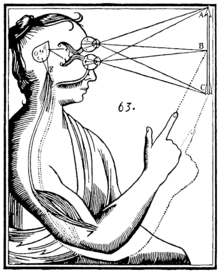
Diagram of the operation of the pineal gland for Descartes in the Treatise of Man (figure published in the edition of 1664)

Seventeenth-century philosopher and scientist René Descartes was highly interested in anatomy and physiology. He discussed the pineal gland both in his first book, the Treatise of Man (written before 1637, but only published posthumously 1662/1664), and in his last book, The Passions of the Soul (1649) and he regarded it as “the principal seat of the soul and the place in which all our thoughts are formed.”[61] In the Treatise of Man, Descartes described conceptual models of man, namely creatures created by God, which consist of two ingredients, a body and a soul.[61][62] In the Passions, Descartes split man up into a body and a soul and emphasized that the soul is joined to the whole body by “a certain very small gland situated in the middle of the brain’s substance and suspended above the passage through which the spirits in the brain’s anterior cavities communicate with those in its posterior cavities”. Descartes attached significance to the gland because he believed it to be the only section of the brain to exist as a single part rather than one-half of a pair. Most of Descartes’s basic anatomical and physiological assumptions were totally mistaken, not only by modern standards, but also in light of what was already known in his time.[61][63]
The notion of a “pineal-eye” is central to the philosophy of the French writer Georges Bataille, which is analyzed at length by literary scholar Denis Hollier in his study Against Architecture. In this work Hollier discusses how Bataille uses the concept of a “pineal-eye” as a reference to a blind-spot in Western rationality, and an organ of excess and delirium.[64] This conceptual device is explicit in his surrealist texts, The Jesuve and The Pineal Eye.[65]
In the late 19th century Madame Blavatsky (who founded theosophy) identified the pineal gland with the Hindu concept of the third eye, or the Ajna chakra. This association is still popular today.[61]
In the short story “From Beyond” by H. P. Lovecraft, a scientist creates an electronic device that emits a resonance wave, which stimulates an affected person’s pineal gland, thereby allowing them to perceive planes of existence outside the scope of accepted reality, a translucent, alien environment that overlaps our own recognized reality. It was adapted as a film of the same name in 1986. The 2013 horror film Banshee Chapter is heavily influenced by this short story.
Nelson Mandela talking talking about what the US did to Hiroshima
How is Sufism related to Islam?
Let’s Talk Religion Today we talk about an often asked question – what is the relatioship between Sufism and Islam? Are they the same thing or is there some difference? Sources/Suggested Reading: Karamustafa, Ahmet T. (2007). “Sufism: The Formative Period”. Edinburgh University Press. Knysh, Alexander (2017). “Sufism : A New History of Islamic Mysticism”. Princeton University Press. Malik, Jamal & John Hinnells (ed.) (2006). “Sufism in the West”. Routledge. Ridgeon, Lloyd (ed.) (2014). “The Cambridge Companion to Sufism”. Cambridge University Press. Van Bruinessen, Martin & Julia Day Howell (ed). (2007). “Sufism and the Modern in Islam”. I.B. Tauris.
We the People Have a Few Ideas for the Constitution
SEVEN PROPOSALS FOR AMENDMENT NO. 28. COMPILED BY THE NEW YORK TIMES OPINION
OPINION
August 4, 2021 (NYTimes.com)
It’s been 50 years* since America’s
last real update to its Constitution. We asked
seven writers and legal scholars
what they think needs amending next.
*Read Jesse Wegman on the 26th Amendment and
why the Constitution stopped changing.
These essays are part of a series exploring bold ideas to
revitalize and renew the American experiment.
All workers shall have the right to form
and join labor unions.
Read more at: https://www.nytimes.com/interactive/2021/08/04/opinion/us-constitution-amendments.html
By Kate Andrias, a professor at Columbia Law School
Neither slavery nor involuntary
servitude, except as a punishment for crime where
of the party shall have been duly convicted,
shall exist within the United States, or any place
subject to their jurisdiction.
By Deborah N. Archer, a professor at N.Y.U. School of Law and
the president of the American Civil Liberties Union
A simple change to the 13th Amendment could eradicate a pillar of white supremacy.
Ratified after the Civil War, the 13th Amendment outlawed slavery with one critical exception: as “a punishment for crime.” In the constitutional amendment that finally freed enslaved people and recognized their full humanity, there should have been no exceptions.
Beyond the importance of making the prohibition of slavery complete and unequivocal, striking the 13th Amendment’s punishment clause would have practical consequences for compulsory prison labor, eliminate a powerful incentive to criminalize Black and brown people and advance the cause of racial and economic justice promised by the amendment.
Racism is central to America. As racist laws are struck from the books, racism has demonstrated a stunning ability to adapt. The end of slavery saw the rise of new tools to exploit Black people. While historians debate whether the punishment clause was included with the continued subjugation of former slaves in mind, it allowed the continuation of penal slavery.
Today, mass incarceration compels inmates to fight deadly fires. It requires them to produce hand sanitizer for the public while they face unsafe and unsanitary conditions. Some argue that these people benefit from gaining work experience. But those benefits do not require subminimum-wage forced labor. By striking the clause, the compensation earned and skills learned can begin to restore the dignity and status of those serving their sentences.
PROPOSED AMENDMENT:
NEITHER SLAVERY NOR INVOLUNTARY SERVITUDE SHALL EXIST WITHIN THE UNITED STATES OR ANY PLACE SUBJECT TO THEIR JURISDICTION.
The word ‘person’ shall apply to all human
life — born or unborn.
By Alexandra DeSanctis, a staff writer at National Review and a
visiting fellow at the Ethics and Public Policy Center
“We hold these truths to be self-evident, that all men are created equal, that they are endowed by their creator with certain unalienable rights, that among these are life, liberty and the pursuit of happiness.”
Since Thomas Jefferson drafted these words, the United States has made enormous strides in recognizing that all human beings — regardless of race, sex or class — inherently possess the natural rights named in the Declaration of Independence. The 13th Amendment, by ending the dehumanizing evil of slavery, affirmed that Black people, too, possess these rights. We must affirm the truth of Jefferson’s words once again, this time by ending the dehumanizing injustice of abortion and securing the right to life of unborn human beings.
The Supreme Court held in Roe v. Wade that the Constitution protects a right to abortion. But a unique human life begins at the moment of fertilization, which means that every abortion intentionally ends a human life; the court’s decision denied to an entire class of human beings that right upon which all other rights depend.
Unless the court overturns its decades of hazy and unworkable precedent protecting abortion, lawmakers who attempt to safeguard the equality of the unborn will remain unable to do so. Even if the court changes course, without a constitutional amendment explicitly recognizing fetal personhood, states will maintain a maze of abortion laws, some of which will continue to allow abortion.
This amendment would affirm that, like each of us, every unborn human being possesses the intrinsic right to life, while accounting for situations in which a woman might need emergency medical treatment that may have the foreseeable secondary effect of harming her unborn child.
PROPOSED AMENDMENT:
SECTION 1. THE WORD “PERSON,” AS USED IN THE FIFTH AND 14TH ARTICLES OF AMENDMENT TO THE CONSTITUTION OF THE UNITED STATES, APPLIES TO ALL HUMAN BEINGS, INCLUDING UNBORN HUMAN BEINGS, FROM THE MOMENT OF CONCEPTION, AT EVERY STAGE OF BIOLOGICAL DEVELOPMENT, IRRESPECTIVE OF AGE, HEALTH, FUNCTION, GENDER, RACE OR DEPENDENCY.
SECTION 2. NOTHING IN THIS CONSTITUTION SHALL BE CONSTRUED AS CONFERRING OR PROTECTING A RIGHT TO ABORTION.
SECTION 3. THIS ARTICLE SHALL NOT BE CONSTRUED TO PREVENT EMERGENCY PROCEDURES IN CASES IN WHICH A REASONABLE MEDICAL CERTAINTY EXISTS THAT CONTINUATION OF PREGNANCY WILL CAUSE THE DEATH OF THE MOTHER.
International law shall be part of American law.
By Samuel Moyn, a professor of law and history at Yale
West Germany’s 1949 Constitution dedicated the country to peace and made international law an “integral part” of domestic law. This was, in part, a penance for just a few years earlier being a dangerous and deadly rogue state.
While the United States today is a far cry from Nazi Germany, it has nonetheless proved itself to be a threat to world peace, blatantly and regularly violating international rules or letting its lawyers twist limits on war into licenses to strike.
An amendment to our Constitution modeled on Germany’s could be a start for America’s atonement, by counseling prudence and placing constraints so the country cannot launch disastrous wars of choice as easily or send drones or special forces practically anywhere for deadly missions. It could also offer protections to Americans as well: While the parents of young Black men killed by police have traveled to speak before the United Nations in Geneva to decry violations of international standards on the streets of our cities, no legal appeal to those standards is possible in our courts.
In fact, what respect American law paid to international law has weakened lately, with conservative Supreme Court justices taking the country even more fully outside international norms by making them ever harder to invoke in our judicial system. Justice Antonin Scalia went so far as to denounce those who invoked such norms as merely examples to consider here.
International law is certainly not a panacea. We could make sure that we never let international law weaken domestic protections when they are stronger. But forcing Americans to take seriously what others think global morality and rules demand would invigorate our discussion — and litigation — about how to exercise power elsewhere and treat one another at home.
PROPOSED AMENDMENT:
IN ORDER TO PROMOTE WORLD PEACE, AND CONSENTING TO SUCH LIMITATIONS ON SOVEREIGN POWERS AS REQUIRED, THE AMERICAN PEOPLE DECLARE THAT INTERNATIONAL LAW IS PART OF OUR LAW, DIRECTLY CREATING RIGHTS AND DUTIES FOR CITIZENS. ACTS TENDING TO AND UNDERTAKEN WITH INTENT TO DISTURB THE PEACEFUL RELATIONS AMONG NATIONS SHALL BE UNCONSTITUTIONAL AND BE MADE A CRIMINAL OFFENSE. THE INVIOLABLE AND INALIENABLE RIGHTS OF PERSONS ARE THE BASIS OF PEACE AND JUSTICE WITHIN AND BEYOND U.S. TERRITORY.
The right of the people to
have privacy and be
secure against searches and seizures of
their persons, houses, papers and effects,
including their data and metadata.
By Cindy Cohn, the executive director of the Electronic Frontier
Foundation, a digital rights organization
The Fourth Amendment, which prohibits “unreasonable searches and seizures,” was written when letters were delivered on horseback and communications, whether stored at home (protected as one’s “castle”) or sent through the mail, had to be searched by hand, one at a time. The contents sealed inside physical letters could reveal much more about a person than the address printed on the outside (the “metadata”), and so only the content received full Fourth Amendment protection.
In our digital age, this amendment has been interpreted in ways that shrink our rights. Today, our most important documents and communications are not typically transmitted by the public postal service or held by us in our homes but are handled by companies like AT&T, Google, Facebook and Slack. These companies also hold our metadata — including not only whom we talk to but also where we are and what we watch and read — which, alone or in aggregation, can reveal information as sensitive as the content of the messages themselves. Police officers no longer need to search our homes and documents one by one; they can go straight to those companies, generally getting content with a warrant but also often doing dragnet digital searches through metadata without a warrant.
Ideally, these privacy violations would be addressed through a fair reading of the current Fourth Amendment, including realigning what’s reasonable with both modern life and international law. But seeking clarification from the Supreme Court is slow, at best. A few tweaks could do a lot to retrofit the Fourth Amendment for our times — and for many years to come.
PROPOSED AMENDMENT:
THE RIGHT OF THE PEOPLE TO HAVE PRIVACY AND BE SECURE AGAINST SEARCHES AND SEIZURES OF THEIR PERSONS, HOUSES, PAPERS AND EFFECTS, INCLUDING THEIR DATA AND THE METADATA CREATED BY THEIR ACTIONS, SHALL EXIST REGARDLESS OF WHERE LOCATED AND SHALL NOT BE VIOLATED EXCEPT THROUGH PROCESSES THAT ARE NECESSARY AND PROPORTIONATE, INCLUDING BY A WARRANT ISSUED BY A JUDGE UPON PROBABLE CAUSE AND SUPPORTED BY OATH OR AFFIRMATION AND PARTICULARLY DESCRIBING THE PERSON OR PLACE TO BE SEARCHED AND THE PERSONS OR THINGS TO BE SEIZED.
The Supreme Court shall be expanded
and its powers limited.
By Barry P. McDonald, a law professor at Pepperdine University
The framers of the Constitution could not have seen how much the less representative branches of our democratic republic — the executive (elected by nonpopular Electoral College vote) and the judiciary (appointed for life) — would hold a grip on governing power.
This has left Americans engaged in bitter power struggles to control the presidency and Supreme Court.
This structural problem cannot be fixed by one constitutional amendment, but it can be alleviated by a change to the structure of the judiciary: This amendment would return important policy decisions to the people rather than have them decreed by life-appointed judges devising vague constitutional provisions. (On the right, think guns and campaign financing; on the left, abortion and same-sex marriage.) The amendment would create institutional constraints on the Supreme Court designed to foster impartial and restrained decision-making — enforcing the clear commands of the Constitution and leaving debatable issues to the democratic process.
A democracy-enhancing amendment would achieve four goals: increase the size of the Supreme Court, which would make it more difficult for partisan voting blocs to form and require broader decision-making consensus (and create an even number of seats to force compromise, if necessary); reasonably limit terms of justices to increase the frequency of nominations, lower the political heat over them and foster greater judicial modesty; require a supermajority of justices to invalidate laws as unconstitutional; and require that qualified potential justices be appointed from various geographic regions to better reflect the diversity and interests of the American people.
PROPOSED AMENDMENT:
SECTION 1: THE SUPREME COURT WILL CONSIST OF 16 JUSTICES, WITH A SEAT ADDED TO THE COURT EVERY TWO YEARS UNTIL THAT NUMBER IS REACHED. SEATS ON THE COURT SHALL BE ALLOCATED IN A GEOGRAPHICALLY UNIFORM MANNER ACROSS THE UNITED STATES, WITH SUCH MANNER TO BE REASONABLY DETERMINED BY CONGRESS.
SECTION 2: NO JUSTICE APPOINTED AFTER THE ADOPTION OF THIS AMENDMENT SHALL SERVE MORE THAN 15 YEARS. UPON SUCH ADOPTION, SITTING JUSTICES WILL SERVE FOR NO MORE THAN 35 YEARS FROM THE DATE OF THEIR APPOINTMENT TO THE COURT.
SECTION 3: NO LAW SHALL BE DECLARED UNCONSTITUTIONAL BY THE COURT EXCEPT BY A VOTE OF AT LEAST TWO-THIRDS OF JUSTICES PARTICIPATING IN A CASE.
No state or city shall restrict people’s movement.
By David Schleicher, a professor at Yale Law School
America needs to get moving again. Over the past 40 years, Americans have moved from one state or city to another less and less frequently. This lack of mobility — and the lack of population growth in highly productive cities and regions — substantially harms the economy.
Once, local economic booms created boomtowns, but they no longer do. Chicago grew from a city of 30,000 people in 1850 to 1 million in 1890 to 3.3 million in 1930; Silicon Valley’s population has increased only slightly since the rise of the tech sector in the 1980s. Low population mobility makes economic redistribution less effective, since poor people are less likely to be in the same states and cities as rich taxpayers. It also makes the job of the Federal Reserve harder, since setting interest rates is challenging when there are varied levels of unemployment and inflation.
While there are several explanations for declining mobility, one is that state and local laws clearly make it harder for people to move toward opportunity. Zoning regulations limit housing construction in many wealthy cities and regions, raising housing costs and limiting in-migration for those who don’t already have high salaries to take advantage of those strong economies. Land use regulations in the most productive regions have reduced economic output by 36 percent between 1964 and 2009. Occupational licensing regulations cover 25 percent of workers and limit the ability of people to move between states because their licenses do not travel.
The Constitution, through the dormant commerce clause, already bars state laws that discriminate against interstate trade. A new constitutional amendment could bar state and local laws that have the effect of limiting interstate population mobility, freeing the national economy from protectionist and not-in-my-backyard state and local legislation. Such an amendment could be used to invalidate unreasonable land use regulations — such as excessive minimum lot size rules and unjustified density limits — and labor regulations that discriminate in their effects against out-of-state workers.
PROPOSED AMENDMENT:
NO STATE OR POLITICAL SUBDIVISION OF A STATE SHALL PASS ANY LAWS, REGULATIONS OR BINDING JUDICIAL DECISIONS THAT, ON THEIR OWN OR IN THEIR CUMULATIVE EFFECT, SUBSTANTIALLY LIMIT THE CAPACITY OF RESIDENTS OF OTHER STATES, LOCALITIES OR TERRITORIES — INDIVIDUALLY, IN AGGREGATE OR AS MEMBERS OF GROUPS OR PROFESSIONS OR TRADES — TO ENTER, RESIDE WITHIN OR WORK WITHIN THEIR BORDERS UNLESS THOSE LAWS ARE FOUND TO FURTHER A SUBSTANTIAL GOVERNMENT INTEREST OTHER THAN POPULATION CONTROL BY MEANS THAT ARE TAILORED TO ACHIEVE THAT INTEREST.
(Contributed by Suzanne Deakins, H.W., M.)
MASS PSYCHOSIS – How an Entire Population Becomes MENTALLY ILL
After Skool This video was made in collaboration with Academy of Ideas. They create videos explaining the ideas of history’s great thinkers in order to help supply the world with more knowledge, to empower the individual, and to promote freedom. Please check out their youtube channel for more brilliant content. https://www.youtube.com/c/academyofideas or visit their website to learn more https://academyofideas.com/ In this video we are going to explore the most dangerous of all psychic epidemics, the mass psychosis. A mass psychosis is an epidemic of madness and it occurs when a large portion of a society loses touch with reality and descends into delusions. Such a phenomenon is not a thing of fiction. Two examples of mass psychoses are the American and European witch hunts 16th and 17th centuries and the rise of totalitarianism in the 20th century. This video will aim to answer questions surrounding mass psychosis: What is it? How does is start? Has it happened before? Are we experiencing one right now? And if so, how can the stages of a mass psychosis be reversed? This video took a tremendous amount of work. It truly is a labor of love and if you appreciate this video and want to help support the creation of more videos, please consider supporting After Skool on Patreon – https://www.patreon.com/AfterSkool
(Contributed by Steve Hines)
SupraCargo class on August 21 & 22
To:you Details
 Discover Your Authentic Identity The SUPRA CARGO CLASS is coming!  Welcome – so glad you’re here! I am Heather C. Williams, H.W.,M. To move out of the ordinary – you must be ready for a peculiar and astonishing experience – YOUR LIFE! Cargo is the goods carried in a ship. Every human being carries cargo. Our world today is unstable due to humans carrying cargo of old habits that are causing big problems. Working together to solve these problems is very challenging because…you cannot enlighten the world unless you enlighten yourself…and the number one cause of our frustration is that most of us have no idea who we really are. The task today is for each of us to look deeply into our real cargo (creative capacity) stored way beneath our old habits. Know that your authentic identity is already here, alive and well, beneath layers of old stuff. You do not have to buy it or create it or affirm it – but – you do have to pay ATTENTION to it! SUPRA CARGO CLASS was created by Thane to help individuals awaken to – and pay ATTENTION to – the creative core of Beingness that is within each of us. Thane studied with Gurdjieff who said: “Everyone is asleep to who they really are. Everyone needs to wake up! This SUPRA CARGO CLASS will be a team project zoom class with Thane Walker and Heather C. Williams, H.M.,M. on Saturday & Sunday, August 21 & 22. Come learn, explore and WAKE UP to your True Identity as Consciousness. ALSO – Heather C. Williams, H.W.,M. will give a free talk on SUNDAY AUGUST 15th at The Prosperos Sunday Meeting. This talk will be on zoom. Calendar the link below. TITLE: WHAT IS MYSTICISM? DATE: Sunday, August 15 TIME: 11:00 am Pacific/Noon Mtn/1:00 pm Central/2:00 pm Eastern. ZOOM LINK: https://us02web.zoom.us/j/332275676 Learn more and register below: Learn More/Register |