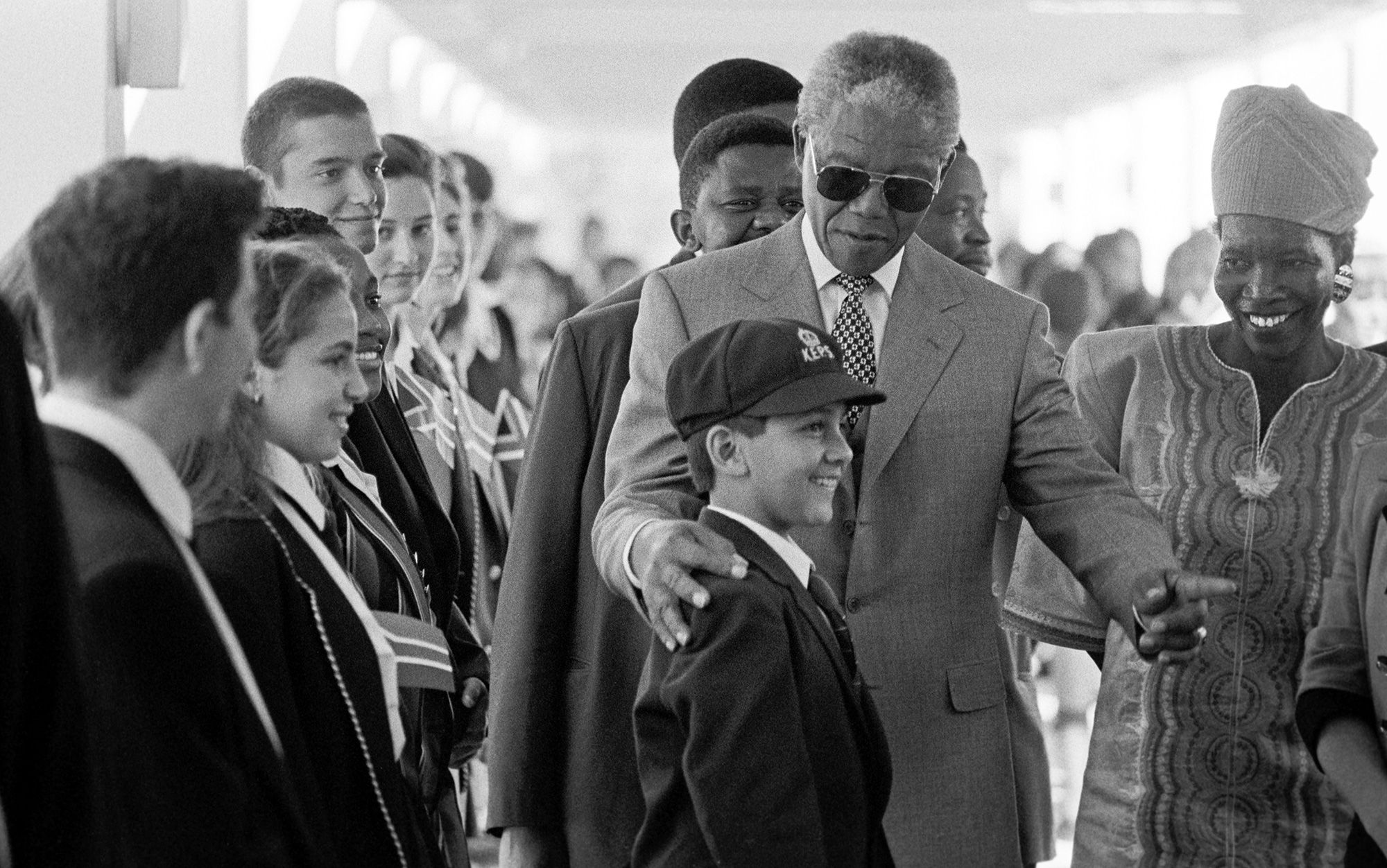
What the United States and other settler societies can learn from South Africa’s push to create a nonracial democracyNelson Mandela with students at a non-segregated high school in Gauteng, South Africa, in 1995. Photo by Ian Berry/Magnum
Mahmood Mamdani is Herbert Lehman Professor of Government at Columbia University in New York City and executive director of the Makere Institute of Social Research in Kampala, Uganda. His books include Saviors and Survivors: Darfur, Politics, and the War on Terror (2009) and Neither Settler Nor Native: The Making and Unmaking of Permanent Minorities (2020).
Edited by Sam Haselby
17 August 2021 (aeon.co)
Aeon for Friends
In the course of the struggle against apartheid, South Africans did something remarkable: they tried, with incomplete success, to destroy the settler and the native by reconfiguring both as survivors. They did so by adopting a response to extreme violence that defied the logic of Nuremberg – the logic of separating perpetrators from victims, punishing the perpetrators, and creating separate spheres in which the two could live without harming each other in an ongoing cycle of violence. By thinking of extreme violence as a political rather than criminal act, South Africans were able to shift focus from individual transgressions of law to the issues that drove the violence and the needs of the people who survived it. Instead of going to court, they sat around the conference table. Rather than turn to a trial to produce truth and punish offenders, they negotiated reforms to make the political system more inclusive, recognising that perpetrators as well had to be brought into the political fold.
Above all, South Africans came to recognise that political identities are not permanent or natural. Activists overcame differences of race imposed on them – differences marked as African, Coloured, Indian, and white – to join in a single cause of breaking down apartheid. Afrikaners, once champions of apartheid, became part of the movement against it. These groups had been formed under colonialism as distinct and often rivalrous, their interests said to be naturally divergent. Because of the racial difference imputed to them, they were subject to different laws and granted different opportunities to participate in the political community, or sometimes no opportunity at all. But in response to apartheid, these people learned to think anew their political relation to each other: not as others or rivals but as equals in law.
In other words, South Africa attempted to decolonise, by breaking down the colonial distinction between settlers and natives and inviting them to participate in the same political community, with settlers reconfigured as immigrants. This attempt was partial. Colonial authorities created, and both colonial and apartheid authorities exploited, two kinds of distinction between settlers and natives: racial distinction and tribal distinction. The struggle against apartheid, and the new South Africa that followed, have made inroads against the politicisation of race. Yet today tribe remains a supposed African tradition. Thus settler and native identities have been dismantled in some respects and retained in others.
The South African case diverges instructively from that of the United States. The two countries have similar colonial histories, but only one has attempted to decolonise. Both are federations of colonised territories; the US formed from the union of the British colonies during the revolution, South Africa in the early 20th century from the union of the Cape Colony, Natal, the Transvaal and other British dominions, some of which previously had been under Dutch or Boer control. The great majority of the territory circumscribed by each federation was set aside for settlers.
What defined settlers in both countries was not the colour of their skin, although in most settler colonies the upper echelons of the power structure were and remain overwhelmingly occupied by white-skinned people. (An exception is Liberia.) The settler also was not defined by language, culture, religion, gender or socioeconomic status, however these are conceived; nor by length of residency, immigration status or even citizenship status. There were British settlers in South Africa, as well as Afrikaners; white European settlers in America, some who came involuntarily, as indentured servants, as well as enslaved and free Blacks. What defined the settler was the law to which she was subject. Call it civil law. Equal subjection to civil law does not mean equality of subjects; settlers were not and are not treated equally. The law may be discriminatory: it may be designed in ways that make it more useful to certain individuals than to others and more useful to certain communities than to others. But all of these individuals and communities are equally subject to the civil law.
Within the borders of each federation were and remain inhabitants subject to another kind of law: customary law. The people governed by it are members of native tribes, so called because the civil law groups them that way. If this sounds circular, it is: natives are not natives because of anything essential to them but because they were created as natives in law by settlers. Like civil law, customary law is unequal. It can offer its native enforcers capricious and tyrannical authority over other natives.
But customary law, in both America and South Africa, is in no sense traditional. It is not a practice predating colonisation. Customary law, like civil law, is created by settlers. The particular practices and norms associated with customary law are sometimes inspired by those of an era preceding colonialism, but customary law’s authority over natives, and the authority of natives to wield it, derives from statutes of the civil law. Those who write the civil law ultimately determine what the customary law is, while the natives themselves serve as customary law’s custodians, implementing it within the tribal territory. Together, the authors and enforcers of law determine, say, who gets to be a tribal member, which land the member may own or use, what religion the member may practice, how the member is to dress and groom himself, or whether the member is at liberty or detained. In this way, settlers ensure that the natives are civilised according to their standards. As a British colonial official in South Africa put it in 1849, customary law would hold so long as it was not ‘repugnant to the general principles of humanity, recognised throughout the whole civilised world’. This proclamation underlined the fact that every colonial power held itself to be the representative of the civilised world and the guardian of general principles of humanity.
Apartheid was an effort artificially to retribalise millions of natives by forcibly settling them in homelands
In the domain of civil law, the US and South African settler states subjugated residents racially. In the domain of customary law, both settler states subjugated residents tribally. These regimes of racial and tribal control overlapped, but they were not and are not reducible to each other. The racial regime embedded in civil law enjoined both the privileged racial community and the deprived racial community to participate in an order in which the privileged benefited from the labour of the deprived. The tribal regime embedded in customary law enjoined only natives. In South Africa, customary law applied to all natives, but only natives considered indigenous within particular tribal homelands had customary rights. Other natives, deemed immigrants within these tribal homelands, were denied the protections of customary law, including customary rights to land. In the US, too, natives considered nonindigenous within a particular reservation are denied membership and therefore customary rights. Thus tribal – customary – law has itself been made discriminatory.
Customary and civil law and their divergent jurisdictions constituted the backbone of the colonial systems in the US and South Africa. That system is retained in the US today, largely without changes. In South Africa, it was altered dramatically by the introduction of apartheid in the late 1940s. From the standpoint of the white-dominated state, apartheid was necessitated by the breakdown of the dual system of tribal and racial control amid industrialisation. With the economy booming, Africans were moving into cities for work. And when they arrived, some of them organised into unions demanding better pay and treatment.
The presence of African agitators in urban South Africa – and the threat they posed to the economic interests of whites – was a crisis in need of solution. Apartheid was that solution: an effort artificially to retribalise millions of natives by forcibly settling them in homelands, renamed Bantustans, which would be administered under the tightened fist of native authorities. Africans could return to cities as migrant labourers, but they would be denied the right to reside there. If the market economy detribalised labour, forcing it out of villages into industry, apartheid’s political solution was to retribalise that labour by sending it ‘home’.
Apartheid, too, sparked unrest and eventually crisis. But this time the crisis had a productive resolution: the Convention for a Democratic South Africa (CODESA), the negotiations to end apartheid carried out between 1990 and 1994. It is CODESA, in particular, that rejected the Nuremberg model. The goal was never to single out perpetrators – to name and shame, in the parlance of the contemporary, Nuremberg-inspired human rights regime. CODESA’s goal was to create a new political system in which all members of the preceding regime – both enemies and supporters of apartheid – would be included.
The creation of a new political system did not happen in Europe after the Second World War. The victims and the perpetrators were separated by means of ethnic cleansing and the establishment of the state of Israel. The post-conflict German state was built by outsiders, while the internal resistance to the Nazis was denied participation. In South Africa, internal resistance movements forced the issue of apartheid’s injustice, necessitating the settlement that ended apartheid. In critical ways, that settlement reflected the key transformation wrought by the resistance. The Black Consciousness Movement, labour organisers and student groups opposed to apartheid overwrote the political identification associated with race. They encouraged Africans, Coloureds, Indians and whites to see themselves as capable of inhabiting the same political community. They showed that political identity is mutable, not inborn; that it is a product of history.
The state that followed apartheid bore this out by uniting South Africans under a single government and law – albeit with many concessions to whites, intended to keep them at the negotiating table. It was, however, not the internal resistance from anti-apartheid groups that led the negotiations. That task fell to representatives of more mainstream organisations, such as the African National Congress (ANC), headed by Nelson Mandela. In the 1960s, the ANC and others initially engaged in a militant ‘liberation movement’ modelled on those of other decolonising African states such as Mozambique, Angola and Algeria. But efforts at armed liberation in South Africa resulted in crackdowns on militant leaders such as Mandela, who were imprisoned or expatriated. In prison and exile, armed liberators lost connection with the very constituencies whose challenges they were committed to addressing. More like diplomats, they won the favour of international politicians and boycott movements, and gained prestige.
Perhaps it was through these international engagements that they learned to be neoliberal – to reduce the work of political systems to the work of individuals, as Nuremberg had. The result was the most famous but least constructive mechanism of the post-apartheid transition: truth and reconciliation. Whereas CODESA responded to apartheid by imagining a new political community in which enemies became adversaries, the Truth and Reconciliation Commission (TRC) sought to pin blame on individual perpetrators and provide restitution to individual victims. Formed in 1995, the TRC transformed the political violence of apartheid into criminal violence, per the Nuremberg-inspired human rights regime. The results were perverse. The TRC ignored millions of Black political prisoners and victims of ethnic cleansing, displaced from their homes into Bantustans. The commission catalogued just 20,000 cases of victimisation. In the meantime, the TRC absolved apartheid’s white constituency by putting all responsibility on individual perpetrators.
The racial political identities of the past were not timeless but rather created by political processes
The TRC’s narrative of apartheid tells South Africans to ignore their history. It says that violence comes down to people’s personal choices – that it is not a matter of how the state functions, or a product of the ways that political constituencies think about the issues that matter to them. This narrative helps to maintain racial privilege even in a South Africa with formal racial equality: whites, ignorant of their complicity as beneficiaries of apartheid, continue to function as a social elite. The result is growing tension over a political system that provides for universal franchise but cannot supply social justice.
The concessions made to whites during the negotiations to end apartheid – concessions enshrined in the national constitution and in laws governing local administration – ensure that the problem of social justice will not be solved any time soon. But it is important to realise that, in exchange for those concessions, something critical was achieved. The crisis of apartheid might have been resolved with mass bloodshed, leading either to new forms of legal subjugation or to political and spatial separation. Both outcomes would likely have fostered more violence, in an ongoing cycle. Instead, South Africa now has competing political constituencies working to achieve their goals under the aegis of a system seen as legitimate by the participants. This is possible because, in spite of the TRC, enough South Africans have been willing to rethink political identity. They have come to recognise that the racial political identities of the past were not timeless but rather created by political processes. As such, they could be dismantled by political processes as well.
South Africans have thus felled one pillar of the settler-versus-native distinction in their country: race as political identity. This is the key divergence from the US situation. The US, too, has partially deracialised but, in the US condition, this does not constitute decolonisation, for racialisation in the US does not distinguish settler from native. In the US, the determinants of the native-versus-settler distinction are more firmly rooted today than ever before – so deep in the marrow of law and society that they are invisible. In South Africa, half of those determinants were made visible and were contested.
The other pillar of the settler-versus-native distinction – tribe – persists in the architecture of the South African state, as it does in the US. In South Africa, tribe has been naturalised, presumed to be part of a timeless native – that is, African – culture. In the former Bantustans, the regime of customary law remains substantially unreformed. In rural South Africa, violence continues among Africans who define themselves as tribally distinct. Africans are still denied rights under the customary regime, should they live in the ‘wrong’ tribal homeland. In urban South Africa, Africans and other persons of colour seen as tribal strangers, and thus intruders, are periodically the target of what is called xenophobic violence. South Africa’s story tells us much about how a society can go about decolonising. But it also speaks to the enormous challenge of that worthy project.
On 2 February 1990, the State President of South Africa F W de Klerk opened a new session of parliament with the announcement that apartheid was over. In doing so, he made official what had become clear on the ground, thanks to the uprisings of the previous two decades. Whatever the supporters and beneficiaries of apartheid might have wished, the system was no longer functional. Once a pillar of South African society, apartheid had become the central focus of what was in effect an insurgent war. To sustain apartheid risked national destruction.
The end of one period was the beginning of another: that of negotiation. But when negotiations began in May, they sidestepped the organisational architecture of the uprising. Like the colonial authorities who allied with customary authorities at the outset of indirect rule, the South African government turned to partners said to be the legitimate leaders of Black South Africa, even though they were marginal to the internal anti-apartheid movement that had actually forced the change that was now afoot.
This time, the negotiating partner would be the ANC-in-exile, and one of its jailed leaders: Mandela. Mandela was released from prison a week after de Clerk’s speech, but his role as the leader of the anti-apartheid negotiators was established earlier. Inside the prison, there was every attempt to isolate him from other activists, especially those associated with the urban uprising – militants who might imbue in him the lessons of Black consciousness and the hope of a nonracial society. His wife Winnie was likely among those who had adopted the new philosophies and methods so threatening to the apartheid system. Unlike Nelson, who had been in jail for the entire duration of the urban uprising, Winnie was very much a product of that uprising, adopting its daring and confrontational attitude.
Nelson and the ANC – which began discarding apartheid’s racial distinctions only a few years before his release – were no longer at the political cutting edge. Indeed, their methods had been repudiated. Their legitimacy came from international approval and Nelson Mandela’s celebrity as a political prisoner, not from their leadership. Mandela wrote of his first meeting with the government’s ‘secret working group’ in May 1988 ‘at a posh officers’ club’ within Pollsmoor Prison. The working group’s primary question was: ‘How would the ANC protect the rights of the white minority?’ The following year in March, Mandela sent a memorandum to State President P W Botha regarding, among other things, the minority question. ‘Two political issues will have to be addressed,’ Mandela wrote. ‘Firstly, the demand for majority rule in a unitary state; secondly, the concern of white South Africa over this demand, as well as the insistence of whites on structural guarantees that majority rule will not mean domination of the white minority by blacks. The most crucial tasks which will face the government and the ANC will be to reconcile these two positions.’ Upon his release in 1990, Mandela brought up the issue at his first press conference:
I wanted to impress upon the reporters the critical role of whites in any new dispensation. I have tried never to lose sight of this. We did not want to destroy the country before we freed it, and to drive the whites away would devastate the nation. I said there was a middle ground between white fears and black hopes, and we in the ANC would find it. ‘Whites are fellow South Africans,’ I said, ‘and we want them to feel safe and to know that we appreciate the contribution that they have made toward the development of this country.’ Any man or woman who abandons apartheid will be embraced in our struggle for a democratic, non-racial South Africa.
It is striking that Mandela had the same the notion of majority and minority as did the apartheid government: both accepted the racialised notion of a Black majority and a white minority. Even though Mandela wrote and spoke of ‘a democratic, non-racial South Africa’, he had yet to formulate the notion of a democratic, nonracial citizenship. Even so, his politics had clearly evolved.
Once, he had admired Algeria and Mozambique, where the postcolonial leadership had been uncompromising in its demand for ‘justice’ and which most settlers had fled rather than become citizens of the new state. Now, he worried that ‘to drive the whites away would devastate the nation’. What had changed? When was Mandela’s moment of epiphany? Had he come to see Mozambique as Aimé Césaire had experienced Haiti in the 1940s – a warning against letting justice turn into revenge – and thus determined to avoid such an outcome in South Africa? If states like Mozambique highlighted the possibility of justice turning into revenge, Mandela’s radical critics would later charge that the post-apartheid transition had not been vengeful enough: reconciliation seemingly turned into an embrace of evil. Specifically, these critics argued that Mandela erred in focusing exclusively on the question of political equality while ignoring extreme social inequality.
Whites accepted that they would not be in charge, and Blacks accepted that whites had something to offer
But to believe that apartheid could simply give way to social equality was to ignore the critical tensions of the South African moment. The consolidation of the anti-apartheid movement had fostered a crisis, not a victory. The option in the early 1990s was to keep fighting, to keep breaking down the state and pitting enemies against each other, or else to reach out and achieve some compromise whereby enemies might live together as political adversaries. The success of the anti-apartheid movement had been based on such compromises, whereby whites accepted that they would not be in charge, and Blacks accepted that whites had something to offer – that their participation meant not capitulation to apartheid but rather resistance to it.
Thabo Mbeki, who in 1999 succeeded Mandela as president of the Republic of South Africa, made a notable speech, ‘I Am an African’, clarifying that the truly radical move was the creation of a new and inclusive political order, which is what he meant by ‘reconciliation’. The speech marked the adoption of the new constitution on 8 May 1996, and took on the question of whether yesterday’s settlers would be accepted as citizens of the new South Africa. Or would they be flushed out of the colony to make way for a racially cleansed independent country? Mbeki’s answer was unequivocal:
I am formed of the migrants who left Europe to find a new home on our native land. Whatever their own actions, they remain still part of me … I am the grandchild who lays fresh flowers on the Boer graves at St Helena and the Bahamas, who sees in the mind’s eye and suffers the suffering of a simple peasant folk: death, concentration camps, destroyed homesteads, a dream in ruins … I am an African.
The concentration camps Mbeki referred to were built by the British to house Boer prisoners during the Second Boer War, when the British conquered their fellow whites and took their colonies. Mbeki was announcing a transformative revision of history, in which it was not only Africans who were colonised – by the British and the Boers – but also the Boers. He was challenging South Africans to reimagine political identity, to see that political identity could be reimagined because it is a product of histories, not nature. If whites, too, could be colonised Africans, then they could be citizens of the postcolonial state.
This did not entail blindness to the stark problem of social inequality. In another speech two years later, titled ‘Two Nations’ and given at the opening of the National Assembly debate on reconciliation and nation-building, Mbeki spoke to ‘the difficult but inevitable challenges posed by white class privilege’. Some on the Left welcomed the speech for addressing so much unfinished business; others dismissed it as a rhetorical gesture that had come too late. But this view unrealistically assumes that more could have been done earlier. And it is not at all clear that the most hardline anti-apartheid activists had something better to offer. The Pan Africanist Congress rejected compromise under the slogan ‘one settler, one bullet’.
The fact is that apartheid and the trappings of white privilege were popular among white South Africans. To steamroll it all at once and right away would have required a political movement much stronger than the one anti-apartheid forces had built. The National Party, the party of apartheid, had come to power in the whites-only House of Assembly through elections in 1948 and was returned to power in every election thereafter for the next 40-plus years. As the anti-apartheid movement gained momentum in the 1970s, the National Party gained in public support. What is more, the process leading to the dissolution of political and juridical apartheid involved a whites-only referendum. It was essential that a majority of the white population authorise its government to negotiate with representatives of the Black majority.
An uncompromising push for social justice might well have swung the white referendum in the direction of the rejectionists, who were gaining power as apartheid came to a close. The pro-apartheid Conservative Party gained seats at the National Party’s expense in the late 1980s, emerging as the official opposition. There was a real risk that organisations such as Afrikaner Weerstandsbeweging, a separatist white-supremacist outfit, would sway hearts and minds. Even liberal intellectuals stoked the fears of whites. For instance, the journalist Rian Malan’s book My Traitor’s Heart (1990) won big sales numbers and widespread admiration with a detailed investigation of what the pro-apartheid press called Black-on-Black violence. The descendent of a former South African state president who considers himself a liberal, Malan wrestled with his family’s contributions to apartheid even as he narrated the story of the Hammerman: a big Zulu who wielded a heavy hammer with which he smashed the skulls of his Black victims, for gains that were often puny. If they can do this to their own, Malan was asking, what will they do to us, given half a chance?
Yet white fear did not carry the day. Why? Because important sections of the liberation movement had learned to think in holistic terms. They told anyone who would listen – and these numbers grew over time – that the struggle was against not settlers but settler power. Without a state legally underwriting settler privileges, settlers would be ordinary immigrants. This was the heart of the South African moment: redefining the enemy as not settlers but the settler state, not whites but white power. By doing so, South Africa’s liberation movements eased whites into the idea of a nonracial democracy.
Excerpted from Neither Settler Nor Native: The Making and Unmaking of Permanent Minorities (2020) by Mahmood Mamdani, published by The Belknap Press of Harvard University Press. Copyright © 2020 by Mahmood Mamdani. Used by permission. All rights reserved.
Race and ethnicityNations and empiresHuman rights and justice