
 |
 Hi! I am Heather C. Williams, H.W.,M. – a High Watch Mentor in The Prosperos School of Ontology since 1978. I am also a retired middle school art teacher and the author of Drawing as a Sacred Activity. Hi! I am Heather C. Williams, H.W.,M. – a High Watch Mentor in The Prosperos School of Ontology since 1978. I am also a retired middle school art teacher and the author of Drawing as a Sacred Activity. Ontology is the science of Being. In The Prosperos School of Ontology, we learn and practice tools to free ourselves of the ego’s limitations and we open our minds and hearts to our True Identity as consciousness. We teach people HOW TO THINK – not what to think. I, and the other Mentors, help people find out who they are so they can live their lives fully. I am 74 and after 50 years of practicing The Prosperos tools, I can say with gratitude I am living more fully and I love sharing with others who are also interested in living more fully. My next class will be the Advance Seminar Monitor Class with Thane. This will be an online ZOOM Class lasting four hours on both Saturday June 12 and Sunday June 13. Class begins both days at 8:00 am Pacific/9:00 am Mtn/11:00 am Central/Noon Eastern. We’ll take breaks and have a good discussion at the end of each day. If you have any questions or just would like to know more about this class please contact me by email at: heather@theprosperos.org. Find Out More |
Monthly Archives: May 2021
Book: “Inherit the Truth: A Memoir of Survival and the Holocaust”

Inherit the Truth: A Memoir of Survival and the Holocaust
In the years following her liberation from the Nazi death camp, Anita Lasker-Wallfisch, like most survivors of the Holocaust, struggled to build a normal life for herself. Decades later, she realized that in her efforts to achieve normality she had not spoken to her children or her grandchildren of her terrifying odyssey. Her memoir of the period between 1939 and 1945, was written for her children so that they would Inherit the Truth.
This is the story of the destruction of a talented Jewish family, and of the survival against all the odds of two young sisters. Anita and her elder sister Renate defied death at the hands of the Gestapo and the SS over a period of two and a half years, being first imprisoned as criminals and then being transferred, separately to Auschwitz, and finally to Belsen. They were saved by their exceptional courage, determination and ingenuity, and by several improbable strokes of good luck — the greatest of which was the fact that Anita played the cello.
Lasker-Wallfisch draws from her own startlingly vivid memories of her experience, and also incorporates the letters her family wrote to one another during this period as well as other primary documents. She succeeds in conveying — in unsentimental prose — what it was to have been a Jew living in Germany at the time of the Third Reich and what it was to have survived.
(Goodreads.com)
More bon mots from Thomas Hübl
“Belonging (the underlying premise of the Republicans) and becoming (the underlying premise of the Democrats) are not two separate ideas. They are one.”
–paraphrasing Thomas Hübl
“By giving instead of taking, I become equal to the force which creates us.”
–Thomas Hübl
“There is a perpetual motion machine, It is consciousness, which gives more than it takes.”
–Thomas Hübl

Thomas Huebl is an Austrian-born[1] contemporary spiritual teacher, author,[2] and founder of the Academy of Inner Science and a non-profit organization known as the Pocket Project.[3]
Huebl completed approximately four years of medical school in his native Austria[2] before deciding to pursue a four-year independent meditation and spiritual retreat in Czechoslovakia.[1]
Following his retreat, Huebl moved to Germany and was invited to teach meditation.[1] He then began working with Holocaust survivors to work through their respective experiences and historical trauma.[4]
In 2008, Huebl founded the Academy of Inner Science, which studies the principles of human inner development and explores the core of humanity’s wisdom traditions.[5]
In 2016, Huebl founded the Pocket Project, a non-profit organization dedicated to understanding collective and intergenerational trauma.[6] The organization brings together experts in various fields to explore healing trauma and expanding trauma research.[7] Among other initiatives, the Pocket Project offers online support group sessions for healthcare workers that have been impacted by the COVID-19 crisis.[8]
Huebl is the author of The Power of We: Awakening in the Relational Field.[9] His second book, Healing Collective Trauma: A Process for Integrating Our Intergenerational and Cultural Wounds, is scheduled for publication in November of 2020.[3]
Lao Tzu and expressing yourself

Imagine for a moment . . . .

Why Does the Universe Bother?

Holocaust and Transgenerational Trauma. Anita Lasker-Wallfisch, her daughter and Thomas Hübl
Thomas Hübl This is a talk about transgenerational trauma between Anita Lasker-Wallfisch, her daughter Maya Jacobs-Wallfisch, and Thomas Hübl. Anita Lasker-Wallfisch (92) is a German-British cellist and one of the last known survivors of the “Girls’ Orchestra” of Auschwitz. Maya Jacobs-Wallfisch has a particular interest in transgenerational trauma arising from her subjective experience of being the daughter of a holocaust surviver. She is Psychoanalytic Psychotherapist and co-founder of the “Forum for Transgenerational Trauma” in the UK. Thanks to Anita Lasker-Wallfisch and Maya Jacobs-Wallfisch for sharing so open-heartedly and generously their memories, and their experience of a special relationship, which is very valuable, instructive and salutary for us all! Recorded at the Celebrate Life Festival August 1, 2017 —– More about the Pocket Project for Trauma Integration: https://pocketproject.org More Info about Thomas Hübl: http://www.thomashuebl.com/en
WHERE THE HORSES SING
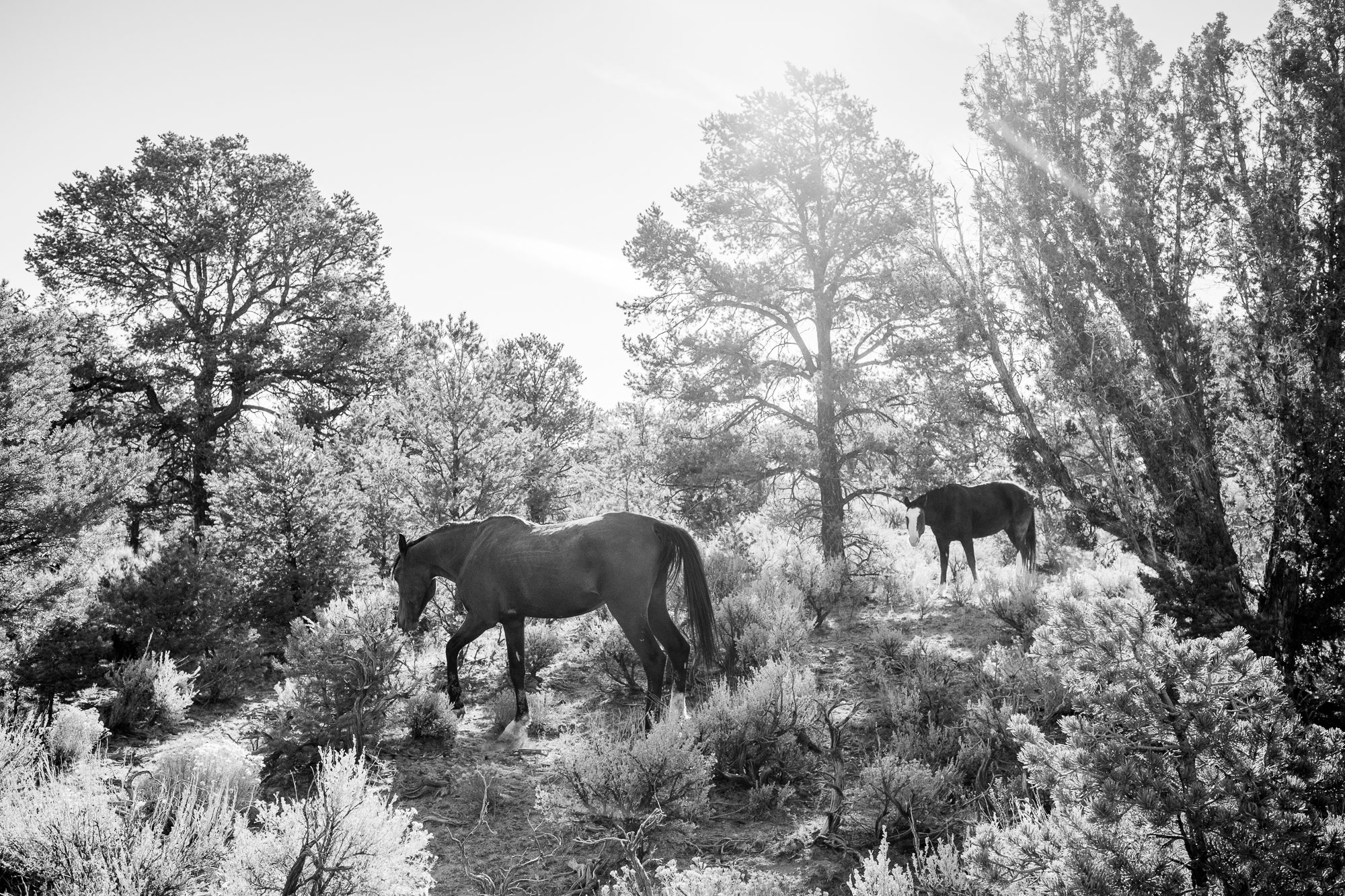
by Llewellyn Vaughan-Lee
May 20, 2021 (emergencemagazine.org)
Witnessing a growing wasteland, Llewellyn Vaughan-Lee seeks the threshold that could bring us back to the place where the land sings—to a deep ecology of consciousness that returns our awareness to a fully animate world.
I LIKE TO WALK early and am often alone on the beach, the ocean and the birds my only companions, the tiny sanderlings running back and forth chasing the waves. Some days the sun rising over the headlands makes a pathway of golden light to the shore. Today, the fog was dense and I could just see two figures walking in the distance, until they vanished into the mist, leaving a pair of footprints in the sand until the incoming tide washed them away. It made me wonder what will remain in a hundred years, when my grandchildren’s grandchildren are alive? Will the rising sea have covered the dunes? Climate crisis will by then be a constant partner, and so many of today’s dramas will be lost in a vaster landscape of primal change.
Sensing this reshaping of the seashore, where the waves roll in from across the Pacific, makes my mind stretch across horizons. How this land and our own lives have evolved. One story of science says it was only seventy thousand years ago that humans left Africa on their long migrations across continents, arriving here on the Pacific coast just thirteen thousand years ago, when the Bering Strait was dry land and not ocean; or possibly they came earlier in boats down the coast.1 But how was life then, long before the written word, when we traveled as small groups, communities of hunters and gatherers? What was the consciousness of our ancestors, before agriculture, long before cities or our industrial way of life, and what did we lose as we settled the land, and then forgot it was sacred?
They may have carried few possessions, but their consciousness contained a close relationship to the land, to its plants and animals, to the patterns of the weather and the seasons, which they needed for their survival. Fully awake with all of their senses, they had a knowing, passed down through generations of living close to the ground, even as they migrated across the continent. Today we are mostly far from the land and its diverse inhabitants. Cut off from these roots, we have become more stranded than we realize, and while our oncoming climate crisis may present us with many problems, we hardly know how to reconnect, to return our consciousness to the living Earth. It is as if, having traveled to the far corners of our planet, we now find ourselves in an increasing wasteland without knowing how to return to where the rivers flow, to where the plants grow wild. And unlike our ancestors, we cannot just pack up and move on, because this wasteland surrounds us wherever we look, like the increasing mounds of plastic and other toxic material we leave in our wake.
And sadly, tragically, our consciousness has become divorced not just from the land under our feet but also from the unseen worlds that surround us. Anyone who looks at the animals in the Paleolithic cave paintings in southern France with a receptive awareness can see that the physical and spirit world are infused together. Those early artists were imaging not just physical animals but spirit beings, shamanic, magical. This is part of their mystery and intensity. And this knowing continued for thousands of years, whether experienced in relation with the powerful beings that for the Native Americans are present in all natural things, invisible but everywhere, or expressed through veneration of the kami, the sacred spirits that exist in nature, mountains, rivers, earthquakes, thunder, animals, and people, which until recently belonged to an elemental Japanese consciousness.2 For most of our history the inner and outer worlds were woven together, as shown in the myths and stories that defined our existence.
Have we wandered so far from the source that we cannot return?
Walking the shoreline, watching the little birds searching for insects, my awareness drawn to the sky, the sea, and the shifting sands, I wonder at this gulf between the simple, magical awareness of our ancestors, and our present-day mind, as cluttered as our consumer world. What has happened to our consciousness, now divorced from the multidimensional existence that used to sustain us? Did we need to exile ourselves from this primal place of belonging? And now, as we tear apart the web of life with our machines and images of progress, is there a calling to return, to open the door that has been closed by our rational selves?
When the fog is dense and you can only see a few yards in front of your feet, the world around becomes more elemental. Watching each wave come to the shore is like watching the breath. Sometimes my feet become wet from the rising water, or I move further up the beach. I try to keep my mind empty, part of the sky and the waves, simple, essential. Here nothing is separate, and the inner and outer worlds are closer.
I cannot return completely to a world in which spirit and matter are always united—I carry too many images from a culture that has denied that the inner world even exists. But I can live closer to this threshold, this place where the waves and the sand meet. I can recognize how easily our defined world can be washed away—how soon the waters will rise. And when many of our toys of triviality, the “things” that clutter our houses and awareness, are lost in the tsunami of climate change, I can be like the Moken, the nomadic boat people of East Asia, who knew to go to deeper water when the waters rose. They remembered the old stories, the old ways, the wisdom of their ancestors, and so their boats rode out the storm—unlike the fishermen who remained close to the shore and perished in the tsunami.
Always there is this primary place of belonging in the land and in our souls. It used to be a part of the way we lived, how we walked and breathed. Crossing oceans and continents, we carried it with us, a lodestone for our existence. For thousands and thousands of years, it was an essential part of us, never forgotten, because how could you forget the feel of the rain on your skin, or the sound of water flowing over stones? How could you forget the stories and songs passed down through the generations? It is only very recently in our human history—only a few hundred years amidst thousands—that we forgot, that we lost this thread, that our mind ceased to be a part of both the land and the unseen worlds. That we forgot that everything we can see and touch is sacred, and in our forgetting no longer inhabited a world in which everything was alive with spirit, the wind and the rain, the plants and animals.
Have we wandered so far from the source that we cannot return? Will climate crisis isolate us even more in our cities as nature becomes more unpredictable? As we try to use our science, our computers to save us? Or is the doorway to return nearer than we know, just as in that moment when we awake and our dreams are still present, before they are lost with the daylight? What would it mean to return to this numinous land, alive in ways we no longer understand, where the Earth can speak to us in its many voices? Or more vital, can we transition through this present self-created crisis without this inner and outer knowing, without this awareness that was central to so much of our human journey?
IT IS EASY to dismiss the magical world as just a fairy tale belonging to childhood or old tales. To maintain that what we need at this moment more than ever is hard science, that carbon reduction and loss of biodiversity are our most pressing concerns. And yes, there is important work to be done reducing our industrial imprint, restoring wetlands and wild places. But if we do not remove the rational blinkers from our consciousness, how can we respond to the deeper need of the moment, and recognize that we are part of a fully animate world? If we are to become partners with the Earth, living our shared journey, we have to once again speak the same language, listen with our senses attuned not just to the physical world but also to its inner dimension. We cannot afford to continue to dismiss so much of our heritage—the thousands of years we were awake to an environment both seen and unseen.
And yet this knowing has been censored so effectively from our present mind that we do not even know how to read the signs, how to look and listen, how to be in the space where dreams are woven into consciousness. We may speak about the need for a new story, one that is not based upon exploitation and greed but recognizes the interdependent oneness of the living world. But real stories arise from the inner worlds, only then do they carry the numinous power that can change a civilization. Myths are not rational, but belong to a deeper dimension of our psyche. We can see the emotive power of the false stories that surround us—whether the recent myth of endless economic growth that is the foundation of our consumer world, or the more recent distortions of social media that grip our collective consciousness. We are living these pathological stories without fully recognizing how much we respond to their emotive and psychic power. The cold facts about climate change and loss of species have not changed our behavior, while conspiracy theories and stories of stolen elections have seized our beliefs. Is our collective consciousness only open to dark myths, such as the Kraken, a tentacled creature of Norse mythology that arises from the deep, swallowing ships?3
Now as we stand at this crossroads, do we have to wait for our present society to fall apart? Are we caught in too many patterns of social and economic divisiveness? Where do we find the hidden gateway into the garden—a place where we are no longer exiles in our own land, living by the “sweat of our brow,” but can hear and then live the songlines of the land; where dreaming nourishes our daily life? Our ancestors are still all around us, in our DNA, in the land, in the spirits still present behind the veils of our rational self. In the millennia of our human history, it is only a few years since most of us divorced ourselves from these companions, and decided to walk alone, unaccompanied, no longer understanding our primal relationship to the Earth and Her ways, no longer speaking the same language, singing Her songs. And those few who carried that remembrance experienced the suffering and pain of that separation, as they struggled to stay true to the songs, dreams, and ceremonies in a world increasingly covered with enforced forgetfulness.
Is it enough just to acknowledge that our ancestors lived in an animate world that is still around us, even if invisible to our eyes, intangible to our other senses? They lived in a world of kinship on many levels; not masters, not the dominant species, but part of a living tapestry—just one species among many—in which the hunter asked the spirit of the animal for permission to hunt, and the gatherer for the plant’s blessing to harvest. Here there was no hierarchy but an interdependent world both physical and spirit, all part of one community that could communicate through dance and dream, song and prayer.
If we are to become partners with the Earth, living our shared journey, we have to once again speak the same language, listen with our senses attuned not just to the physical world but also to its inner dimension.
For them dreaming and waking were not separate but part of a multilayered texture of existence, where dreams could guide the hunt and the spirits of animals and plants were welcomed. And sometimes they ventured deeper into the spirit world through visions, and had access to a wisdom that could help their whole community. For example, the Lakota medicine man, Black Elk, who walked this land less than a century ago, had a seminal vision when he was nine years old that took him to where the horses were singing, and the Thunder Beings spoke to him of the destiny of his people, how his “nation’s hoop was broken.” The spirits called upon him to help restore his people through an awareness of all of life’s sacred nature and its inherent unity:
And while I stood there I saw more than I can tell and I understood more than I saw; for I was seeing in a sacred manner the shapes of all things in the spirit, and the shape of all shapes as they must all live together like one being.4
Our present world is divisive, our consciousness fractured. Our collective values produce greed and endless desires. Science and its foster child, materialism, have become a broken mythology, evident in the ecocide it has created. Where are the visions to guide us, the spirits to sustain us, the singing horses to accompany us? Are we still hoping to find an answer in technology, in its soulless succession of ones and zeros? Or can we begin to remember the lands we have left, the spirit-filled world we have abandoned?
MY OWN GARDEN, on a hillside beside the bay, is a place where the worlds come together: colors and fragrances; lavender; buddleia bushes, whose honey-scented flowers are so often full of bees; chamomile, yellow and white; jasmine, a cascade of evening sweetness; and the soft magic of the spirits that are welcomed, at home like the quail with her babies in the early summer, hiding between the plants. This is how the land was always alive, seen and unseen, movement and stillness. And we were a part of it all, our senses attuned in ways long lost. And now, as the Earth is calling out to us to remember Her sacred ways, there is the possibility to return, to walk as our ancestors walked, to be a part of the world coming alive after a long winter, after storms and snow, after a landscape so barren it pains the eyes.
Here, where the land sings, where the worlds meet, is a way to be that resonates with both the soil and the soul. Making a garden sing, for the unseen to be present, is a simple act of welcoming the worlds our ancestors knew, the spirits of the land as well as the beings of light. I have found it is simplest through an openness of heart and a deep knowing that we are surrounded, nourished, and met in ways beyond our rational minds: a multidimensional kinship. The colors of the flowers then reveal a vibrancy beyond the physical, and even the stones in the garden feel awake.5
This is a simple celebration of the wonder that was always around us, and a nourishment we need for our shared journey together into an uncertain future. It is hard to see how the coming decades will unfold. If the year of the pandemic has taught us anything it is how unpredictable the present moment is, how fragile our present systems. We do not know how much of our present way of life will be lost as the wildfires rage and the seas rise. Will we retreat into the bunkers of materialism, or step into a different way to live with the land? But this moment is also an opportunity to return to an essential awareness that belonged to our ancestors, which, although we have dismissed and forgotten it, is not so far away.
On any journey it is necessary to decide what to take—both for traveling and the new life that awaits. This deep ecology of consciousness that embraces a fully animate world can sustain us, giving us access to the wisdom of the Earth, a knowing we need for the turbulence of this transition. Without this quality of consciousness there is the danger we will just remain in the barren wasteland created by our rational mind, will not fully wake up from the nightmare that is poisoning the planet. Maybe the land and its spirits can welcome us awake, help us to fully see, hear, and inwardly sense the garden we never really left.
The Secret of Happiness: Bronson Alcott on Gardening and Genius
By Maria Popova (brainpickings.org)
“I had a pleasant time with my mind, for it was happy,” Louisa May Alcott wrote in her diary just after she turned eleven, a quarter century before Little Women bloomed from that uncommon mind — a mind whose pleasures and powers were nurtured by the profound love of nature her father wove into the philosophical and scientific education he gave his four daughters.
Bronson Alcott
The progressive philosopher, abolitionist, education reformer, and women’s rights advocate Bronson Alcott (November 29, 1799–March 4, 1888) developed his ideas about human flourishing and social harmony by observing and reflecting on the processes, phenomena, and pleasures of the natural world — something he shared with the Transcendentalists of his generation, and particularly with his best friend: the naturalistic transcendence-shaman Ralph Waldo Emerson.
In 1856, while living next door to the visionary Elizabeth Peabody in Boston — the seedbed of Transcendentalism, a term Peabody herself had coined — Alcott borrowed and devoured Emerson’s copy of a book sent to him by an obscure young Brooklyn poet as a token of gratitude for having inspired it: Walt Whitman’s Leaves of Grass, published months earlier.
Whitman’s unexampled verse — so free from the Puritanical conventions of poetry, so lush with a love of life, so unabashedly reverent of nature as the only divinity — stirred a deep resonance with Bronson’s own worldview and inspired him to try his hand at the portable poetics of nature: gardening.
Tomato, or Love-Apple, from Elizabeth Blackwell’s pioneering 1737 encyclopedia of edible plants. (Available as a print and as a face mask, benefitting The Nature Conservancy.)
Right there in the middle of bustling Boston, where his young country was just beginning to find its intellectual and artistic voice, Alcott set up his humble urban garden. One May morning — a century and a half before bryologist Robin Wall Kimmerer contemplated gardening and the secret of happiness, before Olivia Laing wrote of gardening as an act of resistance, before neurologist Oliver Sacks drew on forty years of medical practice to attest to the healing power of gardens — the fifty-six-year-old Alcott planted some peas, corn, cucumbers, and melons, then wrote in his journal:
Human life is a very simple matter. Breath, bread, health, a hearthstone, a fountain, fruits, a few garden seeds and room to plant them in, a wife and children, a friend or two of either sex, conversation, neighbours, and a task life-long given from within — these are contentment and a great estate. On these gifts follow all others, all graces dance attendance, all beauties, beatitudes, mortals can desire and know.

Hot pepper by Elizabeth Blackwell from A Curious Herbal, 1733. (Available as a print and as a face mask, benefitting The Nature Conservancy.)
By mid-summer, Alcott had discovered in his garden not only a creaturely gladness but a portal into the deepest existential contentment — something akin to the creative intoxication that he, like all artists, found in his literary calling:
Complement with Derek Jarman on gardening as creative redemption and training ground for presence, then revisit Whitman, writing while recovering from a paralytic stroke in the nursery of nature, on what makes life worth living.
COMIC: How To Intervene When Someone Is Harassed Or Attacked
May 20, 2021 (npr.org)
RUTH TAM

Chances are, you’ve already witnessed something as a bystander. Maybe, as a kid on a playground, you saw another kid bullied. Perhaps as a teenager at a party, you saw someone being sexually harassed. Or, as an adult on a bus, you saw someone attacked.
There are countless moments where we instinctively sense someone may need help, but something holds us back.
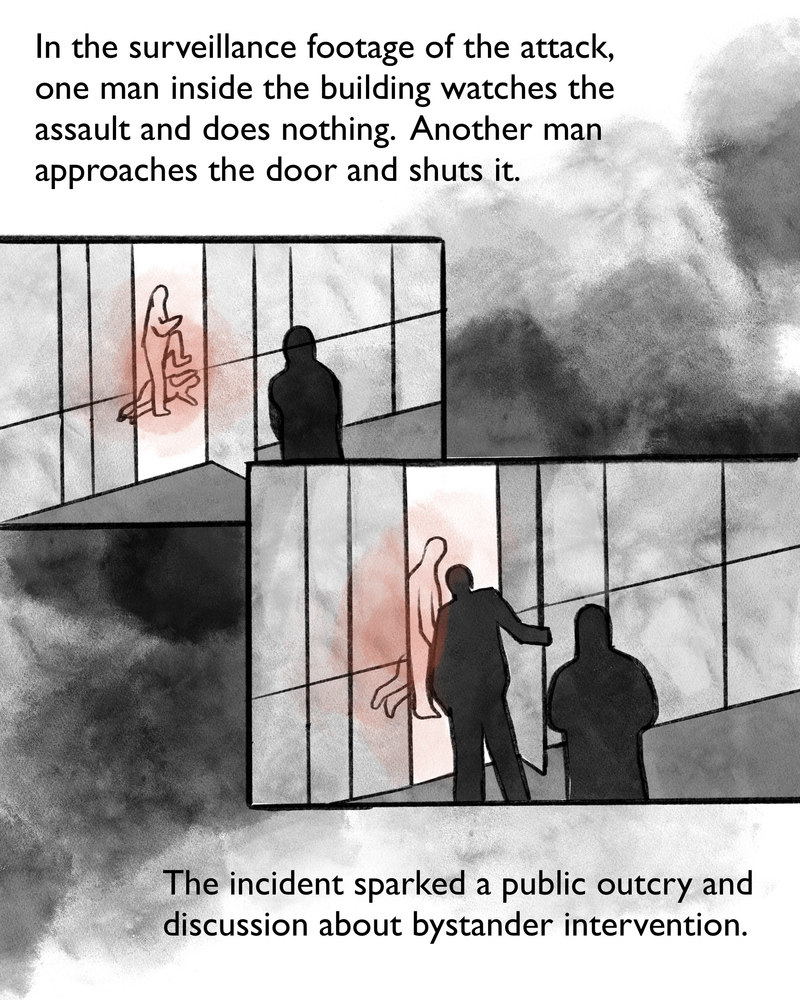
That inaction has a cost. An attack, when it happens in public, isn’t just between two people. It involves everyone who witnesses it, and how we respond sets the tone for what we all tolerate.
Listen to the podcast version of this comic here.
In the episode, illustrator Felicia Chiao describes being publicly attacked. Read her comic about coping with the experience here.
Knowing what to say or how to safely intervene isn’t always clear. But we don’t have to stay paralyzed between a “fight or flight” response. There are many ways to calmly assess a situation and effectively deescalate harm.
For tips and advice, Life Kit spoke with victims of public violence and harassment, as well as trainers at Hollaback!, an organization seeking to end harassment.
![If you see someone being harassed or attacked, what can you do? As the pandemic progresses, news of anti-Asian violence has become more widespread. In March, a man attacked a 65-year-old Filipino woman outside of an apartment building in Manhattan. [Image description: A man kicks an elderly woman on the ground as bystanders look on.]](https://media.npr.org/assets/img/2021/05/18/1-min_custom-a6fac53b78abc9c74058683013a0fbeb633cd34c-s800-c85.png)
Connie Hanzhang Jin/NPR
![If you see a similar situation, what are your options? Gabriela Mejia is a training and communications associate with Hollaback!, an organization seeking to end harassment in its many forms. She shared with Life Kit five options bystanders can take: distract, delegate, document, delay and direct.[Image description: Gabriela is an adult with long wavy hair wearing a dark sweater.]](https://media.npr.org/assets/img/2021/05/18/3-min_custom-6c46287cfe4a801c19effef7b488ebdbe3a2c813-s800-c85.png)
![Cause a distraction to make the person being harassed less of a target, like asking for directions or pretending to know them. [Image description: Gabriela models various scenarios, in one she asks, "Hey, do you know where I can find a bathroom?" while in another, she pretends to know the person being harassed. In a final example, she drops a cup of coffee, saying "Whoops, dropped my drink!"]](https://media.npr.org/assets/img/2021/05/18/4-min_custom-bc5e591a5c5dc3b00fb350f0a039af9537c72f66-s800-c85.png)
![Ask for help from someone around you or an authority figure. But remember the presence of law enforcement doesn't always make people feel safer. Check with the person being harassed before calling the police in order to center their safety. [Image description: Speech bubble reading "Hey, can you help? This person is being harassed," is posed to security guards, a fellow commuter and a bus driver.]](https://media.npr.org/assets/img/2021/05/19/5-min-1-_custom-ee0056fe816266c6670c45f9b6f290c4828ddd2c-s800-c85.png)
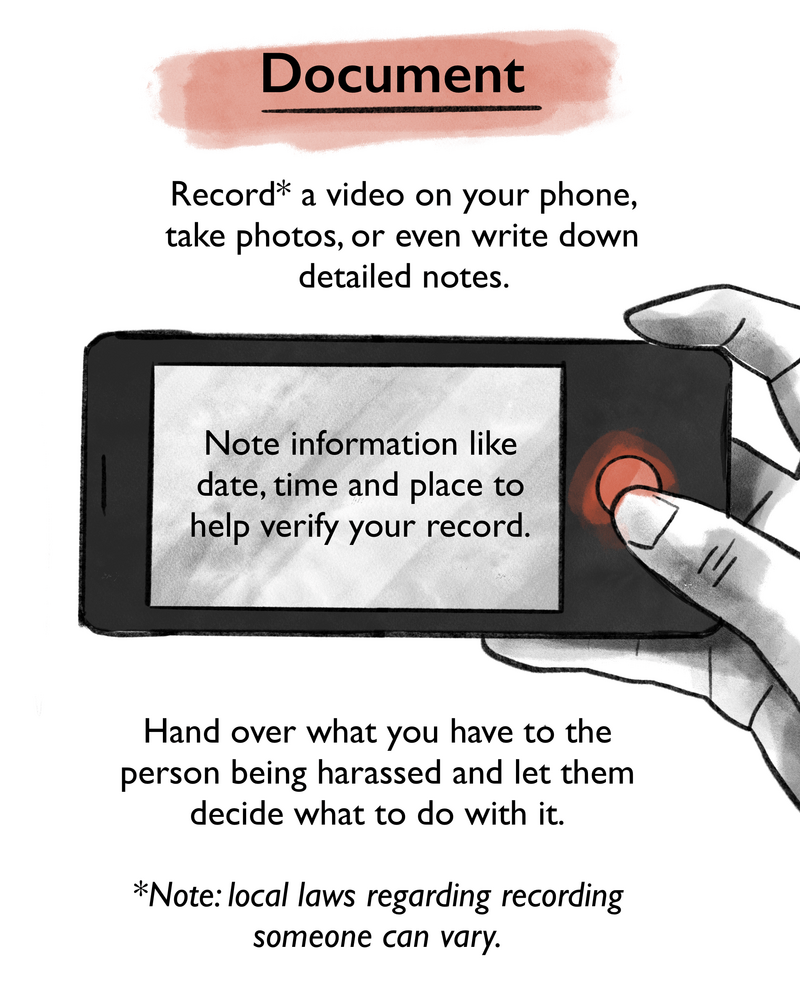
![Debrief with the person being harassed after the situation is over. [Image description: Gabriela addresses an elderly man with concern, asking "Hi, I saw what happened. It was not okay. What can I do to help you feel safer?"]](https://media.npr.org/assets/img/2021/05/18/7-min_custom-e51f846cbb2eb574f9b7ad9849b7cbee5ac46188-s800-c85.png)
![If you feel safe doing so, talk directly to the harasser. Name what is happening and ask them to stop. [Image description: One person grabs the arm of someone else. Gabriela speaks up from behind them, saying "Hey, that's not okay! Let go of them."]](https://media.npr.org/assets/img/2021/05/18/8-min_custom-53801168753ac522e31423efd19973ca98fb7c53-s800-c85.png)
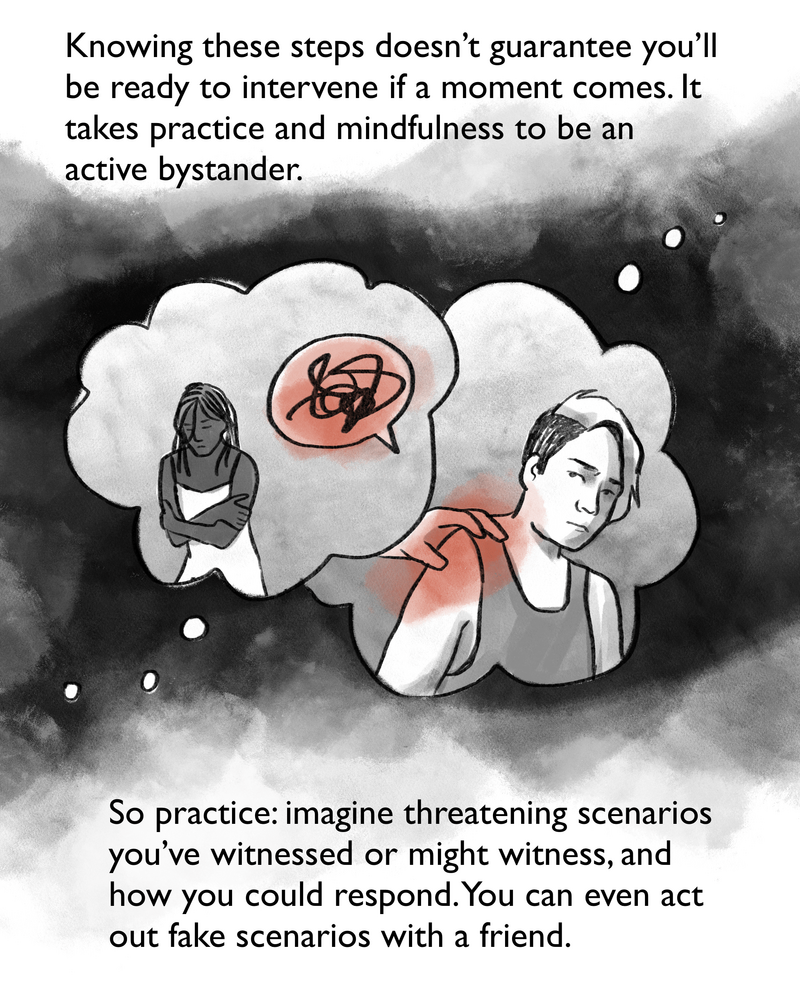
![Always remember that your goal is to deescalate harm, not be the hero of the story. It should never be about you, but instead about how you can support the person being targeted. [Image description: Gabriela and an elderly man hug each other and look off into the distance.]](https://media.npr.org/assets/img/2021/05/18/10-min_custom-2b17c48b5d6a6da2a838f95046f9314ee39ea449-s800-c85.png)
Connie Hanzhang Jin/NPR
This comic, illustrated by Connie Hanzhang Jin, is based on a Life Kit episode on the same topic. The podcast version is hosted by Ruth Tam and was produced by Clare Marie Schneider.
We’d love to hear from you. Leave us a voicemail at 202-216-9823, or email us at LifeKit@npr.org.
For more Life Kit, subscribe to our newsletter.
(Contributed by Michael Kelly, H.W.)