I love my body. My body is perfect for me at this time. My body weight is also perfect. I am exactly where I choose to be. I am beautiful, and every day I become more attractive. This concept used to be very hard for me to accept, yet things are changing now that I am treating myself as if I were someone who was deeply loved. I’m learning to reward myself with healthy little treats and pleasures now and again. Little acts of love nurture me, doing things that I really like, such as a quiet walk in nature, a hot soothing bath, or anything that really gives me pleasure. I enjoy caring for myself. I believe it is okay to like myself and to be my own best friend. I know my body is filled with star light and that I sparkle and glow everywhere I go.
–Louise Hay
Louise Lynn Hay (October 8, 1926 – August 30, 2017) was an American motivational author and the founder of Hay House. She authored several New Thought self-help books, including the 1984 book You Can Heal Your Life. Wikipedia
‘What truly matters in Jung’s message is the understanding that we are ultimately grounded in something infinite and eternal, and that our lives as finite beings, illusory as they be, serve a divine purpose.’ Bernardo Kastrup
In the summer of 1940, despite the tribulations of the time, a meeting took place at Moscia, overlooking Lake Maggiore on the Swiss-Italian border, at which the depth psychologist Carl Gustav Jung gave a surprise extempore talk in response to the main speaker at the event, the Basel mathematician Andreas Speiser.
On this occasion, at the Eranos discussion group founded in 1933 for humanistic and spiritual studies, the subject was ‘the psychology of the Trinity’. Almost apologetically, Jung told his audience: ‘I can formulate my thoughts only as they break out of me. It is like a geyser. Those who come after me will have to put them in order.’
Of course, this remark can be taken with more than a grain of salt, for it belies the thoroughness, even pedantry, with which Jung (1875–1961) put together his material. Yet it does indicate some of the difficulties encountered in readings of his works, particularly those written towards the end of his life.
At that Eranos talk was Anelia Jaffé, who became secretary to the C G Jung Institute, as well as Jung’s personal secretary, and an analytical psychologist. She later wrote: ‘The very profusion of creative ideas and of the material discussed opens out endless vistas, and the spontaneity of his style leads to occasional obscurities.’ (The Myth of Meaning in the Work of C G Jung, 1967).
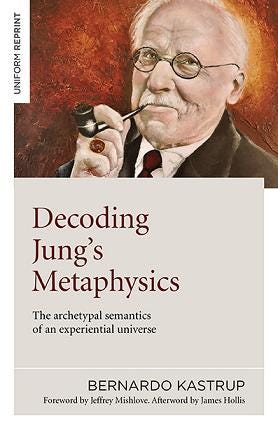
And now the philosopher-scientist Bernardo Kastrup, in his new book, Decoding Jung’s Metaphysics: The Archetypal Semantics of an Experiential Universe (Iff Books, UK £12.99 / US $19.95, February, 2021), becomes one of those envisaged as putting Jung’s thoughts ‘in order’, and Kastrup does this in a masterly manner. For anyone with an interest in Jung’s work, Decoding Jung’s Metaphysics is essential and inspiring reading.
Crucially and topically, for the contemporary culture, Kastrup reinterprets Jung’s message through the lens of metaphysical, or monistic, idealism which understands consciousness as primary and fundamental, regarding Jung’s body of work being the most psychologically sophisticated in the idealist tradition.
Thus Kastrup regards Jung as a ‘metaphysical monist’, contending there is no spirit separate from matter, no matter separate from psyche, and no scope left for dualism. For Jung, the external physical world and the collective unconscious are one and the same thing presenting itself to us in two different ways.
A complex system of metaphysical thought underlies Jung’s amazing body of work, but it’s an implied system because Jung, that secret metaphysician, sought to guard his scientific persona against accusations of philosophical speculation.
Primacy of mind
For Kastrup, Jung was the twentieth century’s greatest articulator of the primacy of mind in nature, indicating that mind and world are one and the same thing, that reality is fundamentally experiential, not material, that the psyche builds and maintains its body, not vice versa, and that the ultimate meaning of human life is to serve ‘God’ by providing ‘a reflecting mirror to God’s own instinctive mentation’.
I put ‘God’ in quotes, above, because the word needs careful usage due to its historical tradition and the baggage it carries. Kastrup has said elsewhere (The Mysteries of Reality: Dialogues with Visionary Scientists by Gayle Kimball, Iff Books, 2021) that he does not believe there is a God with a plan that knows what ‘it’s’ doing at a metacognitive level: God, as the underlying universal consciousness, is metacognitive perhaps only to the extent that we are aspects of it.
Explicit introspective awareness — to be meta-conscious, to know one is having experience — is part of the process of what Jung called individuation and which Kastrup sees as the ultimate goal not only of life but of the universe itself, through us. So, for him ‘God’ is a metonym.
Nevertheless, Kastrup states: ‘The universe is God’s dream and we are here to interpret it … At a time when culture and society are dominated by the simplistic, myopic worldview of metaphysical materialism — with its accompanying existential angst — Jung’s work offers us a renewed horizon of meaning and purpose: life is sacrificial in the noblest sense imaginable, in that we live and die to render an indispensable service to God. What a great honor and opportunity it is to live.’
In a phrase, ‘we help God become aware of itself’ — put another way, through our consciousness we help the universe to contemplate itself. This is what is known as Jung’s myth of meaning, equating to the ‘myth of consciousness’, to which Kastrup makes allusion at the very end of his book.
If Jung had become prominent in the first half of the twentieth century instead of Freud then I believe we would be living in a different world today. As the Copernican revolution brought acceptance that the Earth revolved around the Sun, not the Sun around the Earth, so the Jungian revolution was to propose that the ego revolved around the Self, not the other way round: the Self being an image of the personality as a whole, a central ordering principle embracing both conscious and unconscious.
And as Kastrup says, while Freud thought of the unconscious as merely a passive repository of forgotten or repressed contents of consciousness, Jung saw the unconscious as an active, creative matrix with a psychic life, will and language of its own, often at odds with our conscious dispositions, which is surely much closer to the truth.
Metaphysical significance
Such thinking led Jung ‘down avenues of empirical investigation and speculation rich with metaphysical significance’ which, says Kastrup, is what his new book is all about, together with the philosophical consequences. Jung himself admitted that his work had metaphysical implications, rejecting ‘mainstream metaphysical materialism’, the notion that physicality is all there is. One is thus justified to infer the metaphysical opinions Jung might have held covertly so as to keep up a ‘politically correct image of metaphysically agnostic scientist’.
In the Jungian sense, our metaphysical task is to maintain an ongoing expansion, or heightening, of consciousness; it’s consciousness that bestows meaning on our lives. But also accepting the existence of the unconscious, or obfuscated consciousness in Kastrup’s terms, one, in following Jung, can consider a transcendental meaning prevailing independently of ourselves, as manifested in synchronistic phenomena, in which Jung included, for example, extrasensory perception, premonitions and dreams that come true.
In synchronicity, the inner psychic image is the counterpart of a future or remote event imperceptible to the senses; they are linked not causally but by their meaning. Jung defined it as a ‘coincidence in time of two or more causally unrelated events which have the same or similar meaning’ (Synchronicity: an Acausal Connecting Principle, 1952), and suggested that it could be a fourth dimension added to space, time and causality.
Certainly, synchronicity, by its very nature, is a consciousness-raising experience: in it, we find ourselves part of a profoundly meaningful process which we can actually influence. It seems to arise spontaneously out of the harmony of natural processes.
Indeed, Kastrup asserts that the most significant metaphysical implication of Jung’s work stems from the theory of synchronicity: by saying that the physical world arranges itself to symbolically connote something, then psychic powers somehow control its behaviour. On some underlying immanent and metaphysical level there must be a transpersonal psychic layer, associated with the physical universe at large, performing the cognitive associations necessary for the universe to express meaning through its behaviour.
And in a remarkable insight, Kastrup goes further to conclude that it’s synchronicity that actually drives the universe, that makes it ‘work’, that synchronicity is the only metaphysically real ordering principle in nature.
Archetypal patterns
Jung claimed that synchronicities unfold according to archetypal patterns, implying that the collective unconscious underlies both consciousness and the physical world itself. Significantly, this would mean that physical events are orchestrated by the same a priori patterns that orchestrate events in consciousness.
One implication of this is that the collective unconscious and the physical world are related in effectively the same way as the collective unconscious and ego-consciousness. As Jung suggests that ego-consciousness arises out of the unconscious, it follows that the physical world must also arise from the collective unconscious, as another manifestation of it. So, logically, one must conclude that the physical world is as essentially experiential as the psyche.
Metaphysical idealism is arguably the only option left for making sense of the latest experimental results in fields such as quantum mechanics, Kastrup argues. Many physicists assume that quantum fluctuations at the foundation of our physical environment do not follow any global patterns.
But: ‘For all we know, instead of accidents, quantum events conform to subtle, non-local patterns of organisation corresponding to an as yet unacknowledged metaphysical ordering principle, different from causality.’
Perhaps if Jung had received a proper formulation of idealism that countered all criticisms made against it, Kastrup suggests, he would have allowed himself to express his metaphysical views more openly.
Bernardo Kastrup’s work is in the forefront of the contemporary renaissance of metaphysical idealism, the notion that reality is essentially mental. He has a PhD in philosophy (ontology, philosophy of mind) and a PhD in computer engineering (reconfigurable computing, artificial intelligence). As a scientist, he has worked for the European Organization for Nuclear Research (CERN) and the Philips Research Laboratories, where the ‘Casimir Effect’ of quantum field theory was discovered.
Formulated in detail in many academic papers and eight previous books, his ideas have been featured at Scientific American, the Institute of Art and Ideas, the Blog of the American Philosophical Association and Big Think, among others. For more information, freely downloadable papers, videos and so on, visit www.bernardokastrup.com
A companion piece to The Concept of Anxiety, this work continues Søren Kierkegaard’s radical and comprehensive analysis of human nature in a spectrum of possibilities of existence. Present here is a remarkable combination of the insight of the poet and the contemplation of the philosopher.
In The Sickness unto Death, Kierkegaard moves beyond anxiety on the mental-emotional level to the spiritual level, where — in contact with the eternal — anxiety becomes despair. Both anxiety and despair reflect the misrelation that arises in the self when the elements of the synthesis — the infinite and the finite — do not come into proper relation to each other. Despair is a deeper expression for anxiety and is a mark of the eternal, which is intended to penetrate temporal existence.
scienceandnondualityhttp://www.scienceandnonduality.com In this memorable conversation from SAND 18 Peter Levine, the father of trauma therapy work, and Thomas Huebl, a spiritual teacher known for his work integrating healing of collective trauma, discuss the relationship between healing trauma and spiritual growth. One theme that repeats throughout the discussion is that we are all connected through the traumatization of the world, and that the healing of trauma is a way of returning to the wholeness and fullness of living. For more information visit https://traumahealing.org and https://thomashuebl.com Science And NonDuality is a community inspired by timeless wisdom, informed by cutting-edge science, and grounded in personal experience. We come together in an openhearted exploration to further our individual and collective evolution. New ways of being emerge. We embody our interconnectedness and celebrate our humanity.
Origin Middle English: from Old French blamer, blasmer (verb), from a popular Latin variant of ecclesiastical Latin blasphemare ‘reproach, revile, blaspheme’, from Greek blasphēmein (see blaspheme), to blame God.
The Search for Extraterrestrial Intelligence — or SETI — goes beyond hunting for E.T. and habitable planets. Scientists in the field are using telescopes and satellites looking for signs of outright civilizational intelligence. One of the founding pioneers in this search is astronomer Jill Tarter. She is a co-founder of the SETI Institute and was an inspiration for Jodie Foster’s character in the movie Contact, based on the novel by Carl Sagan. To speak with Tarter is to begin to grasp the creative majesty of SETI and what’s relevant now in the ancient question: “Are we alone in the universe?”
Jill Tarter is the co-founder and chair emeritus for SETI Research at the SETI Institute in Mountain View, California. She currently serves on the management board for the Allen Telescope Array. She has been awarded two Exceptional Public Service medals from NASA and the Women in Aerospace Lifetime Achievement Award. In April of 2021, she was elected to the American Academy of Arts and Sciences.
China National Space Administration (CNSA) rendering Saturday, May 22, 2021, China’s Zhurong rover is depicted on the surface of Mars. China’s first Mars rover has driven down from its landing platform and is now roaming the surface of the red planet, China’s space administration said Saturday. (CNSA via AP)
China’s first Mars rover has driven down from its landing platform and is now roaming the surface of the red planet, China’s space administration said Saturday.
The solar-powered rover touched Martian soil at 10:40 a.m. Saturday Beijing time (0240 GMT), the China National Space Administration said.
China landed the spacecraft carrying the rover on Mars last Saturday, a technically challenging feat more difficult than a moon landing, in a first for the country. It is the second country to do so, after the United States.
Named after the Chinese god of fire, Zhurong, the rover has been running diagnostics tests for several days before it began its exploration today (Saturday). It is expected to be deployed for 90 days to search for evidence of life.
The U.S. also has an ongoing Mars mission, with the Perseverance rover and a tiny helicopter exploring the planet. NASA expects the rover to collect its first sample in July for return to Earth as early as 2031.
China has ambitious space plans that include launching a crewed orbital station and landing a human on the moon. China in 2019 became the first country to land a space probe on the little-explored far side of the moon, and in December returned lunar rocks to Earth for the first time since the 1970s.
is associate professor of psychiatry and behavioural sciences at George Washington University. His work addresses improving mental health services for populations affected by conflict, disasters and other humanitarian emergencies. He has focused on strategies to reduce stigma against people with mental illness around the world. He has consulted with the Carter Center Mental Health Program in Liberia and has been advisor to Transcultural Psychosocial Organization in Nepal. He co-edited the book Global Mental Health: Anthropological Perspectives (2016).Listen here
When I talk to my patients about emotion regulation, among the first things that come into their minds are usually deep breathing and meditation. Those who’ve gone through counselling might describe cognitive-behavioural approaches, where they follow set steps to challenge the assumptions underlying their emotional reactions. With all the added distress, anxiety and depression associated with the COVID-19 pandemic, many of my patients, friends and family members also talk about using the many relaxation and mindfulness apps now available.
As a psychiatrist, I appreciate that these techniques have the potential to be helpful. Many have been validated in well-designed research studies. But there’s another aspect of my identity that makes me doubt whether emotional regulation is something we’re really supposed to do alone. That side of me is the trained anthropologist. I’ve practised psychiatry for more than a decade, but I’ve been travelling around the world for much longer trying to understand how people face and respond to suffering.
Twenty-five years ago, I spent some months at a small concrete temple in southeastern Nepal. Families would bring their loved ones when they could no longer support them at home. The priests at the temple would listen as the families explained their problems. The person in distress would stay a few weeks, months or even longer. Every morning, the residents would worship together, chanting and rocking as they sat cross-legged or kneeling on the floor. While I was initially captivated by what was, to my eyes, this more unusual form of healing, I began to notice the people coming by, day by day, for a conversation with one of the priests. They’d describe the worries in their hearts and their minds, and the holy man would sit with them, never in a rush. Sometimes, he would teach them a mantra or wipe their backs and shoulders with a feather brush. Then they would leave with more light in their faces. Some came back often, others I only saw once.
I’ve seen that style of interaction again and again. In northern Uganda, a village health worker sat under a tree talking to a woman who had been shunned by her neighbours because she had a child with a rare neurological disorder. In Liberia, a police officer, whose daughter lived with a mental illness, sat listening to a colleague who was explaining how distressing it was to enforce quarantine during the Ebola outbreak. In Haiti, a houngan priest talked with a teacher about digging his way out of the rubble after buildings had crumbled around him in the 2010 earthquake. If you listen closely, these conversations aren’t limited to people in helping professions. There’s a taxi driver and a passenger talking about the stress of raising teenagers. Or a woman sharing with her spouse about anger at her coworkers after a day at the office.
Emotion regulation to reduce distress appears to be a fundamental human behaviour that doesn’t just happen within us, but between us. We’re constantly consoling others and being consoled, from instances of forgettable disappointment to life-changing traumas. Unfortunately, mainstream psychiatry and psychology, as well as the self-help movement, is burdened by the expectation that self-regulation skills must be mastered to achieve wellbeing.
In my clinical training, I’d originally thought of managing distress as a technical skill for professionals. To be effective, helping others regulate their emotions called for the training of psychologists, religious leaders or other specialists. However, observing the cross-cultural elements of emotion regulation between people makes me think that it’s actually a human universal taking on myriad manifestations. And as a ubiquitous human behaviour, arguably it should be understood from an evolutionary perspective.
With the anthropologists Catherine Panter-Brick of Yale University and Melvin Konner of Emory University, as well as with Vikram Patel, the world’s leading expert in global mental health at Harvard University, and my colleague Katherine Ottman at George Washington University, we endeavoured to identify what evolutionary theory could tell us about interpersonal healing and emotion regulation between people. Fields such as evolutionary medicine and evolutionary psychiatry had already worked to shed light on the origins of physical and mental illnesses, uncovering mismatches between the selection pressures that shaped who we are and the current environmental, dietary, social and other factors that affect us in daily life. However, the question of psychological healing hadn’t been explored in similar depth. Why do humans spend minutes every day, to hours and weeks of our lives, comforting others in distress, even when that’s not our profession? Why do we as humans support one another, and why does it look similar across cultures and throughout the history of our species?
If emotional processes are bound up with social rupture, it follows that they’ll play a role in social repair
These questions seem superficially like those about altruism: that is, why do we do anything nice for others at all, from an evolutionary perspective? Survival of the fittest, in popular culture, has typically been simplified to an ethos of absolute individualism. However, beginning in the 1960s and ’70s, evolutionary biologists developed models for altruism that moved beyond helping others just because of shared DNA. Tit-for-tat dynamics and quid-pro-quo social exchanges remained prominent as explanations, but contemporary evolutionary theory also recognises how shared social behaviours are important for survival because of competition between social groups. For one thing, cooperation is helpful in procuring and protecting resources. A group member who monopolises all the resources from others might get a short-term benefit, but she’s more vulnerable to threats overall because the group as whole has been weakened. At a certain point in our evolutionary history, other humans became a much bigger threat than other predatory animals. This intragroup competition can be seen in other social mammals too, especially nonhuman primates. Jane Goodall’s writings on chimpanzees are rich with descriptions of group formations and fissures, forced exclusion and intragroup reconciliations.
Emotions, whether positive or distressing, are strongly linked to these social dynamics. Feelings such as anger, jealousy, shame, guilt, loneliness and grief are often triggered by changes to one’s position within a group or to important personal relationships. So, if emotional processes are bound up with social rupture, it follows that they’re likely to play a role in social repair. There must be a mechanism that tells us that other people are part of our social circles and so help us preserve the social fabric. Emotions work a bit like a social immune system: social relationships provoke an emotional inflammatory reaction when something threatens them. But there are also ways to dampen that response and avoid a state of social sepsis, bringing people back into the fold when relationships have been ruptured.
A striking example of this comes from my work with former child soldiers. In many cases, the experience of returning home after being a child combatant is even more distressing than the war itself. Guilt, shame and lasting anger are common. Families, teachers and members of the community might fear the returnees, or feel a sense of guilt and shame about failing to prevent their children from joining the conflict. In Uganda, Mozambique and Sierra Leone, traditional healing rituals were used to symbolically separate children from the actions they’d committed, with gestures representing the guilt, shame, anger and distress leaving the body. In Nepal, traditional healers would symbolically wrap the hearts and minds of child soldiers to calm the distress. Here, though, we saw that the emotional regulation of parents, teachers and others was sometimes even more important. We trained community members to help teachers who were scared of having child soldiers in the classroom to discuss their fears. Similarly, they sat with family members who were overwhelmed with the ambivalence of joy and dread about their child returning. By spending time with these people, community health workers helped them to feel less alone; their emotions made more sense to them, and they could begin reforming relationships with their children.
Just as there are similarities in how language works across cultures, there seems to be a grammar of how humans support one another in the face of psychological distress. From an evolutionary perspective, it makes sense that the human social immune system evolved in a way that resembles language. Language is a social behaviour that supports how groups function, and it requires a listener and a speaker to function. Emotional regulation is a similarly dynamic interpersonal process.
Many anthropologists have written about common elements of shamanic healing, comparing these with psychotherapy and other forms of counselling. In the 1960s, Jerome Frank, a psychiatrist, and Claude Lévi-Strauss, an anthropologist, separately described universal elements of healing. Later, the anthropologist James Dow, who spent decades studying healing practices in the Caribbean and Mexico, built upon deep structure in linguistic theory to identify certain common steps: there’s a body of symbols shared between the healer and the suffering person; the healer persuades the sufferer that the problem can be explained; the healer attaches the suffering to a transactional symbol through emotion; the healer manipulates the symbols to create emotional change and alleviate suffering.
What’s striking is how this description of symbolic healing resonates with what we understand about empathy in nonhuman primates and other mammals. According to the primatologist Frans de Waal and the psychologist Stephanie Preston, emotion is transferred from the animal in distress to another member of its group. That happens through contagion, which can be conveyed by distress sounds, facial expressions or other body language, and is then received via mirror neurons and other neurological processes. As a consequence, the distressed animal and the consoling one share the same affect, or state of feeling. The consoling animal is able to regulate its distress and channel this sense of balance into consolation, in order to help the distressed creature by its physical presence, grooming behaviours or other soothing interactions. De Waal and Preston also add another important step: as the distressed animal is calmed, emotional transfer allows the consoler to experience relief – a form of self-reward that perpetuates such helping behaviours.
We can reframe the suffering of others even when we feel it ourselves. We organise it, make sense of it, alleviate it
These displays of emotional consoling probably evolved because of increased complexity in how animals communicate distress. If a vervet monkey sees a snake and reacts with fear, other monkeys in the group will do better if they can react quickly by internalising that fear, rather than waiting to see the snake for themselves. However, as emotional relationships became more intricate, there are times when an extreme behavioural response won’t be needed – even if it feels that way. Group members need to manage those reactions within a social immune system. In neuroscience terms, we often think of the later-evolving frontal lobe as the part of the brain responsible for emotional regulation: it tamps down or modifies activity in the more ‘primitive’ areas of the brain, such as the amygdala, associated with fear and distress. But our social relationships also play this role of reducing states of distress. Friends, family and social groups are kinds of ‘extended frontal lobes’, as the psychiatrist James Griffith likes to say. They help us to calm down and cope with loss, trauma and violation.
We can map these processes in our everyday lives. Seeing others in a state of despair can bring us to tears. When we see someone who’s afraid, we’re put on alert to the possibility of danger nearby. This emotional contagion would put all of us in total disarray if grief, panic or anger just passed unabated from one group member to the next. When that does happen, we get mob violence. However, that’s not the typical response, because we can reframe the suffering of others even when we feel it for ourselves. We organise it, make sense of it, and alleviate it.
We’re then able to respond to the other person in distress. We implicitly and explicitly communicate how the distress can be calmed. This might be through physical presence, such as sitting together or giving a hug. Physical contact can have profound biochemical reactions that reduce stress. We lean on cognitive processes too, as people talk through the situation and identify reasons for reassurance or hope, or solve the problem collaboratively. At the heart of all of these interactions is being together. Certain psychotherapy techniques or religious or shamanic manipulations can even symbolically transform the stress. One of my collaborators in Uganda is Byamah Mutamba: his parents named him ‘Mutamba’, which is a shortened form of the Runyakitara phrase ‘one who heals loneliness’ – never has there been a more apt name for a gifted psychiatrist. When we boil down psychological therapy, its core message is: ‘You are not alone.’
Unfortunately, we don’t live in a world where it’s easy to alleviate suffering through interactions with other people. The documented rise in distress during the pandemic was likely due to the disruption of many of these processes. After all, physical presence and being together evolved as the most basic form of interpersonal emotion regulation – a chimpanzee grooming another chimpanzee in distress. That contact and its neurophysiological impact on our brains and bodies has been lost or greatly constricted for many of us. Even just mundane human connections can be emotionally soothing: think of the average day for students from preschool to college who are connecting with scores of others in brief encounters. Being thrown together like this offers numerous opportunities to share the small or large distressing bits of the day, leaning on someone to understand and process it – without needing to intentionally reach out in order to connect over a Zoom call. When it comes to professional mental health services, in many ways remote care has been incredibly helpful, and should be continued. But there are also situations when being in the same room is important to observe the body and to allow for emotions to flow freely.
It’s not like we had all of this figured out before COVID-19, anyway. There was plenty of unabated distress going around. Understanding why interpersonal emotional regulation fails is another reason why an evolutionary framework can be useful. While emotional contagion is important within groups, it can be counterproductive for competition between groups. Feeling sadness when you see the suffering face of a rival might not help your kin or collective to thrive. Unfortunately, our biology seems to play out this way. Whereas the neurotransmitter oxytocin has an important role in bonding and empathy for ‘in-group’ members, it contributes to feelings of pleasure at the suffering of ‘out-group’ members. It’s a biological pathway for Schadenfreude. Neuropsychological and neuroimaging studies suggest that we don’t have the same emotional contagion lever for most out-group members. To raise the stakes against empathy even further, when a person is feeling anxious, threatened or distressed, they shrink their circle of who counts as an ‘in-group’. In times when we’re feeling joyful, magnanimity prevails. But when we feel threatened, we retreat to emotional connectedness with a small circle of intimates, and even those individuals might not be seen, proverbially, as being in the same boat.
The question of in-group vs out-group is especially complex for humans because of cultural evolution. In many other species, biological phenotypes – physical features, smells, threat calls, fixed behavioural patterns – tend to determine group status. But thanks to cultural evolution, humans use a whole host of features to fix ‘in-group’ vs ‘out-group’ status. Language is a large part, but also dress, behaviour and symbols that signify belonging and shared life experiences. There’s a mammoth-sized catalogue of studies showing that health professionals, including mental health professionals, often don’t demonstrate empathy for their patients; in particular, most studies have demonstrated notable lack of empathy among white doctors working with Black patients.
If health workers feel this shared humanity, then they’re better able to soothe their patients’ distress
So, what’s an evolutionarily informed response? One part of the story is to expand the diversity of the mental health workforce. If empathy is fostered by shared group identity, then our healers need to look more like the communities they serve. In the United States in 2016, only 16 per cent of active psychologists were from minority populations despite comprising 40 per cent of the US population. It’s worse with practising psychiatrists: only 10 per cent are from underrepresented minorities. Given the disproportionate burden of stressors in minority communities, including racism, economic barriers, police violence and other factors, the gap is especially worrisome. There are similar disparities on a global level. Mental health specialists are concentrated in high-income countries, where one in five people have access to appropriate care for depression. But in the low- and middle-income countries of Africa, East Asia and South America, only one in 27 people have access to comparable care.
One global strategy is to train people who aren’t mental health specialists to take on some of the roles that a psychiatrist or psychologist would play. These programmes are grounded in the idea that we all have the potential to support one another. Whereas clinical training for psychiatrists and psychologists typically focuses on mastering techniques for a specific class of treatment, educating lay persons is about channelling many of these foundational helping skills. Training helps to reclaim abilities that lie inside all of us and aren’t exclusive to those with years of professional training.
Panter-Brick has worked with a programme in Jordan where Syrian refugees are supported to reduce distress and promote resilience among fellow refugees. Patel has led the global movement for these initiatives with community health workers and non-specialists in low- and middle-income countries, and is now expanding these efforts within the US. We’re learning that these programmes, initially designed out of necessity, have the advantage of promoting empathic care because the consolers and consoled come from the same communities and shared life experiences.
That said, my colleagues and I are also aware that identity matching isn’t the only, or even the preferred solution. You might have more in common with someone halfway around the world than with your neighbour, at least in terms of the features bound up with your personal distress. Entire healing systems based on the notion that consoler and consoled should look the same will be problematic – not least because those in power, designing these systems, might not have a clear idea of who’ll feel emotionally connected to whom. Therefore, another strategy is to consider how to foster empathy and connection broadly among health professionals, non-specialists working in communities, and the general public.
This is where social psychology and evolutionary theory can come together. Evolutionary theory suggests why certain group behaviours emerge, while social psychology offers a way to use that information to change social dynamics. The psychologist Gordon Allport established the foundation for this in the 1950s, with work that coincided with the civil rights movement and racial integration in schools. Allport and colleagues suggested that intergroup contact could break down prejudice and barriers when the groups had a common goal (some echoes of evolutionary theory right there), and designed activities for white and Black students to do together to build this cooperation and cement aspects of shared identity. (They placed less effort on integrating teachers, however, as has been widely criticised.)
Since Allport, researchers have paid much more attention to how to build empathy when groups come together. I’ve spent the past decade trying to understand how to foster the empathy that doctors, nurses and community health workers feel towards patients living with mental illness in places ranging from Nepal to Ethiopia to Liberia. We train those living with mental illness to tell their stories, combined with photographs they take of their lives. These narratives follow an arc that brings health workers on an emotional journey, encouraging the flow of empathy and hopefully changing how they connect with patients. They show how much doctors and health workers have in common with those they treat, and how they care about the same things: looking after children and family members, economic security, participating in collective activities, and seeing the beauty in everyday life. If health workers feel this shared humanity – that they share some in-group qualities – then they’re better able to soothe their patients’ distress. The empathy and emotional contagion flow more swiftly, followed by consolation and resolution, and with the health workers getting the psychological reward from helping another person.
Each one of us could benefit from thinking in evolutionary terms about collective emotional regulation. One important step is to recall that being helped by others is not a sign of weakness: it is fundamental to what we do and who we are. We should be willing to seek help when we need it, and to connect with others who are in distress. In hospitals and other workplaces around the world, we expect staff to be able to handle everything they’re going through with COVID-19, at work and at home. And if you’re struggling, then it’s your responsibility to do some form of ‘self-care’. The medical practice where I work paid for all employees to have a subscription to a popular mindfulness app. But it’s equally important to make time to connect with others. A colleague might be the person most likely to be able to sustain that flow of empathy because of a shared context and culture. We all need more confidence that we can be helpful simply by being there, listening, and sharing another’s emotion. It makes us stronger as a group.
Collective empathy is also something that we need to promote in our children, in their schools, and in our parenting, to build on these natural instincts and sustain them. One day, when my wife and I were arguing – as happens when a family is locked up together for a year – our four-year-old daughter came over with a colourful pinwheel. In her remote Zoom preschool classes, she’d been taught to use it when she was feeling angry or upset. Once she experienced the emotional contagion of distress from my wife and me, she brought the pinwheel to us, on her own initiative, as something both symbolic and physiological to do together. She was our little shaman, doing what humans have done to support one another for hundreds of thousands of years. She knew that we heal together.
To read more about emotion regulation, visit Psyche, a digital magazine from Aeon that illuminates the human condition through psychology, philosophical understanding and the arts.
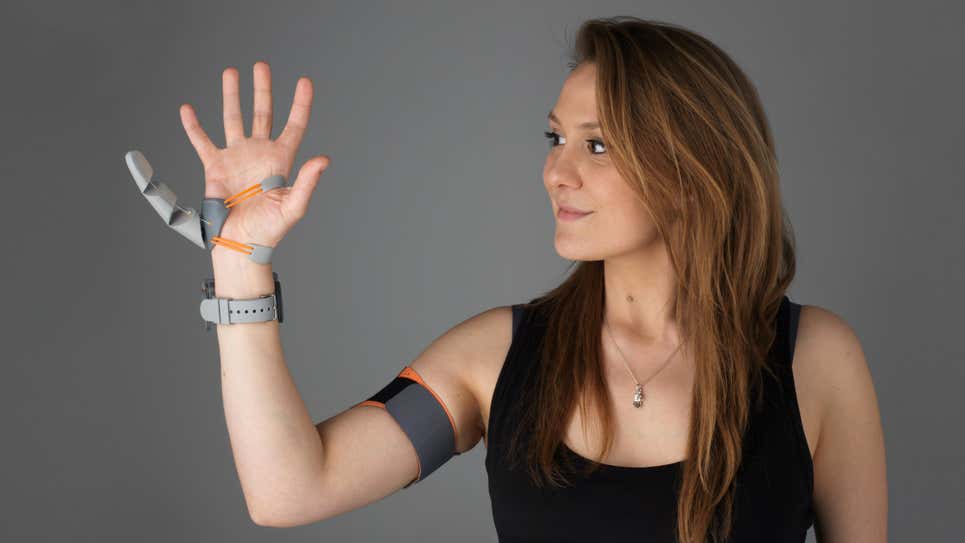
UCL designer Dani Clode with her ‘Third Thumb’ device.
An experiment in which 36 people were fitted with a robotic third thumb has demonstrated the brain’s uncanny ability to adapt and leverage an entirely new body part, and in ways the researchers are still trying to understand.
The Third Thumb started as an award-winning graduate project at the Royal College of Art in London, England, and it was done to reframe the traditional view of prosthetics. “The project began as a way to better understand what it was like to control something extra attached to my body,” Dani Clode, designer of the Third Thumb, explained in an email. “As a prosthetic arm designer, I wanted to understand the unique relationship between a person and a prosthesis. It’s a relationship unlike any other product, and I wanted to explore that.”
Indeed, the Third Thumb represents an augmentation of the human body, as opposed to the replacement or restoration of “normal” human functionality. It’s a very transhumanist concept, but scientists don’t actually know if the human brain can meaningfully support an added body part or the long-term consequences of the extra cognitive load.
A user’s view of the Third Thumb. Image: Dani Clode
“These questions are complex and require the collaboration of experts from different fields,” Tamar Makin, professor of cognitive neuroscience at University College London and head of the Plasticity Lab, said in an email. “In our study, we used Dani’s cleverly designed Third Thumb to explore how the human brain can support an extra body part, and how the augmentative technology might impact our brain.”
The answers are important, as an additional thumb could lead to a host of benefits. It could help with repetitive, difficult, and physically demanding tasks, while also being of assistance to people who have either permanently or temporarily lost the use of one hand. It could also result in entirely new capabilities and activities, whether it be a new way of playing a musical instrument (or enabling the invention of a new type of musical instrument!) or the advent of an entirely new sporting activity. “Personally, I found the Thumb really useful for getting the keys out of a pocket, while simultaneously browsing the internet on my phone.”
“On a more day-to-day level, some of our participants reported using the Thumb to flip pages of a book, holding a banana while peeling it with the rest of their fingers, or opening a bottle one-handed,” wrote UCL neuroscientist Paulina Kieliba, an author of the new Science Robotics study, in an email. “Most of them used it to pick up and carry small objects while their hand was occupied with other tasks. Personally, I found the Thumb really useful for getting the keys out of a pocket, while simultaneously browsing the internet on my phone.”
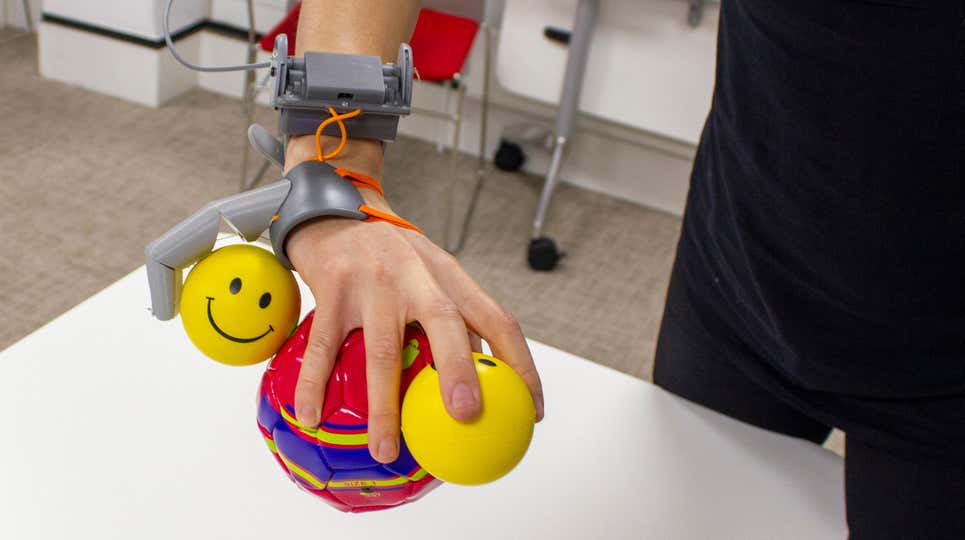
The Third Thumb being used to hold multiple balls.
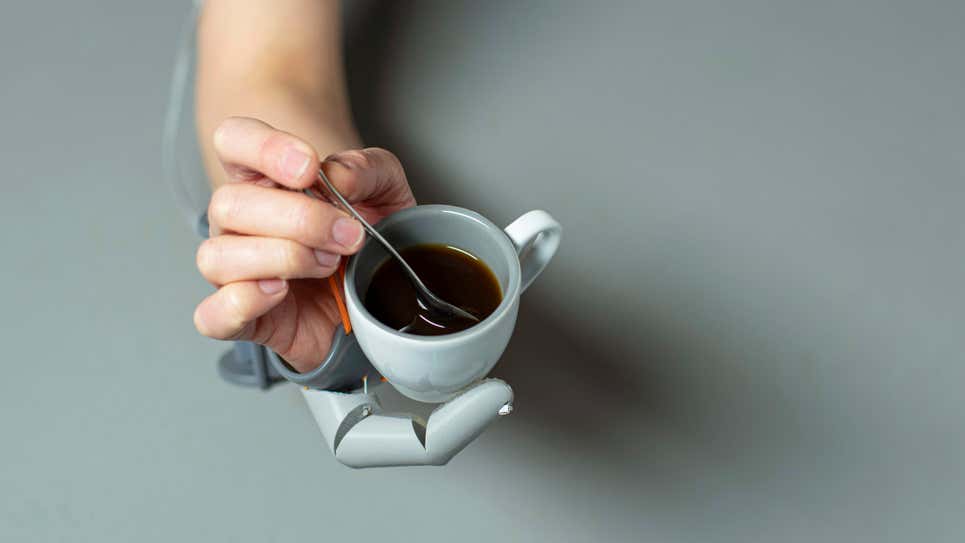
A group of 36 healthy participants were trained on the device (professional musicians were excluded) and used it to perform a variety of tasks, such as building a tower of blocks, manipulating multiple balls simultaneously, or stirring a coffee cup with a spoon. They even managed to perform some of these tasks while blindfolded or distracted with math problems.
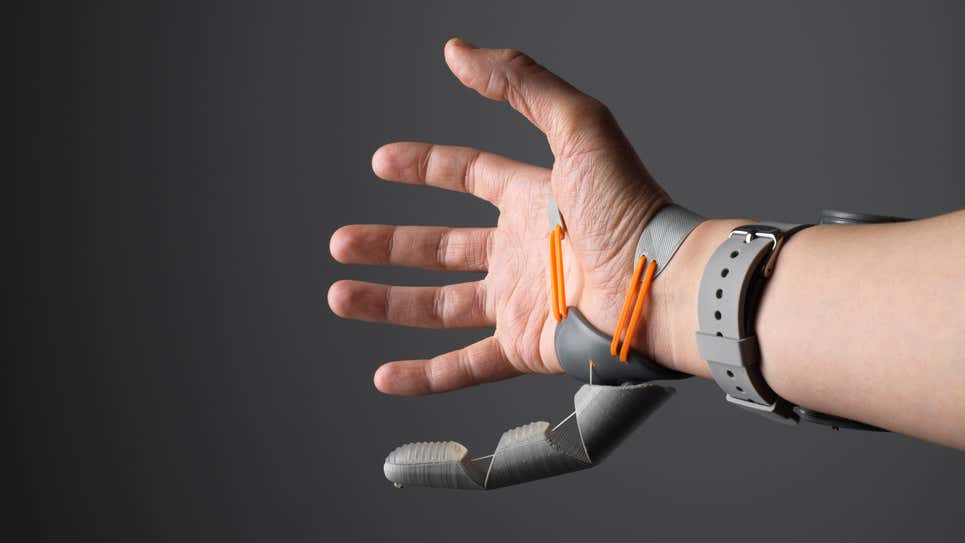
“The Third Thumb is a flexible 3D-printed thumb extension for your hand, controlled by your feet,” said Clode, a designer at UCL. “It is worn on the hand, next to your little finger, and dynamically moves like a thumb by using two motors controlled by two pressure sensors retrofitted into your shoes, under your toes, and communicating with the Thumb piece wirelessly.”
The use of feet to control this device might seem weird, but Clode compared it to driving a car, using a sewing machine, or playing the piano—all activities that make use of foot pedals.
The participants had access to the device for five days, and their brains were fMRI scanned both before and after the experiment. They learned quickly, using the device to pick up wine glasses, sort objects, and go about their daily routines. The participants were encouraged to take the Thumb home each day, allowing them to wear the device between two and six hours each day. A control group was also created, in which participants used a static third thumb with no robotic capability.
A person supporting a coffee cup with the Third Thumb, while stirring a spoon with their natural fingers.
By the end of training, “some of our participants even reported that they started to feel like the Thumb was becoming a part of their body,” said Clode. “We were also surprised to see people forming such strong bonds with the Thumb.” Some participants “needed a little bit of time to say goodbye” to the prosthetic, and some even said they felt like “they were missing something after the training had finished,” she added.
As the training progressed, the participants changed the way they used the device, which resulted in new finger coordination patterns. This was recorded in their hand movements as well as in their brains.“This is a very important message for everyone interested in safe and successful motor augmentation—augmentation may incur changes to how the brain represents our bodies—those changes need to be understood and explored further before this technology can be widely implemented.”
In the brain’s sensorimotor cortex, “each individual finger is represented distinctly from the others, forming what we call a hand representation,” Kieliba explained. After using the device, this hand representation shrunk in the participants’ brains, in that the neural activity patterns corresponding to the individual fingers became less distinct and more alike.
“This is a very important message for everyone interested in safe and successful motor augmentation—augmentation may incur changes to how the brain represents our bodies—those changes need to be understood and explored further before this technology can be widely implemented,” said Kieliba.
At the same time, scientists have seen evidence for brain plasticity when studying how prosthetic devices are represented in the brains of users and amputees, added Makin. Brain plasticity can be understood as a “bidirectional process,” in which the brain will adapt both the representation of the prosthesis and the user’s body to improve adaptability, she said.
Looking ahead, the team would like to develop a Third Thumb that’s easy to use while walking (a problem with the current design) and also a prosthetic that’s safe to use in an fMRI scanner, which would allow the team to study the brain while the device is in use. We wish them the best of luck, as our augmented transhuman future awaits.