Event on March 21, 2021: Releasing the Hidden Splendour workshop facilitated by Richard Hartnett, H.W., M. and Rick Thomas, H.W., M. will be held on Sunday, March 21 at 3 p.m. Pacific time. Open to all students of RHS.
I’ve long been fascinated by the phenomenon of imaginary numbers. Mandelbrot fractals depend on them entirely, at least when they’re used in the form of complex numbers.
And subsequently, they’ve been discovered to be at work in several real-world situations, especially in chaos theory as well as quantum field theory.
One problem with them is the problem physicists imagine because the notion of an imaginary number is so profoundly, well, unimaginable. But whereas some physicists have been horrified by their use, I’ve been endlessly intrigued by them.
An imaginary number is founded upon the square root of -1 which they indicate with the letter i. The problem is there is no such thing as the square root of -1. But, so what? The entire universe is unimaginable!
Benoit Mandelbrot is the guy who made complex numbers famous. He used i in complex numbers from which he plotted graphs where an x-axis is a real number and a y-axis is an imaginary number. The result is what has been famously called Mandelbrot Fractals, derived from complex number math.
If we apply them in an iterated formula Z=Z^2 + C and iterate it billions of times (with a computer of course) we get blossoming images that look like this, called a Mandelbrot zoom:
I dwell in Possibility – A fairer House than Prose – More numerous of Windows – Superior – for Doors –
Of Chambers as the Cedars – Impregnable of eye – And for an everlasting Roof The Gambrels of the Sky –
Of Visitors – the fairest – For Occupation – This – The spreading wide my narrow Hands To gather Paradise –
Emily Elizabeth Dickinson (December 10, 1830 – May 15, 1886) was an American poet. Little known during her life, she has since been regarded as one of the most important figures in American poetry. Dickinson was born in Amherst, Massachusetts into a prominent family with strong ties to its community. Wikipedia
‘Jane’ is a client familiar to every psychotherapist. She is suffering, perhaps intensely, but struggles to put into words the feelings and internal conflicts that drive her suffering, except in the most limited way. She might pin her angst on something specific: she’s terrified of gaining weight, or agonises over the shape of her nose, or says she can’t control her drinking. But when asked to say more about her inner life, she comes up blank, or returns to her already well-trodden initial complaint, or perhaps dismisses the question entirely. It’s not, the therapist soon discovers, that she’s holding back; on the contrary, she doesn’t have the capacity to give a fuller description of her internal life.
People like Jane are alexithymic, a term coined by the US psychoanalysts John Case Nemiah and Peter Sifneos in the 1970s, from the Greek a (‘without’), lexis (‘words’) and thymos (‘emotions’). It refers to a cluster of features including difficulty identifying and describing subjective feelings, a limited fantasy life, and a style of thinking that focuses on external stimuli as opposed to internal states.
Yet even before there was a name for it, psychoanalysts would oftendescribe clients with apparent alexithymia, who reached an impasse in treatment because of their concrete thinking, limited emotional awareness and dismissive attitude toward their inner lives. These people were prone to developing so-called somatic symptoms (bodily complaints such as pain or fatigue) and they used compulsive behaviours to regulate their feelings, such as binge eating and alcohol abuse.
Clinicians have since observed alexithymia among people diagnosed with a wide range of mental health problems, including post-traumatic states, drug dependence, eating disorders and panic disorders. The broad spectrum of problems with which alexithymia is associated is consistent with the notion that when a person can’t express her emotional feelings in symbolic form, such as through words or images, this leads the emotions to have a harmful effect on her physiology, which then manifests as bodily symptoms.
What’s missing in alexithymia is a capacity that Nemiah in 1977 called the ‘psychic elaboration’ of emotion. Alexithymia is an extreme form of a deficit that is present in all of us to varying degrees. Whereas some of us struggle to put our feelings into words in nearly all domains, others can speak with sophistication and complexity about their emotional lives in relation to their artistic pursuits, for example, but not their personal relationships. Developing this capacity – the psychic elaboration of emotion – is a life-long task with which we must all engage. It is a cornerstone of psychological self-knowledge. Moreover, the failure to foster this capacity in psychotherapy is one of the most common factors that undermines its success.
To explain what is meant by the psychic elaboration of emotion, we must first clarify the terms affect, emotion and feeling. In 1917, Sigmund Freud, with his usual foresight, described affects as composite experiences that include ‘particular motor innervations or discharges’ and ‘certain feelings’. Since then, psychologists have defined emotion as the neurophysiological and motor-expressive component of affect (ie, what happens in the body) and feelings as the subjective, cognitive-experiential component (ie, ‘what it feels like to have that emotion’). Meanwhile, the term affect has come to encompass both the emotional and feeling components.
For our purposes, let’s think of affect as being expressed in four different ‘registers’: somatic, motoric, imaginal and verbal (following a model first proposed by the French-Canadian psychoanalysts Serge Lecours and Marc-André Bouchard in the 1990s). In the somatic register, affect is expressed through internal physiological sensations, bodily disturbances and injuries. This is how affect is first experienced in infancy, through sensations such as pain, tension, warmth or nausea, in the internal organs, head, musculature and skin. Throughout life, the body remains our ultimate emotional backdrop, the place in which any experience we cannot know with our minds continues to leave its mark.
The next step up in complexity, also available to infants, is the motoric register, which involves the behaviour and action of the muscular body, including positive and negative manifestations (eg, twitches and pacing, but also silences and stillness). The infant squirms, wiggles, cries and smiles – all are reflexive enactments of bodily affective sensations. Yet adults equally make use of bodily activity as a means of expressing affect: schoolyard fights, slammed doors and enthusiastic hugs are all, in part, expressions in this register.
The next step in the chain that bridges body and mind is the imaginal, which involves using mental pictures and scenes to represent underlying bodily states. Its content can take the form of images as expressed in dreams, fantasies and metaphors. It is a pivotal step, for it is the first register that utilises symbols to represent affect. Crucially, these can be combined to allow for the creation of more complex meaning structures. Note that not all imaginal expressions of affect have this representational quality to the same degree: consider persecutory hallucinations, which are often experienced as ‘things in themselves’ without symbolic qualities.
The psychotherapist helps the client put into words affects that have remained unrecognised
Finally, the verbal register entails the manifestation of affect in language, in words and stories, explanations and insights. It is the pinnacle of our emotional architecture, allowing us to link past and present, to hold up an experience and to examine it from different angles, to put our emotions ‘on pause’ and to bridge, even if only partially, the gaps that separate us as individuals.
As the British psychoanalyst Donald Winnicott argued in the previous century, affect is foremost a bodily experience for infants, and it is only with a ‘good enough’ intersubjective environment – the relationship between mother and infant – that the ‘psyche-soma’ begins to unfold through the psychic elaboration of affect as bodily experience. Psychotherapy is similar in some ways. The relationship between therapist and client creates a new intersubjective space intended to promote the psychic elaboration of emotion – that is, the elaboration of affect into images and words, and the linking together of these images and words with increasing complexity and sophistication. The psychotherapist, like the ‘good enough’ mother, helps the client to put into words affects that have in the past remained unrecognised and unelaborated.
Let’s imagine that ‘Jane’ struggles with binge eating, consuming enormous amounts of food, often to the point of feeling physically ill. In our work together, we discover, through tentative steps of enquiry spanning several weeks, that before many of her binges, there is a barely conscious feeling of anger toward her work colleagues, who take for granted her willingness to ‘pick up the slack’. In fact, I suggest this possibility after she makes an offhand remark about staying at work late – yet again – before stopping at a fast-food restaurant on the way home. We start to become more curious about her experience of anger more generally, and in a later session she describes a fantasy (ie, an image) of herself pouring her coffee onto her boss’s desk, ruining his carefully laid-out papers.
My interpretation of Jane’s binge eating is that, as with many clients, it is driven by her struggles to translate affects – many of which might be described as ‘angry feelings’ – into words and images so that they can be further elaborated and subjected to reflection. Without this capacity, she turns to binge eating as a last-ditch effort to regulate emotions that feel dangerous and out-of-control. The fervour involved in eating large amounts of food provides a ‘motoric pathway’ through which she can express her affects, which brings temporary relief before the cycle begins again. In our work, Jane and I strive to elaborate her affects, to link the resulting representations together in increasingly complex systems. We talk at length about Jane’s history with anger through her life, including how the feeling was handled in her family. Over time, this provides Jane with a ‘thicker’ mental buffer of symbolised material – ‘the “immune system” of the psyche’, as Lecours and Bouchard call it – that protects her from internal and external strife, promoting reflection instead of counterproductive action.
As I hope this abbreviated example has demonstrated, the problem that Jane struggles with – alexithymia – points to a task with which we must all engage: elaborating our affects into images and words, and subjecting them to ongoing reflection. Although most of us are not alexithymic in the clinical sense, we all have ‘pockets’, some larger and others smaller, of our inner lives that remain unelaborated. And in psychotherapy as in life, while a single, brilliant insight can be deeply important, that alone rarely leads to sustained personal development and relief from emotional suffering. It is, on the contrary, the development of this capacity – the psychic elaboration of emotion – that leads, quite literally, to continued mental growth.
“Wanting Memories,” a song composed by Ysaye Barnwell, has touched millions around the world, with its simple, profound beauty. Raise Your Voice Labs organized and produced this music video of “Wanting Memories” to pay tribute to Ysaye Barnwell on her 75th Birthday, and thank her for her lifelong legacy of building musical community. We hope that you enjoy.
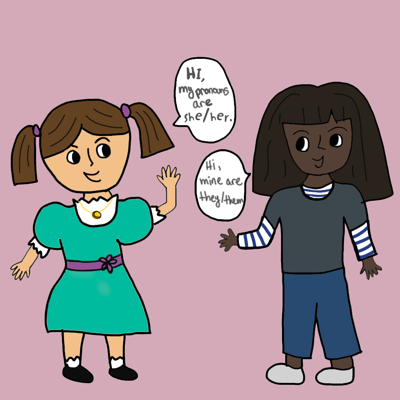
Inform people of your gender pronouns when introducing yourself.Cartoon: Sarah Cheung | Loyolan
The Merriam-Webster dictionary has added a new entry to the definition of the word “they” as a pronoun used to refer to a single person whose gender identity is nonbinary. Gender pronouns and gender fluidity aren’t topics that only LGBTQ+ folk should be knowledgeable about; cisgender people need to educate themselves as well.
Raven Yamamoto is a junior journalism major whose gender pronouns are they/them. They define genderfluid as “an unwillingness to cling to standards or someone who doesn’t adhere to any side or point on the spectrum. It can be going back and forth between the two extremes.” This means that someone can be very feminine-presenting one day, very masculine-presenting another or androgynous.
Millennials and Generation Z are the most familiar with gender-neutral pronouns and do the work to accept and understand gender-nonconforming, trans and LGBTQ+ folk. “[We’re the only ones] who make that effort to recognize the identity that they own,” said Yamamoto. They still think it’s a problem, as there’s a gap in understanding and fear of interacting with people who are trans, gender-nonconforming or who are queer.
Misinformation can breed fear, which leads to people not being willing to ask if they are confused about someone’s gender pronouns. If you aren’t sure about someone’s gender pronouns, ask; this way you avoid any discomfort. Another way to normalize asking for gender pronouns is to offer your own when meeting someone. Simply saying, “Hi, my name is Gloria, and my pronouns are she/her, what are yours?” avoids any possible awkwardness or uncertainty you might have about misgendering someone.
To normalize gender-neutral pronouns, higher education, such as universities and colleges should incorporate training on how to use and ask for pronouns as well as offering their own. This would allow them to be able to handle a situation where someone.
It’s likely to fall into an awkward situation where you have used the wrong pronoun when referring to someone. Do not ignore your mistake in the hopes that it will blow over. Correct yourself the moment you realize that you’ve made a mistake. This shows that you are working on using their correct pronouns moving forward.
Moreover, if you didn’t know someone’s gender identity or what pronouns they prefer and they correct you, express gratitude. Ken Cavanaugh, a senior women’s and gender studies major, who goes by the pronouns they/them or she/her, advises against apologizing when you’ve made the mistake. “Apologizing for using incorrect pronouns puts the person who was just misgendered in the position of comforting you and telling you it’s okay,” they said.
Saying thank you acknowledges that you now understand and are aware of their gender pronouns, and you are both able to move on from that moment.
One way that we can avoid making these mistakes is to practice saying some sentences using they or them to yourself. As silly as it seems, this is a good way to work it into your everyday vocabulary.
Another thing to be conscious of is not policing someone’s gender identity. Gender identity is a spectrum, and just because someone may not fit your definition of a specific gender identity does not mean that they are not valid.
One way to be more aware of what particular pronouns mean is to read up on them. A great resource is Them.us, an online magazine that provides a range of information about topics from entertainment to politics to culture through the lens of today’s LGBTQ+ community.
Although we have come a long way in nonbinary representation, we still have a long way to go. We need to take the simple steps to work non-gendered language into our everyday lives. We can do this by interacting with more nonbinary people and following people on social media that provide more information. Some of Yamamoto’s favorites include Alok Vaid-Menon and Chella Man. A few more people who identify as queer or non-binary that you may not have known of include Sam Smith, Asia Kate Dillon, Ruby Rose and Amandla Stenberg.
This is the opinion of Gloria Ndilula, a senior economics major from Windhoek, Namibia. Tweet comments @LALoyolan or email editor@theloyolan.com.
Big Think New videos DAILY: https://bigth.ink/youtube Join Big Think Edge for exclusive videos: https://bigth.ink/Edge ABOUT BIG THINK: Smarter Faster™ Big Think is the leading source of expert-driven, actionable, educational content — with thousands of videos, featuring experts ranging from Bill Clinton to Bill Nye, we help you get smarter, faster. Subscribe to learn from top minds like these daily. Get actionable lessons from the world’s greatest thinkers & doers. Our experts are either disrupting or leading their respective fields. We aim to help you explore the big ideas and core skills that define knowledge in the 21st century, so you can apply them to the questions and challenges in your own life. Other Frequent contributors include Michio Kaku & Neil DeGrasse Tyson. Michio Kaku Playlist: https://bigth.ink/kaku Bill Nye Playlist: https://bigth.ink/BillNye Neil DeGrasse Tyson Playlist: https://bigth.ink/deGrasseTyson Read more at Bigthink.com for a multitude of articles just as informative and satisfying as our videos. New articles posted daily on a range of intellectual topics. Join Big Think Edge, to gain access to a world-class learning platform focused on building the soft skills essential to 21st century success. It features insight from many of the most celebrated and intelligent individuals in the world today. Topics on the platform are focused on: emotional intelligence, digital fluency, health and wellness, critical thinking, creativity, communication, career development, lifelong learning, management, problem solving & self-motivation. BIG THINK EDGE: https://bigth.ink/Edge If you’re interested in licensing this or any other Big Think clip for commercial or private use, contact our licensing partner, Executive Interviews: https://bigth.ink/licensing
What if your entire life could be infused with and fueled by the energy of evolution itself? In this 16-minute audio, Craig guides you on an experiential journey into the heart of the evolutionary impulse that gave birth to the cosmos and that continues to propel life and consciousness forward toward ever higher orders of goodness, truth, beauty and complexity. This potent audio culminates in a contemplation that invites you into a direct experience of your own “evolutionary self” and shows you how you can begin to activate and align with it in your own life.
Below the video player is an MP3 version of the talk and an edited transcript, if you’d prefer to engage the content in that way.
There’s one way of understanding spirit or divinity as the sacred essence of everything—the ground of everything. It’s the timeless, changeless, unmanifest ground of all manifestation. This is the dimension of spirit or divinity that we primarily work with through meditative practices. When we awaken to our true nature or our natural state or our awakened awareness through these practices, we are awakening to this particular dimension of spirit or the sacred.
But there is another dimension of divinity that is of a completely different order. It is the active face of spirit. It’s the impulse of evolution. It’s spirit as the evolutionary impulse itself—the creative principle, the driving force in the cosmos and in consciousness. It’s the active, dynamic power that moves the cosmos forward.
We now know scientifically that we live in an evolving universe. We used to think the universe was static. Then we realized that the universe started with a Big Bang and then went through all these phases and cycles of evolution. Then life emerged and went through its own stages of evolution, leading to the most remarkable (and potentially precarious) stage: human evolution.
The cosmos evolved, life evolved, and in human beings, consciousness evolved. We went from being primitive, simple animals to having this extraordinary, complex consciousness that has created the world we live in. This consciousness is able to know itself through us, and even discover divinity and spirit and enlightenment. All of this from just stardust.
The universe is not in a process of evolution. The universe is a process of evolution. There is an evolutionary impulse running through the whole thing. This evolutionary impulse is actually who and what we are at the deepest level. We aren’t just an individual body-mind organism. There is a dimension of who we are that is the living, incarnated impulse of evolution itself that has given birth to the whole cosmos and everything in it.
This is an evolutionary imperative, and when we awaken to it, we feel compelled in every cell of our being to align with that impulse, to manifest it, to participate in the further evolution of life and consciousness and even the evolution of God. In this we realize that spirit or divinity isn’t static either. Even though it has a static, timeless, changeless dimension, spirit itself is going through evolution just like everything else in the cosmos. And we can participate in its further development. We can participate in uplifting the world into ever-higher orders of goodness, truth, beauty, and complexity.
In a sense, when we discover who and what we are as the evolutionary principle, we start to see that we can make an enormous difference. Even one person can have a huge impact because this is a free and open system. It’s not a closed system. It’s an evolving process, and everything is dynamic. And it’s all moving forward. And when we become conscious of the evolutionary impulse and we begin to express it, we become an agent of evolution. We become an agent of divinity in the world, and this makes our choices very powerful.
We can make a big difference in whatever context we find ourselves in. It’s not that we’re all necessarily going to become activists. Some might. But the point is that now everything we’re doing in our life takes on a new and profound significance.
This practice ends up being a very powerful self-transcending process, because our petty little concerns don’t seem very important when we awaken to the enormous significance of our life as participants in evolution and as an expression of the evolutionary impulse. The incredible wisdom, power, strength, courage, and love that is coursing through our veins makes so many things that once seemed burdensome and difficult seem pretty inconsequential. We find that we are up for so much more in life than we ever thought possible, because something much bigger than us has stepped into the driver’s seat. It’s not that you’re not you. It’s just that you’re you with a capital Y-O-U. This really realigns everything.
So, how do we work with this evolutionary impulse in a practice context? There is one dimension of practice that has to do with waking up to this evolutionary impulse in a contemplative sense. But once you’ve discovered and begun to realize that you are the evolutionary impulse—that it’s your own true nature—the practice becomes learning to align your life with that. This is what I call the “evolutionary self.” It’s the human face of the evolutionary impulse. When we discover the evolutionary self within us, we realize that it has different values, priorities, concerns, cares, and perspectives. It sees things very differently than your conventional self.
So what are the practices you can begin to do to align your life with this evolutionary self? There are dozens, if not hundreds, of distinct practices that we can derive from this evolutionary orientation. But for our purposes here, what’s important is to get the essence of what it means to align with your evolutionary self. Then you can begin to create all kinds of specific practices to activate and manifest it in your own life.
To begin to give you a taste of what it means to put this evolutionary self into practice, I’m going to guide you in a brief contemplation. This is not a meditation. It’s a reflection or a contemplation. I want to invite you to bring your attention to the part of you that is the energy of the Big Bang still rippling through the universe. Bring your attention to the part of you that is the dynamic, creative force moving through the cosmos. It’s the life force. It’s the evolutionary force moving through life—bringing life to ever higher, more complex, more diverse and beautiful expressions.
Take a moment to just contemplate all the beauty and biological diversity in this world. Think of all the diversity of animal life and plant life—the colorful birds and fishes and flowers. Now think of all the extraordinary diversity that human life has brought into existence—technology, innovation, and this whole explosion of creativity. Now bring your attention to the part of yourself that is that explosion of creativity—that is this explosion of evolution, of spirit in action, of consciousness expanding and moving forward, upward, onward.
Become aware of how this energy and intelligence already lives in you and expresses itself in your life. Feel the part of you that gets thrilled by change, that’s excited by newness and novelty. Feel the part of you that gets excited when things don’t go according to plan, when just for a moment nobody knows what’s going to happen. We’re in the unknown. We’re off the map, on a new frontier we didn’t expect. Notice this impulse to create, this impulse to evolve, this impulse to awaken.
Just notice what it feels like to step fully into that right now. Now acknowledge that this is your own nature; that you are that impulse of evolution. Allow it to continue to ripple forward in whatever way it does.
The work of awakening to and aligning with the evolutionary impulse is a very comprehensive and life-changing spiritual practice. Again, it’s not something we do sitting down with our eyes closed, by ourselves. It’s something that we do when engaged in life, and it propels our engagement with life in a whole new way.
The best way to begin to practice it, is simply to notice the evolutionary impulse in your own life and begin to activate it and align with it. Explore what it’s like to live your life from that different center.
Consciousness, spirituality, biography, sexuality, androgyny, futurism, space, the arts, science, astrology, democracy, humor, books, movies and more