“No one gets away with anything, ever, so take responsibility for your own life. You conjure your own world, not only metaphorically but also literally and neurologically. These lessons are what the great stories and myths have been telling us since civilisation began.”
A dazzling work of personal travelogue and cultural criticism that ranges from the primitive to the postmodern in a quest for the promise and meaning of the psychedelic experience.
While psychedelics of all sorts are demonized in America today, the visionary compounds found in plants are the spiritual sacraments of tribal cultures around the world. From the iboga of the Bwiti in Gabon, to the Mazatecs of Mexico, these plants are sacred because they awaken the mind to other levels of awareness–to a holographic vision of the universe.
Breaking Open the Head is a passionate, multilayered, and sometimes rashly personal inquiry into this deep division. On one level, Daniel Pinchbeck tells the story of the encounters between the modern consciousness of the West and these sacramental substances, including such thinkers as Allen Ginsberg, Antonin Artaud, Walter Benjamin, and Terence McKenna, and a new underground of present-day ethnobotanists, chemists, psychonauts, and philosophers. It is also a scrupulous recording of the author’s wide-ranging investigation with these outlaw compounds, including a thirty-hour tribal initiation in West Africa; an all-night encounter with the master shamans of the South American rain forest; and a report from a psychedelic utopia in the Black Rock Desert that is the Burning Man Festival.
Breaking Open the Head is brave participatory journalism at its best, a vivid account of psychic and intellectual experiences that opened doors in the wall of Western rationalism and completed Daniel Pinchbeck’s personal transformation from a jaded Manhattan journalist to shamanic initiate and grateful citizen of the cosmos.
Wheeler speculated that reality is created by observers in the universe. “How does something arise from nothing?”, he asked about the existence of space and time.[78] He also coined the term “Participatory Anthropic Principle” (PAP), a version of a Strong Anthropic Principle.[79]
In 1990, Wheeler suggested that information is fundamental to the physics of the universe. According to this “it from bit” doctrine, all things physical are information-theoretic in origin:
Wheeler:It from bit. Otherwise put, every it — every particle, every field of force, even the space-time continuum itself — derives its function, its meaning, its very existence entirely — even if in some contexts indirectly — from the apparatus-elicited answers to yes-or-no questions, binary choices, bits. It from bit symbolizes the idea that every item of the physical world has at bottom — a very deep bottom, in most instances — an immaterial source and explanation; that which we call reality arises in the last analysis from the posing of yes-no questions and the registering of equipment-evoked responses; in short, that all things physical are information-theoretic in origin and that this is a participatory universe.[80]
In developing the Participatory Anthropic Principle (PAP), an interpretation of quantum mechanics, Wheeler used a variant on Twenty Questions, called Negative Twenty Questions, to show how the questions we choose to ask about the universe may dictate the answers we get. In this variant, the respondent does not choose or decide upon any particular or definite object beforehand, but only on a pattern of “Yes” or “No” answers. This variant requires the respondent to provide a consistent set of answers to successive questions, so that each answer can be viewed as logically compatible with all the previous answers. In this way, successive questions narrow the options until the questioner settles upon a definite object. Wheeler’s theory was that, in an analogous manner, consciousness may play some role in bringing the universe into existence.[81]
From a transcript of a radio interview on “The Anthropic Universe”:
Wheeler: We are participators in bringing into being not only the near and here but the far away and long ago. We are in this sense, participators in bringing about something of the universe in the distant past and if we have one explanation for what’s happening in the distant past why should we need more? Martin Redfern: Many don’t agree with John Wheeler, but if he’s right then we and presumably other conscious observers throughout the universe, are the creators — or at least the minds that make the universe manifest.[82]
1. the false conviction held by some individuals that their life plan is bound to fail due to other people or to circumstances beyond their control. This was postulated as a method of freeing oneself from personal responsibility. [defined by Alfred Adler]
2. any false belief around which an individual’s life is built.
A Confession — an essay by Leo Tolstoy on his religious thoughts — shows the great author in process of looking for answers to profound questions that trouble all who take them on: “What will come of my life?” and “What is the meaning of life?” these are questions whose answers were an absolute requirement for Tolstoy. In the course of the essay, Tolstoy shows different attempts to find answers on the examples of science, philosophy, eastern wisdom, and the opinions of his fellow novelists. . . . finding no workable solution in any of these, Tolstoy recognizes the deep religious convictions of ordinary people as containing the key to true answers. The first attempt at its publication took place in 1882 (Russkaya Mysl, No 5), but Tolstoy’s work was removed virtually from the whole edition of the journal by Orthodox Church censorship. The text was later published in Geneva (1884), in Russia as late as 1906 (Vsemirnyj Vestnik, No 1).
In Global Origins of the Modern Self, from Montaigne to Suzuki, Avram Alpert contends that scholars have yet to fully grasp the constitutive force of global connections in the making of modern selfhood. Alpert argues that canonical moments of self-making from around the world share a surprising origin in the colonial anthropology of Europeans in the Americas. While most intellectual histories of modernity begin with the Cartesian inward turn, Alpert shows how this turn itself was an evasion of the impact of the colonial encounter. He charts a counter-history of the modern self, tracing lines of influence that stretch from Michel de Montaigne’s encounter with the Tupi through the writings of Jean-Jacques Rousseau into German Idealism, American Transcendentalism, postcolonial critique, and modern Zen. Alpert considers an unusually wide range of thinkers, including Kant, Hegel, Fanon, Emerson, Du Bois, Senghor, and Suzuki. This book not only breaks with disciplinary conventions about period and geography but also argues that these conventions obscure our ability to understand the modern condition.
Ana-Maria Rizzuto’s groundbreaking explorations of the formation of God representations in early childhood and their elaboration throughout the life cycle have made their mark, enriching the practice of psychoanalysis and psychotherapy, as well as scholarship within the psychoanalytic study of religion. Accompanied by illuminating commentaries by Rizzuto, the authors of this edited collectione essays in this volume underscore Rizzuto’s most important contribution to clinical practice: rather than assert that psychoanalysis is incompatible with religious beliefs and practices or with spiritual concerns that patients may bring to a therapeutic context, Rizzuto makes room for the coexistence of psychoanalysis and religion in the therapeutic setting. Demonstrating how Rizzuto’s work has enhanced connections within and among psychoanalytic theories of religion, established pathways for new developments in psychotherapy, and facilitated interdisciplinary conversations, this volume showcases the compelling power of Rizzuto’s work and its ongoing influence.
Medical textbooks are full of anatomical pictures of the penis, but the clitoris barely rates a mention. Many medical professionals are uncomfortable even talking about it
Sat 31 Oct 2020 Last modified on Sun 1 Nov 2020 (theguardian.com)
Melbourne urologist Helen O’Connell holds an anatomically correct clitoris. Her research into the first comprehensive anatomical study of the clitoris was published in 1998. Photograph: Alana Holmberg/The Guardian Urological surgeon Helen O’Connell was the first person to completely map the full anatomy and nerve pathways of the clitoris. Photograph: Alana Holmberg/Oculi for the Guardian
Professor Caroline de Costa is awaiting feedback. Several months ago the editor of the Australian and New Zealand Journal of Obstetrics and Gynaecology requested an editorial from a world-renowned Melbourne urologist to address what she saw as a lack of research and, more concerningly, a persistent lack of knowledge about an essential part of the female reproductive system.
The urologist, Professor Helen O’Connell, agreed. But a week after the editorial was published, De Costa’s inbox remains suspiciously silent. She suspects her colleagues, used though they are to dispassionate discussion of female genitalia, may be too embarrassed to write in.
The editorial was about the clitoris, an organ whose sole function is the female orgasm. And an alarming number of medical professionals remain uncomfortable discussing it.
“It is not discussed,” says De Costa, who is also a professor of obstetrics and gynaecology at James Cook University. “I go to conferences, I go to workshops, I edit the journal, I read other journals. I read papers all the time, and never do I find mention of the clitoris.”
The first comprehensive anatomical study of the clitoris was led by O’Connell and published in 1998. A subsequent study in 2005 examined it under MRI. It was not, O’Connell discovered, just a small nub of erectile tissue, described in some texts as the “poor homologue” of the penis. Instead it was an otherworldly shape, with the nerve-rich glans merely the external protrusion of an organ that extended beneath the pubic bone and wrapped around the vaginal opening, with bulbs that become engorged when aroused. It looked like an orchid. It was beautiful.
In the 20 years since that groundbreaking study was released, clitoral anatomy remains largely absent from the medical curriculum and from medical research. A literature review conducted by O’Connell’s team for her editorial in the Australian and New Zealand Journal of Obstetrics and Gynaecology found just 11 articles on anatomical dissection of the clitoris had been published worldwide since 1947. Hundreds more mentioned clitoral anatomy only as it related to procedures to restore sensation following a cliteradectomy, orfemale genital mutilation. Despite that work, O’Connell wrote, “we see literature doubting the importance of female orgasm, entertaining the argument that from an evolutionary standpoint, female orgasm could merely be a byproduct of selection on male orgasm”.
Speaking to Guardian Australia from her consulting rooms in East Melbourne, O’Connell says the view that the clitoris was at best unimportant and at worst shameful remained pervasive. She recalls a conversation at an awards night, in which one of her students won a prize for a study of the suspensory ligaments that hold the clitoris in place.
“The very senior figure directly across from me thought that her work was – and I was her supervisor, I don’t think he knew that – he thought it was voyeurism,” she says.
“She’s doing scientific research about anatomy, and that, in his world … ”
She pauses. “What happened to him, that he sees a young woman doing a project like that and thinks of it with a sexual innuendo? That is just, to me, unfathomably unrelated to the way my brain works.”
A rebellious doctorate
When O’Connell was a medical student in the 1980s she was infuriated by her anatomy textbooks, which contained extensive anatomical drawings of the penis and registered the clitoris as a footnote.
“There’s the norm that’s the male, and then we’ve got kind of this subset over here who are not male,” she says. “And their unique characteristics are differences … there was a feeling that they were not whole people in the way that these other people are whole people and deserving of having their body parts having a full description.”
When she specialised in urology, she noticed that while attention was paid in prostate removal surgery to not harming the nerves that connected to penile erectile tissue, based on studies that were first conducted in the 1970s, there had been no similar work tracking clitoral nerves. She undertook a study on 12 cadavers following the nerves from the spinal column. “It was pretty clear that what we were looking at was kind of a shadow of an organ rather than the organ itself,” she says.
O’Connell then enrolled in a doctorate to study clitoral anatomy.
“I think the chances of a male realising there was a deficit when most of my female colleagues didn’t see it would have to be incredibly unlikely,” she says. “I think I was raised a little bit rebelliously.”
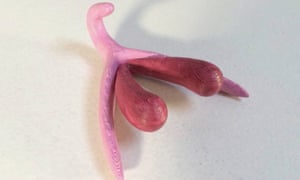
She is now able to describe the shape of the clitoris with the help of a 3D printed model that was designed in conjunction with Dr Ea Mulligan, a doctor from Adelaide who has made the manufacture and distribution of thousands of anatomically correct clitorises a retirement hobby. Mulligan distributes them at conferences and public health seminars, and is planning to set up a stall distributing free clitorises at Feast, Adelaide’s queer arts and culture festival, in November.
It’s just a beautiful case study on the invisibility of women’s concerns in science, in medicineDr Ea Mulligan
When I speak to her on the phone at her home in Adelaide, she offers to send me one of the three boxes, with 200 clitorises apiece, that is currently sitting on her back porch. A box has been sent to O’Connell, a box to De Costa, and a box to the professor of anatomy at a medical school in Dunedin, New Zealand, who was previously working with a pathology sample of a clitoris that “looks like a shred off of last week’s roast”.
“A lot of medical students and doctors I have handed them to have said ‘Oh I didn’t know it was as big as that’, because it’s been diminished in the medical literature,” Mulligan says. “It’s just a beautiful case study on the invisibility of women’s concerns in science, in medicine.”
When Mulligan studied medicine in the 1970s, she was working from an anatomy textbook that had one page on vulvar anatomy and “five pages of penises from every possible angle”.
It is only marginally better now. James Cook university, where de Costa teaches, holds aone-hour lecture in fifth year about the role of clitoris in sexual function. The curriculum to be a fellow of the Royal Australian and New Zealand College of Obstetricians and Gynaecologists covers sexual function and related disorders, but not specifically the function of the clitoris. The college said it encourages “self-directed learning” and “acknowledges a long history of poor understanding of female anatomy and female sexuality”.
“RANZCOG supports all efforts to improve knowledge of genitourinary anatomy, physiology, and pathophysiology, with the aim of best practice in women’s health,” the college said in a statement.
A 3D printed clitoris.
The cliterati
Back in her consulting rooms, O’Connell appears remarkably fresh for someone who was in a mortuary until 1am the night before. She was conducting a dissection to map the anatomy of the urethra as part of a global effort to combat female urethral cancer, she tells Guardian Australia.
With her neat glasses and dry, technical language, O’Connell does not appear the rebel. But then she talks, quite calmly, about subjects that would make many of her peers blush, and the rebel slips out.
Take orgasms. In 2016, O’Connell co-authored a paper that found, based on a series of macroscopic anatomical dissections, that there was no evidence of erectile tissue in the vaginal wall – in other words, that the G-spot did not exist. (O’Connell has stressed there was more work to be done on the subject, including mapping the urethra.) To date, the only known erectile tissue in the area is the clitoris, leading to the working theory that the G-spot is just the engorged bulbs of an aroused clitoris felt through the vaginal wall.
Importantly, that meant that the clitoris would have to be stimulated for that sensation to be felt. This is not a new fact to people with vaginas, but distributing it is an important part of ensuring they have healthy, satisfying sex lives.
That the majority of women and people with vaginas require clitoral stimulation to orgasm is “just a statement of fact”, O’Connell says. “Ignoring the clitoris and acting like that’s not the focus for orgasm is just not going to happen.”
I was in my mid-20s when I saw what a clitoris actually looked like … how the fuck have we not been shown this or taught thisAlli Sebastian Wolf
She speculates – after specifying that she is not speaking as a urologist – that centuries of sexism, fed by unrealistic depictions of sex in Hollywood, have helped build the G-spot myth and minimise the role of the clitoris. And that encourages people to “go about things in a way that is likely to be counterproductive”.
“People want kind of a magical thing, where he gets off through penetration of the vagina and exactly what causes his joy causes her joy,” she says. “Almost everyone is going to fall short on the goal because the organs just don’t seem to be designed in this magical way that would fit with the kind of thrusting behaviour causing an orgasm.”
Outside of medical circles, O’Connell’s research has been enthusiastically embraced. US-based artist Sophia Wallace created a campaign on “cliteracy”, informing women about their own anatomy.
Wallace’s art brings an organ with a dark history into the light, O’Connell says, adding: “It’s cool, isn’t it?” She is unabashedly delighted by unintentionally sparking a feminist art movement. “It’s fantastic!” she says. “Who would ever have imagined something like that happening?”Advertisement
Artists, says De Costa, have “undeniably” done a better job at incorporating clitorial anatomy into their work than the Royal Australian and New Zealand College of Obstetricians and Gynaecologists.
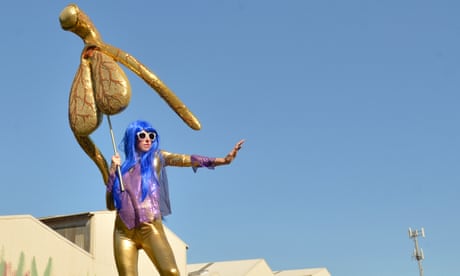
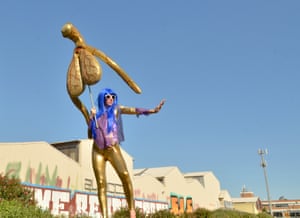
Sydney artist Alli Sebastian Wolf holds up her Glitoris, a giant, gold clitoris. Photograph: Alli Sebastian Wolf
Alli Sebastian Wolf, a Sydney based artist, created 100-1 scale anatomically correct gold clitoris, called the Glitoris, in 2017.
“I was in my mid-20s when I saw what a clitoris actually looked like and was kind of, first of all amazed by how wonderful it is, and second of all: how the fuck have we not been shown this or taught this? When I knew well before puberty what a fallopian tube and uterus shape was. Which, you know, far less important to my daily life,” she says.
The Glitoris can be hung in a gallery but achieved viral fame when Sebastian Wolf took it to the Women’s March, Mardi Gras and other public events, accompanied by the Cliterati – Sebastian Wolf and friends in gold unitards and blue wigs.
“A lot of people just thought it was a golden-y squid creature, a lot of people thought it was lungs, or a dragonfly, or testicles,” she says. “I met a couple of OB-GYNs who hadn’t known about it until the sculpture, which is horrifying.”
Sebastian Wolf says it can be easier for some people to talk about sex and sexual organs at a festival to a woman covered in glitter, than to their doctor. She is currently working on a one-storey high inflatable gold clitoris, but says she hopes knowledge of the clitoris will soon become so uncontroversial that making art about them would be as passé as making art about penises.
“It will hopefully get to the point where my art is totally irrelevant,” she says. “It would be great if the most interesting thing about it is if people were like ‘Oh, how did you get all those sequins on?’ Not, ‘What’s this and why don’t we know about it?’”
O’Connell’s aim is similarly modest: that female anatomy be considered equally alongside male anatomy. And that necessarily means overcoming an institutional and societal prejudice against women enjoying their own sexuality. It means studying the clitoris.
Dante is known for establishing the use of the vernacular in literature at a time when most poetry was written in Latin, making it accessible only to the most educated readers. His De vulgari eloquentia (On Eloquence in the Vernacular) was one of the first scholarly defenses of the vernacular. His use of the Tuscan dialect for works such as The New Life (1295) and Divine Comedy helped establish the modern-day standardized Italian language, and set a precedent that important later Italian writers such as Petrarch and Boccaccio would follow.
Dante was instrumental in establishing the literature of Italy, and his depictions of Hell, Purgatory and Heaven provided inspiration for the larger body of Western art.[7][8] He is cited as an influence on Geoffrey Chaucer, John Milton and Alfred Tennyson, among many others. In addition, the first use of the interlocking three-line rhyme scheme, or the terza rima, is attributed to him. He is described as the “father” of the Italian language,[9] and in Italy he is often referred to as il Sommo Poeta (“the Supreme Poet”). Dante, Petrarch, and Boccaccio are also called the tre corone (“three crowns”) of Italian literature.
Life
Early life
Dante was born in Florence, Republic of Florence, in what is now Italy. The exact date of his birth is unknown, although it is generally believed to be around 1265. This can be deduced from autobiographicallusions in the Divine Comedy. Its first section, the Inferno, begins, “Nel mezzo del cammin di nostra vita” (“Midway upon the journey of our life”), implying that Dante was around 35 years old, since the average lifespan according to the Bible (Psalm 89:10, Vulgate) is 70 years; and since his imaginary travel to the netherworld took place in 1300, he was most probably born around 1265. Some verses of the Paradiso section of the Divine Comedy also provide a possible clue that he was born under the sign of Gemini: “As I revolved with the eternal twins, I saw revealed, from hills to river outlets, the threshing-floor that makes us so ferocious” (XXII 151–154). In 1265, the sun was in Gemini between approximately May 11 and June 11 (Julian calendar).[10]Dante Alighieri, attributed to Giotto, in the chapel of the Bargello palace in Florence. This oldest picture of Dante was painted just prior to his exile and has since been heavily restored.Portrait of Dante, from a fresco in the Palazzo dei Giudici, Florence
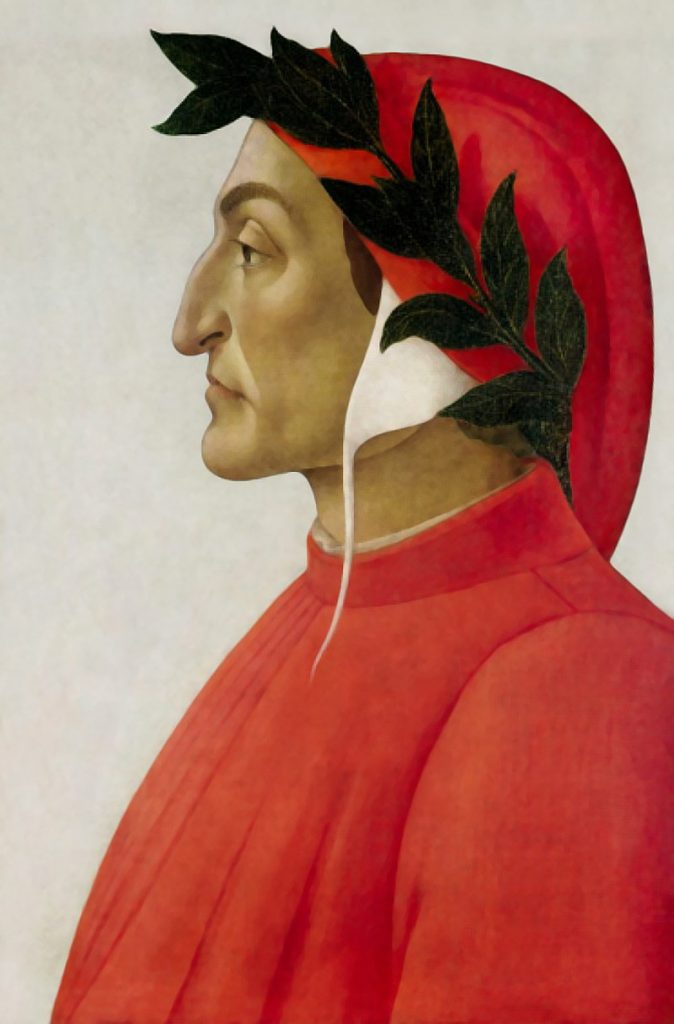
Giovanni Boccaccio described Dante’s appearance and demeanor as follows: “the poet was of middle height, and in his later years he walked somewhat bent over, with a grave and gentle gait. He was clad always in most seemly attire, such as befitted his ripe years. His face was long, his nose aquiline, and his eyes big rather than small. His jaws were large, and his lower lip protruded. He had a brown complexion, his hair and beard were thick, black, and curly, and his countenance was always melancholy and thoughtful.”[11]
Dante claimed that his family descended from the ancient Romans (Inferno, XV, 76), but the earliest relative he could mention by name was Cacciaguida degli Elisei (Paradiso, XV, 135), born no earlier than about 1100. Dante’s father, Alighiero[12] or Alighiero di Bellincione, was a White Guelph who suffered no reprisals after the Ghibellines won the Battle of Montaperti in the middle of the 13th century. This suggests that Alighiero or his family may have enjoyed some protective prestige and status, although some suggest that the politically inactive Alighiero was of such low standing that he was not considered worth exiling.[13]
Dante’s family was loyal to the Guelphs, a political alliance that supported the Papacy and which was involved in complex opposition to the Ghibellines, who were backed by the Holy Roman Emperor. The poet’s mother was Bella, probably a member of the Abati family.[12] She died when Dante was not yet ten years old, and Alighiero soon married again, to Lapa di Chiarissimo Cialuffi. It is uncertain whether he really married her, since widowers were socially limited in such matters, but this woman definitely bore him two children, Dante’s half-brother Francesco and half-sister Tana (Gaetana). When Dante was 12, he was promised in marriage to Gemma di Manetto Donati, daughter of Manetto Donati, member of the powerful Donati family.[12] Contracting marriages at this early age was quite common and involved a formal ceremony, including contracts signed before a notary. But by this time Dante had fallen in love with another, Beatrice Portinari (known also as Bice), whom he first met when he was only nine. Years after his marriage to Gemma he claims to have met Beatrice again; he wrote several sonnets to Beatrice but never mentioned Gemma in any of his poems though other Donati relations, notably Forese and Piccarda, appear in his Divine Comedy. The exact date of his marriage is not known: the only certain information is that, before his exile in 1301, he had three children (Pietro, Jacopo and Antonia).[12]
Dante fought with the Guelph cavalry at the Battle of Campaldino (June 11, 1289).[14] This victory brought about a reformation of the Florentine constitution. To take any part in public life, one had to enroll in one of the city’s many commercial or artisan guilds, so Dante entered the Physicians’ and Apothecaries’ Guild. In the following years, his name is occasionally recorded as speaking or voting in the various councils of the republic. A substantial portion of minutes from such meetings in the years 1298–1300 was lost, however, so the true extent of Dante’s participation in the city’s councils is uncertain.
Gemma bore Dante several children. Although several others subsequently claimed to be his offspring, it is likely that only Jacopo, Pietro, Giovanni, and Antonia were his actual children. Antonia later became a nun, taking the name Sister Beatrice.
Not much is known about Dante’s education; he presumably studied at home or in a chapter school attached to a church or monastery in Florence. It is known that he studied Tuscan poetry and that he admired the compositions of the Bolognese poet Guido Guinizelli—whom in Purgatorio XXVI he characterized as his “father”—at a time when the Sicilian School (Scuola poetica Siciliana), a cultural group from Sicily, was becoming known in Tuscany. His interests brought him to discover the Provençal poetry of the troubadours, such as Arnaut Daniel, and the Latin writers of classical antiquity, including Cicero, Ovid and especially Virgil.[15]
Dante said he first met Beatrice Portinari, daughter of Folco Portinari, at age nine, and claimed to have fallen in love with her “at first sight“, apparently without even talking with her.[16] He saw her frequently after age 18, often exchanging greetings in the street, but never knew her well. In effect, he set an example of so-called courtly love, a phenomenon developed in French and Provençal poetry of prior centuries. Dante’s experience of such love was typical, but his expression of it was unique. It was in the name of this love that Dante left his imprint on the dolce stil novo (sweet new style, a term which Dante himself coined), and he would join other contemporary poets and writers in exploring never-before-emphasized aspects of love (Amore). Love for Beatrice (as Petrarch would show for Laura somewhat differently) would be his reason for poetry and for living, together with political passions. In many of his poems, she is depicted as semi-divine, watching over him constantly and providing spiritual instruction, sometimes harshly. When Beatrice died in 1290, Dante sought refuge in Latin literature.[17] The Convivio chronicles his having read Boethius‘s De consolatione philosophiae and Cicero’s De Amicitia. He then dedicated himself to philosophical studies at religious schools like the Dominican one in Santa Maria Novella. He took part in the disputes that the two principal mendicant orders (Franciscan and Dominican) publicly or indirectly held in Florence, the former explaining the doctrines of the mystics and of St. Bonaventure, the latter expounding on the theories of St. Thomas Aquinas.[18]
At 18, Dante met Guido Cavalcanti, Lapo Gianni, Cino da Pistoia and soon after Brunetto Latini; together they became the leaders of the dolce stil novo. Brunetto later received special mention in the Divine Comedy (Inferno, XV, 28) for what he had taught Dante: Nor speaking less on that account I go With Ser Brunetto, and I ask who are his most known and most eminent companions.[19] Some fifty poetical commentaries by Dante are known (the so-called Rime, rhymes), others being included in the later Vita Nuova and Convivio. Other studies are reported, or deduced from Vita Nuova or the Comedy, regarding painting and music.
Dante, like most Florentines of his day, was embroiled in the Guelph–Ghibelline conflict. He fought in the Battle of Campaldino (June 11, 1289), with the Florentine Guelphs against Arezzo Ghibellines;[14][20] then in 1294 he was among the escorts of Charles Martel of Anjou (grandson of Charles I of Anjou) while he was in Florence. To further his political career, he became a pharmacist. He did not intend to practice as one, but a law issued in 1295 required nobles aspiring to public office to be enrolled in one of the Corporazioni delle Arti e dei Mestieri, so Dante obtained admission to the Apothecaries’ Guild. This profession was not inappropriate since at that time books were sold from apothecaries’ shops. As a politician, he accomplished little but held various offices over some years in a city rife with political unrest.
After defeating the Ghibellines, the Guelphs divided into two factions: the White Guelphs (Guelfi Bianchi)—Dante’s party, led by Vieri dei Cerchi—and the Black Guelphs (Guelfi Neri), led by Corso Donati. Although the split was along family lines at first, ideological differences arose based on opposing views of the papal role in Florentine affairs, with the Blacks supporting the Pope and the Whites wanting more freedom from Rome. The Whites took power first and expelled the Blacks. In response, Pope Boniface VIII planned a military occupation of Florence. In 1301, Charles of Valois, brother of King Philip IV of France, was expected to visit Florence because the Pope had appointed him peacemaker for Tuscany. But the city’s government had treated the Pope’s ambassadors badly a few weeks before, seeking independence from papal influence. It was believed that Charles had received other unofficial instructions, so the council sent a delegation to Rome to ascertain the Pope’s intentions. Dante was one of the delegates.
Exile and death
Pope Boniface quickly dismissed the other delegates and asked Dante alone to remain in Rome. At the same time (November 1, 1301), Charles of Valois entered Florence with the Black Guelphs, who in the next six days destroyed much of the city and killed many of their enemies. A new Black Guelph government was installed, and Cante dei Gabrielli da Gubbio was appointed podestà of the city. In March 1302, Dante, a White Guelph by affiliation, along with the Gherardini family, was condemned to exile for two years and ordered to pay a large fine.[21] Dante was accused of corruption and financial wrongdoing by the Black Guelphs for the time that Dante was serving as city prior (Florence’s highest position) for two months in 1300.[22] The poet was still in Rome in 1302 where the Pope, who had backed the Black Guelphs, had “suggested” that Dante stay. Florence under the Black Guelphs therefore considered Dante an absconder.[23] Dante did not pay the fine, in part because he believed he was not guilty and in part because all his assets in Florence had been seized by the Black Guelphs. He was condemned to perpetual exile; if he returned to Florence without paying the fine, he could have been burned at the stake. (In June 2008, nearly seven centuries after his death, the city council of Florence passed a motion rescinding Dante’s sentence.)[24]Dante in Verona, by Antonio Cotti
He took part in several attempts by the White Guelphs to regain power, but these failed due to treachery. Dante, bitter at the treatment he received from his enemies, grew disgusted with the infighting and ineffectiveness of his erstwhile allies and vowed to become a party of one. He went to Verona as a guest of Bartolomeo I della Scala, then moved to Sarzana in Liguria. Later he is supposed to have lived in Lucca with a woman called Gentucca, who made his stay comfortable (and was later gratefully mentioned in Purgatorio, XXIV, 37). Some speculative sources claim he visited Paris between 1308 and 1310, and other sources even less trustworthy took him to Oxford: these claims, first occurring in Boccaccio‘s book on Dante several decades after his death, seem inspired by readers who were impressed with the poet’s wide learning and erudition. Evidently, Dante’s command of philosophy and his literary interests deepened in exile and when he was no longer busy with the day-to-day business of Florentine domestic politics, and this is evidenced in his prose writings in this period, but there is no real evidence that he ever left Italy. Dante’s Immensa Dei dilectione testante to Henry VII of Luxembourg confirms his residence “beneath the springs of Arno, near Tuscany” in March 1311.
In 1310, Holy Roman Emperor Henry VII of Luxembourg marched into Italy at the head of 5,000 troops. Dante saw in him a new Charlemagne who would restore the office of the Holy Roman Emperor to its former glory and also retake Florence from the Black Guelphs. He wrote to Henry and several Italian princes, demanding that they destroy the Black Guelphs. Mixing religion and private concerns in his writings, he invoked the worst anger of God against his city and suggested several particular targets that were also his personal enemies. It was during this time that he wrote De Monarchia, proposing a universal monarchy under Henry VII.
At some point during his exile, he conceived of the Comedy, but the date is uncertain. The work is much more assured and on a larger scale than anything he had produced in Florence; it is likely he would have undertaken such a work only after he realized his political ambitions, which had been central to him up to his banishment, had been halted for some time, possibly forever. It is also noticeable that Beatrice has returned to his imagination with renewed force and with a wider meaning than in the Vita Nuova; in Convivio (written c. 1304–07) he had declared that the memory of this youthful romance belonged to the past.
An early indication that the poem was underway is a notice by Francesco da Barberino, tucked into his Documenti d’Amore (Lessons of Love), probably written in 1314 or early 1315. Francesco notes that Dante followed the Aeneid in a poem called “Comedy” and that the setting of this poem (or part of it) was the underworld; i.e., hell.[25] The brief note gives no incontestable indication that he himself had seen or read even the Inferno or that this part had been published at the time, but it indicates composition was well underway and that the sketching of the poem might have begun some years before. (It has been suggested that a knowledge of Dante’s work also underlies some of the illuminations in Francesco da Barberino’s earlier Officiolum [c. 1305–08], a manuscript that came to light only in 2003.[26]) It is known that the Inferno had been published by 1317; this is established by quoted lines interspersed in the margins of contemporary dated records from Bologna, but there is no certainty as to whether the three parts of the poem were each published in full or, rather, a few cantos at a time. Paradiso seems to have been published posthumously.
In Florence, Baldo d’Aguglione pardoned most of the White Guelphs in exile and allowed them to return. However, Dante had gone too far in his violent letters to Arrigo (Henry VII) and his sentence was not revoked.Statue of Dante Alighieri in Verona
In 1312 Henry assaulted Florence and defeated the Black Guelphs, but there is no evidence that Dante was involved. Some say he refused to participate in the attack on his city by a foreigner; others suggest that he had become unpopular with the White Guelphs, too, and that any trace of his passage had carefully been removed. Henry VII died (from a fever) in 1313, and with him any hope for Dante to see Florence again. He returned to Verona, where Cangrande I della Scala allowed him to live in certain security and, presumably, in a fair degree of prosperity. Cangrande was admitted to Dante’s Paradise (Paradiso, XVII, 76).
In 1315, Florence was forced by Uguccione della Faggiuola (the military officer controlling the town) to grant an amnesty to those in exile, including Dante. But for this, Florence required public penance in addition to a heavy fine. Dante refused, preferring to remain in exile. When Uguccione defeated Florence, Dante’s death sentence was commuted to house arrest on condition that he go to Florence to swear he would never enter the town again. He refused to go, and his death sentence was confirmed and extended to his sons. He still hoped late in life that he might be invited back to Florence on honorable terms. For Dante, exile was nearly a form of death, stripping him of much of his identity and his heritage. He addressed the pain of exile in Paradiso, XVII (55–60), where Cacciaguida, his great-great-grandfather, warns him what to expect:
… Tu lascerai ogne cosa diletta più caramente; e questo è quello strale che l’arco de lo essilio pria saetta. Tu proverai sì come sa di sale lo pane altrui, e come è duro calle lo scendere e ‘l salir per l’altrui scale …
… You shall leave everything you love most: this is the arrow that the bow of exile shoots first. You are to know the bitter taste of others’ bread, how salty it is, and know how hard a path it is for one who goes ascending and descending others’ stairs …
As for the hope of returning to Florence, he describes it as if he had already accepted its impossibility (in Paradiso, XXV, 1–9):
Se mai continga che ‘l poema sacro al quale ha posto mano e cielo e terra, sì che m’ha fatto per molti anni macro, vinca la crudeltà che fuor mi serra del bello ovile ov’io dormi’ agnello, nimico ai lupi che li danno guerra; con altra voce omai, con altro vello ritornerò poeta, e in sul fonte del mio battesmo prenderò ‘l cappello …
If it ever comes to pass that the sacred poem to which both heaven and earth have set their hand so as to have made me lean for many years should overcome the cruelty that bars me from the fair sheepfold where I slept as a lamb, an enemy to the wolves that make war on it, with another voice now and other fleece I shall return a poet and at the font of my baptism take the laurel crown …
Dante’s tomb exterior and interior in Ravenna, built in 1780










.jpg)
.jpg)


.jpg)