When the young Alan Turing (June 23, 1912–June 7, 1954) lost the love of his life, Christopher, to a bacterium contracted from cow’s milk, the grief-savaged future father of computing comforted his beloved’s grief-savaged mother by telling her that “the body provides something for the spirit to look after and use.” For the remainder of his life, he never ceased contemplating this binary code of body and spirit — a preoccupation fanned by this leveling loss in young adulthood, but ignited in childhood, by a book he had been given at age ten, a book he later told his own mother was what opened his mind and heart to science.
Alan Turing (far left) with classmates at Waterloo Station on the way to the school carriage. (Turing Digital Archive)
Published the year Turing was born, impishly described by its author as being “mostly about things that you do not learn in school,” Natural Wonders Every Child Should Know (public library) by Edwin Tinney Brewster invited young minds to step through the portal of science and contemplate not why life is — the domain of Sunday school theology — but what life is and how it came to be that way. Before there were scientists, it fell on the “natural philosophers” — men (for they were only men) typically trained in theology — to make sense of nature’s phenomena and processes. Born in the middle of the nineteenth century, only a generation after the person for whom the word scientist was coined — the polymathic Scottish mathematician Mary Somerville — Brewster devoted his life to aiding humanity’s great migration from the epoch of religion to the epoch of reality.
The young Turing was captivated by Brewster’s playful analogies and his elegantly reasoned expositions of biological realities, worded so simply as to border on the poetic. How the chicken gets inside the egg, why we grow and grow old, what plants know — these wonders of life impressed the boy’s imagination with a lifelong passion: Unbeknownst to most, the father of modern computing devoted a substantial portion of his mind to an obscure branch of the biology of life known as morphogenesis — the process by which living organisms take their shape — which he illustrated in a series of hauntingly beautiful hand-drawn diagrams.
Alan Turing’s little-known diagrams of morphogenesis.(Turing Digital Archive)
The book’s most captivating chapter, titled “How Much of Us Is Alive,” explores not the existential puzzlement of the question — that is best left to the poets and the artists of life — but the science, the staggering and counterintuitive reality, of aliveness. Brewster writes:
How much of a tree is alive? Certainly not the outer bark. That falls off in dry scales, or can be scraped off down to the white layers within, and the tree be none the worse. Certainly not the wood. One often comes across old trees that have lost limbs or been carelessly pruned, which are entirely decayed out on the inside, so that nothing is left but a thin shell next the bark. Yet these trees grow as vigorously as ever, and bear leaves and fruit like a solid tree. The bark is dead; and the wood is dead. Between the two is a thin layer, perhaps a quarter inch thru, which is alive. On one side, it is changing into dead wood. On the other side, it is changing into dead bark. The new wood is alive, and the new bark. Between them is something neither wood nor bark, but just living tree-stuff. The green leaves also are alive, and the green twigs, and the blossoms, and the growing buds. But at least half of every living tree is already dead; while the larger and longer lived a tree is, the smaller proportion of it is alive at one time.
Art by Arthur Rackham for a rare edition of the Brothers Grimm fairy tales. (Available as a print.)
What is true of trees, Brewster observes, is true of us. (And not only because we see so much of ourselves in trees.) We exert vast portions of our anxious creative energy on devising antidotes to our elemental fear of death — some mightier than others — and yet much of the bodies we live in is not, strictly speaking, alive at all:
Our hair and nails are not alive at all, and that our outer skin, the thin skin, that is, which we tear off when we bark our shins, is fully alive only on the inside. Our “bark” in fact, is very like a tree’s. Each has a soft, thin, living layer on the inside, which grows, hardens, dies, forms a water-tight layer over the rest of the body, cracks into scales, and drops off. Where one forms cork, the other forms horn. Indeed the cork stoppers of our bottles are made from nothing more than an especially thick corky bark of a certain kind of oak, like the especially thick and homy soles of all bare-footed savages and some bare-footed little boys.
With an eye to the biological fallacy at the heart of the famous biblical teaching that the life of every creature is its blood — refashioned in Bram Stoker’s iconic line from Dracula, “The blood is the life!” — Brewster counters:
The blood itself is dead. The watery part is just soup; water and salt and fat and jelly. The minute, coin-like, red blood corpuscles carry the oxygen of the air from the lungs all over the body. But there are similar oxygen-carriers, likewise dead, in bottles in the drug-stores. The corpuscles are dead cells alive once, and like the hard skin cells, a great deal more useful dead than alive.
After delineating how the same holds true of our teeth and the rest of our bones, Brewster draws out his analogy of cells as “living bricks” — with the caveat that even living cells are not fully alive, for the jelly of water and salt coursing through them is “just water and salt” — and adds:
We are, then, built of living bricks, but of living bricks set in dead mortar. We saw that the great trees, complex and long lived, have more wood and bark and other dead substances in them than the shrubs, herbs, and grass. These in turn are less alive than the lowly water plants and yeasts and molds which have no wood or bark at all. The same is true of animals. The jelly-fishes and infusoria have neither skin, hair, bones, nails, nor blood, and are pretty much all alive. So the more a creature’s life is worth, the less of it is alive.
The image of the “living bricks” particularly fascinated the young Turing, but it also struck him as somehow incomplete. Something was missing there, something didn’t add up to the mystery of consciousness, the wonder of what we are. In the mortar of his uncommon imagination, this incompleteness leavened the rise of modern computing. It is impossible to conceive of a Turing machine — that revolutionary mathematical progenitor of artificial intelligence — without brushing up against such elemental questions about the nature of aliveness, as Turing himself did when he gently threw his famous and formidable gauntlet of a test, asking whether a computer could ever “enjoy strawberries and cream, make someone fall in love with it, learn from experience, use words properly, be the subject of its own thought [or] do something really new.” The triumph of history is tracing the roots — ancient and alive — of our present condition in the world. The triumph of self-understanding is tracing the roots of the formative influences that make us who we are, that shape the people who shape the world.
Blessings by Andrew Hinton, Owen Ó Súilleabháin, and David Whyte“
I thank you . . . for the way my ears open even before my eyes as if to remember the way everything began with an original vibrant note.” —David Whyte
Encountering David Whyte’s poetry is an experience rather than a reading. In this short film, Emmy-winning filmmaker Andrew Hinton together with musician and composer Owen Ó Súilleabháin expand on the fullness of this encounter as they interpret David’s “Blessing” poems through a visual and musical journey across the Irish landscape. As David reads the verses of these poems, “Blessing for Sound” and “Blessing for Light,” we are carried through a series of images that evoke gratitude for the wonders and gifts of sound and of light. Owen offers in the reflection he wrote to accompany this film that, “The art of blessing, the art of calling in the invisible help of the divine, is ever present to the Celtic mind.” Having collaborated with David Whyte for over a decade, Owen shares how he came across the recordings of ancient Irish songs, which he reimagined into the music that inspired the creation of this film. Through this collaboration of poetry, music, and film, we encounter a Celtic belonging to place that has not only survived but lives on.
This is a poem dedicated to the body. “The body is a nation I have not known,” Chris Abani writes. Throughout the 21 lines of this work, he describes lungs, skin, bone, touch, smells, sweat, armpits and hunger. For all the embodiedness of the poem, there is disembodiedness too: the poem continues to question how to truly be in your own body.
Our descendants own the future, but the decisions and actions we make now will tremendously impact generations to come, says philosopher Roman Krznaric. From a global campaign to grant legal personhood to nature to a groundbreaking lawsuit by a coalition of young activists, Krznaric shares examples of ways we can become good ancestors — or, as he calls them, “Time Rebels” — and join a movement redefining lifespans, pursuing intergenerational justice and practicing deep love for the planet.
This talk was presented at an official TED conference, and was featured by our editors on the home page.
What would it take for a global totalitarian government to rise to power indefinitely? This nightmare scenario may be closer than first appears.W
What would totalitarian governments of the past have looked like if they were never defeated? The Nazis operated with 20th Century technology and it still took a world war to stop them. How much more powerful – and permanent – could the Nazis have been if they had beat the US to the atomic bomb? Controlling the most advanced technology of the time could have solidified Nazi power and changed the course of history.
When we think of existential risks, events like nuclear war or asteroid impacts often come to mind. Yet there’s one future threat that is less well known – and while it doesn’t involve the extinction of our species, it could be just as bad.
It’s called the “world in chains” scenario, where, like the preceding thought experiment, a global totalitarian government uses a novel technology to lock a majority of the world into perpetual suffering. If it sounds grim, you’d be right. But is it likely? Researchers and philosophers are beginning to ponder how it might come about – and, more importantly, what we can do to avoid it.
Existential risks (x-risks) are disastrous because they lock humanity into a single fate, like the permanent collapse of civilisation or the extinction of our species. These catastrophes can have natural causes, like an asteroid impact or a supervolcano, or be human-made from sources like nuclear war or climate change. Allowing one to happen would be “an abject end to the human story” and would let down the hundreds of generations that came before us, says Haydn Belfield, academic project manager at the Centre for the Study of Existential Risk at the University of Cambridge.
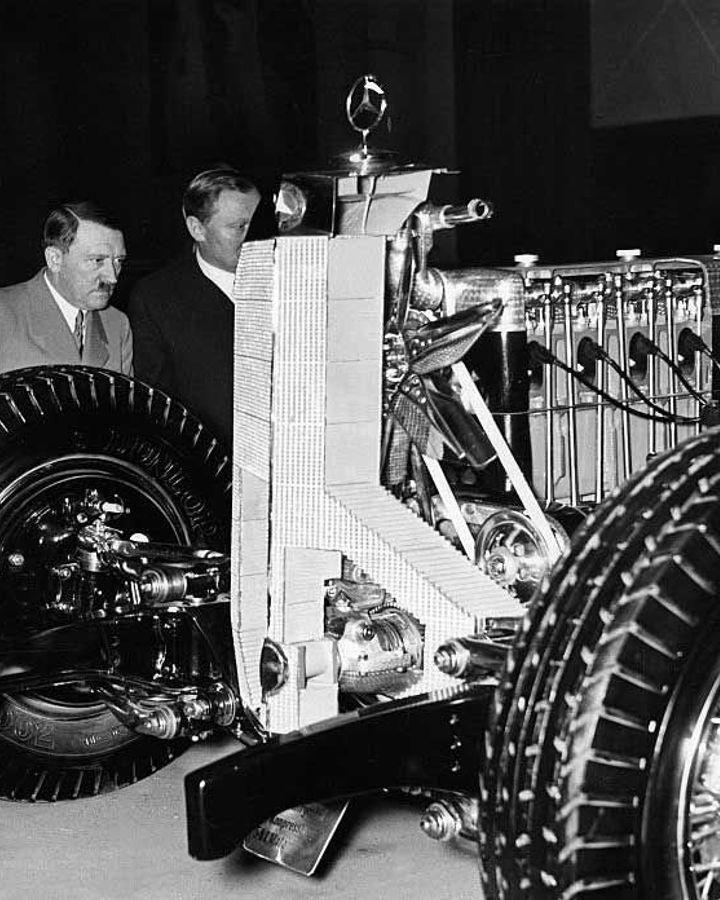
Hitler inspects advanced German engineering of the time – what if it had given the Nazis an unbeatable advantage? (Credit: Getty Images)
Toby Ord, a senior research fellow at the Future of Humanity Institute (FHI) at Oxford University, believes that the odds of an existential catastrophe happening this century from natural causes are less than one in 2,000, because humans have survived for 2,000 centuries without one. However, when he adds the probability of human-made disasters, Ord believes the chances increase to a startling one in six. He refers to this century as “the precipice” because the risk of losing our future has never been so high.
Researchers at the Center on Long-Term Risk, a non-profit research institute in London, have expanded upon x-risks with the even-more-chilling prospect of suffering risks. These “s-risks” are defined as “suffering on an astronomical scale, vastly exceeding all suffering that has existed on Earth so far.” In these scenarios, life continues for billions of people, but the quality is so low and the outlook so bleak that dying out would be preferable. In short: a future with negative value is worse than one with no value at all.
This is where the “world in chains” scenario comes in. If a malevolent group or government suddenly gained world-dominating power through technology, and there was nothing to stand in its way, it could lead to an extended period of abject suffering and subjugation. A 2017 report on existential risks from the Global Priorities Project, in conjunction with FHI and the Ministry for Foreign Affairs of Finland, warned that “a long future under a particularly brutal global totalitarian state could arguably be worse than complete extinction”.
Singleton hypothesis
Though global totalitarianism is still a niche topic of study, researchers in the field of existential risk are increasingly turning their attention to its most likely cause: artificial intelligence.
In his “singleton hypothesis”, Nick Bostrom, director at Oxford’s FHI, has explained how a global government could form with AI or other powerful technologies – and why it might be impossible to overthrow. He writes that a world with “a single decision-making agency at the highest level” could occur if that agency “obtains a decisive lead through a technological breakthrough in artificial intelligence or molecular nanotechnology”. Once in charge, it would control advances in technology that prevent internal challenges, like surveillance or autonomous weapons, and, with this monopoly, remain perpetually stable.
A nuclear missile on display in China (Credit: Getty Images)
If the singleton is totalitarian, life would be bleak. Even in the countries with the strictest regimes, news leaks in and out from other countries and people can escape. A global totalitarian rule would eliminate even these small seeds of hope. To be worse than extinction, “that would mean we feel absolutely no freedom, no privacy, no hope of escaping, no agency to control our lives at all”, says Tucker Davey, a writer at the Future of Life Institute in Massachusetts, which focuses on existential risk research.
“In totalitarian regimes of the past, [there was] so much paranoia and psychological suffering because you just have no idea if you’re going to get killed for saying the wrong thing,” he continues. “And now imagine that there’s not even a question, every single thing you say is being reported and being analysed.”
“We may not yet have the technologies to do this,” Ord said in a recent interview, “but it looks like the kinds of technologies we’re developing make that easier and easier. And it seems plausible that this may become possible at some time in the next 100 years.”
AI and authoritarianism
Though life under a global totalitarian government is still an unlikely and far-future scenario, AI is already enabling authoritarianism in some countries and strengthening infrastructure that could be seized by an opportunistic despot in others.
“We’ve seen sort of a reckoning with the shift from very utopian visions of what technology might bring to much more sobering realities that are, in some respects, already quite dystopian,” says Elsa Kania, an adjunct senior fellow at the Center for New American Security, a bipartisan non-profit that develops national security and defence policies.
A benevolent government that installs surveillance cameras everywhere could make it easier for a totalitarian one to rule in the future (Credit: Steffi Loos/Getty Images)
In the past, surveillance required hundreds of thousands of people – one in every 100 citizens in East Germany was an informant – but now it can be done by technology. In the United States, the National Security Agency (NSA) collected hundreds of millions of American call and text records before they stopped domestic surveillance in 2019, and there are an estimated four to six million CCTV cameras across the United Kingdom. Eighteen of the 20 most surveilled cities in the world are in China, but London is the third. The difference between them lies less in the tech that the countries employ and more in how they use it.
What if the definition of what is illegal in the US and the UK expanded to include criticising the government or practising certain religions? The infrastructure is already in place to enforce it, and AI – which the NSA has already begun experimenting with – would enable agencies to search through our data faster than ever before.
In addition to enhancing surveillance, AI also underpins the growth of online misinformation, which is another tool of the authoritarian. AI-powered deep fakes, which can spread fabricated political messages, and algorithmic micro-targeting on social media are making propaganda more persuasive. This undermines our epistemic security – the ability to determine what is true and act on it – that democracies depend on.
“Over the last few years, we’ve seen the rise of filter bubbles and people getting shunted by various algorithms into believing various conspiracy theories, or even if they’re not conspiracy theories, into believing only parts of the truth,” says Belfield. “You can imagine things getting much worse, especially with deep fakes and things like that, until it’s increasingly harder for us to, as a society, decide these are the facts of the matter, this is what we have to do about it, and then take collective action.”
Preemptive measures
The Malicious Use of Artificial Intelligence report, written by Belfield and 25 authors from 14 institutions, forecasts that trends like these will expand existing threats to our political security and introduce new ones in the coming years. Still, Belfield says his work makes him hopeful and that positive trends, like more democratic discussions around AI and actions by policy-makers (for example, the EU considering pausing facial recognition in public places), keep him optimistic that we can avoid catastrophic fates.
We need to decide now what are acceptable and unacceptable uses of AI
Davey agrees. “We need to decide now what are acceptable and unacceptable uses of AI,” he says. “And we need to be careful about letting it control so much of our infrastructure. If we’re arming police with facial recognition and the federal government is collecting all of our data, that’s a bad start.”
If you remain sceptical that AI could offer such power, consider the world before nuclear weapons. Three years before the first nuclear chain reaction, even scientists trying to achieve it believed it was unlikely. Humanity, too, was unprepared for the nuclear breakthrough and teetered on the brink of “mutually assured destruction” before treaties and agreements guided the global proliferation of the deadly weapons without an existential catastrophe.
We can do the same with AI, but only if we combine the lessons of history with the foresight to prepare for this powerful technology. The world may not be able to stop totalitarian regimes like the Nazis rising again in the future – but we can avoid handing them the tools to extend their power indefinitely.
William Fennie, H.W., M., gave an excellent Translation workshop on Saturday morning (Pacific time). About 14 attended. He began by inviting us all to introduce ourselves and share our experience with Translation. Then he asked for some specific questions which he, along with some others, dealt with in an easy, almost effortless way, even addressing some very personal problems which were brought up.
William went on to describe the 4th and 5th steps of Translation in a way i’d never heard before: as the feminine response to the more masculine logic of the 3rd step.
Finishing with a hand-drawn T-field (which made it less rigid and intimidating), William reviewed the concepts of the C-field and the Clearing in a clear and constructive way.
We only had a few minutes left. I was hoping we’d have more time.
The workshop was recorded by Heather Williams so I suggest all Translators who weren’t there contact Heather to listen to the recording in its entirety.
Towards the end of the workshop William mentioned “the dean of the school.” And I immediately thought, “Oh, he’s going to talk about Thane.”
But I was wrong. He was referring to the current dean of the school.
Words have a history. Especially that word. And especially for those of us who knew the late dean and co-founder of The Prosperos.
To ignore that history and pretend it doesn’t exist, to usurp the word “dean” without regard to that history is irresponsible and dangerous.
The Unknowable Gurdjieff Provides a first hand account of the teachings of George Ivanovitch Gurdjieff, the Russian occultist. Gurdjieff used stylized dance to “free” people to develop their full capabilities and influenced the modern human-potential movement. Full description
A vaccine advances as America’s first treatment is greenlit
Yesterday, Moderna announced that it had enrolled all 30,000 participants in its Phase III vaccine trial. More than a third are minorities and a quarter are over the age of 65 in an attempt to reflect the diversity of the general population. The company expects to have early data about the efficacy of its vaccine in the next month. During a daylong meeting with FDA officials the same day, some vaccine experts urged the agency to request more than the requisite two months of safety data before approving vaccines.The FDA has also moved forward with remdesivir as the first—and only—fully approved drug for treating Covid-19 in the US. The drug was granted emergency use authorization in May, and has been approved or authorized for temporary use in around 50 countries. Now, it can be used for any hospitalized Covid-19 patient in the US who’s at least 12 years old. This news comes approximately a week after a massive international trial found that remdesivir does not prevent deaths among patients with severe cases with Covid-19. The research has not yet been peer reviewed or published in a journal, and some have disputed its conclusiveness. But the trial’s sheer size suggests that the data are still significant.
New measures are taken to curb the viral spread of pandemic misinformation
In the hopes of curbing the rampant spread of coronavirus misinformation, the WHO announced yesterday that it will grant Wikipedia free use of its published information, graphics, and videos in a first-of-its-kind collaboration. The WHO translates its work into six official languages, whereas Wikipedia content is available in around 175. This partnership also means WHO material will be part of the Wikimedia Commons, and can be reproduced or retranslated anywhere so long as there’s appropriate attribution.Since the start of the pandemic, Wikipedia—once widely regarded as unreliable—has been a key resource for debunking misinformation about coronavirus. By contrast, researchers from Cornell recently found that President Trump was likely the loudest source of coronavirus misinformation during the pandemic’s early months. As a result of the president’s attitudes, many prestigious scientific and medical journals have published editorials denouncing his handling of coronavirus.
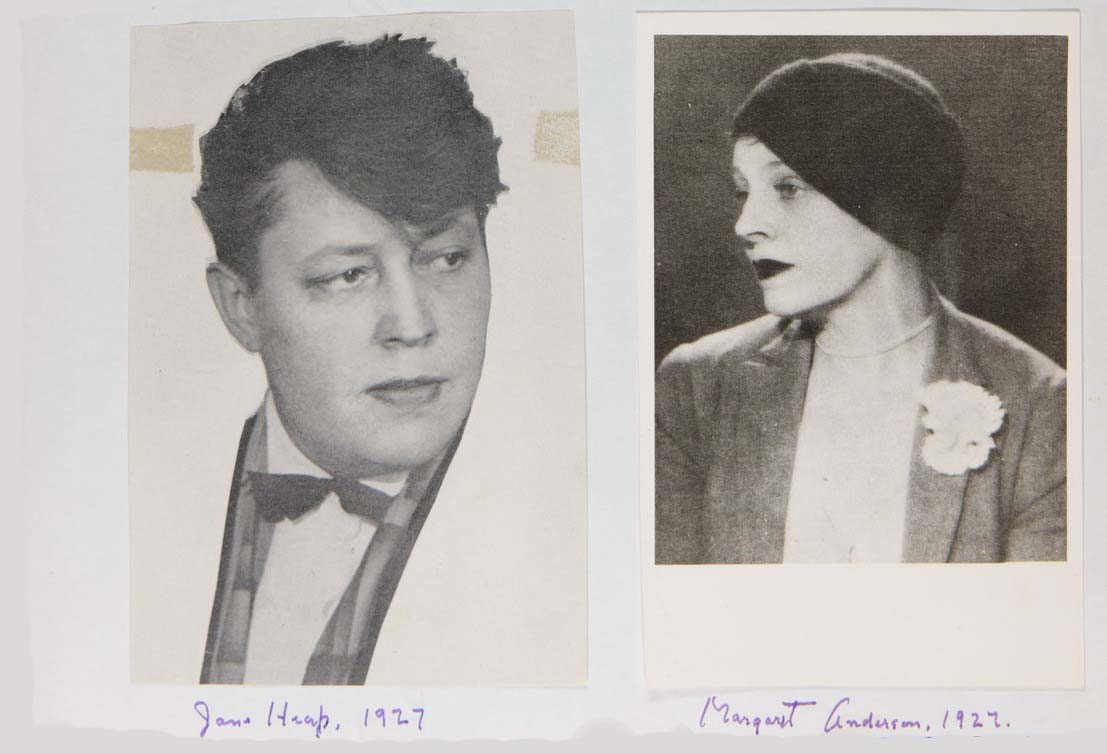
In the early thirties, for a certain clique of Left Bank–dwelling American lesbians, the place to be was not an expat haunt like the Café de Flore or Le Deux Magots. Nor was it Le Monocle, the wildly popular nightclub owned by tuxedoed butch Lulu du Montparnasse and named for the accessory worn to signal one’s orientation. According to the writer Solita Solano, the “only important thing in Paris” was a study group on the philosophies of the Greek-Armenian mystic George Ivanovich Gurdjieff, held at Jane Heap’s apartment. Heap, a Kansas-born artist, writer, and gallerist, was Gurdjieff’s official emissary, a rare honor. Under her supervision, the group engaged in intense self-revelation, narrating the stories of their lives without censoring or embellishing. As the author Kathryn Hulme explained in her memoir, Undiscovered Country: A Spiritual Adventure, the goal was to uncover the real I and thus escape being “a helpless slave to circumstances, to whatever chameleon personality took the initiative.”
Among those who gathered in Heap’s small sitting room were Janet Flanner, the New Yorker Paris correspondent and Solano’s lifelong partner; the journalist and author Djuna Barnes; and the actress Louise Davidson. One attendee, Hulme noted, would enter the room “like a Valkyrie” and “knew how to load the questions she fired at Jane, how to bait her to reveal more than perhaps was intended for beginners.” The Valkyrie was Margaret Caroline Anderson, founder of the trailblazing Little Review, with whom Heap had first encountered Gurdjieff in New York in the early twenties. Heap and Anderson, whose friendship outlasted a love affair and a professional partnership, were kindred geniuses with an exclusive affinity. When Barnes, after a fling with Heap, marveled at her “deep personal madness,” Anderson replied: “Deep personal knowledge—a supreme sanity.” Heap called Anderson “my blessed antagonistic complement.” Via their shared endeavors and the cross-pollination of their ideas—artistic, literary, and spiritual—these two remarkable women left an indelible imprint on avant-garde culture between the wars.
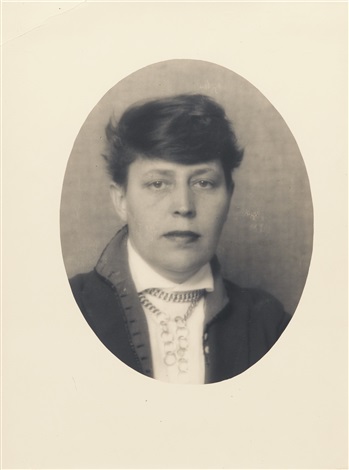
They first met one afternoon in February 1916, when Heap dropped by the The Little Review’s office in the Fine Arts Building on South Michigan Avenue in Chicago. She was thirty-two, with cropped dark hair, a long straight nose, strong cheekbones, and a strikingly androgynous style. A typical outfit was a men’s frock coat, a high-necked shirt, and a tie. In winter, she added a Russian fur hat, and she always wore bright red lipstick. Anderson, three years her junior, had gone through a tomboy phase but was now exquisitely feminine, with a knack for projecting flawless chic despite never having any money. “Her profile was delicious,” Flanner recalled in a posthumous tribute for TheNew Yorker, “her hair blond and wavy, her a laughter a soprano ripple, her gait undulating beneath her snug tailleur.” Anderson set great store by looks and charm, and believed her conversation improved when she felt attractive. To an earnest young short-story writer who came to her for advice, she said: “Use a little lip rouge, to begin with. Beauty may bring you experiences to write about.”
Heap’s handsome face, Anderson wrote in her memoir The Fiery Fountains, resembled Oscar Wilde’s “in his only beautiful photograph.” And yet, “when Jane talked you were conscious of only one feature—her soft deep eyes, in which you could watch thought take form … thought that was always clearest when she talked of the indefinable, the vast, or the unknown.” An unusual childhood had cultivated Heap’s questing, expansive mind. Her English father was a warden at the Topeka State Hospital, and he lived with his family in the hospital grounds. Young Jane roamed the place, lonely and thirsty for knowledge. Adults were poor sources of enlightenment, she found, except for the patients, who seemed to possess an authentic truth and authority that others lacked. The asylum, Heap wrote in a 1917 Little Review piece, “was a world outside of the world, where realities had to be imagined…Very early I had given up everyone except the Insane.” She dreamed of one day meeting those ultimate imaginers of reality, artists. “Who had made the pictures,” she wondered, “the books, and the music in the world?”
Heap studied at the Art Institute of Chicago, and she returned to the city after spending a year in Germany with her first serious girlfriend. During her twenties she taught art, designed theatrical sets, acted in plays, and fell in and out of love. “I believe in living a little more than necessary,” she wrote at age twenty-four, “seeing and believing life to be as one wished it to be, creating beauty where it doesn’t happen to exist.” When she met Anderson, she was nursing a broken heart and craving a grander conduit for her ambitions. At a stroke both problems were solved: she became coeditor of the two-year-old Little Review and moved with Anderson to California. They rented a ranch house in the redwood forests of Marin County and talked, nonstop, about art. “My mind was inflamed by Jane’s ideas,” Anderson reminisced in her memoir My Thirty Years’ War, “because of her uncanny knowledge about the human composition, her unfailing clairvoyance about human motivation. This is what I had been waiting for, searching for, all my life.”
Anderson grew up in Indiana, one of three sisters in a middle-class family. At age twenty-one she dropped out of a women’s college in Ohio, where she studied piano, to move to Chicago. Her bemused parents, who expected her to marry and settle down in their “country clubs and bridge” milieu, wanted to know what on earth she was seeking. Self-expression, she said, which meant “being able to think, say, and do what you believed in.” Her father retorted: “Seems to me you do nothing else.” In Chicago, Anderson became a magazine journalist and a prolific book critic. But she was always restless for her next big adventure. TheLittle Review was conceived when she attributed a depressed mood to “nothing inspired” happening in her life. The remedy came to her: she would launch the most interesting magazine of all time. “I knew that someone would give the money,” she wrote in My Thirty Years’ War. “This is one kind of natural law I always see in operation. Someone would have to. Of course someone did.” She had just turned twenty-seven.
Anderson’s guiding editorial principle was the superiority of artists over intellectuals. As she bluntly put it: “I didn’t consider intellectuals intelligent. I never liked them or their thoughts about life.” Merit would be her sole criteria for accepting work, with no pandering to commercialism or conservatism, or indeed to any ideology—though she had a fondness for anarchism and was an avowed feminist. Fundamental to art, Anderson insisted, was liberty. In the introduction to the March 1914 inaugural issue, she offered this impassioned address:
If you’ve ever read poetry with a feeling that it was your religion, your very life; if you’ve ever come suddenly upon the whiteness of a Venus in a dim, deep room; if you’ve ever felt music replacing your shabby soul with a new one of shining gold; if, in the early morning, you’ve watched a bird with great white wings fly from the edge of the sea straight up into the rose-colored sun—if these things have happened to you and continue to happen till you’re left quite speechless with the wonder of it all, then you’ll understand our hope to bring them nearer to the common experience of the people who read us.
During its first couple of years, TheLittle Review featured work by Sherwood Anderson, John Galsworthy, Rupert Brooke, Emma Goldman, W. B. Yeats, H. D., and Amy Lowell. In the March 1915 issue, Anderson herself put forth an argument for gay rights, the first lesbian to do so in print. “With us,” she railed, “love is just as punishable as murder or robbery … because it is not expressed according to conventional morality.” After Heap joined as coeditor, the magazine published Hemingway’s first short stories and the first excerpts from Ulysses; poetry by T. S. Eliot, Gertrude Stein, and William Carlos Williams; art by Picasso and Brancusi, and essays by Ford Madox Ford and André Breton. Heap introduced a new motto: “To express the emotions of life is to live / To express the life of emotions is to make art.” The magazine’s uncompromising ethos was affirmed in September 1916, when an issue was released with thirteen blank pages as a “want ad.” Too few submissions had been judged worthy of publication, and they saw no point in laboring “to perpetuate the dull.”
TheLittle Review couldn’t pay its contributors and had a circulation of only a few thousand. Still, its reputation for artistic radicalism attracted high-profile collaborators. Amy Lowell, who in Anderson’s opinion “had more feminine whims and humors than ten women,” lobbied to be poetry editor. In a fit of pique after being snubbed by Ezra Pound, Lowell planned to show him “who’s who in this business” and offered to subsidize TheLittle Review with $150 a month. Anderson was not remotely tempted, despite living in virtual penury in order to pay for printing costs: “No clairvoyance was needed to know that Amy Lowell would dictate, uniquely and majestically, any adventure in which she had a part.” Instead, Anderson engaged Pound—who was at a safer distance in London—as European editor. He set out his terms in a letter: “I want an ‘official organ’ (vile phrase). I mean I want a place where I and T. S. Eliot can appear once a month (or once an ‘issue’) and where Joyce can appear when he likes, and where Wyndham Lewis can appear if he comes back from the war.”
Intent on making TheLittle Review an “international organ,” Anderson moved herself, a reluctant Heap, and the magazine to New York in early 1917. They found an apartment on West Sixteenth Street, above an undertaker and an exterminator. This unpropitious location was counterbalanced by the skillful decorative stamp the couple put on all their homes. While living in their California house, they had painted the furniture and fireplace to such pleasing effect that their landlord, the local sheriff, wanted to refund more than the deposit. In New York they covered the walls, painstakingly, with Chinese gold paper and hung a blue-covered divan from the ceiling with large black chains. Here they received would-be contributors, who were sometimes beseeching, sometimes antagonistic. “We were considered heartless, flippant, ruthless, devastating,” Anderson recalled. But, soon enough, “we would stand revealed as two simple sincere people with serious ideas.”
A story by Wyndham Lewis caused TheLittle Review’s first disastrous conflict with the censors. In “Cantleman’s Spring-Mate,” published in the May 1917 issue, a disaffected English soldier seduces a girl before going to fight in France. She writes to tell him she’s pregnant, but he ignores her letters with the same blank ruthlessness that allows him to kill Germans without flinching. The U.S. Post Office, deeming the story both obscene and anti-war, burned the four-thousand-copy print run. If other editors might have been cowed into cautiousness, Heap and Anderson were anything but fainthearted. When Pound sent the first chapter of James Joyce’s Ulysses, he warned it could cause trouble. They didn’t care: they knew it was a masterpiece. “We’ll print it,” Anderson declared, “if it’s the last effort of our lives.” The twenty-three-part serialization began in March 1918; over the next two years, four issues were confiscated and burned by the Post Office. As Anderson wrote in My Thirty Years’ War:
It was like a burning at the stake as far as I was concerned. The care we had taken to preserve Joyce’s text intact; the worry over the bills that accumulated when we had no advance funds; the technique I used on printer, bookbinder, paper houses—tears, prayers, hysterics or rages—to make them push ahead without a guarantee of money; the addressing, wrapping, stamping, mailing; the excitement of anticipating the world’s response to the literary masterpiece of our generation … and then a notice from the Post Office: BURNED.
In October 1920, Heap and Anderson were arrested and charged with distributing obscenity over “Nausicaa,” from the April 1920 issue. In this episode Leopold Bloom, his hand in his pocket, watches a young woman reclining on a beach. Thrilling to his gaze, she lets her skirt fall above her garter belt and he brings himself to orgasm. John Sumner, head of the New York Society for the Suppression of Vice, believed the text would corrupt young women, and he filed a formal complaint. At court for an initial hearing, Anderson and Heap appeared with their supporters, stylishly bohemian Greenwich Village women. The British poet-artist and Little Review contributor Mina Loy observed: “We looked too wholesome in Court representing filthy literature.” The magistrate ruled that the literature was indeed filthy, and the case was sent for trial. In the next issue of TheLittle Review, a defiant Heap pointed out:
Girls lean back everywhere, showing lace and silk stockings; wear low cut sleeveless gowns, breathless bathing suits; men think thoughts and have emotions about these things everywhere—seldom as delicately and imaginatively as Mr. Bloom—and no one is corrupted. Can merely reading about the thoughts he thinks corrupt a man when his thoughts do not? All power to the artist, but this is not his function.
In February 1921, at the Court of Special Sessions, three literary experts were called to testify in front of three judges that “Nausicaa” was art, not pornography. When the British novelist John Cowper Powys declared it a work of beauty that posed no threat to young girls, Heap restrained herself from saying that a young girl’s mind frightened her more than anyone’s. In one farcical moment, the prosecutor asked that the court hear some offending passages. A snoozing white-haired judge perked up, contemplated Anderson in her pearls and silk blouse, and forbade that obscenities be read out in her presence. Told she was the publisher, his honor said with paternal solicitude: “I am sure she didn’t know the significance of what she was publishing.”
Heap and Anderson were, nevertheless, found guilty under the Comstock Laws and each fined $50. Anderson regretted paying it; had she gone to jail, she reasoned, the publicity might have been greater. As it was, neither the New York Times nor any New York newspaper came to the women’s defense. It would be another thirteen years before Ulysses was legally published in the U.S. When critics began lauding it (while often misunderstanding it, Anderson thought), they typically neglected to cite TheLittle Review as the first publisher.
The Ulysses debacle strained Heap and Anderson’s already fraying relationship. For five years, they had been inseparable: moving from place to place, putting all their financial and emotional resources into TheLittle Review, and tolerating each other’s foibles. Anderson idolized Heap, but she was not an easy person to live with. Prone to dark depressions, she regularly threatened suicide. “The light is too brutal for me here,” she would say. “I am going back to the grave from which I came.” She kept a revolver in a trunk; Anderson lived in fear while feigning nonchalance. “I don’t know what poor human being first discovered the fact,” she later mused, “that the surest way to hold people’s interest is to subject them to torment.” She inflicted her own torments by dallying with other women. Heap was her one true love, she assured her. There was no need to be jealous. But to brooding, romantic Heap, casual infidelity was incomprehensible. “If I loved anyone as she says she loves me,” she lamented in a letter to a friend, “it would make me go into a long illness to be as free as she is now of me.”
Yet it was Anderson whose mental equilibrium, her preternatural ability to show no weakness, collapsed. She’d had enough of “publishing drudgery” and wanted to close TheLittle Review. “I argued that it had begun logically with the inarticulateness of a divine afflatus and should end logically with the epoch’s supreme articulation—Ulysses.” But Heap was determined to keep it going. She was also determined that their relationship continue unchanged, despite simmering acrimony and ebbing passion. Then, into this tense household, came Anderson’s young nephews, Fritz and Tom Peters. Her sister Lois had been hospitalized with a nervous breakdown, and the boys had nowhere else to go. Anderson, who didn’t have a maternal bone in her body, felt trapped in all directions and suffered her own nervous breakdown.
Anderson found happiness again in a new relationship, with the French soprano and actress Georgette Leblanc. They met through a mutual friend, the pianist Allen Tanner, and for both women it was love at first sight. Leblanc, who was eighteen years Anderson’s senior and reaching the end of a celebrated performing career, said: “There is something perfect in her soul.” Eager to begin a new chapter, Anderson at last renounced her Little Review responsibilities. Heap was, of course, hurt by this double defection. But she remained committed to the magazine, over which she assumed editorial control. She also set up the Little Review Gallery on East Eleventh Street, specializing in European Dadaists and surrealists such as André Masson, Hans Arp, Kurt Schwitters, and Hannah Höch. And while Anderson and Leblanc enjoyed a romantic idyll in a rustic New Jersey mansion, Heap adopted Fritz and Tom. Perhaps she wanted, even if subconsciously, a permanent tie to Anderson.
Their fates would remain entwined for another reason: a mutual and unending fascination with the doctrines of Gurdjieff. In this diminutive middle-aged esoterist with a shaved head and a black handlebar mustache, they saw, in Anderson’s words, “a messenger between two worlds … a seer, a prophet, a messiah?” In early 1924, the mystic visited New York on a promotional tour. That summer Anderson, Leblanc, Heap and the boys, and other friends all moved to France to study at Gurdjieff’s Institute for the Harmonious Development of Man in Fountainebleau, outside of Paris. A former Carmelite monastery set in forty-five acres of land, it housed around sixty men and women, who listened to talks, participated in sacred dances, and worked in the gardens and kitchens. The Modernist writer Katherine Mansfield spent her final days there, very happily. Just weeks before her death from tuberculosis in 1923, she wrote to her husband, the writer John Middleton Murry: “There is certainly no other spot on this whole planet where one can be taught as one is taught here.”
Gurdjieff hailed from the South Caucasus, part of the Russian Empire, where he was born to a Greek father and an Armenian mother. Around the turn of the twentieth century, he left home to travel the world, visiting monasteries, temples, and other holy places. The various spiritual disciplines he encountered were adapted into his cosmology, what he called The Fourth Way, The Work, or The System. Most people, he believed, exist in a state of “waking sleep,” their dormant souls trapped by their personalities and their lives buffeted by external forces. He taught that to uncover one’s authentic self, or “essence,” and gain free will, it is necessary to consciously, and with effort, observe the self and learn which of the three mechanical centers—physical, emotional, or mental—dominates. In no small part thanks to Heap and Anderson’s endorsement, these ideas spread through the interwar bohemia of New York and Paris. Kathryn Hulme remarked that while no one seemed to know Gurdjieff, “his reputation loomed in Left Bank conversations in a persistent hush-hush way.”
Gurdjieff found a true disciple in Heap, and over the subsequent years, she attained a high enough expertise in The System to teach it. Absorbed with this new purpose, she published the final issue of TheLittle Review in May 1929. Heap’s parting words in that issue were forceful: “Self-expression is not enough; experiment is not enough; the recording of special moments or cases is not enough. All of the arts have broken faith or lost connection with their origin and function.” The transcendence she had hungered for as a lonely little girl, wandering around the insane asylum, was no longer art’s sole dominion.
In 1935, Gurdjieff sent Heap to London to teach. She moved with her girlfriend, Elspeth Champcommunal, a fashion designer. Without a leader, the longstanding Paris study group was bereft. They decided to seek out Gurdjieff himself, and the group re-formed under his supervision. Its members grew to include Anderson, Leblanc, Solano (who also became Gurdjieff’s secretary), Hulme, her friend Alice Rohrer (a milliner from San Francisco), Louise Davidson, and Elizabeth Gordon—an unmarried Englishwoman and the only heterosexual, introduced into the group by Gurdjieff. He likened their “inner world journey” to a high mountain climb where they must be roped together for safety: hence they called themselves The Rope. They met daily, sometimes twice; anyone who sought to join them was curtly rebuffed. They shared meals, performing rituals around food and alcohol, all in the service of learning “how to act, rather than be acted upon.” The meetings went on for only about two years, but the women had formed what Hulme called an “exalted” lifelong bond: “Our work with Gurdjieff had created an inner-world intimacy, a kind of caring for the soul of another such as I had never experienced before in any human relationship.”
Heap and Anderson kept up a correspondence in the late thirties and during the war, when Anderson and Leblanc retreated to Le Cannet, north of Cannes in the unoccupied zone. In October 1941, Leblanc died of cancer, aged seventy-two. Sending her condolence, Heap wrote: “Georgette will never perish. Die all we must, but we can hope that none of us who has ‘eaten’ of Gurdjieff’s food will ever perish.” Heap settled permanently in London, living with Champcommunal in St John’s Wood and conducting Gurdjieff study groups until her death in 1964, at age eighty. Anderson died in 1973, aged eighty-six, and was buried next to Leblanc in Cannes.
In 1962 Anderson published The Unknowable Gurdjieff, a memoir of The Rope and Gurdjieff’s teachings. The book was dedicated to Heap. A fitting epitaph to these lives of peerless nonconformism is Anderson’s affronted reaction, in the late sixties, to questions about TheLittle Review’s selection process: “Mon Dieu, did I have any standards? I had nothing but…”


How much of a tree is alive? Certainly not the outer bark. That falls off in dry scales, or can be scraped off down to the white layers within, and the tree be none the worse. Certainly not the wood. One often comes across old trees that have lost limbs or been carelessly pruned, which are entirely decayed out on the inside, so that nothing is left but a thin shell next the bark. Yet these trees grow as vigorously as ever, and bear leaves and fruit like a solid tree. The bark is dead; and the wood is dead. Between the two is a thin layer, perhaps a quarter inch thru, which is alive. On one side, it is changing into dead wood. On the other side, it is changing into dead bark. The new wood is alive, and the new bark. Between them is something neither wood nor bark, but just living tree-stuff. The green leaves also are alive, and the green twigs, and the blossoms, and the growing buds. But at least half of every living tree is already dead; while the larger and longer lived a tree is, the smaller proportion of it is alive at one time.