The masks and the censorship seem to have arrived together as a metaphor of control over all aspects of how we live and relate to each other .
It appears we are not allowed to say, read or hear certain things that our politicians (directed from the top of the pyramid) have told us.
When J.P.Sears (see my last newsletter) gets banned on Instagram, I am concerned about censorship . I am glad that quite a few of my clients have stopped watching and absorbing the negativity of mainstream media to stay in a positive frequency, however, it is important to still stay educated on current affairs.
I would love us to manifest freedom of speech in all areas and not be told that everything not on mainstream media is a “conspiracy theory “ as decreed by “fact checkers “ paid by the mainstream media.
There will be dubious information everywhere but it is our own hearts, guts and minds that can really know. I would love us to remember how to tune into our own bodies and resist a narrative of interference in that process.
Please watch this excellent documentary that has received a lot of censorship . It is after all your legal right under common law to live in freedom .
What accounts for our polarized public life, and how can we begin to heal it? Political philosopher Michael Sandel offers a surprising answer: those who have flourished need to look in the mirror. He explores how “meritocratic hubris” leads many to believe their success is their own doing and to look down on those who haven’t made it, provoking resentment and inflaming the divide between “winners” and “losers” in the new economy. Hear why we need to reconsider the meaning of success and recognize the role of luck in order to create a less rancorous, more generous civic life.
This talk was presented at an official TED conference, and was featured by our editors on the home page.
The Viking burial ground of Lindholm Hoje, in Denmark. Credit – De Agostini via Getty Images
Part of the Viking image today is a caricature of masculinity—the long-haired warrior still incorporated into the logos or advertising for products appealing to a supposed ideal of manly behavior. But Viking-age Scandinavian reality embraced so much more, including a true fluidity of gender. Patriarchy was a norm of Viking society, but one that was subverted at every turn, often in ways that—fascinatingly—were built into its structures.
The Vikings were certainly familiar with what would today be called queer identities. Gender boundaries were rigidly policed, at times with moral overtones, and the social pressures laid upon men and women were very real. At the same time, however, these borders were permeable with a degree of social sanction. There is a clear tension here, a contradiction that can be productive for anyone trying to understand the Viking mind.
These themes and connections can be pursued in the study of graves. Archaeologists determine the sex of the buried dead through analysis of their bones (which is reliable, though not certain) or DNA (which uses a chromosomal definition that is generally uncontroversial). However, in many cases the deceased were cremated, or preservation conditions in the soil are unfavorable to the survival of bone in any state. In these cases, for centuries, archaeologists have resorted to determining the sex of the dead through association with supposedly gendered objects—weapons in a grave are held to suggest a man, jewellery sets denote a woman, and so on.
Beyond the obvious problems of conflating sex and gender, and also effectively sexing metal, these readings risk simply piling one set of assumptions on another in what forensic decision-makers call a “bias snowball” of cumulatively questionable interpretations.
So, while the majority of these sex/gender/artifact correlations probably do reflect Viking-age reality, not all burials conform to such patterns, and an openness to the exceptions—which we know were there—is vital. Without this, one can never hope to do archaeological justice to the gender spectrum discernible in the medieval texts or compare this with Viking-age empirical reality. More excitingly, the archaeology can turn up evidence for identities and genders that did not make it to the written sources.
The starting point comes in graves with viable bone survival. In such cases, archaeologists occasionally find people buried with objects and clothing that would usually be associated with the opposite sex. These include male skeletons wearing what appear to be dresses of the kind more conventionally buried with women, or with the oval brooches that hold the apron together at the breast, and similar combinations. For burials with female bodies, an equivalent is the presence of weapons in numbers sufficient to plausibly suggest a warrior identity for the dead. At Vivallen in Swedish Härjedalen, there was even a male-bodied person buried according to Sámi rituals, in a Sámi settlement, but wearing conventional Sámi man’s equipment over a Nordic woman’s linen dress, complete with jewellery to match—a crossing of both gender and cultural norms.
The most prominent example to date combines almost all of Viking gender in a single burial, raising more questions than it answers. In a 10th-century chamber grave designated Bj.581 from an urban cemetery at Birka in Sweden, an expensively dressed corpse was buried seated and surrounded by a full weapon set (which is rare), with two riding horses. This truly spectacular burial was excavated in 1878 and has been held up ever since as a type example of a high-status warrior from the mid-900s, a kind of “ultimate Viking” of the time. Bj.581 was published as such in generations of standard works. As part of this interpretative package, the deceased was always assumed to have been a man, because warriors were “obviously” male (conflating sex and gender in the familiar way). In 2011, however, an osteological study suggested the buried person was actually female, and this was confirmed by genomic analysis in 2017—the deceased carried XX chromosomes. The ensuing debate on the apparent “female warrior” of Birka went viral and now convulses Viking studies, in an at-times vituperative discussion that has little to do with women and war but more concerns underlying fault lines of gendered assumption in the discipline and beyond.
In a sense it does not really matter whether the person in the Birka grave was a female-bodied warrior woman or not (though as one of the lead authors in the research team, I firmly believe she was all those things). This person may equally have been transgender, in our terms, or non-binary, or gender fluid. There are other possibilities, too, but the point is that they must all be recognized as possible Viking-Age identities while—crucially—not assuming this must be the case. Not least, in the interpretation of Bj.581, scholars should be careful not to deny the basic agency of women, and their potential to choose one way of life over others; this person does not have to be necessarily different. Furthermore, all these intersections of activity and identity were in themselves deeply gendered—from “warriorhood” to everything else.
Importantly, none of this needed to be fixed and permanent. In the later prose texts, difficult sources though they are, one encounters individuals who change names when they embark upon a new path in life—when certain women become warriors, for example. But only sometimes—there are no universals here, and as ever the medieval sources are problematic, late, ambiguous and uncertain.
While some of their norms can appear rigid, the Scandinavians somehow applied them in ways that also allowed them to be questioned, undermined and contradicted. In many ways and for many years, Viking scholars have been naive and simplistic about their acknowledgement and recognition of gender variation in the later Iron Age. Perhaps Viking-Age people chose and renegotiated their identities every day, much as many of us do. Their ideas about gender went far beyond the binaries of biological sex, as scholars are now beginning to understand. Sadly, we are also only now becoming aware of the privilege that allowed us to overlook this for so long.
Library Journal calls Howard Zinn’s iconic A People’s History of the United States “a brilliant and moving history of the American people from the point of view of those…whose plight has been largely omitted from most histories.” Packed with vivid details and telling quotations, Zinn’s award-winning classic continues to revolutionize the way American history is taught and remembered. Frequent appearances in popular media such as The Sopranos, The Simpsons, Good Will Hunting, and the History Channel documentary The People Speak testify to Zinn’s ability to bridge the generation gap with enduring insights into the birth, development, and destiny of the nation
Restorative justice is an approach to justice in which one of the responses to a crime is to organize a meeting between the victim and the offender, sometimes with representatives of the wider community. The goal is for them to share their experience of what happened, to discuss who was harmed by the crime and how, and to create a consensus for what the offender can do to repair the harm from the offense. This may include a payment of money given from the offender to the victim, apologies and other amends, and other actions to compensate those affected and to prevent the offender from causing future harm.
A restorative justice program aims to get offenders to take responsibility for their actions, to understand the harm they have caused, to give them an opportunity to redeem themselves and to discourage them from causing further harm. For victims, its goal is to give them an active role in the process[1] and to reduce feelings of anxiety and powerlessness.[2] Restorative justice is founded on an alternative theory to the traditional methods of justice, which often focus on retribution. However, restorative justice programs can complement traditional methods.
Academic assessment of restorative justice is positive. Most studies suggest it makes offenders less likely to reoffend. A 2007 study also found that it had a higher rate of victim satisfaction and offender accountability than traditional methods of justice delivery.[2] Its use has seen worldwide growth since the 1990s.[3] Restorative justice inspired and is part of the wider study of restorative practices.
…a process where all stakeholders affected by an injustice have an opportunity to discuss how they have been affected by the injustice and to decide what should be done to repair the harm. With crime, restorative justice is about the idea that because crime hurts, justice should heal. It follows that conversations with those who have been hurt and with those who have inflicted the harm must be central to the process.
Although law professionals may have secondary roles in facilitating the restorative justice process, it is the citizens who must take up the majority of the responsibility in healing the pains caused by crime.[4] The process of restorative justice thus shifts the responsibility for addressing crime.
In 2014, Carolyn Boyes-Watson from Suffolk University defined restorative justice as:
…a growing social movement to institutionalize peaceful approaches to harm, problem-solving and violations of legal and human rights. These range from international peacemaking tribunals such as the South Africa Truth and Reconciliation Commission to innovations within the criminal and juvenile justice systems, schools, social services and communities. Rather than privileging the law, professionals and the state, restorative resolutions engage those who are harmed, wrongdoers and their affected communities in search of solutions that promote repair, reconciliation and the rebuilding of relationships. Restorative justice seeks to build partnerships to reestablish mutual responsibility for constructive responses to wrongdoing within our communities. Restorative approaches seek a balanced approach to the needs of the victim, wrongdoer and community through processes that preserve the safety and dignity of all.”[5]
Difference from other approaches
According to Howard Zehr, restorative justice differs from traditional criminal justice in terms of the guiding questions it asks. In restorative justice, the questions are:
Who has been hurt?
What are their needs?
Whose obligations are these?
What are the causes?
Who has a stake in the situation?
What is the appropriate process to involve stakeholders in an effort to address causes and put things right?[6]
As Braithwaite writes, “Court-annexed ADR (alternative dispute resolution) and restorative justice could not be philosophically further apart”. While the former seeks to address only legally relevant issues and to protect both parties’ rights, restorative justice aims at “expanding the issues beyond those that are legally relevant, especially into underlying relationships.”[8]
In June I wrote an essay for the online publication Erraticus titled Alone in one of Nature’s Threshold Places.In it I explored the idea that there may be something more to nature than just mere matter in conjunction with Ralph Waldo Emerson’s essay Nature (1836). Near the end of it, I wrote:
I do not believe the forests and mountains, prairies and deserts hum with some special quality of spirituality…
yet the point of the essay was that, despite this belief, there still seems to be something to nature that I connect with deeply; what is that something?
It might be that panpsychism offers an answer to this question. I became acquainted with the concept when reading Philip Goff’s most recent book Galileo’s Error: Foundations for a New Science of Consciousness (2019) in which he presents the case for Panpsychism, the idea that all things have some degree of consciousness.
The Two Poles
Contemporary panpsychism champions the view that consciousness is a fundamental and ubiquitous feature of all things. It does not imply that all things have the kind of sophisticated, complex thoughts we associate with human beings, but all things do have a subjective experience of some kind. (Philosophy Now, Issue 121)
This theory attempts to find a middle path between the two standard positions related to consciousness, that of Dualism and Physicalism. Dualism posits that our mind (consciousness) is separate from our body; that the brain does not give rise to the mind, meaning its origin is not a product of physical conditions, dismissing the standard cause and effect relationship. Rather, the mind is something entirely independent of the body which humanity has generally taken to mean there is something very special about us. While this is a popular conception, some think the theory falls flat because it cannot identify from where the mind originates. If it exists, it must have come from somewhere.
Physicalism on the other hand posits that the mind can be fully accounted for in terms of physical entities and processes. Just as everything else in the body is a result of physical processes, so is the mind. But Goff argues, supported by many philosophers and scientists, that after decades to neuroscience exploring the brain:
…we have not the faintest idea how to make sense of experience being generated from material activity such as the firing of neurons. (Philosophy Now, Issue 121)
Goff fully acknowledges that the scientific project since Galileo is responsible for tremendous human progress and our understanding of the universe, but has not been able to account for consciousness. Experience is entirely subjective, and as best we know science does not have an explanation as to how it arises from the brain.
What Matter Is
Mathematics does so much to explain the workings of our physical universe. In fact, Galileo famously called mathematics the language of the universe, and while this objective, quantifying perspective is helpful in many cases, it fails to explain things from an experiential standpoint. Physics and mathematics do a very good job of telling us what matter does and is a marvelous tool for prediction, but it cannot tell us what matter is.
Take an electron for example. Physics tells us things such as electrons have a certain mass and negative charge, and that a negative charge repels other negatively charged things in order to attract positively changed things. These are important properties and prediction aides of an electron and its behavior, but this only tells us what an electron does:
And yet intuitively there must be more to what an electron is than what it does. An electron must have an intrinsic nature, as philosophers like to say. (Galileo’s Error)
What is an electron is very different from what an electron does. Now let us take human beings for example. The human part is easy. Science can tell us all kinds of things about a human such as its identifying features and the physical events that occur within a body that cause it to function in the way it does; these are all aspects of matter. While science can tell us about what a human does, it cannot tell us what a human is. This is the aspect of being. What is a being?
Since science cannot explain how the physical brain gives rise to consciousness, and all things have an intrinsic nature, panpsychism posits that a thing’s intrinsic nature is consciousness. From Galileo’s Error:
Problem 1: We need a place for consciousness.
Problem 2: We have a huge hole at the center of our scientific story [that science can explain so many things but cannot account for how the brain gives rise to consciousness].
Solution: Plug the hole with consciousness.
In other words…consciousness is the intrinsic nature of matter.
If this is true, that all things have a degree of consciousness, then it might help answer my question related to nature.
A World Filled With Consciousness
How is it that we become aware of another being? Not only are other human beings animate, but we recognize something within them that speaks to a unique nature, a certain something that is beingness. We have similar encounters with other animate creatures: the pets we keep and the varieties of other animals we encounter outside of our homes. These creature’s subjective experiences are less sophisticated than ours, yet when we encounter them are we not acknowledging other minds, other consciousnesses?
In the final section of Galileo’s Error, Goff explores the damage a dualist view of nature can have. The dualist considers the world outside of its unique consciousness as mechanistic matter which lacks the consciousness that sanctifies human existence. This gives justification to the viewpoint that allows the natural world to be exploited rather than revered and seen as possessing the same kind of intrinsic value we see in ourselves. It is here that panpsychism offers a perspective that might change our relationship to the natural world; that we are conscious creatures embedded in a world of consciousness.
Though we do not always get it right, we try to treat other humans not as objects but individuals with value and purpose who are worthy of our moral consideration. This is partially what I mean by being able to recognize a certain something within humans and even animals. It is this something – the ability to experience, perhaps expressing individual agency – that causes us to assign moral value to them. From Galileo’s Error:
What if children were raised to experience trees and plants in the same way, to see the movement of a plant toward the light as expressing its own desire and conscious drive for life, to accept the tree as an individual locus of sentience.
There have been multiple studies, many mentioned in Goff’s book, on ecosystems, smaller plant communities, and individual plants that strongly suggest, if not outright confirm, that plants communicate, learn, and remember.
I can see no reason other than anthropic prejudice not to ascribe to them a conscious life or their own.
If consciousness were out there in the forests through which I walk, am I not amidst a community teeming with conscious life – of trees and flowers, butterflies and bees, toads and elk – rather than simply strolling through mere mechanistic matter? If instead of cogs that do nothing more than obey a mandate of evolutionary survival there exists a network of mutual support and care, would this not have massive implications of how we view the natural world?
It would introduce a number of staggering moral and ethical dilemmas, but it would also confirm the notion that we are a part of the world rather apart from it, ushering in an entirely new perspective of the environment which we rely on for survival, making it an end rather than a means to an end.
Perhaps this fills the gap I have when out in nature between my own sense of self and what I am told is nothing more than matter. Could it be an explanation to the kinship I sense, a type of community of consciousness?
Fox News (officially Fox News Channel, abbreviated FNC and commonly known as Fox) is an American multinational conservative[2][3]cablenews television channel. It is owned by Fox News Media, which itself is owned by the Fox Corporation. The channel broadcasts primarily from studios at 1211 Avenue of the Americas in New York City. Fox News provides service to 86 countries and overseas territories worldwide,[4] with international broadcasts featuring Fox Extra segments during ad breaks.
The channel was created by Australian-American media mogulRupert Murdoch to appeal to a conservative audience, hiring former Republican media consultant and CNBC executive Roger Ailes as its founding CEO.[5][6] It launched on October 7, 1996, to 17 million cable subscribers.[7] Fox News grew during the late 1990s and 2000s to become the dominant subscription news network in the U.S.[8] As of September 2018, approximately 87,118,000 U.S. households (90.8% of television subscribers) received Fox News.[9] In 2019, Fox News was the top-rated cable network, averaging 2.5 million viewers.[10][11][12] Murdoch is the current executive chairman and Suzanne Scott is the CEO.[13][14]
Fox News has been described as practicing biased reporting in favor of the Republican Party, the George W. Bush and Donald Trump administrations, and conservative causes while portraying the Democratic Party in a negative light.[15][16][17][18] Critics have cited the channel as detrimental to the integrity of news overall.[19][20] Fox News employees have said that news reporting operates independently of its opinion and commentary programming, and have denied bias in news reporting, while former employees have said that Fox ordered them to “slant the news in favor of conservatives”.[21] During Trump’s presidency, observers have noted a pronounced tendency of the Fox News Channel to serve as a “mouthpiece” for the administration, providing “propaganda” and a “feedback loop” for Trump, with one presidential scholar stating, “It’s the closest we’ve come to having state TV.”[22][23]
In May 1985, Australian publisher Rupert Murdoch announced that he and American industrialist and philanthropistMarvin Davis intended to develop “a network of independent stations as a fourth marketing force” to compete directly with CBS, NBC, and ABC through the purchase of six television stations owned by Metromedia.[24] In July 1985, 20th Century Fox announced Murdoch had completed his purchase of 50% of Fox Filmed Entertainment, the parent company of 20th Century Fox Film Corporation.[25] A year later, 20th Century Fox earned $5.6 million in its fiscal third period ended May 31, 1986, in contrast to a loss of $55.8 million in the third period of the previous year.[26]
Subsequently, and prior to founding FNC, Murdoch had gained experience in the 24-hour news business when News Corporation‘s BSkyB subsidiary began Europe’s first 24-hour news channel (Sky News) in the United Kingdom in 1989.[27] With the success of his fourth network efforts in the United States,[28] experience gained from Sky News and the turnaround of 20th Century Fox, Murdoch announced on January 31, 1996, that News Corp. would launch a 24-hour news channel on cable and satellite systems in the United States as part of a News Corp. “worldwide platform” for Fox programming: “The appetite for news – particularly news that explains to people how it affects them – is expanding enormously”.[29]
In February 1996, after former U.S. Republican Party political strategist and NBC executive[30]Roger Ailes left cable television channel America’s Talking (now MSNBC), Murdoch asked him to start Fox News Channel. Ailes demanded five months of 14-hour workdays and several weeks of rehearsal shows before its launch on October 7, 1996.[1]
At its debut 17 million households were able to watch FNC;[7] however, it was absent from the media markets of New York City and Los Angeles. Rolling news coverage during the day consisted of 20-minute single-topic shows such as Fox on Crime or Fox on Politics, surrounded by news headlines. Interviews featured facts at the bottom of the screen about the topic or the guest. The flagship newscast at the time was The Schneider Report, with Mike Schneider‘s fast-paced delivery of the news. During the evening, Fox featured opinion shows: The O’Reilly Report (later The O’Reilly Factor), The Crier Report (hosted by Catherine Crier) and Hannity & Colmes.
From the beginning, FNC has placed heavy emphasis on visual presentation. Graphics were designed to be colorful and gain attention; this helped the viewer to grasp the main points of what was being said, even if they could not hear the host (with on-screen text summarizing the position of the interviewer or speaker, and “bullet points” when a host was delivering commentary). Fox News also created the “Fox News Alert”, which interrupted its regular programming when a breaking news story occurred.Fox News Studios in 2009.
To accelerate its adoption by cable providers, Fox News paid systems up to $11 per subscriber to distribute the channel.[31] This contrasted with the normal practice, in which cable operators paid stations carriage fees for programming. When Time Warner bought Ted Turner‘s Turner Broadcasting System, a federal antitrustconsent decree required Time Warner to carry a second all-news channel in addition to its own CNN on its cable systems. Time Warner selected MSNBC as the secondary news channel, not Fox News. Fox News claimed this violated an agreement (to carry Fox News). Citing its agreement to keep its U.S. headquarters and a large studio in New York City, News Corporation enlisted the help of Mayor Rudolph Giuliani‘s administration to pressure Time Warner Cable (one of the city’s two cable providers) to transmit Fox News on a city-owned channel.[32] City officials threatened to take action affecting Time Warner’s cable franchises in the city.[33]
During the September 11, 2001 attacks, Fox News was the first news organization to run a news ticker on the bottom of the screen to keep up with the flow of information that day. The ticker has remained, informing viewers about additional news which reporters may not mention on-screen and repeating news mentioned during a broadcast; it has proven popular with viewers.[34]
Political alignment
Fox News has been described as practicing biased reporting in favor of the Republican Party, the George W. Bush and Donald Trump administrations, and conservative causes while portraying the Democratic Party in a negative light.[15][16][17][18] Critics have cited the channel as detrimental to the integrity of news overall.[19][20] Fox News employees have said that news reporting operates independently of its opinion and commentary programming, and have denied bias in news reporting, while former employees have said that Fox ordered them to “slant the news in favor of conservatives”.[21] During Trump’s presidency, observers have noted a pronounced tendency of the Fox News Channel to serve as a “mouthpiece” for the administration, providing “propaganda” and a “feedback loop” for Trump, with one presidential scholar stating, “It’s the closest we’ve come to having state TV.”[22][23]
Our emotions and beliefs form our world. They are the basis for everything we manifest into our lives. Our beliefs are formed over time by our family, upbringing, culture, governments, media, schools, friends and general society. We are often unaware of what deep seated beliefs we hold.
Emotions are an in-the-now expression of our inner beliefs, e.g. the same event can cause one person to feel anger, another sadness, or for a different person no emotional reaction. We often think of emotions as an innate reaction, something we have no control over. However, we can consciously choose to change our emotions and how we react to certain situations through positive thought, which in turn changes our beliefs. Our subconscious (where our beliefs reside) has no judgment or understanding of ‘good’ or ‘bad’; it simply draws to us experiences that support our beliefs. Henry Ford once said, “If you believe you can, or believe you can’t, you are right.”
General negative emotions and beliefs cause general ill health. Anger can cause chemical reactions in the body to produce an acidic environment that welcomes viruses to take up residence. An acidic diet can also bring on anger; some people are attracted to acidic producing foods in the first place by holding an underlying belief such as, “I’m not worthy of health or happiness.” Germs aren’t the bad guys; it is the environment in which the germs thrive that cause the problems,1 which are directly connected to our emotions.
Specific medical issues can be connected to specific beliefs, e.g. rheumatism comes from feeling victimised, resentment, lack of love and chronic bitterness.2 An illness or pain is your body’s final warning that something is wrong and needs to be treated on the physical level. However, if the emotional cause behind the illness or pain is not addressed, the physical symptoms will return over time.
Positive emotions, such as joy and gratitude, bring healing energy to the body. Having a good laugh or thinking of something that makes your heart go ‘ahh’ is the best medicine for your body and spirit. Positive thoughts, gratitude and affirmations are very powerful when repeated over time for improving health and wellbeing.
The Hawaiian practice of healing and forgiveness, Ho’oponopono,3 suggests we repeat the phrase, “I’m sorry, forgive me, thank you, I love you,” wherever negative emotions arise. “I’m sorry” is an acknowledgement that you created pain or caused errors. “Forgive me” for not knowing this was inside you. “Thank you” for allowing yourself to release and cleanse the memory. “I love you” is directed to your inner being. This is a very empowering exercise.
The body directs us to negative beliefs and emotions by how and where it exhibits pain and illness.
Louise Hay (1926–2017) was an American motivational author and the founder of Hay House. She authored several New Thought self-help books, including the 1984 best seller, You Can Heal Your Life.
One of the best systems I have found to identify and rectify health problems is the work of Louise Hay (1926–2017). For over forty years she shared her knowledge of positive thinking. Louise’s work is based on using positive affirmations to change your inner beliefs. She suggested that by repeating these affirmations over and over, seeds are planted in your subconscious for new beliefs to blossom. Love Your Body came out in the mid 1980s with affirmations for each specific body part. You repeat one affirmation each day, taking note of any negative emotions that arise. Then go back to these problem areas and work specifically with them for a few months. The subconscious needs at least a month of constant repetition to plant those seeds of change. When doubts and fears arise, Louise suggests we acknowledge they are old limiting beliefs that no longer have power over us, and say “Out! I no longer need you.”
Some examples from Love Your Body:
I Love My Neck – I willingly turn to acknowledge other viewpoints and other ways of doing things. I am willing to change. I choose thoughts that keep me flexible in my ideas and in my creative expression. I express myself freely and joyously. I am safe. I love and appreciate my beautiful neck!
I Love My Toes – My toes are inspectors of the future, going before me to clear the way. They are straight, flexible and strong. They reach out, feeling and finding the perfect pathway in life. I choose the thoughts that protect my pathway. As I move forward, all details take care of themselves. I love and appreciate my beautiful toes!
You can also use the book for information on acute conditions, e.g. if you have a sore neck, ask yourself if there is some viewpoint you are ignoring or if you are being inflexible. Sometimes just acknowledging the emotional cause can help clear the physical symptom.
Louise’s book Heal Your Body was first published in 1976 listing ailments, possible causes and affirmations. This is my most used resource from my hundreds of books, with my 1988 edition falling to pieces! The insights into the emotional causes of illness are still as relevant today as when they were first written. Here are some examples:
Abdominal cramps = Fear. Stopping the process. = I trust the process of life. I am safe.
Acne = Not accepting the self. Dislike of the self. = I am a Divine expression of life. I love and accept myself where I am right now.
Gum Problems = Inability to back up decisions. Wishy-washy about life. = I am a decisive person. I follow through and support myself with love.
Heart Attack = Squeezing all the joy out of the heart in favour of money or position etc. = I bring joy back to the centre of my heart. I express love to all.
Indigestion = Gut-level fear, dread, anxiety. = I digest and assimilate all new experiences peacefully and joyously.
Migraines = Dislike of being driven. Resisting the flow of life. Sexual fears. = I relax into the flow of life and let life provide all that I need easily and comfortably. Life is for me.
Overweight = Fear, need of protection. Running away from feelings. Insecurity, self rejection. Seeking fulfilment. = I am at peace with my own feelings. I am safe where I am. I create my own security. I love and approve of myself.
Skin problems = Anxiety, fear. Old, buried gunk. I am being threatened. = I lovingly protect myself with thoughts of joy and peace. The past is forgiven and forgotten. I am free in this moment.
Here is one of Louise’s daily general affirmations: “Everything I need to know is revealed to me. Everything I need comes to me. All is well in my life.” Imagine how wonderful life could be if this affirmation was the basis for you creating your day. My personal affirmation is, “I am happy, healthy, wealthy and wise,” and on most days I achieve at least one of these goals!
In her book The Secret Language of Your Body, Inna Segal, a Melbourne based healer and teacher, also lists body parts, medical conditions and possible emotional causes similar to Louise Hay’s work. However, instead of using affirmations, Inna advises to ask your ‘Divine Healing Intelligence’ for help, in combination with visualisations. This phrase is an acknowledgement that you have created the negative health condition and you have the power and means to heal it.
For example, gums represent being unsure of yourself or decisions you have made, procrastinating, not following through on projects, being too demanding or selfish or a refusal to change. Remedy: Close your eyes. Focus on your gums. Visualise a red ray of light moving through your gums, clearing and dissolving all infections, stagnation and blockages. You might even feel your gums begin to tingle. Say: “Divine Healing Intelligence, I ask you to release all procrastination, indecision, self sabotage, selfishness and stagnation from my gums, as well as all points of view, positive and negative charge, and all patterns that contribute to this condition.” Repeat the word “CLEAR” until you feel a shift occur. Visualise a white ray of light moving through your gums, cleansing and regenerating them. Say: “Divine Healing Intelligence, please install my ability to make empowering decisions, follow through with projects, be persistent and open myself to positive change and transformation. Thank you.” Say: “Divine Healing Intelligence, please heal and regenerate my gums and teeth to their maximum strength, vitality and health.”4
Both Louise and Inna connect gums with decision-making. Become your own health detective (as well as healer) by matching body parts with the way the condition exhibits itself, i.e. itching, inflammation, infection, pain, tumours etc. You can change beliefs, emotions, stresses and reactions through awareness of the part you play in the process of manifesting.
For example: itching = unsatisfied, remorse, irritated and annoyed; Inflammation = anger, frustration, fear, seething and self sabotage; legs = carrying us forward in life, facing our future; left side of the body = feminine aspect.
So, if you have an itchy left leg ask yourself, “Am I annoyed with the direction my future is taking? Has a female irritated me? Am I feeling unsatisfied with the feminine side of myself with regards to this future project?” If the right leg is inflamed, ask yourself, “Do I have a fear of the future? Am I angry at a male for blocking my progress?”
If the itching or inflammation is acute, then it may clear up quickly once you have acknowledged the emotional cause or situation that caused it. If it is a chronic condition, then this detective exercise can point you in the right direction for identifying your beliefs, to enable you to write your own positive thoughts to change the limiting belief.
Here is a brief list of conditions, body parts and emotions I have compiled mainly from Louise Hay:
A lifetime of your subconscious supporting negative beliefs results in “becoming set in your ways.” Many symptoms of ‘old age’ reflect this, e.g. being inflexible can cause aching joints, stooped posture and arthritis, while fear of the future can result in poor eyesight, loss of hearing, leg pain and Alzheimer’s.
Have lots of fun being a health detective, and keep your physical body healthy through your emotions. Remember, fairy dust can only make Peter Pan fly when combined with happy thoughts, and Harry Potter can only defeat the dementors that feed on fear with his happiest memory!This article was published in New Dawn Special Issue Vol 13 No 4.If you appreciate this article, please consider a contribution to help maintain this website.
FOOTNOTES
1. The Truth About Cancer by Ty Bollinger (see review in New Dawn 160)
2. Heal Your Body by Louise Hay
3. The Book of Ho’oponopono by Luc Bodin M.D., Nathalie Bodin Lamboy & Jean Graciet (see review in New Dawn 158)
The most enigmatic figure to emerge from the “occult revival” of the early twentieth century was also the most successful, the Austrian “spiritual scientist” Rudolf Steiner (1861-1925). Although many of his contemporaries were outwardly more eccentric – think of Madame Blavatsky, Gurdjieff or Aleister Crowley – it’s precisely Steiner’s sobriety that is so striking, making him seem somewhat out of place in the often flamboyant world of the esoteric.
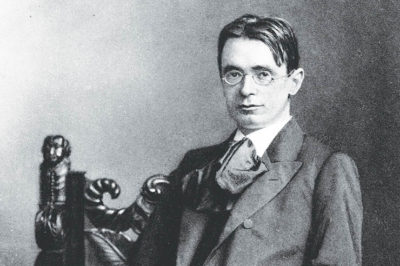
We generally associate ideas of the occult, higher consciousness and spiritual worlds with exotic, extraordinary characters with something of the trickster about them; Blavatsky, Gurdjieff and Crowley would certainly fall into this category. Steiner was precisely the opposite. Standing at the lectern with his pince-nez in hand, he projected an image of irreproachable rectitude. Steiner was earnestness incarnate, his one gesture of bohemian extravagance the flowing bow ties he was fond of wearing, a remnant of his early student days. Where Blavatsky, Gurdjieff and Crowley each took pains to present a formidable self-image, there was something simple and peasant-like about Steiner. Combined with this wholesomeness was an encyclopedic erudition. If we were to use an archetype to describe Steiner, it would have to be that of “the Professor” – or more precisely, “the Doctor,” as he was known by those around him. Commenting on her magnum opus, The Secret Doctrine, Madame Blavatsky once remarked that she “wrote, wrote, wrote” like the Wandering Jew “walks, walks, walks.” Steiner too wrote a great deal, but his main mode of disseminating his ideas was lecturing, and in the years between 1900 and 1925, he lectured, lectured, lectured, delivering more than 6,000 talks across Europe.
In a dry and often pedantic style, Steiner informed his audience of the results of his spiritual research, his “supersensible” readings of the occult history of the world made available to him through what is called “the Akashic Record.” In matter-of-facts terms, he introduced them to his teaching, Anthroposophy, telling them along the way about ancient Atlantis, life after death, astral and etheric bodies, the true meaning of Christianity and much, much more. Yet this humble, self-effacing character became one of the most influential, and simultaneously vilified, forces in the spiritual and cultural life of early twentieth century Europe, and his ideas are still relevant today.
Steiner’s efforts to lead “the Spiritual in the human being to the Spiritual in the Universe” have produced remarkably concrete results. Since his death, more than 1,000 schools around the world work with Steiner’s pedagogical principles, not to mention the many special-needs schools, working along lines developed by Steiner a century ago. There are also the hundreds of “bio-dynamic” farms, employing Steiner’s agricultural insights, developed decades in advance of our interest in ecology and organic foods. The practical application of Steiner’s ideas had also informed very successful avenues in holistic healing, the arts, architecture, economics, religion and other areas.
Given these achievements in the “real world,” which certainly exceed those of other esoteric teachers, why isn’t Steiner better known? You would reasonably expect the average educated person to have some idea of who, say, Jung is, or Krishnamurti, or the Dalai Lama; possibly even Blavatsky, Gurdjieff or Crowley. But Steiner? He remains something of a mystery, a name associated with a handful of different disciplines and endeavours, but not solidly linked to any one thing. He remains, as one of his most eloquent apologists, the Inkling Owen Barfield, called him “the best kept secret of the twentieth century.” It’s certainly time that he was better known.
Early Life
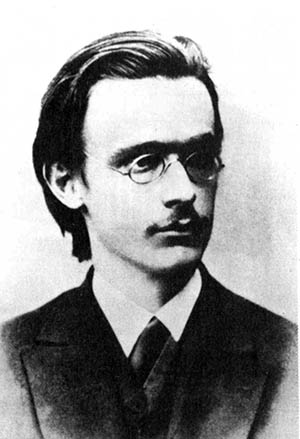
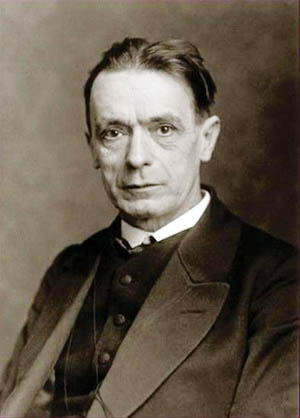
Rudolf Steiner as 21-year-old student (1882)
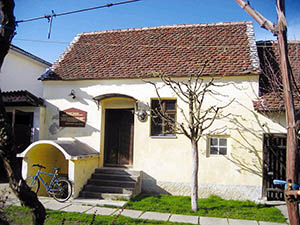
Rudolf Steiner was born on 27 February 1861, in the small rural town of Kraljevec in what was then Hungary but is today part of Croatia. His father was a telegraph operator for the Southern Austrian Railway, and Steiner spent his first years amidst magnificent scenery: mountain ranges and green plains were his playgrounds. Steiner felt that it was significant that he grew up in a part of Europe where East meets West, as it was also significant that childhood had an equal measure of natural beauty and modern technology – at the time, both the railways and the telegraph were relatively new innovations.
In Knowledge of the Higher Worlds and its Attainment (1905), Steiner relates that a crucial experience on the path of higher consciousness is an encounter with the Guardian of the Threshold, a spiritual being embodying one’s unredeemed karma. Well before his career as an esoteric teacher, Steiner was himself a dweller on several thresholds, having one foot in the mysteries of nature, the other in the methodology of science. It was this combination of mystic visionary and disciplined thinker that gave Steiner’s later career its peculiar character.
The house where Rudolf Steiner was born, in present-day Croatia.
When Steiner was eight, his father was transferred to Neudörfl, near the border with Lower Austria. An argument with the local teacher led his father to educate the boy himself, and this meant that he spent a great deal of time on his own at the railway station where his father worked. Young Steiner was deeply introverted; as he admits in his Autobiography (1925), he had great difficulty relating to the outer world. He also had an inquisitive mind and was obsessed with many questions the adults he knew seemed unable to answer. This subjectivity might have taken a morbid turn were it not for his discovery of mathematics. When Steiner came upon a book of geometry, it was a revelation. “That one can work out forms which are seen purely inwardly, independent of the outer senses, gave me a feeling of deep contentment. I found consolation for the loneliness caused by the many unanswered questions. To be able to grasp something purely spiritual brought me an inner joy. I know that through geometry I first experienced happiness.”1
Steiner’s joy upon discovering geometry may strike us as odd, yet the experience was essential in getting him through an early crisis. What impressed Steiner so greatly about geometry was that it seemed to offer proof that within the mind there existed a kind of “soul space,” an inner equivalent of the external space of the natural world. The soul space was “the setting for spiritual beings and events.” Thoughts for the young Steiner were not “mere pictures we form of things”; they were rather the “revelations of a spiritual world seen on the stage of the soul.” Geometry, Steiner believed, although produced by the human mind, had an objective reality independent of it, and for him this meant that the soul space in which it was revealed was also real.2
Rather precocious stuff, perhaps, but Steiner’s early years included an event that made him question the outer world’s monopoly on reality.
A Paranormal Encounter
One day at the railway station, he had a paranormal experience, an early manifestation of his psychic abilities. Sitting in the waiting room, he saw a strange woman enter; although he didn’t know her, he felt she resembled other members of his family. Standing in the middle of the room, the woman spoke to the boy. “Try to help me as much as you can – now as well as in later life,” she said. Then she walked into the stove and disappeared. Steiner decided not to tell his parents, afraid that they would scold him for lying. But he noticed that his father was sad, and he later discovered that a female relative who lived in the neighbouring town had committed suicide at the same time that he had had his vision.
This early experience marks for Steiner the beginning of a life-long involvement with the dead. Much of his later esoteric teaching involves accounts of the soul’s experiences in the afterlife and of the machinery of karma and reincarnation, the balancing of the spiritual books that casts the departed back into the stream of life in order to complete their tasks. While other boys of his age were fantasising about the Austrian equivalent of cowboys and Indians, Steiner was preoccupied with the reality of the spirit worlds and the soul’s encounter with the beings that inhabit them.
Later, as a young man, Steiner would on two occasions have unusual opportunities to verify some of his ideas about the meaning of death. Twice he would come into intimate contact with families in which the father was a recluse who would die soon after Steiner made their acquaintance. Yet on both occasions, although never actually meeting the man, Steiner formed a profound intuitive relation with the deceased, so deep and insightful in fact that he was asked by both families to give the funeral orations. Later still, during his years as an esoteric teacher, Steiner informed his followers that one means of helping the dead in their spiritual journeys was to read to them from his writings.
When Steiner was eighteen, his father was transferred once again, this time to Inzersdorf. His new location had the advantage of being close to Vienna, and it was decided that Steiner would study at the Technical School there. Although he had leanings toward literature and philosophy, he chose instead to work towards becoming a science teacher.
One day on the train to Vienna, he met a man who would have a profound influence on his life. Felix Koguzki was a herb-gatherer who travelled to Vienna regularly to sell his wares. It’s not known how they fell into conversation, but the teenaged Steiner soon discovered that this simple, uneducated man had strange experiences like his own, and a deep, personal knowledge of the other worlds. He was the first person with whom he could speak about his spiritual visions, and their talks boosted Steiner’s confidence; more than likely, they also convinced him that he wasn’t crazy.
Rudolf Steiner
Meeting a Master
Around the same time, Steiner had an encounter with another individual whose name has not come down to us. Steiner refers to him only as “the Master.” The French writer Edouard Schuré, author of the bestselling The Great Initiates (1889), and later a friend and follower of Steiner, remarked that the Master was “one of those potent personalities who are on Earth to fulfil a mission under the mask of some homely occupation.” Steiner had by this time read widely in philosophy, specifically the German Idealists, and had worked his way through Hegel, Schelling and several others, absorbing Kant’s Critique of Pure Reason during his history class, which bored him. Steiner was obsessed, then and later, with refuting scientific materialism, and this became the impulse that drove his philosophical studies.
Although he doesn’t mention this episode in his Autobiography, in a lecture given in Berlin in 1913, Steiner spoke of the experience. Speaking in the third person, he told his audience: “from that time onward a soul-life began to develop in the boy which made him entirely conscious of worlds from which not only external trees or mountain speak to the human soul, but also the Beings who live behind them…”3
What little we know of the Master is that he pointed out some passages in the work of Johann Gottlieb Fichte, one of Kant’s most important followers, which helped Steiner in his quest. Fichte’s work focused on the centrality of the human ego, the “I,” the locus of consciousness and the self that scientific materialism argued was mere illusion. Steiner’s spiritual experiences convinced him that this was palpably false and the “I,” rather than being an illusion, was a concrete, irreducible reality. For the next twenty years, until Steiner’s re-invention as a spiritual leader, his work would focus on developing a methodical epistemology proving this fact.
Introduction to Goethe
The single most important influence on his ideas, however, was the work of Johann Wolfgang von Goethe. Goethe is best known for his drama Faust (1808-1832), which takes a cautionary tale about a pact with the Devil and transforms it into an archetype of Western consciousness. Although he’s never enjoyed the same reputation among English speakers, Goethe is one of the Olympians of Western literature, sharing the top shelf with Plato, Dante and Shakespeare (Jung too thought Goethe a key figure, even to the extent of sometimes believing he was an illegitimate descendent of the great man.) Often regarded as the last true Renaissance man, Goethe was not just a giant of literature but also a statesman, traveller, and most important for Steiner, a scientist, making important contributions to botany, anatomy, mineralogy, and optics. Through his literature tutor Karl Schröer, who opened his mind to Goethe’s importance, Steiner was offered what must have seemed the chance of a lifetime. At twenty-two, he was head-hunted as the editor of Goethe’s scientific writings for a major edition of the polymath’s work.
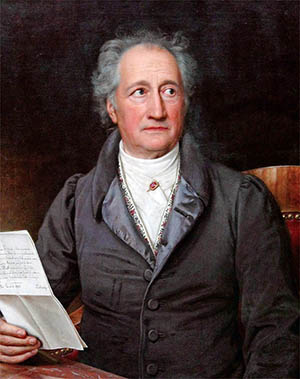
Johann Wolfgang von Goethe (1749–1832)
For an unknown rural scholar to be offered such a position might seem unusual, but the general consensus on Goethe’s scientific musings at this point was that they were useless as science and dreary as literature; in truth, no one else wanted the job of editing them. Aside from his early success in proving that the human upper jaw contained the intermaxillary bone found in other mammals – Goethe was, in a different way, an evolutionist long before Darwin – most scientists found Goethe’s attempts to disprove Newton’s theory of colour, or to demonstrate the existence of what he called the Urpflanze, the archetypal plant from which others emerged, muddleheaded if not insane.
Yet for Steiner, Goethe’s science was the prototype for what would become his own phenomenology of the spirit worlds. Instead of the conventional scientist’s cold, dispassionate eye regarding the world as mere matter, passive to his intrusions, Goethe called instead for “objective imagination,” an active participation in the reality under scrutiny. The subjectivity of the scientist – his state of consciousness – was vastly more important than the increasingly hair-splitting exactitude provided by his instruments. This “objective imagination” became for Steiner the basis for his own “supersensible cognition.”
Encountering Nietzsche
Steiner’s work on Goethe opened many doors. One led to Weimar, Goethe’s city, where he was asked to work on the Goethe Archive, another prestigious task. Although Steiner found few congenial colleagues, the work had other compensations. He was introduced to the city’s literary and cultural life and made many acquaintances. One in particular led to a momentous meeting. Elizabeth Forster Nietzsche, sister of the ill-fated philosopher, approached Steiner to work with her in establishing a Nietzsche Archive. This led to Elizabeth introducing Steiner to her brother, who had been insane from syphilis for several years. Elizabeth had taken to dressing the defenceless Friedrich in a toga, and positioning him by the window, where his blank stare and unkempt appearance provided the impression of a great prophet. Steiner, aware of Nietzsche’s madness, was nevertheless impressed – not with the figure before him, but with its spiritual aura. He saw Nietzsche’s soul “hovering over his head, infinitely beautiful in its spiritual sight…” It was a soul that “brought from former lives on Earth golden riches of great spirituality…”4
If mention of Nietzsche’s “soul” brimming with “golden riches of great spirituality” suggests to readers familiar with the author of Beyond Good and Evil and The Antichrist that Steiner was as ignorant of Nietzsche’s philosophy as his sister Elizabeth notoriously was, they should have a look at Steiner’s book Friedrich Nietzsche: Fighter for Freedom (1895), a remarkable perceptive study which at times even reads like Nietzsche. Throughout his career, Steiner had an uncanny knack for entering into and defending the ideas of thinkers with whom he had profound disagreements – like the staunch materialist Ernst Haeckel – a critical sympathy that often led to much misunderstanding.
When his work at Weimar was ending, rather than embark on academic career (Steiner had received his doctorate in philosophy during his stay and could easily have found a comfortable niche somewhere), he decided instead to move to Berlin, home of Germany’s nascent avant-garde. He had by this time published what many believe to be his most important book, The Philosophy of Freedom (1894), an exhilarating, if often difficult work of epistemology which Steiner believed established beyond doubt the reality of the human “I.” Others, like the influential philosopher Eduard von Hartmann, author of the once immensely popular The Philosophy of the Unconscious, were less convinced and suggested he had muddled the question. Steiner, however, was undaunted and believed he had a mission to disseminate his ideas. He also needed to find work. Although his followers tend to see Steiner’s life as the undeviating unfolding of a pre-ordained destiny – and Steiner himself, we must admit, contributes to this belief – like the rest of us, he was looking for his place in the world and the means to get on in it. He was also filled – rightly so – with the conviction of his own genius. The literary and cultural world of Berlin might offer opportunities not available elsewhere.
Steiner, however, made the thoroughly impractical decision of buying a moribund periodical, The Magazine for Literature. His previous brief catastrophic experience in Vienna as an editor of a political magazine seemingly forgotten, Steiner proceeded to run the already failing Magazine for Literature into the ground, alienating its readers with his persistent exhortations regarding the spiritual life. In the age of Strindberg, Wilde, Ibsen, Wedekind, and Shaw, Steiner’s idealism seemed a stale leftover from a forgotten time.
Yet, although he bemoaned the burden destiny had placed on him, Steiner seems to have enjoyed hobnobbing with bohemians: his acquaintances include poets, playwrights, novelists and political activists. In fact, his reputation among the demi-monde caused academics to cancel their subscriptions, and Steiner earned the unique distinction of being the one esoteric teacher – as far as I know – to have a periodical banned in Czarist Russia, because its editor was known to socialise with anarchists.
It was also in Berlin that Steiner married his first wife, although one gets the impression that the relationship with Anna Eunicke was little more than platonic. Anna had been Steiner’s landlady in Weimar, and when he moved to Berlin she followed him. There he moved in with her again, and, almost as an afterthought, married her in 1899 in a civil ceremony. (It was in the Eunicke household in Weimar that Steiner had had one of his experiences with the death of a reclusive father.) Anna, not particularly well-educated or cultured, was apparently very happy to have Herr Doctor Steiner under her roof; Steiner, for his part, thus avoided the “misery of living alone,” as well as that of the cheap lodgings and bad food he had endured up till then. Anna was ten years older than Rudolf, and their relationship raises the question of Steiner’s sexuality, of which there is no mention in the entire 406 pages of his Autobiography. I do have it on the authority of one Steiner scholar, Christopher Bamford, that the Doctor was indeed celibate.
But it was in Berlin that Steiner’s real career began. For a time he seemed willing to speak to any group who would listen to him. He lectured on history and other subjects at the Workingman’s College, surreptitiously slipping large doses of Idealism to budding Marxist materialists. He also lectured to the Giordano Bruno Society and The Coming Day, a quasi-Nietzschean cultural group. He managed, however, to alienate all of this (as well as Anna Eunicke, whom he soon left) when he accepted a request to lecture to the Berlin Theosophical Society. For years, Steiner had tried to express his insights into the spiritual worlds under the cover of philosopher. Now, at the turn of the century and the age of forty, he decided to forgo the camouflage and speak directly of his experiences.
Steiner quickly rose to prominence among the Theosophists and was soon made head of the society’s branch. One member of his audience was particularly struck. Marie von Sivers, who became Steiner’s second wife in 1914, was a Baltic Russian actress. She asked if it weren’t time for a new spiritual movement to arise in Europe. More to the point, didn’t Steiner think he should lead it? Steiner did, but he insisted that any such movement would be firmly based on Western esoteric sources. Steiner had recently passed through a spiritual crisis which convinced him that the “Christ event” was the single most important incident in human history. He had no time for “Eastern wisdom” or mystic Mahatmas. He more or less adopted the cosmic evolutionary framework of Madame Blavatsky’s Secret Doctrine and informed it with large helpings of German Idealist philosophy and Christian mysticism, developing a peculiarly idiosyncratic neo-Rosicrucian system of esoteric thought, aided by his own readings of the Akashic Record. In light of this it’s difficult to ignore the occult historian James Webb’s remark that Steiner joined the Theosophical Society in order to take it over.
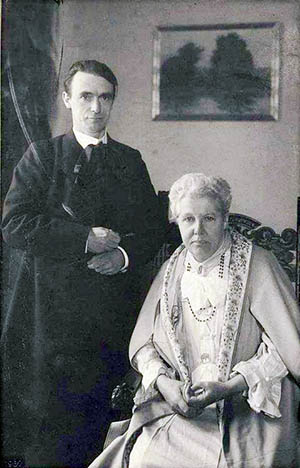
Rudolf Steiner & Annie Besant (1907)
His relationship to the society was rocky, and in 1913 he and its head, the ex-Fabian Annie Besant, came to rhetorical blows over C.W. Leadbeater’s advocacy of the Indian boy Krishnamurti as the second coming of Christ. Steiner was disgusted at the idea, and even more so at Leadbeater’s known paedophilic predilections. He demanded Besant’s resignation; she retaliated by ex-communicating him. Steiner left with much of his flock – by this time several thousand – and started his own group, the Anthroposophical Society. As opposed to Theosophy, which spoke of the wisdom of the gods, anthroposophy was concerned with the wisdom of the human being.
Building a New Movement & the Goetheanum
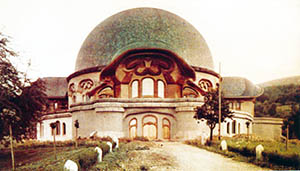
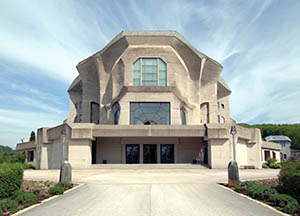
Practically the first thing Steiner did was to build a temple for his new movement. Land was secured in Dornach, Switzerland, and during WWI Steiner gathered a community of followers from several different countries to construct the Goetheanum, a weirdly beautiful fusion of art nouveau and Expressionist architecture that Steiner himself designed. His lecturing was curtailed by the fighting, but his greatest popularity came with the war’s end. Steiner’s plan to reconstruct Europe, The Threefold Commonwealth (1922), sold some 80,000 copies in its first edition, and audiences for his public appearances were now in the thousands; on one occasion the crowds outside a Berlin auditorium were so great they stopped traffic.
The original Goetheanum, which burned to the ground on New Year’s Eve 1922.
This period, however, also saw the start of the anti-Steiner campaign that would plague him henceforth. Practically everybody hated him: Catholics, Protestants, Marxists, proto-Nazis, not to mention other esotericists. There were at least two attempts on his life, and the number of occult attacks fomented by the “black brotherhoods” is unknown. One clear victory from this time was the establishment of the first Steiner school in Stuttgart in 1919. Based on pedagogical principles developed over decades of tutoring – in Vienna he had cured a retarded hydrocephalic boy to the extent that child grew up to earn a medical degree – Steiner’s educational ideas earned him deserved renown, and an international reputation among experts that continues today.
Steiner endured vilification in the press and disruption at his lectures with equanimity, but one victim of the attacks was, many believe, the Goetheanum, which burned to the ground on New Year’s Eve 1922. Arson by right-wing proto-Nazis is the common assumption, although an electrical fault remains a possibility. In any case, a decade’s effort, not to mention an architectural wonder, was lost overnight: the building was made of the same wood as that used in making violins and burned fiercely. Steiner took the tragedy as a sign that some changes in the society were necessary. His original occult teachings, based on the idea of an evolution of consciousness and the ability to achieve “supersensible thinking,” were, he felt, obscured by the success of subsequent initiatives.
Front view of the Goetheanum in the Swiss town of Dornach, the seat of the General Anthroposophical Society.
Steiner education, the Christian Community (a religious group using Steiner’s ideas), the Threefold Movement for social change, eurythmy – a form of what he called “visible speech” – and newer developments like bio-dynamic farming and anthroposophical medicine were taking centre stage. Steiner had attracted many younger followers after the war, eager to rebuild society, and these clashed with his older, more esoterically inclined devotees. Bickering within the Anthroposophical Society, whose numbers had swollen in the post-war years, threatened to undo much that had been achieved. On the first anniversary of the Goetheanum’s destruction, Steiner announced plans for a second temple; it stands today in Dornach, defiantly made of concrete. He also told his followers that he was reconstructing the society as well. Although he had not previously even been a member of the society, remaining only its spiritual guide and adviser, he now declared himself president of the newly formed General Anthroposophical Society which, although most successful in Germany, today has branches around the world.
Ahriman & Coming World Inferno
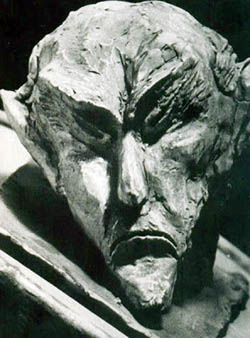
Steiner’s last years were spent in sowing as many seeds as possible for future work; they were also darkened by his belief in a coming world conflagration, when the archangel Michael, overseer of the current stage of human consciousness, would face off against the power of Ahriman, a spiritual being who seeks to prevent humanity’s development. Steiner spoke ominously of the incarnation of Ahriman, an Antichrist-like figure, whose display of miraculous powers would precede a catastrophic “war of all against all.” Steiner believed this unavoidable destiny would take some time to unfold – Ahriman is scheduled to arrive in the 3000s – yet many of his followers suspect that in recent years the process has been speeded up. Steiner himself had grave doubts about the growing pace of technological development, warning his followers that materialist science gains its great power through unwittingly releasing Ahrimanic entities. In his last communications, Steiner called on his followers to develop their consciousness in order to rise above nature to the same extent that technology sank below it. He also gave series of lectures about karma and its work in human history.
The head of Ahriman, carved in wood by Rudolf Steiner.
Steiner died on 30 March 1925. He had been ill for at least a year with an undisclosed stomach ailment, although there is some speculation he had been poisoned. He continued lecturing until it was physically impossible for him to do so, and his followers were astounded when, on the evening of his last scheduled lecture, they found a note saying that it had to be cancelled because of the Doctor’s health. Nothing like this had ever happened before. The Doctor, they believed, was invulnerable.
The exact nature of Steiner’s illness remains unknown, but it is clear that his inability to refuse help to those who came to him was a key factor. Along with his public and private lectures, and his practical work as a teacher, architect, and agriculturalist, Steiner made himself available to any who needed his counsel. For many years, he had practically no free time, and wherever he went his hotel room saw a constant stream of visitors including, on one occasion, Franz Kafka. Some asked about their astral bodies; others their diet or their marriages; Kafka asked about his writing. Steiner advised them all, giving little bits of himself to thousands. He was, as the Russian novelist Andrei Biely, a follower, once remarked, “a giant of the power of kindness.”5 It’s not hard to see how such solicitude would eventually wear anyone down.
In the end, it’s difficult to give an exact assessment of a man whose work combines cogent criticisms of Kant with accounts of life in Atlantis. But this “mild, gentle, good, kindly man,” whose achievement in “humanitarian terms is remarkable and enduring,” as the psychiatrist Anthony Storr wrote of Steiner in his study of gurus, Feet of Clay, remains, for devotees and non-initiate alike, something of an enigma.
This article first appeared in Fortean Times 205, January 2006.
This article was published in New Dawn 171.If you appreciate this article, please consider a contribution to help maintain this website.
FOOTNOTES
1. Rudolf Steiner, Autobiography, Rudolf Steiner Publications, 1977, 28
2. Ibid, 28-29.
3. Quoted in Colin Wilson, Rudolf Steiner: The Man and his Vision, Aquarian Press, 1985. 38
4. Steiner, Autobiography, 223
5. Andrei Biely, Reminiscences of Rudolf Steiner, Adonis Press, 1987, 8
Gary Lachman was born in Bayonne, New Jersey, but has lived in London, England since 1996. A founding member of the rock group Blondie, he is now a full time writer with more than a dozen books to his name, on topics ranging from the evolution of consciousness and the western esoteric tradition, to literature and suicide, and the history of popular culture. Lachman writes frequently for many journals in the US and UK, and lectures on his work in the US, UK, and Europe. His work has been translated into several languages. His website is www.garylachman.co.uk.