‘Most ignored’ metric: Why coronavirus recoveries aren’t being reported across Bay Area
By Kellie Hwang May 6, 2020 (SFChronicle.com)
Amid last week’s coronavirus statistics came one piece of seemingly good news: Globally, the number of people who have recovered has risen to more than 1 million. So what does the data on COVID-19 recoveries look like for the Bay Area?
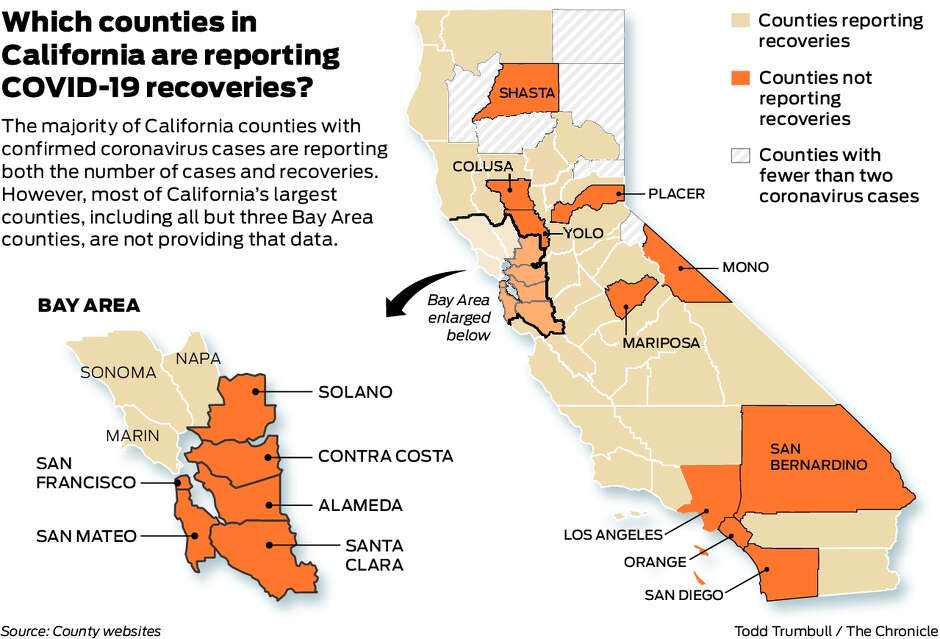
Many readers have asked The Chronicle this question, seeking a hopeful counterpoint to the case counts, hospitalizations and deaths updating every day in The Chronicle’s Coronavirus Tracker. But many of California’s largest counties, including most in the Bay Area, are not providing data on how many people have recovered from the virus.
“It’s probably the most ignored of the public metrics that are out there,” said Jeffrey Martin, professor of epidemiology and biostatistics at UCSF. Martin says the reason counties are deprioritizing this data is simple: “In short, it isn’t telling us that much.”
One key issue with data on recovered patients is that counties are defining what it means to be “recovered” in different ways. Martin lays this at the feet of the federal Centers for Disease Control and Prevention, which has issued “vague” criteria for the term. The CDC says a “recovered” person is someone whose fever goes away without the use of fever-reducing medications, whose respiratory symptoms have improved and whose symptoms first appeared more than seven days ago.
Neetu Balram, public information manager for the Alameda County Public Health Department, said that public health agencies including the CDC and the World Health Organization do not offer guidance for reporting this data.
“Recovery is not systematically recorded by health care providers or reported to health departments the way that new cases, hospitalizations and deaths are,” Balram said.
She said that data is more important to health departments because those numbers show the direct impact of COVID-19 on the health system.
While the majority of California counties are reporting data on recovered cases to the public, only three are doing so in the Bay Area: Marin (185 recovered, as of Saturday), Napa (32 recovered, as of Sunday) and Sonoma (128 recovered, as of Saturday night). Sacramento County displays recoveries as “likely recovered,” and was reporting 803 on Sunday.
Molly Rattigan, deputy county CEO for Napa, said her county is defining recovered cases as individuals diagnosed with COVID-19 who meet the following criteria: At least seven days have passed since the onset of symptoms, or at least 14 days have passed since the diagnosis, and they no longer have symptoms. Individuals who were hospitalized must be discharged and no longer in isolation, she said.
To determine recovered cases requires quite a bit of legwork.3
1of3A crowd lines up for coronavirus tests in Hayward. Alameda is among the counties not reporting virus recovery data.Photo: Brittany Hosea-Small / Special to The Chronicle3of3These doors lead to patients’ rooms on the COVID-19 floor at St. Francis Hospital in San Francisco.Photo: Gabrielle Lurie / The Chronicle
“Our case and contact team follows up daily with those that are at home,” Rattigan said.
Santa Cruz County also lists recoveries on its health department website. Jason Hoppin, communication manager for the county, said officials follow CDC guidelines to determine the number based on patient contacts.
“Our health officer reports all positives and negatives to us, and we have patient information through that process,” he said. “We follow up with the positives and check in on symptoms.”
Once the patient’s condition matches the guidelines, they are able to list that person as recovered.
San Francisco, Contra Costa, Alameda, Santa Clara, San Mateo and Solano do not share recovered cases on their websites. In Southern California, Los Angeles, Orange and San Diego counties do not report the data, either.
Experts say especially for larger counties, the process is too time-consuming and would require resources that could be better spent elsewhere.
“To actually ascertain it, you need to track down patients and ask them how they’re doing, have they been tested?” Martin said. “Many people are choosing to not actually bother to test people once they are feeling better, and even if not, there’s no point clinically to do it.”
John Swartzberg, an infectious disease expert at UC Berkeley, said in theory, tracking recoveries seems simple. A person is confirmed to have gotten the virus, and then they get better. But he said it’s more complicated than that.
“So they’ve clinically recovered, but are they still shedding the virus?” Swartzberg said. “Most of the data we have is not robust enough. … They may have recovered clinically but can’t answer that they are 100% recovered from the contagion.”
Another way to determine recoveries is via antibody tests, but Swartzberg said only a handful of companies offer accurate testing, and the rest have gone through little verification.
“We’re seeing a lot of false positives where the test was positive, but the person never was positive,” he said. “It’s a big problem that has to be ironed out. We have to have tests that are very specific.”
Martin said the recovery data being provided is “too crude” based on the CDC’s definition and is underestimated. He said counties shouldn’t spend time trying to gather it.
“It will never be done for everyone,” he said. “It’s incompletely being recorded, and it’s not reproducibly being recorded.”
Martin said the more important question down the line is seeing how patients look three, six and nine months out, which is one research effort at UCSF.
The early months of 2020 have offered a glimpse of a world with less demand for fossil fuels as it tries to contain the coronavirus pandemic. It is a world in which renewable energy makes up a greater share of energy use, and carbon emissions are turned back to levels from a decade ago. Researchers at the Paris-based International Energy Agency, which last week released its Global Energy Review 2020, say any lasting effects “will be determined by the duration of lockdown measures and the recovery paths taken.”
Plants talk to this ecologist. They tell her how to do better science.
BY STEVE PAULSON APRIL 29, 2020 (nautil.us)
Plants are intelligent beings with profound wisdom to impart—if only we know how to listen. And Monica Gagliano knows how to listen. The evolutionary ecologist has done groundbreaking experiments suggesting plants have the capacity to learn, remember, and make choices. That’s not all. Gagliano, a senior research fellow at the University of Sydney in Australia, talks to plants. And they talk back. Plants summon her with instructions on how to live and work. Some of Gagliano’s conversations happened in prophetic dreams, which led her to study with a shaman in Peru while tripping on psychoactive plants.
Along with forest scientists like Suzanne Simard and Peter Wohlleben, Gagliano raises profound scientific and philosophical questions about the nature of intelligence and the possibility of “vegetal consciousness.” But what’s unusual about Gagliano is her willingness to talk about her experiences with shamans and traditional healers, along with her use of psychedelics. For someone who’d already received fierce pushback from other scientists, it was hardly a safe career move to reveal her personal experiences in otherworldly realms.
Gagliano considers her explorations in non-Western ways of seeing the world to be part of her scientific work. “Those are important doors that you need to open and you either walk through or you don’t,” she told me. “I simply decided to walk through.” Sometimes, she said, certain plants have given her precise directions on how to conduct her experiments, even telling her which plant to study. But it hasn’t been easy. “Like Alice, [I] found myself tumbling down a rather strange rabbit hole,” she wrote in a 2018 memoir, Thus Spoke the Plant. “I did doubt my own sanity many times, especially when all these odd occurrences started—and yet I know I do not suffer from psychoses.”
Shortly before the COVID-19 lockdown, I talked with Gagliano at Dartmouth College, where she was a visiting scholar. We spoke about her experiments, the new field of plant intelligence, and her own experiences of talking with plants.
You are best known for an experiment with Mimosa pudica, commonly known as the “sensitive plant,” which instantly closes its leaves when it’s touched. Can you describe your experiment?
I built a little contraption that allowed me to drop the plants from a height of maybe 15 centimeters. So it’s not too high. When they fall, they land in a softly padded base. This plant closes its leaves when disturbed, especially if the disturbance is a potential predator. When the leaves are closed, big, spiny, pointy things stick out, so they might deter a predator. In fact, they not only close the leaf, but literally droop, like, “Look, I’m dead. No juice for you here.”
You did this over and over, dropping the plants repeatedly.
Exactly. It makes no sense for a plant or animal to repeat a behavior that is actually useless, so we learn pretty quick that whatever is useless, you don’t do anymore. You’re wasting a lot of energy trying to do something that doesn’t actually help. So, can the plant—in this case, Mimosa—learn not to close the leaves when the potential predator is not real and there are no bad consequences afterward?
After how many drops did they stop closing their leaves?
The test is for a specific type of learning that is called habituation. I decided they would be dropped continuously for 60 times. Then there was a big pause to let them rest and I did it again. But the plants were already re-opening their leaves after the first three to six drops. So within a few minutes, they knew exactly what was going on—like, “Oh my god, this is really annoying but it doesn’t mean anything, so I’m just not going to bother closing. Because when my leaves are open, I can eat light.” So there is a tradeoff between protecting yourself when the threat is real and continuing to feed and grow. I left the plants undisturbed for a month and then came back and repeated the same experiment on those individuals. And they showed they knew exactly what was going on. They were trained.
This is who I am. And nobody has the right to tell me that it’s not real.
You say these plants “understand” and “learn” that there’s no longer a threat. And you’re suggesting they “remember.” You’re not using these words metaphorically. You mean this literally?
Yes, that’s what they’re doing. This is definitely memory. It’s the same kind of experiment we do with a bee or a mouse. So using the words “memory” and “learning” feels totally appropriate. I know that some of my colleagues accuse me of anthropomorphizing, but there is nothing anthropomorphic about this. These are terms that refer to certain processes. Memory and learning are not two separate processes. You can’t learn unless you remember. So if a plant is ticking all the boxes and doing what you would expect a rat or a mouse or a bee to do, then the test is being passed.
Do you think these plants are actually making decisions about whether or not to close their leaves?
This experiment with Mimosa wasn’t designed to test that specific question. But later, I did experiments with other plants, with peas in particular, and yes, there is no doubt the plants make choices in real decision-making. This was tested in the context of a maze, where the test is actually to make a choice between left and right. The choice is based on what you might gain if you choose one side or the other. I did one study with peas that showed the plants can choose the right arm in a maze based on where the sound of water is coming from. Of course, they want water. So they will use the signal to follow that arm of the maze as they try to find the source of water.
So plants can hear water?
Oh, yeah, of course. And I’m not talking about electrical signals. We have also discovered that plants emit their own sounds. The acoustic signal comes out of the plant.
What kind of sounds do they make?
We call them clicks, but this is where language might fail because we are trying to describe something we’re not familiar enough with to create the language that really describes the picture. We worked out that, yes, plants not only produce their own sound, which is amazing, but they are listening to sounds. We are surrounded by sound, so there are studies, like my own study, of plants moving toward certain frequencies and then responding to sounds of potential predators chewing on leaves, which other plants that are not yet threatened can hear. “Oh, that’s a predator chewing on my neighbor’s leaves. I better put my defenses up.” And more recently, there was some work done in Israel on the sound of bees and how flowers prepared themselves and become very nice and sweet, literally, to be more attractive to the bee. So the level of sugars gets increased as a bee passes by.
You are describing a surprising level of sophistication in these plants. Do you have a working definition of “intelligence?”
That’s one of those touchy subjects. I use the Latin etymology of the word and “intelligere” literally means something like “choosing between.” So intelligence really underscores decision-making, learning, memory, choice. As you can imagine, all those words are also loaded. They belong in the cognitive realm. That’s why I define all of this work as “cognitive ecology.”
Do you see parallels between this kind of intelligence in plants and the collective intelligence that we associate with social insects in ant colonies or beehives?
That kind of intelligence might be referred to as “distributed intelligence” or “collective intelligence.” We are testing those questions right now. Plants don’t have neurons. They don’t have a brain, which is often what we assume is the base for all of these behaviors. But like slime molds and other basal animals that don’t have neural systems, they seem to be doing the same things. So the short answer is yes.
What you’re saying is very controversial among scientists. The common criticism of your views is that an organism needs a brain or at least a nervous system to be able to learn or remember. Are you saying neurons are not required for intelligence?
Science is full of assumptions and presuppositions that we don’t question. But who said the brain and the neurons are essential for any form of intelligence or learning or cognition? Who decided that? And when I say neurons and brains are not required, it’s not to say they’re not important. For those organisms like ourselves and many animals who do have neurons and brains, it’s amazing. But if we look at the base of the animal kingdom, sponges don’t have neurons. They look like plants because when they’re adults, they settle on the bottom of the ocean and pretty much just sit there forever. Yet if you look at the sponge’s genome, they have the genetic code for the neural system. It’s almost like from an evolutionary perspective, they simply decided that developing a neural system was not useful. So they went a different way. Why would you invest that energy if you don’t need it? You can achieve the same task in different ways.
Your food is psychedelic. It changes your brain chemistry all the time.
Your critics say these are just automatic adaptive responses. This is not really learning.
You know, they just say plants do not learn and do not remember. Then you do this study and stumble on something that actually shows you otherwise. It’s the job of science to be humble enough to realize that we actually make mistakes in our thinking, but we can correct that. Science grows by correcting and modifying and adjusting what we once thought was the fact. I went and asked, can plants do Pavlovian learning? This is a higher kind of learning, which Pavlov did with his dogs salivating, expecting dinner. Well, it turns out plants actually can do it, but in a plant way. So plants do not salivate and dinner is a different kind of dinner. Can you as a scientist create the space for these other organisms to express their own, in this case, “plantness,” instead of expecting them to become more like you?
There’s an emerging field of what’s called “vegetal consciousness.” Do you think plants have minds?
What is the mind? [Laughs] You see, language is very inadequate at the moment in describing this field. I could ask you the same question in referring to humans. Do you think humans have a mind? And I could answer again, what is the mind? Of course, I have written a paper with the title “The Mind of Plants” and there is a book coming called The Mind of Plants. In this context, language is used to capture aspects of how plants can change their mind, and also whether they have agency. Is there a “person” there? These questions are relevant beyond science because they have ethical repercussions. They demand a change in our social attitude toward the environment. But I already have a problem with the language we are using because the question formulated in that way demands a yes or no answer. And what if the answer cannot be yes or no?
Let me ask the question a different way. Do you think plants have emotional lives? Can they feel pain or joy?
It’s the same question. Where do feelings arise from, and what are feelings? These are yes or no questions, usually. But to me, they are yes and no. It depends on what you mean by “feeling” and “joy.” It also depends on where you are expecting the plant to feel those things, if they do, and how you recognize them in a human way. I mean, plants might have more joy than we do. It’s just that we don’t know because we’re not plants.
We have only talked about this from the scientific perspective, which is the Western view of the world. But I’ve also had a close relationship with plants from a very different perspective, the indigenous world view. Why is that less valuable? And when you actually do explore those perspectives, they require your experience. You can’t just understand them by thinking about them. My own personal experience tells me that plants definitely feel many things. I don’t know if they would use those words to describe joy or sadness, but they are feeling bodies. We are feeling bodies.
Science is full of assumptions and presuppositions that we don’t question.
You’ve studied with shamans in indigenous cultures and you’ve taken ayahuasca and other psychoactive plants. Why did you seek out those experiences?
I didn’t. They sought me. So I just followed. They just arrived in my life. You know, those are important doors that you need to open and you either walk through or you don’t. I simply decided to walk through. I had this weird series of three dreams while I was in Australia doing my normal life. By the time the third dream came, it was very clear that the people that I was dreaming of were real people. They were waiting somewhere in this reality, in this world. And the next thing, I’m buying a ticket and going to Peru and my partner at the time is looking at me like, “What are you doing?” [laughs] I have no idea, but I need to go. As a scientist, I find this is the most scientific approach that I’ve ever had. It’s like there is something asking a question and is calling you to meet the answer. The answer is already there and is waiting for you, if you are prepared to open the door and cross through. And I did.
What did you do in Peru?
The first time I went, I found this place that was in my dream. It was just exactly the same as what I saw in my dream. It was the same man I saw in my dream, grinning in the same way as he was in my dream. So I just worked with him, trying to learn as much as I could about myself with his support.
This was a local shaman whom you identify as Don M. And there was a particular plant substance, a hallucinogen, that you took.
I did what they call a “dieta,” which is basically a quiet, intense time in isolation that you do on your own in a little hut. You are just relating with the plant that the elder is deciding on. So for me, the plant that I worked with wasn’t by itself a psychedelic in the normal way of thinking about it. But of course, all plants are psychedelic. Even your food is psychedelic because it changes your brain chemistry and your neurobiology all the time you eat. Sugars, almonds, all sorts of neurotransmitters are flying everywhere. So, again, even the idea of what a psychedelic experience is needs to be revised, because a lot of people might think that it’s only about certain plants that they have a very strong, powerful transformation. And I find that all plants are psychedelic. I can sit in my garden. I don’t have to ingest anything and I can feel very altered by that experience.
You’ve said the plant talked to you. Did you actually hear words?
When you’re trying to describe this to people haven’t had the experience, it probably doesn’t make much sense because this kind of knowledge requires your participation. I don’t hear someone talking to me as if from the outside, talking to me in words and sound. But even that is not correct because inside my head it does sound exactly like a conversation. Not only that, but I know it’s not me. There is no way that I would know about some of the information that’s been shared with me.
Are you saying these plants had specific information to tell you about your life and your work?
Yeah, I mean, some of the plants tell me exactly how wrong I was in thinking about my experiments and how I should be doing them to get them to work. And I’m like, “Really?” I’m scribbling down without really understanding. Then I go in the lab and try what they say. And even then, there is a part of me that doesn’t really believe it. For one experiment, the one on the Pavlovian pea, I was trying to address that question the year before with a different plant. I was using sunflowers. And while I was doing my dieta with a different tree back in Peru, the plant just turned up and said, “By the way, not sunflowers, peas.” And I’m like, “what?” People always think that when you have these experiences, you’re supposed to understand the secrets of the universe. No, my plants are usually quite practical. [laughs] And they were right.
Do you think you are really encountering the consciousness of that plant? Maybe your imagination has opened up to see the world in new ways, but it’s all just a projection of your own mind. How do you know you are actually encountering another intelligence?
If you had this experience of connecting with plants the way I have described—and there are plenty of people who have—the experience is so clear that you know that it’s not you; it’s someone else talking. If you haven’t had that experience, then I can totally see it’s like, “No way, it must be your mind that makes it up.” But all I can say is that I have had exchanges with plants who have shared things about topics and asked me to do things that I have really no idea about.
What have plants asked you to do?
I’m not a medical scientist, but I’ve been given information by plants about their medical properties. And these are very specific bits of information. I wrote them in my diary. I would later check and I did find them in the medical literature: “This plant is for this and we know this.” I just didn’t know. So maybe I’m tapping into the collective consciousness.
What do you do with these kinds of personal experiences? You are a scientist who’s been trained to observe and study and measure the physical world. But this is an entirely different kind of reality. Can you reconcile these two different realities?
I think there are some presuppositions that a scientist should just explore the consensus reality that most of us experience in more or less the same way. But I don’t really have a conflict because I find this is just part of experimenting and exploring. If anything, I found that it has enriched and expanded the science I do. This is a work in progress, obviously, but I think I’m getting better at it. And in the writing of my book, which for a scientist was a very scary process because it was laying bare some parts of me that I knew would likely compromise my career forever, it also became liberating because once it was written, now the world knows. And it’s my truth. This is how I operate. This is who I am. And nobody has the right or the authority to tell me that it’s not real.
Steve Paulson is the executive producer of Wisconsin Public Radio’s nationally syndicated show “To the Best of Our Knowledge.” He’s the author of Atoms and Eden: Conversations on Religion and Science. You can subscribe to TTBOOK’s podcast here.
Eckhart Tolle Death is a stripping away of all that is not you. The secret of life is to “die before you die” and find that there is no death.” For Eckhart, the only ‘real’ death is never knowing who you really are, never understanding your true ‘being’. When you have a true sense of self, this can never die. Subscribe to find greater transcendence in life: http://bit.ly/EckhartYT “Staying Conscious In The Face of Adversity” A free teaching series on how crisis propels awakening with Eckhart Tolle. Sign up for free here: https://bit.ly/freecoursesignup Want to watch and hear more of Eckhart’s Teachings? Become a member today and join our growing community! http://bit.ly/ETmembership Interested in diving deeper into Eckhart Tolle’s work? Enjoy a FREE 10-DAY TRIAL to Eckhart Tolle Now: https://www.eckharttollenow.com/v9/join/ Check out some of our other playlist: Meditation – https://bit.ly/2QkG5uU Our True Identity – https://bit.ly/2COKGTo Supporting Awakening – https://bit.ly/2O4M6dW Daily Life – https://bit.ly/2O70SRp Conversations with Guests – https://bit.ly/2MiB2Ig Connect with us elsewhere: http://www.EckhartTolleNow.comhttps://www.facebook.com/Eckharttollehttp://www.instagram.com/eckharttollehttps://twitter.com/EckhartTollehttp://pinterest.com/eckharttolle Eckhart Tolle is widely recognized as one of the most original and inspiring spiritual teachers of our time. He travels and teaches throughout the world. Eckhart is not aligned with any particular religion or tradition, but excludes none. His profound yet simple and practical teachings have helped thousands of people find inner peace, healing and greater fulfillment in their lives. At the core of his teachings lies the transformation of individual and collective human consciousness – a global spiritual awakening. Eckhart Tolle is the author of The Power of Now, a #1 New York Times Bestseller, which has been translated into over 52 languages and become one of the most influential spiritual books of our time. In his most recent book, A New Earth, he shows how transcending our ego-based state of consciousness is not only essential to personal happiness, but also the key to ending conflict and suffering throughout the world.
If you, me and every person and thing in the cosmos were actually characters in some giant computer game, we would not necessarily know it. The idea that the universe is a simulation sounds more like the plot of “The Matrix,” but it is also a legitimate scientific hypothesis. In 2016, researchers pondered the controversial notion at the annual Isaac Asimov Memorial Debate here at the American Museum of Natural History.
Moderator Neil deGrasse Tyson, director of the museum’s Hayden Planetarium, put the odds at 50-50 that our entire existence is a program on someone else’s hard drive. “I think the likelihood may be very high,” he said. He noted the gap between human and chimpanzee intelligence, despite the fact that we share more than 98 percent of our DNA. Somewhere out there could be a being whose intelligence is that much greater than our own. “We would be drooling, blithering idiots in their presence,” he said. “If that’s the case, it is easy for me to imagine that everything in our lives is just a creation of some other entity for their entertainment.”
Virtual Minds
A popular argument for the simulation hypothesis came from University of Oxford philosopher Nick Bostrum in 2003, when he suggested that members of an advanced civilization with enormous computing power might decide to run simulations of their ancestors. They would probably have the ability to run many, many such simulations, to the point where the vast majority of minds would actually be artificial ones within such simulations, rather than the original ancestral minds. So simple statistics suggest it is much more likely that we are among the simulated minds.
And there are other reasons to think we might be virtual. For instance, the more we learn about the universe, the more it appears to be based on mathematical laws. Perhaps that is not a given, but a function of the nature of the universe we are living in. “If I were a character in a computer game, I would also discover eventually that the rules seemed completely rigid and mathematical,” said Max Tegmark, a cosmologist at the Massachusetts Institute of Technology (MIT). “That just reflects the computer code in which it was written.”
Furthermore, ideas from information theory keep showing up in physics. “In my research I found this very strange thing,” said James Gates, a theoretical physicist at the University of Maryland. “I was driven to error-correcting codes—they’re what make browsers work. So why were they in the equations I was studying about quarks and electrons and supersymmetry? This brought me to the stark realization that I could no longer say people like Max are crazy.”
Room for Skepticism
Yet not everyone on the panel agreed with this reasoning. “If you’re finding IT solutions to your problems, maybe it’s just the fad of the moment,” Tyson pointed out. “Kind of like if you’re a hammer, every problem looks like a nail.”
And the statistical argument that most minds in the future will turn out to be artificial rather than biological is also not a given, said Lisa Randall, a theoretical physicist at Harvard University. “It’s just not based on well-defined probabilities. The argument says you’d have lots of things that want to simulate us. I actually have a problem with that. We mostly are interested in ourselves. I don’t know why this higher species would want to simulate us.” Randall admitted she did not quite understand why other scientists were even entertaining the notion that the universe is a simulation. “I actually am very interested in why so many people think it’s an interesting question.” She rated the chances that this idea turns out to be true “effectively zero.”
Such existential-sounding hypotheses often tend to be essentially untestable, but some researchers think they could find experimental evidence that we are living in a computer game. One idea is that the programmers might cut corners to make the simulation easier to run. “If there is an underlying simulation of the universe that has the problem of finite computational resources, just as we do, then the laws of physics have to be put on a finite set of points in a finite volume,” said Zohreh Davoudi, a physicist at MIT. “Then we go back and see what kind of signatures we find that tell us we started from non-continuous spacetime.” That evidence might come, for example, in the form of an unusual distribution of energies among the cosmic rays hitting Earth that suggests spacetime is not continuous, but made of discrete points. “That’s the kind of evidence that would convince me as a physicist,” Gates said. Yet proving the opposite—that the universe is real—might be harder. “You’re not going to get proof that we’re not in a simulation, because any evidence that we get could be simulated,” said David Chalmers, a professor of philosophy at New York University.
Life, the Universe and Everything
If it turns out we really are living in a version of “The Matrix,” though—so what? “Maybe we’re in a simulation, maybe we’re not, but if we are, hey, it’s not so bad,” Chalmers said.
“My advice is to go out and do really interesting things,” Tegmark said, “so the simulators don’t shut you down.”
But some were more contemplative, saying the possibility raises some weighty spiritual questions. “If the simulation hypothesis is valid then we open the door to eternal life and resurrection and things that formally have been discussed in the realm of religion,” Gates suggested. “The reason is quite simple: If we’re programs in the computer, then as long as I have a computer that’s not damaged, I can always re-run the program.”
And if someone somewhere created our simulation, would that make this entity God? “We in this universe can create simulated worlds and there’s nothing remotely spooky about that,” Chalmers said. “Our creator isn’t especially spooky, it’s just some teenage hacker in the next universe up.” Turn the tables, and we are essentially gods over our own computer creations. “We don’t think of ourselves as deities when we program Mario, even though we have power over how high Mario jumps,” Tyson said. “There’s no reason to think they’re all-powerful just because they control everything we do.” And a simulated universe introduces another disturbing possibility. “What happens,” Tyson said, “if there’s a bug that crashes the entire program?”
Clara Moskowitz is a senior editor at Scientific American. She covers space and physics.
Tog-me Zong-po lived nearly 800 years ago yet his 37 Practices of a Bodhisattva is still considered a pinnacle list of traits a person who wishes to become enlightened for the benefit of all beings has. The following 13 practices (which I’ve put into simpler terms to make them easier to understand) are what I consider the most practical and helpful out of the 37 and by applying these practices to our daily lives we can make a lasting positive impression on the collective consciousness of humanity…a positive influence that is deeply needed in this time of transition from the old order to the new paradigm. Some of these are not easy but for those of us that want to embark on the journey to awakened enlightenment, these are practices that will lead us there.
1.) Day and night, be fully alert and present. Listen, reflect, and do alot of meditation.
2.) Attraction to those close to you catches you in its currents. Aversion to those who hate on you burns inside. Indifference that ignores what should be done is a black hole. Take a step outside your comfort zone.
3.) Some so-called friends take you further and further away from the path to awakened consciousness. These kinds of friends ridicule and discourage learning, reflection, and meditation. These kinds of friends make you lose kindness and compassion. Give up these bad friends.
4.) All suffering comes from wanting to please our own selves. Enlightened awakening arises from when our thoughts and actions help others. So, in exchange for our selfish desires and neglect of our suffering humanity, replace thoughts of self with concern for all others.
5.) If someone spreads ugly rumors about us with cruel words, and even if what that person has said spreads to others and gains wide acceptance as being the truth; wish for that person to overcome their troubles and gain peace of mind. Applaud all their positive traits and treat them with kindness.
6.) If in a crowd full of people someone exposes our faults before others and points out the flaws we still have; do not get angry or become defensive; just listen in silence and reflect on their words. Treat this person as a teacher.
7.) If someone we love and have cared for with kindness treats us with thankless resentment and treats us as if we are their most hated enemy, then see these acts as a terrible sickness that has infected and affected their mind. Treat them with even more love and affection.
8.) Even when you are famous, praised, and rich don’t be arrogant. Know that the magnificence of existence, as awesome as it is, ultimately has no substance. Cast out what pride you might have as a result of fame.
9.) If we are not able to take control of the anger inside of us, although we may overpower and conquer others outside, the anger will just keep coming. Turn inwards and tame the wild flow of your mind-stream.
10.) Whatever appears to be truly real is simply what a mind in delusion creates. This mind of ours is also from the beginning devoid of an essence inherently real. Realize Truth is beyond the conceptions we have known and beyond the knower as well. Dispel the belief in inherent existence.
11.) Abusive words and language that we say in anger cause others alot of pain by disturbing their minds and we who are striving to be enlightened will find that our practice will decline. So seeing the faults that arise from harsh language, abandon abusive and hurtful language.
12.) Without making efforts to clearly analyze delusions we have and mistakes we commit, then even though on the outside we look and play the part, we may simply be spiritual materialists. For this reason, try to examine mistakes, delusions, and faults you possess, then afterwards try to remove them completely.
13.) In everything you do, be mindful of what is happening in your mind. By being constantly present and aware that you are feeling, thinking, and acting in a way that helps others.
Journeyman Pictures Perspectives on the Pandemic Episode 5: In this highly-charged follow-up interview, Knut Wittkowski says his initial claim has been vindicated: The lockdowns – always a dubious proposition for a respiratory virus – came too late in the U.S. and elsewhere, and were therefore even worse than useless. By turns emotional and darkly comic, Wittkowski ranges across all the essential topics of the crisis, and gives answers you are unlikely to see in the major media. Not to be missed.
Watch previous episodes of Perspectives on the Pandemic here:
With our faces covered from the nose down by masks when we go out in public, our eyes are more important communication tools than ever. That’s where the ability to smize like you mean it comes into play.
The term “smize” entered the lexicon in 2009 when Tyra Banks first used it on the 13th season of her competition series, “America’s Next Top Model.” Banks taught the contestants how to bring life and expression to their eyes — to “smile with your eyes” — while keeping the rest of their face neutral. (Smile + Eyes = Smize.)
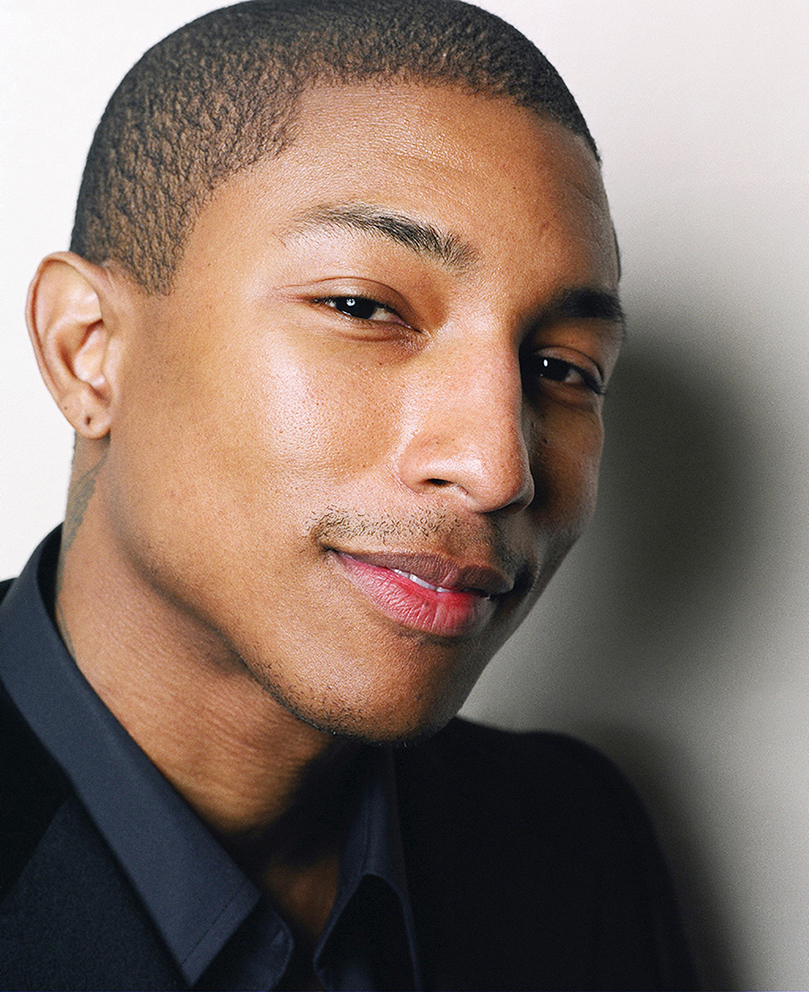
The term quickly took hold in modeling and photography. Cyril Kollock, the director of Look Model Agency in San Francisco, says it’s part of model vocabulary now. The word has also been in use in Europe for the past decade, says London photographer Frederic Aranda, who has shot portraits of everyone from Pharrell Williams to Prince Philip. (Pharrell is smizing in his photo, Aranda notes. Prince Philip, alas, is looking sideways.) The word also caught on in pop culture, was added to Urban Dictionary in 2009, and rose in usage with another combination word: selfie. If you can smize while you selfie, all the better.
Pharrell Williams, photographed by Frederic Aranda, demonstrating the “smize,” or “smiling with your eyes.”Photo: Frederic Aranda
While Banks may have popularized the idea, smizing has long existed in culture. The subjects of Renaissance paintings including Paolo Veronese’s “Portrait of a Woman” and Albrecht Durer’s “The Furlegerin With Braided Hair” are smizing hard, and the silent films of the 1910s and ’20s are dependent on smizing. Actors Charlie Chaplin and Greta Garbo were among the most prolific smizers of their era.
But go to a mirror and try to bring life to your eyes without actually smiling and you’ll see it is harder than it looks. I don’t just want my smize to be sufficient, I want people to be able to read my smize from 6 feet of social distance.
Banks’ usual advice is to think of something warm and desirable and let that feeling wash over your expression. When I’ve tried that, I just look confused, so I asked model Laila Rachki if she had a different method for getting the perfect smize. I worked with Rachki in 2016 for a Chronicle photo shoot at the Marin Civic Center, and her smize was so intense you could see it through sunglasses.
In addition to The Chronicle, Rachki has modeled for Banana Republic, the North Face and Levi’s and walked the runway at Milan Fashion Week. She’s also the creator and co-host of the “Model Lite” podcast with Melissa Haro, where they discuss stories from behind the scenes in the industry. Their May 12 episode will be dedicated to smizing.
Laila Rachki at a 2016 shoot at the Marin Civic Center.Photo: Russell Yip, The Chronicle
For Rachki, smizing is as much a feeling as it is a facial expression. To have that inner ebullience, she says you have to be relaxed, which isn’t easy during a pandemic. One of the ways she practiced smizing early in her career was to look in the mirror and isolate the movement of different parts of her face. She’d start by smiling, then would let her mouth drop back to a neutral expression while keeping her eyes as much like they were when she was smiling as possible.
“One of the mistakes people make is thinking smizing is just about the eyes,” says Rachki. “It’s about everything around your eyes, too. Look at what your cheekbones are doing. Look at what your eyebrows are doing when you smile.”
Rachki says that, “like a smile, everyone’s smize is different.” She suggests I think about something I want or something that makes me happy to keep the lift in my eyelids and the intention in my focus. For me, that something is life beyond coronavirus.
I thought about museums and venues being open again. I thought about what it will be like to hear live music without streaming it. I thought about the people I can’t wait to see outside the square views of Zoom conferencing. And it helped!
I’m prepping my smize for whenever that day is, when we can start gathering again. The way things look now, it’s hard to imagine masks and distance won’t be a part of those first gatherings. When I finally get to see the people I’ve been missing in person again, I want them to see the happiness on the part of my face that’s uncovered. In 2020, the smize have it.
Tony BravoTony Bravo’s column appears Mondays in Datebook. Email: tbravo@sfchronicle.com Twitter: @TonyBravoSF
As we know and if you watch or read Bruce Lipton, you know the science around positive thought and how important it is to collectively project positive thought out into the world.
I would encourage you all as I am sure you are doing, to use this time to be positive and imagine a new future of peace and connectedness to each other and nature.
At the same time it’s important to stand up for our rights and question what the mainstream news media is telling us about the crisis.
Is social distancing actually the right way to handle this virus and why the world, to the detriment of so many people, has been bought to a standstill.
Why is it that people are so easily led by what they read in the news and aren’t interested in what kind of draconian laws are in place during these times?
Why believe one person’s science and not another’s? Business men like Bill Gates have huge power that they wield through the funding of institutions, the very institutions that our government bases its policies on…
As I said in my last newsletter, know the shadow inside you and outside of you and do not allow it to run our precious lives and the life of your mother, this planet. I know there is a great storm of information blowing around out there, so If any of you would like to ask me more about what I see before me during these unprecedented times then do get in touch.