
Monthly Archives: October 2019
This UK City Wants to Win with the Sharing Economy
Could a collaborative approach to urban living put Norwich on the global map?
Lauren Razavi Jun 12, 2018 · (Medium.com)
You’ve probably never heard of Norwich. Located on the United Kingdom’s picturesque east coast, this small urban center held the title of England’s second city until the Industrial Revolution. Today, however, it’s home to just 200,000 people, and almost nobody outside Britain can point to it on a map. But that may not be the case for long.
According to the 2017 State of the Nation report, Norwich ranks among the country’s worst areas for social mobility. Meanwhile, reeling from Brexit uncertainty, the UK’s economy recently posted its worst quarterly GDP figures in five years. In the face of economic stagnation and poor local conditions, a group in Norwich has decided to take action in pursuit of a future based on hope, solutions, and global connections. At the beginning of 2018, city residents and local organizations came together and began campaigning for Norwich to be recognized as the UK’s leading city for sharing.
The Norwich Sharing City collective brings together municipal authorities, voluntary organizations, universities, and businesses to raise awareness of the sharing activities happening in Norwich, primarily through an events program. They’re also arranging public discussions intended to generate new ideas for citizen-led projects to help overcome issues such as food waste, plastic pollution, and traffic congestion on the local level. During Global Sharing Week (June 3–10), the collective will project a sharing animation onto Norwich Castle, a 900-year-old monument overlooking the city, and they’ll soon start crowdfunding monthly donations through the Open Collective platform.
“For me, the sharing city concept is an opportunity to look closely at how communities, towns, and cities work and how they might operate in the future. The next generation are starting to shape their culture and environment in ways that reflect how they feel about their society,” says Stefan Gurney, executive director of Norwich’s Business Improvement District, an organization working as part of the collective. “We see the sharing city as a real opportunity for people, communities, and businesses to work together in new and innovative ways.”
With globally renowned and well-funded cities such as London, Manchester, and Edinburgh within easy reach, it’s perhaps surprising that Norwich has chosen to pursue the sharing city title. Locals, however, are quick to list Norwich’s unique advantages. “We have a good mix of academic institutions and small businesses here, making the city a great place to pilot new things,” says Ali Clabburn, founder of the global car-sharing platform Liftshare, which has been based in Norwich for 20 years. “Small businesses can change and pick up new habits fast, and the same is true of the individuals working within them.”

According to Gurney, Norwich’s size also gives it a unique and attractive position. “It helps the local community engage and really feel like part of the city. That encourages independence and thinking differently, which is really the ethos of Norwich, in my eyes,” he explains.
Kate Cooper is co-founder of a social enterprise called We Wear the Trousers, which promotes sustainable fashion and new business models for the industry. Before launching her nonprofit in May, Cooper worked across Norwich’s sharing economy in a variety of roles, including launching a swap shop for clothes. She argues that Norwich has long held the credentials to be a sharing city, but current efforts are helping make connections.
“Sharing has always been what people in Norwich do naturally, but calling it the ‘sharing economy’ has given it a fresh feel and a kind of legitimacy. Helping citizens feel like they’re part of a global movement has really captured the city’s imagination. There’s such power in naming things,” Cooper says. “A couple of years ago, even though people were sharing, we didn’t quite have the language to talk about it. Now we have momentum, and we’re ready to lead the UK.”
With a strong and collaborative voluntary sector and a fast-growing tech and startup scene, Norwich is already an active sharing economy location. So, is the campaign to see Norwich recognized as the UK’s leading sharing city just a marketing scheme focused on showcasing activities the city is already engaged in? Or are new projects arriving, too?
“You need both fresh projects and awareness-raising. You need someone to be at the vanguard, to have thought of it first, to have the drive and energy to start making things happen,” Gurney explains. “The current sharing activities in Norwich provide the credentials to push for recognition, and this allows others to make the case for funding and support, knowing that the infrastructure and environment work. But you need fresh initiatives, too. The moment you’re stood still, you stagnate and fall behind.”
Norwich aims to tell a compelling story about its commitment to sharing and garner national and international attention as a modern, free-thinking, and vibrant city. The collective also hopes to create a stronger sense of community and encourage peer-to-peer projects that can improve social mobility, as well as help local businesses look to the future: at uses of technology, the changing high street, and new ways of doing business. According to Clabburn, the social benefits of sharing are considerable as well.
“Sharing can pretty much solve our city’s transport crisis, given the right resources. It could wipe out congestion, improve air quality, and give access to work or services for everyone who needs this,” he explains. “Apply that to health, skills, food, or accommodation, and the potential is enormous. All it takes is a few people being brave and pushing for the potential they see.”
But as with any ambitious campaign that sets out to challenge the status quo, Norwich has hurdles to overcome if it is to succeed.
“The biggest obstacle will always be the knowledge and understanding,” Gurney says. “When you’re the first people pushing at the door to drive change, you’ll always come up against inertia and people who believe something like the sharing city will never work in Norwich.”
That sort of negativity certainly has the potential to slow things down. In the UK, budgets and campaigns are often concentrated at the national level, with smaller cities left with a “trickle down” from London and a lack of urban autonomy. “For some in Norwich, there is a tendency to just accept what others deliver or do what they tell us,” Gurney says. “But we must support those with the motivation and ideas to make our city better. People are the key asset in sharing cities. They have to buy into it.”
Bureaucracy, too, could quickly dampen the passion of Norwich’s proactive citizens. This is especially true of millennials, who are both the driving force behind the Norwich Sharing City collective and the most likely to be put off if traditional forces stand in the way of the future they envision. “If people get onboard and then stop things from happening, they shouldn’t be on the bus in the first place,” Clabburn says. “Other UK cities are already taking note of what we’re doing. We want to be a world leader, and that means moving fast.”
The “sharing cities” concept has huge power in terms of uplifting cities that have not had the opportunity to share their knowledge and culture in the past. For decades, the phrase “Do Different” has been the local motto in Norwich, encapsulating a citywide ethos of creative and independent thinking. While the Norwich Sharing City collective is at the beginning of its campaign, it might not be long until more people around the world have heard of Norwich and England’s second city reclaims its title.
This story is part of the series “Building a City,” examining the opportunities and challenges of the sharing economy in different cities.
Soon And Very Soon Brenda Fassie
Madeleine Peyroux – Don’t Wait Too Long
Conexão Mundo Conexão Mundo – www.conexaomundo.com.br Madeleine Peyroux é uma cantora de jazz nascida na Geórgia, que escreve e interpreta suas próprias composições e letras. É especialmente lembrada por seu estilo vocal, que em muito lembra o estilo da cantora Billie Holiday. Peyroux nasceu no estado americano da Geórgia, mas viveu também no sul da Califórnia, na cidade de Nova Iorque e em Paris. Começou a cantar com quinze anos de idade, quando descobriu os artistas de rua do boêmio Quartier Latin, em Paris. www.conexaomundo.com.br
Scientific Proof that Spirituality is the Answer
Marc Benioff says capitalism, as we know it, is dead
By Paul R. La Monica, CNN Business
October 4, 2019 (cnn.com)
New York (CNN Business) Marc Benioff says “capitalism, as we know it, is dead,” and it is time for a new form of capitalism that focuses more on societal good.”That new kind of capitalism that is going to emerge is not the Milton Friedman capitalism, that’s just about making money,” the billionaire co-CEO of Salesforce and owner of Time Magazine, said at the TechCrunch Disrupt conference in San Francisco Thursday evening.”If your orientation is just about making money, I don’t think you’re going to hang out very long as a CEO or a founder of a company. You have to be more than that in today’s world,” Benioff added.Benioff is one of the more outspoken corporate leaders but he is not alone. Others are also trying to prioritize the good of their employees and customers over profit.
The Business Roundtable, an influential group of CEOs, said in August that America’s top corporations are responsible for improving society by serving all stakeholders ethically, morally and fairly — and not just for boosting the stock price for shareholders.The group is currently led by JPMorgan Chase (JPM) CEO Jamie Dimon. Walmart (WMT) CEO Doug McMillon will take over as chairman of The Business Roundtable in January and will serve a two-year term.
Benioff is widely known for being one of the more progressive CEOs in Silicon Valley — and all of Corporate America for that matter.Salesforce (CRM) has spent millions of dollars over the past few years to raise salaries for female employees in order to bridge the pay gap between men and women at the company.CEOs are finally admitting to shortchanging society. It’s about timeBenioff also donated $30 million to UC San Francisco earlier this year so the school could set up a new program dedicated to researching the root causes of homelessness — a problem that has hit the Bay Area particularly hard.He is a staunch champion for environmental causes as well. Benioff co-wrote two op-eds for the CNN Business Perspectives section this year about the need to do more to prevent climate change and help save marine wildlife.
Benioff: Facebook should be regulated
Benioff also is not afraid to call out the tech industry for not doing enough to help the public good. He has repeatedly called Facebook (FB) an addiction that is similar to cigarettes — and should be regulated like tobacco companies.Benioff reiterated his criticism of Facebook Thursday, saying that “we need a national privacy law. Otherwise you’re going to get a patchwork of privacy laws. We have to get our privacy and data locked down so we know where we’re going.”And Benioff also addressed the issue of corporate governance that has been a problem for many young public tech companies and private startup unicorns that are hoping to one day go public. WeWork recently shelved its IPO plans, in part due to criticism of how much control founder Adam Neumann wields.Benioff said he thinks many startups are now waiting too long to go public.”What public markets do is indeed the great reckoning,” Benioff said, adding that “I think in a lot of private companies these days, we’re seeing governance issues all over the place.”
Francis of Assisi: Queer side revealed for saint who loved creation, peace and the poor
by Kittredge Cherry | Oct 3, 2019 (qspirit.net)

Historical records reveal a queer side to Saint Francis of Assisi, one of the most beloved religious figures of all time. The 13th-century friar is celebrated for loving animals, hugging lepers, embracing poverty and praying for peace, but few know about his love for another man and his gender nonconformity. His feast day is Oct. 4.
Francis is “a uniquely gender-bending historic figure” according to Franciscan scholar Kevin Elphick. His extravagant love crossed boundaries. Other Franciscan friars referred to Francis as “Mother” during his lifetime. He encouraged his friars to be mothers to each other when in hermitage together, and used other gender-bending metaphors to describe the spiritual life.
He experienced a vision of an all-female Trinity, who in turn saluted him as “Lady Poverty,” a title that he welcomed. Francis allowed a widow to enter the male-only cloister, naming her “Brother Jacoba.” His partner in ministry was a woman, Clare of Assisi, and he cut her hair in a man’s tonsured style when she joined his male-only religious order.
Pope Francis took him as his namesake in 2013, explaining that “Francis was a man of peace, a man of poverty, a man who loved and protected creation.”
Francis embraced outcasts and nature
Francis was born to a wealthy family in 1181 or 1182 in the Italian town of Assisi. As a young man he renounced his wealth, even stripping off his clothes, and devoted himself to a life of poverty in the service of Christ.
He connected with nature, calling all animals “brother” and “sister” and celebrating them in his famous Canticle of the Sun. Animal blessing events are happening all over the world in October for the Feast of St. Francis, the patron saint of animals. Click here for animal blessing prayer by Q Spirit founder Kittredge Cherry.
He saw the face of Christ in lepers, the most reviled outcasts of his time, and nursed them with compassion. William Hart McNichols puts Francis’ ministry into a contemporary context by showing him embracing a gay Jesus with AIDS in “St. Francis ‘Neath the Bitter Tree,” pictured here. Words on the cross proclaim that Christ is an “AIDS leper” as well as a “drug user” and “homosexual,” outcast groups at high risk for getting AIDS. The two men gaze intently at each other with unspeakable love as Francis hugs the wounded Christ. It was commissioned in 1991 by a New Jersey doctor who worked with AIDS patients, and is discussed in the book Art That Dares: Gay Jesus, Woman Christ, and More by Kittredge Cherry.

“Saint Francis Embracing Christ” by Francisco Ribalta (Wikimedia Commons)

McNichols created the icon in his own style based on a 1668 painting by Spanish painter Bartolome Esteban Murillo, which was surely inspired by the more passionate 1620 version of fellow Spaniard Francisco Ribalta. In Ribalta’s work, Christ responds to St. Francis’ ecstatic kiss by giving the saint his crown of thorns, the symbol of suffering that leads to divine union.
Francis dearly loved his male companion
When Francis (1181-1226) was a young man, he had an unnamed male companion whom he dearly loved — and who was written out of history after the first biography. Elphick has spent years researching the queer side of Saint Francis, including travel to his hometown of Assisi. There he photographed artwork depicting the man he believes may have been the saint’s beloved soulmate: Brother Elias of Cortona.

Francis of Assisi and the man he loved in “They Shelter in a Cave” by José Benlliure y Gil, 1926 (Wikimedia Commons)

The earliest companion of Francis, a man whom Francis “loved more than any other because he was the same age” and because of “the great familiarity of their mutual affection” remains nameless. Elphick’s research suggests that the unnamed soulmate of Saint Francis was Brother Elias of Cortona.
Francis called Elias “Mother” and gave him a special blessing. Elias expressed much concern about Francis’ body and his health. Francis and Elias each describe the other in affectionate terms. However, very quickly after Francis died, Elias is written out of history and discredited. Elphick presents the scholarly evidence about their relationship in the detailed article at the Jesus in Love Blog: “Brother Elias: Soulmate to Saint Francis of Assisi?”
Early evidence of the various ways that Francis crossed gender boundaries are gathered in the ground-breaking unpublished master’s thesis “Gender Liminality in the Franciscan Sources” by Elphick, who is both a Franciscan scholar and a supervisor on a suicide prevention hotline in New York. He wrote the thesis for a master’s degree in Franciscan studies from St. Bonaventure University in New York.

Francis’ love for another man is described in his earliest biography, The First Life of St Francis of Assisi by Thomas of Celano, a follower of Francis who knew him personally. The biography was completed by 1230, just four years after Francis died. Celano says that when Francis was in his 20s, before embracing a life of poverty, he dearly loved a special male friend:
“Now there was a man in the city of Assisi whom Francis loved more than any other, and since they were of the same age and their constant association and ties of affection emboldened Francis to share his secret with him, he would often take this friend off to secluded spots where they could discuss private matters and tell him that he had chanced upon a great and precious treasure. His friend was delighted and, intrigued by what he had heard, he gladly accompanied Francis wherever he asked. There was a cave near Assisi where the two friends often went to talk about this treasure.”
In his thesis, Elphick points out, “Because homosexuality and ‘gay’ identities are modern constructs, it is impossible and inaccurate to attempt to read these modern categories into the personalities of historical figures.” Instead he uses the word “homoaffectional” to describe the relationship of Francis and his beloved companion.
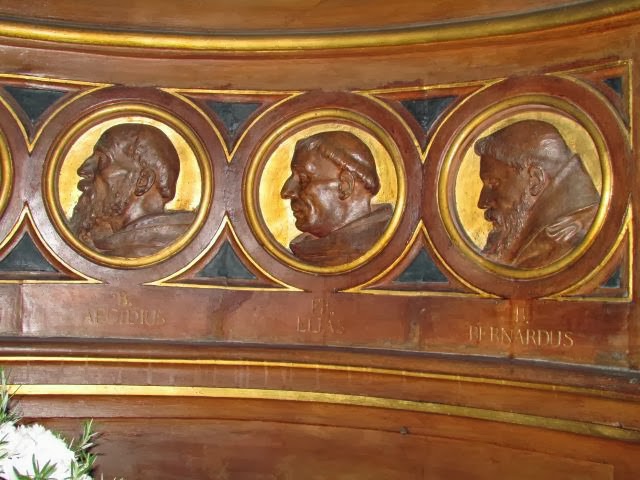
Brother Elias (center) at the Baptismal font where St. Francis was christened in the Cathedral of San Rufino in Assisi, Italy. (Photo by Kevin Elphick)
“The relationship is inescapably homoaffectional, describing a shared intimacy between two Medieval men. That this first companion disappears from the later tradition is cause for suspicion and further inquiry…. The tone in Celano’s earliest account captures the flavor and intimacy of this relationship, perhaps too much so for an increasingly homophobic church and society.”
Francis and his beloved friend are seldom depicted by artists, but they are shown together in a rare and hard-to-find image: “They shelter in a cave” (Se cobijan en una cueva) by Spanish painter José Benlliure y Gil. It is the 8th in his series of 74 images from the life of Saint Francis. The series was published by Franciscans in Valencia, Spain, in 1926 in a book to mark the 700th anniversary of the saint’s death. A commentary in Spanish about the picture is available online.
Elphick finds many more examples of what he calls “gender liminality” in historical documents on Francis. He defines liminality as “crossing the threshold of gender, either symbolically, or by actions within a person’s life that breach the social boundaries of gender.”
Francis and the all-female Trinity: “Three women appeared”
Francis rejoiced when an all-female Trinity greeted him as “Lady Poverty” in a queer experience that has been ignored, sanitized and perhaps suppressed for centuries, even though it is “hiding in plain sight” in the earliest source and in at least one famous altarpiece:.
The 13th-century friar’s little-known encounter disrupts and reverses traditional distinctions of gender and social class. For Francis, such earthly restrictions cannot limit God.

Detail of Saint Francis with female Trinity by Sassetta… better known as “The Marriage of Saint Francis with Lady Poverty” (Wikipedia)

Christian doctrine says that there is one God in three persons: “Father, Son and Holy Spirit.” Francis saw this Holy Trinity embodied instead as “three poor women.” Does that make them Mother God, Christa and the Holy Spirit? Church authorities sometimes allow the Holy Spirit to be represented as female, but never the entire Trinity — except this time.
Disregarding his biological sex, the women call Francis himself “Lady Poverty” — and he loves it! The genderbending name honors his commitment to upend social hierarchies and embrace poverty as a spiritual path.
Later writers and artists downgraded the identity of the three women. Instead of embodying the Holy Trinity, they were said to represent the virtues of poverty, chastity and obedience. Lady Poverty ceased to be a name for Francis, and was recast as his bride in a mystical marriage.
Take a close look at the 15th-century painting by Italian Renaissance artist Stefano di Giovanni di Consolo, who is known as Sassetta.
Many usually reliable websites display this painting with titles such as “The Marriage of Saint Francis to Lady Poverty” or “The Mystical Marriage of Saint Francis.” Mystical, yes. But what makes them think this is a marriage? And how did the identity of Lady Poverty switch from Francis himself to one of the women? The dominance of heterosexual marriage and gender conformity must have been too powerful to resist. However, the painting matches the original story much better than the marriage model.
The painting is labeled as the mystical marriage of Francis with Lady Poverty, but a close examination shows that it illustrates the story of Francis and the female Trinity. He is not marrying Lady Poverty — he IS Lady Poverty! Later the same female Trinity floats over the ecstatic Francis in the altar’s climactic central image.

A female Trinity appears in “Saint Francis in Ecstasy” by Sassetta. (Wikipedia)


The story of Francis’ encounter with the female Trinity is recorded in chapter LX of “The Remembrance of the Desire of a Soul,” one volume in the Francis trilogy. It was written within two years of Francis’ death in 1226 by Thomas of Celano, a contemporary of Francis and his earliest biographer. Here is the text, as translated by Regis Armstrong:
Chapter LX: How three women appeared to him on the road, and how they disappeared after a novel greeting
I will tell in a few words something marvelous, doubtful in interpretation, most certain in truth. When Francis, the poor man of Christ, was traveling from Rieti to Siena for the treatment of his eyes, he passed through the plain near Rocca Campiglia, taking as a companion on the journey a doctor who was very devoted to the Order. Three poor women appeared by the road as Saint Francis was passing. They were so similar in stature, age, and face that you would think they were a three-part piece of matter, modeled by one form. As Saint Francis approached, they reverently bowed their heads, and hailed him with a new greeting, saying: “Welcome, Lady Poverty!” At once the saint was filled with unspeakable joy, for he had in himself nothing that he would so gladly have people hail as what these women had chosen. And since he thought at first that they really were poor women, he turned to the doctor who was accompanying him, and said: “I beg you, for God’s sake, give, something to these poor women.” The doctor immediately took out some coins, and leaping from his horse he gave some to each of them. They then went on for a short way, and suddenly the doctor and the brothers glanced back and saw no women at all on that whole plain. They were utterly amazed and counted the event as a marvel of the Lord, knowing these were not women who had flown away faster than birds.

Who are these three supernatural women? Early Franciscan writer Saint Bonaventure (1221-1274) wrote in his Life of Saint Francis that this triple goddess symbolized the three virtues of charity, obedience and poverty. His interpretation has been widely accepted.
Kevin Elphick, a scholar specializing in queer Franciscan subjects, explains in a recent article how “the language describing the three women is inescapably Trinitarian in formula.” The description of them as “a three-part piece of matter, modeled by one form,” closely resembles Christian creeds that proclaim the Trinity as three distinct persons of one substance.
He points out how the appearance of the three women also echoes the story in Genesis of how Abraham and Sarah welcomed three mysterious visitors. They are interpreted in Christian tradition as the three persons of the Holy Trinity. Elphick presents full evidence for the Trinitarian understanding in his article “Thee Poor Women Appeared” in the winter 2016 issue of “Franciscan Connections: A Spiritual Review.”
Of course, all this mislabeling makes it virtually impossible for researchers to find the beautiful paintings of Francis with the female Trinity… despite the fact that art prints are widely available for both the “marriage” and the ecstasy of Francis.
More info is available in the Q Spirit article Saint Francis rejoiced when all-female Trinity called him “Lady Poverty” by Kittredge Cherry.
Francis embraced a Muslim sultan
A famous peace prayer is attributed to St. Francis. It begins, “God, make me an instrument of your peace.” Late in his life Francis embodied this message through man-to-man Christian-Muslim dialogue in the Mideast, a region where people are still at war.

“St. Francis and the Sultan” by Robert Lentz
In 1219 Francis went to Damietta, Egypt, with the European armies during the Fifth Crusade. He hoped to discuss religion peacefully with the Muslims. He tried to prevent Crusaders from attacking Muslims at the Battle of Damietta, but he failed. Francis was captured and taken to the sultan Malek al-Kamil. At first they tried to convert each other, but each man soon recognized that the other already knew and loved God. They remained together, discussing spirituality, for about three weeks between Sept. 1 and Sept. 26.
Their meeting is celebrated as a model of interfaith dialogue in the icon “St. Francis and the Sultan” by Robert Lentz, a Franciscan friar known for his innovative and LGBTQ-positive icons. He is stationed at Holy Name College in Silver Spring, Maryland. Lentz discussed the icon in a video.
Francis received the stigmata
In 1224, when Francis was in his 40s, he received the stigmata — marks like the crucifixion wounds of Christ in his hands, feet and side. California artist Kevin Raye Larson emphasizes the sensuality of the ecstatic moment in “St Francis of Assisi Receiving the Stigmata,” pictured here. The painting has appeared on the cover of the spirituality issue of “Frontiers,” the Los Angeles gay lifestyle magazine.
| “St Francis of Assisi Receiving the Stigmata” by Kevin Raye Larson © 1991 |

Along with the stigmata came other health problems. When Francis sensed death approaching, he called for Jacoba de Settesoli, a Roman noblewoman devoted to him and his teachings. Francis stayed in her house when in Rome. Celano’s 13th-century account in the “Treatise on the Miracles of Blessed Francis” reports that Francis greeted the news of her arrival at the male-only cloister with a decidedly queer statement that breaks gender rules::
“Blessed be God, who has guided the Lady Jacoba, our brother, to us. Open the door and bring her in, for our Brother Jacoba does not have to observe the decree against women.”

The widow called “Brother Jacoba” by Francis kneels near the dying Francis of Assisi in “48. Jacoba of Settesoli is associated with the mourning” (Jacoba de Settesoli se asocia al duelo) by José Benlliure y Gil, 1926 (Wikimedia Commons)

Francis died a few days later on Oct. 3, 1226. Two years after Francis’ death, Pope Gregory IX declared him a saint and commissioned Celano’s biography, the one that includes the love between Francis and his male companion.
Elphick adds an intriguing footnote about how the queer side of Francis has manifested outside official Christianity. Francis is venerated in the Yoruba religion of Africa as Orunmila, the orisha of wisdom, patron of animals and a transgendered deity who engages in same-sex eroticism.
At the end of his thesis, Elphick concludes that breaking gender rules is an extraordinary God-given power or “charism” that Franciscans offer to the church and the world.
“What are the lives of figures like Mother Francis, Brother Jacoba and Mother Juana de la Cruz revealing to us in our own day? I think that the Franciscan charism of gender liminality has much to teach our Church and fellow community of humans in our day. In a church divided over issues of ordination of women, inclusive language, and sexual orientation, I believe that the Franciscan tradition has important figures to hold up and from whom to learn. For issues which we have not even yet begun to explore theologically in authentic ways, issues such as hermaphroditism, transsexuality, genderedness and sexual orientation, I believe the Franciscan voice can be prophetic.”

“Saint Francis in Ecstasy” by Caravaggio (Wikimedia Commons)
Links related to Francis of Assisi
“The Message of St. Francis” by Kevin C. A. Elphick (The Empty Closet)
To read this post in Spanish / en español, go to Santos Queer:
San Francisco de Asís: La evidencia histórica revela su lado gay
___
Top image credit:
“St. Francis ‘Neath the Bitter Tree” by William Hart McNichols ©

Follow
Kittredge Cherry
Founder at Q Spirit, Kittredge Cherry is a lesbian Christian author who writes regularly about LGBTQ spirituality.She holds degrees in religion, journalism and art history.She was ordained by Metropolitan Community Churches and served as its national ecumenical officer, advocating for LGBTQ rights at the National Council of Churches and World Council of Churches.
See victim’s brother hug convicted ex-cop Amber Guyger
CNN After former Dallas police officer Amber Guyger was sentenced Wednesday to 10 years in prison for the murder of Botham Jean, his brother embraced her and said he forgives her. Brandt Jean went over to Guyger and the two hugged. Jean told her he doesn’t want her to go to prison. “I love you as a person and I don’t want to wish anything bad on you,” Jean said before they hugged for nearly 30 seconds. Jurors on Tuesday had found Guyger, 31, guilty of murder for fatally shooting Jean in his Dallas apartment in 2018. She had faced between five years and 99 years for the shooting.
Malcolm Gladwell on Why We Can’t Tell When Someone’s Lying
“Human beings are by definition vulnerable to those determined to mislead them”

Katie Couric Sep 9 · (medium.com)
As a journalist, it’s part of my job to have honest conversations with people I frequently don’t know in order to help myself and others better understand the world. So I was really interested in Malcolm Gladwell’s new book, Talking to Strangers, which uses a series of case studies to show how we so often misread strangers and the real problems that that can cause. Read our conversation about what we so often get wrong when we meet someone new — and why we have a hard time telling when we’re being misled…
Katie Couric: It’s been six years since your last book, congrats! I know you commit an enormous amount of time to researching and studying the topics you write about. How do you know when you’ve finally found the one that you want to devote an entire book to?
Malcolm Gladwell: Well, I’m mildly obsessive. And I tend to be obsessing about one thing or another at all times. (Like, at the moment, I’ve spent the entire day mulling over why Serena Williams lost the U.S. Open final). But sometimes I find myself obsessing over the same thing for weeks on end. That’s usually a sign that a topic is rich enough to be worth doing a podcast episode–or writing a book about.
The book opens with the heartbreaking case of Sandra Bland. Why do you say that it’s “the perfect example” of what you wanted to explore? Why do you think it affected you so deeply?
I don’t know. Maybe it’s unlike most of the other highly publicized cases of encounters between young African Americans and law enforcement, the officer’s dash-cam captured the whole episode. We know every word that was spoken between Bland and the police officer, Brian Encinia. There is no “he said, she said” in this case. And that meant there is no way to re-interpret or explain away the awfulness and tragedy of their meeting. That tape became one of my obsessions. And after watching it half a dozen times, I thought—I should write a book about this.
A major idea in the book is our tendency to “default to truth” when we meet strangers. Can you tell us what this means exactly and how it can end up causing some real problems?
One of the big questions that psychologists have been wrestling with for decades is why human beings are so bad at detecting lies. We’re terrible at it. And the psychologist Tim Levine argues that that’s because as humans we “default to truth.” That is: we automatically assume that anyone we speak to is telling the truth, and it takes a mountain of evidence of doubt for us to change our minds. Levine makes the case that this is part of what is special and beautiful about us: default to truth is what allows us to form groups, cooperate, start businesses, communicate with others, and put our children on the school bus every morning without interrogating the bus driver about his qualifications and motives. But it also means that when someone really wants to deceive us, we’re really easily duped. He says—and I agree—that that is a small price to pay for the many advantages of implicit truth in others. But it does mean being human necessarily leaves us open to deception.
Talking to Strangers is a series of case studies of cases in the news that I think make this point explicitly. Why did Bernie Madoff fool so many people for so long? How did the pedophile Larry Nasser get away with abusing so many girls in his care for so long? That’s not because people in positions of authority were negligent. It’s because human beings are by definition vulnerable to those determined to mislead them.
We’re both journalists, so our jobs require that we spend a lot of time talking to strangers and, hopefully, getting them to open up to us truthfully. How do you think your work on the book has affected the way you engage with your subjects?
One of the things that I spend a lot of time on in Talking to Strangers is how we rush to judgement about strangers–we rely on very flawed clues, like facial expressions or body language. And we systematically underestimate the importance of context in making sense of another’s behavior. This has made me way, way more cautious as a journalist. I think the only way for a journalist to honestly profile someone, for example, is if writers limit themselves to painting very specific narrow pictures of their subjects. You can spend a few hours with Brad Pitt and talk about the way he is with you–and you can watch his movies and talk about the way he is on the screen–but you can’t begin to know him. Sadly I think too few of us exercise that kind of caution.
With everything you’ve learned, what’s your best advice for all of us to have better and more honest interactions with strangers?
Be humble. Be cautious. Don’t imagine that you can get to the heart of someone else from a single encounter. Human beings are much more complex than that.
This interview originally appeared in the September 10, 2019 edition of Katie Couric’s Wake-Up Call newsletter. Subscribe here.Wake-Up Call
Katie Couric and friends talk career, culture, politics, wellness, love, and money

WRITTEN BY
Katie Couric
Journalist, podcaster, @SU2C founder, doc filmmaker of @FedUpmovie on @netflix, #GenderRevolution on @iTunes and #AmericaInsideOut on @natgeochannel & @hulu

Wake-Up Call
Katie Couric and friends talk career, culture, politics, wellness, love, and money
4 Carl Jung Theories Explained: Persona, Shadow, Anima/Animus, The Self

A Brief Introduction to Carl Jung and Jungian Psychology.
Harry J. Stead Oct 2 · (Medium.com)
The Persona
Inevery public arena we present an exaggerated version of ourselves which we hope will make an impression. The character we display in our occupation is not the same as at home. When alone we have no one to impress, but in public we wear a mask, a persona, so that we might impose a desirable image of ourselves onto others. Every profession has subtle agreements about the manners which are acceptable, and those which are not; and it is expected that the individual will adapt to these requirements without anyone having to openly explain them. A doctor, for instance, is expected to behave as a doctor should, with a patience and sympathy that would be difficult for an ordinary person to achieve; any propensity for impatience or hostility would not be acceptable, and for good reason.
It is then the distinct purpose of the persona to subdue all of the primitive urges, impulses, and emotions that are not considered socially acceptable, and that, if we were to act upon them, would make us look fools. Anyone with any sense at all sees through the façade; but we each participate in pretending that all this is real, so that society might carry on as normal. The difficulty with the persona arises only when one becomes so closely identified with his role that he loses all sense of self. At this point the damage is surely done: he will be entirely unaware of any distinction between himself and the world in which he lives. The result of an inflated persona, Jung warned, is a ‘shallow, brittle, conformist kind of personality which is ‘all persona’, with its excessive concern for ‘what people think.’ Such a person will sacrifice himself for the wishes of others without limit — not because he is a saint, but because he does not have the courage to refuse and endure conflict.
The Shadow
Ifnothing else, the persona is obedience to expectations; it is the mask one wears to convince himself, and others, that he is not an altogether bad person. But one cannot go beyond the persona until he has incorporated into his character those darker character traits which belong to what Jung called the ‘shadow self’. The shadow is everything that we have denied in ourselves and cast into oblivion, or rather everything that the ego has refused to associate with itself, but that we can notice in other people — such things might include our sexuality, spontaneity, aggression, instincts, cowardice, carelessness, passion, enthusiasm, love of material possessions. It embraces all those sins, dark thoughts, and moods for which we felt guilt and shame.
The shadow is necessarily emotional in nature, for it must oppose the rigidness of the ego; it holds its own autonomy, separate from the conscious mind. Therefore, in being instinctive and irrational, the shadow is prone to psychological projection, whereby we attribute to others all our evil and inferior qualities that we do not want to admit are in ourselves. ‘A man who is unconscious of himself’, Jung writes, ‘acts in a blind, instinctive way and is in addition fooled by all the illusions that arise when he sees everything that he is not conscious of in himself coming to meet him from outside as projections upon his neighbour.’ (The Philosophical Tree, page 335.) When we perceive a moral deficiency in others we can be sure there is a similar inferiority within ourselves. ‘If you feel’, Von Franz writes, ‘an overwhelming rage coming up in you when a friend reproaches you about a fault, you can be fairly sure that at this point you will find a part of your shadow, of which you are unconscious.’ If we observe our resentment towards ourselves and others, and if we consider the moral aspects of our behaviour, then we have the opportunity to bring the shadow into consciousness, and achieve a renewed sense of strength and independence.

Anima/Animus
Jung believed that nested inside the shadow are the qualities of our opposite gender. The anima is the archetype that expresses the fact that men have a minority of feminine qualities; and the animus expresses the masculine qualities within women. In every man there is a woman, and in every woman a man; or rather, there is the image of the ideal man/woman, which is, as a rule, formed in part by the experience of our mother/father, and by the influence of culture and heritage. One might argue that the ideas of feminine and masculine are based on arbitrary stereotypes. But Jung presented the concept of the anima and animus as the ancient archetypes of Eros and Logos. Eros (the female) is associated with receptivity, creativity, relationships, and wholeness.. Logos (the male) is identified with power, thought, and action. (In Ancient Greek Eros means ‘love’, or ‘life energy’; whereas Logos is the term for a principle of order and knowledge.)
The anima then is a personification of all feminine tendencies, positive or negative, in a man’s psyche. A positive expression of the anima might include sensitivity and empathy, capacity for loving relationships, a feeling for nature. But if the anima is rejected — that is, if a man represses those characteristics which might be considered classically feminine — the anima becomes deformed: feelings and emotions are replaced by moodiness, sentimentality, hysteria; fidelity becomes possessiveness; aesthetics become sensuality; tenderness becomes effeminacy; imagination becomes mere fantasizing. The animus, on the other hand, is a personification of masculine tendencies in a woman’s psyche, such as strength of conviction, assertiveness, courage, strength, vitality, and a desire for achievement. But if the woman disregards her masculine edge then she will become possessed by the animus: assertiveness will become aggression and ruthlessness; and analytical thought will become argumentativeness.
As with the shadow, the archetypes of the anima/animus have their own autonomy, and are independent from our conscious mind. Thus the anima/animus can be projected in the world so that they appear to be some qualities of a particular man/woman. In the presence of the anima, or at least a good imitation of anima, a man feels a peculiar familiarity with her, as if he has known this woman for all time; in some cases, the energy between the two is intoxicating, to the degree that one might say he has fallen in ‘love at first sight’. In truth, he has fallen in love with a deception, with the image that he has projected onto another woman. It is only when the mirage of the projection disperses will he realise himself as a fool. Once the projection is withdrawn the anima can be recognised as a force within oneself. After having integrated the anima, men seemingly reconnect with a divine power in the inner world — which might express itself as a creative ability, or a sensitivity for the natural world— which must have always been within them; but which had to shown to them by the presence of the feminine, by the guiding hand of a woman.
The Self
After one has overcome the persona, and integrated his shadow and the aspects of the anima/animus archetype into one’s character, one then is given access, Jung believed, to enter into the deepest and highest reaches of the psyche, the archetype of wholeness– which Jung named the ‘Self’, the most significant of all the archetypes. ‘The Self embraces’, Jung writes, ‘ego-consciousness, shadow, anima, and collective unconscious in indeterminable extension.’ (Mysterium Coniunctionis, page 108.) The self then is the sum of everything we are now, and we once were, as well as everything we could potentially become; it is the symbol of the ‘God within us’, that which we are as a totality.
The archetype of the self is the origin of our impulse towards self-realisation; it is the single point from which our character and our personality matures as we grow older — just as a seed holds the whole potential future of a flower. It is the Self that brings forth what Jung called ‘the process of individuation’, which begins from the potential of childhood to an expansive journey of self-discovery, whereby one consciously and gradually integrates the unconscious aspects — the parts of ourselves that we have refused to confront — of one’s personality into the whole. Jung believed that it is the end purpose of human life to experience this coming together of the whole, to fully integrate and make conscious everything about ourselves that was hidden in the shadow. This end is the fullest expression of one’s character, and allows one to hold firm their individuality against the collective mass unconscious.
WRITTEN BY
Harry J. Stead
timeandritual.com
