

Monthly Archives: July 2019
Narrative as the Pillar of Identity
The Building Blocks of Personhood: Oliver Sacks on Narrative as the Pillar of Identity
“Biologically, physiologically, we are not so different from each other; historically, as narratives — we are each of us unique.”
BY MARIA POPOVA (brainpickings.org)

“A person’s identity,” Amin Maalouf wrote in his brilliant treatise on personhood, “is like a pattern drawn on a tightly stretched parchment. Touch just one part of it, just one allegiance, and the whole person will react, the whole drum will sound.” In thinking about how identity politics frays that parchment and fragments the essential wholeness of our personhood, I was reminded of a poignant passage by neurologist Oliver Sacks(July 9, 1933–August 30, 2015), the poet laureate of the mind, from his 1985 classic The Man Who Mistook His Wife For A Hat (public library).
In the twelfth chapter, titled “A Matter of Identity,” Dr. Sacks recounts the case of a patient with a memory disorder that rendered him unable to recognize not only others but himself — unable, that is, to retain the autobiographical facts which a person constellates into a selfhood. To compensate for this amnesiac anomaly, the man unconsciously invented countless phantasmagorical narratives about who he was and what he had done in his life, crowding the void of his identity with imagined selves and experiences he fully believed were real, were his own, far surpassing what any one person could compress into a single lifetime. It was as though he had taken Emily Dickinson’s famous verse “I’m Nobody! Who are you?” and turned it on himself to answer with a resounding “I’m Everybody!”
But just as depression can be seen as melancholy in the complex clinical extreme and bipolar disorder as moodiness in the complex clinical extreme, every pathological malady of the mind is a complex clinical extreme of a core human tendency that inheres in each of our minds in tamer degrees. By magnifying basic tendencies to such extraordinary extremes, clinical cases offer a singular lens on how the ordinary mind works — and that, of course, is the great gift of Oliver Sacks, who wrests from his particular patient case studies uncommon insight into the universals of human nature.

“Such a patient,” Sacks writes of the inventive amnesiac man, “must literally make himself (and his world) up every moment.” And yet that is precisely what we are all doing in a certain sense, to a certain degree, as we continually make ourselves and our world up through the stories we tell ourselves and others.
A decade after philosopher Amelie Rorty observed that “humans are just the sort of organisms that interpret and modify their agency through their conception of themselves,” Sacks examines the building blocks of that self-conception and how narrative becomes the pillar of our identity:
We have, each of us, a life-story, an inner narrative — whose continuity, whose sense, is our lives. It might be said that each of us constructs and lives, a “narrative,” and that this narrative is us, our identities.
If we wish to know about a man, we ask “what is his story — his real, inmost story?” — for each of us is a biography, a story. Each of us is a singular narrative, which is constructed, continually, unconsciously, by, through, and in us — through our perceptions, our feelings, our thoughts, our actions; and, not least, our discourse, our spoken narrations. Biologically, physiologically, we are not so different from each other; historically, as narratives — we are each of us unique.
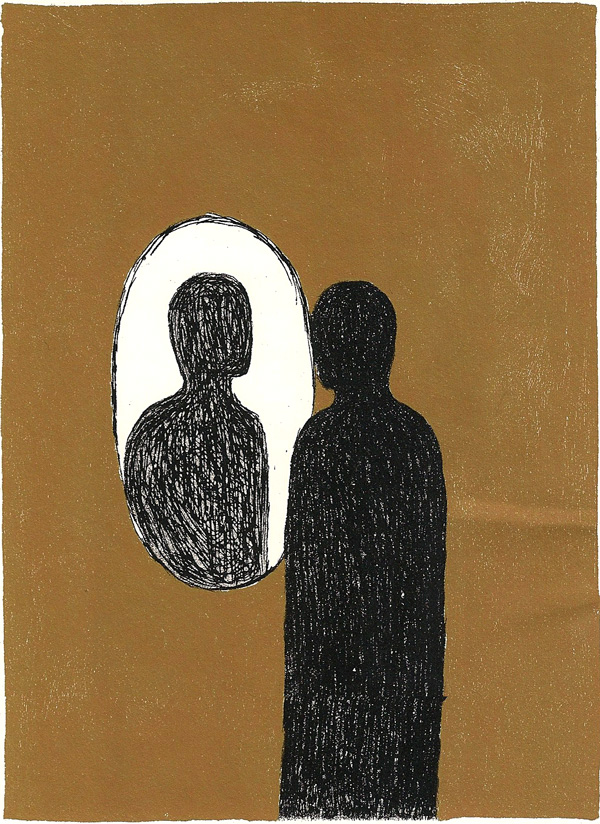
Sacks considers the basic existential responsibility that stems from our narrative uniqueness:
To be ourselves we must have ourselves — possess, if need be re-possess, our life-stories. We must “recollect” ourselves, recollect the inner drama, the narrative, of ourselves. A man needs such a narrative, a continuous inner narrative, to maintain his identity, his self.
The Man Who Mistook His Wife For A Hat remains a classic of uncommon illumination. Complement this particular portion with Rorty on the seven layers of personhood and Borges on the nothingness of the self, then revisit Dr. Sacks on the three essential elements of creativity, the paradoxical power of music, what a Pacific island taught him about treating ill people as whole people, and his stunning memoir of a life fully lived.
An Apollo 11-themed advertisement for “2001: A Space Odyssey” that appeared in The San Francisco Chronicle in July 1969

Film: The Lion King, ‘the most ideologically coherent Hollywood defense of monarchy’
FRANCE 24 English
Published on Jul 17, 2019
Subscribe to France 24 now:
http://f24.my/youtubeEN
FRANCE 24 live news stream: all the latest news 24/7
http://f24.my/YTliveEN
Critic Lisa Nesselson speaks to Eve Jackson about the week’s film news, including “The Lion King”, Luc Besson’s “Anna”, and the re-release of Terrence Mallick’s sumptuous “Days of Heaven”.
Your brain hallucinates your conscious reality | Anil Seth
TED
Published on Jul 18, 2017
Right now, billions of neurons in your brain are working together to generate a conscious experience — and not just any conscious experience, your experience of the world around you and of yourself within it. How does this happen? According to neuroscientist Anil Seth, we’re all hallucinating all the time; when we agree about our hallucinations, we call it “reality.” Join Seth for a delightfully disorienting talk that may leave you questioning the very nature of your existence.
Check out more TED talks: http://www.ted.com
The Creator of Godwin’s Law Says You Definitely Should Compare White Nationalists to Nazis
Internet rule be damned.


GETTY IMAGES
It’s one of the primary rules of Internet discourse: The longer you get into a debate online, the more likely someone will bring up Hitler or Nazis. The trend is known as Godwin’s Law, and it was coined by Mike Godwin, a lawyer and author, back in the 1990s. But in light of the racist protests in Charlottesville, Virginia, this weekend, Godwin wants to make it clear: You can go ahead and bring up the Nazis.
Godwin wrote on Facebook that someone had asked him to post a statement about Charlottesville, because people bring up his law to shut down arguments all the time. Turns outhe was happy to oblige. “By all means, compare these shitheads to the Nazis,” he wrote. “Again and again. I’m with you.”
Godwin clarified his statement further to Gizmodo: “Like so many people, I’m so appalled at what happened in Charlottesville that I haven’t known what to say, or whether to say anything at all. But [the requester] asked for something that was easy for me to give.”
In general, Godwin has always said you can bring up the Nazis in an online conversation, as long as you’re doing some research first. “If you’re thoughtful about it and show some real awareness of history, go ahead and refer to Hitler or Nazis when you talk about Trump. Or any other politician,” he wrote in The Washington Postbackin 2015. But in the case of the white supremacists in Virginia, there’s no research necessary to make that comparison. The facts speak for themselves.
History: “Cornerstone” speech by Confederate Vice President Alexander H. Stephens | March 21, 1861
Our new government is founded upon exactly the opposite idea; its foundations are laid, its corner-stone rests, upon the great truth that the negro is not equal to the white man; that slavery subordination to the superior race is his natural and normal condition. This, our new government, is the first, in the history of the world, based upon this great physical, philosophical, and moral truth. This truth has been slow in the process of its development, like all other truths in the various departments of science. It has been so even amongst us. Many who hear me, perhaps, can recollect well, that this truth was not generally admitted, even within their day. The errors of the past generation still clung to many as late as twenty years ago. Those at the North, who still cling to these errors, with a zeal above knowledge, we justly denominate fanatics. All fanaticism springs from an aberration of the mind from a defect in reasoning. It is a species of insanity. One of the most striking characteristics of insanity, in many instances, is forming correct conclusions from fancied or erroneous premises; so with the anti-slavery fanatics. Their conclusions are right if their premises were. They assume that the negro is equal, and hence conclude that he is entitled to equal privileges and rights with the white man. If their premises were correct, their conclusions would be logical and just but their premise being wrong, their whole argument fails. . . .
Jane Goodall on climate change: ‘Something’s got to give’
FRANCE 24 English
Published on Jul 15, 2019
At the age of 26, Dr Jane Goodall pioneered new ways of researching animals including by living with them. Now, aged 85 and a UN Messenger of Peace, she travels more than 300 days a year to share the urgency of taking action on climate change on behalf of all living things and the planet we share. She sat down with FRANCE 24’s Marjorie Paillon, at the recent USI conference in Paris, to discuss this issue, the problems of poverty and being a role model.
“It’s crazy to think that we can have unlimited economic development on a planet with finite natural resources and a still-growing human population. Something’s got to give,” Dr. Jane Goodall told FRANCE 24.
The Art of Conversation
Become an intellectual explorer: Master the art of conversation. Want to be smarter than you were yesterday? Learn to have better conversations using these 3 design principles.
EMILY CHAMLEE-WRIGHT
Dr. Emily Chamlee-Wright is the president and CEO of the Institute for Humane Studies, which supports and partners with scholars working within the classical liberal tradition. She was previously Provost and Dean at Washington College in Chestertown, Maryland. Prior to joining Washington College, she was Elbert Neese Professor of Economics and Associate Dean at Beloit College in Beloit, Wisconsin.
17 July, 2019 (bigthink.com)
Apollo 11: former astronaut Michael Collins returns to launch site 50 years on
FRANCE 24 English
Published on Jul 17, 2019
Lunar eclipse to mark launch of Apollo 11 mission, 50 years on
Text by:
NEWS WIRES (France24.com)
Fifty years to the day since mankind launched the first mission to set foot on it, the Moon is set to treat Earthlings to a partial lunar eclipse on Tuesday.
Britain’s Royal Astronomical Society said in a statement the event would be visible from parts of northern Europe, Asia, Africa, South America and Western Australia.
Lunar eclipses happen when the Earth gets aligned in between the Sun and the Moon.
Tuesday’s eclipse should see around 60 percent of the Moon’s visible surface obscured by the Earth’s shadow, known as the umbra, the RAS said.
Best viewing conditions in Britain will be around 2230 (2130 GMT), it added.
Unlike solar eclipses, lunar eclipses can be seen by the naked eye without risk of damage. Experts recommend those seeking to take photos of the phenomenon use a tripod.
More than 400,000 people worked on NASA’s Apollo 11 mission, which launched on July 16, 1969 and put the first humans on the Moon four days later.
(AFP)