
The ‘debate of the century’: what happened when Jordan Peterson debated Slavoj Žižek
The controversial thinkers debated happiness, capitalism, and Marxism in Toronto. It was billed as a meeting of titans – and that it was not. But it did reveal one telling commonality

The event was billed as “the debate of the century”, “The Rumble in the Realm of the Mind”, and it did have the feel of a heavyweight boxing match: Jordan Peterson, local boy, against the slapdash Slovenian Slavoj Žižek, considering “Happiness: Capitalism vs Marxism” in Toronto.
Peterson, in his opening remarks, noted that scalped tickets were selling at higher prices than the Maple Leafs playoff game happening on the other side of town. He couldn’t believe it. Who could?
Peterson and Žižek represent a basic fact of intellectual life in the twenty-first century: we are defined by our enemies.
Peterson has risen to fame on the basis of his refusal to pay the usual fealties to political correctness. The size and scope of his fame register more or less exactly the loathing for identity politics in the general populace, because it certainly isn’t on the quality of his books that his reputation resides. Žižek is also defined, and has been for years, by his contempt for postmodern theory and, by extension, the more academic dimensions of political correctness.

Peterson’s opening remarks were disappointing even for his fans in the audience. They were a vague and not particularly informed (by his own admission) reading of The Communist Manifesto. His comments on one of the greatest feats of human rhetoric were full of expressions like “You have to give the devil his due” and “This is a weird one” and “Almost all ideas are wrong”.
I’ve been a professor, so I know what it’s like to wake up with a class scheduled and no lecture prepared. It felt like that. He wandered between the Paleolithic period and small business management, appearing to know as little about the former as the latter. Watching him, I was amazed that anyone had ever taken him seriously enough to hate him.
He said things like “Marx thought the proletariat was good and the bourgeoisie was evil”. At one point, he made a claim that human hierarchies are not determined by power because that would be too unstable a system, and a few in the crowd tittered. That snapped him back into his skill set: self-defense. “The people who laugh might do it that way,” he replied. By the end of his half-hour he had not mentioned the word happiness once.
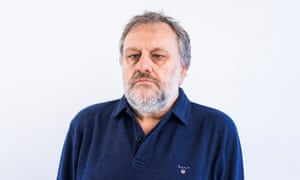
Žižek didn’t really address the matter at hand, either, preferring to relish his enmities. “Most of the attacks on me are from left-liberals,” he began, hoping that “they would be turning in their graves even if they were still alive”. His remarks were just as rambling as Peterson’s, veering from Trump and Sanders to Dostoevsky to the refugee crisis to the aesthetics of Nazism. If Peterson was an ill-prepared prof, Žižek was a columnist stitching together a bunch of 1,000-worders. He too finished his remarks with a critique of political correctness, which he described as the world of impotence that masks pure defeat.
One hated communism. The other hated communism but thought that capitalism possessed inherent contradictions. The first one agreed that capitalism possessed inherent contradictions. And that was basically it. They both wanted the same thing: capitalism with regulation, which is what every sane person wants. The Peterson-Žižek encounter was the ultra-rare case of a debate in 2019 that was perhaps too civil.
They needed enemies, needed combat, because in their solitudes, they had so little to offer. Peterson is neither a racist nor a misogynist. He is a conservative. He seemed, in person, quite gentle. But when you’ve said that, you’ve said everything. Somehow hectoring mobs have managed to turn him into an icon of all they are not. Remove him from his enemies and he is a very poor example of a very old thing – the type of writer whom, from Samuel Smiles’ Self-Help to Eckhart Tolle’s The Power of Now, have promised simple answers to complex problems. Rules for Life, as if there were such things.
The mere dumb presence of the celebrities on the stage mattered vastly more than anything they said, naturally. But there was one truly fascinating moment in the evening. It came right at the end of Žižek’s opening 30-minute remarks.
Both of these men know that they are explicitly throwbacks. They do not have an answer to the real problems that face us: the environment and the rise of China as a successful capitalist state without democracy. (China’s success makes a joke out of the whole premise of the debate: the old-fashioned distinction between communism and capitalism.) Neither can face reality or the future. Therefore they retreat.
Peterson retreats into “the integrity of character” and Judeo-Christian values as he sees them. Žižek is more or less a Gen X nostalgia act at this point, a living memento from a time when you would sit around the college bar and regale your fellow students about the time you saw that eastern European prof eating a couple of hot dogs in the street.
Unfortunately, this brief moment of confrontation of their shared failure couldn’t last. They returned to their natural subject: who is the enemy? Žižek asked what Peterson meant by cultural Marxists when postmodern thinkers, like Foucault, weren’t Marxist at all. Peterson was an expert on this subject, at least. He gave a minor history of the French critical theorists who transposed categories of class oppression for group oppression in the 1960s.
And they both agreed, could not have agreed more, that it was all the fault of the “academic left”. They seemed to believe that the “academic left”, whoever that might be, was some all-powerful cultural force rather than the impotent shrinking collection of irrelevances it is. If the academic left is all-powerful, they get to indulge in their victimization.
And that was the great irony of the debate: what it comes down to is that they believe they are the victims of a culture of victimization. They play the victim as much as their enemies. It’s all anyone can do at this point.
In the end Peterson-Žižek was less of a heavyweight boxing match than a WWE Grand Slam. Not that I was disappointed. I did see “the debate of the century”, the debate of our century. It was full of the stench of burning strawmen. A big deal, with huge numbers, and really very little underneath.
The whole 2 1/2 hour debate: https://youtu.be/pT1vutd4Gnk
“Hollow Talk” by Choir of Young Believers
Eric Rodewald
Published on Nov 8, 2009
Looped this cool video of the 300,000 birds a few times because it seemed to suit the song.
Lyrics:
Echoes start as a cross in you
Trembling noises that come too soon
Spatial movement which seems to you
Resonating your mask or feud
Hollow talking and hollow girl
Force it up from the root of pain
Never said it was good, never said it was near
Shadow rises and you are here
And then you cut
You cut it out
And everything
Goes back to the beginning
Silence seizes a cluttered room
Light is shed not a breath too soon
Darkness rises in all you do
Standing and drawn across the room
Spatial movements are butterflies
Shadows scatter without a fire
There’s…
“The Controversial Guru Who Wants to Upgrade Civilization” – Bentinho Massaro
TED Talk: Inside the Black Hole Image That Made History
At the center of a galaxy more than 55 million light-years away, there’s a supermassive black hole with the mass of several billion suns. And now, for the first time ever, we can see it. Astrophysicist Sheperd Doeleman, head of the Event Horizon Telescope collaboration, speaks with TED’s Chris Anderson about the iconic, first-ever image of a black hole — and the epic, worldwide effort involved in capturing it.
This talk was presented at an official TED conference, and was featured by our editors on the home page.
ABOUT THE SPEAKER
Sheperd Doeleman · Astrophysicist
Sheperd Doeleman led the global team behind the Event Horizon Telescope that captured the historic, first-ever image of a black hole.
MORE RESOURCES
Event Horizon Telescope
Learn more about the Event Horizon Telescope and how it captured the first direct image of a black hole.
More at eventhorizontelescope.org →
Emotional and Spiritual Maturity: Gabor Mate and Adyashanti
scienceandnonduality
Published on Apr 11, 2019
In a rare meeting of minds, and a rare exploration of whether there is a predilection for spirituality, Gabor Mate asks Adyashanti to expand on passages from his recent book My Secret Is Silence. Later they discuss the influence of trauma on the spiritual path and the need for specialist help, spiritual bypassing, and the relationship between spiritual insight and emotional growth.
For more information visit https://drgabormate.com and https://www.adyashanti.org
Science And NonDuality is a community inspired by timeless wisdom, informed by cutting-edge science, and grounded in personal experience. We come together in an openhearted exploration to further our individual and collective evolution. New ways of being emerge. We embody our interconnectedness and celebrate our humanity.
Greta Thunberg’s full speech at the EU Parliament in Strasbourg
My full speech at the EU Parliament in Strasbourg.#FridaysForFuture #schoolstrike4climate #climatestrike
Posted by Greta Thunberg on Wednesday, April 17, 2019
Libra Full Moon, April 19, 4:12 am PDT

Wendy Cicchetti
The Libra Full Moon is at the critical 29th degree, right at the sign’s end, marking a strong urge to get something finished. In a Full Moon chart, this is a double whammy, as there is already an emphasis on completion, with a sense of “do or die” or reaching a breaking point. Libra is all about equality, harmony, and balance, and anything standing in the way of that goal’s fulfillment may now need to be addressed.
This could push some of us to the brink, if we realize that it is no longer workable to continue pretending that an imbalance is acceptable or even tolerable. Whether or not we can speak that truth externally is probably less vital than knowing for ourselves that untenable differences exist and that they have simply become too much. In a relationship, we may experience being too far apart from the other person. With work ethics, committees, or mentoring setups, we might observe a lack of sufficient common ground.
Despite the Libra Moon’s love of agreement, it could be easier to feel different now, since the Sun is conjunctUranus, reminding us that each individual is unique. Uranus is the planet of the outsider, often in the minority. Yet our uniqueness also reflects individual value, and therein lies a contradiction: Who decides where value lies? We live in societies that emphasize popularity through the affirmation of large numbers of people. Ultimately, however, we must each decide what and whom we value. And nobody can instill a stronger sense of worth in us than we ourselves. Therefore, even if others stand opposed to us now, we can know that we represent something special that has its own merit.
The outsider theme of Uranus conjunct the Sun is even more highlighted because the conjunction is dissociate, or out of sign: Uranus, transiting a different zodiac sign from the Sun in Aries, is in the neighboring sign of Taurus. Sometimes, we have a good motive for working to get along with our neighbors. Other times, though, we feel like the misfit among those who have a different set of habits or beliefs. While we may seem to be outnumbered, what we hold is precious in its own way and, in true Taurus style, should be carefully protected. One way of providing such protection could be to move away from the environment that’s making us feel “odd” and head, instead, towards something more nurturing for our specific lifestyle values. This may involve a different community, or it might revolve around a particular building, or even getting closer to nature, considering that Taurus is a sign that is often linked with earthy structures. Perhaps it is in this different place that we find our true peace and inner harmony.
The Libra Full Moon, in a sticky t-square with Pluto, speaks to an issue around power — or the lack of it. Someone may want to attribute power to us that we don’t feel we really have. Or, conversely, we feel disempowered through a situation that overwhelms us. Either way, the dynamic,cardinal nature of this t-square represents taking action.
Pluto pulls the South Node and Saturn into the t-square, simply by being close by in Capricorn, and the South Node between both planets indicates that power and control issues are rooted in patterns of the past. Sometimes, there is an abusive situation that has been hidden under the shadows of Pluto. This kind of scenario may continue because other people are not able to witness these incidents in the light of day or because they are so far from the expectations and norms of most people that no one would even have imagined them. Still, some insight into the circumstances could well come to light, finally, under the current Full Moon — perhaps not a minute too soon, given the late degree of that Moon.
There is a sense of good fortune and blessings abounding, since the Moon is sextile Jupiter in Sagittarius. For individuals, the Uranian and Jupiterian message here is to not ignore something vital and potentially life-giving — it could be a suddenly open door, an opportunity to see more clearly or speak the truth, or any special chance to escape a limiting, imprisoning, unfair, or otherwise disempowering situation. Therein lies a route to freedom!
Written by Diana McMahon Collis for the Mountain Astrologer Magazine
Did you know . . . . .

‘Polish go home’ graffiti prompted Polish-British photographer to walk 1,900 kilometres ‘home’
FRANCE 24 English
Published on Apr 15, 2019
Subscribe to France 24 now:
http://f24.my/youtubeEN
FRANCE 24 live news stream: all the latest news 24/7
http://f24.my/YTliveEN
Back in 2016, with the Brexit referendum breaking Britain in half, Polish-British photographer Michal Iwanowski spotted some graffiti reading “Polish go home”. The words set him off on a 1,900 kilometer journey on foot from Wales to Poland as part of his own personal art project to fight back against racism, and the rising wave of nationalism sweeping across Europe.
P.D. Ouspensky on Notre Dame Cathedral
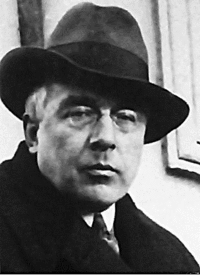
P.D. Ouspensky
Taken from “A New Model of the Universe” by P.D. Ouspensky:
On my departure I still admitted much that was fantastic in relation to schools. “Admitted” is perhaps too strong a word. I should say better that I dreamed about the possibility of a non-physical contact with schools, a contact, so to speak, “on another plane.” I could not explain it clearly, but it seemed to me that even the beginning of contact with a school may have a miraculous nature. 1 imagined, for example, the possibility of making contact with schools of the distant past, with schools of Pythagoras, with schools of Egypt, with the schools of those who built Notre-Dame, and so on.
MANY strange thoughts have always been evoked in me by the view from the top of the towers of Notre Dame. Looking down from these towers you feel that the real history of humanity, the history worth speaking of, is the history of the people who built Notre Dame and not that of those passing below. And you understand that these are two quite different histories. One history passes by in full view and, strictly speaking, is the history of crime, for if there were no crimes there would be no history. All the most important turning-points and stages of this history are marked by crimes; murders, acts of violence, robberies, wars, rebellions, massacres, tortures, executions. Fathers murdering children, children murdering fathers, brothers murdering one another, husbands murdering wives, wives murdering husbands, kings massacring subjects, subjects assassinating kings. This is one history, the history which everybody knows, the history which is taught in schools. The other history is the history which is known to very few.
For the majority it is not seen at all behind the history of crime. But what is created by this hidden history exists long afterwards, sometimes for many centuries, as does Notre Dame.
The visible history, the history proceeding on the surface, the history of crime, attributes to itself what the hidden history has created. But actually the visible history is always deceived by what the hidden history has created. So much has been written about the Cathedral of Notre Dame, and so little is actually known about it. One who has never tried to find out anything about it for himself, or to make something out of the material available, would never believe how little in fact is known about the building of the cathedral. It took many years to build; the dates when it was begun and when it was finished are known; the bishops who, in one way or another, contributed to this construction are also known, and so are the popes and kings of that time. But nothing has remained concerning the builders themselves with the exception of names, and even that seldom. 1 And no facts have remained concerning the schools which stood behind all that was created by that strange period.
It is known that there existed Schools of Builders. Of course they had to exist, for every master worked and ordinarily lived with his pupils. In this way painters worked, in this way sculptors worked. In this way, naturally, architects worked. But behind these individual schools stood other institutions of very complex origin. And these were not merely architectural schools or schools of masons. The building of cathedrals was part of a colossal and cleverly devised plan which permitted the existence of entirely free philosophical and psychological schools in the rude, absurd, cruel, superstitious, bigoted and scholastic Middle Ages. These schools have left us an immense heritage, almost all of which we have already wasted without understanding its meaning and value.
In the voluminous records of the church of Notre Dame, which go back beyond the 12th century, there is not a single word about the actual work of the construction of the cathedral. According to the chronicles of the period before the Gothic the libraries of monasteries were foil of descriptions of the construction of their buildings and of the biographies and praises of their builders. But with the coming of the Gothic period suddenly all became silent. Until the 12th century there is no mention of any of the architects.” (From a book by Viollet-le-Duc.) These schools, which built the ” Gothic ” cathedrals, concealed themselves so well that traces of them can now be found only by those who already know that such schools must have existed.
Certainly the Catholic Church of the 11th and 12th centuries, which already used torture and the stake for heretics and stifled all free thought, did not build Notre Dame. There is not the slightest doubt that for a time the Church was made an instrument for the preservation and propagation of the ideas of true Christianity, that is, of true religion or true knowledge, which were absolutely foreign to it. And there is nothing improbable in the fact that the whole scheme of the building of cathedrals and of the organisation of schools under cover of this building activity was created because of the growing ” heretic-mania ” in the Catholic Church and because the Church was rapidly losing those qualities which had made it a refuge for knowledge.
By the end of the first thousand years of the Christian era the monasteries had gathered all the science, all the knowledge, of that time. But the legalisation of the hunting and prosecution of heretics, and the approach of the Inquisition, made it impossible for knowledge to reside in monasteries. There was then found or, to speak more accurately, created, for this knowledge a new and convenient refuge. Knowledge left the monasteries and passed into Schools of Builders, Schools of Masons. The schools within presented a complex organisation and were divided into different degrees; this means that in every ” school of masons ” where all the sciences necessary for architects were taught there were inner schools in which the true meaning of religious allegories and symbols was explained and in which was studied ” esoteric philosophy ” or the science of the relations between God, man and the universe, that is, the very ” magic “, for a mere thought of which people were put on the rack and burnt at the stake.
Notre Dame has remained, and to this day guards and shows us the ideas of the schools and the ideas of the true ” freemasons “.
Such, for instance, is the tall, slender, pierced spire over the eastern part of the cathedral, from which the twelve Apostles, preceded by the apocalyptic beasts, are descending to the four comers of the world. The whole scenic effect which was undoubtedly a part of the builders’ design. The spire with the Apostles is an inseparable part of this view. You stand on the top of one of the big towers and look towards the east. The city, the houses, the river, the bridges, the tiny, microscopic people. . . . And not one of these people sees the spire, or sees the Teachers descending upon the earth preceded by the apocalyptic beasts. This is quite natural, because from there, from the earth, it is difficult to distinguish them. If you go there, to the embankment of the Seine, to the bridge, the Apostles will appear from there almost as small as the people appear from here, and they will merge into the details of the roof of the cathedral. They can be seen only if one knows of their existence, like so many other things in the world. But who cares to know? And the gargoyles? They are regarded either simply as an ornament, or as individual creations of different artists at different times. In actual fact, however, they are one of the most important features of the design of the whole building.
This design was very complex. To be more exact, it is not even one design, but several designs completing one another. The builders wished to put all their knowledge, all their ideas, into Notre Dame. You find there mathematics, astronomy; some very strange ideas of biology’ or ” evolution ” in the stone bushes, on which human heads grow, on the balustrade of the large platform under the flying buttresses. The gargoyles and other figures of Notre Dame transmit to us the psychological ideas of its builders, chiefly the idea of the complexity of the soul. These figures are the soul of Notre Dame, its different ” I “s: pensive, melancholy, watching, derisive, malignant, absorbed in themselves, devouring something, looking intensely into a distance invisible to us, as does the strange woman in the headdress of a nun, which can be seen above the capitals of the columns of a small turret high up on the south side of the cathedral. The gargoyles and all the other figures of Notre Dame possess one very strange property: beside them people cannot be drawn, painted or photographed; beside them people appear dead, expressionless stone images.
It is difficult to explain these ” I “s of Notre Dame; they must be felt, and they can be felt. But it is necessary to choose the time when Paris becomes quiet. This happens before daybreak, when it is not yet quite light but when it is already possible to distinguish some of these strange beings sleeping above. I remember such a night; it was before the war. I was making a short stay in Paris on the way to India and was wandering about the town for the last time. It was already growing light, and the air was becoming cold. The moon moved swiftly among the clouds. I walked round the whole cathedral. The huge massive towers stood as though on the alert. But I already understood their secret. And I knew that I was taking with me a firm conviction, which nothing could shake, that this exists, that is, that there is another history apart from the history of crime, and that there is another thought, which created Notre Dame and its figures. I was going to search for other traces of this thought, and I was sure that I should find them. Eight years passed before I saw Notre Dame again. These were the years of almost unprecedented commotion and destruction. And it seemed to me that something had changed in Notre Dame, as though it was beginning to have a presentiment of its approaching end.
During these years, which have written such brilliant pages into the history of crime, bombs dropped over Notre Dame, shells burst, and it was only by accident that Notre Dame did not share the fate of that wonderful fairy-tale of the twelfth century, Rheims Cathedral, which perished a victim of progress and civilisation. And when I went up the tower and again saw the descending Apostles I was struck by the vainness and almost complete useless-ness of attempts to teach people something they have no desire whatever to know. And again, as many times before, I could find only one argument against this, namely, that perhaps the aim both of the teaching of the Apostles and of the construction of Notre Dame was not to teach all the people, but only to transmit certain ideas to a few men through the ” space of time “. Modern science conquers space within the limits of the surface of the small earth. Esoteric science has conquered time, and it knows methods of transferring its ideas intact and of establishing communications between schools through hundreds and thousands of years.
(Submitted by Pam Rodolph, H.W., m. and Zoë Robinson, H.W., M.)