
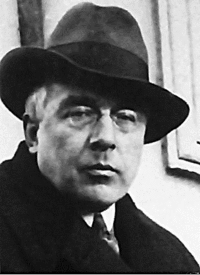
P.D. Ouspensky
Taken from “A New Model of the Universe” by P.D. Ouspensky:
On my departure I still admitted much that was fantastic in relation to schools. “Admitted” is perhaps too strong a word. I should say better that I dreamed about the possibility of a non-physical contact with schools, a contact, so to speak, “on another plane.” I could not explain it clearly, but it seemed to me that even the beginning of contact with a school may have a miraculous nature. 1 imagined, for example, the possibility of making contact with schools of the distant past, with schools of Pythagoras, with schools of Egypt, with the schools of those who built Notre-Dame, and so on.
MANY strange thoughts have always been evoked in me by the view from the top of the towers of Notre Dame. Looking down from these towers you feel that the real history of humanity, the history worth speaking of, is the history of the people who built Notre Dame and not that of those passing below. And you understand that these are two quite different histories. One history passes by in full view and, strictly speaking, is the history of crime, for if there were no crimes there would be no history. All the most important turning-points and stages of this history are marked by crimes; murders, acts of violence, robberies, wars, rebellions, massacres, tortures, executions. Fathers murdering children, children murdering fathers, brothers murdering one another, husbands murdering wives, wives murdering husbands, kings massacring subjects, subjects assassinating kings. This is one history, the history which everybody knows, the history which is taught in schools. The other history is the history which is known to very few.
For the majority it is not seen at all behind the history of crime. But what is created by this hidden history exists long afterwards, sometimes for many centuries, as does Notre Dame.
The visible history, the history proceeding on the surface, the history of crime, attributes to itself what the hidden history has created. But actually the visible history is always deceived by what the hidden history has created. So much has been written about the Cathedral of Notre Dame, and so little is actually known about it. One who has never tried to find out anything about it for himself, or to make something out of the material available, would never believe how little in fact is known about the building of the cathedral. It took many years to build; the dates when it was begun and when it was finished are known; the bishops who, in one way or another, contributed to this construction are also known, and so are the popes and kings of that time. But nothing has remained concerning the builders themselves with the exception of names, and even that seldom. 1 And no facts have remained concerning the schools which stood behind all that was created by that strange period.
It is known that there existed Schools of Builders. Of course they had to exist, for every master worked and ordinarily lived with his pupils. In this way painters worked, in this way sculptors worked. In this way, naturally, architects worked. But behind these individual schools stood other institutions of very complex origin. And these were not merely architectural schools or schools of masons. The building of cathedrals was part of a colossal and cleverly devised plan which permitted the existence of entirely free philosophical and psychological schools in the rude, absurd, cruel, superstitious, bigoted and scholastic Middle Ages. These schools have left us an immense heritage, almost all of which we have already wasted without understanding its meaning and value.
In the voluminous records of the church of Notre Dame, which go back beyond the 12th century, there is not a single word about the actual work of the construction of the cathedral. According to the chronicles of the period before the Gothic the libraries of monasteries were foil of descriptions of the construction of their buildings and of the biographies and praises of their builders. But with the coming of the Gothic period suddenly all became silent. Until the 12th century there is no mention of any of the architects.” (From a book by Viollet-le-Duc.) These schools, which built the ” Gothic ” cathedrals, concealed themselves so well that traces of them can now be found only by those who already know that such schools must have existed.
Certainly the Catholic Church of the 11th and 12th centuries, which already used torture and the stake for heretics and stifled all free thought, did not build Notre Dame. There is not the slightest doubt that for a time the Church was made an instrument for the preservation and propagation of the ideas of true Christianity, that is, of true religion or true knowledge, which were absolutely foreign to it. And there is nothing improbable in the fact that the whole scheme of the building of cathedrals and of the organisation of schools under cover of this building activity was created because of the growing ” heretic-mania ” in the Catholic Church and because the Church was rapidly losing those qualities which had made it a refuge for knowledge.
By the end of the first thousand years of the Christian era the monasteries had gathered all the science, all the knowledge, of that time. But the legalisation of the hunting and prosecution of heretics, and the approach of the Inquisition, made it impossible for knowledge to reside in monasteries. There was then found or, to speak more accurately, created, for this knowledge a new and convenient refuge. Knowledge left the monasteries and passed into Schools of Builders, Schools of Masons. The schools within presented a complex organisation and were divided into different degrees; this means that in every ” school of masons ” where all the sciences necessary for architects were taught there were inner schools in which the true meaning of religious allegories and symbols was explained and in which was studied ” esoteric philosophy ” or the science of the relations between God, man and the universe, that is, the very ” magic “, for a mere thought of which people were put on the rack and burnt at the stake.
Notre Dame has remained, and to this day guards and shows us the ideas of the schools and the ideas of the true ” freemasons “.
Such, for instance, is the tall, slender, pierced spire over the eastern part of the cathedral, from which the twelve Apostles, preceded by the apocalyptic beasts, are descending to the four comers of the world. The whole scenic effect which was undoubtedly a part of the builders’ design. The spire with the Apostles is an inseparable part of this view. You stand on the top of one of the big towers and look towards the east. The city, the houses, the river, the bridges, the tiny, microscopic people. . . . And not one of these people sees the spire, or sees the Teachers descending upon the earth preceded by the apocalyptic beasts. This is quite natural, because from there, from the earth, it is difficult to distinguish them. If you go there, to the embankment of the Seine, to the bridge, the Apostles will appear from there almost as small as the people appear from here, and they will merge into the details of the roof of the cathedral. They can be seen only if one knows of their existence, like so many other things in the world. But who cares to know? And the gargoyles? They are regarded either simply as an ornament, or as individual creations of different artists at different times. In actual fact, however, they are one of the most important features of the design of the whole building.
This design was very complex. To be more exact, it is not even one design, but several designs completing one another. The builders wished to put all their knowledge, all their ideas, into Notre Dame. You find there mathematics, astronomy; some very strange ideas of biology’ or ” evolution ” in the stone bushes, on which human heads grow, on the balustrade of the large platform under the flying buttresses. The gargoyles and other figures of Notre Dame transmit to us the psychological ideas of its builders, chiefly the idea of the complexity of the soul. These figures are the soul of Notre Dame, its different ” I “s: pensive, melancholy, watching, derisive, malignant, absorbed in themselves, devouring something, looking intensely into a distance invisible to us, as does the strange woman in the headdress of a nun, which can be seen above the capitals of the columns of a small turret high up on the south side of the cathedral. The gargoyles and all the other figures of Notre Dame possess one very strange property: beside them people cannot be drawn, painted or photographed; beside them people appear dead, expressionless stone images.
It is difficult to explain these ” I “s of Notre Dame; they must be felt, and they can be felt. But it is necessary to choose the time when Paris becomes quiet. This happens before daybreak, when it is not yet quite light but when it is already possible to distinguish some of these strange beings sleeping above. I remember such a night; it was before the war. I was making a short stay in Paris on the way to India and was wandering about the town for the last time. It was already growing light, and the air was becoming cold. The moon moved swiftly among the clouds. I walked round the whole cathedral. The huge massive towers stood as though on the alert. But I already understood their secret. And I knew that I was taking with me a firm conviction, which nothing could shake, that this exists, that is, that there is another history apart from the history of crime, and that there is another thought, which created Notre Dame and its figures. I was going to search for other traces of this thought, and I was sure that I should find them. Eight years passed before I saw Notre Dame again. These were the years of almost unprecedented commotion and destruction. And it seemed to me that something had changed in Notre Dame, as though it was beginning to have a presentiment of its approaching end.
During these years, which have written such brilliant pages into the history of crime, bombs dropped over Notre Dame, shells burst, and it was only by accident that Notre Dame did not share the fate of that wonderful fairy-tale of the twelfth century, Rheims Cathedral, which perished a victim of progress and civilisation. And when I went up the tower and again saw the descending Apostles I was struck by the vainness and almost complete useless-ness of attempts to teach people something they have no desire whatever to know. And again, as many times before, I could find only one argument against this, namely, that perhaps the aim both of the teaching of the Apostles and of the construction of Notre Dame was not to teach all the people, but only to transmit certain ideas to a few men through the ” space of time “. Modern science conquers space within the limits of the surface of the small earth. Esoteric science has conquered time, and it knows methods of transferring its ideas intact and of establishing communications between schools through hundreds and thousands of years.
(Submitted by Pam Rodolph, H.W., m. and Zoë Robinson, H.W., M.)
Some might quibble with what Ouspenski says here, since so much of what he discusses is the product of the Nineteenth Century renovation of Notre Dame by Eugène Viollet-le-Duc. But that renovation was painstakingly faithful to the original designs – or as close to them as could then be achieved. And besides, it’s more than possible that Viollet-le-Duc was himself a member of some sort of School.
Ouspenski speaks of “a colossal and cleverly devised plan” that has “left us an immense heritage”. Here are a couple of statistics that yield an idea of exactly the scale involved:
First, during the Gothic period, in France alone, more stone was quarried than in the entire history of Egypt – almost all to be used in the construction of cathedrals, churches, and other ecclesiastical buildings – most of which still stand to this day.
Second, taken as a percentage of gross domestic product, the various peoples of the Gothic period spent on cathedrals (and churches, etc.) what we today spend on weapons.
One final thought: If one were encoding knowledge for future generations, and one was using buildings as one’s vehicle, it would behoove one to build as many such buildings as possible, each embodying that knowledge, with only enough variation from one to the next to make each one distinguishable from the others – variations on a theme in other words. And such it is with Gothic cathedrals and churches…