
|
||
|
Monthly Archives: September 2018

“9-11 The World Has Changed: Yet Are the Answers Found in the Past” by Calvin Harris, H. W., M.
The World Has Changed: A continuing series of Conversation snippet by Calvin Harris, H. W., M. that includes compelling conversations between colleagues, students, lovers and friends on significant educational, social, literary and cultural themes
As a storyteller. a device used for saying something important that may have been missed. One of my favorite forms of storytelling is Music. I think of my friend Carver Cossey whose voice has touched thousands as well as Marion Bell. I think of Broadway and the Musical Theater that has helped many in times of distress and trouble.
9-11 was just such an event. But with the tragedy and tears, I will take a minute, this day. to think of what the past has told me of such times. Trust in the Humanity and Goodness that is in people. What strangers will do for strangers in the spirit of Love. I will spend a bit of today listening to the story of humanity. of mankind, of openness and kindness, it may not have made the news, but it is important that the story is told.
Thank you all that create sanctuary and hope in times of crisis and to those who tell the story in whatever way you can. My gratitude and Thanks – Calvin
Book: “Grammatical Man” by Jeremy Campbell
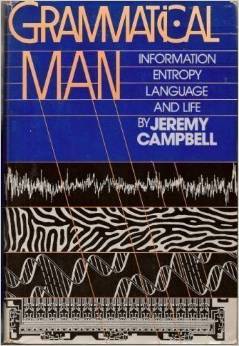
Grammatical Man: Information, Entropy, Language, and Life
By Jeremy Campbell
Grammatical Man is the first book to tell the story of information theory, how it arose with the development of radar during WW2, and how it evolved. It describes how the laws and discoveries of information theory now support controversial revisions to Darwinian evolution, begin to unravel the mysteries of language, memory and dreams, and stimulate provocative ideas in psychology, philosophy, art, music, computers and even the structure of society.
Perhaps its most fascinating and unexpected surprise is the suggestion the order and complexity may be as natural as disorder and disorganization. Contrary to the entropy principle, which implies that order is the exception and confusion the rule, information theory asserts that order and sense can indeed prevail against disorder and nonsense. From the simplest forms of organic life to the words used to express our most complex ideas, from our genes to our dreams, from microcomputers to telecommunications, virtually everything around us follows simple rules of information. Life and the material world, like language, remain “grammatical.” Grammatical man inhabits a grammatical universe.
(Submitted by Richard Branam)
Book: “The Leaderless Revolution” by Carne Ross

The Leaderless Revolution: How Ordinary People Will Take Power and Change Politics in the 21st Century by Carne Ross
“if people do not have responsibility, do not expect them to behave responsibly.”
― The Leaderless Revolution: How Ordinary People Will Take Power and Change Politics in the 21st Century
“In neo-classical economic theory, it is claimed without evidence that people are basically self-seeking, that they want above all the satisfaction of their material desires: what economists call “maximising utility”. The ultimate objective of mankind is economic growth, and that is maximized only through raw, and lightly regulated, competition. If the rewards of this system are spread unevenly, that is a necessary price. Others on the planet are to be regarded as either customers, competitors or factors of production. Effects upon the planet itself are mere “externalities” to the model, with no reckoning of the cost – at least for now. Nowhere in this analysis appears factors such as human cooperation, love, trust, compassion or hatred, curiosity or beauty. Nowhere appears the concept of meaning. What cannot be measured is ignored. But the trouble is that once our basic needs for shelter and food have been met, these factors may be the most important of all.”
― The Leaderless Revolution: How Ordinary People Will Take Power and Change Politics in the 21st Century
“Life is about means not ends. There is no utopia to be gained, there is no end-state that is static and eternal, once accomplished. This was one of the great lies of communism. Likewise, capitalism offers the great deception that thanks to its machinations everyone will be richer in the future, thus justifying gross inequality and humiliation today.”
― The Leaderless Revolution: How Ordinary People Will Take Power and Change Politics in the 21st Century
Why Do We Still Need Shamans?
Posted September 7, 2018 (theshiftnetwork.com)
By Kenn Day

Standing at the firelight’s periphery, the shaman has, through eons of time, served as both shield and intermediary between the community huddled around the fire and the vastness of the unknown. Today’s shaman still holds this position, but the nature of both community and the unknown have changed beyond recognition. Almost no one reading this lives in a tribal culture as a cohesive whole, and the unknown is defined as that which cannot be measured by science.
But we still peer into the darkness together, searching for connections between ourselves and our ancestors, the Earth, and each other. These same connections have defined more than 70,000 years of human existence, where the most important unit was the tribe, the clan, the whole — rather than the individual. It is only in the past few hundred years that this structure has broken down so far that those of us born into today’s Western cultures no longer know what it means to belong in the same way our ancestors did.
This shift from tribal consciousness — identifying as the group before the individual — to post-tribal culture has left us with an invisible wound, a deep yearning for connection, for union, for the immediate and palpable presence of our ancestors and the spirits that populate the world. This wound is invisible, because it rests beneath our conscious mind, out of sight of our experience of everyday life. Yet it manifests in every part of our lives, from parental/child disconnections to addiction and abusive relationships. We only sense an undefined hunger that drives us to seek solace in alcohol, drugs, or anything else that seems like it might be that for which we are starving. But nothing we reach for in this way can fill the void.
These are the needs that today call to the shaman. The need for connection; to know where we belong; to know where we come from; to feel we are a part of something larger than ourselves; the need of all these parts to realize themselves as one complete whole. When these universal human needs are not met, when we find ourselves instead feeding our hunger with addictions and self-abusive choices, we lose something of our humanity.
Years ago, I coined the term Post-Tribal Shamanism to define the shaman’s altered role in modern culture. Many traditional shamanic tools, like soul retrieval and energetic healing, still play an important role in the work of the post-tribal shaman. The focus of the work itself, however, has shifted…
In tribal cultures, the shaman maintains the health and cohesion of the tribe as a whole. Individuals are treated in service to the good of the community in addition to their personal wellbeing. The post-tribal shaman’s community consists of those individuals to whom they are in service. It is now the individual who needs to be supported, empowered, and healed, with the goal of restoring community as our wounds are addressed.
In soul retrieval, for example, the tribal shaman generally performs the retrieval for the client, journeying to the location of the fragment, capturing it, and “blowing” it back into the client’s body. In our current culture of extreme individuation, it can be much more effective for the shaman to engage the client in the process, to bring them on the journey and have them experience directly the return of missing soul fragments. It is also important for the client to recognize they have done the work and are responsible for integrating the retrieved parts of the soul back into the self.
The post-tribal shaman still stands at the edge of the light, though now it is cast by computer screens, mobile phones, and LED lights. The darkness has also changed. Becoming deeper and less easily navigated, even by the light of day. As long as our need for wholeness exists, there will be shamans who call us into the sacred space where we all feel a profound link with each other, the Earth, the Divine, and our ancestors — and where we rediscover the healing power of deep connection with the self.
 |
Kenn Day is a nationally recognized lecturer, educator, and author with over 25 years’ experience exploring the mysteries of the human spirit. He founded the Foundation for Post-Tribal Shamanic Studies and the practice of Post-Tribal Shamanism, developing the essential teachings of shamanic practice for those who grew up in the highly individualized culture of the West. Post-Tribal Shamanic Studies espouse that the reality models and techniques of traditional shamanism can be effectively adapted for use in our post-technological society. |
The Difficult Art of Giving Space in Love: Rilke on Freedom, Togetherness, and the Secret to a Good Marriage
By Maria Popova (brainpickings.org)

“Love one another but make not a bond of love: let it rather be a moving sea between the shores of your souls,”the great Lebanese-American poet, philosopher, and painter counseled in what remains the finest advice on the secret to a loving and lasting relationship.
Our paradoxical longing for intimacy and independence is a diamagnetic force — it pulls us toward togetherness and simultaneously repels us from it with a mighty magnet that, if unskillfully handled, can rupture a relationship and break a heart. Under this unforgiving magnetism, it becomes an act of superhuman strength and self-transcendence to give space to the other when all one wants is closeness. And yet this difficult act may be the very thing — perhaps the only thing — that saves the relationship over and over.
Two decades before Gibran, at the dawn of the twentieth century, another great poet of abiding insight into the turbulences of the human heart contemplated this predicament. In a letter to the 19-year-old cadet and budding poet Franz Xaver Kappus, Rainer Maria Rilke (December 4, 1875–December 29, 1926) offered some spectacular advice on managing the bipolar pull of autonomy and togetherness in a way that assures the longevity of any close bond and protects love from self-destruction. The passages, originally published in Rilke’s classic Letters to a Young Poet — the record of his six-year correspondence with Kappus, which also gave us Rilke’s timeless wisdom on the lonely patience of creative work, what it takes to be an artist, why we read, and how hardship enlarges us — appear in the wonderful poetry and prose anthology Rilke on Love and Other Difficulties: Translations and Considerations (public library), selected and translated by the scholar and philosopher John Mood.

1902 portrait of Rainer Maria Rilke by Helmuth Westhoff, Rilke’s brother-in-law
Rilke writes to his young correspondent:
I hold this to be the highest task of a bond between two people: that each should stand guard over the solitude of the other. For, if it lies in the nature of indifference and of the crowd to recognize no solitude, then love and friendship are there for the purpose of continually providing the opportunity for solitude. And only those are the true sharings which rhythmically interrupt periods of deep isolation.
A century before psychologist Esther Perel asserted in her landmark book on the central paradox of relationships that “love rests on two pillars: surrender and autonomy” because “our need for togetherness exists alongside our need for separateness,” Rilke considers how our cultural constructs around what it means to be coupled obstruct happiness in union:
Therefore this too must be the standard for rejection or choice: whether one is willing to stand guard over the solitude of a person and whether one is inclined to set this same person at the gate of one’s own solitude, of which he learns only through that which steps, festively clothed, out of the great darkness.

Illustration from An ABZ of Love, Kurt Vonnegut’s favorite vintage Danish guide to sexuality
This principle, Rilke points out, holds true not only in marriage but in any close relationship and any bond desired to last a lifetime:
Two millennia after Epictetus offered the Stoic cure for heartbreak in the recognition of the temporality and flux of all things, Rilke adds:
The outliers impervious to this supreme challenge of love are rare, Rilke notes; for the rest of us, there is only the hard, necessary work of love:
[…]
For one human being to love another: that is perhaps the most difficult of all our tasks, the ultimate, the last test and proof, the work for which all other work is but preparation.
Complement this particular portion of the altogether beautiful and healing Rilke on Love and Other Difficulties with Anna Dostoyevskaya on the secret to a happy marriage, Virginia Woolf on what makes love last, and Kahlil Gibran on the courage to weather the uncertainties of love, then revisit Rilke on inspiration and the combinatorial nature of creativity.
SUNDAY NIGHT TRANSLATION GROUP – 9/9/18
Translators: Mike Zonta, Melissa Goodnight, Richard Branam
SENSE TESTIMONY: Heart inflammation may cause stress and disrupt circulation of forthcoming good.
5th Step Conclusions:
1) One Infinite Consciousness Beingness, the authentic fundamental core essence of All, is always already completely available and accessible — making perfect ease and wellbeing the constant present goodness.
2) The function of Truth is the unstoppable, unpreventable, never defensive, harmonious pressure of heartfelt enthusiasm.
3) Consciousness Awareness Being Truth, Realizing its” own Intimately resonating Cordiality, of the Hearts’ Essential thinking, feeling Dynamic; This streaming of Paradisaical Flamboyant Innocence, Omnipotently Enrapturing Its’ own I am I, Individuated Iso-Morphed Peri: Equaling Its’ Autismically Instinctive Pleasuring Principle.
“The World Has Changed: A continuing series of Conversation snippet” from Calvin Harris, H. W., M.
The World Has Changed: A continuing series of Conversation snippet from Calvin Harris, H. W., M. that includes compelling conversations between colleagues, students, lovers and friends on significant educational, social, literary and cultural themes.
A note that I had received, that had been written some years back:
Calvin:
I’ve been paying a lot of attention to Desmond Tutu’s “Truth and Reconciliation” A program, which is a real mirror of RHS on a cultural scale — find out what happened; tell the truth and place the blame correctly; react with pain, horror, etc.; recognize
the validity of those feelings; realize that we still have our lives and our hearts; and then start figuring out how to go on from there and work together to make the world a better place for everyone.
Large-scale RHS from a High Church aborigine. Strange world, ain’t it?
– Janet Cornwell H. W.
TRANSLATION ADVENTURE – 9/9/18
Translators: Alex Gambeau, Bo Lebo, Ned Henry, Heather Williams
SENSE TESTIMONY: Language divides us.
5th Step Conclusions:
-
Truth is the eternal language that communicates Love, Joy and the pursuit of Happiness.
-
Truth is constant connection and ever present, undivided recognition of our ONENESS.
-
Consciousness conscious of consciousness celebrates the diversity of connectedness and creates understanding.
-
AHA is the language that unites us.