Christina Rossetti: Queer writer of Christmas carols and lesbian poetry


Christina Georgina Rossetti was a 19th-century English poet whose work ranged from Christmas carols to sensuous lesbian love poetry. A devout Christian who never married, she has been called a “queer virgin” and “gay mystic.” Her feast day is April 27 on the Episcopal and Church of England calendars.

Portrait of Christina Rossetti
by Dante Gabriel Rossetti

Many consider her to be one of Britain’s greatest Victorian poets. Rossetti’s best-known works are the Christmas carol “In the Bleak Midwinter” and “Goblin Market,” a surprisingly erotic poem about the redemptive love between two sisters who overcome temptation by goblins. The homoeroticism is unmistakable in verses such as these:

She cried, “…Did you miss me?
Come and kiss me.
Never mind my bruises,
Hug me, kiss me, suck my juices
Squeez’d from goblin fruits for you,
Goblin pulp and goblin dew.
Eat me, drink me, love me…”

She clung about her sister,
Kiss’d and kiss’d and kiss’d her…
She kiss’d and kiss’d her with a hungry mouth.

Some of these verses were set to music in a choral piece commissioned by the Sydney Gay and Lesbian Choir: “Heartland” by Matthew Hindson.

There is no direct evidence that Rossetti was sexually involved with another woman, but historian Rictor Norton reports that her brother destroyed her love poems addressed to women when he edited her poetry for publication. Rossetti is included in “Essential Gay Mystics” by Andrew Harvey.  A comprehensive chapter titled “Christina Rossetti: The Female Queer Virgin” appears in “Same Sex Desire in Victorian Religious Culture” by Frederick S. Roden. Rossetti is also important to feminist scholars who reclaimed her in the 1980s and 1990s as they sought women’s voices hidden in the church’s patriarchal past.

Rossetti (Dec. 5, 1830 – Dec. 29, 1894) was born in London as the youngest child in an artistic family. Her brother Dante Gabriel Rossetti became a famous Pre-Raphaelite poet and artist. Encouraged by her family, she began writing and dating her poems starting at age 12.

When Rossetti was 14 she started experiencing bouts of illness and depression and became deeply involved in the Anglo-Catholic Movement of the Church of England. The rest of her life would be shaped by prolonged illness and passionate religious devotion. She broke off marriage engagements with two different men on religious grounds. She stayed single, living with her mother and aunt for most of her life.

Christina posed
for this Annunciation
by Dante Gabriel Rossetti

During this period she served as the model for the Virgin Mary in a couple of her brother’s most famous paintings, including his 1850 vision of the Annunciation, “Ecce Ancilla Domini” (“Behold the Handmaid of God.”)

Starting in 1859, Rossetti worked for 10 years as a volunteer at the St. Mary Magdalene “house of charity” in Highgate, a shelter for unwed mothers and former prostitutes run by Anglican nuns. Some suggest that “Goblin Market” was inspired by and/or written for the “fallen women” she met there.

Goblin Market” was published in 1862, when Rossetti was 31. The poem is about Laura and Lizzie, two sisters who live alone together and share one bed. They sleep as a couple, in Rossetti’s vivid words:

Cheek to cheek and breast to breast
Lock’d together in one nest.

But “goblin men” tempt them with luscious forbidden fruit and Laura succumbs. After one night of indulgence she can no longer find the goblins and begins wasting away. Desperate to help her sister, Lizzie tries to buy fruit from the goblins, but they refuse and try to make her eat the fruit. She resists even when they attack and try to force the fruit into her mouth. Lizzie, drenched in fruit juice and pulp, returns home and invites Laura to lick the juices from her in the verses quoted earlier. The juicy kisses revive Laura and the two sisters go on to lead long lives as wives and mothers.

“Goblin Market” can be read as an innocent childhood nursery rhyme, a warning about the dangers of sexuality, a feminist critique of marriage or a Christian allegory. Lizzie becomes a Christ figure who sacrifices to save her sister from sin and gives life with her Eucharistic invitation to “Eat me, drink me, love me…” The two sisters of “Goblin Market” are often interpreted as lesbian lovers, which means that Lizzie can justifiably be interpreted as a lesbian Christ.

Rossetti was an important inspiration to a younger English poet who is also frequently considered queer because of his homoerotic themes: Gerard Manley Hopkins.  Fourteen years younger than her, he was a Catholic convert and a priest.  They shared a passion for religious poetry and met in person once, in 1864.

In 1872 Rossetti was diagnosed with Graves Disease, an auto-immune thyroid disorder, which caused her to spend her last 15 years as a recluse in her home. She died of cancer on Dec. 29, 1894 at age 64.

She wrote the words to “In the Bleak Midwinter” in 1872 in response to a request from Scribner’s Magazine for a Christmas poem. It was published posthumously in 1904 and became a popular carol after composer Gustav Holst set it to music in 1906. Her poem “Love Came Down at Christmas” (1885) is also a well known carol.  “In the Bleak Midwinter” continues to be sung frequently in churches, by choirs, and on recordings by artists such as Sarah McLaughlin (video below), Julie Andrews, Loreena McKennitt, Susan Boyle and James Taylor. The haunting song includes these verses:

In the bleak mid-winter
Frosty wind made moan,
Earth stood hard as iron,
Water like a stone;
Snow had fallen, snow on snow,
Snow on snow,
In the bleak mid-winter
Long ago.
Our God, Heaven cannot hold Him
Nor earth sustain;
Heaven and earth shall flee away
When He comes to reign:
In the bleak mid-winter
A stable-place sufficed
The Lord God Almighty,
Jesus Christ….

Enough for Him, whom cherubim
Worship night and day,
A breastful of milk,
And a mangerful of hay;
Enough for Him, whom angels
Fall down before,
The ox and ass and camel
Which adore.

Angels and archangels
May have gathered there,
Cherubim and seraphim
Thronged the air –
But only His mother
In her maiden bliss
Worshipped the Beloved
With a kiss.

What can I give Him,
Poor as I am?
If I were a shepherd
I would bring a lamb,
If I were a wise man
I would do my part,
Yet what I can I give Him,
Give my heart.

The Episcopal Church devotes a feast day to Christina Rossetti on April 27 with this official prayer:

O God, whom heaven cannot hold, you inspired Christina Rossetti to express the mystery of the Incarnation through her poems: Help us to follow her example in giving our hearts to Christ, who is love; and who is alive and reigns with you and the Holy Spirit, one God, in glory everlasting. Amen.

Rossetti herself may well have felt ambivalent about being honored by the church or outed as a queer. She shared her own thoughts for posterity in her poem “When I am dead, my dearest” (1862):

When I am dead, my dearest,
Sing no sad songs for me;
Plant thou no roses at my head,
Nor shady cypress tree:
Be the green grass above me
With showers and dewdrops wet;
And if thou wilt, remember,
And if thou wilt, forget.
I shall not see the shadows,
I shall not feel the rain;
I shall not hear the nightingale
Sing on, as if in pain:
And dreaming through the twilight
That doth not rise nor set,
Haply I may remember,
And haply may forget.

___
Related links:

The Many Weird and Wonderful Illustrations for Christina Rossetti’s Goblin Market (Unpretentious Blabberings)

___
Top image credit:
Cover illustration for Christina Rossetti’s “Goblin Market and Other Poems” (1862) by Dante Gabriel Rossetti___
This post is part of the LGBTQ Saints series by Kittredge Cherry. Traditional and alternative saints, people in the Bible, LGBTQ martyrs, authors, theologians, religious leaders, artists, deities and other figures of special interest to lesbian, gay, bisexual and transgender and queer (LGBTQ) people and our allies are covered.

Copyright © Kittredge Cherry. All rights reserved.
Qspirit.net presents the Jesus in Love Blog on LGBTQ spirituality.

Kittredge Cherry

Kittredge Cherry

Founder at Q Spirit
Kittredge Cherry is a lesbian Christian author who writes regularly about LGBTQ spirituality.She holds degrees in religion, journalism and art history.She was ordained by Metropolitan Community Churches and served as its national ecumenical officer, advocating for LGBTQ rights at the National Council of Churches and World Council of Churches.

Book: “The Implacable Hunter” by Gerald Kersh

The Implacable Hunter

The Implacable Hunter

by Gerald Kersh

‘[This] is the story of the beginning and the end of St Paul, that most complicated and worrying of all the saints. The narrator is Diomed, a colonial officer stationed at Tarsus, enlightened, intelligent, a great fraterniser with the patrician natives, [who] sends the strange young Jew to persecute the Nazarenes… [Kersh brings] a highly concentrated area of Roman colonial history to very real life – the ornate wine-cup, the crapulous cold fruit-juice at dawn, dust on a sandal… King Jesus is here, all the time… the fly-itch nuisance to the Empire that wakes its prefects up in nightmare… This is a masterly book, full of live people and a live age, live language, too… We may adjudge Mr Kersh, after reading The Implaccable Hunter, to be now at the height of his powers.’

–Anthony Burgess, Yorkshire Post, 1961

(submitted by Richard Branam)

“The (missed) Perceptions that Leads to Penis Envy in Men” by Calvin Harris, H.W.,M.

May 5, 2018 (siteofcontact.net)

It seems that sooner or later that within a conversation about masculinity the subject of the Penis will pop up and rear its head. Since all things Masculine has been a subject of conversations, reading, and writing with me lately I am not surprise the subject of Penis came up. Since this is a difficult subject to discuss, some levity has been added in this post as “puns” disguised as  “Freudian Slips.” We learn through humor as much as through struggle.

Neptunes Penis, Bologa, Italy

I am not new to the subject of men and their relationships to their penis, but in this context, of Penis envy, two situation occurred that tip the balance and moved me to write. One situation is a repeating occurrence that happens, and the second situation occurred in a relax few friends at lunch gathering. I was taken aback by the rise of emotion and  in heat of the conversation over the despair at the lost of foreskin and the possible pleasure missed as a result of that. At the time, I felt pieces were missing to the dialogue presented at the lunch conversation and needed to be put in a larger context along with Health, Love, Sexuality, Sensuality, and Relationship.

I am not surprised with the notion about the penis and its importance in receiving pleasure in some men’s lives (it is the most interesting thing they do), yet I am surprise as to the absence of any mention of other components to pleasuring oneself such as through other erogenous zones about the body, or to healthy relationships either with the self or anyone else? Well back to my story.

The latest instance for me in the Penis envy scenario occurred three weeks back at this pub, when an associate I don’t know well, turns to me and says: “How” lucky I was to be born African American!, with that look of envy on his glassy eyed face, and you know that he didn’t mean I was born with a silver spoon in my mouth. As I looked at him, you could just picture, in his minds eye, him in that 1974 scene as the Monster with Madeline Kahn, from the  Young Frankenstein Movie – He sees himself toting an enormous schwanzstucker. You can hear Marty Feldman saying to him – “You are going to be very Popular.”  Unfortunately, I am looking at him and thinking maybe, He should sober up before meeting his date, that sexual encounter he describes he wants with such vigor ( upturn  shot glass after shot) and yet his fear of self prophecy of being dissipated, failing  his date, by being a rudely inebriated mess that has repeatedly fallen asleep mid coitus.  Personally I am thinking she declines sex with him, and considering an android companion that talks, learns and satisfies sexual desires on que.

Sizing each other up

The second instance of professed envy came during a lunch meet up of several friends, when  the discussion turned to an article by Van Barrett, an author and blog writer. He had written a blog on the envy of the uncircumcised penises.  One of the men felt a strong need to defend Barrett’s  position, for it turn out, that he too longed for and desired foreskin.  A wish not to have been circumcised.

Van Barrett blog had come about due to one of his fictional book. his feeling  was so prevalent in the book that a reader wrote to question his sexual gender. The article he wrote in  response is found at the end of this blog.

As to Mr. Barrett and the Lunch partner,  bemoaning lost of foreskin – It sounded like “the grass is always greener.” To give the other side of the coin, we turn to – Hayley MacMillen, who did an article on the problems that Uncircumcised men face in the U. S. in her article in Cosmopolitan Magazine, Oct 5, 2016. The magazine titled – 9 Things Uncircumcised Guys Want You to Know.

Cosmopolitan quoted one interviewee, named only as Henry, as saying: “that while he’s open about not being circumcised with his partners, it’s a different story with his guy friends. “I never talk about it with other guys,” he says, and even though “guys talk about their dicks all the time … fear is absolutely a factor because being different is stigmatized.”

WHAT IS KEY HERE IS  ‘PERCEPTION’ – “WHAT ARE MEN FOCUSING ON WHEN IT COMES TO  PLEASURABLE SEX?”

Most times Male banter is about  “getting off,” not about having an experience that is a satisfying sensual-sexual experience.  This maybe due to Porn, or the speed of living life, or the unwillingness of men to make time for themselves to create an environment for true sexual pleasure. There is a large majority of men that  have concluded that all sexual pleasure is encapsulated in the manipulation of the skin that surrounds their penis, and they want to work it until, in the jargon of the day, you bust a nut – i.e. get off.

Given how much symbolic baggage this body part carries, it’s no wonder the misconceptions about it. To enlarge this conversation, as difficult as it is, it is  yet worthwhile.  Beginning with the misperception that your penis is ‘”The” Sex Organ’, if you think that is so, you have completely missed out on your Biggest Sex Organ experience, which is the Skin that covers your entire body coupled with the creativity  of the Consciousness of the Mind …. roll that around for a while, you may find that statement to be correct. Now that being said, think then how much sense- satiable pleasure you have missed out on, if you are not activating your whole-body/mind experience?

Dr. Debby Herbenick, a sex researcher, educator, and author as wells as the Co-Director of the Center for Sexual Health Promotion at Indiana University School of Public Health-Bloomington & the Kinsey Institute for Research in Sex, Gender and Reproduction.  From her research findings, she states: “Often when people think about the pleasures of sex, they think about genital arousal (e.g., erections or vaginal warmth or lubrication) or orgasm. While I certainly wouldn’t argue these, I would add that one of the most pleasurable parts of sexual intimacy is the experience of touching and being touched all over.

Decades of research have shown that humans…. need touch…. not only to survive, but to thrive. Touch can have a biological effect that releases oxytocin (which has often been referred to as the “Cuddle Effect”) Touch can have psychological effects of helping people to feel loved, happy, accepted, calm or reassured.

In sex, we have the uncommon opportunity to touch and be touched all over our bodies. … press bodies against each other in a hug or, while kissing or in one of many possible sexual positions, they get to experience an enormous amount of skin closeness. They may touch cheeks, lips, chests, legs, and feel… hand along their back, thighs, or stomach. There is, after all, something qualitatively… intimate in the experience of being exposed – physically, and often emotionally.” [sexual dilation].

From that point of view then the almighty penis becomes just another body part, vital but still one among many body parts in a mind body- somatic sexual dilation.  I’d like you to entertain the notion of making time for the sex experience (or putting sex on maximum drive).  Think of sex as something you gift to yourself be it alone or with a partner. Permit yourself to be mindful of being naked, of touching all over as much you can. To relax into an exploration that promotes sensual enjoyment, an inner awareness of intimacy and dilation.  Have an experience of sexuality that does not start nor stop (uncircumcised or circumcised) with those few centimeters of skin that extends over an Erect Penile Length and Circumference but engages a full mind-body (somatic) experience.  Then and only then can the identity of Sexuality be disengaged from the notion that it is a control of genitals. You can begin then to stop comparing or lamenting about genitalia, what you have or do not have and start enjoying the mind-body (somatic) wholeness that you truly are.

I recommend the following four books, they can be helpful in your striving for control and perception of a healthier, loving, and more pleasurably experience during sex.

The Penis Book Photo.jpg

The Penis Book: A Doctor’s Complete Guide to the Penis―From Size to Function and Everything in Between” by Aaron Spitz MD.

Manhood: The Rise and Fall of the Penis” by Mels van Driel, Paul Vincent (Translator)

Sex Made Easy: Your Awkward Questions Answered—For Better, Smarter, Amazing Sex” by Dr. Debby Herbenick.

Anal Pleasuring (A Good in Bed Guide)” by Dr. Debby Herbenick.
Now here is the article that created weeks of discussion, debate and finally my blog.  I would be interested on your take on this,  so jot me a note.

Van Barrett, Are You Really A Man?

 An article by Van Barrett  July 28, 2016 vanbarrett.com

I had an e-mail recently from a reader of my book Seven Nights who was quite convinced that I am secretly a female, hiding behind a male pen name — and they were not too happy about it, either!

I must be a female, they wrote to me, because I write about men with circumcised cocks and men with uncut cocks — therefore, it’s a given that I’m writing about something I can’t possibly know or have firsthand experience of. Right? From there, it’s surely a small leap of logic to assume that I actually know nothing about what it is to have a cock, how they work and what they feel like, because I’m just a woman making crap up as I go. Insert eye roll here.

So? What say you, Van Barrett?

I’ll give you the answer to this burning question in a moment! But first I wanna share a personal anecdote.

I was in the seventh grade when I first had to take a ‘lifestyle’ class. I forget the exact name of it — something like “health and lifestyle” — but whatever, you get the gist. It’s the sort of course where you learn about balancing a checkbook and how to eat healthy and oh, oh gosh, (*cheeks blush*) human anatomy and sexuality. So that was the first time, age 13, that I’d had any sort of formal sex education.

And here’s where I should point out that some form of sex-ed probably should’ve come a lot sooner, as I remember riding the school bus home in the 4th grade with my best friend. Curious about sex, we looked up the word ‘sperm’ in the dictionary. We’d both heard this term, this magical sperm before, and we knew that it was related in some way to sex. When we read the definition, we looked at each other with puzzled expressions. Embarrassingly, I concluded that a sperm must be the head of your cock, and it detached from the shaft when the moment was right. Cough. We had trouble wrapping our brains around how there could possibly be some ~100 million more cock-head sperms just waiting around in our nuts to be ejaculated. Fun image, right? Clearly, something didn’t add up, and we still had no idea what a sperm was.

… Anyhow, I digress.

It was because of this lifestyle class in 7th grade that I first learned of the concept of circumcision. I’d never heard it before. I think we glanced over it and class and I didn’t give it much thought. It wasn’t until a couple days later, when I was hanging with a friend of mine, that it came up again.

My friend was uncircumcised. He gloated about being intact, he bragged about how uncut men statistically are said to have better orgasms and better sex and their partners report being more pleased. He asked me if I was uncircumcised. I had no idea! Again, I’d never heard this word before our class and even then, it didn’t seem like it applied to me. My penis seemed to work fine, and it didn’t look cut up, so why bother, right? But based on all the stats he told me, I sure hoped I hadn’t been cut!

greekwrestlers3.jpg

But I wasn’t sure. I asked my friend to describe what a circumcision looked like. There were no suitable pictures or illustrations in our textbook for me to get the idea. He kept saying something along the lines of, “c’mon, this isn’t hard — it either looks like a bell or like it has a turtleneck that can cover the whole thing up! Which one is it?”

And still I was truly stumped. But more than that, I was a little frazzled. This idea that I might have been altered as a baby … without my knowledge or consent … that resulted in a less fulfilling sex life?

“No way,” I protested. “It looks fine. It’s totally natural. It doesn’t look like it was hurt.”

He wanted to see it: he said he’d tell me if it was or not. A shy kid in my youth, I said no way. So we opted to look at my newborn baby pictures instead.

“Dude,” he laughed. “You’re circumcised, alright. See that? That’s the head of your dick and it’s not covered. That’s a circumcision, Van.”

So it was. The realization set in immediately: I had a circumcised penis.

Was I crushed? Was I disappointed?

I’m sure I was — on some level. But not a consciously-available level. That would probably require more self-awareness than a 13-year-old possessed. Instead, I adopted a psychological tool more fitting for a teen: indignant anger.

“Yeah, well, everyone says a circumcised penis looks better!” I gloated right back at him. “And it’s cleaner, too!”

Then we’d argue back and forth about who had the better and the best pleasure-giving penis. It got pretty heated — and we even wrestled and threw punches over the debate. Yeah … 13 year olds … what can you really say?

Okay, to give some perspective as to why I’m sharing this story with you — it took years for me to process the emotions I’ve had over the fact that I was circumcised. As I aged and became an adult, I thankfully dropped that self-defense mechanism of “nah nah nah boo boo, my cock is better than yours!” and I started to think of it differently.

It was kinda fucked up, after all, that I’d been robbed of some level of sensitivity down there to the tune of 20,000 nerve endings! I’d never asked for it and I probably wouldn’t have, if given the chance. I also began to see uncut cocks in a different light. Hell, they started to look kinda pretty — and that foreskin sure looked fun to play with. I was sad, angry, and depressed over what had been taken from me.

*Lifts needle from the record*

I just want to stop here and say that I don’t want to make any parents out there feel bad — that’s not my goal at all! I understand why my parents did it, and I don’t begrudge them for it at all. There’s just so much information out there, and societal customs and so on — it’s hard to make any sense of it sometimes.

But future parents, please do educate yourself about this topic before you make the decision! And if you still choose to circumcise your kids, that’s fine, that’s your choice and I wouldn’t give anyone a hard time for it. But just educate yourself because there’s a lot to learn and it’s one hell of an interesting area to research. E.g., did you know that John Harvey Kellogg, the doctor who pushed for circumcisions in the US [and yes, the cereal man], also wanted females to be circumcised? Yup — he wanted to pour carbolic acid on the clitorises of newborn girls. Lucky for all you ladies, that one didn’t catch on.

Thankfully, this story isn’t all sadness and depression. So, it was back in 2010 when I discovered that a man can actually restore his foreskin. It’s not a surgical procedure — it’s done through applied tension to the skin over a long period of time (2-5 years). It can be as simple as using your hands to tug and stretch the skin. Stretched to its physical limit, cellular mitosis takes over and the skin cells begin to duplicate. It takes a while, but you can absolutely grow your foreskin back.

Okay, so you’ll never be exactly the way you were prior to getting cut, of course. Some nerves endings are permanently lost. But it’s a big improvement, with a fuller spectrum of pleasures and sensations that simply weren’t available before.

So, yes, I write characters with cut and uncut dicks, because I’ve personally been both. I know what it’s like to be cut — the contrived sense of superiority over what is actually our natural form, the repressed anger, the jealousy, etc. I also know what it’s like to have a foreskin now — and it’s made me so much more sensitive. I also know how this topic is taboo, and a lot of people don’t like to think or talk about it at all. I’ve been called names just for going on this journey of restoring. Clearly, there’s a lot of emotional trauma swirling around this topic. It’s not an easy one for people to deal with. I get that.

So you’ve probably figured by now that in my book Seven Nights, Austin’s ‘jealousy’ and fawning over Cedar’s uncut cock comes from a deeply personal place for me. (Let’s just add an unofficial line to the epilogue: Austin, inspired by Cedar, began the journey of restoring his foreskin. Yay!)

If anyone wants more information about this, feel free to leave a comment or drop me an e-mail. Obviously, it’s something I’m personally invested in and passionate about, and believe me, I have a lot more to say.

For any guys out there, who want to get started on the journey of restoring, I’d recommend starting with the Foreskin Restoration forum on reddit. I say journey because it takes time — and it will require you to be dedicated and patient. But it’s worth it, in my experience.

Sooo, to answer the original question that prompted this blog post — yes, I’m actually a man. Shocking plot twist, eh?

SiteofContact can be reached for comments, information, or appointments at calvin2talk@gmail.com

Theodore Roosevelt on the Cowardice of Cynicism and the Courage to Create Rather Than Criticize

By Maria Popova (brainpickings.org)

“There is nothing quite so tragic as a young cynic,” Maya Angelou wrote in contemplating courage in the face of evil“because it means the person has gone from knowing nothing to believing nothing.”

How to prevent that cultural tragedy, which poisons the heart of a just and democratic society, is what Theodore Roosevelt (October 27, 1858–January 6, 1919) examined when he took the podium at the Sorbonne in Paris on April 23 of 1910 to deliver one of the most powerful, rousing, and timelessly insightful speeches ever given, originally titled “Citizenship in a Republic” and later included under the title “Duties of the Citizen” in the 1920 volume Roosevelt’s Writings (public library).

Theodore Roosevelt

A century before Caitlin Moran cautioned that “cynicism scours through a culture like bleach, wiping out millions of small, seedling ideas,” Roosevelt admonishes against “that queer and cheap temptation” to be cynical, and writes:

The poorest way to face life is to face it with a sneer. There are many men who feel a kind of twister pride in cynicism; there are many who confine themselves to criticism of the way others do what they themselves dare not even attempt. There is no more unhealthy being, no man less worthy of respect, than he who either really holds, or feigns to hold, an attitude of sneering disbelief toward all that is great and lofty, whether in achievement or in that noble effort which, even if it fails, comes to second achievement. A cynical habit of thought and speech, a readiness to criticise work which the critic himself never tries to perform, an intellectual aloofness which will not accept contact with life’s realities — all these are marks, not as the possessor would fain to think, of superiority but of weakness. They mark the men unfit to bear their part painfully in the stern strife of living, who seek, in the affection of contempt for the achievements of others, to hide from others and from themselves in their own weakness. The rôle is easy; there is none easier, save only the rôle of the man who sneers alike at both criticism and performance.
One of the tendencies I find most troubling in contemporary culture is that of mistaking cynicism for critical thinking. This confusion seeds a pernicious strain of unconstructive and lazily destructive opprobrium. Amid this epidemic of self-appointed critics, it becomes harder and harder to remember just how right Bertrand Russell was when he asserted nearly a century ago that “construction and destruction alike satisfy the will to power, but construction is more difficult as a rule, and therefore gives more satisfaction to the person who can achieve it.”

With an eye to those lazy critics — the dead weight of society — Roosevelt offers:

It is not the critic who counts; not the man who points out how the strong man stumbles, or where the doer of deeds could have done them better. The credit belongs to the man who is actually in the arena, whose face is marred by dust and sweat and blood; who strives valiantly; who errs, who comes short again and again, because there is no effort without error and shortcoming; but who does actually strive to do the deeds; who knows great enthusiasms, the great devotions; who spends himself in a worthy cause; who at the best knows in the end the triumph of high achievement, and who at the worst, if he fails, at least fails while daring greatly, so that his place shall never be with those cold and timid souls who neither know victory nor defeat… The man who does nothing cuts the same sordid figure in the pages of history, whether he be a cynic, or fop, or voluptuary. There is little use for the being whose tepid soul knows nothing of great and generous emotion, of the high pride, the stern belief, the lofty enthusiasm, of the men who quell the storm and ride the thunder.

The entire twenty-seven-page speech, found in Roosevelt’s Writings and on par with JFK’s superb speech on the artist’s role in society, is a masterpiece of thought and feeling, replete with insight into what it means to be a good citizen, a good leader, and a complete human being. Complement this particular fragment with Leonard Bernstein on the countercultural courage of resisting cynicism, Goethe on the only criticism worth voicing, and philosopher Daniel Dennett on how to criticize with kindness, then revisit Eleanor Roosevelt on how uncynical personal conviction powers social change.

TED talk: “Why you don’t like the sound of your own voice”


Your voice is indistinguishable from how other people see you, but your relationship with it is far from obvious. Rébecca Kleinberger studies how we use and understand our voices and the voices of others. She explains why you may not like the sound of your own voice on recordings, the differences between your outward, inward and inner voices — and the extraordinary things you communicate without being aware of it.

This talk was presented to a local audience at TEDxBeaconStreet, an independent event. TED’s editors chose to feature it for you.

ABOUT THE SPEAKER
Rébecca Kleinberger · Voice expert
Rébecca Kleinberger is a voice expert pursuing research as a PhD candidate in the MIT Media Lab’s Opera of the Future group.

SUNDAY NIGHT TRANSLATION GROUP — MAY 6, 2018

Translation is a 5-step system of syllogistic reasoning using words and their meanings and histories to transform the testimony of the senses and uncover the underlying timeless reality of Being/Consciousness.

Translators:  Hanz Bolen, Melissa Goodnight, Richard Branam, Mike Zonta.

Sense testimony:  Family can be a source of hurt, attention deficit, loss, and harm.

Conclusions:

1)  Truth is all attending to all, the sole, invulnerable risen Christ, abstract and indestructible, totally free from sorrow, grief, burden, loss or harm.
2)  One Infinite, Consciousness Beingness, That I AM, is the optimal origination of boundless benefaction, bestowing the quintessential blessing of purposeful awareness on all it’s numberless kin.
3)  I am I is the Self Evident Integrity Graciously Attending Soundly Sourcing Each and Every Individuation of Being I am. ——– Consciousness is the Complete Gracious Attentive Agreeable Source of all there is.
4)  Truth is ALL ATTENTIVE, sensuousness, intimately androgynous interactions’ effectively masterful kinship. its’ own best friend, resourcefully limitless, genuinely nutritious relationships’. constantly achieving its’ tension oriented purposes.

The Sunday Night Translation Group meets at 7pm Pacific time via Skype. There is also a Sunday morning Translation group which meets at 7am Pacific time via GoToMeeting.com.  See Upcoming Events on the BB to join, or start a group of your own.

The 10 best books on AI

Article Image
GERARD JULIEN/AFP/Getty Images


Artificial intelligence has been the stuff of mad dreams, and sometimes nightmares, throughout our collective history. We’ve come a long way from a 15th century automaton knight crafted by Leonardo da Vinci. Within the past century, artificial intelligence has inched itself further into our realities and day to day lives and there is now no doubt we’re entering into a new age of intelligence.

Early computing technology ushered in a new branch of computer science dealing with the simulated intelligence of machines. In recent history, we’ve used AI for common tasks, such as playing against the computer in chess matches and other game play behaviors. Thanks to advances in computer technology, however, AI is advancing now 10 times faster than it had before. AI can also be defined as the capability of a machine to imitate human behavior. The holy grail — and what most people probably think about when they hear AI — is something called artificial general intelligence, or AGI. With advanced AGI, robots would, in theory, be able to do anything a human could do. This usually conjures up pictures of anthropomorphic robot butlers or Westworld type androids.

One can get lost in the rich history, rabid speculations, and intriguing fictionalized world of AI. Here are some of the best books on artificial intelligence that’ll guide you and provide a multifaceted view of this incredible technology.

Changes on the horizon 

We have personal assistant in our pockets and on our desks. Automated factories and self-driving cars being tested on the daily. We’re living in the imagined futures of our past. Here’s some books to help us get to the next step.

Machines of Loving Grace: The Quest for Common Ground Between Humans and Robots

Author and journalist John Markoff offers a detailed and rich history of the field of robotics and artificial intelligence. He’s interested in the interplay between human societies and the effect that increasing automation and intelligence will have in the workplace and other areas. Markoff explores the views of the designers behind these machines and the paradoxical nature of the potentialities of this new tech. He states: “The same technologies that extend the intellectual power of humans can displace them as well”

Markoff writes about the concept of AI vs IA – or artificial intelligence versus intelligence automation. He believes that this and building a human element into the technologies is one of the more important aspects of this field.

Isaac Asimov’s Robot Series

c/o Amazing Stories Magazine

Science fiction often has a way of not only predicting the future, but preparing us for it as well. During the Golden Age of Science Fiction, Issac Asimov, along with Arthur C. Clarke and Robert Heinlein, was part of “the big three” in the sci-fi genre. These authors covered topics ranging from philosophical free love martians to spaceship robots having mental breakdowns.

Asimov’s contribution paved the way for something many robot ethicists and people are still thinking about today: The Three Laws of Robotics. These were immortalized in his anthology and Robot novel series.

  1. A robot may not injure a human being or, through inaction, allow a human being to come to harm.
  2. A robot must obey the orders given it by human beings except where such orders would conflict with the First Law.
  3. A robot must protect its own existence as long as such protection does not conflict with the First or Second Laws.

The complete robot series includes all of Asimov’s short fiction and novellas and if you’re interested in his novels then start with Caves of Steel and follow that to his last robot novel: Robots and Empire. Almost every common robotics trope we have in our culture today was seeded by Asimov.

How to Create a Mind: The Secret of Human Thought Revealed

Ray Kurzweil was arguably responsible for popularizing the idea of the technological singularity. In which, much to the hopes of sun-deprived dreamers everywhere that the end was nigh for a super-intelligence would eventually emerge out of a self improving runaway reaction. With it there’d be no telling what comes next in a world unknowable, ending history in its wake and bringing in a time of unfathomable change. While not all of Kurzweil’s predictions are as verbose, many of Kurzweil’s lesser predictions from years past have rung true

By combining an investigation into the neocortex, study of language and the development of AI, this book dives into many thought-provoking lines of inquiry. How to Create a Mind is part twenty-first century AI treatise and part philosophical doctrine on the implications of unlocking the unbridled power of artificial intelligence. 

Practical programming

While we can sometimes get lost within the the existential or even eschatological ramifications (sorry Kurzweil!) of artificial intelligence; we’re still very much in the infancy of the technology. The early seeds of this enterprise still require human ingenuity and some good old fashioned hard coding.

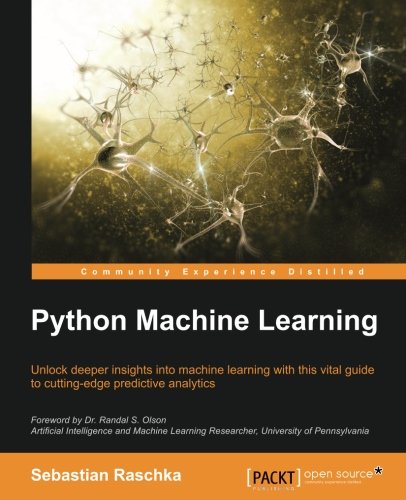
Python Machine Learning

Many of the breakthroughs in current AI research come from applications of machine learning. Python has proved to be an excellent language to use to further one’s knowledge in the field. This book includes a Github link and helps teach the fundamentals of machine learning through Python. 

The book sets out to teach: 

  • Development of Learning Algorithms 
  • Transforming Raw Data into Useful Information
  • Classifying Objects
  • Regression Analysis 

Author Sebastian Raschka sets out step-by-step examples of real world machine learning applications. You can follow along and by the end of the book have the skills necessary to implement your own machine learning system for sentiment analysis in a live web app. 

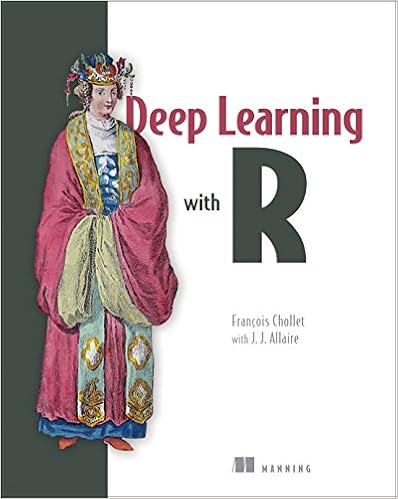
Deep Learning with R 

Written by Google AI research and Keras library creator, François Chollet, Deep Learning with R sets out to teach the fundamentals of deep learning in the R programming language. It serves as an excellent instruction manual for Keras and can be supplemented with more theoretical works for a fuller picture of the discipline.  

  • Deep learning from first principles
  • Setting up your own deep-learning environment
  • Image classification and generation
  • Deep learning for text and sequences

Readers should have an intermediate skill level with R programming. You won’t need any previous experience with machine learning, but this paired with another practical book like Python Learning is a plus. 

Artificial Intelligence: A Modern Approach (3rd Edition)

You all knew we were going to get to this one. An accessible book for undergraduate or graduate level students in Artificial intelligence, this is a standard across in academia. Written by Peter Norvig, Artificial Intelligence: a Modern Approach has been used in over 1200 universities and is one of the most highly cited publications. 

Many students find it an accessible read as it’s also approachable for laymen, scientists, and tinkerers too. As a best seller in the field, the text offers a comprehensive and constantly updated stream of information to the theory and growing practice of AI.

Ethics & philosophical musings

Enough movies and stories have been written about the potential pitfalls of this tech. Metropolis occult rituals and Arnold Schwarzenegger terminators have left some people weary and a bit scared. But that hasn’t stopped us yet has it?

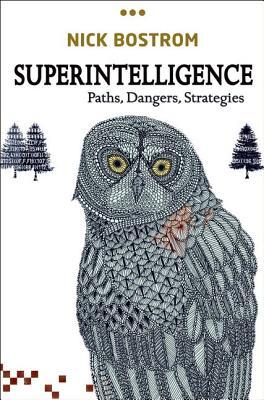
Superintelligence: Paths, Dangers, Strategies


Nick Bostrom’s highly ambitious book has already become a classic. It raises more questions than it answers – as any great philosophical work should. Bostrom wonders about what will happen in the world when machines surpass humans in general intelligence. Will these new beings be our downfall or our saving grace? 

On the subject of our origins of intelligence Bostrom writes: “We know that blind evolutionary processes can produce human-level general intelligence, since they have already done so at least once. Evolutionary processes with foresight—that is, genetic programs designed and guided by an intelligent human programmer—should be able to achieve a similar outcome with far greater efficiency.”

Bostrom assumes the mantle of 21st century techno-sage, breathing life into a real possibility of a much greater intelligence in this universe.


Life 3.0: Being Human in the Age of Artificial Intelligence

A favorite book of Elon Musk and one in which Musk was inspired to describe developing advanced AI as akin to “summoning the demon.”  

Max Tegmark, an MIT professor, covers a wide range of spectrums in the potential future of AI. It’s a little watered down compared to Bostrom’s Superintelligence. But it gets the point across that things are changing rapidly. What it does best is it helps inform the layperson in areas of impact that will be affected most by AI in our day to day lives.


Robot Ethics: The Ethical and Social Implications of Robotics


The first book in a two-part series, Robot Ethics is a starting point for learning how to design and hard-code ethics into robotic artificial systems. As ethical concerns become even more pressing, roboticists and other technologists need to start thinking about what they can do now to stop any future catastrophic events.

Some of the covered topics include:

  • Exploring Emotional Bonds With Robots 
  • Programming A Code of Ethics 
  • Ethical Military Use in War 
  • Liability and Privacy Concerns 

Regulation often comes too late with new technologies. But the authors of this book state that we must reverse this trend. Ethics and regulations need to be on the forefront for such a game-changing tech.

Our Final Invention: Artificial Intelligence and the End of the Human Era


Author James Barrat explores the many governments and agencies around the world researching (AGI) and pouring billions into funding. Many scientists believe that once this lofty goal has been reached, these machines will have similar survival drives as we do.

Barratt explores this line of thinking and takes it to its logical conclusion as many others have. A superintelligent AGI would become an alien-like entity to the human race.

James wonders if we would serve any further purpose to a being as powerful as this. Would it begin to suck up as much matter and energy as it could for its foreign purposes and simply brush us aside? It’s a despondent and completely apocalyptic view of what may happen, bringing up images of The Matrix and other fictional worlds bereft of biological life.

And that’s it for now. Thanks for reading!

Consciousness, spirituality, biography, sexuality, androgyny, futurism, space, the arts, science, astrology, democracy, humor, books, movies and more