
The Shift Network
Uploaded on Apr 30, 2018
Discover the magic in ‘meaningful coincidences’ to bring more courage, creativity & healing into your life
Monthly Archives: May 2018
TRANSLATION ADVENTURE – 5/6/18
Biography: Matthew Walker
| Matthew Walker | |
|---|---|
| Born | Matthew P. Walker 1972/1973 (age 44–45)[1] Liverpool, England |
| Other names | Sleep Diplomat |
| Alma mater | |
| Scientific career | |
| Fields | Neuroscience, psychology |
| Institutions | Harvard University University of California, Berkeley |
| Website | www |
Matthew P. Walker is a British scientist and professor of neuroscience and psychology at the University of California, Berkeley. His research focuses on the impact of sleep on human health and disease. He was previously a professor of psychiatry at Harvard Medical School. He is also the founder and director of the Center for Human Sleep Science. He has received numerous funding awards from the National Science Foundation and the National Institutes of Health, and is a Kavli Fellow of the National Academy of Sciences. He has published over 100 scientific research studies and has been featured on numerous television and radio outlets, including 60 Minutes, National Geographic, NOVA scienceNOW, NPRand the BBC.
Works:
Why We Sleep
In October 2017, Penguin Random House and Scribner published Walker’s first book, Why We Sleep: Unlocking the Power of Sleep and Dreams.[9][10][11][12][13][14] He spent four years writing the book,[15] in which he argues that sleep deprivation is linked to numerous fatal diseases, including dementia.[16]
More at: https://en.wikipedia.org/wiki/Matthew_Walker_(scientist)
WTF Is Going On? Episode #2 Spring 2018 Intuitive Forecast
Prediction machines: Why A.I.’s true potential is learning to read the future
By Ajay Agrawal, Artificial Intelligence Economist
May 4, 2018 (bigthink.com)
When most of us look at A.I. we see magical capabilities. When economists look at A.I. they see something very different. Economist Ajay Agrawal explains: “What economists bring to the conversation is that they are able to look at a fascinating technology like artificial intelligence and strip all the fun and wizardry out of it and reduce A.I. down to a single question, which is, ‘What does this technology reduce the cost of?'” Never has one person taken such delight in stripping the fun from something awesome. But what does A.I. lower the cost of? Predictions, says Agrawal. Intelligent machines can take information we have and use it to generate information we need. Uncertainty is the single biggest hurdle in good decision making, and A.I. can drastically increase certainty in many areas, like automated vehicles, language translation, human resources and medical diagnostics. As A.I. becomes a cheaper technology, its use will become even more widespread. “Where I think it’s really interesting is that when it becomes cheap, we’ll start using it for things that weren’t traditionally prediction problems but we’ll start converting problems into prediction problems to take advantage of the new, cheap prediction.” Ajay Agrawal is the co-author of Prediction Machines: The Simple Economics of Artificial Intelligence.
Transcript:
Ajay Agrawal: I think economics has something to contribute in terms of our understanding of artificial intelligence because it gives us a different view. So, for example, if you ask a technologist to tell you about the rise of semiconductors they will talk to you about the increasing number of transistors on a chip and all the science underlying the ability to keep doubling the number of transistors every 18 months or so. But if you ask an economist to describe to you the rise of semiconductors they won’t talk about transistors on a chip, instead they’ll talk about a drop in the cost of arithmetic. They’ll say, what’s so powerful about semiconductors is they substantially reduced the cost of arithmetic.
It’s the same with A.I., everybody is fascinated with all the magical things A.I. can do and what economists bring to the conversation is that they are able to look at a fascinating technology like artificial intelligence and strip all the fun and wizardry out of it and reduce A.I. down to a single question, which is, “What does this technology reduce the cost of?” And in the case of A.I. the recent economists think it’s such a foundational technology and why it’s so important it stands in a different category from virtually every other domain of technology that we see today, is because the thing for which it drops the cost is such a foundational input, we use it for so many things; in the case of A.I., that’s prediction.
And so why that’s useful is that as soon as we think of A.I. as a drop in the cost of prediction, first of all, it takes away all the confusion of well, what is this current renaissance in A.I. actually doing? Is it Westworld? Is it C-3PO? Is it a Hal, what is it? And really what it is, it’s simply a drop in the cost of prediction. And we define prediction as taking information you have to generate information you don’t have. So it’s not just through the traditional form of forecasting like taking last months sales and predicting next months sales. It’s also taking, for example, if we have a medical image and we’re looking at a tumor and the data we have is the image and what we don’t have is the classification of the tumor as benign or malignant, the A.I. makes that classification, that’s a form of prediction. And so when something becomes cheap—from economics 101 most people remember there’s a downward sloping demand curve—and so when something becomes cheaper that means we use more of it. And so in the case of prediction as it becomes cheaper we’ll use more and more of it. And so that will take two forms: one is that we’ll use more of it for things we traditionally use prediction for like demand forecasting and supply chain management. But where I think it’s really interesting is that when it becomes cheap, we’ll start using it for things that weren’t traditionally prediction problems but we’ll start converting problems into prediction problems to take advantage of the new, cheap prediction.
So one example is driving. We’ve had autonomous cars for a long time, or autonomous vehicles, but we’ve always used them inside a controlled environment like a factory or a warehouse. And we did that because we had to control the number of—think of it as the if/then statement. So we have a robot, the engineer would program the robot to move around the factory or the warehouse and then they would give it a bit of intelligence. They would put a camera on the front of the robot and they would give it some logic, saying okay if something walks in front then stop. If the shelf is empty then move to the next shelf. If/then. If/then.
But you could never put that vehicle on a city street because there is an infinite number of ifs. There are so many things that could happen in an uncontrolled environment. That’s why as recently as six years ago experts in the field were saying we’ll never have a driverless car on a city street in our lifetime—until it was converted into a prediction problem. And the people who are familiar with this new, cheap form of prediction said why don’t we solve this problem in a different way and instead we’ll treat it as a single prediction problem? And the prediction is: What would a good human driver do?
And so effectively the way you can think about it is that we put humans in a car and we told them to drive and humans have data coming in through the cameras on our face and the microphones on the side of our heads and our data came in, we process the data with our monkey brains and then we take action. And our actions are very limited: we can turn left; we can turn right; we can brake; we can accelerate. The way you can think about it is, think about an A.I. sitting in the car along with the driver and what that A..I is trying to do is—it doesn’t have its own input sensors, eyes and ears, so we have to give it some: we put a radar camera, LiDAR, around the car—and then the A.I. has this incoming data and every second it’s got data coming in, it tries to predict in the next second what will the human driver do? In the beginning, it’s a terrible predictor it makes lots of mistakes. And from a statistical point of view, we can say it has big confidence intervals; it’s not very confident. But it learns as it goes and every time it makes a mistake, it thinks that the driver is about to turn left but the driver doesn’t turn left and it updates its model. It thinks the driver was going to brake, the driver doesn’t brake, it updates its model. And as it goes, the predictions get better and better and better and the confidence intervals get smaller and smaller and smaller.
So we turned driving into a prediction problem. We’ve turned translation into a prediction problem. That used to be a rules-based problem where we had linguists with many rules and many exceptions and that’s how we did translation. Now we’ve turned it into a prediction problem.
I think probably the most common surprise that people have is we have a lot of HR people that come into our lab and they say: ‘Hey, we’re here to learn about A.I. because we need to know what kinds of people to hire for our company you know, for our manufacturing or our sales or this or that division. Of course, it won’t affect my division because I’m in HR and we’re a very people-part of the business and so A.I. is not going to affect us.’ But of course, people are breaking HR down to a series of prediction problems.
So for example, the first thing HR people do is recruit, and recruit is essentially they take in a set of input data like resumes and interview transcripts and then they try to predict from a set of applicants who will be the best for this job. And once they hire people then the next part is promotion. Promotion has also been converted into a prediction problem. You have a set of people working in the company and you have to predict who will be the best at the next-level-up job. And then the next role they do is retention. They have 10,000 people working in the company and they have to predict which of those people are most likely to leave, particularly their stars, and also predict: what can we do that would most likely increase the chance of them staying? And so one of the, what I would say, a black art right now in A.I. is converting existing problems into prediction problems so that A.I.s can handle them.
Alonzo King LINES Ballet
Alonzo King LINES Ballet from LINES Ballet on Vimeo.
“I think it is a cruel act of social injustice when people aren’t introduced to the world of art. Art is a key. It is one of the first ways of entering into your internal self…”
–Alonzo King
“Stand on the word” (KEEDZ)
Universal Music France
Published on Jun 6, 2008
©2008 ULM
Réalisation : Superdeux
Musique: Stand on the word (KEEDZ)
That’s how he works
That’s how
The good Lord, he works
That’s how he works
That’s how
The good Lord, he works
That’s how the good Lord works
That’s how the good Lord works
That’s how the good Lord works
That’s how he works
That’s how the good Lord works
That’s how the good Lord works
That’s how the good Lord works
That’s how he works
We must not question the good Lord
Have faith in God and trust his words
We don’t don’t know how, we don’t know when
To see his day, so whe should stand
We must not question the good Lord
Have faith in God and trust his words
We don’t don’t know how, we don’t know when
To see his day, so whe should stand
That’s how he works
That’s how
The good Lord, he works
That’s how he works
That’s how
The good Lord, he works
That’s how the good Lord works
That’s how the good Lord works
That’s how the good Lord works
That’s how he works
That’s how the good Lord works
That’s how the good Lord works
That’s how the good Lord works
That’s how he works
We must not question the good Lord
Have faith in God and trust his words
We don’t don’t know how, we don’t know when
To see his day, so whe should stand
We must not question the good Lord
Have faith in God and trust his words
We don’t don’t know how, we don’t know when
To see his day, so whe should stand
Stand on the words
The words of God
Stand on the words
The words of God
Stand!
Stand on the words
The words of God
Stand on the words
The words of God
Stand on the words
The words of God…
Gavin Newsom ad touts same-sex marriages
by Joe Garofoli April 30, 2018 (SFChronicle.com)
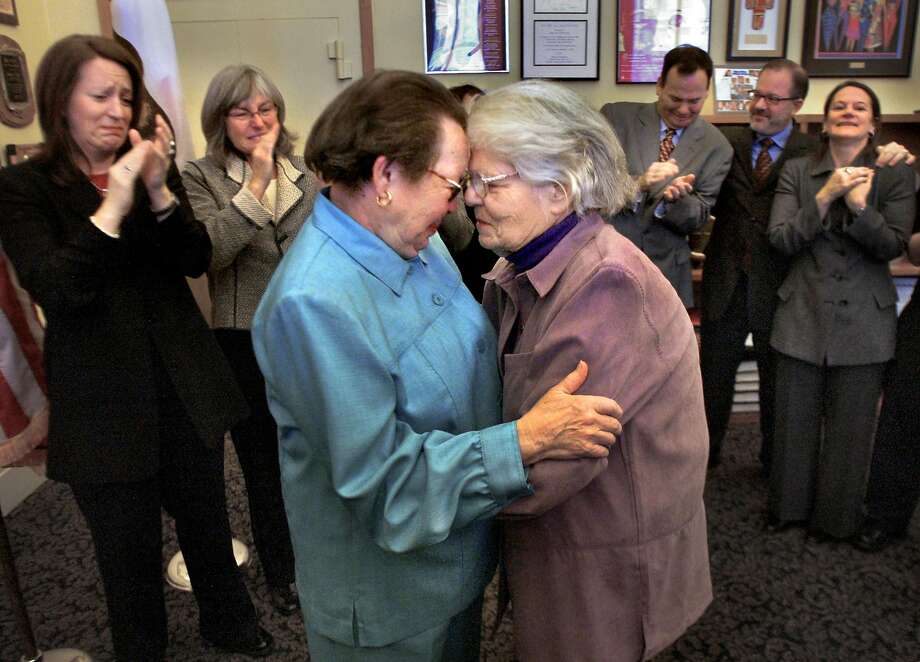
Photo: Liz Mangelsdorf / The Chronicle 2004. Phyllis Lyon, left, and Del Martin, who had been together for more than 50 years, embrace after their marriage at City Hall.
Phyllis Lyon — half of the first same-sex couple to be married in San Francisco — stars in a new ad with Democratic gubernatorial candidate and former Mayor Gavin Newsom, who officiated, being released Tuesday.
Lyon and her late wife, Del Martin, were among more than 4,000 same-sex couples married at City Hall in 2004, before the state Supreme Court halted the weddings. The longtime lesbian rights activists were married at City Hall again — legally — in June 2008 by Newsom. Martin died two months later.
In the 30-second ad, titled “Phyllis,” Newsom, now the state’s lieutenant governor, and Lyon reminisce while looking at photos — and Chronicle headlines — from those heady days of the same-sex marriage movement.
“Well, it took courage. Well, it did, you know — you had to think about what was going to happen when everybody heard it,” Lyon tells Newsom as they sit next to each other in her home, holding hands. “But, it seemed like it was a better idea to let everybody hear it.”
Newsom’s campaign hopes the ad reinforces the notion that Newsom has the “courage” to take on controversial issues like same-sex marriage, universal health care and gun control. The ad is part of the Newsom campaign’s current “seven-figure” advertising buy. This spot will start running in the Bay Area, then branch out into other markets.
— Joe Garofoli
“Masculinity: Is It The Problem or A Programed Expectation?” by Calvin Harris, H.W., M.
April 5, 2018 (siteofcontact.net)
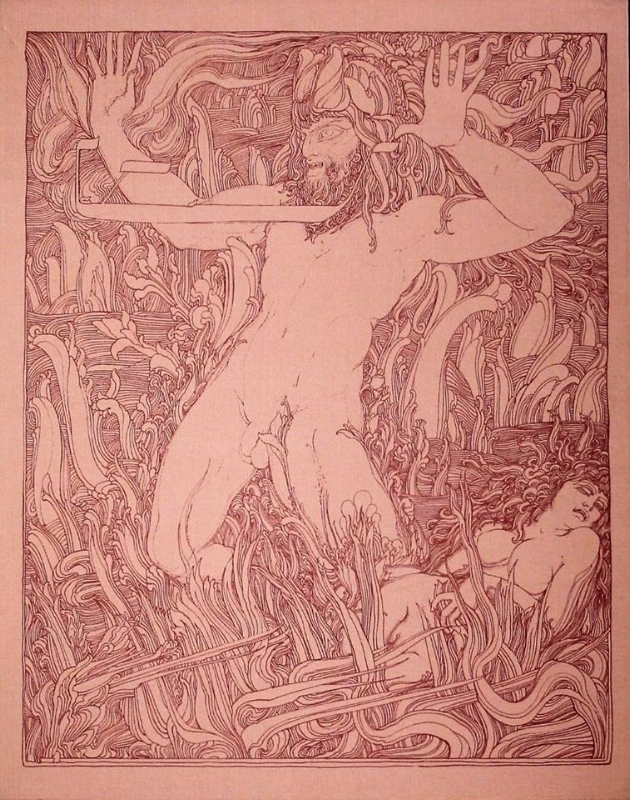
Samson by Ernst Fuchs shared by William Floyd
This blog came about due to conversations and comments sent to me about my March 2018 blog post, which was titled ‘A Conversation on Masculinity, Society, and Change” located in the Male on Man section of SiteOfContact. I thank my faithful readers for their comments, responses, and interest in the subject. This article also takes on its particular tone of delivery, due to a deep probing conversation with a client over an article written by David de las Morena’s from his Website called: “How to Beast,” his blog titled – “ How to Increase Masculine Energy and Rebuild Self-Esteem.” (At the end of this piece you will find the link to David’s blog article
I really don’t want to get into a critique of Mr. Morena’s concepts especially his concept of ‘No More Mr. Nice Guy’ other than to say it was the touchstone for my client and myself to engage in a deeper conversation on ‘Masculinity and Gender.’ David de las Morena ’s comments. per se. have more to do with self-respect and self-worth, rather than perhaps a focus on a root cause of gender (mis)label. Personally, I must warn you that some may find David’s manner of expression distasteful and rude, yet beyond his style as a ‘straight heterosexual,’ he does make one or two valid suggestions to gain self-respect and self-worth. But again that is not my central theme. I am wanting to address the early social conditioning that gets associated with expected behavior or expected gender patterns coming to us as early as our nursery days, and in the stories we are told which we then (mis)label as “masculine.”
What is Masculinity? How is it measured? What are its demands? And how is that person meant to look, think, act, and feel? and should that be according to the mores of society?
We have a lot of opinions about being a “Man” or more to the point having “Masculinity “. Now to surprise you, you could say Masculinity is not, gender-specific, I say this because I have known some masculine women, including my Mom (not to look at her), but that woman had balls. This is all to say, what are we focusing on? The word, or is it behaviors that get labeled as Masculinity?
Masculinity comes up a lot lately and unfortunately, you can expect it to be related to trauma in an experience. Or sometimes in ‘How’ to integrate the Masculine aspect of oneself into a more positive and holistic lifestyle
This piece of writing is not to diminish any circumstance where trauma has occurred, we can all see how under various circumstances the word masculinity has been misrepresented by men caught in stereotypes, causing the word to lose luster, respect, and aliveness. We could say Masculinity is lost due to diminished meaning.
I could see how some people can be caught up in the illusion that to be masculine only meant to be aligned with bathroom bullies; politicized pulpits; with privilege; overt racism or sexism; or with bigotry toward groups of people. That kind of action portrayed by a few men is not a true representation of Masculinity, and yes if that is a view of the word, it needs to be tanked in the toilet.
I have seen, in my work as a life coach, the effect of the above description of what masculinity misrepresented can do to some men, for example, the issues of self-worth become diminished. Abandonment and loss of manhood become issues. Male childhood developmental trauma, which can color men’s interactions with other men and women. The clue to the problem is “early childhood trauma.”

This is not the first time in history were maleness appeared to be vilified. I can recollect in my own history, in the 1950’ s, being taunted by a younger sister who loved to recite repeatedly, a portion of an old nursery rhyme called “What are folks made of?” by Robert Southey writen in 1842. The segments of the rhyme my sister loved to taunt me with was the portion called – “What are little boys made of?” and “what are girls made of?”
What are little boys made of?
Slugs and snails
And puppy-dogs’ tails,
That’s what little boys are made of.
And what are little girls made of?
Sugar and spice
And all things nice,
That’s what little girls are made of.
This was a common nursery rhyme of the late 19th and early 20th centuries. This rhyme deserves our attention in part, due to its negative descriptors of the male gender, described as slugs, snails, snips, and frogs depending on where in the world the rhyme was told.
The rhyme by Southey in two additional verses goes on to say:
What are young men made of, made of?
What are young men made of?
Sighs and leers and crocodile tears;
That’s what young men are made of.
What are young women made of, made of?
What are young women made of?
Rings and jings and other fine things
Sugar and spice and all things nice;
That’s what young women are made of.
I think you get the jest of it…

Nursery Rhymes play key roles in how we explain to children our cultural attitudes about themselves and gender behavior. Reciting Nursery Rhymes to children is one of a series of first steps to providing children’s education about self-esteem and what is expected of them.
It can implant gender shame and things not good in the youngest minds of our society before (arguably) they have the critical function to question such assumptions and provides children with ideas of masculinity and femininity to which they may well not conform (thank heavens) yet creating a pressure towards adopting gender stereotypes which, frankly, toddling tots could have done without. Here is a place to start, with a new vision, stories, and Nursery Rhymes.
These new stories, to be made then in part for the cultural socialization process, would not expect transgressions of young males but does expect exploration, and do not dismiss and expect ‘boys to be bad, and then require them to do more ‘to prove themselves otherwise.’ While shaping young girls into passive restrained toys that need do nothing but be pretty for worry not you can do nothing wrong attitudes, that does not prepare them for a life of diverse opportunity that may not always need sweetness and passivity. These kinds of stories had fallacy, any conscious mother of children of both sexes could debunk and tell you that, ‘it was a pile of the well-known stuff.’
The bad behavior displayed in teen males may come from early unconscious childhood expectations. Expectations that come from the nursery. A more positive model is needed to be created and employed. Nursery rhymes that re-imagine, re-envision, and ground masculinity in a self-affirming way.

Often a male child, if traumatized by his childhood environment is then expected to, on his own, “get over it, “to “outgrow” it, or somehow zap it away. Yet it is that very trauma that will freeze him into isolation, into not seeking help, into not allowing himself to talk about it. because he feels it is expected of him to bear up especially if viewed by other males. Yet, there are some things that happen to men that they never “get over,” and must reach out to their culture and other men to correct the concept.
So, to refocus this discussion for the conscious adults amongst us, I ask, that Masculinity not be looked at as the Problem, but perhaps as your Expectation?
If it is the Expectation, then where did that expectation come from? A change of the approach, to re-envision Masculinity is needed. We must begin by realizing that both males and females are comprised of Male and Female components or as Carl Jung called it Anima and Animus. We are both Masculine and Feminine in attributes, some of us more of one than the other and by God, we should not all try and fit a cookie cutter visions of what that is going to manifest as. It is not one definition fits all.
Okay, we have Men, beyond the age of nursery rhymes, that have the pressures to refashion a new sense of them-self, of self-being. Let’s be bold here and strip everything away and start with an identity as individuation of consciousness, with emotional intelligence. This concept is of course for the person who wants to have dominion over their own life, then he can start by re-inhabiting his maleness even in the face of disturbing experiences, as he then weaves a more “integrated” narrative of his life for himself. Re-authoring the sacred story of ‘who am I’ and calling forth a new future for himself not yet known
Trusting the worth and validity of his expression of masculinity, and in that expression a self-love, that will be able to soften the callus wounds of the body, mind and the heart, embracing a fully realized masculinity by his design a vision of masculinity, designed for him by him, so it becomes alive within his being as a force for good. This allows for a profound empowerment, that for anyone is revolutionary, if lucky enough even contain bits of humor, and sometimes bold in its persona. These skills will be needed to then start writing and telling the New nursery stories for those yet unborn.

The goal then is not some fixed, “cured” state where we have successfully purged masculinity which is an aspect of our self-experience from what we are, as if it were some wretched foreign substance, but rather to find a larger home for it within our concept of the self. Slowly, we can allow what has become frozen and solidified to thaw and become flexible. To make the masculine force rightly seen within us and children to come, as a valued and balanced energy. A refocus of our attention and thoughts, to break out of that cycle of trauma, blame, and shame. To move towards a balanced identity, that has a stable, and positive context for humans with masculinity, who are given an expectation to be a force for life-sustaining good.
David de las Morena’s Blog post: https://www.howtobeast.com/how-to-reclaim-your-manhood-and-rapidly-cultivate-masculine-energy/