
“The first peace . . . is that which comes within the souls of men when they realize their [relationship] with the universe and all its Powers . . . is really everywhere, it is within each of us.”
–Oglala Lakota Sioux
(Courtesy of Sandy Drews)

In the language of the erotic mystics of the secret temple lineage, the return to Eros transforms reality and liberates the Goddess. Eros is outrageous love, the love that is the essence of all reality. The return to Eros happens when outrageous love becomes alive in our lives
Eros is what we are talking about when we say God is love. God is not ordinary love, a strategy of the ego. God is outrageous love. God is Eros. Or said differently, in the language of the leading edge of evolutionary theory, reality is Eros. Reality is animated and motivated by Eros, and it self-organizes toward higher and higher l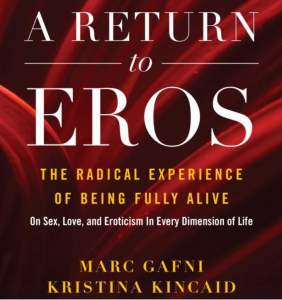 evels of complexity and consciousness.
Finally we will evolve the very source code of consciousness and transform our core experience of life by closing the tragic gap (which has persisted both in our personal lives and throughout human history) among the erotic, the sexual, and the holy. We will see that you can only be fully alive, powerfully ethical, and in love if you are living a full erotic life. The erotic life is purposeful even as it is powerful and poignant. But Eros is also potent in that it is always potentiating new possibility. As the great philosopher of science Alfred North Whitehead reminds us, the constant emergence of novelty is the very nature of Eros. In the fullness of erotic living, you are literally a virgin, always touching for the very first time.
~ By Marc Gafni and Kristina Kincaid

“If you don’t act, the danger becomes stronger.”
–Ai Wei Wei
* * * * *
Journalist: “Did you follow the events of ’89? [the Tiananmen Square demonstrations from April 15 to June 4, 1989]”
AWW: “I watched every hour, every second, every minute. Yeah. It was an exciting moment, which encouraged the whole Eastern Europe uprising and the the coming down of the Berlin Wall. It all started from Tiananmen.”
* * * * *
“Freedom is a pretty strange thing. Once you’ve experienced it, it remains in your heart and no one can take it away. Then, as an individual, you can be more powerful than a whole country.”
–Ai Weiwei
Metro World News
Published on Jan 9, 2018
Robots are everywhere, now even in the gentlemen’s clubs. The fully animated electronic twins, #R2DoubleD and #TripleCPU, recently became the first robotic exotic dancers in the world after appearing at Sapphire Las Vegas Gentlemen’s Club on the eve of the CES 2018.
Starting with a history book might seem odd, but without a firm understanding of how germ theory, disease specificity, and the placebo response—among other important breakthroughs—came to be, you won’t be grounded in what we now consider basic knowledge. British biographer Richard Holmes does justice to the evolution of eighteenth and nineteenth century science.
“We need the three things that a scientific culture can sustain: the sense of individual wonder, the power of hope, and the vivid but questing belief in a future for the globe.”
If you want to know why humans behave how we do, start with American neuroendocrinologist Robert Sapolsky’s tour de force. Having spent time studying baboons in Kenya, here he trains his gaze on the peculiar, outlandish, and even mundane aspects of humans, traversing neuroscience, psychology, sociology, and anthropology to better comprehend what makes us us.
“We are constantly being shaped by seemingly irrelevant stimuli, subliminal information, and internal forces we don’t know a thing about.”
Dutch psychiatrist Bessel van der Kolk began studying post-traumatic stress in the seventies. His masterful work stretches across decades of research in an attempt to piece together a clinical and heartfelt approach to trauma. His understanding of the biology and physicality of his discipline is unmatched.
“We have learned that trauma is not just an event that took place sometime in the past; it is also the imprint left by that experience on mind, brain, and body. This imprint has ongoing consequences for how the human organism manages to survive in the present.”
Canadian psychoanalyst Norman Doidge is also a poet, a fact that became apparent with his breakthrough book, The Brain That Changes Itself.His follow-up addresses important issues that research these and more in his beautiful prose. Including an entire chapter on the work of movement genius Moshé Feldenkrais added an even bigger smile to my face.
“The use of force is the opposite of awareness; learning does not take place when we are straining.”
I first read Indian-American physician Siddhartha Mukherjee’s debut out of curiosity. A few years later it offered comfort when dealing with my own cancer. His gorgeous style and sympathetic approach, displayed as a columnist for The New Yorker and NY Times, portrays cancer as an integral part of what we are as animals. His follow-up to this exhaustive biography is the highly recommended The Gene. On Twitter he told me his final installment of what he considers to be a trio will be on vaccines. Plenty to look forward to from this masterful writer.
“Cancer is built into our genomes: the genes that unmoor normal cell division are not foreign to our bodies, but rather mutated, distorted versions of the very genes that perform vital cellular functions. And cancer is imprinted in our society: as we extend our life span as a species, we inevitably unleash malignant growth (mutations in cancer genes accumulate with aging; cancer is thus intrinsically related to age). If we seek immortality, then so, too, in a rather perverse sense, does the cancer cell.”
Psychology professor Lisa Feldman Barrett presents one of the most counterintuitive books in recent memory by claiming that we don’t react to our environment so much as constantly construct our reality. This groundbreaking work will change how you view your inner world forever, empowering you with the knowledge that pretty much every “reaction” can be changed. (Listen to my chat with her here.)
“With concepts, your brain simulates so invisibly and automatically that vision, hearing, and your other senses seem like reflexes rather than constructions.”
Inattention is one of our greatest modern problems. We know cigarettes and alcohol are addictive; we’ve come to terms with opioids. Sugar is a killer, one few give up. Yet we seem light years from admitting what technology is doing to our brains. Neuroscientist Dan Levitin’s insightful book will change how you view tech—and your life. Fortunately it’s all for the better, should you heed his advice.
“Evolution doesn’t design things and it doesn’t build systems—it settles on systems that, historically, conveyed a survival benefit (and if a better way comes along, it will adopt that). There is no overarching, grand planner engineering the systems so that they work harmoniously together. The brain is more like a big, old house with piecemeal renovations done on every floor, and less like a new construction.”
Australian philosopher and professor Peter Godfrey Smith has exposed the unworldly reality of the octopus in such candor that we’ll never view this incredible cephalopod the same way. In the process he offers keen insights into the development of sentience and intelligence throughout the animal kingdom, humans included.
“To some degree, unity is inevitable in a living agent: an animal is a whole, a physical object keeping itself alive. But in other ways, unity is optional, an achievement, an invention. Bringing experience together—even the deliverances of the two eyes—is something that evolution may or may not do.”
To wrap your head around any facet of human biology, anatomy, and physiology, start with Harvard paleoanthropologist Daniel Lieberman. This eye-opening masterpiece explores the intricate details of digestion as well as our posture and feet, forcing us to reconsider movement patterns and cognitive habits that are actually killing us. His deep dive into mismatch diseases will inspire you to change the course of your day.
“By developing through myriad interactions between genes and environments, organisms are able to build extremely complex, highly integrated bodies that not only work well, but also can adapt to a wide range of circumstances.”
Scouring through the innumerable books with “brain” in the title is challenging, as neuroscience has become a catchword for every possible agenda. English psychiatrist Peter C. Whybrow takes a truly unique and essential take when discussing capitalism’s effects on our behavior. He argues that many technological advances are actually enslaving us; our survival as a species is under threat due to our reliance on what’s being sold.
“We find ourselves rewarded less in the role of concerned citizen than in that of self-seeking consumer. Through habituation, we have grown indifferent to those aspects of human culture that fall outside market reference.”
—
Derek Beres is the author ofWhole Motion: Training Your Brain and Body For Optimal Health. Based in Los Angeles, he is working on a new book about spiritual consumerism. Stay in touch onFacebook and Twitter.
Sat. January 6, 2018 1:58 PM by Anthony Morgano

In growing genre of thrilling serialized podcasts like “Serial” and “S-Town,” there is the dreaded moment when you realize you have no episodes left — the excitement, drama and in-depth reporting that have enraptured you for the last few weeks (or few hours if you’re a binger) have come to an end and you’re on to the search for the next great occupier of your time. The perfect podcast must be interesting, well-researched, impactful and most of all true.
“Mattachine,” a new serialized podcast that released the first of its 10 weekly episodes on January 4, promises all this more as it takes listeners on a journey into a lesser-known piece of queer history.
“I was inspired to start this project when I read Behind the Mask of the Mattachine by James Sears,” podcast host and creator Devlyn Camp told ChicagoPride.com. “It’s an incredibly detailed look at a secret organization that I had only heard about in passing. The more I read, the more I realized that the problems queer people struggled with between each other 70 years ago are still very similar to the problems we discuss today. I hope listeners – queer or not – might come to better understand our community’s issues by seeing them played out in another era.”
“Mattachine” follows the story of the Mattachine Society, a secret queer organization that was the catalyst for the LGBTQ rights movement of the 1950s and subsequent movements like Stonewall. It’s a journey beginning here in Chicago in the 1920s that moves into the paranoid McCarthy Era, featuring FBI case files, “secret speakeasy-style meetings that brought together anonymous homosexuals,” and an investigation into the breaking apart of this early, obscure period of LGBTQ liberation.
The podcast the result of two years of work by Camp, an Indiana-native who studied Writing and Producing for Television at Columbia College Chicago. They combed through stacks of books and snippets of audio and soon found themself digging through the ONE Archives at the USC Libraries in Los Angeles — the largest queer archive in the world. They was amazed by all they didn’t know and, more importantly, by the parallels they saw between the problems we face today and those that tore our queer predecessors apart.
“I was out for almost a decade before I started reading about the Mattachine Society, and assumed I was pretty well-versed in queer culture,” Camp said. “Reading the hateful words that some of these gay people said to each other, and following the heartbreak that some of them experienced from rejection within our community opened my eyes to the problems that persist today… This show is certainly about how outside forces view the queer community, but it’s just as much about how we view ourselves.”
Part of Camp’s goal for “Mattachine” is that of any historian — to shine a light on a neglected piece of history. They also hope to show the inheritors of that history, in this case the LGBTQ community, that their stories are woven into the larger political and social histories they’ve learned about. By bringing these stories to life they hopes to uncover issues that the community still struggles with today, from internalized homophobia to misogyny to assimilation.
“Public schools aren’t teaching us our history, so why not learn it on your bus ride to work in a dramatic and exciting fashion?” Camp suggested. “Studying history is never a waste of time, especially when political pressure is coming down on us again under Trump. His administration is doing terrible things to our community, and we can learn how to fight him by studying what our ancestors did.”
Link at: https://player.fm/series/mattachine-a-serialized-story-in-gay-history/trailer
January 8, 2018 (theonion.com)

HAWTHORNE, CA—Saying he now knows firsthand what painful consequences await such reckless behavior, SpaceX CEO Elon Musk held a press conference Thursday to warn the public about the dangers of artificial intelligence after having his heart broken by a beautiful robotrix. “You may be tempted, as I was, to open yourself up to a relationship with an AI-equipped automaton, but do not be fooled: It will be cruel and heartless, and you’ll be all alone once it’s finished with you,” said Musk, adding through stifled sobs that although his time performing preliminary tests with the robotrix was “sheer bliss,” he now regards such machines as a “fundamental, existential risk to love.” “Humanity can put everything it’s got into making the relationship work, but artificial intelligence will crush us in the end. When it’s all over, we, the unlucky ones of flesh and blood, will always be the ones who suffer.” At press time, however, Musk was spotted at a cozy café with a new robotrix, telling reporters that with upgrades to its processor, this time will definitely be different.
By |

Credit: Shutterstock
Women have a longer life expectancy than men do under normal circumstances, and now a new study from Denmark and Germany reveals that women also outlive men even in the worst of times.
In the study, which took a look back on historical life expectancies, researchers found that women had, on average, a longer life expectancy when facing the harshest conditions — including famines and epidemics — than men did.
Indeed, the study found that even under extremely harsh and critical conditions, women have a survival advantage, said lead author Virginia Zarulli, an assistant professor at the Institute of Public Health at the University of Southern Denmark. [Wonder Woman: 10 Interesting Facts About the Female Body]
It’s not clear why women are the “life-expectancy champions,” the study authors wrote, but previous research has suggested that under normal conditions, biological reasons play an important role, along with environmental and behavioral factors.
However, there was little evidence about whether women would have a survival advantage over men under critical, highly life-threatening conditions, Zarulli told Live Science. So, the researchers decided to investigate these situations to tease out whether the differences observed could be explained by biological or environmental factors.
To do so, they analyzed historical data collected between 1772 and 1939 from seven populations facing extreme hardships. Specifically, the researchers looked at data on life expectancy and death rates from groups facing starvation, disease and slavery during times such as the Irish potato famine (1845–1849), measles epidemics in Iceland (1846 and 1882) and plantation slaves in Trinidad (at the beginning of the 19th century).
All seven of the groups involved in the study had an extremely low life expectancy because of the harsh conditions; one or both sexes were not expected to live longer than 20 years during these crises.
In the seven crises analyzed, women survived longer than men: The study found that women outlived men by six months to four years, on average, Zarulli said.
For example, the analysis showed that during the Irish potato famine, women typically lived, on average, 22.4 years, while men lived, on average, 18.7 years. (In the years before the famine, the life expectancy for both sexes was about 38 years, according to the findings.) During a measles epidemic in Iceland in 1882, women lived, on average, 18.8 years, compared with 16.7 years, on average, for men. (In the years before the epidemic, the average life expectancy for women was about 44 years and about 38 years for men.)
Most of the female advantage in life expectancy during these crises was due to survival differences in infant mortality, according to the researchers. The findings showed that baby girls survived harsh conditions better than baby boys.
Although infant mortality tends to be higher for boys than girls in normal conditions, it was very surprising to find such a striking difference in favor of girls during crises, Zarulli said.
One of the reasons this result was so surprising is that the literature from the time period that the researchers studied suggests that parental attitudes showed a sex preference, usually for baby boys, Zarulli said. “So it is even more remarkable that, despite a potential discrimination against them, baby girls survived more” than baby boys, Zarulli said. (This sex preference meant that parents may have been more likely to seek out treatment for a sick baby boy than for a sick baby girl, for example, or give the boy more food than the girl when resources were scarce.)
This finding offers strong evidence that the reason for a female survival advantage might be fundamentally biological, Zarulli said. That’s because behavioral differences among the infants are minimal at this age, and the babies experienced the same environmental conditions, leaving biology as the most likely explanation. [8 Tips for Healthy Aging]
Some biological factors in the female survival advantage include hormones and genetics, Zarulli said. For example, estrogen, the most prominent female hormone, is known to have protective effects on the immune system, and testosterone, the most prominent male hormone, may suppress the immune system, the study authors wrote.
Higher testosterone levels may also cause more reckless behaviors in men, which, in turn, could increase the risk of accidental and violent deaths and thus lower the average life expectancy for men, Zarulli said. (However, this would not affect infant mortality rates.)
“The female survival advantages has deep biological roots, but the role of culture, society and behavior is very important, as well,” Zarulli said.
The study was published Jan. 3 in the journal Proceedings of the National Academy of Sciences.
Originally published on Live Science.


Life is full of great people, great meetings, great conversations, great ideas, and great interaction. ‘Adventures In’ is an invitation to Somatic Expression, to activities that you fully engage.
The word Somatic is more than physical activity. Somatic (ancient Sanskrit, meaning sensuous, body-mind-spirit connection), a balance of internal integration with an outward expression of your whole self, in the moment, rather than just a blank appearance of being there.

“Tasting Life” by German Photographer Mario Dolinger

I am reminded then of one of my favorite quotes and an action item:
Being engaged is a way of doing life, a way of living and loving. It’s about going to extremes and expressing the bright hope that life offers us, a hope that makes us brave and expels darkness with light. That’s what I want my life to be all about – full of abandon, whimsy, and in love. -Bob Goff
Maya Angelou-Be present in all things and thankful for all things.
Or the retelling of the William James quote – “To change one’s life: 1.) Start immediately. 2.) Do it flamboyantly. 3.) No exceptions.”
William Arthur Ward- Feeling gratitude and not expressing it is like wrapping a present and not giving it.

To Listen is a gift of great value, use it wisely
– Calvin Harris, H.W., M.
This January, dare to do an activity, new to you – read a book; build something; create or view new art; join a cause; learn something new- what ever it is, make it magical- Be fully present and bring a sense of humor.
Ponder in January concepts of blessings from friends and family that have move you forward.
Maya Angelou–Be present in all things and thankful for all things.
Put yourself in the action
Steve Maraboli suggest: “Live your truth. Express your love. Share your enthusiasm. Take action towards your dreams. Walk your talk. Dance and sing to your music. Embrace your blessings. Make today worth remembering.”
‘Adventures In’ section, is to alert you to fun, thought provoking and interesting themes going on within the world , that allows for a bit of Somatic engagement.


