TRANSLATION ADVENTURE September 17, 2017

Translators: Alex Gambeau, Ned Henry, Sara Walker, Bo Lebo, Heather Williams
Sense Testimony:  Confusion causes separation
5th Steps:
  1. Truth is the flowing eternal wave of ONE POWER
  2. Truth is here now flower Power connection ALL as ONE WHOLE
  3. One Awareness continuously expresses clarity
  4. The Allness of Truth knows that within the appearance of confusion is ever present order manifesting perfectly
  5. To come…

Quotes from “The Mystic Heart” by Wayne Teasdale

“If you could get rid of yourself just once, the secret of secrets would open to you.  The face of the unknown, hidden beyond the universe would appear on the mirror of your perception.”

–Rumi

“At the evening of life, you will be examined in Love.”

–St. John of the Cross

“The most beautiful and profound emotion we can experience is the sensation of the mystical.  It is the sower of all true science.  He (or she) to whom this emotion is a stranger, who can no longer wonder and stand rapt in awe, is as good as dead.”

–Albert Einstein

“HARRISON BERGERON” by Kurt Vonnegut, Jr.

THE YEAR WAS 2081, and everybody was finally equal. They weren’t only equal before God and the law. They were equal every which way. Nobody was smarter than anybody else. Nobody was better looking than anybody else. Nobody was stronger or quicker than anybody else. All this equality was due to the 211th, 212th, and 213th Amendments to the Constitution, and to the unceasing vigilance of agents of the United States Handicapper General.

Some things about living still weren’t quite right, though. April for instance, still drove people crazy by not being springtime. And it was in that clammy month that the H-G men took George and Hazel Bergeron’s fourteen-year-old son, Harrison, away.

It was tragic, all right, but George and Hazel couldn’t think about it very hard. Hazel had a perfectly average intelligence, which meant she couldn’t think about anything except in short bursts. And George, while his intelligence was way above normal, had a little mental handicap radio in his ear. He was required by law to wear it at all times. It was tuned to a government transmitter. Every twenty seconds or so, the transmitter would send out some sharp noise to keep people like George from taking unfair advantage of their brains.

George and Hazel were watching television. There were tears on Hazel’s cheeks, but she’d forgotten for the moment what they were about.

On the television screen were ballerinas.

A buzzer sounded in George’s head. His thoughts fled in panic, like bandits from a burglar alarm.

“That was a real pretty dance, that dance they just did,” said Hazel.

“Huh” said George.

“That dance-it was nice,” said Hazel.

“Yup,” said George. He tried to think a little about the ballerinas. They weren’t really very good-no better than anybody else would have been, anyway. They were burdened with sashweights and bags of birdshot, and their faces were masked, so that no one, seeing a free and graceful gesture or a pretty face, would feel like something the cat drug in. George was toying with the vague notion that maybe dancers shouldn’t be handicapped. But he didn’t get very far with it before another noise in his ear radio scattered his thoughts.

George winced. So did two out of the eight ballerinas.

Hazel saw him wince. Having no mental handicap herself, she had to ask George what the latest sound had been.

“Sounded like somebody hitting a milk bottle with a ball peen hammer,” said George.

“I’d think it would be real interesting, hearing all the different sounds,” said Hazel a little envious. “All the things they think up.”

“Um,” said George.

“Only, if I was Handicapper General, you know what I would do?” said Hazel. Hazel, as a matter of fact, bore a strong resemblance to the Handicapper General, a woman named Diana Moon Glampers. “If I was Diana Moon Glampers,” said Hazel, “I’d have chimes on Sunday-just chimes. Kind of in honor of religion.”

“I could think, if it was just chimes,” said George.

“Well-maybe make ’em real loud,” said Hazel. “I think I’d make a good Handicapper General.”

“Good as anybody else,” said George.

“Who knows better than I do what normal is?” said Hazel.

“Right,” said George. He began to think glimmeringly about his abnormal son who was now in jail, about Harrison, but a twenty-one-gun salute in his head stopped that.

“Boy!” said Hazel, “that was a doozy, wasn’t it?”

It was such a doozy that George was white and trembling, and tears stood on the rims of his red eyes. Two of of the eight ballerinas had collapsed to the studio floor, were holding their temples.

“All of a sudden you look so tired,” said Hazel. “Why don’t you stretch out on the sofa, so’s you can rest your handicap bag on the pillows, honeybunch.” She was referring to the forty-seven pounds of birdshot in a canvas bag, which was padlocked around George’s neck. “Go on and rest the bag for a little while,” she said. “I don’t care if you’re not equal to me for a while.”

George weighed the bag with his hands. “I don’t mind it,” he said. “I don’t notice it any more. It’s just a part of me.”

“You been so tired lately-kind of wore out,” said Hazel. “If there was just some way we could make a little hole in the bottom of the bag, and just take out a few of them lead balls. Just a few.”

“Two years in prison and two thousand dollars fine for every ball I took out,” said George. “I don’t call that a bargain.”

“If you could just take a few out when you came home from work,” said Hazel. “I mean-you don’t compete with anybody around here. You just sit around.”

“If I tried to get away with it,” said George, “then other people’d get away with it-and pretty soon we’d be right back to the dark ages again, with everybody competing against everybody else. You wouldn’t like that, would you?”

“I’d hate it,” said Hazel.

“There you are,” said George. The minute people start cheating on laws, what do you think happens to society?”

If Hazel hadn’t been able to come up with an answer to this question, George couldn’t have supplied one. A siren was going off in his head.

“Reckon it’d fall all apart,” said Hazel.

“What would?” said George blankly.

“Society,” said Hazel uncertainly. “Wasn’t that what you just said?

“Who knows?” said George.

The television program was suddenly interrupted for a news bulletin. It wasn’t clear at first as to what the bulletin was about, since the announcer, like all announcers, had a serious speech impediment. For about half a minute, and in a state of high excitement, the announcer tried to say, “Ladies and Gentlemen.”

He finally gave up, handed the bulletin to a ballerina to read.

“That’s all right-” Hazel said of the announcer, “he tried. That’s the big thing. He tried to do the best he could with what God gave him. He should get a nice raise for trying so hard.”

“Ladies and Gentlemen,” said the ballerina, reading the bulletin. She must have been extraordinarily beautiful, because the mask she wore was hideous. And it was easy to see that she was the strongest and most graceful of all the dancers, for her handicap bags were as big as those worn by two-hundred pound men.

And she had to apologize at once for her voice, which was a very unfair voice for a woman to use. Her voice was a warm, luminous, timeless melody. “Excuse me-” she said, and she began again, making her voice absolutely uncompetitive.

“Harrison Bergeron, age fourteen,” she said in a grackle squawk, “has just escaped from jail, where he was held on suspicion of plotting to overthrow the government. He is a genius and an athlete, is under-handicapped, and should be regarded as extremely dangerous.”

A police photograph of Harrison Bergeron was flashed on the screen-upside down, then sideways, upside down again, then right side up. The picture showed the full length of Harrison against a background calibrated in feet and inches. He was exactly seven feet tall.

The rest of Harrison’s appearance was Halloween and hardware. Nobody had ever born heavier handicaps. He had outgrown hindrances faster than the H-G men could think them up. Instead of a little ear radio for a mental handicap, he wore a tremendous pair of earphones, and spectacles with thick wavy lenses. The spectacles were intended to make him not only half blind, but to give him whanging headaches besides.

Scrap metal was hung all over him. Ordinarily, there was a certain symmetry, a military neatness to the handicaps issued to strong people, but Harrison looked like a walking junkyard. In the race of life, Harrison carried three hundred pounds.

And to offset his good looks, the H-G men required that he wear at all times a red rubber ball for a nose, keep his eyebrows shaved off, and cover his even white teeth with black caps at snaggle-tooth random.

“If you see this boy,” said the ballerina, “do not – I repeat, do not – try to reason with him.”

There was the shriek of a door being torn from its hinges.

Screams and barking cries of consternation came from the television set. The photograph of Harrison Bergeron on the screen jumped again and again, as though dancing to the tune of an earthquake.

Continue reading “HARRISON BERGERON” by Kurt Vonnegut, Jr.

Book: “The Guide for the Perplexed” by Maimonides

This is the full, unabridged text of one of the greatest philosophic works of all time. Written by a 12th- century thinker who was equally active as an original philosopher and as a Biblical and Talmudic scholar, it is both a classic of great historical importance and a work of living significance today.

The Guide for the Perplexed was written for scholars who were bewildered by the conflict between religion and the scientific and philosophic thought of the day. It is concerned, basically, with finding a concord between the religion of the Old Testament and its commentaries, and Aristotelian philosophy. After analyzing the ideas of the Old Testament by means of “homonyms,” Maimonides examines other reconciliations of religion and philosophy (the Moslem rationalists) and then proposes his own resolution with contemporary Aristotelianism.

The Guide for the Perplexed was at once recognized as a masterwork, and it strongly influenced Jewish, Christian, and Moslem thought of the Middle Ages. It is necessary reading for any full comprehension of the thought of such scholastics as Aquinas and Scotus, and indispensable for everyone interested in the Middle Ages, Judaism, medieval philosophy, or the larger problems which Maimonides discusses.

“2017 Hawaii Excursion” by Calvin Harris, H.W., M.

“Aloha mai e”  = Greetings and salutations

Journal diary entry – 11 September 2017 – As I awaken from my cat nap not fully recovered from my overnight flight from O’ahu, Hawaii to LAX, California. I look around my bedroom from my prone position I see the disarray of papers from my briefcase, and down on the floor the unpacked travel bag near the bed, I reach for a glass of water, and my Journal falls onto the Bed, there’s a pen nearby, and as I reach for the pen and apply it to the page, my thoughts unravel.

My baggage tag still on the bag reads O’ahu to LAX. O’ahu, yes that Hawaiian island called the “Gathering Place.” Being the most visited destination of all the Hawaiian Islands, yes you can say the handle fits. Unfortunately For many visitors, commercial O’ahu, will be the only experience of the Islands that they will ever experience, which only scratches the surface of the various experiences that it and the other islands offer. Now I must say my being from Southern California, with its bustling population, I still felt cultural shock with the humanity overload on this island. It is a wonder how the cities of Waikiki and Honolulu on this island still hold to the magic of expectation and celebrations as it does. Even Oahu as each of the other Hawaiian island showcases its own special form of “E Komo Mai.” -(Welcome). Each island saying to your heart and brain be still and know ( Pa`a ka waha.) Aloha.

* * * * *

Journal diary entry 12 September 2017 – This morning, the second day of my return from Oahu, my writing seems to be re-experiencing, maybe even remixing past and present. I should start by saying this is not my first venture onto the Hawaiian Islands, but it has been more than 15 years since last, I step foot on any Hawaiian island. It was on the island “Hawaii” known as “the Big Island” is where my memories have taken me as I write this.

Legend has it, Pele rules the Big Island, she who is honored as the fire goddess represented by the color red, representing her Lava flow that still spills and flows from the shore and into the sea. I remember the Pua lehua flower, bright red feather-like blossoms that represented Pele and the Big Island. The Big Island, for me, represents transformation. It began as the site of my personal integration from Prosperos student to acknowledge Mentor studies. A process, first started with Mentor Perry Dickey and Thane, as time went on other Mentors of the Prosperos soon became part of my learning and transformation process. In time locations of Prosperos Assemblies like Victoria, B.C., Canada; Santa Monica, California; and Kah-Nee-Ta Village, Warm Springs Reservation of Oregon; and Kona on the Big Island of Hawaii.

On Kona, while at a Prosperos Assemblies being held in one of the resort hotels, I found myself at one of their outdoor bar tables with a view of the Beach and the sea beyond. That is where I met Uncle George Lanakilakekiahialiʻi Naʻope, as he sat down at my table to get a better view of a Hula Class that was taking place on the sand below us. One of his trained Hula instructors was teaching this class, and Uncle George came to keenly watch every movement of the students, the teaching instructor, and the dance, all this he did, while we chatted. He talked about the power and potency contained in storytelling, in history, and the art of Hula as the vehicle to reveal a visceral knowing of the power of the hidden or unspoken.  I was amazed, how this chance encounter and conversation has stayed with me, then coalesced and seemed serendipitous with concepts my close friend and Prosperos Mentor Mary Ritley and I would discuss at our ongoing monthly meals together and its relationship to her Cultural History class where she too, spoke to the subjects of culture and history and storytelling.

Returning in consciousness to the present, I find myself on O’ahu, at my nephews Chris and his mate Natasha marriage, I realize the elements of culture, history, and storytelling are all coming together in the marriage ceremony. The ceremony which is a formal series of archetype words and actions prescribed by ritual to create a greater sense of visceral oneness, a bringing together of people, as a family as a whole is what the encounter entailed. The next day the experience was created again in the guise of sharing a meal. An invitation to spend the afternoon and evening on the other side of the island, had been extended to myself and members of my family by Maureen Malanaphy and Kathleen Malanaphy-Morita, (E komo mai, e noho mai, e `ai a e, wala`au) join them in conversation food and drink at their home’s. My family and I had a chance to caravan from different points on Oahu to converge at the Maureen and Kathleen’s respective homes. various homes. Once there we were all made to feel welcomed and comfortable in a sense of Love and Oneness which is Aloha. We shared together in fellowship, laughter, conversation, a vision as old as man has been in community.  As a side note, Maureen and Kathleen talked about possibly coming to the mainland for Assembly 2018 taking place over the Labor Day weekend next year.

Sitting quite in this moment, back at my writing, in my room, I have been looking back, feeling blessed, and yet looking forward and inward – knowing there is no such thing as ordinary human circumstance, our lives in all human activities hold moments of cosmic and even mythic events. the heights and depths of life goes beyond the seemly static experiences and finds us once more at that moment, as a preface to something new, and yet rooted in something older than time itself.

I chuckled, consciously embracing my own natural cycle of return, A chance to share a new richness, depth, and meaning not only in my life but to others that come to share in the celebration of the Oneness of Light and joined lives.

“Aloha mai e”

Calvin

Is Archetypal Astrology the Rosetta Stone of the Human Psyche?

The Shift Network
Is Archetypal Astrology the Rosetta Stone of the Human Psyche?

A Free Online Seminar with

Stanislav Grof & Rick Tarnas

Premieres Saturday, September 16, 2017 at 10:00am Pacific

Click here to access the event. If this link shows you a message that the live event is over, please check back soon to access the replay.

We look forward to you joining us!

P.S. If you’re brand new to The Shift Network, I’m also going to add you to our ‘best of’ emails so you receive some great stuff that you may have missed. Keep an eye out for an email with this subject line: “Welcome to The Shift Network!”

To ensure that you receive all the important details for your event and upcoming Shift Programs, please add support@theshiftnetwork.com and Stephen@theshiftnetwork.com to your contacts.

(Submitted by Žoe Robinson, H.W.,. M.)

“What Shape Is the Universe?” by Natalie Shoemaker

Article Image
This artist’s impression shows how photons from the early universe are deflected by the gravitational lensing effect of massive cosmic structures as they travel across the universe. Image Credit: ESA

The universe is flat, according to scientists. But to say our universe is flat and leave it there would be irresponsible – it’s not quite that simple. So, we must first delve into what scientist mean by “flat” and how they came to such a conclusion.

The Baryon Oscillation Spectroscopic Survey (BOSS) telescope gave astrophysicists a new view of the universe, and a pretty accurate one, too. The telescope down in New Mexico mapped out 1.2 million galaxies in the universe, plotting their locations to an accuracy of one percent. This map represents a tiny sliver of the universe and it was still able to tells us a lot about how it functions on a large scale. With this accurate measurement, cosmologists were able to determine the universe is “extraordinarily flat” and infinite, extending forever throughout space and time.

What does a “flat” universe mean?

When scientists say the universe is flat, they are speaking in geometric terms. At this point, I’m going to ask you to go back to math class, when you learned about parallel lines. So, let’s scale down how cosmologists might rule out that the universe is round, by asking how do we know the Earth is not flat?

Well, one way would be to draw two lines from the equator, going directly north. These lines may start out parallel, but eventually they will intersect. The distance between them does not remain constant.

Diagrams of three possible geometries of the universe: closed, open and flat from top to bottom. The closed universe is of finite size and, due to its curvature, traveling far enough in one direction will lead back to one’s starting point. The open and flat universes are infinite and traveling in a constant direction will never lead to the same point. Image and caption text permission of NASA Official: Gary Hinshaw

By using this as the basis for our knowledge, we then must observe how light from a few of these 1.2 million observable galaxies behaves. Scientists noted the light from several galaxies from the observable universe remained parallel to one another; these two lines will stay parallel forever.

“One of the reasons we care is that a flat universe has implications for whether the universe is infinite,” said David Schlegel, a member of the Physics Division of the U.S. Department of Energy’s Lawrence Berkeley National Laboratory. “That means – while we can’t say with certainty that it will never come to an end – it’s likely the universe extends forever in space and will go on forever in time. Our results are consistent with an infinite universe.”

Geometry vs. Topology

Geometrically, the universe is flat. Parallel lines stay parallel, but it doesn’t tell us about the topology of the universe. Scientists believe the universe could have one of 18 different shapes. It could be a Möbius strip for all we know—a shape where space bends and distorts, but lines stay parallel, ultimately connecting one end of space to another. That is to say, you could start from one point in the universe and drive in a straight line, you would end up back where you came.

But we cannot yet determine what shape the universe has taken because of our small view.

Most of the Sun’s Energy Doesn’t Come From Fusing Hydrogen Into Helium. 

The Sun is the source of the overwhelming majority of light, heat, and energy on Earth’s surface, and is powered by nuclear fusion. But less than half of that, surprisingly, is the fusion of hydrogen into helium. Public domain image.

The Sun’s Energy Doesn’t Come From Fusing Hydrogen Into Helium (Mostly)

It does undergo nuclear fusion, but there are more reactions and more energy released from reactions other than H → He.


“The sun is a miasma
Of incandescent plasma
The sun’s not simply made out of gas
No, no, no
The sun is a quagmire
It’s not made of fire
Forget what you’ve been told in the past” –
They Might Be Giants

If you start with a mass of hydrogen gas and bring it together under its own gravity, it will eventually contract once it radiates enough heat away. Bring a few million (or more) Earth masses’ worth of hydrogen together, and your molecular cloud will eventually contract so severely that you’ll begin to form stars inside. When you pass the critical threshold of about 8% our Sun’s mass, you’ll ignite nuclear fusion, and form the seeds of a new star. While it’s true that stars convert hydrogen into helium, that’s neither the greatest number of reactions nor the cause of the greatest energy release from stars. It really is nuclear fusion that powers the stars, but not the fusion of hydrogen into helium.

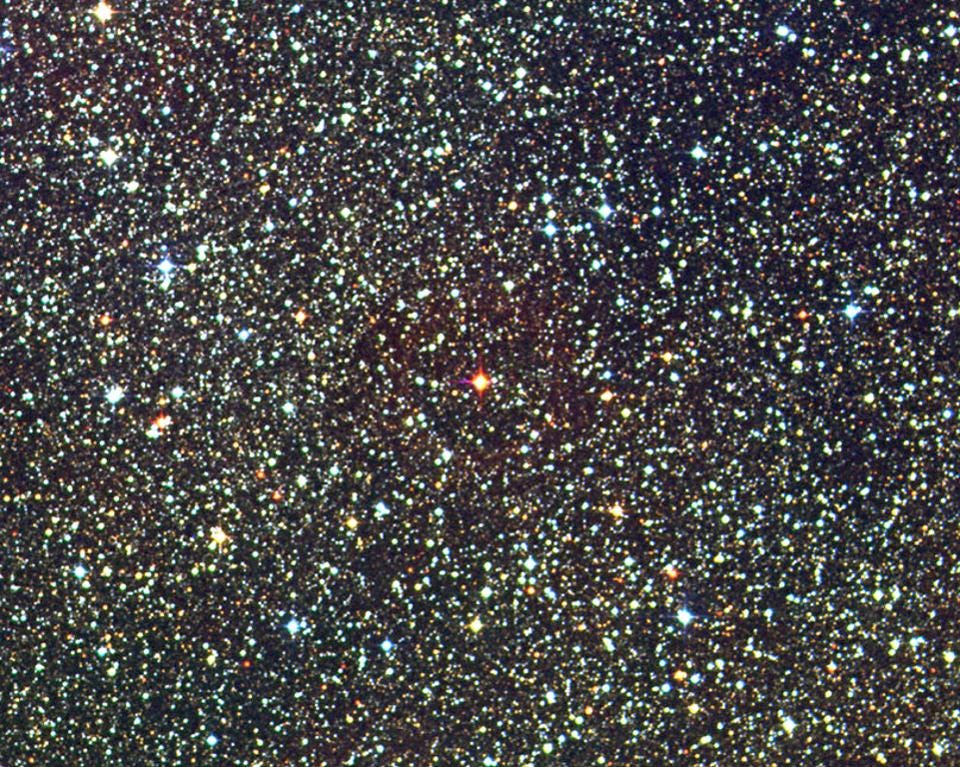
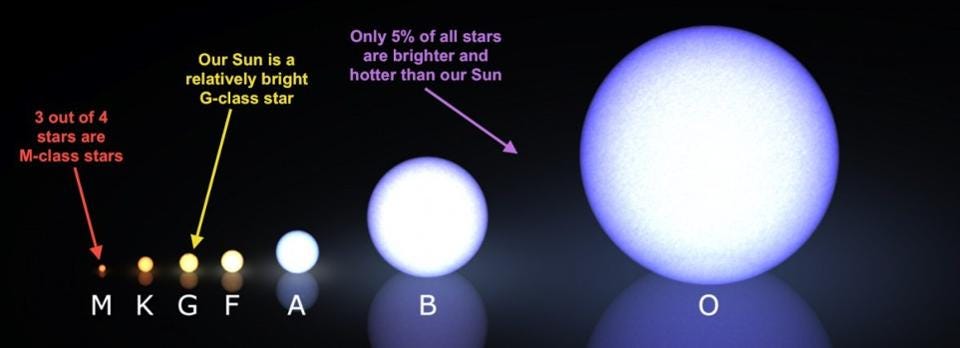
A portion of the digitized sky survey with the nearest star to our Sun, Proxima Centauri, shown in red in the center. While sun-like stars like our own are considered common, we’re actually more massive than 95% of stars in the Universe, with a full 3-out-of-4 stars in Proxima Centauri’s ‘red dwarf’ class. Image credit: David Malin, UK Schmidt Telescope, DSS, AAO.

All stars, from red dwarfs through the Sun to the most massive supergiants, achieve nuclear fusion in their cores by rising to temperatures of 4,000,000 K or higher. Over large amounts of time, hydrogen fuel gets burned through a series of reactions, producing, in the end, large amounts of helium-4. This fusion reaction, where heavier elements are created out of lighter ones, releases energy owing to Einstein’s E = mc2. This occurs because the product of the reaction, helium-4, is lower in mass, by about 0.7%, than the reactants (four hydrogen nuclei) that went into creating it. Over time, this can be significant: over its 4.5 billion year lifetime thus far, the Sun has lost approximately the mass of Saturn through this process.

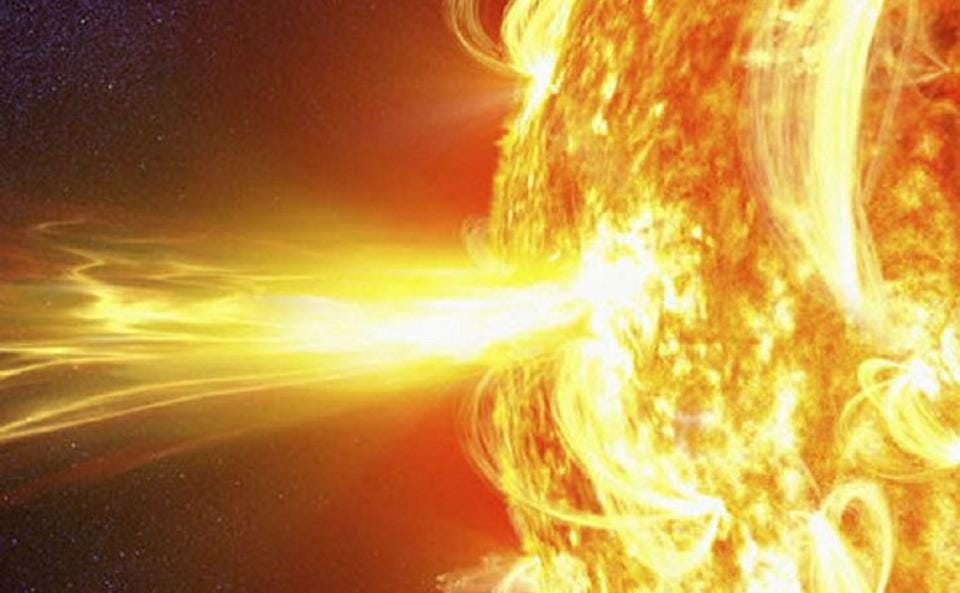
A solar flare from our Sun, which ejects matter out away from our parent star and into the Solar System, is dwarfed in terms of ‘mass loss’ by nuclear fusion, which has reduced the Sun’s mass by a total of 0.03% of its starting value: a loss equivalent to the mass of Saturn. Image credit: NASA’s Solar Dynamics Observatory / GSFC.

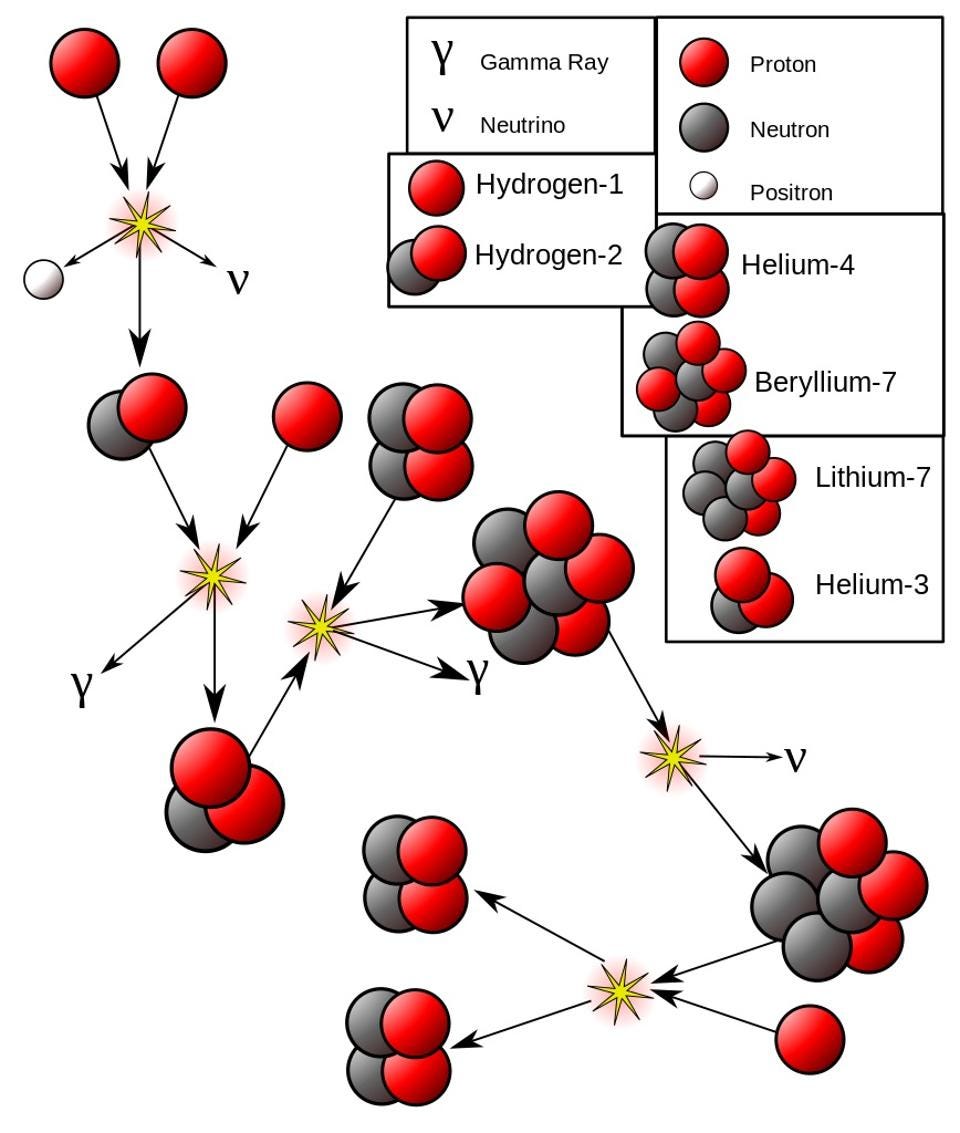
But the way it gets there is complicated. You can never have more than two objects collide-and-react at once; you can’t simply put four hydrogen nuclei together and turn them into a helium-4 nucleus. Instead, you need to go through a chain reaction to build up to helium-4. In our Sun, that involves a process called the proton-proton chain, where:

  • Two protons fuse together to form a diproton: a highly-unstable configuration where two protons temporarily create helium-2,
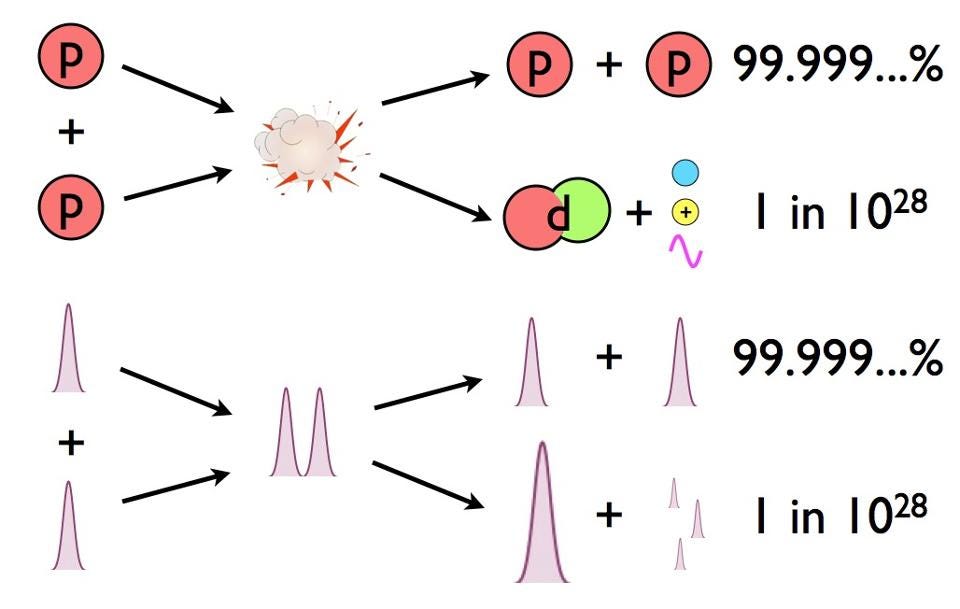
  • A tiny fraction of the time, one-in-10,000,000,000,000,000,000,000,000,000 times, that diproton will decay to deuterium, a heavy isotope of hydrogen,
  • And it happens so quickly that humans, who can only view the initial reactants and the final products, the diproton lifetime is so small that they’d only see two protons fuse either scatter off of each other, or fuse into a deuteron, emitting a positron and a neutrino.
When two protons meet each other in the Sun, their wavefunctions overlap, allowing the temporary creation of helium-2: a diproton. Almost always, it simply splits back into two protons, but on very rare occasions, a deuteron (hydrogen-2) is produced. Image credit: E. Siegel / Beyond The Galaxy.
  • Then that deuteron can easily combine with another proton to fuse into helium-3, a much more energetically favorable (and faster) reaction,
  • And then that helium-3 can proceed in one of two ways:
  • It can either fuse with a second helium-3, producing a helium-4 nucleus and two free protons,
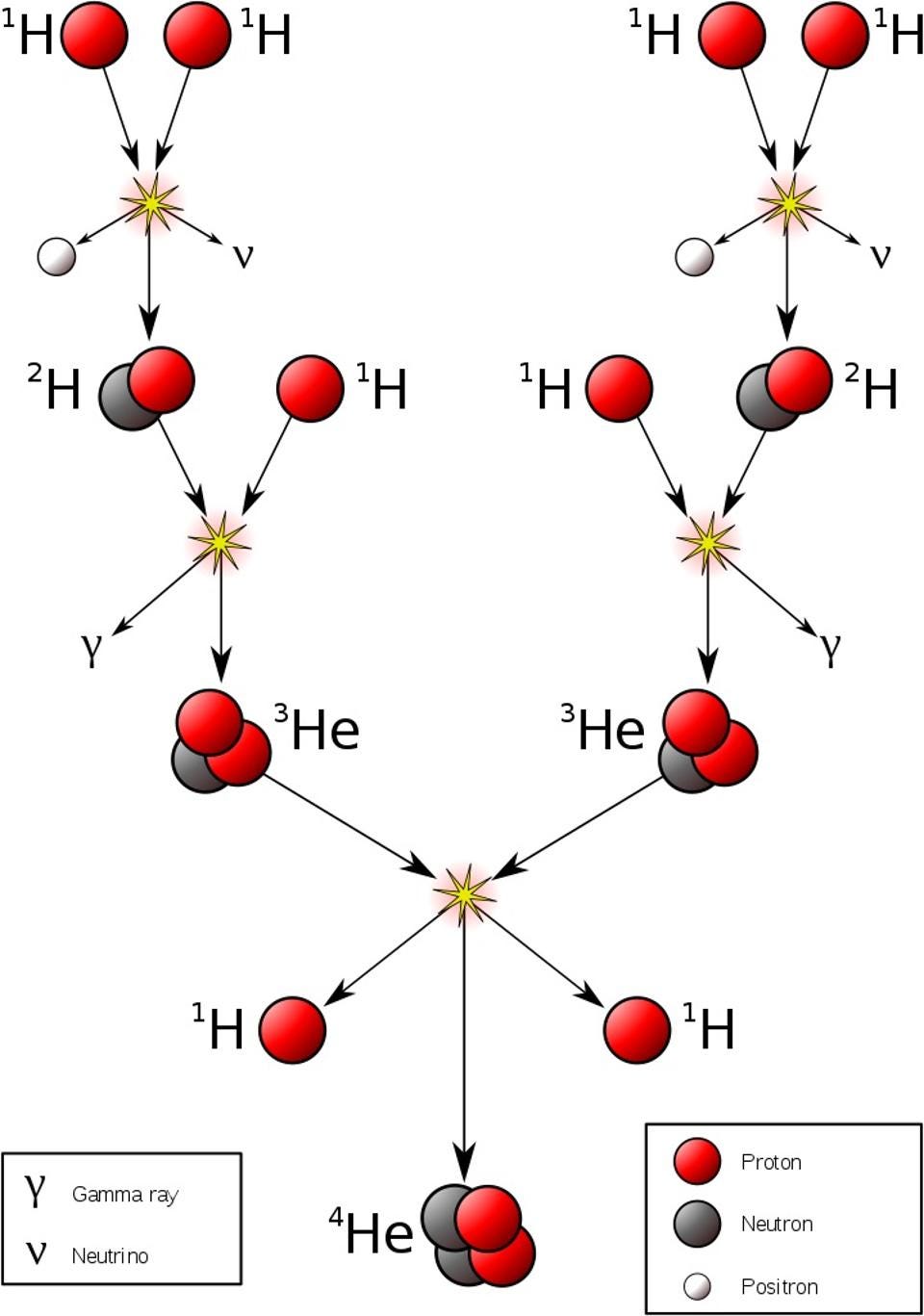
The most straightforward and lowest-energy version of the proton-proton chain, which produces helium-4 from initial hydrogen fuel. Note that only the fusion of deuterium and a proton produces helium from hydrogen; all other reactions either produce hydrogen or make helium from other isotopes of helium. Image credit: Sarang / Wikimedia Commons.
  • Or it can fuse with a pre-existing helium-4, producing beryllium-7, which decays to lithium-7, which then fuses with another proton to make beryllium-8, which itself immediately decays to two helium-4 nuclei.
A higher-energy chain reaction, involving the fusion of helium-3 with helium-4, is responsible for 14% of the conversion of helium-3 into helium-4 in the Sun. In more massive, hotter stars, it can dominate. Image credit: Uwe W. and Xiaomao123 / Wikimedia Commons.

So those are the four possible overall steps available to the components that make up then entire “hydrogen fusing into helium” process in the Sun:

  1. Two protons (hydrogen-1) fuse together, producing deuterium (hydrogen-2) and other particles plus energy,
  2. Deuterium (hydrogen-2) and a proton (hydrogen-1) fuse, producing helium-3 and energy,
  3. Two helium-3 nuclei fuse together, producing helium-4, two protons (hydrogen-1), and energy,
  4. Helium-3 fuses with helium-4, producing beryllium-7, which decays and then fuses with another proton (hydrogen-1) to yield two helium-4 nuclei plus energy.

And I want you to note something very interesting, and perhaps surprising, about those four possible steps: only step #2, where deuterium and a proton fuse, producing helium-3, is technically the fusion of hydrogen into helium!

Only brown dwarfs, like the pair shown here, achieve 100% of their fusion energy by turning hydrogen into helium. Because deuterium fusion (deuterium+hydrogen=helium-3) occurs at temperatures of just 1,000,000 K, ‘failed stars’ that don’t reach 4,000,000 K get their energy exclusively from the deuterium they’re formed with. Image credit: NASA/JPL/Gemini Observatory/AURA/NSF.

Everything else either fuses hydrogen into other forms of hydrogen, or helium into other forms of helium. Not only are those steps important and frequent, they’re moreimportant, energetically, and a greater overall percentage of the reactions than the hydrogen-into-helium reaction. In fact, if we look at our Sun, in particular, we can quantify what percentage of energy and of the number of reactions in each step is. Because the reactions are both temperature dependent and some of them (like the fusion of two helium nuclei) require multiple examples of proton-proton fusion and deuterium-proton fusion to occur, we have to be careful to account for all of them.

The classification system of stars by color and magnitude is very useful. By surveying our local region of the Universe, we find that only 5% of stars are as massive (or more) than our Sun is. More massive stars have additional reactions, like the CNO cycle and other avenues for the proton-proton chain, that dominate at higher temperatures. Image credit: Kieff/LucasVB of Wikimedia Commons / E. Siegel.

In our Sun, helium-3 fusing with other helium-3 nuclei produces 86% of our helium-4, while the helium-3 fusing with helium-4 through that chain reaction produces the other 14%. (Other, much hotter stars have additional pathways available to them, including the CNO cycle, but those all contribute insignificantly in our Sun.) When we take into account the energy liberated in each step, we find:

  1. Proton/proton fusion into deuterium accounts for 40% of the reactions by number, releasing 1.44 MeV of energy for each reaction: 10.4% of the Sun’s total energy.
  2. Deuterium/proton fusion into helium-3 accounts for 40% of the reactions by number, releasing 5.49 MeV of energy for each reaction: 39.5% of the Sun’s total energy.
  3. Helium-3/helium-3 fusion into helium-4 accounts for 17% of the reactions by number, releasing 12.86 MeV of energy for each reaction: 39.3% of the Sun’s total energy.
  4. And helium-3/helium-4 fusion into two helium-4s accounts for 3% of the reactions by number, releasing 19.99 MeV of energy for each reaction: 10.8% of the Sun’s total energy.
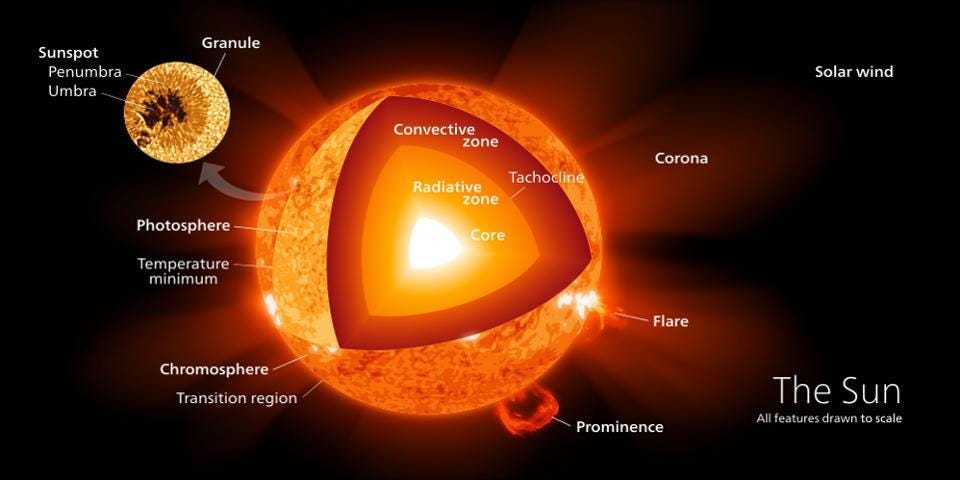
This cutaway showcases the various regions of the surface and interior of the Sun, including the core, which is where nuclear fusion occurs. Although hydrogen is converted into helium, the majority of reactions and the majority of the energy that powers the Sun comes from other sources. Image credit: Wikimedia Commons user Kelvinsong.

It might surprise you to learn that hydrogen-fusing-into-helium makes up less than half of all nuclear reactions in our Sun and that it’s also responsible for less than half of the energy that the Sun eventually outputs. There are strange, unearthly phenomena along the way: the diproton that usually just decays back to the original protons that made it, positrons spontaneously emitted from unstable nuclei, and in a small (but important) percentage of these reactions, a rare mass-8 nucleus, something you’ll never find naturally occurring here on Earth. But that’s the nuclear physics of where the Sun gets its energy from, and it’s so much richer than the simple fusion of hydrogen into helium!

By Ethan Siegel

“Gender Norms Get a Workout in Stilettos” by Carolyne Zinko

Photographer Devlin Shand moved to San Francisco after graduation from Fordham University because he said the city is receptive and welcoming to free spirits like himself. He enjoys his ability to express himself through a gender-fluid manner of personal attire, whether at work or at community events. Photo: Liz Hafalia, The Chronicle

Photo: Liz Hafalia, The Chronicle.  Photographer Devlin Shand moved to San Francisco after graduation from Fordham University because he said the city is receptive and welcoming to free spirits like himself. He enjoys his ability to express … more

September 10, 2017 (SFChronicle.com)

When the shutter snaps, it’s usually the fashions seen through the lens that matter — from glamorous gowns to glittering gems. But behind the camera, San Francisco photographer Devlin Shand is drawing attention for his own flair.

He’s a familiar face at Drew Altizer Photography, the go-to firm for high-society events, and he tries to fade into the background to the extent possible. But as a 6-foot, 2-inch man who wears spike heels, makeup and strands of pearls around his neck, he’s hard to ignore.

Guests smile at his appearance, but when he’s out of earshot, there’s usually a one-word whisper: “Why?”

The answer, strangely enough, can be found in the name of the purple Nyx brand lipstick the openly gay 29-year-old wears. It’s called Volcano, and is a metaphor if ever there was one for the way he’s trying to explode gender norms with his appearance.

“At first I was dressing this way because it felt good — it’s fun to play with people’s ideas of normalcy,” said Shand, an East Coast transplant. “As we’re moving into the future, I want to do it as an act of resistance. There are no categories. Gender is arbitrary. People can do and be whatever they want.”

Shand grew up in the Hudson Valley, an hour outside New York. His father, now deceased, owned a roofing company. His mother taught culinary arts and fashion at a local high school. An older brother is a contractor; a younger brother cooks at a country club.

Shand owes his love of the dramatic in part to his parents, who both performed in community theater. He studied theater at Ithaca College, but midway through grew disenchanted. “I saw what the life of an actor would be like,” he said, “and decided it wouldn’t be for me — a life of rejection.”

He transferred to Fordham University in New York and earned a degree in visual arts and photography. He sang in the choir and performed with the mimes and mummers. After college, he worked in retail and at upscale restaurants in New York, but longed to find a place where he could, as he put it, “be queer, and queer the way I wanted to be.” He considered London, Seattle and Portland, Ore., before settling in San Francisco.

A college roommate had moved here and invited him to visit. During a month-long stay in 2013, he quickly found a job taking photos for a startup company. He liked the LGBTQ history. And he felt welcome. “I see San Francisco as a living, breathing entity, and she wants you here or she doesn’t,” he said. “I felt she wanted me here.”

A year later, he was back permanently, and soon working for Drew Altizer. Bit by bit, he began experimenting with his clothing on the job. (It’s the clients who are supposed to be the center of attention.)

At the San Francisco Ballet gala in January, he wore a jacket and pants with black stilettos, a medallion brooch with chains and lipstick. At a Lake Tahoe benefit luncheon this summer, he sported a pair of ivory culottes with a white polo shirt, suede oxford shoes — and dangling gold tassel earrings.

The outfit caught the eye of Michael Oliver, a luxury real estate agent in Tahoe, who as a descendant of the oldest family in the Society of California Pioneers might have turned a blue-blooded cheek in disapproval. He didn’t.

“Everyone at my table was talking about his outfit,” Oliver said. “Nobody thought it was a bad outfit. They thought it was a lovely outfit. Very creative.”

Even Altizer gets a kick out of Shand, noting, “Devlin is such a sweet guy and talented in putting together a great outfit — I just hope we don’t lose him to the fashion or performance world!”

Shand began playing with color in his wardrobe at 12, and in college wore 4-inch heels for the first time — to a Halloween party, dressed as a doll that was half Barbie and half Ken. His feet hurt at the end of the night, but not badly enough to keep heels at bay. He likes the way they elongate the leg and change one’s posture. “It’s a whole attitude shift,” he says.

He goes to Burning Man and supports the Crucible industrial arts school (he designed attire for one of its Hot Couture fashion shows). He is also working on a project he hopes will be exhibited at an art gallery: portraits of men in drag, dressed “in their most queer fantasy — wigs, makeup, whatever” with the help of Grace Towers, a performer who runs a drag lab and workshop in San Francisco.

Shand’s mother came for a visit not long ago and embraced his new life by joining him in a night on the town in which he dressed in drag and she wore a corset. And so far, the rest of San Francisco has embraced him, too.

“If people have a reaction, I would like it to be introspective,” he says. “I would like for it to be, ‘How does this affect my view of fashion and gender?’”

“And,” he adds for emphasis, “Does it really matter what people think? Can’t fabulous just be fabulous?”

Carolyne Zinko

Features Reporter

Consciousness, spirituality, biography, sexuality, androgyny, futurism, space, the arts, science, astrology, democracy, humor, books, movies and more