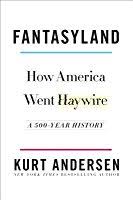
Book: “Fantasy-Industrial Complex: How America Got Lost Inside a Dream”

September 13, 2017 (bigthink.com)

Author and Podcaster

The start of the 20th century was the birth of a strange new reality in the United States. The advent of the moving image, of Hollywood and sudden celebrity, caused a quantum shift in how Americans thought about the experience of life. Actors were elevated to the status of superheroes and demigods, and those left in the obscurity of the masses began to desire that elusive privilege: fame. But where America really went haywire, author Kurt Andersen explains, is when the cult of celebrity and the cult of capitalism merged: it was the opening of Disneyland in 1955. A bizarre reality where advertising met animation. You could buy real wares, from fake characters, in real stores, with make-believe themes. “What happened in Disneyland… did not stay there,” says Andersen. From Mickey Mouse all the way to the White House, Anderson doesn’t find it at all surprising that Americans might have a hard time telling what’s true from what’s false. He calls it the fantasy-industrial complex, and it might just be America’s beautifully branded nightmare. Kurt Andersen’s new book is Fantasyland: How America Went Haywire: A 500-Year History.

NASA’s Cassini will take a fiery swan dive into Saturn (pbs.org)


Some 800 million miles away, NASA’s Cassini spacecraft has orbited Saturn and captured images of its rings and icy moons. After nearly 5 billion miles traveled and 20 years of sending revealing data from the gas giant, Cassini is winding down its way toward a suicide plunge into the planet. Science correspondent Miles O’Brien reports on how NASA is choreographing the spacecraft’s final dive.

Recipe: Bread and Butter Pudding (mmm!)

Bread and butter pudding is a traditional type of bread pudding popular in British cuisine. It is made by layering slices of buttered bread (often stale bread) scattered with raisins in an oven dish, over which an egg custard mixture, made with milk or cream and normally seasoned with nutmeg, vanilla or other spices, is poured.  It is often served with custard or cream.

Recipe here: https://en.wikipedia.org/wiki/Bread_and_butter_pudding

An important outlook for those who Translate (from smithsonian.com and Suzanne Deakins, H.W., M.)

We Legitimize the ‘So-Called’ Confederacy With Our Vocabulary, and That’s a Problem

Tearing down monuments is only the beginning to understanding the false narrative of Jim Crow

By Christopher Wilson

smithsonian.com
September 12, 2017 7:00AM

As the debate escalates over how we publicly remember the Civil War following the tragic events in Charlottesville, Virginia, the passionate and contentious disputes have centered on symbols like monuments, street names, and flags. According to a study by the Southern Poverty Law Center, at least 1,503 symbols to the Confederacy are displayed in public spaces, mostly in the South and the Border States, but even in decidedly Yankee locales like Massachusetts. Most of these monuments sprang from the Lost Cause tradition that developed in the wake of the war, during the establishment of white supremacist Jim Crow laws around 1900, and as a response to the Civil Rights Movement of the 1950s and 1960s. Those artifacts are not the only way we legitimize and honor the deadly and racist 19th-century rebellion against the United States. Much of the language used in reference to the Civil War glorifies the rebel cause.

The language we turn to in describing the war, from speaking of compromise and plantations to characterizing the struggle as the North versus the South, or referring to Robert E. Lee as a General, can lend legitimacy to the violent, hateful and treasonous southern rebellion that tore the nation apart from 1861 to 1865; and from which we still have not recovered. Why do we often describe the struggle as between two equal entities? Why have we shown acceptance of the military rank given by an illegitimate rebellion and unrecognized political entity? In recent years, historians in academia and in the public sphere have been considering these issues.

Historian Michael Landis suggests professional scholars should seek to change the language we use in interpreting and teaching history. He agrees with people like legal scholar Paul Finkelman and historian Edward Baptist when they suggest the Compromise of 1850 be more accurately referred to as an Appeasement. The latter word precisely reflects the sway that Southern slaveholders held in the bargain. Landis goes on to suggest that we call plantations what they really were—slave labor camps; and drop the use of the term, “the Union.” A common usage in the 19th century to be sure, but now one we only use “the Union” in reference to the Civil War and on the day of the State of the Union address. A better way to speak of the nation during the war, he argues, is to use its name, the United States.

In the same way, we could change the way we refer to secessionist states. When we talk of the Union versus the Confederacy, or especially when we present the strife as the North versus the South, we set up a parallel dichotomy in which the United States is cast as equal to the Confederate States of America. But was the Confederacy really a nation and should we refer to it as such?

When historian Steven Hahn participated in the 2015 History Film Forum at the Smithsonian’s National Museum of American History, he noted that using these customary terms to tell the story of the Civil War —Hahn suggests we use “War of the Rebellion”—lends legitimacy to the Confederacy.

“If you think about it,” Hahn said, “nobody in the world recognized the Confederacy. The question is can you be a state if no one says you are a state?”

Of course, international recognition and support for the rebellion was intensely important to secessionist leaders, not just because Jefferson Davis desired the military backing of Great Britain and other European nations, but because they sought the legitimacy that came with it. Hahn says that President Abraham Lincoln and his administration believed that its leaders didn’t have the right to leave the United States or the authority to take their states with them. Looking at leaders like Lincoln during the war and Frederick Douglass in its aftermath, it is apparent that the concept of being careful about the terms we use to describe the period is not a new challenge. In his writings, Lincoln referred to the group he was fighting as the “so-called Confederacy” and Jefferson Davis never as president, only as the “insurgent leader.”

And if the so-called Confederacy wasn’t a country, but rather what political scientists would call a proto-state, because not a single foreign government in the entire world recognized it as a nation-state, then could Jefferson Davis legitimately be a president? Could Robert E. Lee be a General?

The highest rank Lee achieved in the United States Army was colonel, so given his role as general in service to a failed revolution by a group of rebels, how should we now refer to him?

It would be just as accurate to refer to Lee, who led an armed group against national sovereignty, as an insurgent or a warlord, if not a terrorist. Imagine how different it would be for a school-age child to learn about the War of the Rebellion if we altered the language we use.

When news reports about the debate over monuments say “Today the City Council met to consider whether to remove a statue commemorating General Robert E. Lee, commander of the Confederate Army,” what if they instead were written in this way: “Today the City Council debated removing a statue of slaveholder and former American army colonel Robert E. Lee, who took up arms in the rebellion against the United States by the so-called Confederacy?”

Yale historian David Blight, whose book Race and Reunion called for a reexamination of how we remember the war, says our memorializing language and ideology about the Confederacy became a potent revisionist force in how we understand our history. The Lost Cause tradition, which Blight said he always calls “a set of beliefs in search of a history, more than actually a history,” revolves around an “idea that there was one Confederacy, and there was this noble struggle to the end to defend their sovereignty, and to defend their land and to defend their system, until they could defend it no more. And that image has been reinforced over the intervening years in popular literature and in films like Birth of a Nation, and Gone with the Wind, and the many monuments as well as the use of the Confederate flag.”

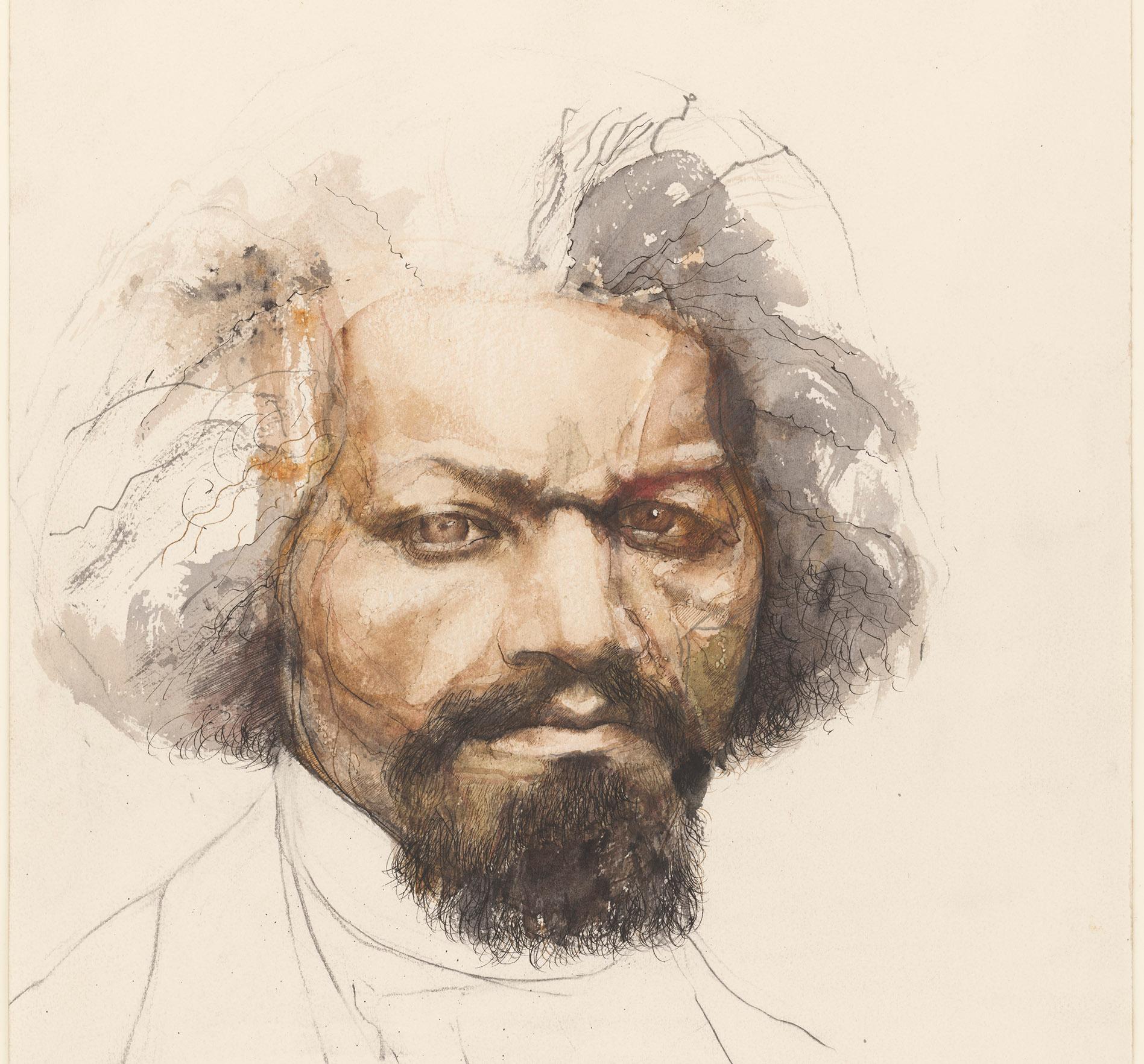
Frederick Douglass

Douglass had already begun to see that the losers of the war were winning the peace because he felt that the American people were “destitute of political memory.” (NPG, Charles Arthur Wells, Jr.)

Frederick Douglass was, Blight says, “acutely aware that the postwar era might ultimately be controlled by those who could best shape interpretations of the war itself.”

Just a few years after the war, Douglass had already begun to see that the losers of the war were winning the peace because he felt that the American people were “destitute of political memory.” Douglass often referred to the war as a “rebellion” and was careful not to speak of the rebels in any honorific way, and pledged himself to never forgive the South and to never forget the meaning of the war. On Memorial Day in 1871 at the Tomb of the Unknown Soldier at Arlington National Cemetery, Douglass’ speech was resolute:

We are sometimes asked in the name of patriotism to forget the merits of this fearful struggle, and to remember with equal admiration those who struck at the nation’s life, and those who struck to save it—those who fought for slavery and those who fought for liberty and justice. I am no minister of malice . . . I would not repel the repentant, but . . . may my tongue cleave to the roof of my mouth if I forget the difference between the parties to that . . . bloody conflict . . . I may say if this war is to be forgotten, I ask in the name of all things sacred what shall men remember?

As Douglass was already concerned that the victors were losing the war of historical memory to the supposedly vanquished, I am not sure that he would have been surprised that not far from where he stood at the national cemetery—often considered the nation’s most hallowed ground—a Confederate memorial would be built in the early 20th century to the insurgents he felt “struck at the nation’s life.”

Douglass knew, day-by-day, after the shooting stopped, a history war was playing out. It is clearly not over yet. Words, though they do not stand as marble and bronze memorials in parks and in front of buildings or fly on flagpoles, are perhaps even more powerful and pernicious. The monuments we’ve built with language may, in fact, be even more difficult to tear down.

Read more: http://www.smithsonianmag.com/smithsonian-institution/we-legitimize-so-called-confederacy-vocabulary-thats-problem-180964830/#20jx8tgQQbZAAYuF.99

Suzanne Deakins, Ph.D., H.W.M.

suzannedeak@gmail.com
503-954-0012

Blogs

www.sacredpractices.com

“GURDJIEFF’S INDELIBLE ADVICES TO HIS DAUGHTER” by FAENA ALEPH

NOVEMBER 27, 2013

This series of short and simple advice represents the basic principles for anybody who seeks mental peace.

After traveling through Africa and Asia, G.I. Gurdjieff arrived in Russia in the year 1912, bringing with him teachings that were neither a religion nor a philosophy, but practical lessons that had to be experienced. And since this was not the path of the fakir, the monk or the yogi, he named his teachings the “Fourth Way”.

According to Gurdjieff, the evolution of humankind has entered an uncertain phase, and unless the “wisdom” of the Orient and the “energy” of the West come together and mutually feed each other, the world will inevitably collapse. His legacy of formidable teachings is one of the wisest and most adaptable for our contemporary lifestyle.

The following is a list of advice he wrote for his daughter Duska Howard. However, anyone who wishes to awake his consciousness and develop a more integral and satisfactory life, will appreciate it. This list is also, and above all, a cluster of concise recommendations that could help us to lucidly transcend daily situations, reminding us that integrity is far easier than we think. Gurdjieff’s councils allude to hard work, nourishment, human passions and emotions, cynicism and generosity, and together they comprise a sort of manifesto, one which would be wise to read every morning.

1. Fix your attention on yourself, be aware at every moment of what you think, feel, want and do.

2. Always finish what you started.

3. Do what you are doing as best as possible.

4. Do not be chained to anything that in the long run can destroy you.

5. Develop your generosity without witnesses.

6. Treat every person as a close relative.

7. You must order what is disordered.

8. Learn to receive and be grateful for each gift.

9. Stop defining yourself.

10. Do not lie, do not steal, for if you do, you lie and steal from yourself.

11. Help your neighbor without doing making them depend on you.

12. Do not wish to be imitated.

13. Make plans and see them through.

14. Do not take up too much space.

15. Do not make unnecessary noises or gestures.

16. If you do not have faith, act as if you do.

17. Do not be impressed by strong personalities.

18. Do not appropriate anything or anyone.

19. Distributed equally.

20. Do not seduce.

21. You must only eat and sleep as much as is necessary.

22. Do not discuss your personal problems.

23. Do not pass judgments or criticize when you do not know all the facts.

24. Do not have useless friendships.

25. Do not follow fads.

26. Do not sell yourself.

27. Respect the contracts you have signed

28. Be punctual.

29. Do not envy others’ property or goods.

30. Speak only what is necessary.

31. Do not think of the benefits that your work will bring.

32. Never threaten.

33. Follow through with your promises.

34. In an argument, put yourself in the place of the other.

35. Accept when someone is better than you.

36. Do not eliminate, transform.

37. Defeat your fears; each one of them is a desire that is camouflaged.

38. Help the other help themselves.

39. Put an end to your antipathy and get closer to people that you want to reject.

40. Do not react when they speak well or ill of you.

41. Transform your pride into dignity.

42. Turn your anger into creativity.

43. Transform your greed into respect for the beauty.

44. Transform your envy into the admiration for the values of others.

45. Transform your hate into charity.

46. Do not praise nor insult yourself.

47. Treat the things that do not belong to you as if they did.

48. Do not complain.

49. Develop your imagination.

50. Do not give orders for the pleasure of being obeyed.

51. Pay for the services you are given.

52. Do not boast about your work or ideas.

53. Do not try to arouse emotions like pity, admiration, sympathy and complicity in others.

54. Do not try to distinguish yourself by your appearance.

55. Never contradict, just be silent.

56. Do not fall in debt, buy and pay immediately.

57. If you offend someone, ask for forgiveness.

58. If you have offended publicly apologize publicly.

59. If you realize that you have said something wrong, accept your mistake and desist immediately.

60. Do not defend your old ideas simply because it was you who said them.

61. Do not keep useless objects.

62. Do not embellish yourself with the ideas of others.

63. Do not get pictures with celebrities.

64. Be your own judge.

65. Do not let your possessions define you.

66. Never talk about yourself, without allowing yourself the possibility of changing.

67. Accept that nothing is yours.

68. When you are asked what you think about something or someone, mention only their qualities.

69. When you fall ill, instead of hating this evil, consider it your teacher.

70. Do not look surreptitiously, stare steadily.

71. Do not forget the dead, but give them a limited place to prevent them from taking over your life.

72. In the place where you dwell, always consecrate a sacred place.

73. When you do a favor do not make others notice your effort.

74. If you decide to work for others, do it with pleasure

75. If in doubt between doing and not doing, take risks and do.

76. Do not try to be everything to your partner, accept that he must seek in others the things you cannot give him.

77. When someone has an audience, do not disrupt them with the purpose of stealing their audience.

78. Live with the money you have earned.

79. Do not brag about your love affairs.

80. Do not take pride in your weaknesses.

81. Never visit someone just to fill your time.

82. Obtain with the purpose of sharing.

83. If you are meditating and a devil arrives, make the devil meditate.

“Consciousness” by Robert McEwen, H.W., M.

Consciousness is stable and constant.  It is not bound in time and it has no history or story. You are only consciousness and consciousness only.  You are observing what is appearing or comes up for you in consciousness.  Now, put it down.  Put down these concepts and sensations you give meaning to and think you are real.

You may try to change or fix yourself or others, yet this is futile. You are not the content of what you are observing in consciousness.  It does not BELONG to you so this is impersonal in nature, or you are not attached to the content.   You are ONLY the presence of consciousness observing.   Only this, not the content; the objects or ideas.  These thoughts come and go.  They are like clouds going by. You make up your identity of these thoughts or content, and think this is you.  You are not these thoughts you have identified with.  They come and go.  But,  as consciousness you are are constant and stable.  As long as you are awareness of this, you will always be at  relaxed, secure and at peace. So breathe deep and BE at peace now.  Let go of any content you attach to, or judge and suffer about.

You are no longer attached to the content you suffer over and are caught up as your story.  Let go of any idea of past baggage you have been carrying  now. This or that happened to you and your feelings about that.  You are free as consciousness and watching only.  You have permission to just be.  Give Being to yourself.  Accept Being by letting it go.  It is painless.  Relief now is experienced and you experience great joy!  Presence is not a perception or idea.  Presence is being.

 It is simple. Too simple for the intellect, so the intellect has to be dropped in order experience this exquisite joy.  You are awakening to what you were before you came. This is eternal in nature and has no name.

~ Enjoy.

 Love Blessings,

Robert McEwen, HWM
robbystarman@aol.com
503  706-0396

Book: “Mathematical Recreations and Essays”

Three Pieces of Music That Helped Me Get Through the Aftermath of the September Eleventh Attacks

At the end of a recent episode, entitled “Fugue”, of the British (ITV) series Endeavor, Detective Inspector Fred Thursday tells the young Detective Constable Morse, after they’ve both narrowly escaped being killed by a homicidal psychopath, to “Go home. Put on your best record. Play it as loud as you can. And tell yourself, ‘This is something the darkness can’t take from me!'”

Years ago, in the aftermath of the September Eleventh attacks, I found myself listening to the same three pieces of music – over and over – I think in aid of much the same end.

The first of these was the song “O Superman (For Massenet)“, by Laurie Anderson. Almost eerily prophetic, since it had first come out some twenty years before:

The second was a set of Psalm settings in Hebrew by Steve Reich, entitled Tehillim. Dancing, vibrant, joyous, profound; plus, for connoisseurs of Halleluia Choruses, the last movement will be a revelation. Tehillim makes up the first four tracks of this post on YouTube:

(Another composition by Steve Reich, The Desert Music, is to be found on the seven other tracks of this YouTube post, and is also well worth a listen, though tangential to my main thrust here…)

For the lyrics of Tehillim, including translations into English, visit:

https://lyrics.az/steve-reich/tehillim/

Finally, there was A Love Supreme, by John Coltrane (featuring what is now known as his “Classic Quartet“), about which comment would be superfluous:

NOTE: Twelve years ago, on my way back to New Orleans from my brief but productive exile with Billye in Hyattsville, Maryland, I passed through New York City (long story that, and something else less germane to this post…).  There, the Manhattanites I spoke with referred to what everyone else calls “Nine-Eleven” as “September Eleventh”. Hence the title and diction above – to honor them…

Consciousness, spirituality, biography, sexuality, androgyny, futurism, space, the arts, science, astrology, democracy, humor, books, movies and more