“7 People Whose Words Changed the Course of History” by Stephen Johnson

September 6, 2017 (bigthink.com)

A speech is more than a set of spoken words. It’s a combination of the speaker, the context, the language, and these things working together can make it far greater than the sum of its parts. In that vein, we compiled some of the greatest public speakers of all time, people whose words changed the course of societies and defined eras.

Winston Churchill 

When Paris fell to the Nazis on June 14, 1940, England began to steel itself for the brunt of the Axis powers on the Western front. Winston Churchill, who had taken over as prime minister just a month prior, delivered his famous “Our Finest Hour” to a country bracing itself for full-scale attack. In 1953, Churchill was awarded the Nobel Prize in Literature, in part for his speeches, which he wrote himself.

In his history of World War II entitled “The Storm of War,” Andrew Roberts writes:

“Winston Churchill managed to combine the most magnificent use of English — usually short words, Anglo-Saxon words, Shakespearean. And also this incredibly powerful delivery. And he did it at a time when the world was in such peril from Nazism, that every word mattered.”

John F. Kennedy

Few speeches are as oft quoted as John F. Kennedy’s inaugural address, which he spent months writing. Kennedy’s ability to speak as if he was having an authentic conversation with an audience, as opposed to lecturing to them, is one quality that made him such a compelling communicator.

Socrates

Standing accused of crimes including corrupting the youth of Athens, Socrates had a choice: defer and apologize to his accusers for his alleged crimes, or reformulate their scattered accusations into proper legal form (thereby embarrassing his accusers) and deliver an exhaustive defense of the pursuit of truth, apologizing for nothing. He chose the latter and was sentenced to death. Part of Socrates’ “Apology” includes:

How you have felt, O men of Athens, at hearing the speeches of my accusers, I cannot tell; but I know that their persuasive words almost made me forget who I was – such was the effect of them; and yet they have hardly spoken a word of truth. But many as their falsehoods were, there was one of them which quite amazed me; – I mean when they told you to be upon your guard, and not to let yourselves be deceived by the force of my eloquence.

Adolf Hitler

Hitler was well aware that mastering the art of public speaking was crucial to his political career. He wrote all of his speeches himself, sometimes editing them more than five times. He practiced his facial expressions and gestures, and he was adept at interweaving metaphor and abstract ideas into his speeches about political policy.

Martin Luther King Jr.

The strong musicality of Martin Luther King Jr.’s rhetoric is perhaps just as recognizable as the words “not be judged on the color of their skin, but by the content of their character.” Martin Luther King drew inspiration from Shakespeare, the bible, his own past speeches, and numerous civil rights thinkers to write his “I Have a Dream” speech, one of the most famous of all time.

James Baldwin

Until his death in 1987, James Baldwin pushed the conversation about race in America forward with his carefully intense social criticism. He traveled extensively throughout his life, saying that “Once you find yourself in another civilization, you’re forced to examine your own.”

Mister Rogers

Mister (Fred) Rogers spent his life communicating soft-spoken yet direct messages of practical advice to children, ultimately earning him a Peabody Award and the Presidential Medal of Freedom. Rogers was an expert in using rhetoric to effectively communicate with any audience, not just children, a quality best evidenced in his appearance before a senate committee to save his show’s funding in 1969.

“Educators must counter falsehoods by shining light on facts” by Janet Napolitano

September 1, 2017 (SFChronicle.com)

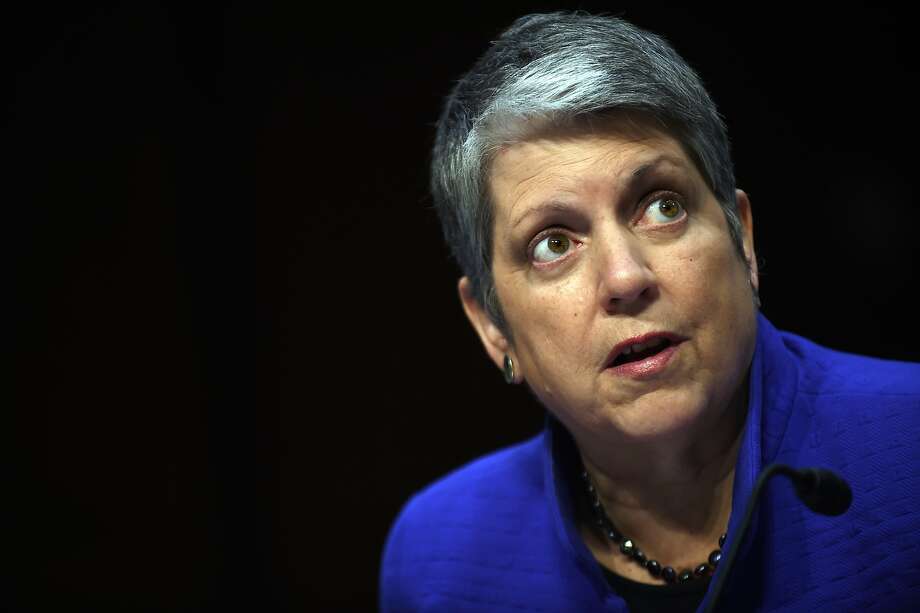
Janet Napolitano, president of the University of California, speaks during a hearing of the Senate Health, Education, Labor, and Pensions Committee on July 29, 2015 in Washington, DC. Photo: Astrid Riecken, Getty Images

Photo: Astrid Riecken, Getty Images

Janet Napolitano, president of the University of California, speaks during a hearing of the Senate Health, Education, Labor, and Pensions Committee on July 29, 2015 in Washington, DC.

The acts of violence in Charlottesville represented an assault on the very foundations of our democracy, and an affront to all people who believe the strength of our future as a nation hinges upon our ability to become a more tolerant nation, a nation that fully respects and includes all Americans, in all of our diversity.

An equally enduring threat to American democracy is the “myth of many sides” — the myth that all sides of an argument have equal value.

This is a unique time of false equivalencies, when real news is labeled fake news and fake news is spun as the truth. So, the role of members of the academic community as sources of facts and context is more important now than ever. Public participation — public engagement — is a responsibility we in the academic world can and must embrace. All of us must do more to counteract misinformation and outright bigotry.

Princeton history professor Kevin Kruse recently shared examples of false equivalencies in history, and suggested that educators invite their students to find others. Among the examples he cited were Govs. Earl Long of Louisiana and Orval Faubus of Arkansas, who likened the NAACP to White Citizen Councils opposing the integration of public schools after the U.S. Supreme Court’s Brown vs. Board of Education decision in the 1950s.

Conservative intellectual William F. Buckley Jr., the founding editor of the National Review, once described moral equivalence in these words: “To say that the CIA and KGB engage in similar practices is the equivalent of saying that the man who pushes an old lady into the path of a hurtling bus is not to be distinguished from the man who pushes an old lady out of the path of a hurtling bus: on the grounds that, after all, in both cases someone is pushing old ladies around.”

Speech not rooted in facts is proliferating. It is increasingly difficult for the public to distinguish fact from fiction. And falsehoods undercut the role of science in society, as well as fact-based policy analysis.

We see the negative impact on public policy when the findings of climate science are denied, just as the denial of the connection between tobacco and lung disease delayed policies in the past that could have saved lives. And false equivalencies feed false expectations when we’re told that coal mining jobs will somehow reappear if we rewrite our environmental laws, rather than preparing workers for careers in alternative energy.

Pluralism is supposed to provide a solid foundation for a strong democracy. But false equivalencies are corrupting the underpinnings of democracy — eroding faith in our public institutions.

Those of us in the academic community share a responsibility to guard against falsehoods and false equivalencies. The ideologies of white nationalists and neo-Nazis do not represent the truth by any measure. There is no place in American democracy for white supremacy. Period. But because there will always be a place in America for freedom of expression, even when it’s hateful, we must counter the hate and falsehoods by shining a light on the facts.

Truth telling, of course, is the essence of both teaching and learning. Within the University of California community of students, faculty and staff, we can draw on academic expertise and shared values to speak out against intolerance. That might require only an email or a letter, published commentary or a call to an elected official. Whether it’s a professor illuminating forgotten episodes of our past, or students peacefully expressing themselves, it’s important that we muster the collective will to participate fully in the public square.

Janet Napolitano is president of the University of California. This commentary is adapted from a speech to the annual meeting of the American Political Science Association in San Francisco on Thursday, Aug. 31.

Shelley Berman (February 3, 1925 – September 1, 2017)

Mr. Berman as a misanthrope in a 1961 episode of “The Twilight Zone” in which, getting his wish, everyone ends up just like him. CreditCBS, via Photofest (New York Times)

Sheldon Leonard Berman (February 3, 1925 – September 1, 2017) was an American comedian, actor, writer, teacher, lecturer and poet. In his comedic career, Berman was awarded three gold records and he won the first Grammy Award for a spoken comedy recording in 1959. Wikipedia

New York Times obit: “Louise Hay, Widely Read Self-Help Author, Dies at 90”

Louise Hay in an undated photograph. CreditHay House

Louise Hay, who from a 1984 best seller built a self-help publishing empire that has attracted millions of devotees with its messages about the power of thought and attitude, died on Wednesday at her home in San Diego. She was 90.

Her death was announced on the website of her company, Hay House.

In books like “You Can Heal Your Life,” “The Power Is Within You” and “Meditations to Heal Your Life,” Ms. Hay espoused an upbeat message with a metaphysical underpinning. She wrote that there is a link between thoughts and disease and life’s other misfortunes, and she urged people to find a positive way to spin even the worst of them.

Ms. Hay became an early example of the sort of self-improvement gospel that has sprung up over the last several decades. (A 2008 New York Times Magazine article about her carried the headline “The Queen of the New Age.”) And she was one of its most successful adherents.

Few women have sold more books, and Hay House, which she started in her living room in the mid-1980s, has grown into a multimillion-dollar company handling a long roster of authors and an extensive line of products, including books, CDs and online courses. The company also stages lectures and workshops featuring its authors.

Ms. Hay (who sometimes used the name Louise L. Hay in her books) was born on Oct. 8, 1926, in Los Angeles. Few details about her early life, including her surname at birth, are readily known, though by her account it was a difficult period. She recalled being abused by her stepfather and raped by a neighbor around the age of 5. As a teenager she dropped out of school and gave birth to a girl, her only child, whom she gave up for adoption.

After living in Chicago for a time, she moved to New York, where she worked as a fashion model and, in the mid-1950s, married Andrew Hay, an English businessman.

They divorced 14 years later, and in her devastation afterward she went to the First Church of Religious Science in Manhattan, whose message about the power of thought to improve one’s circumstances resonated.

Photo

One of Louise Hay’s best sellers.

“I heard somebody say there, ‘If you’re willing to change your thinking, you can change your life,’ ” she told The Times Magazine. “My jaw dropped. I said, ‘Really?’ ”

Ms. Hay began to study and practice that philosophy, and around 1977, as she told the story, she had a chance to put it to a serious test when she was given a diagnosis of cervical cancer. She concluded, she said, that the disease had been caused by lingering resentment over the childhood abuse. Refusing medical treatment, she said, she cured herself with a regimen that included nutrition, reflexology and forgiveness.

About the same time, she compiled a small book, “Heal Your Body,” a reference guide to the mental causes of physical ailments. She expanded on these ideas and philosophies in “You Can Heal Your Life” (1984), which became a best seller; according to her company, it has sold more than 50 million copies.

In 1985, at a time when fear of AIDS was high and those who had it were being shunned by much of society, Ms. Hay, by now relocated to the West Coast, began holding support meetings for people living with H.I.V. or AIDS. The first sessions were in her home.

“I said, ‘I have no idea what we’re doing, but I know what we’re not going to do,’ ” she recalled in 2008. “ ‘We’re not going to play Ain’t it awful.’ ”

Eventually the sessions, called Hayrides, were moved to an auditorium in West Hollywood, with hundreds in attendance, including mothers of those with the disease.

“Whenever a mother came, we gave them a standing ovation, because so many mothers weren’t speaking to their sons,” she said. What of the fathers? “The fathers almost never came — they couldn’t forgive.”

Photo

Louise Hay in an undated photo. CreditCharles Bush

Ms. Hay’s brand of wisdom relied on catchphrases — “Life loves you” was one — and pithy if often vague affirmations that she urged people to adapt in their thinking. A list of “101 Best Louise Hay Affirmations of All Time” on louisehay.com includes these:

• Every thought we think is creating our future.

• My happy thoughts help create my healthy body.

• Only good can come to me.

• I always work with and for wonderful people. I love my job.

• In the infinity of life where I am, all is perfect, whole and complete.

Other affirmations were developed for more specific purposes and problems. “You Can Heal Your Heart: Finding Peace After a Breakup, Divorce or Death” (2014), written with David Kessler, suggests affirmations for someone resentful over a divorce that was initiated by his or her spouse. One is “My divorce has no power over my future”; another, “I think we could still be married, but there is a greater knowledge in the Universe.”

Ms. Hay’s critics found such mantras simplistic at best and damaging at worst. The idea that good thoughts are the key to a good or healthy life, they said, could lead people to blame themselves for problems beyond their control, or to decide not to seek medical care.

In the 2008 Times magazine interview, she was asked if the notion that people’s thoughts were responsible for their condition meant that victims of genocide were to blame for their own deaths.

“I probably wouldn’t say it to them,” she replied. “I don’t go around making people feel bad. That’s not what I’m after.”

Ms. Hay leaves no immediate survivors.

In the preface to “You Can Heal Your Heart,” Mr. Kessler, who writes and lectures on grief and loss, wrote of a conversation he had with Ms. Hay eight years ago in which she announced to him, “David, I’ve been thinking about it, and I want you to be with me when I die.”

Mr. Kessler wrote that the remark had led him to ask her if there was anything wrong.

“No,” she replied. “I’m 82, healthy as I can be, and I’m living my life fully. I just want to make sure that when the time comes, I live my dying fully.”

Heather C. Williams, Visual Artist, Tells Her Story

My story is about SEARCHING. To me, drawing is the simplest, most powerful, creative and inexpensive art form capable of doing DEEP, CREATIVE SEARCHING. I feel that it is essential for all of us to learn HOW TO THINK more clearly, critically and creatively. The good news is that drawing can help all of us practice this.

As a child I was fascinated with drawing as a way to learn about the world around me and within me. I drew my thoughts. I drew my feelings. I drew my parents arguing to better understand them. I drew birds and animals. I drew stories. I liked a boy in 4th grade and wanted to get to know him but was too shy to approach him directly, so I found a photograph of him and got to know him a bit by drawing his face.

My kindergarten teacher told my mother to encourage my drawing and mom was happy to do this. Drawing and painting were activities she used to bring her mind and body back to wholeness from a serious nervous breakdown at age 19. Mom spent 10 years living in an upstairs bedroom, and then, at 29 years of age, in 1941, she felt strong enough to leave the house and go to a local USO dance where she met my dad, a much younger US Army Sergeant.

Mom was always a quiet person, not a social person or a big talker. She also was not a deep thinker. My dad was the deep thinker, philosopher, and questioner of life. I think I am a bit more like dad. But, like mom, I find drawing and painting to be healing, centering and a valuable way of feeling connected.

 
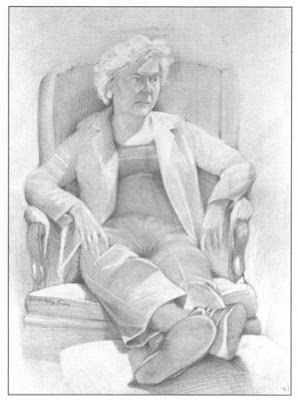
Mom, Pencil on Paper, 18″x20″

This is an observational drawing of my mom two years after her very serious heart attack at age 89. She sat completely still, hardly saying a word, while I drew her for 2 hours.

 
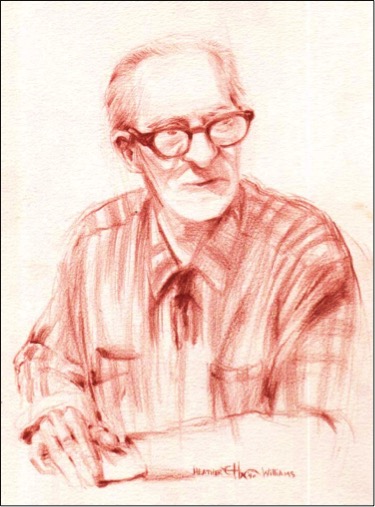
Dad, Prismacolor Pencil on Rives Paper, 8″x10″

This is an observational drawing of my Dad done a few weeks before he died from cancer in 1992. He was staying with me while getting radiation treatments at the Veteran’s Hospital in Milwaukee. These two drawings kind of connect me eternally with my parents.

 
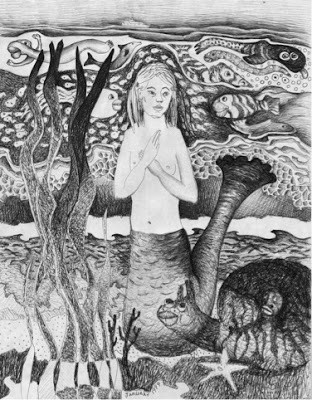
Mom’s Journey, Pen and Ink on Paper,  8″x10″

This is an emotional/intuitive drawing that I did of my mom while I was sitting next to her as she lay in Intensive Care hooked up to many machines and could not speak. The year was 1999. I sat next to her bed, held her left hand in my right hand and drew with my left, or non-dominant hand. I started by just scribbling. I did not know where I was going with this drawing. It took hours and hours. At one point there was a mean-looking spider in the bottom right corner and I saw it as a creature coming to take mom away. Thankfully the spider turned into a smiling snail that told me “this will take a little time”.

The whole drawing expresses my mother’s journey in the sea of unknown possibilities. At one point the doctors talked about hooking her up to a ventilator. My sister and I told them, no, mom would not want that. Amazingly, mom began getting better the next morning. She survived and lived another 7 years with the pacemaker.

During this time with mom, I discovered what I call Intuitive drawing. I continue to practice this kind of drawing today. I quiet down, relax and focus my mind on the highest Truth that I know and I spend one minute focusing on this Truth. Then, I draw a line or a squiggle and letting my intuition or imagination take that line and develop a drawing.

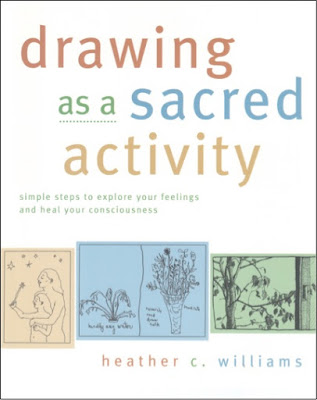
I write about this in my book, Drawing as a Sacred Activity. In the book, I offer three different kinds of drawing exercises: Observational Drawing, Emotional Drawing and Intuitive Drawing.

 
My book, Published by New World Library, 2002

My SEARCH took a DEEP DIVE when I left home to live in a college dorm at age 18. My parents loved me and to prepare me to live in the world safely, they told me their beliefs about what I would find in the world. However, I did not see what they told me I would see. So I concluded that what they told me was a belief or an opinion. But it was not the Truth.

That’s when I began to look around and ask this deep question that no one seemed able to answer: “Is there such a thing as Truth…or is it all opinion?” Be aware, dear reader, (especially if you are a young person), that if you have a deep question that cannot easily be answered – it will begin to drive your life and take you places far beyond what you presently know.

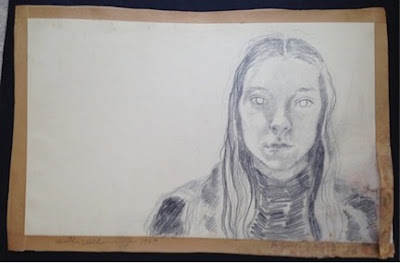
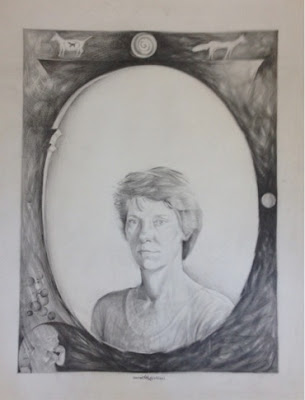
In 1968, I left college and went to San Francisco to explore hallucinogenics. Below is a self-portrait of me at age 22 after spending a year doing hallucinogenics. My friends were panhandling on the street and I quietly wondered: Is this how I am to live the rest of my life? I was pretty lost and I knew it. Thankfully, I finished college in 1970 and went back to San Francisco to search for a teacher to help me answer my BIG QUESTION about Truth.

 
Self Portrait, Pencil on Paper, 22” x 29”

In San Francisco, I met Thane Walker, who became my teacher, at The Prosperos School of Ontology. One day, I distinctly remember grabbing my remaining mescaline tablets and flushing them down the toilet when I heard Thane say: “Drugs may take you to a new, different, even higher place. . . but you always have to return to where you started. If you want to LIVE in a higher place – you must do some work on yourself!”  

So I began “working on myself” by taking Prosperos classes, talking with counselors, and wouldn’t you know – I could see that my ego was caught up in my drawing! So I decided to temporarily stop drawing so that I could study my ego and learn about the deeper Truth of my Being. I said silently to myself, “If ART is meant to be part of my life – it will return to me.” And it did. But it took a few years.

I moved to Mt Shasta in 1971 to do more intensive work on myself with Liz Andrews, HWM. Then, in 1972 I moved to Santa Monica to live close to and work at The Prosperos Inner Space Center. In 1978, after 6 years of classes and working on my memories, beliefs, attitudes, etc., I became a Prosperos High Watch Mentor. A High Watch Mentor is a degree that means, I have committed myself to keep the “High Watch” (to look beyond materialistic circumstances to reveal the eternal and boundless reality always present in the midst of things). The Prosperos School of Ontology continues, to this day, to be the greatest influence in my life.

The self portrait above, at age 45, is an expression of myself as an artist and High Watch Mentor, practicing self-observation, or  nonjudgmental seeing.

 
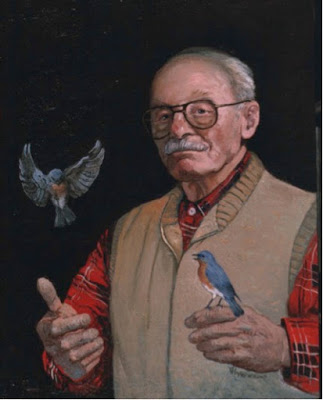
 Max, Oil Painting,18 “ x 24″

For the next 5 years, I was an apprentice to Master Artist, Jan Valentin Saether, where I learned not only WHAT to look for in order to draw and paint what I see, but also how to grind pigments, boil mediums and work with oil paint. I have done many oil paintings but this one I did of Max is probably my favorite. Max is Cindy’s grandfather. Who is Cindy? Keep reading, and you’ll find out at the end of this story.

 
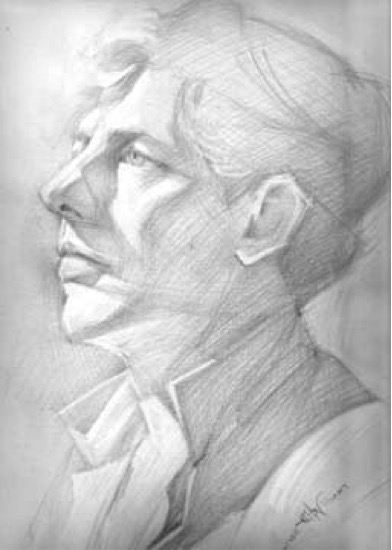
Eduardo, Pencil on Paper, 8” x 10”

I am deeply grateful for what Mr. Saether taught me about letting go of seeing things you can name (tree, cup, face, man, woman, hand) and instead looking for vertical, horizontal and diagonal directions. Paying close attention to where the directions intersect is also something I practice.

 
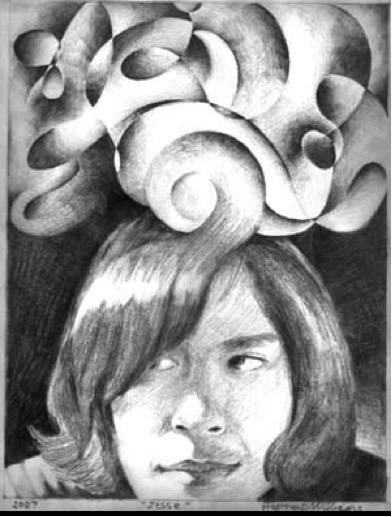
Jesse, Pencil on Paper, 8”x10”

The portrait above is of one of my students named Jesse. Recently, I retired from 15 years of teaching Special Ed and ART in the Vista Unified School District. Whew! Teachers are searchers! Being a teacher in the public school system is an amazing and very valuable experience. You are part of a huge system. You cannot just teach what you want to teach. You have to collaborate, prepare activities that inspire young minds, create rubrics & websites & blogs, manage behavior issues, write reports, call parents, be observed by administrators – just to name a few things.

My last four years were at VIDA (Vista Innovation and Design Academy) a public, magnet middle school in Vista, California. At VIDA, I learned the value of Empathy as a central part of the very creative Design-Thinking Process. Before I was a public school teacher, I was a Teaching Artist who taught a wide variety of students. I was also an assistant teacher for 10 years for the International Louise Hay Teacher Trainings held around the world (Mexico, Italy, England, Canada, Australia, Hawaii and the continental United States).

I used art to engage all kinds of people. I taught drawing to inmates in the Milwaukee County Jail and brought art activities to people with eating disorders, manic depression, schizophrenia, autism, developmental disabilities, traumatic brain injury, homeless, helping each to express themselves creatively. ART searches every kind of brain cell and brings it forward and shares it with the world.

 
Cindy, Prismacolor Pencil on Rives paper, 6”x9”

Cindy is my life partner. We met in 1993 and got married in 2008, when it became legal in California. Cindy teaches nurses. Together, we help each other to blossom! I am deeply grateful for her love of the home and her marvelous skills in gardening and cooking. She is also a very talented artist.

This is Week 35 of Artists Tell Their Stories. Thank you for reading and sharing Heather’s story today. To connect with Heather and see more of her work, please visit the following links:

Some Middle Eastern Voices of Note

Saadi Shirazi
Persian poet
Image result for sadi
Abū-Muhammad Muslih al-Dīn bin Abdallāh Shīrāzī, better known by his pen-name Saadi, also known as Saadi of Shiraz, was one of the major Persian poets and literary men of the medieval period. Wikipedia
NationalityIranian
Have patience. All things are difficult before they become easy.
A man is insensible to the relish of prosperity till he has tasted adversity.
The rose and the thorn, and sorrow and gladness are linked together.
Hafez
Persian poet
Khwāja Shams-ud-Dīn Muḥammad Ḥāfeẓ-e Shīrāzī, known by his pen name Hafez, was a Persian poet who “lauded the joys of love and wine but also targeted religious hypocrisy.” Wikipedia
Major worksDivan-e-Hafez
Even After All this time The Sun never says to the Earth, “You owe me.” Look What happens With a love like that, It lights the whole sky.
I wish I could show you when you are lonely or in darkness the astonishing light of your own being.
Fear is the cheapest room in the house. I would like to see you living in better conditions.
Image result for omar khayyam
Omar Khayyam
Persian mathematician
Omar Khayyám was a Persian mathematician, astronomer, philosopher, and poet, widely considered to be one of the most influential thinkers of the Middle Ages. He also wrote treatises on physics and music theory.Wikipedia
BornMay 18, 1048, Nishapur, Iran
DiedDecember 4, 1131, Nishapur, Iran
NationalityIranian
Be happy for this moment. This moment is your life.
The moving finger writes, and having written moves on. Nor all thy piety nor all thy wit, can cancel half a line of it.
Here with a Loaf of Bread beneath the Bough, A Flask of Wine, a Book of Verse – and Thou Beside me singing in the Wilderness – And Wilderness is Paradise enow.
Image result for rumi
Rumi
Poet
Jalāl ad-Dīn Muhammad Rūmī, also known as Jalāl ad-Dīn Muhammad Balkhī, Mevlânâ/Mawlānā, Mevlevî/Mawlawī, and more popularly simply as Rumi, was a 13th-century Persian Sunni Muslim poet, jurist, Islamic scholar, theologian, and Sufi mystic. Wikipedia
BornOctober 7, 1207, Vakhsh, Tajikistan
DiedDecember 24, 1273, Konya, Turkey
Full nameJalāl ad-Dīn Muhammad Balkhī
TitleMevlânâ, Mawlānā, Mevlevî, Mawlawī
Out beyond ideas of wrongdoing and rightdoing there is a field. I’ll meet you there. When the soul lies down in that grass the world is too full to talk about.
Let yourself be silently drawn by the stronger pull of what you really love.
The wound is the place where the Light enters you.
Image result for naguib mahfouz
Naguib Mahfouz
Egyptian writer
Naguib Mahfouz was an Egyptian writer who won the 1988 Nobel Prize for Literature. He is regarded as one of the first contemporary writers of Arabic literature, along with Tawfiq el-Hakim, to explore themes of existentialism.Wikipedia
BornDecember 11, 1911, Cairo, Egypt
DiedAugust 30, 2006, Agouza, Giza, Egypt
NationalityEgyptian
You can tell whether a man is clever by his answers. You can tell whether a man is wise by his questions.
As the tension eases, we must look in the direction of agriculture, industry and education as our final goals, and toward democracy under Mr Mubarak.
Today’s interpretations of religion are often backward and contradict the needs of civilization.

A mad world: capitalism and the rise of mental illness

It seems rather self-evident…

A mad world: capitalism and the rise of mental illness

What if it’s not us who are sick, asks Rod Tweedy, but a system at odds with who we are as social beings?

Mental illness is now recognised as one of the biggest causes of individual distress and misery in our societies and cities, comparable to poverty and unemployment. One in four adults in the UK today has been diagnosed with a mental illness, and four million people take antidepressants every year. ‘What greater indictment of a system could there be,’ George Monbiot has asked, ‘than an epidemic of mental illness?’

The shocking extent of this ‘epidemic’ is made all the more disturbing by the knowledge that so much of it is preventable. This is due to the significant correlation between social and environmental conditions and the prevalence of mental disorders. Richard Bentall, professor of clinical psychology at the University of Liverpool, and Peter Kinderman, president of the British Psychological Society, have written compellingly about this connection in recent years, drawing powerful attention to ‘the social determinants of our psychological wellbeing’. ‘The evidence is overwhelming,’ notes Kinderman, ‘it’s not just that there exist social determinants, they are overwhelmingly important.’

A sick society

Experiences of social isolation, inequality, feelings of alienation and dissociation, and even the basic assumptions and ideology of materialism and neoliberalism itself are seen today to be significant drivers – reflected in the titles of a number of recent articles and talks on this subject, such as those of consultant psychotherapist David Morgan’s groundbreaking Frontier Psychoanalyst podcasts, which have included discussions on whether ‘Neoliberalism is dangerous for your mental health’, and ‘Is neoliberalism making us sick?’

Clinical psychologist and psychotherapist Jay Watts observes in the Guardian that ‘psychological and social factors are at least as significant and, for many, the main cause of suffering. Poverty, relative inequality, being subject to racism, sexism, displacement and a competitive culture all increase the likelihood of mental suffering. Governments and pharmaceutical companies are not as interested in these results, throwing funding at studies looking at genetics and physical biomarkers as opposed to the environmental causes of distress. Similarly, there is little political will to combine increasing mental distress with structural inequalities, though the association is robust and many professionals think this would be the best way to tackle the current mental health epidemic’.

There are clearly very powerful and entrenched interests and agendas here, which consciously or unconsciously act to conceal or try to deny this relationship, and which also makes the recent willingness amongst so many psychoanalysts and therapists to embrace this wider context so exciting and moving.

Commentators often talk about society, social context, group thinking, and environmental determinants in connection with mental distress and disorders, but we can I think actually be a bit more precise about what aspect of society is mainly driving it, is mainly responsible for it. And in this context it’s probably time we talk about the c word – capitalism.

Many of the contemporary forms of illness and individual distress that we treat and engage with certainly seem to be correlated with and amplified by the processes and byproducts of capitalism. In fact, you might say that capitalism is in many respects a mental illness generating system – and if we are serious about tackling not only the effects of mental distress and illness, but also their causes and origins, we need to look more closely, more precisely, and more analytically at the nature of the political and economic womb out of which they emerge, and how psychology is fundamentally interwoven with every aspect of it.

Ubiquitous neurosis

Perhaps one of the most obvious examples of this intimate connection between capitalism and mental distress is the prevalence of neurosis. As Joel Kovel, a former psychiatrist and professor of political science, notes: ‘A most striking feature of neurosis within capitalism is its ubiquity.’ In his classic essay ‘Therapy in late capitalism’ (reprinted in The Political Self), Kovel refers to the ‘colossal burden of neurotic misery in the population, a weight that continually and palpably betrays the capitalist ideology, which maintains that commodity civilization promotes human happiness’:

‘If, given all this rationalization, comfort, fun and choice, people are still wretched, unable to love, believe or feel some integrity to their lives, they might also begin to draw the conclusion that something was seriously wrong with their social order.’

There’s also been some fascinating work done on this more recently by Eli Zaretsky (Political Freud), and Bruce Cohen (author of Psychiatric Hegemony), who have both written on the relations between the family, sexuality, and capitalism in the generation of neuroses.

It is significant, for example, that one of the most prominent features of the psychological landscape that Freud encountered in late nineteenth-century Vienna were the neuroses – which, as Kovel notes, Freud saw as being entirely continuous with ‘normal’ development in modern societies – with much of these, he adds, being rooted in our modern experience of alienation. ‘Neurosis,’ Kovel says, ‘is the self-alienation of a subject who has been readied for freedom but runs afoul of personal history.’

It was of course Marx who was the great analyst of alienation, showing how capitalist economics generates alienation as part of its very fabric or structure – showing how, for instance, alienation gets ‘lost’ or ‘trapped’, embodied, in products, commodities – from the obvious examples (such as Nikes made in sweatshops, and sweatshops embodied in Nikes) – to a wider and much more pervasive sense that the whole system of production and creation is somehow alienating.

As Pavon Cuellar remarks, ‘Marx was the first to realise that this alienation actually gets contained and incarnated in things – in “commodities”‘ (Marxism and Psychoanalysis). These ‘fetishised’ commodities, he adds, seem to retain and promise to return, when consumed, the subjective-social part lost by those alienated while producing them: ‘the alienated have lost what they imagine [or hope] to find in what is fetishised.’

Capitalism is in many respects a mental illness generating systemThis understanding of alienation is really the core issue for Marx. People probably know him today for his theories of capital – how issues of exploitation, profit, and control continually characterise and resurface in capitalism – but for me the key concern of Marx, and one that is constantly neglected, or misunderstood, is his view on the centrality and importance of human creativity and productivity – man’s ‘colossal productive power’ as he calls it – exactly as it was in fact for William Blake, slightly earlier in the century.

Marx refers to this extraordinary world-transformative energy and agency as our ‘active species-life’, our ‘species-being’ – our ‘physical and spiritual energies’. But these immense creative energies and transformative capacities are, he notes, under the present system, immediately taken from us and converted into something alien, objective, enslaving, fetishised.

Restructuring desire

The image he evokes is of mothers giving birth – another form of labour perhaps – with the baby immediately being taken away and converted into something alien, something doll-like — a commodity. He considers what effect that must have on the mother’s spirit. This, for Marx, is the source of the alienation and unease, the sort of profound dislocation of the human spirit that characterises industrial capitalism. And as Pavon Cuellar shows, we can’t buy our way out of this alienation – by producing more toys, more dolls – because that’s where the alienation occurs, and is embodied and generated.

Indeed, consumerism and materialism are themselves widely recognised today as key drivers of a whole raft of mental health problems, from addiction to depression. As George Monbiot notes, ‘Buying more stuff is associated with depression, anxiety and broken relationships. It is socially destructive and self-destructive’. Psychoanalytic psychotherapist Sue Gerhardt has written very compellingly on this association, suggesting that in modern societies we often ‘confuse material well-being with psychological well-being’. In her book The Selfish Society she shows how successfully and relentlessly consumer capitalism reshapes our brains and reworks our nervous systems in its own image. For ‘we would miss much of what capitalism is about,’ she notes, ‘if we overlook its role in restructuring and marketing desire and impulse themselves.’

Another key aspect of capitalism and its impact on mental illness we could talk about of course is inequality. Capitalism is as much an inequality-generating system as it is a mental illness producing system. As a Royal College of Psychiatrists report noted: ‘Inequality is a major determinant of mental illness: the greater the level of inequality, the worse the health outcomes. Children from the poorest households have a three-fold greater risk of mental ill health than children from the richest households. Mental illness is consistently associated with deprivation, low income, unemployment, poor education, poorer physical health and increased health-risk behaviour.’

Some commentators have even suggested that capitalism itself, as a way of being or way of thinking about the world, might be seen as a rather ‘psychopathic’ or pathological system. There are certainly some striking correspondences between modern financial and corporate systems and individuals diagnosed with clinical psychopathy, as a number of analysts have noticed.

Robert Hare for instance, one of the world’s leading authorities into psychopathy and the originator of the widely accepted ‘Hare Checklist’ used to test for psychopathy, remarked to Jon Ronson: ‘I shouldn’t have done my research just in prisons. I should have spent some time inside the Stock Exchange as well.’ ‘But surely stock-market psychopaths can’t be as bad as serial-killer psychopaths?’ the interviewer asks. ‘”Serial killers ruin families,” shrugged Bob. “Corporate and political … psychopaths ruin economies. They ruin societies.”‘

Pathological institutions

These traits, as Joel Bakan brilliantly suggested in his book The Corporation, are encrypted into the very fabric of modern corporations – part of its basic DNA and modus operandi. ‘The corporation’s legally defined mandate,’ he notes, ‘is to pursue, relentlessly and without exception, its own self-interest, regardless of the often harmful consequences it might cause to others.’ By its own legal definition, therefore, the corporation is ‘a pathological institution’, and Bakan helpfully lists the diagnostic features of its default pathology (lack of empathy, pursuit of self-interest, grandiosity, shallow affect, aggression, social indifference) to show what a reliably disturbed patient the corporation is.

Why should all of these contemporary social and economic practices and processes generate so much illness, so many disorders? To answer this I think we need to look back at the wider Enlightenment project, and the psychological models of human nature out of which they emerged. Modern capitalism grew out of seventeenth century concepts of man as some sort of disconnected, discontinuous, disengaged self – one driven by competition and a narrow, ‘rational’ self-interest – the concept of homo economicus that drove and underwrote much of the whole Enlightenment project, including its economic models. As Iain McGilchrist notes, ‘Capitalism and consumerism, ways of conceiving human relationships based on little more than utility, greed, and competition, came to supplant those based on felt connection and cultural continuity.’

We now know how mistaken, and destructive, this model of the self is. Recent neuroscientific research into the ‘social brain’, together with exciting developments in modern attachment theory, developmental psychology, and interpersonal neurobiology, are significantly revising, and upgrading, this rather quaint, old-fashioned view of the isolated, ‘rational’ individual – and also revealing a far richer and more sophisticated understanding of human development and identity, through increased knowledge of ‘right hemisphere’ intersubjectivity, unconscious processes, group behaviour, the role of empathy and mentalisation in brain development, and the significance of context and socialisation in emotional and cognitive development.

As neuroscientist David Eagleman observes, the human brain itself relies on other brains for its very existence and growth—the concept of ‘me’, he notes, is dependent on the reality of ‘we’:

We are a single vast superorganism, a neural network embedded in a far larger web of neural networks. Our brains are so fundamentally wired to interact that it’s not even clear where each of us begins and ends. Who you are has everything to do with who we are. There’s no avoiding the truth that’s etched into our neural circuitry: we need each other.

Dependency is therefore built into the fabric of who we are as social and biological beings, hardwired into our mainframe: it is ‘how love becomes flesh’, in Louis Cozolino’s striking phrase. ‘There are no single brains,’ Cozolino observes, echoing Winnicott, ‘brains only exist within networks of other brains.’ Some people have termed this new neurological and scientific understanding of the deep patterns of interdependency, mutual cooperation, and the social brain ‘neuro-Marxism’ because of the implications involved.

Capitalism is, it seems, rooted in a fundamentally flawed, naive, and old-fashioned seventeenth-century model of who we are – it tries to make us think that we’re isolated, autonomous, disengaged, competitive, decontextualised – an ultimately rather ruthless and dissociated entity. The harm that this view of the self has done to us, and our children, is incalculable.

Many people believe, and are encouraged to believe, that these problems and disorders – psychosis, schizophrenia, anxiety, depression, self-harm – these symptoms of a ‘sick world’ (to use James Hillman’s terrific description) are theirs, rather than the world’s. ‘But what if your emotional problems weren’t merely your own?’, asks Tom Syverson. ‘What if they were our problems? What if the real problem is that we’re living in wrong society? Perhaps Adorno was correct when he said, “wrong life cannot be lived rightly”.’
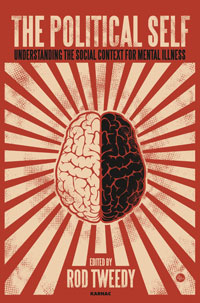
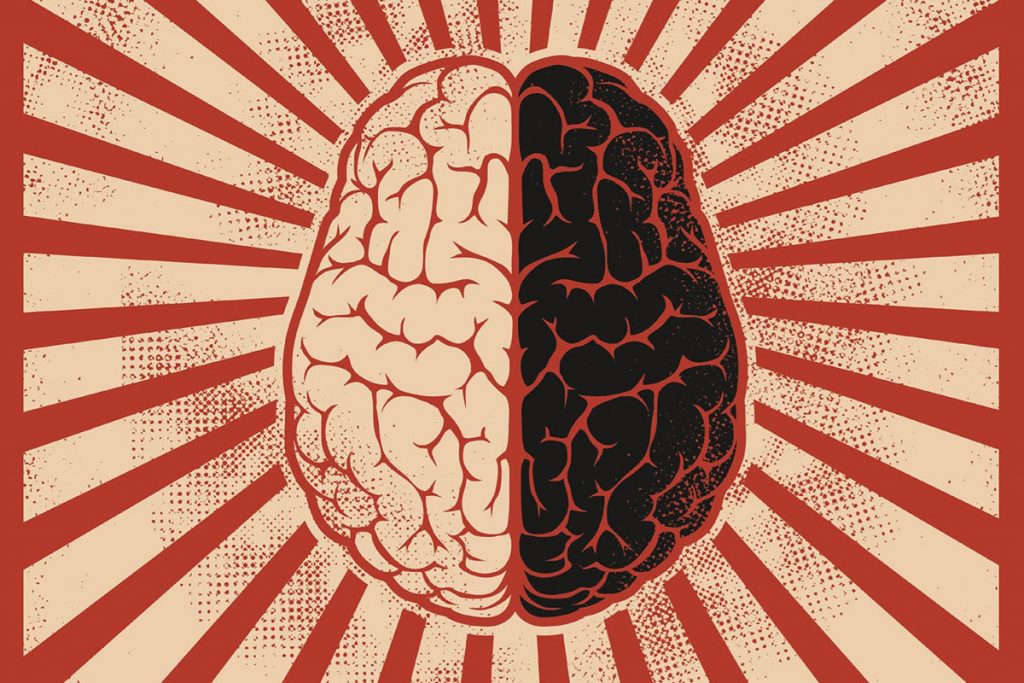
The root of this ‘living wrongly’ seems to be because we live in a social and economic system at odds with both our psychology and our neurology, with who we are as social beings. As I suggest in my book, we need to realise that our inner and outer worlds constantly and profoundly interact and shape each other, and that therefore rather than separating our understanding of economic and social practices from our understanding of psychology and human development, we need to bring them together, to align them. And for this to happen, we need a new dialogue between the political and personal worlds, a new integrated model for mental health, and a new politics.

Rod Tweedy is an author and editor of Karnac Books, a leading independent publisher of books on mental health and therapy. His edited collection, The Political Self: Understanding the Social Context for Mental Illness, is published by Karnac.

Poetry: “Queer” by Frank Bidart

Lie to yourself about this and you will
forever lie about everything.

Everybody already knows everything

so you can
lie to them. That’s what they want.

But lie to yourself, what you will

lose is yourself. Then you
turn into them.

*

For each gay kid whose adolescence

was America in the forties or fifties
the primary, the crucial

scenario

forever is coming out—
or not. Or not. Or not. Or not. Or not.

*

Involuted velleities of self-erasure.

*

Quickly after my parents
died, I came out. Foundational narrative

designed to confer existence.

If I had managed to come out to my
mother, she would have blamed not

me, but herself.

The door through which you were shoved out
into the light

was self-loathing and terror.

*

Thank you, terror!

You learned early that adults’ genteel
fantasies about human life

were not, for you, life. You think sex

is a knife
driven into you to teach you that.

*

Frank Bidart

Frank Bidart who was born in California in 1939, was educated at the University of California at Riverside, and at Harvard University, and has taught at Wellesley College in Massachusetts since 1972.

For the past nine years he’s been a Chancellor of the Academy of American Poets .

*

(Submitted by Michael Kelly)

Handel’s Fireworks Music / Le Concert des Nations / Jordi Savall, Cond.

I’ve been in love with George Frideric Handel‘s Music for the Royal Fireworks ever since I first heard it over fifty years ago.  In getting caught up with Jordi Savall and everything he’s done over the years, I discovered this version, in which he conducts one of the several ensembles he’s founded, Le Concert des Nations.

There is much worth noting here, and I could go on at great length about it, but it strikes me as probably best, at least for now, to let the music speak for itself…

Consciousness, spirituality, biography, sexuality, androgyny, futurism, space, the arts, science, astrology, democracy, humor, books, movies and more