Subconscious Can’t Wait To Turn Offhand Remark From Boss Into Dream About Drowning Horse (theonion.com)

BROOKLINE, MA—Chomping at the bit to twist the benign statement into an absolutely terrifying image, the subconscious of local man David Vanwell reportedly couldn’t wait Monday to turn an offhand remark by his boss into a dream about a drowning horse. “Oh yeah, as soon as he falls asleep I’m going to manifest that frivolous comment from the earlier meeting into a horrifying visual of a stallion vainly flailing for its life as it slowly disappears underwater,” said Vanwell’s psyche, excitedly planning every detail of the panicked horse’s descent to a watery grave that will somehow represent his supervisor’s innocuous observation. “I’ve been waiting for the perfect excuse to drop a stallion in an above-ground swimming pool where it can sink down, down, down as if to the bottom of the ocean even though the pool itself is only six feet high, and now I have it. He’s not going to know what hit him when the horse starts gurgling for help in his boss’s voice.” At press time, Vanwell’s subconscious suddenly realized the drowning horse scenario could segue nicely into a scene of him being trapped inside a burning freight elevator that symbolized a casual text from his girlfriend.

Biography: Evelyn Hooker

Evelyn Hooker (née Gentry, September 2, 1907 – November 18, 1996) was an American psychologist most notable for her 1957 paper “The Adjustment of the Male Overt Homosexual” in which she administered several psychological tests to groups of self-identified male homosexuals and heterosexuals and asked experts to identify the homosexuals and rate their mental health. The experiment, which other researchers subsequently repeated, argues that homosexuality is not a mental disorder, as there was no detectable difference between homosexual and heterosexual men in terms of mental adjustment.

Her work argued that a false correlation between homosexuality and mental illness had formed the basis of classifying homosexuality as a mental disorder by studying only a sample group that contained homosexual men with a history of treatment for mental illness. This is of critical importance in refuting the existence of the category of cultural heterosexism because it argues that homosexuality is not developmentally inferior to heterosexuality. Her demonstration that it is not an illness led the way to the eventual removal of homosexuality from the American Psychiatric Association‘s Diagnostic and Statistical Manual of Mental Disorders.

More at:  https://en.wikipedia.org/wiki/Evelyn_Hooker

Biography: Karen Horney

Karen Horney (born Danielsen, 16 September 1885 – 4 December 1952) was a German psychoanalyst who practiced in the United States during her later career. Her theories questioned some traditional Freudian views. This was particularly true of her theories of sexuality and of the instinct orientation of psychoanalysis. She is credited with founding feminist psychology in response to Freud’s theory of penis envy. She disagreed with Freud about inherent differences in the psychology of men and women, and she traced such differences to society and culture rather than biology.[4] As such, she is often classified as Neo-Freudian.

More at:  https://en.wikipedia.org/wiki/Karen_Horney

Getting to “got It!”: Helping Struggling Students Learn how to Learn

Front Cover

ASCD, 2007 – Education168 pages
 

It’s one of the great mysteries of teaching: Why do some students “get it” and some students don’t?

In this book, Betty K. Garner focuses on why students struggle and what teachers can do to help them become self-directed learners. Difficulty reading, remembering, paying attention, or following directions are not the reasons students fail but symptoms of the true problem: underdeveloped cognitive structures–the mental processes necessary to connect new information with prior knowledge; organize information into patterns and relationships; formulate rules that make information processing automatic, fast, and predictable; and abstract generalizable principles that allow them to transfer and apply learning.

Each chapter focuses on a key cognitive structure and uses real-life accounts to illustrate how learners construct meaning by using recognition, memorization, conservation of constancy, classification, spatial orientation, temporal orientation, and metaphorical thinking. The author’s simple techniques stress reflective awareness and visualization. It’s by helping students to be conscious of what their senses are telling them, encouraging them to visualize the information for processing, and then prompting them to ask questions and figure out solutions on their own that teachers can best help students develop the tools they need to
* Gather, organize, and make sense of information,

* Become cognitively engaged and internally motivated to achieve, and

* Experience learning as a dynamic process of creating and changing.

Suggestions for using these techniques in daily classroom practice, advice on lesson planning for cognitive engagement, and guidelines for conducting reflective research expand this book’s practical applications. Use it not only to help struggling students break through hidden barriers but to empower all students with tools that will last a lifetime.

(Google Books.  Recommended by Richard Branam.)

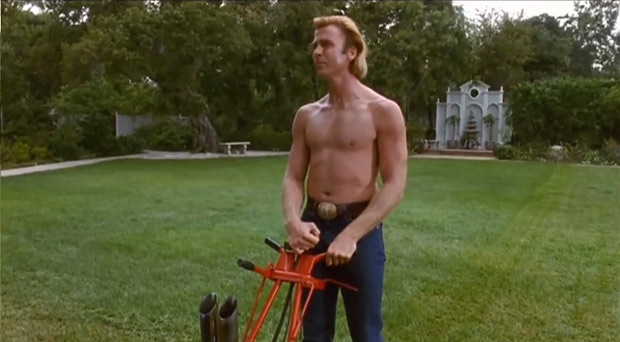
Vintage movie: “The Lawnmower Man”

The eccentric Dr. Lawrence Angelo (Pierce Brosnan) puts mentally disabled landscaper Jobe Smith (Jeff Fahey) on a regimen of experimental pills and computer-simulated training sequences in hopes of augmenting the man’s intelligence. In time Jobe becomes noticeably brighter and also begins to fare much better with the opposite sex. But, as he develops psychic powers, he realizes that those around him have taken advantage of his simplicity his whole life, and he plots a bloody revenge.

(Recommended by Richard Branam.)

“The Art of Everything” by Laura Parker

MAY 22, 2017

In David OReilly’s video game, you can be anything you see: a bacterium, a blade of grass, a galaxy.

SFMOMA’s pop-up arcade, part of an exhibit on avant-garde interactive entertainment, was being assembled on the fourth floor, just past an Ellsworth Kelly exhibition. Stepping off the elevator, OReilly nearly walked into Kelly’s Untitled (Mandorla) — two 8-foot bronze leaflike sculptures protruding from a nearby wall. OReilly paused. “So, this is Everything,” he deadpanned.

In the back room, workers were constructing the pop-up arcade, laying Astroturf, assembling wooden booths, and unboxing video game consoles. Several, taking breaks on beanbags, were seemingly mesmerized by an underwater scene from OReilly’s game, a school of krill swimming across the ocean floor.

The game, OReilly’s second ever, is highly conceptual. There are no clear objectives, no rewards, no sense of progression. The only purpose, if it can be characterized as such, is to interact with and inhabit any object on the screen. In other words, anything you see, you can be. A rock. A cedar. A sun. How long you explore the game as any given object is entirely your choice. The purpose of Everything is so simple, so untethered to traditional gaming conventions, that it’s easy to worry about whether you’re playing it right. But the game encourages players to let go of those anxieties. “Don’t get discouraged,” a towering cedar might say. “Everything here is to help you.” OReilly was partly inspired by the late British philosopher Alan Watts, who in the 1950s and ’60s popularized Eastern ideas of universal connectedness. Throughout the game, short audio clips from Watts’s lectures on perception and the structure of the universe appear on the screen and can be played. “He is describing in words what the game is describing through image and sound,” OReilly told me.

Scenes from Everything

Everything is part of a growing movement of independent games that blur the boundary between art and entertainment. “Digital distribution has opened up a lot of opportunities for smaller-scale, more challenging experimental work to find an audience,” Frank Lantz, the director of the Game Center at NYU, said. While commercial publishers used to be conservative, often “burdened with the legacy of escapist adolescent male power fantasies,” according to Lantz, they’re now taking notice, supporting projects that overturn conventional notions of what a game is and add artistic prestige to their lineups. “It’s kinda like showing a Stan Brakhage film next to Guardians of the Galaxy at the mall movieplex.”

Some of the high-prestige indie games that made their way onto Xbox and PlayStation include Journey (a melancholy pilgrimage to a mountaintop in which you sometimes encounter other random players), Gone Home (players explore an empty house in Portland, Oregon, and un-lock its secrets through hidden journal entries), and What Remains of Edith Finch (a narrative adventure published by the video game arm of the film production company Annapurna Pictures).

OReilly is something of a Michel Gondry of the gaming world. At 14, he started working for a small animation studio in Kilkenny, Ireland. (The studio, Cartoon Saloon, went on to make the Oscar-nominated film The Secret of Kells.) After a three-year stint in London, where he worked on a music video for Beck and animation sequences for the 2005 film The Hitchhiker’s Guide to the Galaxy, OReilly moved to Berlin to start making his own animated shorts. “It was a disaster,” he said of his first attempt, which he refused to describe. “So then I was like, fuck — I have to do something else.”

Everything is so simple, so untethered to traditional gaming conventions, that it’s easy to worry about whether you’re playing it right.

His next animated short, Please Say Something, about a cat and mouse “with a troubled relationship,” won a top prize at the 2009 Berlin International Film Festival. It was a perfect example of his graphically minimalist style. “In animation in general, you’re taught how to decorate things — and my thing is: How do I strip it down?” OReilly said. “It doesn’t have to be perfect, it doesn’t have to be beautiful.” One of his most popular films, The External World, which premiered at the Venice Film Festival in 2010 and Sundance in 2011, is composed of a series of characters — crudely drawn, almost nightmarish — in absurdly bleak circumstances; in one, a crying girl pulls tissues from a box, which yells in pain.

His wry style soon caught the attention of Spike Jonze, who asked OReilly to be the animation director for his film Her. OReilly spent nine months working on three minutes of animation: a scene in which the movie’s lead (Joaquin Phoenix) plays a video game featuring an alien with a shockingly foul mouth, voiced by Jonze. “The alien — that’s the essence of Spike,” OReilly said.

After Her wrapped, OReilly was exhausted. He began questioning whether his career was headed in the right direction. “I know people who make animated shows for TV, and they don’t have lives I envy.” So he decided to try his hand at making a real video game. “The difference between games and animated shorts is that people are actually interested in paying for the former.”

When Double Fine Productions, a San Francisco video game developer, heard of OReilly’s interest, they offered to publish his work. OReilly’s first game, Mountain, was released in 2014 through the iTunes App Store. There’s a mountain: It spins, stuff grows on it (trees, plants) and things fall from the sky (bicycles, vehicles, furniture, baked goods). It rains, it snows. It goes on for about 50 hours. You can rotate the mountain, zoom in and out, and play it songs. The reviews were mixed, encapsulating a long-running debate in the world of interactive entertainment: What makes a game a game? “People were expecting a funny thing,” OReilly said. “But it’s not intended to be funny. It came from a sincere place.”

Mountain garnered enough acclaim, however, that PlayStation signed on to distribute Everything, which was released in the spring. Reviews have been far less polarizing, with most praising the game’s inventiveness (a critic from Polygon, the gaming website, characterized it as a “magical playpen”).

Back at SFMOMA, several more gallery attendants had stopped what they were doing to watch OReilly, now inhabiting a human tooth on the screen, make a cluster of other teeth dance. “OK,” he said. “I’m going to show you the secret to this game.” He set down the controller. After a few seconds, the game began to play itself. The teeth danced on their own.

“It’s basically an installation piece at this point,” OReilly mused before the crowd, as the world he created kept spinning on without him.

(Recommended by Rick Thomas, H.W., m.)

Prosperos teachings reach Down Under

June 5, 2017

According to reliable sources, The Prosperos, a school of ontology and self-transcendence (and the core readership of the Bathtub Bulletin), is now teaching its foundation class, Translation, online in New Zealand.  In addition, a new online Find Yourself and Live listening and dialogue group has begun in Australia, following a successful online Translation class in that country.

The world has become a bit smaller.