
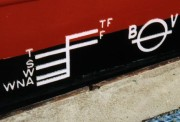
| TF: | tropical fresh water |
| F: | fresh water |
| T: | tropical seawater |
| S: | summer temperate seawater |
| W: | winter temperate seawater |
| WNA: | winter North Atlantic |
| BV: | Bureau Veritas (the classification society that surveyed this vessel’s load line) |
Photo: Wualex / Wikimedia
A.Word.A.Daywith Anu Garg
Plimsoll line
PRONUNCIATION:
MEANING:
noun:
1. Any of various horizontal lines on the side of a ship indicating the depth to which it may be immersed under various conditions.
2. A threshold or limit.
ETYMOLOGY:
After Samuel Plimsoll (1824-1898), British MP, whose efforts led to the regulation of the shipping industry. Earliest documented use: 1877.
NOTES:
Samuel Plimsoll fought to prevent overloaded ships from becoming death traps. Before his reforms, unscrupulous shipowners would slap fresh paint on decrepit vessels, overfill them with cargo (sometimes junk disguised as valuables), and insure them for more than they were worth. These vessels, often called “coffin ships”, were more valuable when sunk (never mind the sailors on board).
Plimsoll’s campaign led to the Merchant Shipping Act, which set legal limits on how much cargo a ship could carry. The safety marks on a ship’s hull, known as the Plimsoll line or Plimsoll mark, indicate safe loading levels based on water type (salt or fresh), temperature, and other conditions.
Having saved countless sailors, Plimsoll turned his attention to another group suffering at sea — cattle, which were often transported in horrific conditions on overcrowded ships.
And what about Plimsoll shoes? Originally designed as beachwear, they feature a horizontal band where the rubber sole meets the canvas upper — resembling a Plimsoll line.