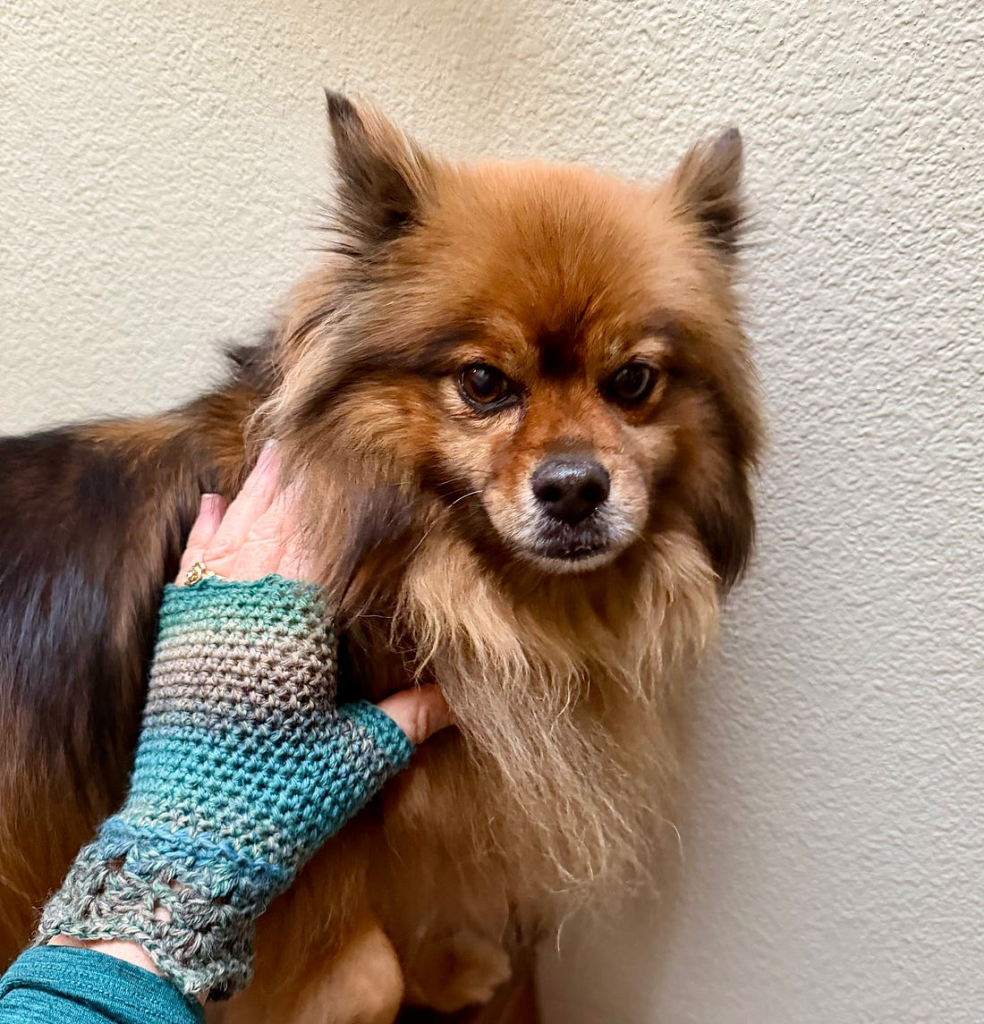
Right now there are fifteen pounds of timid rescue dog asleep beside me.This boy’s name is Koa. He’s a German Spitz, long-furred and soft as a dandelion gone to seed, and his red sable coat reminds me of the Hawaiian hardwood. Whenever I sit in my rocker, he wedges himself in with me. I let him—I’d miss the weight and warmth if it were gone.When he settles there, my breath slows. Whatever I’d been bracing against all day loosens its grip and lets go as I stroke his fur; it’s the silkiest, springiest and most enjoyable texture. He even smells good most days (for a dog.)A warm animal asleep at your side is one of the coziest things a home can hold.
I’ve loved three dogs into and out of this life.
When I left Maui and followed Mike to the continent in 2017, I came with what mattered: a couple of suitcases, and our then-dog Liko in my arms.Liko bounded across baggage claim to swamp Mike in barking joy loud enough to turn heads once we arrived. This little Shih-Tzu told the world that we were still a family, and that the next chapter of our life could be wonderful, too.Before Liko there was Nalu, a Chihuahua-terrier who never understood how small she was. Fierce, loyal, a Rottweiler trapped in a six-pound body, she was certain she was our last line of defense. If you’ve read my Paradise Crime Mysteries, you’ve met her: she’s the inspiration for Keiki, the brave Rottie who guards Lei through every danger I throw at them both.I gave Nalu a second life in fiction because I couldn’t bear for that much loyalty to ever end. Gah! That our dogs precede us is one of life’s truest hardships.After Liko passed, I swore I couldn’t handle the pain of loss. I tried to go pet free; but I got depressed. Had no excuse for my nature and forest walks. Six months into malaise Mike was the one to find Koa on Petfinder; I was too apathetic to make such an important choice.Koa is the most submissive dog I’ve ever known. He lets bigger dogs shove him until they lose interest, and he’s terrified of loud noises and bags in any form. He’s a great pet, don’t get me wrong—but he’s not perfect. None of them are. Get a pet, and you’re signing up for EXPERIENCES—but a pet in the house changes the air to a cozier feel.
Animals know things about us that they shouldn’t.
I have loved three dogs in this life, and each taught me about love in a different way.A reader named Valerie wrote to me about her two shih-tzu mixes, Huck and Finn, half-brothers born a year apart. Neither dog had ever been the cuddly type. Then, when Valerie and her family lost their thirty-one-year-old daughter to cancer, the dogs changed overnight. “They seemed to know I needed them,” she said. “They became my shadows, and were always on my lap when I sat down. They brought so much comfort and love–they helped me through the darkness.” Years later, the dogs have never stopped this comforting behavior, and Valerie counts Huck and Finn the greatest blessings she could have asked for during the hardest season she’s lived through.
No one trained Valerie’s dogs. Grief moved through a house, and two empathetic animals responded to be closer and more present.
For years I assumed this bond with pets was sentiment, the soft anthropomorphizing we drape over creatures who can’t speak for themselves–but research revealed more.Stroke an animal, and your nervous system calms measurably. A 2022 systematic review in the International Journal of Psychophysiology pooled 129 studies and found that human–dog interaction reliably moves the body toward the parasympathetic state, the “rest and digest” branch of the nervous system, lifting heart-rate variability, lowering cortisol, and quieting the stress axis of anxiety. Researchers at Sweden’s Karolinska Institutet found that a few minutes of gentle contact between dogs and their owners raises oxytocin, the same bonding hormone that flows between a nursing mother and her baby, lowering the owner’s cortisol (and probably the animal’s, too.)Cats have their own set of comfort skills. A cat’s purr lands roughly between 25 and 150 hertz, squarely inside the “sound healing” frequency range clinicians use to ease pain and encourage healing. In a randomized controlled trial of 249 college students, ten minutes of hands-on time with shelter cats and dogs measurably lowered the students’ salivary cortisol, more than watching others pet the animals, more than looking at photographs of them. Ten minutes, measurable in spit.Co-regulation is the clinical word that describes what happens with me and Koa in that rocker: one nervous system borrows steadiness from another, the way a frightened child borrows calm from a parent’s heartbeat. (It’s the same thing happening when Kat holds Tiki, the one-eared former feral feline in my Paradise Crime Cozy Mysteries.I’ve spent much of my career as a therapist teaching people to find their way toward calm and feeling good; my dog delivers it without a single technique.
(that fur though…and Anita’s gloves)
Kelly shared with me that her life changed drastically with COVID, when she developed a permanent disability that ended her career. Her rescue cats have carried her through much of the devastation. “My cats are my daily companions,” she said. “They sit with me when I’m in pain or sad. So grateful to be blessed with these loving rescues.”A reader named Meli shared that she took in a cockatiel named Buddy when an elderly owner, ninety years old, had to move into senior care. Buddy was twelve by then and had been mostly ignored for years. Under Meli’s roof he came roaring back to life, affectionate and opinionated in equal measure. “He talks my ear off,” she said, “even when I’m having important conversations on the phone. He can be downright embarrassing.” At the moment, she says, he’s overusing a single phrase: “You hoo?” Announcing that it is, in fact, dinnertime, and he would like his carrots and lettuce now, or that he wants attention. Cockatiels can live thirty-five years with good care, and Meli expects Buddy to go the distance. “He has brought light to my life that I didn’t know I needed,” she shared. “Life without Buddy would be awful right now.”
A grieving mother’s dogs. A disabled woman’s cats. A widow’s loud, ridiculous, beloved bird. The animal can be different. The mechanism doesn’t change: a living, breathing presence that asks nothing of you but your attention and love, and in return gives your body permission to relax and feel good.
The Danes, who gave us hygge, count a sleeping animal among the most hyggelig things a home can offer, right up there with candlelight and a warm drink–and I totally understand why.Every few days, when the weather allows, I sit with Koa out on the deck and brush his coat, letting the loosened underfluff drift off my fingertips into the wind to catch on a nearby bush; lining for a bird’s nest later in the season.He goes boneless with pleasure. So do I. No one can hurry while brushing a happy dog (or cat, or horse, or chicken, for that matter).Animals and cozy living: they don’t just live in the warmth you make. They amplify it
(A note on the science, and some references:)Teo, J. T., Johnstone, S. J., Römer, S. S., & Thomas, S. J. (2022). Psychophysiological mechanisms underlying the potential health benefits of human–dog interactions: A systematic literature review. International Journal of Psychophysiology, 180, 27–48.Petersson, M., Uvnäs-Moberg, K., Nilsson, A., Gustafson, L.-L., Hydbring-Sandberg, E., & Handlin, L. (2017). Oxytocin and cortisol levels in dog owners and their dogs are associated with behavioral patterns. Frontiers in Psychology, 8, 1796. (Karolinska Institutet / Swedish University of Agricultural Sciences.)Pendry, P., & Vandagriff, J. L. (2019). Animal Visitation Program (AVP) reduces cortisol levels of university students: A randomized controlled trial. AERA Open, 5(2).Cat-purr frequency range (25–150 Hz): widely reported in veterinary and bioacoustics literature.
(Contributed by John Atwater, H.W.)
Leave a Reply
Consciousness, spirituality, biography, sexuality, androgyny, futurism, space, the arts, science, astrology, democracy, humor, books, movies and more