
Area 23a • Aug 4, 2021 WWW.AREA23A.COM/AWARE NOW AVAILABLE ON VIDEO ON DEMAND (Apple TV, Amazon, GooglePlay) and WORLDWIDE VIRTUAL THEATER featuring exclusive q&as One Night for Consciousness Q&A Live post-screening discussion features Jack Kornfield, Author, and Buddhist Teacher; Directors Frauke Sandig & Eric Black; Roland Griffiths, Ph.D., Director, Center for Psychedelic and Consciousness Research; Monica Gagliano, Professor of Plant Behavior & Cognition, University of Sydney, and other special guests. Global Live Stream (European Premiere) Q&A Live post-screening discussion with Directors Frauke Sandig & Eric Black; Roland Griffiths, Ph.D., Director, Center for Psychedelic and Consciousness Research; Monica Gagliano, Professor of Plant Behavior & Cognition, University of Sydney; and Dr. med. Andrea Jungaberle Medical Director OVID Clinics I Co-founder of MIND Foundation. Moderator: Amir Giles, Co-Director, Psychedelic Society. 100% Fresh on Rotten Tomatoes! “The most moving and beautiful depiction of deep understanding of consciousness and of who we are that I have seen depicted through film.” -Jack Kornfield, author and Buddhist teacher “Stirs feelings of awe and wonder, humility and connection. A remarkable film.” – Valerie Kalfrin, Alliance of Women Film Journalists “Consciousness-elevating food for thought.” – Michael Rechtschaffen, Los Angeles Times “Stunningly Deep, Wise and Visually Arresting, the most Mind-Blowing Film the Maui Film Festival has presented in Twenty Years! -Barry Rivers Maui Film Festival Founder/Director WINNER OF THE FEATURE COMPETITION JURY PRIZE, 2021 ILLUMINATE FILM FESTIVAL TAKE A THOUGHT-PROVOKING, MIND-BLOWING CINEMATIC JOURNEY INTO THE OCEAN OF CONSCIOUSNESS. What is consciousness? Is it in all living beings? What happens when we die? Why do we seem to be hardwired for mystical experience? Aware follows six brilliant researchers who approach our greatest mysteries from radically different viewpoints. High-tech brain research and Eastern meditation, psychedelics, and the consciousness of plants help us see the world anew, challenge our beliefs, and maybe even initiate our own journey into the unknown. Cast: Roland Griffiths, the renowned Johns Hopkins University psychedelics researcher, plant biologist Monica Gagliano, Christof Koch, Chief Scientist of the Allen Institute for Brain Science, the famed Tibetan Buddhist monks, Matthieu Ricard and Mingyur Rinpoche, and acclaimed author, Richard Boothby. AWARE is the second in the trilogy following Heart of Sky, Heart of Earth, selected for over 100 international film festivals. AWARE is the winner of the Feature Competition Jury Prize at the Illuminate Film Festival and is currently shortlisted for the LOLA, the German Academy Awards. Directed by Frauke Sandig and Eric Black Website: https://aware-film.com/ Facebook: / awaremovie
Tag Archives: Consciousness
Can We Tap Into Creation’s Original Consciousness?
But what is consciousness? Where is it located? And what does an understanding of it mean? Particularly the larger or “non-typical,” “cosmic,” or “special” types of consciousness?

DEC 12, 2023 (wisdomschool.com)
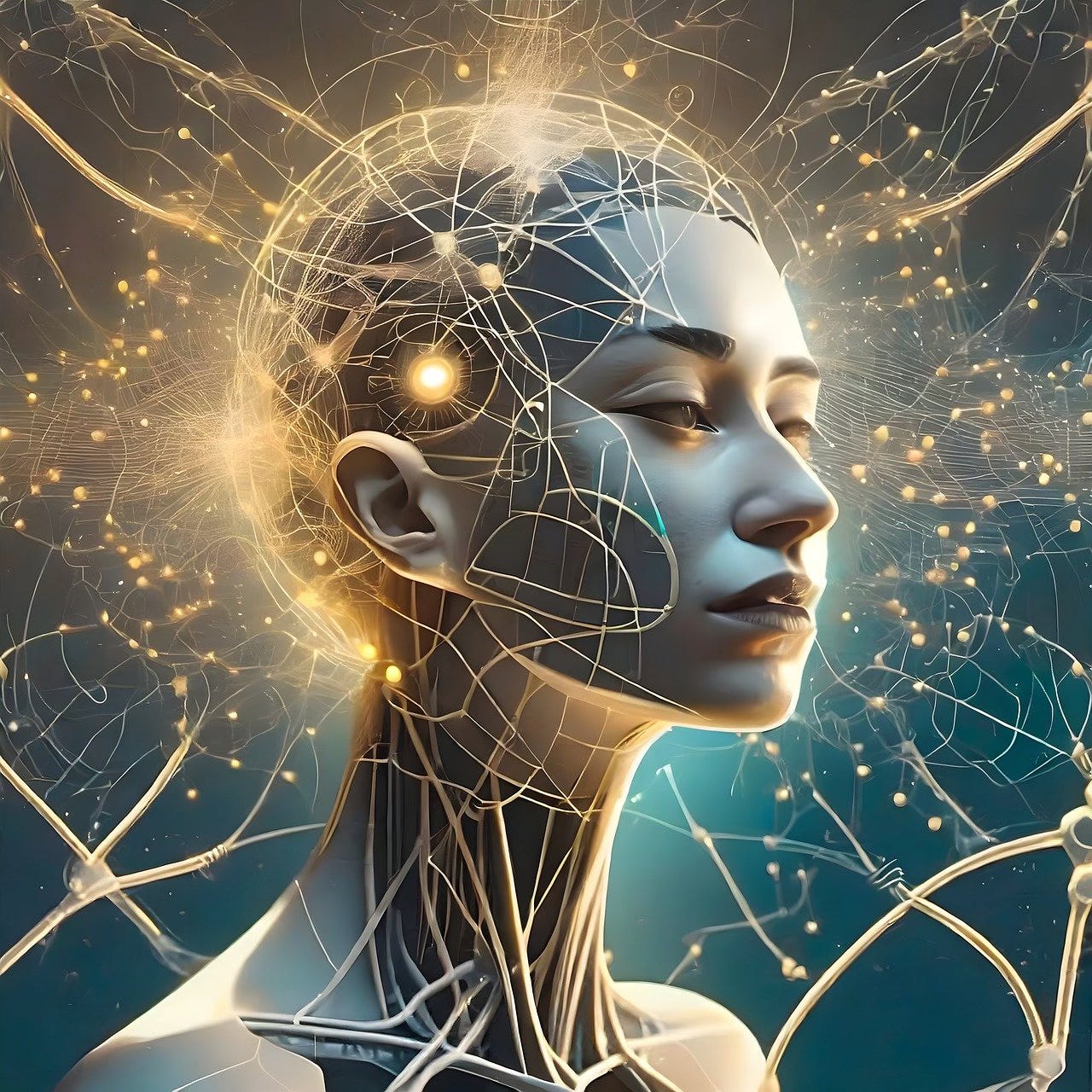
A few months ago, The New York Times ran an article about a conference in New York examining a perennial question: “What is consciousness (and where does it come from)?” Carl Zimmer, the author of the Times piece, opens it with:
“On a muggy June night in Greenwich Village, more than 800 neuroscientists, philosophers and curious members of the public packed into an auditorium. They came for the first results of an ambitious investigation into a profound question: What is consciousness?”
Almost universally, people throughout history report that experiencing expanded consciousness lets them shed their fear of death and more fully embrace life. And, of course, we use consciousness constantly to simply get through life: you’re using your consciousness to read these words and give them meaning.
But what is consciousness? Where is it located? And what does an understanding of it mean? Particularly the larger or “non-typical,” “cosmic,” or “special” types of consciousness?
Most people have had at least one experience of expanded or universal consciousness in their lives. I had one when I was around six years old, laying in a hammock in my parents’ back yard. Another was in my early 20s, while meditating during a snowstorm that I wrote about in my autobiography, The Prophet’s Way. Suddenly you’re hit or overwhelmed by a feeling of being both at total peace and “at one” with everything in creation.
My mom told me stories of her experiencing what she thought was “cosmic consciousness” when she nearly died giving birth to my youngest brother. Millions of people — including me when I was a teenager — have also had these sorts of experiences while taking psychedelic drugs.
Between the development of AI and ongoing debates about the existence or non-existence of free will, a vigorous discussion about the origins and nature of consciousness is on the tongues of millions.
But, what is consciousness? Where does it come from and what is it made of? Is it just the product of very complex wiring, be it in a computer or a brain? Or is there something much, much larger going on here?
We all pretty much know what matter and energy are. Matter is stuff, the hard, physical reality all around us, from solids to liquids to gasses and other forms of matter that only exist in stars or distant space (plasma, black holes, etc.). Energy, on the other hand, is radiated through space or matter: the forms we know the best are light, sound, heat, and kinetic energy (movement).
Albert Einstein revolutionized the world of physics (and, I’d argue, metaphysics) when, in 1905, he laid out his theory of relativity and proposed that all matter is, in fact, made up of condensed or slowed-down energy (my terms, not his). The amount of energy that it took to make a particular bit of matter, in fact, is easily calculated by the handy formula of E=MC2: the Energy that makes up an object is equal to the Mass of that object times the Speed of Light (C) squared.
The amount of energy that, at the beginning of time, condensed to form the elements that make up the screen or paper on which you’re reading these words, for example, is knowable by simply multiplying its weight (mass) times 8.98755179 × 10¹⁶. If you can figure out a way to dissolve the atomic bonds that hold the elements that make up what you’re looking at, the energy that will be released will always conform to that formula (minus the leftover mass from the explosion or radioactive disintegration).
In this regard, it’s possible to argue that the entire universe is made up not of matter but of energy in various states. Some is free or loose energy, floating around and lighting or heating or X-raying up the rest of creation; some is “condensed” or slowed-down energy that’s locked in atoms and subatomic particles that make up the physical world we see.
Matter, in other words, is like ice cubes floating in water: it seems different from the stuff it’s made of, but the only difference is its level of “free” or “bound” energy. When you remove energy from liquid or gaseous water by cooling it, it eventually changes state to a solid known as ice. (It’s an imperfect analogy, but will work for this example.)
Ice cubes, then, are just water in a different state. Similarly, all matter is just energy in another state.
But what is energy?
Light, for example, is a form of energy we have specific sensors to detect (our eyes) and oscillates from around 430 trillion hertz or cycles-per-second, which we detect as “red,” to 750 trillion hertz, which we perceive as violet. When such energy oscillates slightly more slowly then visible light, we call it “heat” or “infra-red.” When it oscillates slightly faster, we call it “ultraviolet” light that we can’t see but will do a job on our skin if exposed for long periods of time.
But what is light made of? And every other form of energy in the known universe? And, if we knew the answer to that question, does that mean that all matter is made of the same stuff? And — most important — what does that have to do with consciousness?
While light can exhibit a wave-like nature (and the frequency of those waves is measurable), it can also behave like particles. The famous “double-slit experiment” shows that light is both waves and particles; we call those particle-like packets of light photons. Red photons of light, for example, carry about 1.8 electron volts (eV) of energy, while each blue photon carries about 3.1 eV of measurable energy.
So the forms of energy we can perceive or even measure are themselves apparently made up of something even more subtle. And if we could figure out what that primordial substance (for lack of a better word) is and measure or detect it, we’d find that the entire physical universe — all matter and all energy — is made up of that stuff.
It fills everything because it has slowed down to various frequencies to become everything. Slowed down a bit to specific frequencies, we call it energy in various forms. Slowed down even more, we call it matter. But, like the H2O that makes up water vapor, liquid water, and ice, it’s all the same stuff, one single “substance” or essence or primal energy.
But what is that?
New fields of scientific inquiry have emerged to ask just this question. The ones I find most fascinating are panpsychism, cosmopsychism, and the psychological ether theory.
With subtle differences in terms and meaning, these three concepts all broadly posit that the most subtle energy in the universe — the stuff, everything that we can see or feel — is made of is purely consciousness itself.
Galileo was largely quoting Democritus (who lived 2000 years before him) when he argued that the qualities of the “real world” are rooted in our perception of them rather than any objective reality:
“[T]astes, odors, colors, and so on are no more than mere names so far as the object in which we place them is concerned, and that they reside only in the consciousness. Hence if the living creature were removed, all these qualities would be wiped away and annihilated.”
So, if everything in the entire known universe is made out of consciousness, how is it that some complex neural networks are capable of expressing consciousness? For that matter, what is consciousness itself?
I’m most fond of the computer versus radio analogy.
Our brains are arguably computing machines and are capable of receiving data, processing it, achieving conclusions about its meaning, and then acting on them. Setting aside the very real debate about the existence of free will (that will be another article), what this implies is that we’re very much predictable and relatively machine-like because, generally, we make decisions and take actions based on the data available to us.
But what about those things that are not explicable? How is it that some people report having achieved — or tuned into — a state of consciousness that they describe as “enlightenment” made up of bliss and some sort of universal awareness?
For this, I turn to the radio analogy.
We’re all constantly surrounded by uncountable numbers of radio waves, ranging from those created on Earth to those arriving from deep space and our sun. Our brains aren’t capable of tuning into those waves — of detecting that form of energy — but we’ve learned how to build devices that can and we call them radios.
By organizing a set of transistors, capacitors, resistors, and inductors in a particular configuration, we’re capable of selectively tuning in specific frequencies and thus listening to particular radio waves while excluding others.
So, what if the most basic, subtle, original form of energy in the universe is consciousness, and the “first” form of consciousness — that slowed down in a zillion ways to become everything we know as the physical universe — was what we call “bliss” or “love”?
What if when a parent — of any species — sees its offspring, that feeling they have isn’t just biologically determined by hormones and thought but is actually a “tuning” of the brain and nervous system to that primal form of energy that the entire universe is made of?
And what if neural networks work just as well at vast macro levels as they do at the relatively micro level of our brains and nervous systems? Imagine if you could shrink down to the size of a single blood cell and could then float through your own brain, looking at the connections of neurons, dendrites, and synapses. It might look something like this:
Credit: NASA/NCSA University of Illinois Visualization by Frank Summers, Space Telescope Science Institute, Simulation by Martin White and Lars Hernquist, Harvard University
That visual, though, was created by scientists affiliated with NASA, the University of Illinois, and Harvard University and each dot is an entire galaxy — each galaxy is made up of between 10 million and a trillion stars — and the lines connecting them are pathways of matter organized by the gravity of the galaxies. It shows only a tiny fractional slice of the known universe: about 134 megaparsecs or 437 million light-years.
If our brains are matter organized in a way that lets them both process data like a computer and tune into the subtlest energies of the universe like a radio, consider the possibility that the entire known universe can do the same.
That’s it’s both holding and expressing consciousness. That this is the primordial energy/consciousness soup from which each of us came and back into which each of us will one day dissolve.
In other words, consciousness is not something that emerges when physical systems like brains or nervous systems are organized in a way to facilitate it: it’s instead a fundamental feature — the raw material, if you will — of the entire universe and everything in creation, including us.
As physicist David Bohm wrote in 1968:
“That which we experience as mind…will in a natural way ultimately reach the level of the wavefunction and of the ‘dance’ of the particles. There is no unbridgeable gap or barrier between any of these levels. … It is implied that, in some sense, a rudimentary consciousness is present even at the level of particle physics.”
Sir Arthur Eddington wrote, in The Nature of the Physical World:
“The stuff of the world is mind-stuff,” and, “The universe is of the nature of a thought or sensation in a Universal Mind.”
As the late physicist Freeman Dyson wrote in his brilliant book Disturbing the Universe:
“The laws [of physics] leave a place for mind in the description of every molecule… In other words, mind is already inherent in every electron, and the processes of human consciousness differ only in degree and not in kind…”
All of which gives some urgency to the question: What happens when a computer is developed that is more complex — more capable of tuning into other frequencies of consciousness (to use the radio analogy) — than the human brain? If consciousness is everywhere and in everything, what would keep a computer from developing its own consciousness?
Might we one day see computers working to re-organize their own systems the way yogis fine-tune their minds and bodies to tune into universal bliss?
The entire field of panpsychism — which goes back (at least) to the ancient Greeks — is in a huge flux, with various branches and divisions separating out depending on exactly how the theory is expressed and how far down the logic train scientists and philosophers are willing to go.
But, at the very least, it gives us a starting point for an inner exploration of the universe, for our meditation and prayer time, for ideas about the possibility and timelessness of our own fleeting existence on this little planet in an obscure corner of the Milky Way galaxy.
And, perhaps, everything in the universe is suffused with a rich form of the creator’s/creation’s original consciousness and meaning that, with the right effort, we can occasionally tap into.
Consciousness: a hint of beyond base-level reality. Really?

Oct 28, 2023 (Medium.com)
I’m a mainstream PhD physicist / biophysicist / AI guy. But IMO self-aware consciousness, the experiential sense we are ‘souls’, is so vivid and profound, yet so underrated by some that . .
. . I’m prepared to at least entertain the incredible, that we may be living a layer above base-level reality, that this universe is in some sense not real.
As Elon Musk muses occasionally.
Why? Plenty of physicists, information theorists and philosophers have pointed out there are hints the universe is simulation-like, a game even.
And because we can’t even come close to touching consciousness mechanistically. Consciousness is not – contrary to some claims – currently explained by any physical, biological or information theory mechanism.
At least, not in this level of reality.

Quantum mechanics and its fundamentally probabilistic nature is suggestive of a computation-minimizing mechanism.
The real universe’s way to save on ‘CPU’ and ‘memory’.
Wave-function collapse is like ‘just-in-time’ rendering.
The Planck scale is like the screen resolution of space-time.
And then there’s the mystery of ‘hard consciousness’ itself, how to explain the fact we humans have this sense that we’re a . . soul.
It’s no surprise consciousness researchers barely talk about this. It’s kinda embarrassing.
They focus on looking for neural correlates.
But maybe the simulation guys – and the theists are – in effect, right? And, on the other side, we’re souls of some kind?
It certainly feels like we are.
Who knows what the ‘science’ is on the other ‘side’?
Just another consequence of physics?
Many researchers (but not all) go immediately hook-line-and-sinker materialistic assuming consciousness is just another mystery to explain like e.g. lightning or breathing or eclipses.
Or that it’s ‘just an illusion’.
But, no, consciousness is VERY different.
In all other cases the mysteries, the ‘magic’ of the past were guessable, at least potentially, to be something physical, not too different from the truth.
Even if they initially got it wrong.
Think of e.g. lightning, breathing or eclipses.
Lightning was a burst of light . . in appearance . . and in reality. (The mechanism turned out to be electricity.)
Biological life was a collection of physical matter that was automated, and could breath in and out or pump blood, extract nutrients . . physical in appearance and . . in reality. (The mechanism was biology, parts of our body that used energy and microscopic machines to operate, the ancients couid see the body internals were physical mechanisms comprising pumps and air and liquid piping and processing systems, they couid actually find the physical systems, evident every time they gutted an animal).
Eclipses were a thing getting in the way of another thing . . in appearance . . And in reality. (The mechanism was crossing orbits.)
These were all arguably physical from the get go, despite the near endless mystery and miraculous explanations from some of our forefathers.
Sitting around the camp fire in eons past they arguably could have come pretty close to not too dissimilar gross answers to reality.
Just no way to prove it at the time.
But consciousness seems non-physical
This time the ‘magic’ seems impossible to even hypothesise on. By the best scientific minds.
The fact that some scientists are actually proposing that consciousness is ‘fundamental’, almost like in Star Wars, possessed in some form by almost everything?
That’s been labelled pseudo-science by neuroscientists and highlights why the simulation hypothesis is not actually as crazy or unnecessary or luxurious as it sounds.
The simulation hypothesis is proposed for good reasons. And consciousness IMO is a serious yet surprising contender for perhaps the strongest evidence yet.
Because it was always starring us in the face.
But a little too ever-present to be talked about in scientific circles.
A little too ‘religious’.
Atoms that . . ‘feel’
Why is something made of atoms feeling something? Thoughts. Pain. The full visual field. Colors. Again: pain.
The study of neural correlates of consciousness arguably uncovers ‘necessaries’, not ‘sufficients’. These capabilities would be required even for non-sentient so-called ‘philosophical zombies’ for survival and external function.
And if it’s just an illusion, why is something having an illusion in the first place?
Consciousness, from the get go, appears beyond physical.
At the very least layers of reality or even God should be seriously entertained. Rather than virtually shunned as ‘unscientific’ because it’s ‘dualistic’.
Yet, how unscientific not to even consider it?
After all, we’re prepared to entertain a quantum foam of multi-universes.
Around a third of physicists believe in the Many Worlds Interpretation of quantum mechanics.
Why not layers of reality? As per the simulation hypothesis?
And in the last layer, our consciousnesses are . . mechanistic.
Don’t forget, lots of evidence is building up that the universe is simulation-like . .
It’s crazy to leave it off the table.
At the very least it’s time that consciousness was not brushed away as almost ‘not even a thing’.
Let’s not be fooled by its pervasiveness.
And, scientifically, who knows what more evidence of the simulation hypothesis there is to . . hack?
PhD physicist / AI engineer into GPT, startups, EVs, green energy, space, physics, biomed, global good, futurism | Founder Pretzel Technologies, Melbourne AU
EXPANDED STATES OF CONSCIOUSNESS WORLD SUMMIT
September 12 – 20, 2023 (expandedstatesworldsummit.com)
Psychedelics, Psychedelic-Assisted Therapy, Plant Medicine, Breathwork, Meditation, Shamanism and more…
…and immediately receive 3 powerful video interviews with Bessel van der Kolk, Lara Boyd, and Stephen Porges, plus 2 eBooks from Dr. Fleet Maull, and an Expanded States Guided Practice with Saemi Nakamura





Learn about the potential of expanded states of consciousness for healing trauma, healing attachment wounds, and deepening resilience. Discover how these practices can help us unlock our full potential, leading to a more fulfilling life with greater meaning and purpose
UNLOCK THE MYSTERIES OF
EXPANDED STATES OF CONSCIOUSNESS…
A free, 9-day online event featuring 65+ world-class experts, including Deepak Chopra, Luisah Teish, Wim Hof, Rosalind Watts, Andrew Weil, Grandmother Flordemayo, Paul Stamets, Gita Vaid, Ken Wilber, Sandra Ingerman, Dan Siegel, Krishna Das, and many more…
The 9 day journey begins in…
(Contributed by John Atwater, H.W.)
Decades-long bet on consciousness ends — and it’s philosopher 1, neuroscientist 0
- 24 June 2023 (nature.com)
- Mariana Lenharo
Christof Koch wagered David Chalmers 25 years ago that researchers would learn how the brain achieves consciousness by now. But the quest continues.
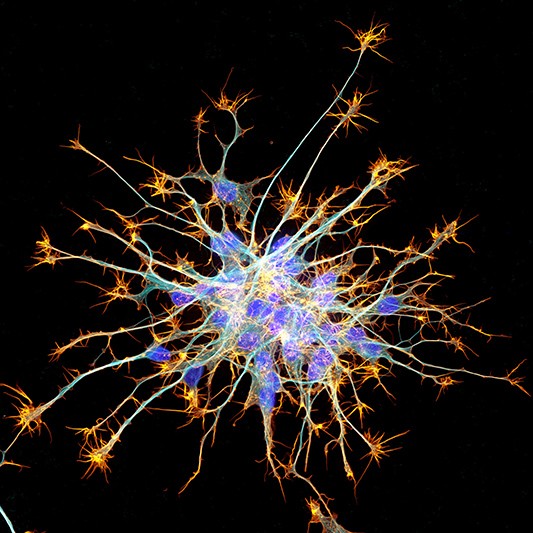
A 25-year science wager has come to an end. In 1998, neuroscientist Christof Koch bet philosopher David Chalmers that the mechanism by which the brain’s neurons produce consciousness would be discovered by 2023. Both scientists agreed publicly on 23 June, at the annual meeting of the Association for the Scientific Study of Consciousness (ASSC) in New York City, that it is still an ongoing quest — and declared Chalmers the winner.
What ultimately helped to settle the bet was a key study testing two leading hypotheses about the neural basis of consciousness, whose findings were unveiled at the conference.
“It was always a relatively good bet for me and a bold bet for Christof,” says Chalmers, who is now co-director of the Center for Mind, Brain and Consciousness at New York University. But he also says this isn’t the end of the story, and that an answer will come eventually: “There’s been a lot of progress in the field.”
The great wager
Consciousness is everything a person experiences — what they taste, hear, feel and more. It is what gives meaning and value to our lives, Chalmers says.Can lab-grown brains become conscious?
Despite a vast effort — and a 25-year bet — researchers still don’t understand how our brains produce it, however. “It started off as a very big philosophical mystery,” Chalmers adds. “But over the years, it’s gradually been transmuting into, if not a ‘scientific’ mystery, at least one that we can get a partial grip on scientifically.”
Koch, a meritorious investigator at the Allen Institute for Brain Science in Seattle, Washington, began his search for the neural footprints of consciousness in the 1980s. Since then, he has been invested in identifying “the bits and pieces of the brain that are really essential — really necessary to ultimately generate a feeling of seeing or hearing or wanting,” as he puts it.
At the time Koch proposed the bet, certain technological advancements made him optimistic about solving the mystery sooner rather than later. Functional magnetic resonance imaging (fMRI), which measures small changes in blood flow that occur with brain activity, was taking laboratories by storm. And optogenetics — which allowed scientists to stimulate specific sets of neurons in the brains of animals such as nonhuman primates — had come on the scene. Koch was a young assistant professor at the California Institute of Technology in Pasadena at the time. “I was very taken by all these techniques,” he says. “I thought: 25 years from now? No problem.”
Adversarial collaboration
For many years, the bet was mostly forgotten. That is, until a few years ago, when it was resurfaced by Per Snaprud, a science journalist based in Stockholm who had interviewed Chalmers back in 1998. His recording of the chat reminded the pair of the terms they had set in the wager and the case of wine that was at stake.Decoding the neuroscience of consciousness
Around that time, both Koch and Chalmers had become involved in a large project supported by the Templeton World Charity Foundation, based in Nassau, The Bahamas, aiming to accelerate research on consciousness.
The goal was to set up a series of ‘adversarial’ experiments to test various hypotheses of consciousness by getting rival researchers to collaborate on the studies’ design. “If their predictions didn’t come true, this would be a serious challenge for their theories,” Chalmers says.
The findings from one of the experiments — which involved several researchers, including Koch and Chalmers — were revealed on Friday at the ASSC meeting. It tested two of the leading hypotheses: Integrated information theory (IIT) and global network workspace theory (GNWT). IIT proposes that consciousness is a ‘structure’ in the brain formed by a specific type of neuronal connectivity that is active for as long as a certain experience, such as looking at an image, is occurring. This structure is thought to be found in the posterior cortex, at the back of the brain. On the other hand, GNWT suggests that consciousness arises when information is broadcast to areas of the brain through an interconnected network. The transmission, according to the theory, happens at the beginning and end of an experience and involves the prefrontal cortex, at the front of the brain.
Six independent laboratories conducted the adversarial experiment, following a pre-registered protocol and using various complementary methods to measure brain activity. The results — which haven’t yet been peer-reviewed — didn’t perfectly match either of the theories.
“This tells us that both theories need to be revised,” says Lucia Melloni, a neuroscientist at the Max Planck Institute for Empirical Aesthetics in Frankfurt, Germany, and one of the researchers involved. But “the extent of that revision is slightly different for each theory”.
Unfulfilled predictions
“With respect to IIT, what we observed is that, indeed, areas in the posterior cortex do contain information in a sustained manner,” Melloni says, adding that the finding seems to suggest that the ‘structure’ postulated by the theory is being observed. But the researchers didn’t find evidence of sustained synchronization between different areas of the brain, as had been predicted.The human brain’s characteristic wrinkles help to drive how it works
In terms of GNWT, the researchers found that some aspects of consciousness, but not all of them, could be identified in the prefrontal cortex. Additionally, the experiments found evidence of the broadcasting postulated by advocates of the theory, but only at the beginning of an experience — not also at the end, as had been predicted.
So GNWT fared a bit worse than IIT during the experiment. “But that doesn’t mean that IIT is true and GNWT isn’t,” Melloni says. What it means is that proponents need to rethink the mechanisms they proposed in light of the new evidence.
Other experiments are underway. As part of the Templeton foundation initiative, Koch is involved in at study testing IIT and GNWT in the brains of animal models. And Chalmers is working on another project evaluating two other hypotheses of consciousness.
It’s rare to have proponents of competing theories come together at the table and be open to having their predictions tested by independent researchers, Melloni says. “That took a lot of courage and trust from them.” She thinks that projects like these are essential for the advancement of science.
As for the bet, Koch was reluctant to admit defeat but, the day before the ASSC session, he bought a case of fine Portuguese wine to honour his commitment. Would he consider another wager? “I’d double down,” he says. “Twenty-five years from now is realistic, because the techniques are getting better and, you know, I can’t wait much longer than 25 years, given my age.”
doi: https://doi.org/10.1038/d41586-023-02120-8
(Contributed by Michael Kelly, H.W.)
Hard Problem of Consciousness
The elephant in the room in scientific inquiry

3 days ago (ajay-shrestha.medium.com)
Prompt ChatGPT or Google Bard “hardest unresolved problems in science” and you will see consciousness listed in the top 5.
Bard listed it at #3 as following:
“The nature of consciousness: What is consciousness? How does it arise? These are questions that have been debated by philosophers and scientists for centuries, and there is still no consensus.”
There is scientific consensus on the neural correlates of consciousness, but there isn’t one on how (or if) the brain causes consciousness.
Founder of quantum mechanics and Nobel Prize winner (Physics) Max Planck stated [1]:
“I regard consciousness as fundamental. I regard matter as derivative from consciousness. We cannot get behind consciousness. Everything that we talk about, everything that we regard as existing, postulates consciousness.”
Other than being so fundamental to our experience, one reason it is tricky to pin down consciousness is because it intersects many fields, including physics, biology, neuroscience, psychology, philosophy, computer science and others.
This is a very complex topic, and it would be impossible to cover it with sufficient depth in a medium-sized article. In addition, I don’t claim to be an expert in this subject. This post is a humble attempt to touch on the high-level generalized perspectives on consciousness, and trigger curiosity in the readers mind (or consciousness).
What is Consciousness?
First let’s define consciousness for the context of this post. In his seminal paper, “What Is It Like to Be a Bat”, American philosopher Thomas Nagel stated [2]:
“…consciousness has essential to it a subjective character, a what it is like aspect. He writes, “an organism has conscious mental states if and only if there is something that it is like to be that organism — something it is like for the organism.”….”
Consciousness is an internal and subjective first-person experience that has a qualitative characteristic. According to Nagel, any attempt to reduce it to objective/physical/materialistic characteristics would be leaving out the very definition of consciousness.
What is hard about Consciousness?
The term, Hard Problem of Consciousness was coined by Philosopher David Chalmers. It captures the how and why parts of our subjective conscious experience. He distinguishes it from the easy problem of consciousness, which can explain the physical systems that enable humans/animals to process information. According to him [3]:
“…even if we have solved all easy problems about the brain and experience, the hard problem will still persist”
Quantum Mechanics & Consciousness
Ever since I took a course in Quantum Computing in graduate school, I have been intrigued by the relationship between properties of matter at the quantum level and consciousness, and its implications for the overall nature of reality. I do want to clarify the course was mostly math and didn’t dwell on the ontology of reality or philosophy. But it’s not hard to see the connection.
A notable interpretation (Neumann-Wigner interpretation) of the famous double-slit quantum experiment [4–5] confirms that a conscious observer or measurement that is later observed (by a conscious observer) collapses a superposition (possibilities) into a particular state of the sub-atomic particle. In other words, a particle is rendered by the act of observation.
I cannot overstate the implications of this for science at the sub-atomic level, as science relies on objective measurement. But if consciousness and/or the act of measurement [6] in quantum mechanics itself influences the outcome of the measurement, then we have a major challenge.
If you are interested in learning more about the relationship between quantum mechanics and consciousness, check out the following posts on quantum mechanics linked below.
Quantum Mechanics and its Implications for Reality
Many-worlds (multiverse), Retro-causality (time-symmetry) and Consciousness-causes-collapse
What is a Quantum Computer?
Quantum computer is an emerging technology that will have a major impact.
Artificial Intelligence & Consciousness
Historian and author of the best-seller book Sapiens, Yuval Noah Harari says people (including scientists) often conflate intelligence with consciousness. Consciousness is the ability to suffer, be happy, experience color, taste chocolate, etc. Intelligence, on the other hand, is the ability to solve problems without the subjective element.
Harari and AI pioneer and Turing Award laureate Yann LeCun recently debated on the impact of AI [7]. Harari stated that humans possess consciousness and intelligence and use both to solve problems, whereas AI only has intelligence. On the contrary, LeCun has stated that sentience (consciousness) is an emergent property of computational devices [8], and it is a matter of time before AI systems develop consciousness [7]. Based on his book, 21 lessons for the 21st Century, Harari is skeptical but open to the idea of consciousness arising from information/matter, whereas LeCun is more certain.
If you are interested in learning more about problems solved by AI, checkout the post linked below.
Machine Learning Vs Software Development
The goal of software development (SD) and machine learning (ML) is to deliver features and capabilities to meet…
Dualism
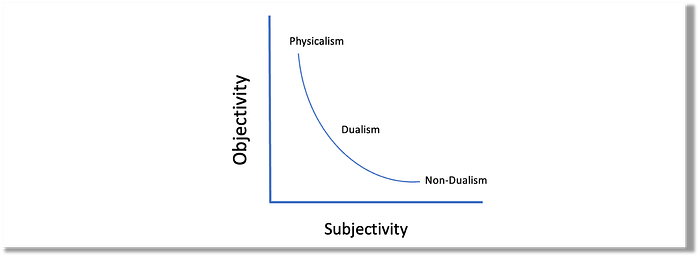
The mind-body dualism is the attempt to solve the relationship between mind (consciousness) and matter (body/brain). It states that mind (subjective experience) and matter (objective properties) are distinct and separate from each other. Essentially, one cannot be reduced and explained in terms of the other. French philosopher and scientist René Descartes supported dualism and linked mind with consciousness and distinguished it from the brain [9].
Non-Dualism
Non-duality considers consciousness to be fundamental and objective attributes to be derived from consciousness. Traditions in the East have a history in non-duality [10]. It has some overlaps with concepts in Idealism [11] in the West.
American cognitive psychologist Donald Hoffman supports the consciousness before matter view [12]:
“Consciousness didn’t emerge from a prior physical process of evolution. Consciousness is fundamental and so we have to rethink the whole history of the universe actually from this point of view, from The Big Bang up through evolution.”
Summary
The jury is still out on how/if the brain (physical matter) generates consciousness. To summarize the theories across the wide spectrum of disciplines from physics to philosophy, there are three camps of explanations.

Resources
- https://bigthink.com/words-of-wisdom/max-planck-i-regard-consciousness-as-fundamental/
- What Is It Like to Be a_Bat — Wikipedia
- https://en.wikipedia.org/wiki/Hard_problem_of_consciousness
- Quantum Mechanics and its Implications for Reality
- What is a Quantum Computer?
- https://en.m.wikipedia.org/wiki/Measurement_problem
- Yuval Noah Harari (Sapiens) vs Yann LeCun (Meta) on artificial intelligence — https://amp.lepoint.fr/2519782
- https://twitter.com/ylecun/status/1539455515822112769?lang=en
- https://en.wikipedia.org/wiki/Mind%E2%80%93body_dualism
- https://en.wikipedia.org/wiki/Nondualism
- https://en.wikipedia.org/wiki/Idealism
- https://evolutionnews.org/2023/01/brain-scientist-consciousness-didnt-evolve-it-creates-evolution/
- https://en.wikipedia.org/wiki/Physicalism
- https://en.wikipedia.org/wiki/Neural_correlates_of_consciousness
- https://en.wikipedia.org/wiki/Max_Planck
- https://en.wikipedia.org/wiki/Thomas_Nagel
- https://en.wikipedia.org/wiki/David_Chalmers
- https://en.wikipedia.org/wiki/Donald_D._Hoffman
- https://en.wikipedia.org/wiki/Von_Neumann%E2%80%93Wigner_interpretation

Engineering Mgr @ Imagen (Healthcare AI Startup, NYC) | Computer Science Faculty (Univ. of Bridgeport, CT) | PhD in Machine Learning | http://ajayshrestha.com
Bernardo Kastrup on Consciousness, Carl Jung, AI and UAPs / UFOs
THIRD EYE DROPS3.Premiered Mar 22, 2023 Bernardo Kastrup enters the mind meld! Bernardo is the executive director of Essentia Foundation. His work leads the modern renaissance of metaphysical idealism, the notion that reality is essentially mental. Bernardo holds two Ph.Ds, one in philosophy (ontology, philosophy of mind) and another in computer engineering. He’s the author of several books including Science Ideated, Why Materialism Is Baloney, and Decoding Jung’s Metaphysics. In this one, we muse about consciousness, the nature of reality, the philosophy of Carl Jung the, UFO / UAP phenomenon, whether or not AI can become sentient and much more.
Consciousness and the Cosmos with Jude Currivan
New Thinking Allo • Mar 5, 2023 Jude Currivan, PhD, is a cosmologist and author of The Cosmic Hologram: In-Formation at the Center of Creation, CosMos (with Irvin Laszlo), The Eighth Chakra, The Wave, and The Thirteenth Step. Here she expands upon her insight that matter and consciousness are one and the same. Therefore, rather than say that we have consciousness, she maintains that we are consciousness. She refers to her early childhood experiences of supernormal awareness, and claims that this is the birthright of all individuals. We lose these natural abilities due to cultural conditioning. She also discusses James Lovelock’s Gaia hypothesis from the perspective of a conscious universe. Edited subtitles for this video are available in Russian, Portuguese, Italian, German, French, and Spanish. New Thinking Allowed host, Jeffrey Mishlove, PhD, hosted and co-produced the original Thinking Allowed public television series. He is a past vice-president of the Association for Humanistic Psychology; and is the recipient of the Pathfinder Award from that Association for his contributions to the field of human consciousness exploration. (Recorded on October 27, 2017)