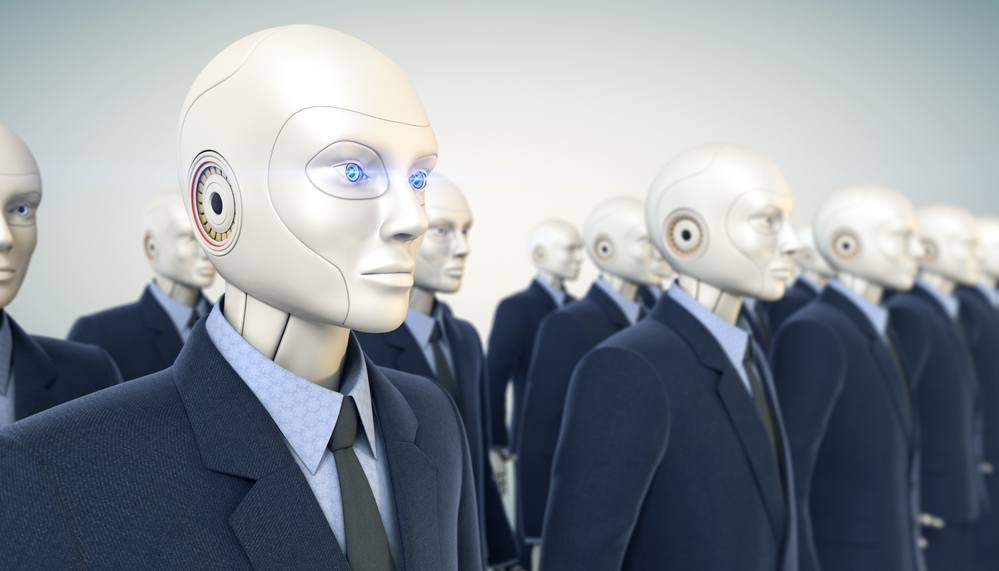
Two years before he died, legendary physicist Dr. Stephen Hawking ominously warned that the development of artificial intelligence, or AI, would be “either the best, or the worst thing, ever to happen to humanity.” Today, the rapid proliferation of artificial intelligence, or AI, is already wreaking havoc on workers in multiple industries. In May 2023 alone, AI took an estimated 4,000 jobs away from workers.
CEOs using AI to cut labor costs is only likely to intensify: The CEO of IBM said he would be using AI to replace nearly 8,000 jobs at the company over the next five years. Summit Shah, the CEO of an Indian e-commerce tech startup, recently made headlines for laying off 90% of his support staff and replacing them with an AI chatbot similar to ChatGPT. And according to a 2020 report by the World Economic Forum, AI could be utilized to fill 85 million jobs around the globe by 2025.
In the ongoing WGA and SAG-AFTRA strike that’s brought Hollywood to a standstill, one of the points of contention is studios wanting to use AI to capture an actor’s likeness and then use that likeness in perpetuity while only paying an actor for their initial appearance. And while Disney CEO Bob Iger could make up to $25 million in yearly compensation under his current contract, actress Jana Schmieding, who acts in the Disney+ series Reservation Dogs, makes just $0.03 every three months in streaming residuals for that show.
But despite all of the conversation around AI, what has yet to be seriously discussed is using AI to perform the job where it would be the most useful and cost-effective: As a CEO.
AI is exacerbating the war against the working class
The logic behind corporations replacing human workers with AI is that it will reduce payroll costs and make the company more efficient, allowing it to make other investments that will improve its balance sheet and its share price over time. AI may be new, but its use in this way is merely an acceleration of a decades-long trend of corporate executives paying workers as little as possible while rewarding themselves with increasingly excessive compensation packages.
At every company, the CEO role is easily the most costly. According to a 2023 study by Equilar and the Associated Press, CEO pay packages at publicly traded companies still average between $10 million and $20 million annually across 11 different industries when accounting for both salary and stock. The top 10 highest paid CEOs collectively were paid nearly $900 million in total compensation in 2022 alone.
When comparing CEO compensation with average worker compensation, top executives made roughly 400 times more than the average worker, according to a 2022 study by the Economic Policy Institute (EPI). Since 1978, CEO pay has risen by almost 1,500%. The EPI also found that while worker productivity and wages were growing at roughly the same pace between 1948 and 1978, wage growth abruptly flatlined in the 1980s and onward even as productivity continued to steadily increase. By 2021, worker productivity had grown by more than 64% since 1978, while wages had grown by only 17%. This means nearly 50% of workers’ labor value was effectively stolen by their employers over the course of several decades.
Interestingly, that period of time was also when the percentage of American workers who belonged to labor unions began to decline while the incomes of the richest 10% of Americans started climbing rapidly. After President Ronald Reagan busted the federal air traffic controllers union in 1981, union membership declined steadily each year with other companies likely viewing Reagan’s anti-worker policies as a green light to do the same.
A separate chart from EPI showed that in 1978, the percentage of workers who were unionized was around 25%, while 32% of income went to the top 10%. By 2014, only 11% of workers were unionized, and the top 10% held more than 47% of income. Conversely, in 1956, when union membership was the highest at 33% of workers, the top 10% held just 32% of income. This data strongly suggests the drive for “efficiency” and “cost-cutting” could be better described as the owner class pillaging the wealth of the working class, or, more simply, class war.
AI would be less costly and more efficient than a human CEO
When analyzing all of this data in a larger context, it could be argued that, at least in the US, a CEOs’ primary role is not just strengthening the company’s balance sheet, but fattening their own net worth. After all, when considering more than 52% of CEO compensation is in the form of stock options, CEOs are incentivized to do whatever it takes to increase the value of company shares, so the shares they’re paid with are worth even more. This is not only greedy and self-serving, but highly inefficient.
In June of this year, US News & World Report ranked the 50 best countries in the world for business. The publication ranked countries based on criteria like the favorability of a tax system, the level of bureaucracy, manufacturing costs, corruption, and government transparency. Switzerland ranked #1, and Panama, Finland, Luxembourg, and Norway rounded out the top five, respectively. To compare, the US didn’t even crack the top 50.
The best countries for business all share a few common traits: They typically have universal healthcare and public health insurance options, free education through the college level, generous paid leave policies, maternity and paternity leave, and child care among other well-funded safety net programs, freeing up companies from having to provide those benefits themselves. Additionally, CEOs are paid well, but far more modestly than American CEOs. Workers in these countries are also paid far more on average than in the US. According to Glassdoor data, the average Swiss CEO makes roughly $236K in US dollars (USD), while average Swiss workers make between $7,800 and $9,089 USD per month.
It could be easily argued that creating an AI to perform executive level functions like data analysis, risk assessment, and resource allocation would be preferable given AI’s strengths in those areas, especially when considering a machine doesn’t need compensation in the tens of millions of dollars to do so. While it would be somewhat concerning as a worker to know you’re reporting to a machine, that machine would still report to human beings on the company’s board and would be supplanted by other human C-suite executives who could come up with organizational vision and be the human faces of the company,
Just as Summit Shah had a programmer create the AI chatbot he used to replace support staff, an AI CEO could be programmed to include the well-being and happiness of the company’s workers in its performance metrics, rather than being chiefly driven by share prices. And if a company was no longer bound to pay a CEO tens of millions of dollars in compensation and bonuses over the course of a multi-year contract, it could have millions more to use for talent recruitment and retention, capital expenditures, and other things that would strengthen a company over the long term.
Like it or not, AI is here to stay. If it can be utilized where it will create the most efficiency and do the least harm, it could, as Stephen Hawking noted, be not the worst thing, but the best thing for humanity.
Carl Gibson is a freelance journalist and columnist whose work has been published in CNN, the Guardian, the Washington Post, the Houston Chronicle, the Louisville Courier-Journal, Barron’s, Business Insider, the Independent, and NPR, among others. Follow him on Bluesky @crgibs.bsky.social.
The team behind Gorilla trained it on a specific training recipe and designed it to connect large language models, or LLMs, with services accessed through application programming interfaces, or APIs, according to Patil.
Researchers from the Sky Computing lab and the Berkeley AI Research, or BAIR, Lab recently released Gorilla, a large language model, or LLM, designed to revolutionize the way AI algorithms function, according to Shishir Patil, campus computer science doctoral student and project lead.
Since the release of OpenAI’s ChatGPT in November 2022, researchers around the world have been brainstorming ways to increase the efficiency and abilities of LLMs.
ChatGPT generates a response to the question a user asks based on what it learned during its training phase. While this question and answer function is popular given its novelty, Patil said looking forward, there are more useful functions for this technology.
“One example could be you want to book a flight ticket, right? Or you want to book a reservation at a restaurant. Now today, an LLM cannot do that because it cannot interact with the rest of the world. So that’s where Gorilla comes in. Gorilla is a large language model that trains LLMs how to interact with the rest of the world through tools,” Patil said.
The “tools” being used to teach this model are application programming interfaces, or APIs, which allows systems to communicate with one another, according to Patil.
The team behind Gorilla trained it on a specific training recipe and designed it to connect LLMs with services accessed through APIs, according to Patil. The models and code the team used for training are all open sourced — meaning they are available in the public domain — allowing for quick processing times.
Just this morning, the team released a newer model with an Apache-2.0 license, allowing it to be used commercially, according to Patil.
“We are studying ways to automatically integrate with the millions of services on the web by teaching LLMs to find and then read API documentation,” said Joseph Gonzalez, a professor in the electrical engineering and computer sciences department and the director of the Sky Computing lab, in an email.
In addition to Gorilla’s API capabilities, Patil noted the model can measure how much it “hallucinates,” or how often it relays made-up information.
Because LLMs are trained to generate their own answers, hallucinations are rather common. Gorilla, however, provides scientifically rigorous ways to determine exactly how much the model is hallucinating while also being proven to hallucinate less often than ChatGPT, according to Patil.
“As we are serving Gorilla to the outside world. We have multiple requests from Korea, Israel, obviously India, China and the Bay Area dominates,” Patil said. “All of this is being sold on infrastructure that’s being provided by UC Berkeley and more specifically the Skylab that we’re all part of.”
The researchers behind Gorilla include Patil and Tianjun Zhang, a campus computer science doctoral students; Gonzalez, who is the lead faculty member on the project and Xin Wang, a senior researcher at Microsoft who was a doctoral student of Gonzalez’s at UC Berkeley.
Gonzalez noted the collaboration with Wang and her colleagues at Microsoft were “instrumental” to the success of Gorilla.
Patil noted the team named the project “Gorilla” because the animals use tools similarly to how they want their LLM to be used.
“This is like unlocking the new next frontier,” Patil said. “Before, LLMs were this closed box that could only be used within this domain. Now by teaching LLMs how to write thousands of APIs, we are, in some sense, unlocking what an LLM can do. Now it’s like there are no limits.”
SAN MATEO, CA—After spending the past three decades of his life being totally unable and unwilling to engage in any meaningful way with the world around him, James Parker, a local guy who sucks at being a person, told reporters Thursday that he saw huge potential in AI. “While it’s still in its early phase, artificial intelligence will one day accomplish things that humans could have never even dreamed of doing,” said Parker, who, by all accounts, has never stretched himself to do something he found difficult; has never created anything truly original; and, deep down, has absolutely zero understanding of what makes things good, enjoyable, or rewarding. “Just yesterday, I asked an AI program to write an entire sci-fi novel for me, and [as someone who will die an empty shell of a man who wasted his life doing nothing for the world and, perhaps, should never have been born] I was super impressed. Soon, humans won’t need to do anything at all! Awesome.” At press time, Parker added that as someone whose contributions to society would almost certainly be measured cumulatively as a net loss, he also saw great potential in the future of the metaverse.
It’s been living up to that removal lately. At its annual I/O in San Francisco this week, the search giant finally lifted the lid on its vision for AI-integrated search — and that vision, apparently, involves cutting digital publishers off at the knees.
Google’s new AI-powered search interface, dubbed “Search Generative Experience,” or SGE for short, involves a feature called “AI Snapshot.” Basically, it’s an enormous top-of-the-page summarization feature. Ask, for example, “why is sourdough bread still so popular?” — one of the examples that Google used in their presentation — and, before you get to the blue links that we’re all familiar with, Google will provide you with a large language model (LLM) -generated summary. Or, we guess, snapshot.
“Google’s normal search results load almost immediately,” The Verge’s David Pierce explains. “Above them, a rectangular orange section pulses and glows and shows the phrase ‘Generative AI is experimental.’ A few seconds later, the glowing is replaced by an AI-generated summary: a few paragraphs detailing how good sourdough tastes, the upsides of its prebiotic abilities, and more.”
“To the right,” he adds, “there are three links to sites with information that Reid says ‘corroborates’ what’s in the summary.”
As it goes without saying, this format of search, where Google uses AI tech to regurgitate the internet back to users, is wildly different from how the search-facilitated internet works today. Right now, if you Google that same query — “why is sourdough bread still so popular?” — you’d be met with a more familiar scene: a featured excerpt from whichever website won the SEO race (in this case, that website was British Baker), followed by that series of blue links.
At first glance, the change might seem relatively benign. Often, all folks surfing the web want is a quick-hit summary or snippet of something anyway.
But it’s not unfair to say that Google, which in April, according to data from SimilarWeb, hosted roughly 91 percent of all search traffic, is somewhat synonymous with, well, the internet. And the internet isn’t just some ethereal, predetermined thing, as natural water or air. The internet is a marketplace, and Google is its kingmaker.
As such, the demo raises an extremely important question for the future of the already-ravaged journalism industry: if Google’s AI is going to mulch up original work and provide a distilled version of it to users at scale, without ever connecting them to the original work, how will publishers continue to monetize their work?
“Google has unveiled its vision for how it will incorporate AI into search,” tweeted The Verge’s James Vincent. “The quick answer: it’s going to gobble up the open web and then summarize/rewrite/regurgitate it (pick the adjective that reflects your level of disquiet) in a shiny Google UI.”
Research has shown that information consumers hardly ever make it to even the second page of search results, let alone even the bottom of the page. And worse, it’s not like Google’s taking clicks away from its longtime information merchants by hiring an army of human content writers to churn out summarization. Google’s new search interface, which is built on a model that’s already been trained by way of boatloads upon boatloads of unpaid-for human output, will seemingly be swallowing even more human-made content and spitting it back out to information-seekers, all the while taking valuable clicks away from the publishers that are actually doing the work of reporting, curating, and holding powerful interests like Google to account.
As of now, it’s unclear whether or how Google plans to compensate those publishers.
In an emailed statement to Futurism, a Google spokesperson said that “we’re introducing this new generative AI experience as an experiment in Search Labs to help us iterate and improve, while incorporating feedback from users and other stakeholders.”
“As we experiment with new LLM-powered capabilities in Search, we’ll continue to prioritize approaches that will allow us to send valuable traffic to a wide range of creators and support a healthy, open web,” the spokesperson added.
Asked specifically whether the company has plans to compensate publishers for any AI-regurgitated content, Google had little in response.
“We don’t have plans to share on this, but we’ll continue to work with the broader ecosystem,” the spokesperson told Futurism.
Publishers, however, are extremely wary of these changes.
“If this actually works and is implemented in a firm way,” wrote RPG Site owner Alex Donaldson, “this is literally the end of the business model for vast swathes of digital media lol.”
At the end of the day, there are a lot of questions that Google needs to answer here, not the least being that AI systems, Google’s included, spew fabrications all the time.
The Silicon Valley giant has long claimed that its goal is to maximize access to information. SGE, though, seemingly seeks to do something quite different — and if the company doesn’t figure out a way to compensate publishers for the labor it’ll be gleaning from the journalists, the effects on the public’s actual access to information could be catastrophic.
In this exclusive preview of groundbreaking, unreleased technology, former Apple designer and Humane cofounder Imran Chaudhri envisions a future where AI enables our devices to “disappear.” He gives a sneak peek of his company’s new product — shown for the first time ever on the TED stage — and explains how it could change the way we interact with tech and the world around us. Witness a stunning vision of the next leap in device design.
Imran Chaudhri spent more than 20 years at Apple creating some of the world’s most beloved consumer products. Now he’s using AI to rethink and reshape the role of technology in our lives.
Artificial intelligence pioneer Geoffrey Hinton says he’s leaving Google so that he can freely share his concern that AI could cause the world serious harm.Chloe Ellingson/The New York Times
The AI pioneer who blazed the trail for a breakthrough approach to artificial intelligence has quit his post at Google.
Geoffrey Hinton, who served as a Google vice president and has been called the “godfather of AI” for his work on deep learning, has left Google to speak out on the dangers of artificial intelligence.
The New York Times first reported Hinton’s departure. Hinton tweeted Monday to clarify his reason for leaving, saying the report “implies that I left Google so that I could criticize Google.
“Actually, I left so that I could talk about the dangers of AI without considering how this impacts Google,” Hinton said in a tweet. “Google has acted very responsibly.”
The New York Times report actually focused on Hinton’s concerns about the progress of AI and his regrets about the role his work played in that advance. “I console myself with the normal excuse: If I hadn’t done it, somebody else would have,” he told the newspaper.
Google’s search engine technology became a leading driver of machine learning, the AI method that trains computers to solve problems by figuring out patterns.
Hinton is considered a pioneer of a new approach called deep learning, which uses artificial neural networks that can pick up, record, and process data and signals that are then organized the way human memory operates. With deep learning, a computer can mimic how the human brain works.
Deep learning paved the way for what’s now called generative AI, tools that let users create sophisticated content, including video and photographs. It was also critical in the rise of ChatGPT, the chatbot launched in November 2022 that unleashed a frenzy over AI.
But the AI craze has triggered serious concerns about the use of the technology. In March, more than 1,000 technology leaders and experts signed an open letter calling for a pause in AI development to give the industry and policymakers time to come up with “a set of shared safety protocols for advanced AI design and development that are rigorously audited and overseen by independent outside experts.”
But other experts are skeptical of the campaign, especially given the intense industry competition triggered by the ChatGPT frenzy. Google recently merged two major AI labs in a clear reaction to Microsoft’s stronger alliance with OpenAI, which created ChatGPT.
Hinton’s Twitter post defending Google’s approach underscores the debates within the tech industry on how AI should be developed. Last year, Google fired a software engineer who said an AI chatbot the company was developing was sentient and had the ability to express human emotions and thoughts.
Another AI pioneer who signed the letter calling for a pause in AI development — Louis Rosenberg, CEO of Unanimous AI — praised Hinton’s decision to leave Google.
“His words have an impact across the field,” he told The Examiner. “I applaud him for leaving Google if that is what he feels he needs to do in order to speak freely about the dangers.”
“There is nothing more important right now than for pioneering technologists to speak up about the AI risks they see, for the dangers come from many different directions and perspectives,” Rosenberg said. “Some dangers are obvious. Some are not. And all are amplified considerably when the largest companies in the world are engaged in an all out arms-race to hit the market first with next generation systems. These are risky times.”
In a statement, Google Chief Scientist Jeff Dean said, “Geoff has made foundational breakthroughs in AI, and we appreciate his decade of contributions at Google. I’ve deeply enjoyed our many conversations over the years. I’ll miss him, and I wish him well!”
Computer scientist Yejin Choi is here to demystify the current state of massive artificial intelligence systems like ChatGPT, highlighting three key problems with cutting-edge large language models (including some funny instances of them failing at basic commonsense reasoning.) She welcomes us into a new era in which AI is becoming almost like a new intellectual species — and identifies the benefits of building smaller AI systems trained on human norms and values. (Followed by a …SHOW MORE
The term “AI” has been commodified to mean any clever machine. It is used to describe everything from your smart thermostat to the personal data mining program the company used to determine if you get the job. Today, in 2023, the unfortunate fact with which we must all contend is this: every AI in the world is nothing compared to ChatGPT. If you don’t get the job, that’s a problem. If a hundred industries disappear, that is a crisis. When you have to work to find reliable news, that is a problem. When no information of any kind can be trusted, that is a crisis. I intend to demonstrate that those crises are written into the very guts of ChatGPT.
OpenAI’s development of ChatGPT should not be thought of as a really cool improvement on a common technology. It should be thought of in the same way we might think of the discovery of petroleum and its introduction into every facet of human life. There will be no escaping it and everyone will find themselves using it whether they realize it or not. Hyperbole does not begin to encompass its full import.
I am an engineer but I am not an expert in AI. I have spent some time training a neural network and I have developed several expert systems. I have seen how clever mere software can appear and I am not strictly skeptical of how far AI can go. I suspect that Alan Turing, conducting his own Turing test against ChatGPT, would be pretty impressed. What I’ve been pondering goes beyond that.
So, let’s assume that all the hype about ChatGPT is correct and that it will usher in a new era wherein a single electronic system can answer all of the questions we would normally pose to intelligent humans. Let’s further assume that a general pre-trained transformer (GPT) evolves into a true artificial general intelligence (AGI) which can learn from mistakes and answer questions with near flawless accuracy. With those assumptions in place, let’s consider our glorious future.
Who the Tech Serves
From the Industrial Revolution to the 1970s, improvements in efficiency and worker productivity have inspired many. Through most of the 20th century, polymath and philosopher R. Buckminster Fuller promoted his sincere belief in an economy of abundance, lauding the latest technological advances and predicting that the 40 hour work week would soon become a 20 hour work week and people would be freed to dedicate more time to enjoying life. He wrote:
We must do away with the absolutely specious notion that everybody has to earn a living.
To be fair, Karl Marx had the same aspiration, believing that the worker could put in four hours in the morning at conventional work and dedicate the afternoon to fishing, painting or other private projects. The difference being that Marx did not believe this would ever be possible in a capital-intensive profit-based economy.
As far as we can see now in the year 2023, Marx was right and Fuller was wrong. Higher productivity does not increase worker leisure. It increases unemployment, and executive salaries.
Creating a Thinking Machine
For years now, companies have been trying to build an artificial general intelligence (AGI). Most purely algorithmic designs fell well short of expectations leading someone to finally conclude that, rather than simulate the human brain with software algorithms, it might be easier to emulate the human brain with a network of neuron-like circuitry. The idea was to construct a thinking machine by interconnecting a large number of artificial neurons configured in interconnecting layers. In the industry, this is called a neural network.
That neural network is not “programmed” in the conventional sense. It must be trained. In order to recognize a hockey stick, images of hockey sticks in many different positions, locations and lighting angles must be shown to the input computer along with some kind of indication that the output should identify this as a hockey stick. Ten images won’t do it, a thousand images won’t do it. At 100,000 precisely labeled images, we might begin to form the desired interconnections and amplitudes of the neurons to reliably recognize a hockey stick in any reasonable scene.
The sheer magnitude of the training process led some scientists to turn to the wealth of information readily available on the Internet (mostly for free). They opened a fire hose of raw Internet information into their machine from web sites all over the world. This produced AI models that correctly reflected the randomness of the poorly curated input data. They communicated in a believable fashion but incorporated unfounded conclusions and profanity. For this reason, much research was applied to the development of the various curation algorithms for training the systems. In many specific cases, human intervention was also required in order to assure that the data was not just “processed” but, in a sense, “understood”.
For example, the AI needs to recognize not only that a disciplined legal assessment of the January 6th insurrection represents actual facts on the ground, but also that a Fox “News” transcript of the event does not. ChatGPT is in the news because its developer, OpenAI, figured out how to implement a practical solution to the massive problem of training an AI model to communicate using words that are, for the most part, good representations of well-evaluated information.
Turning AI Into Money
OpenAI produced GPT-4 for the purpose of making money and there is plenty of money to be made. Currently the company provides limited access to the general public through the online platform ChatGPT and enhanced access to paying customers who may use a number of useful online interfaces to exploit the full GPT-4 capabilities. This AI-as-a-service model is adequate for now but eventually large corporations will tire of sharing a common resource with their competitors and will demand options that they control completely.
Imagine you are a big company and you’ve developed cool technologies that you don’t want anyone else to know about. What you want is a GPT that’s all your own. If you start asking questions of OpenAI’s online version, you’ll get the same answers your competitors are getting. If you try to train it with your own proprietary information, how do you know that information won’t leak through to your competitors? This is a big problem. OpenAI doesn’t make money if they can’t convince you that your private access is completely hidden from your competitors. What do they do?
They will sell you your own GPT hardware in the form of a computer installation similar to their own but isolated within your lab. They will then sell you a training machine, a specialized trainer, that will allow you to train your own personal installation with all of the information on the Internet that applies to what your company does. That specialized trainer will allow you to build up your own specialized intelligence (SI) with minimal human intervention.
Imagine hundreds of paying customers using their personal OpenAI GPTs and specialized trainers to scour the online literature for scholarly papers, dialogues, lectures and critiques relating to music, mathematics or biochemistry. Companies would use these tools to initially build out their own SI; but also, to incorporate the very latest research into each operational SI as that research comes online. OpenAI (and undoubtedly competitors) would provide these tools and services to companies seeking an edge over any competitor still using humans or the generic online GPT intelligence.
A Pharmacological Example
Let’s imagine a pharmaceutical company specializing in treatments for autoimmune diseases. The company purchases an OpenAI GPT and installs it in their own lab. They also purchase specialty trainers focused on the disciplines of pharmacology and genetic manipulation. They start the trainers and watch for a few months as petabytes of data are reviewed, curated and filtered into the waiting GPT mechanism.
From time to time human employees will pose questions to the developing SI and assess the usefulness of the answer. Eventually, over time, the assessments come back as competent and correct. Next, the employees feed in their own internal proprietary papers and presentations and the SI folds that new information into its state-of-the-art genetic/pharmacological skill-set.
Of course the goal, in a profit-based pharmacology, is to transform a fatal disease into a chronic disease. For this reason the company also needs to train the SI to produce drugs that mitigate the disease without actually curing it. A cure for muscular dystrophy would introduce a fairly minor improvement to the bottom line. An expensive drug to be taken for the life of the patient is always preferred.
So now the company initiates a project to develop a system for improving the quality of life for those with progressive multiple sclerosis. A team is assembled and instructed to submit to the SI a full description of the problem to be solved. With that done, the SI is left to cogitate.
A few hours later, the SI prints the formula and experimental testing plan for a new drug and an improved method for injecting the drug. That drug and method are tested first in mice, then in specially-bred rhesus monkeys and finally in humans. The results are excellent and the FDA approves the drug and method for sale.
When a second project shows similar results, it becomes clear to management that a machine is doing the work of hundreds of human experts. The company lays off 95% of its physicians and biochemists, keeping only enough to compose the problem statements to the SI. Crazy? Of course, but admit it. You’ve seen crazier, haven’t you?
In response to that move, the competitors clamor for their own specialized intelligences. They buy the hardware and the trainers and begin training and testing. Soon, they all lay off most of their scientists and proceed through FDA testing with their own artificially designed super-genius drugs. Other types of companies will undoubtedly do the same thing, but we’ll stick with pharmacology for this discussion.
We soon find that biochemistry is no longer an appealing skill since wages have been dropping consistently as all that is required is the ability to describe a medical problem. The astounding success of the SI-developed drugs (along with extensive lobbying efforts) leads the FDA to enact an abbreviated protocol for the SI-developed drug approval process.
Drug companies, using specialized AI, begin producing more and more such drugs. The vast majority of biochemists have moved on, some into art, some into podcasting, some into retail sales. Their skills grow stale and they lose track of the latest research. The world sees a decade of rapidly developed drugs and processes that alleviate much suffering and offer patients easy monthly payments for disease mitigation solutions assuring a lifetime of almost-not-miserable existence.
As the various specialty trainers scour the internet for new research, fewer and fewer documents are found. Biochemistry is now a wholly uninteresting endeavor. Universities are closing down those departments, confident in the competence of the AIs. Only a few government laboratories are looking into any kind of medical research and since government researchers, thanks to Ronald Reagan’s memorandum on patents, don’t usually get to keep their patents any more, the research tends to be halfhearted and proforma investigations into fairly simple issues.
After several years of unmitigated success, one of the drugs shows fatal side-effects after a few years of use. A degenerative effect on the heart valves leads to the sudden deaths of hundreds of patients with SLE. The offending drug is removed from the market. Now the question becomes: Was the error contained in that company’s proprietary data or was it from a common source? If from a common source then other drugs developed with the use of that same training may also lead to deaths. Which drugs would those be? Where will we find experienced biochemists to work with the findings of the autopsies in order to figure out what went wrong? What schools still teach biochemistry and pharmacology curricula? Once resolved, how is that faulty training corrected in the complex neural nets of the various SIs?
The larger question may be this: Is the SI a simulation of human ingenuity (monkey see, monkey do) or is it an emulation of human ingenuity capable of surpassing its examples not merely by expertly integrating existing human works but by actually experiencing human-like curiosity and revelation? Do we call upon the SIs to do basic research, making the humans in the lab merely the arms and eyes of the machine?
A Political Example
With ChatGPT gaining popular acclaim as a counselor of laudable repute, those who seek the comfort of Fox “News” or OANN will find its answers disturbing and frightening. Incompatible with their restricted world view, MAGA sycophants will cry out for a chatbot that really understands the actual oppression of the suffering white male. The Republican Organization will have to respond. Surely, it doesn’t want its followers to ask ChatGPT if climate change is a threat. That answer would undoubtedly be inconsistent with Sean Hannity’s latest screed. They must, therefore, have their own chatbot version of Pure Flix.
For this reason, regressive organizations will purchase and deploy their own MagaGPT which will be easily trained from the unedited writings and transcripts of the reactionary Right. Maria Bartiromo’s latest pronouncement will be disgorged directly into the inputs of the various authoritarian models every day. The corresponding chatbot will be provided freely to MAGA Republicans and its conclusions will be used to confirm Marjorie Taylor Greene’s current rant, the undeniable innocence of the latest Republican presidential candidate and the vile corruption of any Democrat.
This specialized AI will be trained on an inconsistent corpus of lies, innuendo and partial truths. They will become part of a definitive knowledge base that emulates the innocent certainty of a twelve-year-old explaining why girls aren’t as smart as boys. The chatbot will leave no room for doubt regarding the spendthrift policies of the democrat president. It will, of course, have no understanding at all of the War Between the States or the Civil Rights movement or the actual U.S. Constitution.
Like its more expert cousin, though, it will be able to quickly formulate a fiendishly persuasive argument to support each statement. No longer needing to leak falsehoods to the New York Times in order to assure a façade of respectability, there is now an army of AI bots to do that and every smart person knows that AIs are never wrong. It will be the AI to make the libs cry. And one wonders how many more ideology-specific creations will follow.
Why Should Robots Have All the Fun?
Let’s imagine that anything I’ve suggested here seems reasonable. Is this our fate? Are we just going to have to hope that people are smart enough to recognize that there is something special about humans that we just don’t want to relegate to a machine? Can we humans decide that we, ourselves, really enjoy solving problems and we don’t want those necessary skills to atrophy? Can we use these AI projects to improve our understanding of the process of thought without redefining thinking as an artificial construct?
So what if our machines are amazingly smart — smarter than we can ever be? Does that mean we want them to do the thinking? Why do they get all the fun? Why would we give that up? More importantly, what does all of this mean for the human livelihood?
As we have seen, from the turn of the 19th century onward, machines that can help humans do not benefit the average human: they benefit those in power. Until recently, those machines have primarily replaced factory workers. Some have replaced white collar workers. Now they will be replacing those jobs that were considered sacrosanct only a decade ago: the technical and artistic creative person. As art and literature is generated more and more effectively by machine; as technical designs are produced more quickly and thoroughly; as political principles are invented and presented more persuasively, the machine predominates.
In the end, of course, the machine is not the master. People are making these decisions, determining the goals and exploiting the results. Is AI useful? Under certain circumstances, AI has certainly proved useful. Is it an idiot? Being oblivious to the ethics or moral ramifications of the tasks to which it is set and undertaking those tasks without question, it is certainly an idiot. The machines will not launch a robot revolution, it will happen through a psychological coup. Humans will become more and more uncertain and confused. An individual will ask, “Am I persuaded because 3000 years of human genius has been synthesized by machine into an inescapable argument or because it actually makes sense?” We will give up our power and our freedom because the masters of the machines will make it that easy.
Simulation or emulation? If a simulation, those AI systems will drive us to the intellectual brick wall that represents the end of human research and ingenuity. If an emulation, do the machines actually “deserve” to triumph in this merit-based zero-sum game?
Julian S. Taylor is the author of Famine in the Bullpen a book about bringing innovation back to software engineering. Available at or orderable from your local bookstore. Rediscover real browsing at your local bookstore. Also available in ebook and audio formats at Sockwood Press.
Cambridge Union • Nov 24, 2019 … MOTION FOR THE DEBATE: This House Believes AI Will Bring More Harm Than Good This debate was run in association with IBM Research. ABOUT THE SPEAKERS: PROPOSITION: Project Debater Project Debater is designed by IBM research. It will deliver a speech based on over 1,100 arguments collected from Union members and others over the past week. It will not be taking points of information. Sharmila Parmanand Sharmila Parmanand is a PhD Candidate in Gender Studies at the University of Cambridge and a Gates Scholar. She has served as a debate trainer or chief judge in debating events in 45 countries. She served as a chief judge for most major global debating competitions (World Universities, World Schools, European Universities, Asian Universities, Austral-Asian Universities, North American Universities, and PanAmerican Universities). Professor Neil Lawrence Neil Lawrence is the DeepMind Professor of Machine Learning at the University of Cambridge and the co-host of Talking Machines. Neil’s main research interest is machine learning through probabilistic models. He focuses on both the algorithmic side of these models and their application. His recent focus has been on the deployment of machine learning technology in practice, particularly under the banner of data science. OPPOSITION Project Debater Project Debater is designed by IBM research. It will deliver a speech based on over 1,100 arguments collected from Union members and others over the past week. It will not be taking points of information. Harish Natarajan Harish Natarajan is a graduate of the University of Oxford and the University of Cambridge. He was a grand fnalist and 2nd best speaker at the 2016 World Debating Championships and won the European Debating Championship in 2012. Harish holds the record for most competition victories. He currently works as the Head of Economic Risk Analysis at AKE International in London. Professor Sylvie Delacroix Sylvie Delacroix is professor in Law and Ethics at the University of Birmingham. Her work has notably been funded by the Wellcome Trust, the NHS and the Leverhulme Trust, from whom she received the Leverhulme Prize. She has recently been appointed to the Public Policy Commission on the use of algorithms in the justice system. ABOUT THE CAMBRIDGE UNION: From its small beginnings as a debating society, the Cambridge Union is the oldest debating society in the world and the largest student society in Cambridge. The Union remains a unique forum for the free exchange of ideas and the art of public debate.
In a talk from the cutting edge of technology, OpenAI cofounder Greg Brockman explores the underlying design principles of ChatGPT and demos some mind-blowing, unreleased plug-ins for the chatbot that sent shockwaves across the world. After the talk, head of TED Chris Anderson joins Brockman to dig into the timeline of ChatGPT’s development and get Brockman’s take on the risks, raised by many in the tech industry and beyond, of releasing such a powerful tool into the world.