A calming and helpful conversation for making sense of the very story of our time, and how that is coming to us and being powerfully shaped through media and journalism. The theory of change of journalism as it came out of the 20th century, David Bornstein says, is that shining a light on what is going wrong — what is dangerous and dysfunctional, catastrophic or corrupt — will mobilize and lead us to correct it. But this emphasis on the terrible and the extreme, from whichever side of our cultural trenches you inhabit, has helped fuel a paralyzing, dehumanizing fear and the collapse of trust in institutions and in each other. Many of us are turning away from the news altogether. Is that the answer? How to live in this world with this media and retain meaningful, reasonable hope and agency? And what are we not seeing and hearing that we can orient towards? There is no one wiser on these questions than David Bornstein.
Krista spoke with David Bornstein before a small group of citizens of Minneapolis in November, 2024.
Find an excellent transcript of this show, edited by humans, on our show page.
Sign yourself and others up for The Pause to be on our mailing list for all things On Being and to receive Krista’s monthly Saturday morning newsletter, including a heads-up on new episodes, special offerings, recommendations, and event invitations.
BIO
David Bornstein is co-founder and CEO of the globally esteemed Solutions Journalism Network. Learn more about their work with news organizations around the world, and their solutions story tracker at solutionsjournalism.org. He has been a journalist focusing primarily on social innovation for three decades. From 2010 to 2021, he co-authored the “Fixes” column in The New York Times. He is the author of The Price of a Dream: The Story of the Grameen Bank and How to Change the World: Social Entrepreneurs and the Power of New Ideas, which has been published in 25 languages.
Special thanks to Dana Mortenson, who created the event that brought Krista and David together. She is founder of World Savvy, an organization that seeks to reimagine education to build the global competence necessary to navigate a complex and ever-changing world.
The Upanishads represent a foundation for Indian philosophies. Using complex linguistic devices such as puzzles, paradoxes, metaphors, dramatic personae and word-play, they force an engagement of consciousness. The Isha Upanishad is among the most concise and complex of Upanishads, and one of the most diversely interpreted. Sri Aurobindo wrote a commentary on this Upanishad, seeing it as embodying a problem of becoming, the attainment of a consciousness in which unity and multiplicity are identical and do not erase each other.
From the days of the first shamans, through Homer, Dante, the traditional ballads, Rumi, Blake, Emily Dickinson and Lew Welch, poetry has been rooted in metaphysics. In What Poets Used To Know: Poetics, Mythopoesis, Metaphysics, Charles Upton presents poetry both as a set of contemplative techniques and as a key to the accumulated lore hoard of the human race. This bookdoes what it can to restore poetry to its original theurgic function: the concentrated expression of human and spiritual truth.
Imagination has been marginalized – depicted as a way of escaping reality, rather than coming to grips with it. This insightful and inspiring book argues that, for the sake of the future of our world, we must redress the balance. Ranging from the teachings of ancient mystics to the latest developments in neuroscience, The Lost Knowledge of the Imagination introduces a philosophy and tradition that restores imagination to its rightful place, and argues that it is not only essential to our knowing reality to the full, but to our very humanity itself.
This 820 page book details the academic research findings of the world’s first comprehensive multi-language quantitative and qualitative five-year academic research study on individuals that have had UFO related contact with Non Human Intelligence (NHI).
Controlled Remote Viewing, or CRV, is an easy set of written protocols designed to help you distinguish true intuitive perceptions from mere imagination. Sitting at a table with paper and pen, you are free to explore the far reaches of time and space. This first book in the series will teach you the basics of the first phase of the CRV process, and show you how to use this information in practical ways in your own life.
Pterois is a genus of venomous marine fish, commonly known as the lionfish, native to the Indo-Pacific. It is characterized by conspicuous warning coloration with red or black bands and ostentatious dorsal fins tipped with venomous spines. (Featured Image from New Thinking Allowed)
Hollywood icon Robert De Niro had a heartwarming reaction to his daughter, Airyn De Niro, coming out publicly as trans earlier this week.
In a statement released to multiple news outlets, Robert De Niro declared that he loved and supported Airyn De Niro before she came out and that nothing has changed.
Americans are as unhappy with his anti-trans priorities as they are with his handling of the economy and immigration.
“I love and support Airyn as my daughter,” he said, before boiling down the current backlash to trans people’s existence in the simplest of terms: “I don’t know what the big deal is.”
He then added, “I love all my children.” He has seven.
Airyn De Niro, 29, came out as trans on Tuesday in an interview with Them after a series of gossipy articles about her “new look” essentially outed her before she could do it herself.
“Not only did they get information wrong about me… They just sort of reminded me that people really don’t know anything about me,” she said, adding, “There’s a difference between being visible and being seen. I’ve been visible. I don’t think I’ve been seen yet.”
She told the publication she has presented as femme since middle school but decided to begin hormone therapy last November.
“Trans women being honest and open, especially [in] public spaces like social media and getting to see them in their success… I’m like, you know what? Maybe it’s not too late for me. Maybe I can start.”
“I think a big part of [my transition] is also the influence Black women have had on me,” she said. “I think stepping into this new identity, while also being more proud of my Blackness, makes me feel closer to them in some way.”
She also shared the way she hopes to be that influence for others.
“I’d want to hopefully be an inspiration for at least one other person like me who is Black, who is queer, who’s not a size extra small. I’d want to see more trans women, more Black women who are maybe bigger-bodied or don’t fit the mold of super thin or heroin chic.”
While working toward her own acting and modeling dreams, she also said she’s studying to be a mental health counselor.
“People of color and queer people definitely need more mental health advocacy and support. So I’m hoping I’m able to do that,” she said. “The field originally was so catered to white cis hetero men — what they deem as wrong or right or mentally ill or whatever, that is from their lens.”
“It’s really beneficial to work with a counselor or mental health professional who can relate to you or intersects with some part of you.”
She added that she hopes when people see her, they see “someone who is trying their hardest to heal from growing up not feeling good about themselves. [And] in the process of that, trying to make other people feel good about themselves.”
Subscribe to the LGBTQ Nation newsletter and be the first to know about the latest headlines shaping LGBTQ+ communities worldwide.
Most mammalian males have nipples. The duck-billed platypus does not have nipples but you begin to see development of nipples in marsupials (Park and Lindberg 2004) like the opossum and kangaroo. Development of a complete nipple begins in the eutherian (placental) mammals.
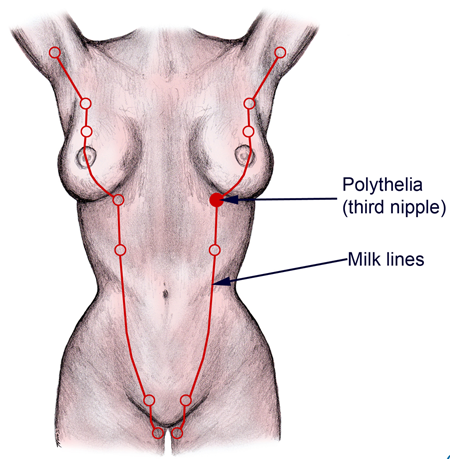
The mammary glands develop early in the embryo along a pair of ridges called the mammary ridge, mammary lines, or milk line (shown in an adult human in the figure below, taken from Wikipedia). The nipples form along this line. In humans, this happens during the fifth week of development. Within a few days, nipples begin to form. The number of nipples pairs that form is characteristic of the species (e.g., 1 pair in humans to 9 pairs in pigs). The development of nipples occurs before sexual differentiation begins which, in humans, is during the sixth week of development. That’s why both males and females have nipples. This same order of develop occurs in other mammals, revealing our common ancestry.
However, because the process is under genetic control, mistakes can happen. Occasionally, humans (and other mammals) can develop extra nipples, the so-called supernumerary nipple(s). The most common places that humans develop one or more supernumerary nipples are identified by the circles in the figure above. The actor Mark Wahlberg is not shy about showing his.
For a general overview of mammary gland development, Dr. Jacqueline Veltmaat has a nice web page that highlights her research in this area. For those interested in the more technical genetic aspects of mammary gland development, a paper by Watson and Khaled (2007) reviews the genetic processes that regulate development of the mammary gland in mammals, based on the mouse model system. The article covers all stages of mammary gland development, from the embryo through puberty to pregnancy. Their Figure 1 shows one row of embryonic mammary buds (labeled MB1 – MB5) in the embryonic mouse. In the case of the mouse, all of the mammary buds will develop into fully functioning mammary glands. Another paper by Robinson (2007) discusses the signalling pathways during development of the mammary glands.
Literature Cited
Park, C.S. and G.L. Lindberg. 2004. The mammary gland and lactation. pp. 720-741 in Dukes’ Physiology of Domestic Animals, W.O. Reece, ed. (Publisher not identified.)
Robinson, G.W. 2007. Cooperation of signalling pathways in embryonic mammary gland development. Nature Reviews Genetics 8: 963-972.
Watson, C.J. and W.T. Khaled. 2008. Mammary development in the embryo and adult: a journey of morphogenesis and commitment. Development 135: 995-1003.
Bone tool shaped on a 1.5-million-year-old elephant humerus. Credit: CSIC
Scientists have discovered 1.5-million-year-old standardized bone tools in Tanzania, pushing back the timeline of early hominin technology by over a million years.
The discovery of 1.5-million-year-old bone tools in Tanzania shows that early human ancestors had advanced cognitive abilities and were systematically crafting tools from bone much earlier than previously thought. This breakthrough pushes back the known timeline of complex toolmaking and abstract reasoning by nearly a million years.
Twenty-seven standardized bone tools dating back more than 1.5 million years were recently discovered in the Olduvai Gorge in Tanzania. This groundbreaking find was made by a team of scientists from the CNRS and l’Université de Bordeaux, in collaboration with international and Tanzanian researchers.
The discovery significantly alters current understandings of early hominin technological development. Until now, the oldest known standardized bone tools were dated to approximately 500,000 years ago. These newly discovered tools push that timeline back by more than a million years.
Evidence of Sophisticated Tool-Making
During the excavations, researchers identified tools that had been shaped on-site using bones from hippopotamuses. These tools were found in the same geological layer, indicating they were made and used during the same time period.
Even more remarkably, the team found elephant bones that had been transported to the site. These were likely brought in either as ready-made tools or as raw material for tool production. This behavior points to early planning abilities and the transmission of technical knowledge among these ancient hominin groups.
The findings were made possible through a multidisciplinary approach that combined traditional archaeological excavations with experimental archaeology. This allowed researchers to better understand how the tools were made and used, and to place the discovery within a broader evolutionary and cultural context.
Reference: “Systematic bone tool production at 1.5 million years ago” by Ignacio de la Torre, Luc Doyon, Alfonso Benito-Calvo, Rafael Mora, Ipyana Mwakyoma, Jackson K. Njau, Renata F. Peters, Angeliki Theodoropoulou and Francesco d’Errico, 5 March 2025, Nature. DOI: 10.1038/s41586-025-08652-5
Male self-esteem is indexed to wealth, an unstable prospect in a highly economically unequal society. In search of an alternative source of validation, many young men are turning to misogynistic ideas. The Left needs to provide alternatives of our own.
Influencer Andrew Tate attends UFC 313 at T-Mobile Arena on March 8, 2025, in Las Vegas, Nevada. (Ian Maule / Getty Images)
(jacobin.com)
The Netflix series Adolescence, which follows the aftermath of a teen boy’s murder of a female classmate, has amassed nearly 100 million views, making it one of the streamer’s biggest hits to date. Viewers have praised the show’s nuanced portrayal of a youth social world pervaded with the views of the misogynist online “manosphere.” But not everyone is a fan. A spokesman for top manosphere influencer and alleged sex trafficker Andrew Tate, who is named directly in the show, told Newsweek:
The reference to Andrew Tate in Adolescence is an attempt to pin broader societal issues on one individual, which is neither fair nor accurate. Whilst online influence is a valid topic, it’s unjust for the public to make him the scapegoat for complex problems like radicalization and violence, which stem from far wider cultural and systemic factors.
Tate’s spokesman has a point: his noxious brand of seething chauvinism is symptomatic of sweeping cultural and economic trends. Anthropologist Kristen Ghodsee, who previously spoke to Jacobin’s Meagan Day about the political economy of tradwives, returns for this discussion about the social pressures and contradictions that elevate figures like Tate and deliver young men into their orbit.
Kristen Ghodsee is the author of Why Women Have Better Sex Under Socialism, Everyday Utopia, and many other books and chairs the Russian and East European studies department at the University of Pennsylvania. In this conversation, she proposes that the manosphere is filling a self-esteem void created by the indexing of male value to wealth accumulation in a climate of profound economic inequality. She also proposes that we take seriously the idea that modern society is producing “extra men,” introducing an element of social instability that is everyone’s problem. The question is how to address the issue of lost, angry, and hurting young men without undermining women’s hard-won autonomy.
MEAGAN DAY
What is so attractive to young men about the manosphere right now?
KRISTEN R. GHODSEE
Boys and young men are very lost. The future looks bleak to them, and they’re struggling to find sources of validation. Most men are economically disenfranchised, yet male social status is still primarily indexed to wealth. A 2017 Pew Research Center survey showed that 71 percent of Americans believe that “it is very important for a man to be able to support a family financially to be a good husband or partner.” Young men get the message that to be desirable and respected, they must make money, yet our economy makes that incredibly difficult.
Whether consciously or unconsciously, they believe that without cash, women won’t want them and other men won’t respect them. They see figures like Elon Musk, Mark Zuckerberg, and Jeff Bezos upheld as ideal men, but they know they’ll never get close. So they’re looking for alternatives, something near at hand.
That’s where this jacked-up masculinity comes in. It’s cheaper. Men already have the “equipment” — they were born with it, and half of the population doesn’t have it, which puts them at an automatic advantage. That’s why Tucker Carlson talks about red light therapy for your testicles. It’s all about treasuring your natural resources. Of course, this stuff is all too often predicated on putting women down. Look at Andrew Tate and his open misogyny. Look at how Ultimate Fighting Championship (UFC) fighters feminize their opponents as much as possible.In reality, puffing men up for being men is just throwing them a bone for depriving them of the fruits of their labor.
In reality, puffing men up for being men is just throwing them a bone for depriving them of the fruits of their labor. This is a classic move when you have a massively disenfranchised population that poses a threat to social stability. You need to placate them. In Everyday Utopia, I write about how historically, one way to placate angry young men who may destabilize an economic system beset by vast inequality is to give every man a wife so he can be a dictator in his own home. When men feel disempowered in the public sphere, they can channel that frustration at home: “At least in my own house, I’m a king.” This is an ancient technique for social stabilization.
Young men aren’t thinking about it critically, and many of them mean well. Most guys, especially young men I teach, just want esteem. They want to be respected, loved, and appreciated. It’s not nefarious at all, but it ends up in this terrible place.
MEAGAN DAY
Inequality among men is a major fixation for the manosphere. The “alpha” and “beta” discourse is about intramale inequality. The whole “80–20” incel discourse is about male winners and losers, which is also the central and highly dramatized conceit of the UFC. It’s Trump’s leitmotif too. It’s as though the collective psyche is ruminating on the issue of male social rank.
This isn’t intrinsic to masculinity or inevitable in society, right? Tell me about the compression of inequality between men in Eastern European state socialism, and what effect that had on men’s way of relating to each other and to women.
KRISTEN R. GHODSEE
There was still patriarchy in Eastern Europe — getting rid of capitalism doesn’t automatically eliminate patriarchy. But they detached patriarchy from its role in upholding wealth inequality, and that blunted it.
There were also still inequalities, but these were inequalities of privilege, not wealth. Even at the highest level of Communist society, there were limits on how big your apartment could be. You couldn’t have a mansion. It was very difficult to get a car, and if you did, it was the same car everyone else got. People showed off by bragging about how many books they’d read and what month they got assigned to visit their communal seaside resorts. (July was the most high-status month to go, by the way.)
In order to attract partners and get social esteem, men were not invested in making more money, which wouldn’t work in a socialist society anyway (because there wasn’t anything to buy). In this context, women chose partners based on attraction, mutual compatibility, shared interests, and affection — not on whether the man could pay the rent, which was irrelevant, because you had housing from the state. These states also provided child allowances, childcare, and paid job-protected parental leave. Under socialism, men had to be attentive and good partners in order to attract women.After socialism, once wealth became important for attracting women, men found that it was much easier to just get money than to be interesting.
The result, as I documented in my bookWhy Women Have Better Sex Under Socialism, was that men ended up investing in being interesting guys that women wanted to be with. Of course, this improved gender relations!
After socialism, once wealth became important for attracting women, men found that it was much easier to just get money than to be interesting. This shift was obviously bad for women, but it was also bad for men. I’ve talked to men who grew up under socialism who say that after 1989 or ’91, they were never really sure if women were with them because they loved them or because they needed their money. They have an idealized view of relationships before capitalism because if a woman was with you, it was because she genuinely liked you. That made men feel secure.
MEAGAN DAY
You said something a moment ago about elites placating young men because they’re afraid of their destabilizing potential. What did you mean?
KRISTEN R. GHODSEE
There is a ton of anthropological research about the way that disenfranchised and unpartnered young men pose a serious threat to the social order. There’s one fascinating article in particular by Joseph Henrich and colleagues about how polygamy is inherently unstable, because polygamous societies produce a class of unmarried low-status men. These men then engage in all kinds of antisocial behaviors because they have nothing to lose.
Capitalism and monogamy usually go hand in hand, and that’s not a coincidence. People often note that monogamy is important for capitalism because it facilitates the intergenerational transfer of wealth from fathers to legitimate sons. But one thing we overlook is how, in a society with incredible inequality among men — a few very wealthy men at the top and many not-wealthy men at the bottom — those disadvantaged men are a problem for those in power. Monogamy ensures that the men who get all the wealth don’t also get all the wives. Thus, building on the work of Henrich and of historians like Laura Betzig, I’ve argued that socially imposed universal monogamy is a tool by which elite men maintain stability in an unequal society. If you can redistribute wives more broadly through society, you can stave off social chaos and unrest.
A 2016 paper tested the relationship between monogamy and male violence and found that having a partner did indeed reduce violent male behavior. One 2019 paper on “excess men” in the Journal of Conflict Resolution also found good evidence that “young men who belong to polygynous groups,” or polygamous societies involving multiple wives per husband and thus many single men, “feel that they are treated more unequally and are readier to use violence in comparison to those belonging to monogamous groups.” Monogamy is the solution to the wife shortage created in societies that still practice polygyny.
But what happens if there’s a shortage of wives because women are getting married later, or aren’t getting married at all, or are exercising their hard-won right to divorce — not because rich men are hoarding them? In other words, because of the advances of feminism and women’s independence? That creates the same problem as polygamy: it produces a class of restless, directionless, potentially volatile, unpartnered men.
And these men are quite vulnerable. For socially constructed reasons, men get their primary emotional support from women, while women get it from each other. In 2022, when I lived in Germany, two of my colleagues were Ukrainian psychologists doing trauma counseling by phone with people on the front lines in Ukraine. They told me almost all their callers were women, even though most soldiers were men and were also dealing with massive trauma. Men were embarrassed to seek psychological help. Young men without emotional support are easily radicalized because they’re suffering real pain.
MEAGAN DAY
You’re proposing we recognize the real destabilizing potential of unpartnered men. Capitalism doesn’t want the chaos they would bring — but neither do we.
It’s a real problem, but of course the solution can’t be rolling back feminist advances or, even worse, “state-mandated girlfriends,” as the incel half-joke goes. Women’s autonomy is contributing to the issue, but we can’t violate women’s autonomy to solve it. So what do we do?
KRISTEN R. GHODSEE
We need to promote alternative models of masculine achievement besides being a UFC fighter or a billionaire.
As we become more economically unequal, disenfranchised men will be increasingly desperate for methods of distinguishing themselves. We’ll get more manosphere misogyny and with it more bigotry of all kinds. It’s content to distract the bachelors, the “excess men,” and it’s not going away as long as wealth inequality remains unaddressed. The obvious answer is reducing wealth inequality through redistribution. That’s the big project.
Additionally we might imagine other sources of esteem that aren’t rooted in wealth accumulation and raw physical aggression. To accomplish that, we need institutions that reward young unpartnered men for other values. Interestingly there’s one institution full of unpartnered young men that manages to control the chaos energy somewhat, and that’s the military. Why? Because in the military, esteem is achievable. Soldiers get promotions, insignia, and rank that determine how they’re treated, how people salute them. The nonmonetary form of esteem is built into military structures.
MEAGAN DAY
We need institutions that give unpartnered men a reliable source of positive self-regard. Ideally those institutions could be put in the service of ending inequality, rather than just distracting from it or acting out its anxieties — or, in the case of the military, ultimately upholding it.
A highly active labor movement, for example, would reward values like political leadership, community service, political education, and so on. High unionization rates create whole social worlds with their own incentive and affirmation structures. This could be a powerful social stabilizing force.
In the 1930s, unpartnered men at the bottom rungs of society individuated through class struggle. They became people they were proud to be by participating in it. They had adventures worthy of novels by John Steinbeck and Upton Sinclair. That feels like a clue.
KRISTEN R. GHODSEE
This is what I meant by saying we should look to the Eastern European socialist countries. They were really good at building institutions like the Young Pioneers and Komsomol, similar to Boy Scouts or Eagle Scouts. These civic organizations provided systems people could ascend through and feel accomplished. They provided alternative sources of esteem besides wealth accumulation and physical domination. Germany today still has a density of civic organizations. In the United States, as Robert Putnam wrote in Bowling Alone, we’ve lost these.
MEAGAN DAY
So the answer to masses of ideologically unstable unpartnered men is not to undo feminism but to resurrect Kiwanis and Lions Clubs?
KRISTEN R. GHODSEE
[Laughs] Maybe not exactly that, but perhaps weekend soccer leagues or traditional martial arts, where you have belts and ascend through ranks. In a society where everything is about wealth, we need other metrics of achievement — you earn esteem not just because you’re rich or ripped, but because of your accomplishments. These kinds of institutions promote self-esteem and prosocial behavior.In a society where everything is about wealth, we need other metrics of achievement — you earn esteem not just because you’re rich or ripped, but because of your accomplishments.
But beyond class struggle and civic organizations, the main thing we need is good jobs. Workplaces can serve the same purpose, but in capitalism they absolutely don’t.
MEAGAN DAY
Right. For the working class, jobs don’t provide a sense of accomplishment or esteem. For many, there’s no rising through the ranks, no sincere congratulations on a job well done, no fulfilling community, no reassuring reflection of yourself. Better jobs wouldn’t just pay better. They’d be reliable sources of self-respect.
KRISTEN R. GHODSEE
Everybody needs money. But beyond that, everybody wants the same thing: to be appreciated, validated, and recognized for who they are and what they give to the world. That’s why Jordan Peterson’s 12 Rules for Life was such a huge bestseller. It was a book talking to young men and telling them, “Here are some ways you can get esteem.” They’re hungry for it.
As socialists, feminists, and humanists, we absolutely must understand this. Our politics must be grounded in it, and we should propose viable alternatives that can make people feel better about themselves.
MEAGAN DAY
I would certainly rather address the problem of restless disenfranchised bachelors by redistributing wealth and rebuilding civic organizations than by forcing women back into a position of financial and legal dependency on men.
KRISTEN R. GHODSEE
The Right is very actively trying to pursue the latter option. They’ve already overturned Roe v. Wade. They’re shaming women, like J. D. Vance’s dig at “childless cat ladies,” and they’re promoting tradwife content to convince women to leave the workforce. Some conservatives are even already talking about making divorce harder, since women are the primary initiators of divorce. They want to prevent women from leaving marriages to deal with this problem.If men had an alternative form of validation, they would be happier.
Guys like Andrew Tate are trying to convince young men that there is no other route to admiration and status than through wealth and domination over each other and over women — and if they try to pursue other avenues, they’re not real men.
If men had an alternative form of validation, they would be happier. But our society is based on this competitive notion that we’re all better off if everybody is fighting for scraps from the billionaire’s table. It’s a form of social control. Young men who buy into all of this manosphere stuff need to hear that they’re being distracted and used.
CONTRIBUTORS
Kristen Ghodsee is author of Everyday Utopia, Red Valkyries, and Why Women Have Better Sex Under Socialism.
noun: The quality of being the only one of its kind: uniqueness or oneness.
ETYMOLOGY:
From Latin unicus (one, unique). Earliest documented use: 1691. A synonym is uniquity.
NOTES:
Philosophers use “unicity” when talking about things like the unicity of God or the unicity of truth; or you might do so in reference to the unicity of your Bluetooth connection when it’s finally working properly for once in its life. Not to be confused with duplicity, when one is being two-faced (aka Janus-faced).
Consciousness, spirituality, biography, sexuality, androgyny, futurism, space, the arts, science, astrology, democracy, humor, books, movies and more