Frederick Marx is an Academy and Emmy nominated filmmaker and author. He most well-known for his film Hoop Dreams. In a recent article by Shahnaz Mahmud published by the Sundance Institute Mahmud says,
“Once in a while a rare film comes along that demonstrates cinematic storytelling at its absolute finest, shaking us to our core and encouraging us to think differently about the world we live in.”
He goes on to say,
“Hoop Dreams accomplished that — and so much more. The sports documentary, which chronicles the lives of two inner city youths in Chicago as they pursue dreams of playing professional basketball — and escaping their dangerous environment — is still perceived as seminal work.”
Hoop Dreams left Marx wondering who exactly is doing what’s necessary to mentor adolescent boys across the threshold into maturity. He made the TV mini-series Boys to Men? to find out, wanting to hear directly from teen boys themselves how they approach the challenges of adult masculinity.
Marx has created many more films, books, and articles through his company Warrior Films.
In his book, Rites to a Good Life, Marx says,
“I think the greatest crime of the last two centuries has been the countless millions of children who have been brought into the world but never taught to discover their unique purpose in life.”
He goes on to quote Michael Meade who reminds us of what’s at stake:
“When a culture doesn’t provide formal Rites of Passage or initiations, people find their own. Or they don’t find them and never really find the traction of their life. And when a society or culture doesn’t attempt to create circumstances in which that can be worked on creatively, then you get usually destructive versions of them.”
We recognize the effect of these missing Rites of Passage in the behavior of many of our boys as well as many adult males at all levels of society — from our bedrooms and boardrooms to our federal government.
“All these men have something in common,” say psychologist Robert Moore and Douglas Gillette. “They are all boys pretending to be men. Their kind of ‘manhood’ is a pretense to manhood.”
The historian, Ruth Ben-Ghiat, describes political leaders throughout the world who are “boys pretending to be men.” In her book, Strongmen: Mussolini to the Present, she says,
“For ours is the age of authoritarian rulers: self-proclaimed saviors of the nation who evade accountability while robing their people of truth, treasure, and the protections of democracy. They use masculinity as a symbol of strength and a political weapon. Taking what you want, and getting away with it, becomes proof of male authority. They use propaganda, corruption, and violence to stay in power.”
Dr. Mark Schillinger and The Young Men’s Ultimate Weekend (YMUW)
All young people, males and females, need Rites of Passage. However, when they are missing for our boys and young men, the results are disastrous for everyone. There is an African proverb:
“The child who is not embraced by the village will burn it down to feel its warmth.”
We are all aware of the violent behavior of uninitiated boys and men.
The Young Men’s Ultimate Weekend was founded by Dr. Mark Schillinger, DC. Mark was inspired by Brad Leslie who started a weekend mentoring program for young men in Vancouver, Canada in 1990. Mark took his son to this program and when he returned he knew he needed help raising his son as a single parent.
He put out a call for help in the Bay Area and with the commitment and cooperation of dozens of caring mothers, fathers, and mentors the Young Men’s Ultimate Weekend was born. I had the opportunity to interview Mark for one of my recent podcasts. We had a lively discussion which you can watch here.
In 2012 YMUW was one of 25 organizations selected to participate in the first International Rite of Passage Council, founded by Frederick Marx. YMUW has now produced more than 50 initiation events, graduating more than 3500 young men. I asked Mark to tell us a bit more about the weekend.
“The purpose of the weekend is to provide young men with a weekend filled with incredible fun and challenges, while building a foundation for a confident and successful adulthood, through learning the importance of teamwork, developing a sense of accomplishment and acquiring leadership skills.”
I recently received an email from Mark about an upcoming weekend.
“We’re excited to announce that registration is now open for the 2025, Young Men’s Ultimate Weekend. a modern, wilderness-based rite of passage adventure camp for young men ages 13 to 20.”
This life-changing weekend, featured on CNN’s, “This Is Life with Lisa Ling,” gives our sons the opportunity to:
Step away from digital distractions.
Be mentored by experienced, trained, men of our community.
Face meaningful challenges designed to build his character and confidence.
Discover who he truly is and how he wants to show up in the world.
Channel his energy constructively.
The next weekend will take place on June 19-22, 2025. You can get more information on this weekend as well as other events for young men and their families by visiting the Young Men’s Ultimate Weekend Website: https://www.ymuw.org/.
You can also get more information about this event and other supportive programs for young men and their families by contacting Mark directly:
Our Office: 119 A Paul Dr., San Rafael, CA 94903 (Note this is not the location of the weekend).
You can also learn more about Frederick Marx and his work by visiting his website: https://warriorfilms.org/.
If you would like to read more articles like these, please feel free to subscribe to our free weekly newsletter here: https://menalive.com/email-newsletter/
Julian of Norwich is a medieval English mystic who celebrated “Mother Jesus” and had important relationships with women. Her feast day, May 8, always falls near Mother’s Day in the United States.
She had some queer ideas about God, shared her hermit’s cell with a woman, and spent many days communing with another powerful woman mystic, Margery Kempe. Julian is also listed with LGBTQ saints because of her genderbending visions of Jesus and God. She wrote, “As truly as God is our Father, so truly is God our Mother.”
Her discussions of Jesus as a mother sound radical even now, more than 600 years later. Her omnigendered vision of the Trinity fits with contemporary feminist and queer theology.
Mother’s Day is also a great time to honor mothers whose love for their LGBTQ children helped launch organizations such as Parents, Families, and Friends of Lesbians and Gays (PFLAG), founded by Jeanne Manford and Adele Starr.
Julian of Norwich (c.1342-1416) is the first woman to write a book in English. The book, “Revelations of Divine Love,” recounts a series of 16 visions or “showings” that she experienced from May 8-13, 1373, during a severe illness when she was 30 years old. Just having mystical experiences is rather queer because it goes beyond standard ways of knowing. The book includes Julian’s most famous saying, “All shall be well and all shall be well and all manner of things shall be well” — words spoken to her by God in one of Julian’s visions.
After her recovery Julian went on to become an anchoress, a type of recluse who lives in a cell attached to a church and does contemplative prayer. Becoming an anchoress involved an impressive ceremony with a requiem mass before the doorway was literally sealed with bricks. Her hermit’s cell was at the Church of St. Julian in Norwich. The cell had three windows, a church window for viewing worship and taking communion, a window for daily life, and a window to the street for communicating with the world. She became known throughout England for the spiritual counseling that she gave there.
Little is known about Julian, but she was probably born in 1342 in Norwich and lived there for her whole life. She probably came from a wealthy family that provided financial support for her life at the anchorage.
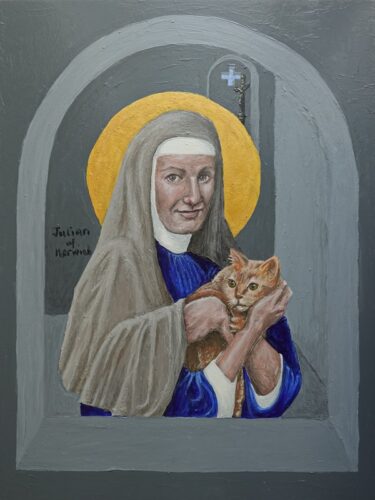
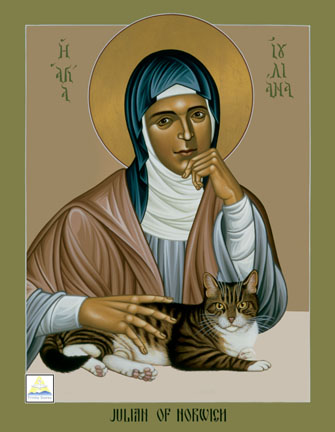
Julian was famously allowed to share her room was a cat — officially for the practical purpose of keeping it free from rats and mice. Many believe she developed a friendship with her cat companion. She has been depicted with her cat by many artists including frequent Q Spirit at least two whose work appears frequently at Q Spirit: Tobias Haller and Doug Blanchard.
Julian had important relationships with women
Julian lived as a recluse in a hermit’s cell, but she was not as isolated as is often supposed. A cat was not her only companion. A room for a servant was often attached to the cell, and in this space the anchoress and her servant form formed a long-term bond. Julian shared her cell at different times with women named Alice and Sarah. These companions are described as her “servant” or “maid.” But history suggests that sometimes a same-sex partner was called a servant to hide from social disapproval of homosexuality. Others whose same-sex “servants” were dearly beloved include the centurion and his “boy”, Boris and his servant George, and Good King Wenceslas and his “page” Podiven. Julian’s live-in companions Alice and Sarah are known because devout patrons gave bequests to them and Julian in their wills, documenting the significance of their relationships.
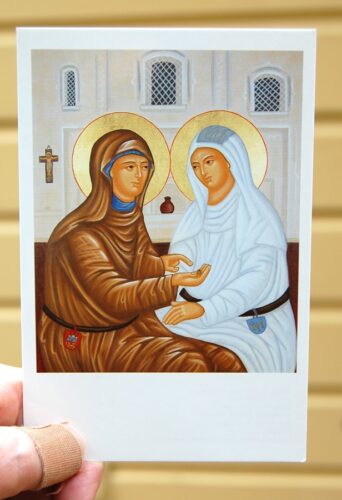
Julian also had an important relationship with another trailblazing woman writer and mystic, Margery Kempe. They appear together in the image at the top of this post. This queer side of Julian is explored in the chapter “Queer Touch Between Holy Women: Julian of Norwich, Margery Kempe, Birgitta of Sweden, and the Visitation” by scholar Laura Saetveit Miles of the University of Bergen, Norway, in the 2019 scholarly book “Touching, Devotional Practices, and Visionary Experience in the Late Middle Ages.” It “takes a new approach to the well-known meeting between two late-medieval English visionary women, Margery Kempe and the anchoress Julian of Norwich,” thereby revealing “the full transgressive effect of queer touch between women—or even its unspoken possibility,” according to the chapter summary.
When Margery Kempe wrote the first autobiography in English, she described her long and intimate visit in 1413 with Julian, the first woman to write a book in English. Their literary landmarks sound impressive now, but at the time English was the low-ranking local dialect of the common people. Scholars used Latin, and English was in the early stages of replacing French as prestige language of England’s government.
Kempe was in her 40s when she visited the elderly Julian. Kempe was seeking approval for the visions that she received from God. During their many days together, Julian assured Kempe that her visions were genuine and counseled her about spiritual life. They shared their visions and became chosen family, calling each other “sister.”
Here’s how Kempe described their connection in “The Book of Margery Kempe”: “Much was the dalliance that the anchoress [Julian] and this creature [Kempe] had by communing in the love of our Lord Jesus Christ the many days that they were together.” This text is updated from Middle English to modern English, but Miles points out that both “dalliance” and “communing” had a wide spectrum of meanings, from conversation to sexual union. Anchoresses were allowed to have overnight female guests, so it’s possible that Kempe stayed overnight in the cell with Julian.
Some say that Julian entrusted her handwritten book manuscript to Kempe, who preserved it and lent it to close friends to copy and circulate. The printing press was not yet invented. The unpublished manuscripts were carefully preserved by a long and mysterious chain of guardians that included an English convent of Benedictine nuns in France. Women were preserving women’s writing over the centuries, despite harrowing clashes with authorities during the Protestant Reformation and French Revolution. A Benedictine monk published a translation in 1670, but it got little attention. Finally in 1901 Grace Warrack, a Scots Presbyterian, discovered a copy made by French nuns at the British Library, painstakingly copied it by hand, translated it into modern English, and introduced it to an enthusiastic 20th-century audience. Based on gender stereotypes, many readers assumed that the author of such profound spiritual visions must be a man, especially since the name Julian is more common for men. Many of the most popular and best-remembered historical women in the Q Spirit’s LGBTQ Saints series were writers, including Julian, Perpetua, and Hildegard of Bingen.
Julian lived a long life. The date of her death is unknown, but records show that she was still alive at age 73 to receive an inheritance in 1416. She was never formally canonized, but Julian is considered a saint by popular devotion. The Episcopal and Lutheran Churches keep her feast day on May 8.
Julian wrote of God as mother
Julian is considered the first Catholic to write at length about God as mother. Her profound ideas speak powerfully today to women and queer people of faith. A popular theory is that Julian drew on her own personal experience as a mother whose children and husband died in the Black Plague before she became an anchoress.
Here are a few short quotes from Julian’s extensive writings about “Mother Jesus”:
“So Jesus Christ who sets good against evil is our real Mother. We owe our being to him–and this is the essence of motherhood! –and all the delightful, loving protection which ever follows. God is as really our Mother as he is our Father.“ (Chapter 59)
“So Jesus is our true Mother by nature at our first creation, and he is our true Mother in grace by taking on our created nature.” (Chapter 59)
“A mother can give her child milk to suck, but our dear mother Jesus can feed us with himself, and he does so most courteously and most tenderly with the holy sacrament, which is the precious food of life itself… The mother can lay the child tenderly to her breast, but our tender mother Jesus, he can familiarly lead us to his blessed breast through his sweet open side….” (Chapter 60)
“Dame Julian’s Hazelnut” by Brother Robert Lentz, OFM, Prints available at Amazon or TrinityStores.com
Julian saw God’s love in ordinary life
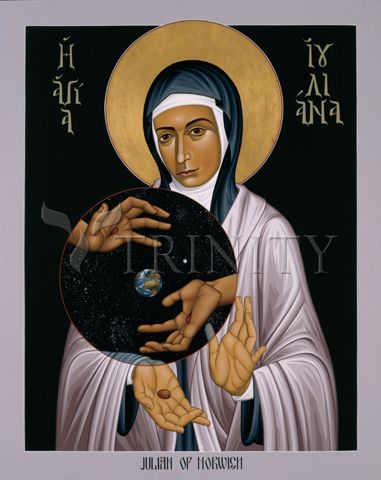
The sacred feminine is just one of the many revelations that have endeared Julian to the public. She also uses objects from ordinary life to illustrate God’s loving, forgiving nature. For example, in one vision God shows Julian a small object like a hazel-nut in the palm of her hand. Julian writes:
“I looked at it and thought, ‘What can this be?’ And the answer came to me, ‘It is all that is made.’ I wondered how it could last, for it was so small I thought it might suddenly disappear. And the answer in my mind was, ‘It lasts and will last forever because God loves it; and in the same way everything exists through the love of God’.” (Chapter 5)
Julian of Norwich in art
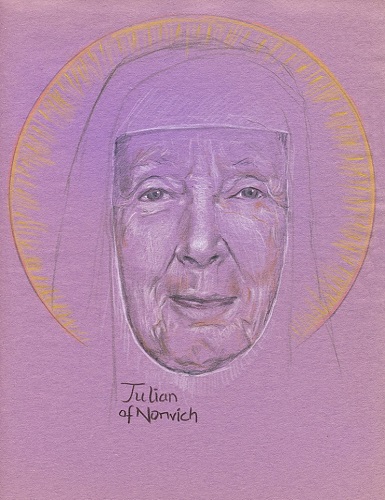
Julian is a favorite subject for Tobias Haller, an iconographer, author, composer, and vicar of Saint James Episcopal Church in the Bronx. In addition to the icon at the top of this post, Haller sketched an elderly “Julian of Norwich” was sketched against a lavender background.
Haller enjoys expanding the diversity of icons available by creating icons of LGBTQ people and other progressive holy figures as well as traditional saints. He and his spouse were united in a church wedding more than 30 years ago and a civil ceremony after same-sex marriage became legal in New York. He is the author of “Reasonable and Holy: Engaging Same-Sexuality.”
“Julian of Norwich,” a memorial drawing for his cat Betty, by Douglas Blanchard
New York painter Douglas Blanchard shows the saint with the artist’s own cat Betty in a drawing done as a memorial tribute to a beloved feline companion who died in 2013. He includes a favorite quote from Julian:
“He that made all things for love, by that same love keepeth them, and shall keep them without end.”
Blanchard is best known for his epic series “The Passion of Christ: A Gay Vision,” which is now available as a book. He teaches art and art history at the Bronx Community College of the City University of New York.
“Julian of Norwich” by Brother Robert Lentz, OFM, Prints available at Amazon or TrinityStores.com
Another icon of Julian and her cat was created by Robert Lentz, a Franciscan friar based in New York. Known for his innovative icons, he was rebuked by the church for painting LGBTQ saints and God as female.
Many important writers have been influenced by Julian, including 20th-century British poet T.S. Eliot. He quotes her in his masterpiece “Four Quartets,” which led to him receiving the Nobel Prize for literature in 1948.
Books about Julian of Norwich
Julian is the inspiration for the queerly creative book “Visions of Divine’s Love: A Drag Theopoetic” by Max Brumberg-Kraus (author) and J. C. A. Freeman (illustrator). It reframes Julian’s 16 visions as 16 poems about the drag queen Divine by a 21st-century professor and film buff — a reimagined Julian — and her unnamed teaching assistant, a novice nun. It was published in 2023 by AC Books.
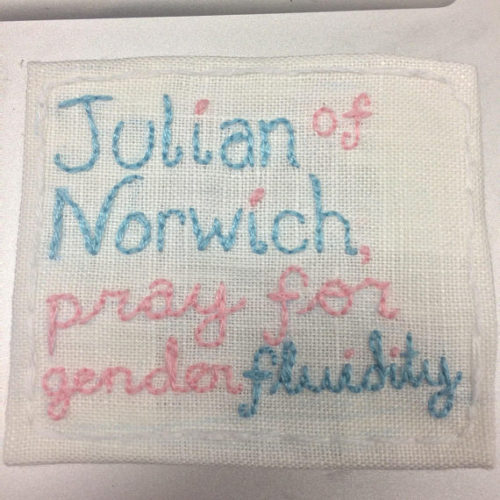
Various prayers related to Julian of Norwich are in circulation, including “Julian of Norwich, pray for gender fluidity.” The prayer was hand-sewn onto embroidered patch by artist Avery Smith of Louisville, Kentucky. Smith runs an Etsy shop called Sapphic Stitches that offers a variety of patches on LGBTA+ Christian and other themes.
“LGBTA+ Christians who choose to pray for the intercession of Saints deserve to have patrons whom they trust understand and support them,’ Smith affirms. “Whatever Saint or paired-Saint couple resonates with you as an LGBTA+ Christian can be made into a customizable patch.”
Julian’s famous words are set to music in the song “All Will Be Well” by Meg Barnhouse, a Texas-based Unitarian minister and singer/songwriter. The moving song comes from her album “Mango Thoughts in a Meatloaf Town” and is available on YouTube.
A longer quotation from Julian, again including “All will be well,” was set to music by 20th-century Welsh composer William Matthias in his piece “As Truly as God is Our Father.” it is sung on video by Plymouth Choir of First Plymouth Church, Lincoln Nebraska.
A mug shows Julian with her cat and her best-loved quote: “All shall be well and all shall be well and all manner of things shall be well.” Available from the Drinklings Coffee Mugs Etsy shop.
___ Top image credit: Hand holding a devotional card credited as follows: “Icon by Brother Leon of Walsingham of the English mystics, Julian of Norwich and Margery Kempe of Lynn, at S. Michael and All Angels, Brighton. Printed by The Postcard Company Ltd. (028) 8224-9222” Julian appears on the left.
___ This post is part of the LGBTQ Saints series by Kittredge Cherry. Traditional and alternative saints, people in the Bible, LGBTQ martyrs, authors, theologians, religious leaders, artists, deities and other figures of special interest to lesbian, gay, bisexual and transgender and queer (LGBTQ) people and our allies are covered.
This article has evolved and expanded greatly since the first version was posted in May 2011. It was published on Q Spirit in May 2017, was enhanced with new material over time, and was most recently updated on May 3, 2025.
Kittredge Cherry is a lesbian Christian author who writes regularly about LGBTQ spirituality.She holds degrees in religion, journalism and art history.She was ordained by Metropolitan Community Churches and served as its national ecumenical officer, advocating for LGBTQ rights at the National Council of Churches and World Council of Churches.
Jesse Boy • Aug 26, 2017 The official channel RE-RELEASE of J Pee’s first music video, I’M NOT GAY. A HUGE thank you to the video’s original producers, Branden Blinn and TBBMG, for allowing me to re-release this on my own channel. Check out more of their content at:
Inferno ???? • Dec 26, 2022 • Content owned by Fox. No copyright infringement intended. ** Note that Family Guy is not family-friendly and may be unsuitable for younger audiences. (Viewer discretion is advised.)
Warner Bros. • Jan 8, 2025 • From the studio that brought you The Notebook, and the creators of Barbarian. ❤️???????? #CompanionMovie tickets on sale now. Only in theaters January 31. https://www.fandango.com/Companion New Line Cinema—the studio that brought you “The Notebook”—and the unhinged creators of “Barbarian” cordially invite you to experience a new kind of love story… Written and directed by Drew Hancock (“My Dead Ex,” “Suburgatory”), “Companion” stars Sophie Thatcher (“Yellowjackets,” “The Boogeyman”), Jack Quaid (“The Boys,” “Spider-Man: Across the Spider-Verse”), Lukas Gage (“Smile 2,” “Dead Boy Detectives”), Megan Suri (“Never Have I Ever,” “It Lives Inside”), Harvey Guillén (“What We Do in the Shadows,” “Blue Beetle”) and Rupert Friend (“High Desert,” “Asteroid City”). The film is produced by the filmmakers behind “Barbarian”—Raphael Margules, J.D. Lifshitz, Zach Cregger and Roy Lee. The executive producers are Tracy Rosenblum and Jamie Buckner. The cinematographer is Eli Born (“The Boogeyman,” “Hellraiser”). The production designer is Scott Kuzio (“Dumb Money,” the “Fear Street” trilogy). The editors are Brett W. Bachman (“The Fall of the House of Usher,” “Pig”) and Josh Ethier (“Don’t Move,” “Orphan: First Kill”). The costume designer is Vanessa Porter (“The Toxic Avenger,” “Archive 81”). The composer is Hrishikesh Hirway (“Song Exploder,” “Everything Sucks!”). The music supervisor is Rob Lowry (“Do Revenge,” “Miracle Workers”). The casting is by Nancy Nayor (“Saw X,” “Barbarian”). New Line Cinema presents A BoulderLight Pictures Production, In Association With Vertigo Entertainment/Subconscious: “Companion.” The film will be distributed worldwide by Warner Bros. Pictures, in theaters only nationwide on January 10, 2025, and internationally beginning on 8 January 2025.
New Thinkin • Apr 30, 2025 Beverly Rubik, PhD, a biophysicist, is president of the Institute for Frontier Science. She is a former president of the U. S. Psychotronics Association. She is also professor of integrative medicine at Saybrook University. In this video, rebooted from 2019, she points out that the notion of “aether” goes back to Aristotle, although she views it as akin to the Sanskrit concept of “akasha”. It is the matrix within which all experience, and wave-propagation in particular, occur. She describes the thinkers who advanced the idea of the “aether” and she points out how we now have an assortment of new concepts — such as dark matter and dark energy — that have replaced it. New Thinking Allowed host, Jeffrey Mishlove, PhD, is author of The Roots of Consciousness, Psi Development Systems, and The PK Man. Between 1986 and 2002 he hosted and co-produced the original Thinking Allowed public television series. He is the recipient of the only doctoral diploma in “parapsychology” ever awarded by an accredited university (University of California, Berkeley, 1980). He is also the Grand Prize winner of the 2021 Bigelow Institute essay competition regarding the best evidence for survival of human consciousness after permanent bodily death. He is Co-Director of Parapsychology Education at the California Institute for Human Science. (Recorded on May 6, 2019)
New Thinking • May 2, 2025 This video is a special release from the original Thinking Allowed series that ran on public television from 1986 until 2002. It was recorded in about 1992. It will remain public for only one week. A professor of hydraulic engineering at U.C. Berkeley, the late James Harder, PhD, was one of America’s foremost specialists in the hypnotic examination of individuals who have had “contact” with extra-terrestrial intelligences. He has testified before Congress about UFOs, and served as Research Director of the Aerial Phenomena Research Organization (APRO). He discusses his insights concerning extra-terrestrial societies as a result of over 100 hypnotic sessions. Such civilizations, Dr. Harder points out, may be constructed quite differently from our own. Now you can watch all of the programs from the original Thinking Allowed Video Collection, hosted by Jeffrey Mishlove. Subscribe to the new Streaming Channel (https://thinkingallowed.vhx.tv/) and watch more than 350 programs now, with more, previously unreleased titles added weekly. Free month of the classic Thinking Allowed streaming channel for New Thinking Allowed subscribers only. Use code THINKFREELY.
In May, Salon Calvin brings another of the master storyteller William Shakespeare’s plays to enjoy – Othello
This Story tells of our protagonist’s fall, a fall into lies, deception, and destruction. It points a finger at an issue that may not be apparent to its audience until it is pointed out. Storytelling is one of the most effective ways to connect with people’s hearts and minds.
The Tragedy of Othello, the Moor of Venice, is a tragedy Set in Venice and Cyprus. The play depicts the Moorish military commander Othello as he is manipulated by his ensign, Iago, into suspecting his wife Desdemona of infidelity, with fatal consequences.
Join us for an evening of video and conversation like no other
noun: 1. An act of purification by means of rituals. 2. The purging of those associated with crimes committed under an earlier regime.
ETYMOLOGY:
From Latin lustrare (to make bright). Earliest documented use: 1614.
NOTES:
If you’ve ever tried to cleanse your browser history or remove the lingering influence of a previous group project gone wrong, congratulations — you’ve dabbled in lustration.
Originally used for religious or ceremonial purification, lustration was what you did when your crops failed, your city got a plague, or someone angered Jupiter by parking a chariot in a fire lane. Think of it as spring cleaning for your soul.
In modern political use, lustration took on a sharper edge. After the fall of totalitarian regimes (e.g., post-Communist Eastern Europe), it came to mean the act of cleansing the government of people tied to past abuses.
There’s something poetic in the root lustrare, “to make bright”. You’re not just wiping the slate clean, you’re polishing it until it gleams. Although some politicians subjected to lustration might prefer a dimmer switch.
Logo of the Ukrainian Lustration Committee Image: Ukrainian Lustration Committee / Wikimedia
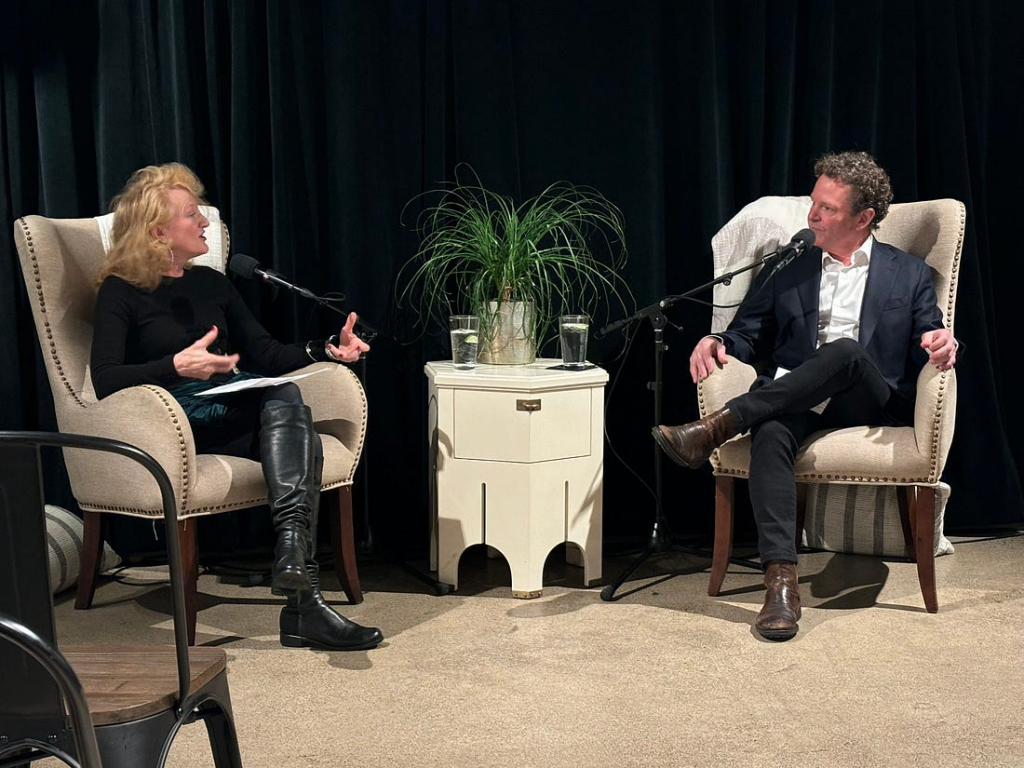
A calming and helpful conversation for making sense of the very story of our time, and how that is coming to us and being powerfully shaped through media and journalism. The theory of change of journalism as it came out of the 20th century, David Bornstein says, is that shining a light on what is going wrong — what is dangerous and dysfunctional, catastrophic or corrupt — will mobilize and lead us to correct it. But this emphasis on the terrible and the extreme, from whichever side of our cultural trenches you inhabit, has helped fuel a paralyzing, dehumanizing fear and the collapse of trust in institutions and in each other. Many of us are turning away from the news altogether. Is that the answer? How to live in this world with this media and retain meaningful, reasonable hope and agency? And what are we not seeing and hearing that we can orient towards? There is no one wiser on these questions than David Bornstein.
Krista spoke with David Bornstein before a small group of citizens of Minneapolis in November, 2024.
Find an excellent transcript of this show, edited by humans, on our show page.
Sign yourself and others up for The Pause to be on our mailing list for all things On Being and to receive Krista’s monthly Saturday morning newsletter, including a heads-up on new episodes, special offerings, recommendations, and event invitations.
BIO
David Bornstein is co-founder and CEO of the globally esteemed Solutions Journalism Network. Learn more about their work with news organizations around the world, and their solutions story tracker at solutionsjournalism.org. He has been a journalist focusing primarily on social innovation for three decades. From 2010 to 2021, he co-authored the “Fixes” column in The New York Times. He is the author of The Price of a Dream: The Story of the Grameen Bank and How to Change the World: Social Entrepreneurs and the Power of New Ideas, which has been published in 25 languages.
Special thanks to Dana Mortenson, who created the event that brought Krista and David together. She is founder of World Savvy, an organization that seeks to reimagine education to build the global competence necessary to navigate a complex and ever-changing world.
Consciousness, spirituality, biography, sexuality, androgyny, futurism, space, the arts, science, astrology, democracy, humor, books, movies and more