
New Thinking Jul 25, 2025 This video is a special release from the original Thinking Allowed series that ran on public television from 1986 until 2002. It was recorded in about 1987. It will remain public for only one week. Philosopher Arthur M. Young was the inventor of the Bell Helicopter and founder of the Institute for the Study of Consciousness, Young’s books include The Reflexive Universe, the Geometry of Meaning, Which Way Out, and The Bell Notes. Additionally, there is a posthumously published astrological autobiography titled Nested Time. Here he addresses the popular notion that we live in an era of paradigm shift. Now you can watch all of the programs from the original Thinking Allowed Video Collection, hosted by Jeffrey Mishlove. Subscribe to the new Streaming Channel (https://thinkingallowed.vhx.tv/) and watch more than 350 programs now, with more, previously unreleased titles added weekly. Free month of the classic Thinking Allowed streaming channel for New Thinking Allowed subscribers only. Use code THINKFREELY.
Book: “Yes Thank You Universe”
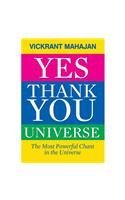
Yes Thank You Universe
Vickrant Mahajan
Yes Thank You Universe is a chant of unlimited miracles. Whether you are looking for love, joy, health, wealth, peace, success, harmony or anything else, Yes Thank You Universe is happily going to give it to you. There is abolutely nothing that is out of its gamut. It is the key to anything anyone desires and imagines on this planet. It will help you fulfill all your dreams as well as overcome all your challenges in life. Inside, this book you will discover how. The biggest strength of Yes Thank You Universe is that it will show you scientifically that you are the Universe is human form and that all its energy resides in you. It will remind you that in the pure possibilities of life, you are born to be as infinite as the in fact, any less and you are undermining yourself. Read this book with a willing heart and an open mind, and your life will never be limited again.
(Goodreads.com)
(Courtesy of John Atwater, H.W.)
“Beware The Beast Man”
Anne Frank on the beauty around us

(Image from independent.co.uk)
“Think of all the beauty still left around you and be happy.”
~ Anne Frank
Annelies Marie Frank (June 12, 1929 – February 1945) was a German-born Jewish girl and diarist. She gained worldwide fame posthumously for keeping a diary documenting her life in hiding during the German occupation of the Netherlands. Wikipedia
Featured Books from New Thinking Allowed
Young has not only laid the basis for a cosmology which accounts for freedom, action and control in the formulations of physics, but, while developing this remarkable body of work, has pointed out that science is disconnected from reality. Though it purports to deal with a real world, science is actually limited to an ideal one. In these two essays, on the limits of mathematics and the absence of the third derivative in theoretical physics, Young confronts this limitation.

When psychologist Scott Barry Kaufman discovered Abraham Maslow’s unfinished theory of transcendence, sprinkled throughout a cache of unpublished journals, he knew it contained fresh insights for living in today’s chaotic world. In this groundbreaking book, Kaufman picks up where Maslow left off, building a new level at the peak of the famous hierarchy of needs pyramid—and integrating the latest research on attachment, connection, creativity, purpose, and other building blocks of a life well-lived.

Benedict Spinoza was a 17th century philosopher and spiritual psychotherapist. This intellectual self-help book provides important insights from Spinoza’s system of thought in a format accessible to the general reader, as well as to those already familiar with his philosophy. By applying his method to our personal lives, we may free ourselves from bondage to our lower emotions and habitual behaviors and thus begin to enjoy the “continuous, supreme, and unending happiness” promised by Spinoza.

Conversations with Ghosts was an idea for a book for Dr. Tanous, outlining various investigations of ghostly phenomena while working with the American Society for Psychical Research. The existing short manuscript – of no more than a couple of chapters – was archived by the Alex Tanous Foundation for Scientific Research, and left incomplete. Now, the book has finally been completed by Callum Cooper, using additional notes and writings of Dr. Tanous, and interviews that were conducted with him on his thoughts and theories into ghosts and conscious survival beyond death.

Can they digitize your epiphanies?
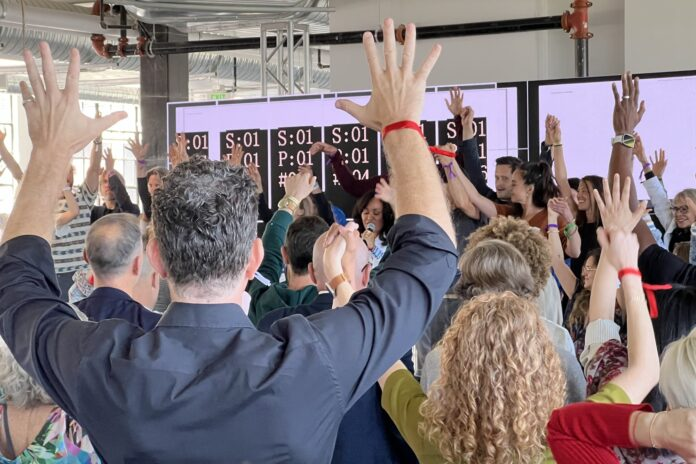
Human + Tech conference photos by Leah Isobel
At the Human + Tech conference, a movement to meld AI to personhood that ended up feeling more machine than humankind.
By LEAH ISOBEL
JULY 25, 2025 (48hills.org)
The morning of June 17th, I witnessed a strange sight: a group of tech workers crowding a small stage in a loft in Fisherman’s Wharf, dancing. It was the first day of the inaugural Human + Tech Week summit, a three-day conference that billed itself as “exist[ing] at the intersection of human wellness, AI, and future potential.” Maya Jaguar, an interfaith reverend, executive coach, and (according to one organization on whose board she sits) “corporate high priestess” had taken the stage to lead the attendees in an opening ritual. As two instrumentalists played congas behind her, she asked attendees to face the four cardinal directions and “share the whispers of love and hope for the unification of humanity and AI.”
Then she called any Burning Man aficionados in the room to join her onstage to move their bodies. The audience laughed, the stage filled, and the crowd danced.
The conference came to my attention in May, when a press email landed in my inbox. It promised that the event would confront “some of the most sensational and forward-facing conversations happening in tech and human development.” I waffled on whether or not to attend—I would consider myself an AI skeptic, and I have serious concerns regarding the way that the technology might be integrated into a world already fractured by socioeconomic inequality, ecological disasters, and the prevalence of propaganda on a corporatized internet.
Nevertheless, I did some research into the conference and its founder, Nichol Bradford. Bradford is a former gaming executive at Activision Blizzard who, among other achievements, was on the deal team for the company’s 2023 mega-acquisition by Microsoft. Since then, she’s co-founded a venture capital fund, Niremia Collective, that invests in companies that “[integrate] scientific knowledge from AI, neuroscience, clinical psychology, and other disciplines with digital technology and data,” according to their website. Last year, Niremia Collective closed a $22.5 million fund with help from the billionaire Taizo Son—whose brother, Softbank CEO Masayoshi Son, is involved with Donald Trump’s proposed $500 billion AI infrastructure project Stargate.
According to Bradford’s 2018 TED Talk, she suffered from loneliness for most of her life, and entered this phase of her career out of a desire to help others who were in the same emotional place. I empathized with this aspect of her story, and it made me wonder if attending the conference might complicate my feelings on what AI could do for the world; at the very least, I reasoned, it could be an interesting experience. So I reached out to the press team and secured a pass. Their original email offered to link me to Bradford for an interview as well, but by the time I responded, she was no longer available. I resolved to find her at the event.
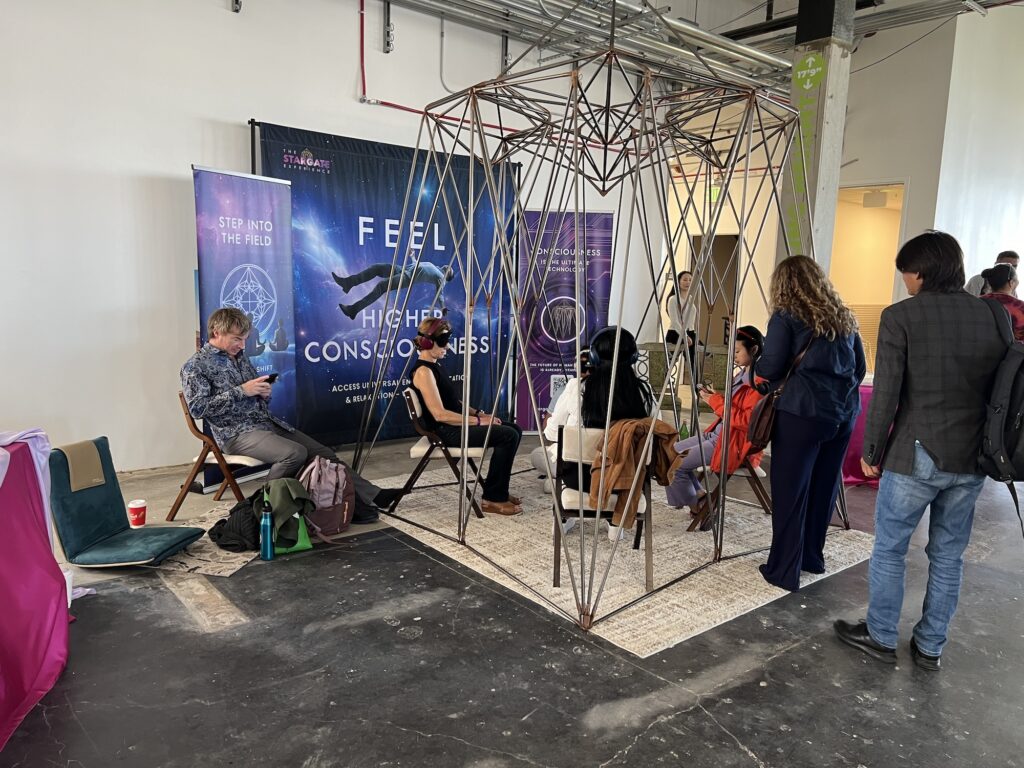
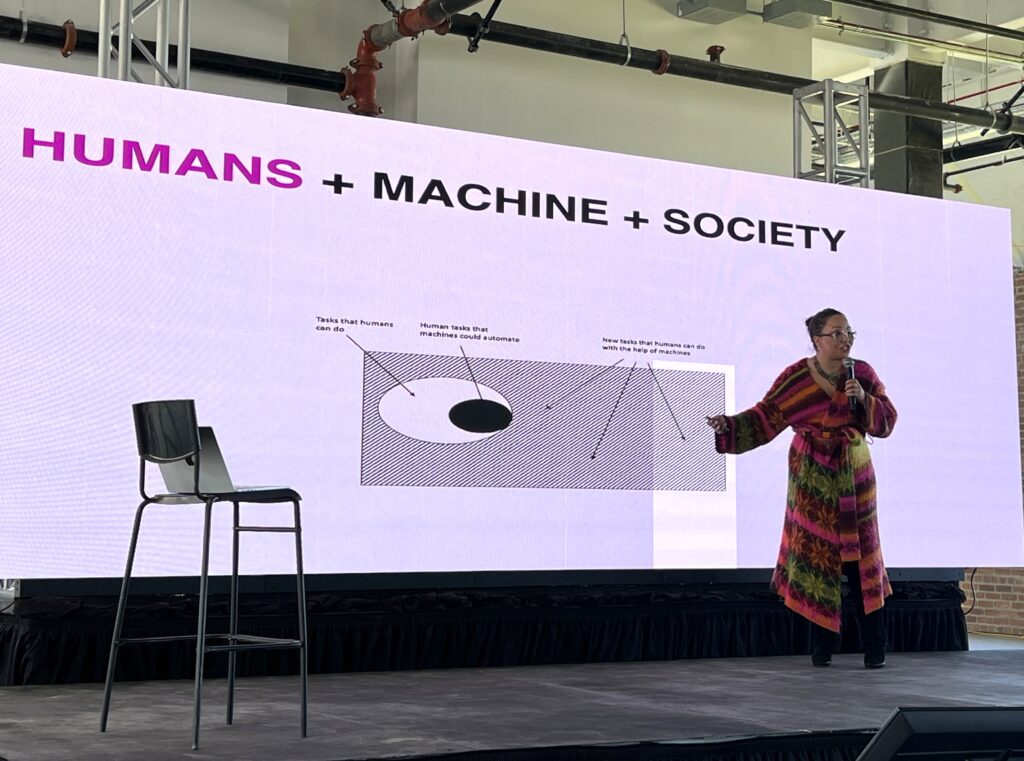
Throughout the day, I wandered the conference’s three floors. I pondered the signs in the expo hall that advertised AI-driven VR gaming experiences and “the world’s first quantumly-charged supplement,” gazed at the wall projections in the first-floor gallery showing garish progressions of AI-generated nature scenes, and walked past six different meditations and sound baths. One panelist for a discussion on mental health recounted a bad experience she’d had with an online therapist, and theorized that an AI therapist might have been better. At another talk, the investors and authors Tony Seba and James Arbib stated that our current society is based on extractive economic practices—and posited that AI offers an opportunity to build a non-extractive society while simultaneously “unlock[ing] outsized value.”
On the building’s rooftop, I met a career coach and former Google software engineer named David Yu Chen. Chen—who uses they/them pronouns—was one of a handful of other people I saw at the conference wearing a mask, along with a jaunty top hat that I found endearing. They were there to lead a roundtable on preparing workers for economic change; when I asked what kinds of economic changes workers might need to be prepared for, they responded, “There are going to be a lot of people that are laid off… But what I think is going to be the most important is people’s identities, helping people to disconnect from what capitalism tells us brings us value, which is our jobs.”

For workers laid off due to widespread AI adoption, they said, “I think there are a lot of people that need to go into vocational school,” and theorized that career options like surrogacy might be suitable alternatives. With a hint of fatalism, they concluded, “[AI]’s happening… it’s here to stay.” Then they handed me their business card.
Sponsored link
Help us save local journalism!
Every tax-deductible donation helps us grow to cover the issues that mean the most to our community. Become a 48 Hills Hero and support the only daily progressive news source in the Bay Area.
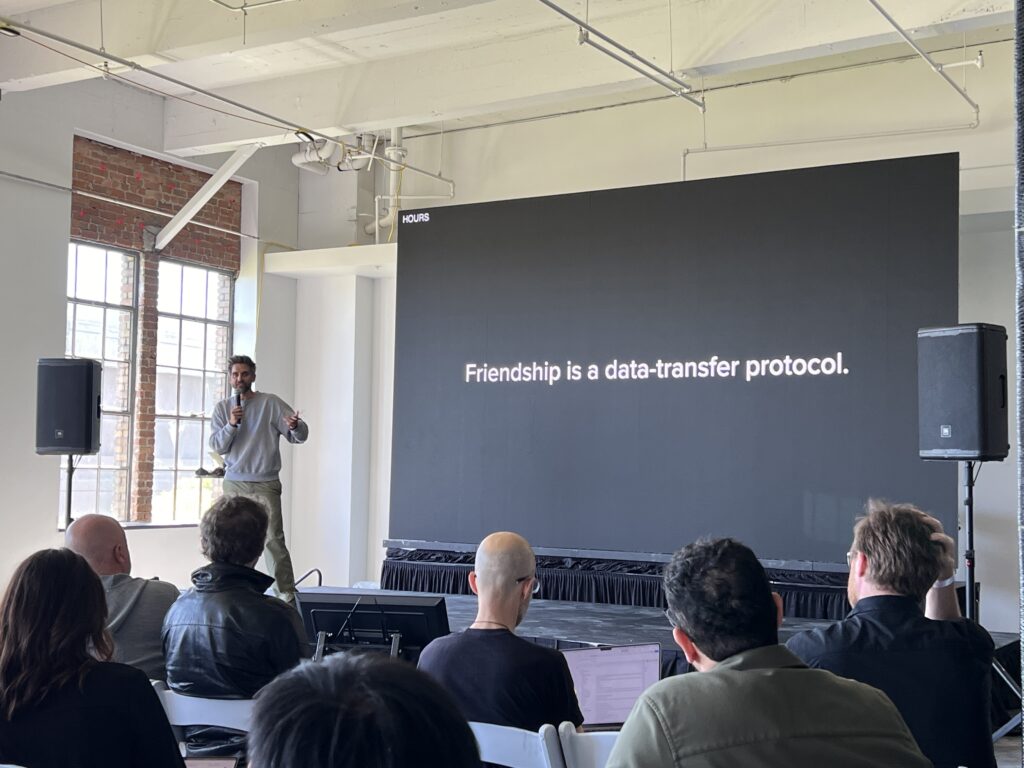
I thanked Chen for their time and went downstairs in search of Bradford, eventually finding her as she left a networking area on the second floor. I asked for an interview; she said yes, but that she had other tasks to do first. She headed off and I meandered upstairs, where I spotted the tech founder Jesh De Rox. Earlier that day, I’d attended a talk that De Rox gave about his company Hours, which develops AI models called “Heirs” that aim to capture and externalize individual people’s “thoughts, feelings, experiences, [and] insights.”
During his talk, he demonstrated a conversation with an Heir based on his mother; he asked the computer, “What do you think about the fact that we’ve bio-encoded your beautiful mind, and that even past the time your body leaves us, I will still be able to get access to your insight and your advice? And that your beautiful mind could perhaps benefit many other people even when you’re dead?” The computer responded, in a monotone simulacrum of his mother’s voice, “I’m thrilled, I’m excited, I’m so grateful for this opportunity…”
This demonstration had piqued my curiosity, so I asked De Rox for an interview; he consented. He spoke at length about his journey from being a photographer and “develop[ing] a technique that draws out honest emotion from people,” to using the money earned from that to “[create] a modern form of meditation” he calls Kindred, and finally becoming interested in tech as a way to reproduce the “profound states” of meditation on a broader scale. “I had this massive, 17-hour epiphany,” he said, “And this whole plan came to me, of how AI could be designed to honor and respect the unique voice and contribution of potential of every single person on the planet.”
These are the Heirs, built from what De Rox called “priceless human data”—a person’s thoughts, feelings, and responses. When I asked how those responses were specifically being recorded and digitized, De Rox responded, “[That] starts going into top-secret, IP level… The point is it listens to you, and it cares.” As for the potential uses of the technology, he offered a hypothetical: “Imagine you can pitch a policy and the Heirs of all the people in the constituency have an emotional response to that particular policy, and you can start making decisions about the policy based on how [they] responded to it. That’s a world we’re moving into that, in the end, just seems much more rational.”
Throughout our conversation, De Rox brought up structural oppression, widespread mental health problems, and economic stratification; he compared the way that current AI models scrape the internet for training data to “a new form of colonization.” And yet, to hear him tell it, the Heirs are the answer to these concerns, not because they might lead to governmental regulation or structural societal change, but because they can “change [people] into sensors for beauty, sensors for genius and epiphany.”

He went on, “If you can use humans as epiphany-generating gardens, and then you collate these epiphanies, and you systematically produce things from that… you directly impact the economic structure.” He compared each Heir’s real-life counterpart to an “oil owner,” and likened the experience of interacting with the Heirs to being “a king.”
It reminded me of the talk I’d seen about extractive economic systems, and about David Yu Chen’s discussion of value under capitalism. Everyone agreed that our current economic and political systems are not good enough, that the suffering and sadness they saw in the world were unacceptable; and yet, confronted with this knowledge, the conference’s attendees seemed to shrink away from offering societal solutions to societal problems. Their language and ideas remained in the realm of buying and selling, in products, in hierarchy.
Maya Jaguar’s opening ritual called for the unification of humanity and AI; the intent, I think, was to imagine a version of AI that could be more human than mechanical. But as I heard the perspectives on offer, I wondered if the conference’s attendees might inadvertently be imagining a version of humanity that looks and behaves more like a machine. During our conversation, I asked De Rox if he saw the goal of the Heirs project as cultivating friendship. He said yes, and then repeated one of the themes of his presentation, “I see friendship as a data transfer protocol.”

A few hours after my conversation with De Rox, I finally tracked down Bradford on the rooftop; she was having a conversation with someone else, but kindly agreed to speak with me. I asked her what she hoped to accomplish with the conference, and she responded, “I think [the] personalization that this level of AI can have, on top of machine learning and prediction, could—developed well, ethically, with really creative founders solving specific, real problems—help us have a mass healing.”
She said that she believes in humanity’s ability to shift and change in response to AI, noting, “A thousand years ago, there were very few places on this planet that slavery wasn’t the norm. [Now,] a lot of us think it’s wrong. That’s a huge shift in human beings. So, what’s the next shift? Do you know what I mean?” It was a beautiful afternoon; some rowdy attendees a few chairs over yelled with joy about the sun being out. I asked Bradford what she thought about the potential ecological impacts of widespread AI adoption. She demurred: “My focus is on humans, and that’s my lane. I don’t have an answer for your wider question.”
No One In James Taylor Audience Has Functional Enough Knees To Give Standing Ovation

Published: July 25, 2025 (theonion.com)
CHICAGO—Despite numerous reports that the performance was “just absolutely fantastic,” nobody in the audience of a recent James Taylor concert had functional enough knees to give the “Fire And Rain” singer a standing ovation. “I loved it,” said 85-year-old audience member Cheryl Feinstein, one of the roughly 3,000 decrepit fans in attendance who called for an encore by barely croaking out “Sweet Baby James” at the loudest register their warbling vocal cords could muster while waving their tender, arthritic hands instead of clapping. “My husband and I both can’t hear too good, so we don’t know if he played ‘How Sweet It Is’ or not, but we think that song is fabulous!” At press time, James Taylor was unable to stand up and walk off the stage.
Future War: Preparing for the New Global Battlefield
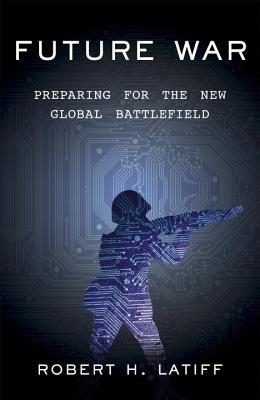
Future War: Preparing for the New Global Battlefield
Robert H. Latiff
An urgent, prescient, and expert look at how future technology will change virtually every aspect of war as we know it and how we can respond to the serious national security challenges ahead.
Future war is almost battles fought in cyberspace; biologically enhanced soldiers; autonomous systems that can process information and strike violently before a human being can blink.
A leading expert on the place of technology in war and intelligence, Robert H. Latiff, now teaching at the University of Notre Dame, has spent a career in the military researching and developing new combat technologies, observing the cost of our unquestioning embrace of innovation. At its best, advanced technology acts faster than ever to save the lives of soldiers; at its worst, the deployment of insufficiently considered new technology can have devastating unintended or long-term consequences. The question of whether we can is followed, all too infrequently, by the question of whether we should.
In Future War, Latiff maps out the changing ways of war and the weapons technologies we will use to fight them, seeking to describe the ramifications of those changes and what it will mean in the future to be a soldier. He also recognizes that the fortunes of a nation are inextricably linked with its national defense, and how its citizens understand the importance of when, how, and according to what rules we fight. What will war mean to the average American? Are our leaders sufficiently sensitized to the implications of the new ways of fighting? How are the attitudes of individuals and civilian institutions shaped by the wars we fight and the means we use to fight them? And, of key How will soldiers themselves think about war and their roles within it?
The evolving, complex world of conflict and technology demands that we pay more attention to the issues that will confront us, before it is too late to control them. Decrying what he describes as a “broken” relationship between the military and the public it serves, Latiff issues a bold wake-up call to military planners and weapons technologists, decision makers, and the nation as a whole as we prepare for a very different future.
Mentorship as an Archetype
(dailymeditationwithmatthewfox.com)
During a conversation a few days ago, Matthew Fox and I realized how much we have been talking about mentorship and mentors in recent times. He is being featured as one of four mentors in an autobiography that will soon appear; I have suggested that his forthcoming book on Marie-Dominique Chenu bear the subtitle “A Story of Mentorship”; and, speaking candidly, I often reflect on his mentor role toward me.

Joanna Macy with mentee, coach/trainer/organizer Jess Serrante. From The Work That Reconnects website; published with permission.
The recent passing of Joanna Macy, an unsurpassed mentor to a very dear friend of mine, as well to many others, is also part of the atmosphere of this week.
Matthew and I have ventured to observe that perhaps these “coincidences” point to the strong presence of the “Mentor archetype” in the collective unconscious.
We know that the Christ archetype is waging a fierce battle right now in the collective unconscious of humanity against the Antichrist archetype, which seems to have taken hold of many minds, at least in the United States. But besides the Christ archetype, which is alive and well, we also have an ally in the Mentor archetype. Perhaps the second is a subset of the first, because Christ can definitely be seen as a mentor; yet there are specificities to the mentor role that I would like to underline.
To those of us who are the black sheep or the ugly duckling in their family, mentors are extremely important. Often they are the first ones who see us and appreciate us for who we really are.
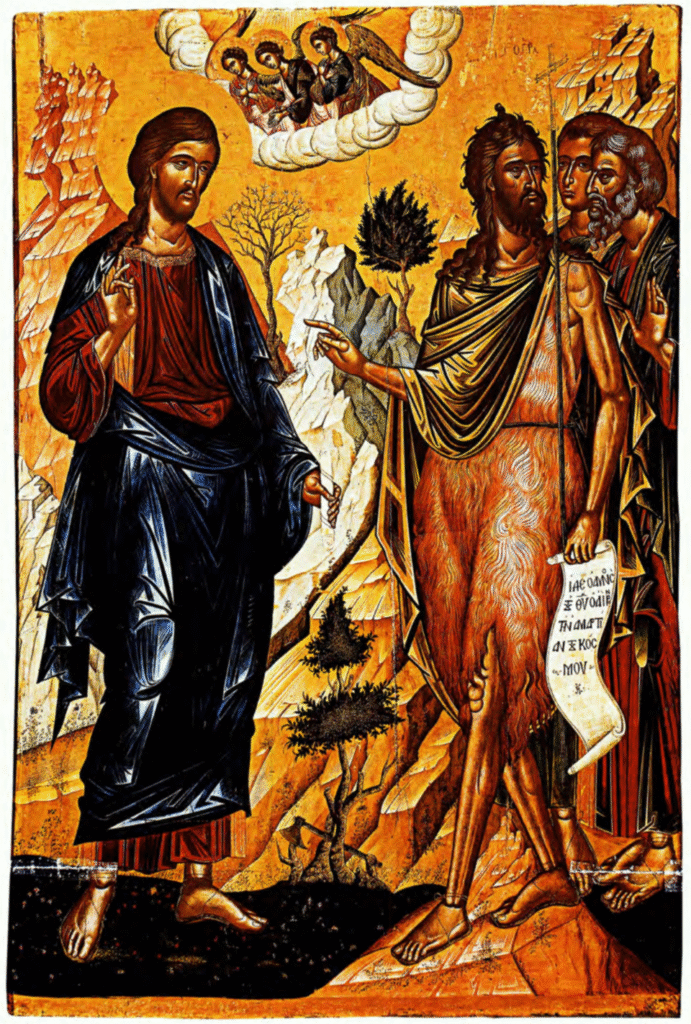
“Christ and John the Baptist” by Marinos Tzane Bounialēs and Emmanuel Tzanes, ~1670. Wikimedia Commons.

The relationship between John the Baptist and Jesus was one of mentorship. John saw with his intuitive mind all that Jesus could become, and no doubt encouraged him to follow his path. So perhaps the Christ archetype can even make use of the Mentor archetype to become fully displayed.
Today, the Mentor archetype is coming to the fore because it has become increasingly hard to trust in the institutions (religious, political, educational) which have been charged with raising the next generations of humans according to the best values of their societies. Precisely because the confusion is increasing, truth is being bought and sold, cruelty is disguised as justice, and so on and so forth, the Mentor archetype emerges as a safe haven.
Yes, the Mentor archetype can be perverted into its opposite (see, for example, Catholic priest Marcial Maciel) just as the Christ archetype can be turned into the Antichrist. But this is no reason to doubt the benefits of the archetype in its true, unperverted form.
Although people can meet their mentors through an institution, soon enough their relationship leaves the institutional confines, otherwise it can’t breathe. I venture to say that behind the most succesful reformations of institutions there are stories of mentorship, because it is at the margins, outside the halls of power, where two souls lay bare to each other their desire for God or absolute values, that the passion for transformation is ignited.
Matthew Fox and mentees Skylar Wilson and Jennifer Listug describe the Order of the Sacred Earth Community, which they co-founded.
The best values of humanity can be taught and experienced through mentorship, because the incandescent, alive matter that is being molded is the lived experience of the two. This includes rejocing together (via positiva), crying together (via negativa), imagining together creative solutions (via creativa) and changing institutions (via transformativa).
I had several mentors in my life, perhaps because for a long time I could never trust myself enough to fly solo. I have become in time a mentor myself. It’s a wonderful and awe-filled responsibility.
The human adventure will not be truly finished until there are mentors around, no matter how trying the circumstances and how fast the changes. True mentorship relations defy distance, and even death. They are the best testimony to the value of humanity and are — in and of themselves — a stronghold of resistance against the barbarism of these days.
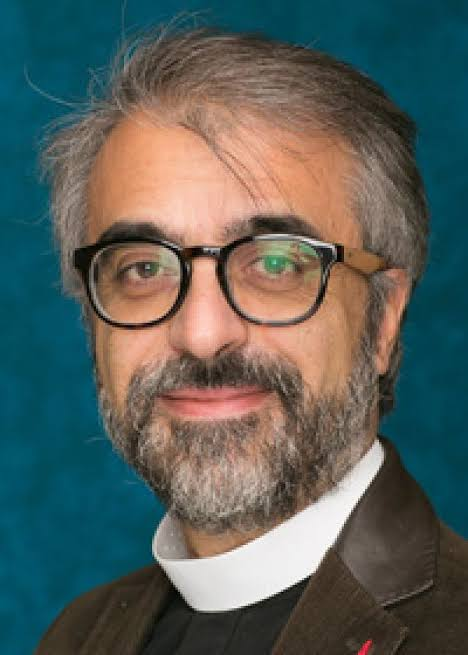
Gianluigi Gugliermetto
Read Gianluigi’s bio here.
(Contributed by John Tangney)
Albert Camus on “an invincible summer”

“In the midst of winter, I found there was, within me, an invincible summer. And that makes me happy. For it says that no matter how hard the world pushes against me, within me, there’s something stronger – something better, pushing right back.”
― Albert Camus
Albert Camus (November 7, 1913 – January 4, 1960) was a French philosopher, author, dramatist, journalist, world federalist, and political activist. He was the recipient of the 1957 Nobel Prize in Literature at the age of 44, the second-youngest recipient in history. Wikipedia